

Fentanyl charges in North Carolina carry some of the most severe consequences in drug law. Whether you face charges for possession, sale, trafficking, or manufacturing, the stakes are extremely high. North Carolina lawmakers have repeatedly increased penalties for fentanyl offenses, reflecting the state’s aggressive stance on opioid-related crimes.
If you or someone you know has been arrested on fentanyl charges, understanding what you’re facing is the first step toward protecting your rights and your future.
What Makes Fentanyl Different from Other Drugs in North Carolina?
North Carolina law treats fentanyl and carfentanil as Schedule II controlled substances under N.C. Gen. Stat. § 90-90. This classification places them among the most tightly regulated drugs in the state—substances recognized as having high potential for abuse but some accepted medical use.
What sets fentanyl apart from many other controlled substances is the severity of punishment. North Carolina has created enhanced penalties specifically for fentanyl offenses, distinguishing them from other Schedule II drugs. Recent legislative changes effective December 1, 2025, further increased these penalties, making fentanyl charges even more serious than they were before.
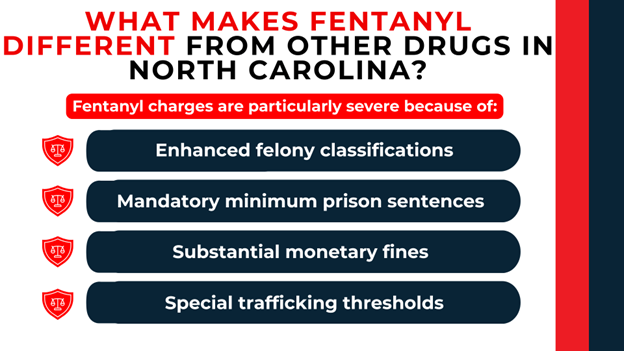
Key characteristics that make fentanyl charges particularly severe include:
- Enhanced felony classifications compared to other Schedule II substances
- Mandatory minimum prison sentences for trafficking offenses
- Substantial monetary fines that can reach into the hundreds of thousands of dollars
- Special trafficking thresholds that are lower than those for many other drugs
The state’s focus on fentanyl reflects ongoing concerns about overdose deaths and the drug’s extreme potency. Even small quantities can trigger serious criminal charges.
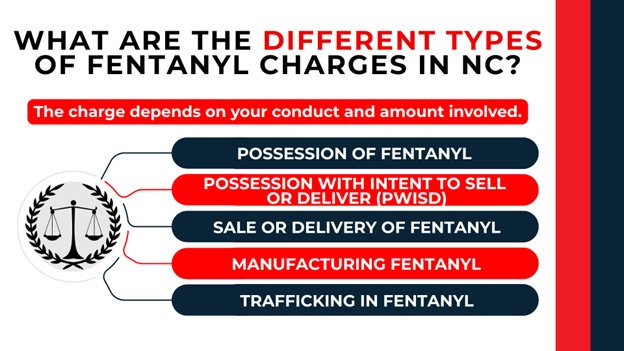
What Are the Different Types of Fentanyl Charges in North Carolina?
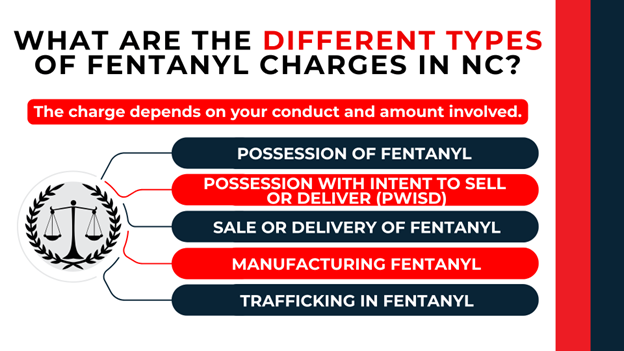
North Carolina law creates several distinct criminal offenses involving fentanyl. The specific charge you face depends on the alleged conduct and the amount of the substance involved.
Possession of Fentanyl
Under N.C. Gen. Stat. § 90-95(a)(3), it is unlawful to possess a controlled substance. When the substance is fentanyl or carfentanil, possession is treated as a felony offense. As of December 1, 2025, possession of fentanyl is classified as a Class H felony—an increase in severity from previous law.
This charge applies when law enforcement alleges that you knowingly had fentanyl in your custody or control. The state must prove that you knew the substance was present and that you had the ability to control it. If prosecutors cannot establish that you knew about the fentanyl or that you had the power to control it, the possession charge may not be sustainable.
Possession with Intent to Sell or Deliver (PWISD)
When the state believes that you possessed fentanyl not for personal use but to distribute it to others, you may face charges under N.C. Gen. Stat. § 90-95(a)(1). This offense—possession with intent to sell or deliver—is significantly more serious than simple possession.
Under changes taking effect December 1, 2025, PWISD involving fentanyl or carfentanil becomes a Class F felony. The state must prove not only that you possessed the substance but also that you intended to transfer it to another person. Evidence supporting this intent might include:
- The quantity of fentanyl found
- Packaging materials such as small baggies or scales
- Large amounts of cash
- Text messages or other communications suggesting drug transactions
- Testimony from confidential informants or undercover officers
If the evidence does not clearly establish your intent to distribute the fentanyl—for instance, if the amount found could reasonably be for personal use and no other indicators of distribution exist—the PWISD charge may not hold.
Sale or Delivery of Fentanyl
The actual sale or delivery of fentanyl is prohibited under N.C. Gen. Stat. § 90-95(a)(1). Beginning December 1, 2025, selling or delivering fentanyl or carfentanil is classified as a Class F felony.
“Delivery” includes any transfer of the substance from one person to another, whether or not money changes hands. The state must prove that you knowingly transferred fentanyl to someone else. If you were unaware that the substance you transferred was fentanyl—perhaps because you believed it was a different drug or no drug at all—this lack of knowledge could undermine the charge.
Manufacturing Fentanyl
Manufacturing fentanyl is also prohibited under N.C. Gen. Stat. § 90-95(a)(1). This charge applies not only to large-scale production but also to activities such as mixing, preparing, or compounding the drug. As of December 1, 2025, manufacturing fentanyl is a Class F felony.
The state must prove that you engaged in the process of creating, preparing, or producing fentanyl. If the evidence shows only possession—not active involvement in making or altering the substance—a manufacturing charge may be inappropriate.
Trafficking in Fentanyl
Trafficking charges arise when the amount of fentanyl allegedly possessed, sold, manufactured, delivered, or transported exceeds certain weight thresholds. Unlike other charges that focus primarily on conduct, trafficking focuses on quantity.
Under N.C. Gen. Stat. § 90-95(h)(4) and the new subsection (h)(4c) effective December 1, 2025, trafficking in fentanyl or carfentanil is established when the amount involved is four grams or more. The law creates escalating levels of trafficking based on weight:
- Four grams or more, but less than 14 grams: Beginning December 1, 2025, this becomes a Class E felony with mandatory prison time.
- Fourteen grams or more, but less than 28 grams: This becomes a Class D felony with mandatory prison time.
- Twenty-eight grams or more: This remains a Class C felony with mandatory prison time.
Trafficking charges carry mandatory minimum prison sentences, meaning that even first-time offenders may face substantial incarceration. The law also imposes significant financial penalties.
Because trafficking is defined by weight, even someone who possessed fentanyl solely for personal use can face trafficking charges if the amount exceeds four grams. The state need not prove that you intended to sell or distribute the substance—possession of the threshold amount alone is sufficient.
However, if the substance was improperly weighed, if the alleged fentanyl was actually a different substance or a mixture containing only trace amounts of fentanyl, or if law enforcement lacked probable cause to search and seize the drugs, these issues could form the basis for challenging a trafficking charge.
How Does North Carolina Prove Fentanyl Charges?
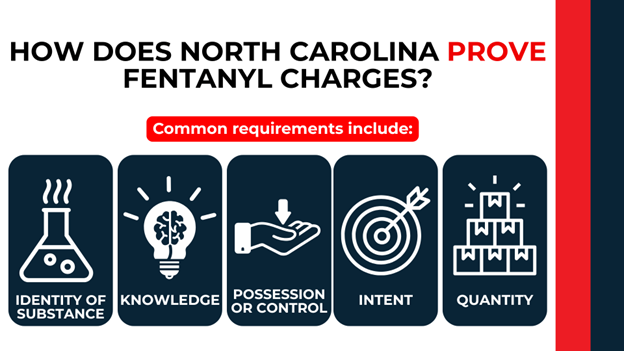
To convict you of any fentanyl-related offense, the state must prove each element of the crime beyond a reasonable doubt. The specific elements vary depending on the charge, but common requirements include:
- Identity of the substance: The state must establish that the substance in question was actually fentanyl or carfentanil. This typically requires laboratory testing by a certified analyst. If the lab report is flawed, if the chain of custody was broken, or if the substance was not properly preserved, the identity element may be in question.
- Knowledge: For possession-based offenses, the state must show that you knew the substance was present and knew (or reasonably should have known) that it was an illegal drug. If you were unaware of the fentanyl’s presence—for example, if it was hidden in your vehicle without your knowledge—this lack of awareness could negate the knowledge element.
- Possession or control: The state must prove that you possessed the fentanyl, either actually (on your person) or constructively (in a place you control). Constructive possession requires showing that you had the power and intent to control the substance. If fentanyl was found in a shared space where multiple people had access, proving your exclusive control becomes more difficult.
- Intent (for certain charges): For PWISD, sale, delivery, and manufacturing charges, the state must prove your specific intent to engage in that conduct. Evidence of intent is often circumstantial. If the evidence is weak or ambiguous, the intent element may not be satisfied.
- Quantity (for trafficking): Trafficking charges hinge on the weight of the substance. The state must accurately measure the amount of fentanyl involved. Challenges to the weight calculation—such as arguments that the total weight included non-drug materials or that the scale was inaccurate—can be critical.
What About Fentanyl Found in a Shared Space or Vehicle?
A common scenario involves fentanyl discovered in a car, home, or other location accessible to multiple people. In these cases, the state may attempt to charge everyone present with constructive possession.
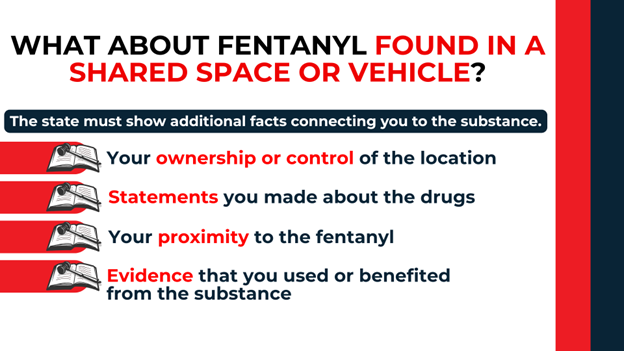
Constructive possession exists when you do not have physical custody of the fentanyl but have the power and intent to control it. North Carolina courts have held that mere presence in a place where drugs are found is not enough to establish possession. The state must show additional facts connecting you to the substance, such as:
- Your ownership or control of the location
- Statements you made about the drugs
- Your proximity to the fentanyl
- Evidence that you used or benefited from the substance
If the evidence shows only that you were in a vehicle or home where fentanyl was present, without more, constructive possession may not be proven. This is especially true when another person had greater access or control over the area where the drugs were found.
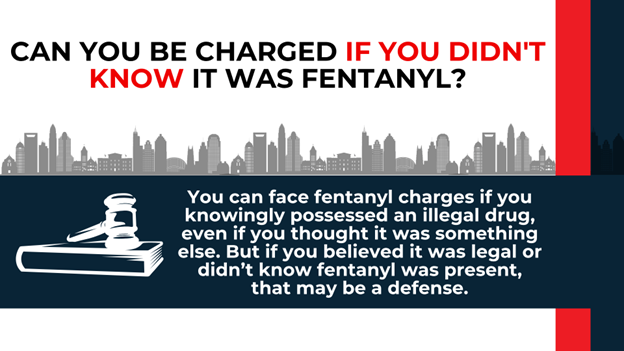
Can You Be Charged if You Didn’t Know It Was Fentanyl?
A critical question arises when someone possesses a substance believing it to be a different drug, only to learn later that it contained fentanyl. Under North Carolina law, the state must prove that you knowingly possessed a controlled substance, but it generally does not have to prove that you knew the specific identity of the drug.
If you believed you were possessing heroin or cocaine, for instance, but the substance turned out to be fentanyl, you may still face fentanyl-related charges. However, if you had no knowledge that the substance was any kind of illegal drug—perhaps you believed it was an over-the-counter medication or a legal substance—this lack of knowledge could undermine the charge.
Additionally, if fentanyl was mixed with another substance and you were unaware of its presence, the circumstances may raise questions about whether you knowingly possessed fentanyl specifically. These fact-intensive inquiries often require careful legal analysis.
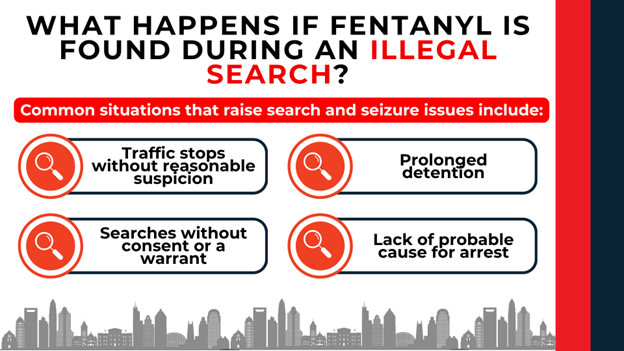
What Happens If Fentanyl Is Found During an Illegal Search?
The Fourth Amendment to the U.S. Constitution and Article I, Section 20 of the North Carolina Constitution protect you from unreasonable searches and seizures. If law enforcement discovered fentanyl during a search that violated your constitutional rights, the evidence may be suppressed—meaning it cannot be used against you at trial.
Common situations that raise search and seizure issues include:
- Traffic stops without reasonable suspicion: Officers must have a lawful reason to pull you over. If the stop was pretextual or unsupported, any evidence found afterward may be inadmissible.
- Searches without consent or a warrant: Police generally need your consent, a warrant, or an applicable exception (such as probable cause coupled with exigent circumstances) to search your person, vehicle, or home. If none of these applied, the search may have been illegal.
- Prolonged detention: Even if a traffic stop begins lawfully, officers cannot extend the stop beyond the time reasonably necessary to address the original reason for the stop unless they develop reasonable suspicion of additional criminal activity.
- Lack of probable cause for arrest: If you were arrested without probable cause and fentanyl was found during a search incident to that arrest, both the arrest and the search may be invalid.
If a motion to suppress evidence succeeds, the prosecution may be unable to proceed with the charges, as the primary evidence against you would be excluded.
What Are the Consequences of a Fentanyl Conviction?
A conviction for a fentanyl-related offense can have life-altering consequences. While this article does not detail specific sentence lengths or fine amounts, it is important to understand that fentanyl charges generally result in:
- Prison or jail time: Felony convictions often lead to active incarceration. Trafficking offenses carry mandatory minimum prison sentences, meaning judges have limited discretion to impose lighter penalties.
- Substantial fines: Convictions can result in significant financial penalties, particularly for trafficking offenses.
- Permanent criminal record: A felony conviction remains on your record and can affect employment, housing, professional licensing, firearm ownership, and voting rights.
- Collateral consequences: Beyond the direct penalties, a drug conviction can impact child custody, immigration status, eligibility for federal benefits, and more.
The severity of these consequences underscores the importance of mounting a strong defense.
Are There Differences Between Federal and State Fentanyl Charges?
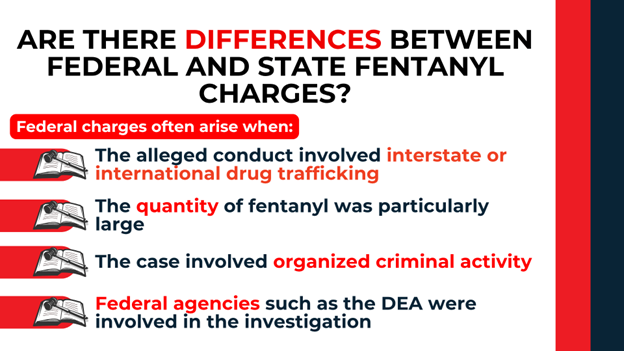
Fentanyl offenses can be prosecuted under either federal or North Carolina state law, depending on the circumstances. Federal charges often arise when:
- The alleged conduct involved interstate or international drug trafficking
- The quantity of fentanyl was particularly large
- The case involved organized criminal activity
- Federal agencies such as the DEA were involved in the investigation
Federal fentanyl charges are governed by the Controlled Substances Act and typically carry even harsher penalties than state charges, including longer mandatory minimum sentences. Federal courts also follow different sentencing guidelines. If you face federal charges, the legal strategies and procedural rules differ significantly from those in state court. Understanding which jurisdiction is prosecuting your case is essential.
What Should You Do If You’re Facing Fentanyl Charges?
If you have been arrested or charged with a fentanyl offense in North Carolina, taking immediate action is important. The decisions you make in the early stages of your case can significantly impact the outcome.
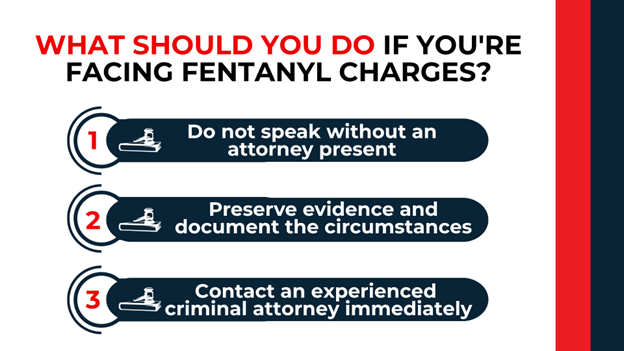
Do not speak to law enforcement without an attorney present. Anything you say can be used against you. Even seemingly innocent statements can be twisted or taken out of context. Politely decline to answer questions and invoke your right to counsel.
Preserve evidence and document the circumstances. If you believe the search was unlawful, the substance was misidentified, or other factors could support your defense, make note of these details as soon as possible. Witness statements, video footage, and other evidence can fade or disappear over time.
Contact an experienced criminal defense attorney immediately. Fentanyl charges are among the most serious drug offenses in North Carolina. You need a lawyer who understands the nuances of state drug laws, the science of substance identification, search and seizure law, and trial advocacy.
Attorney Patrick Roberts has extensive experience handling drug cases in North Carolina. He understands what is at stake and works diligently to protect his clients’ rights at every stage of the criminal process—from the initial investigation through trial if necessary.
Why Early Legal Representation Matters
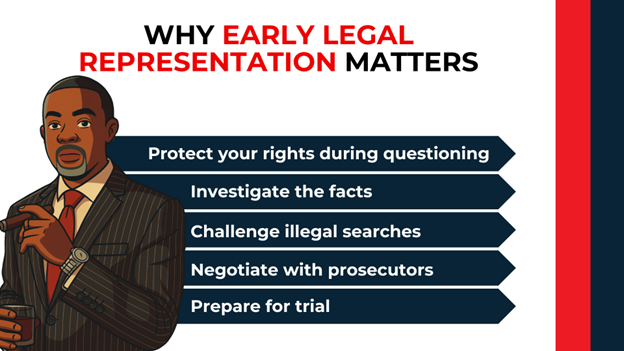
Engaging a defense attorney early in your case provides several advantages:
- Protecting your rights during questioning: Your attorney can be present during any police interviews, ensuring that you do not inadvertently harm your case.
- Investigating the facts: Your lawyer can conduct an independent investigation, interview witnesses, review evidence, and identify weaknesses in the state’s case.
- Challenging illegal searches: If your rights were violated, your attorney can file motions to suppress evidence before trial.
- Negotiating with prosecutors: In some cases, early intervention can lead to reduced charges, alternative sentencing options, or even dismissal.
- Preparing for trial: If your case goes to trial, thorough preparation is essential. Building a strong defense takes time.
Contact Patrick Roberts Law Today
Fentanyl charges in North Carolina are serious, but a charge is not a conviction. You have rights, and there may be defenses available in your case.* Whether the issue involves an illegal search, insufficient evidence, mistaken identity of the substance, or lack of knowledge or intent, a skilled attorney can evaluate the facts and develop a strategy tailored to your situation.
Attorney Patrick Roberts is committed to providing aggressive, knowledgeable representation to individuals facing drug charges* in North Carolina. He takes the time to understand each client’s unique circumstances and fights to protect their future.
If you or someone you care about is facing fentanyl charges, do not wait. Contact Patrick Roberts Law to schedule a consultation and discuss your case.
*Disclaimer: Each case is different and must be evaluated separately. Prior results achieved do not guarantee similar results can be achieved in future cases.

Former assistant district attorney
Contact Patrick Roberts
Facing criminal charges in North Carolina demands seasoned representation. Trust in the experience and dual perspective of Patrick Roberts. Reach out today for a confidential consultation.
-
Call Our Team
Calls answered 24/7









For more information on the selection criteria, go to www.martindale.com
*Each case is different and must be evaluated separately. Prior results achieved do not guarantee similar results can be achieved in future cases.