

What Constitutes a First Degree Murder Charge in North Carolina?
First degree murder represents the most serious homicide charge under North Carolina law. According to N.C. Gen. Stat. § 14-17, prosecutors can pursue this Class A felony charge when an alleged killing involves specific circumstances that demonstrate the highest level of culpability.
The state must prove that the killing occurred through one of several specific methods or during the commission of certain felonies. Understanding these elements becomes critical for anyone facing or concerned about such charges.
The prosecution must establish that the killing was perpetrated by:
- Nuclear, biological, or chemical weapons of mass destruction
- Poison
- Lying in wait
- Imprisonment
- Starving
- Torture
- Any other willful, deliberate, and premeditated killing
Alternatively, first degree murder charges apply when the killing occurs during:
- Arson
- Rape or sex offenses
- Robbery
- Kidnapping
- Burglary
- Other felonies committed or attempted with a deadly weapon
These statutory requirements mean prosecutors face a significant burden in proving their case. Each element requires specific evidence, and the absence of any required element could result in reduced charges or acquittal.

How Does First Degree Murder Differ from Other Homicide Charges?
North Carolina law recognizes multiple levels of homicide charges, each carrying different penalties and requiring different proof. First degree murder sits at the top of this hierarchy due to the presence of premeditation and deliberation or the commission of specific dangerous felonies.
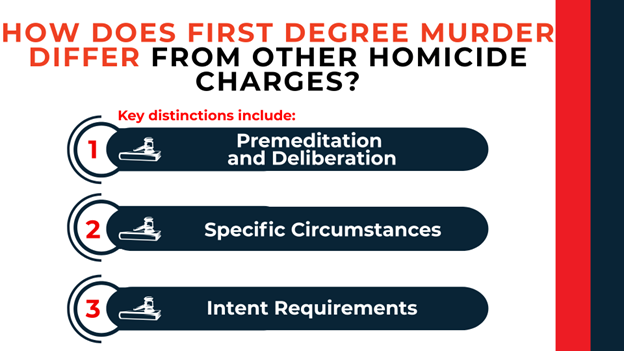
Key distinctions include:
- Premeditation and deliberation: Unlike second degree murder or manslaughter, first degree murder typically requires proof that the defendant thought about and planned the killing beforehand
- Specific circumstances: The law enumerates particular methods and situations that automatically elevate a killing to first degree murder
- Intent requirements: While all murder charges require malice, first degree murder demands the highest level of intent or occurs during inherently dangerous felonies
Second degree murder, by contrast, involves killings with malice but without premeditation and deliberation. Voluntary and involuntary manslaughter charges apply to unlawful killings without malice, with distinctions based on the nature of the underlying act and the defendant’s intent.
What About Domestic Violence Cases and First Degree Murder Charges?
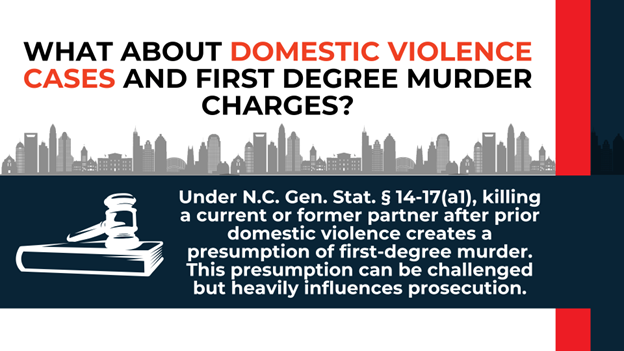
North Carolina law contains special provisions for killings involving domestic partners. Under N.C. Gen. Stat. § 14-17(a1), when someone kills a current or former spouse, dating partner, or co-parent with whom they have a prior history of certain offenses, the law creates a rebuttable presumption that the killing constitutes first degree murder.
This presumption applies when the defendant previously committed against the same victim:
- An act of domestic violence
- Violation of a domestic violence protective order
- Communicating threats
- Stalking
- Cyberstalking
- Domestic criminal trespass
The phrase “rebuttable presumption” means the defendant can present evidence to challenge this classification. However, this provision significantly impacts how prosecutors approach domestic violence homicides and underscores the serious nature of repeated domestic violence patterns.
What Does “Willful, Deliberate, and Premeditated” Mean Under North Carolina Law?
These three terms form the cornerstone of many first degree murder prosecutions. Understanding their legal significance helps clarify what separates first degree murder from other homicide charges.
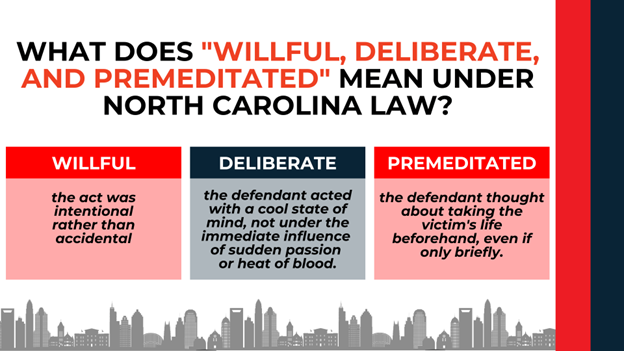
Willful means the act was intentional rather than accidental. The defendant meant to perform the action that caused death.
Deliberate indicates the defendant acted with a cool state of mind, not under the immediate influence of sudden passion or heat of blood. This doesn’t mean the person was calm—it means they were capable of reasoning about their actions.
Premeditated requires that the defendant thought about taking the victim’s life beforehand, even if only briefly. North Carolina courts recognize that premeditation can form in an instant, though the thought must precede the fatal act.
Prosecutors often rely on circumstantial evidence to prove these elements, such as:
- The nature and number of wounds inflicted
- Evidence of planning or preparation
- Statements made before or after the incident
- The defendant’s conduct and demeanor
- The relationship between the parties
Can Someone Be Charged with First Degree Murder Without Intending to Kill?
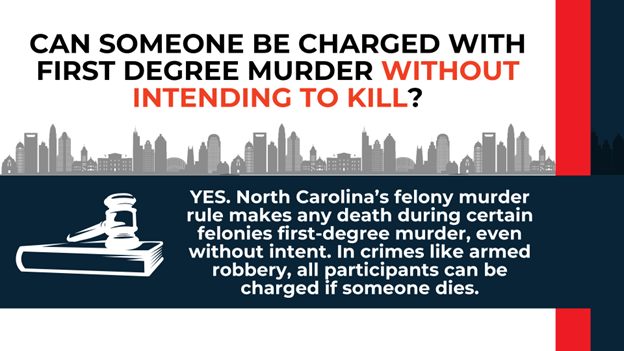
Yes. North Carolina’s felony murder rule allows first degree murder charges even when the defendant didn’t specifically intend to kill anyone. If someone dies during the commission or attempted commission of certain felonies listed in N.C. Gen. Stat. § 14-17, the defendant faces first degree murder charges regardless of their intent regarding the death itself.
This means that if someone participates in an armed robbery and a death occurs—whether of a victim, bystander, or even a co-defendant—all participants may face first degree murder charges. The law treats the inherent danger of these felonies as sufficient to establish the culpability required for first degree murder.
Critical considerations for felony murder include:
- The death must occur during or in furtherance of the felony
- All participants in the underlying felony may face murder charges
- The defendant’s role in the actual killing may affect sentencing but not guilt
Defenses to the underlying felony can defeat the murder charge
What Defenses Might Apply to First Degree Murder Charges?
Several potential defenses exist, though their availability depends entirely on the specific facts of each case. Effective defense strategies often focus on challenging the prosecution’s ability to prove required elements beyond a reasonable doubt.
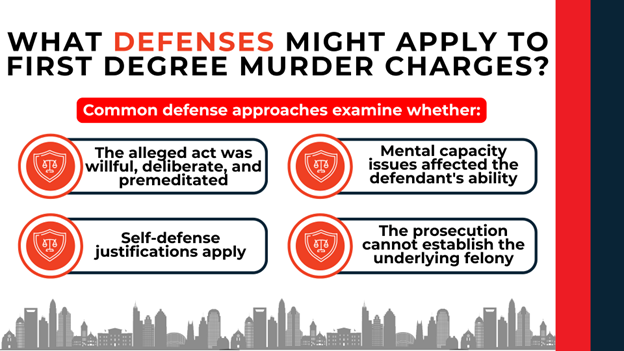
Common defense approaches examine whether:
The alleged act was truly willful, deliberate, and premeditated. If evidence suggests the defendant acted in the heat of passion or sudden anger, this might negate the premeditation required for first degree murder. Such circumstances could potentially reduce the charge to second degree murder or voluntary manslaughter.
Self-defense justifications apply. North Carolina recognizes the right to defend oneself against unlawful force. When someone reasonably believes they face imminent death or great bodily harm, the use of deadly force might be justified. However, imperfect self-defense—where the defendant was the aggressor or used excessive force—might reduce but not eliminate criminal liability.
Mental capacity issues affected the defendant’s ability to form the required intent. Severe mental illness or intellectual disability might prevent someone from deliberating or premeditating as the law requires.
The prosecution cannot establish the underlying felony in felony murder cases. If the state cannot prove the defendant committed or attempted the enumerated felony, the first degree murder charge based on that felony cannot stand.
How Are First Degree Murder Cases Investigated and Prosecuted?
First degree murder investigations typically involve extensive resources and multiple law enforcement agencies. These cases demand thorough investigation given the serious nature of the charges and potential penalties.
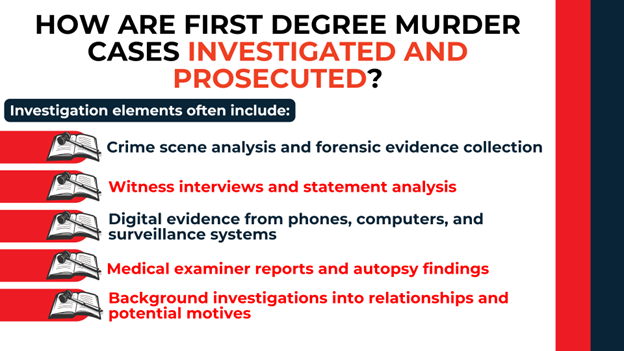
Investigation elements often include:
- Crime scene analysis and forensic evidence collection
- Witness interviews and statement analysis
- Digital evidence from phones, computers, and surveillance systems
- Medical examiner reports and autopsy findings
- Background investigations into relationships and potential motives
Prosecutors must present this evidence to establish each element of the charge beyond a reasonable doubt. This high burden means they carefully evaluate evidence before proceeding with first degree murder charges.
The complexity of these cases often results in lengthy pre-trial proceedings. Defense attorneys need time to review discovery materials, consult with experts, and develop comprehensive defense strategies. The stakes involved make thorough preparation essential for both sides.
Why Does Legal Representation Matter in First Degree Murder Cases?
The consequences of a first degree murder conviction in North Carolina are severe, potentially including the most serious penalties available under state law. The complexity of the law and the resources devoted to prosecution make experienced legal representation crucial.
An experienced criminal defense attorney understands the nuances of homicide law and can identify weaknesses in the prosecution’s case. They know which experts to consult, what evidence to challenge, and how to present alternative theories that create reasonable doubt.
Early involvement of counsel proves particularly important. Evidence can disappear, witnesses’ memories fade, and critical opportunities for investigation may be lost without prompt action. An attorney can also ensure that constitutional rights are protected during questioning and throughout the legal process.

Contact Patrick Roberts Law for Experienced Criminal Defense
If you or someone you know faces first degree murder charges or any serious criminal allegations in North Carolina, immediate legal consultation becomes essential. Attorney Patrick Roberts brings extensive experience handling complex criminal cases* and understands the life-changing nature of these charges.
The prosecution has already begun building their case. You need an advocate who will fight to protect your rights and pursue the best possible outcome* given the circumstances of your case. Contact Patrick Roberts Law today to discuss your situation and understand your options.
Time matters in criminal cases. Evidence needs to be preserved, witnesses interviewed, and defense strategies developed. Don’t wait to get the legal help you need during this critical time.
*Disclaimer: Each case is different and must be evaluated separately. Prior results achieved do not guarantee similar results can be achieved in future cases.

Former assistant district attorney
Contact Patrick Roberts
Facing criminal charges in North Carolina demands seasoned representation. Trust in the experience and dual perspective of Patrick Roberts. Reach out today for a confidential consultation.
-
Call Our Team
Calls answered 24/7








For more information on the selection criteria, go to www.martindale.com
*Each case is different and must be evaluated separately. Prior results achieved do not guarantee similar results can be achieved in future cases.