

When someone is charged with unlawfully causing another person’s death in North Carolina, the specific circumstances surrounding that killing determine the severity of the charge. Two critical concepts that prosecutors and defense attorneys examine are whether the killing was premeditated or committed in the heat of passion. Understanding the difference between these terms can mean the distinction between a murder conviction and a manslaughter charge—with dramatically different consequences.
This article explains how North Carolina law distinguishes premeditated killings from those committed in the heat of passion, what these terms mean in practice, and why these distinctions matter if you or someone you know is facing homicide-related charges.
What Does Premeditation Mean in North Carolina Law?
Premeditation refers to the mental process of thinking about or planning a killing before it occurs. Under North Carolina law, a murder is considered first-degree murder when it is committed with premeditation and deliberation.
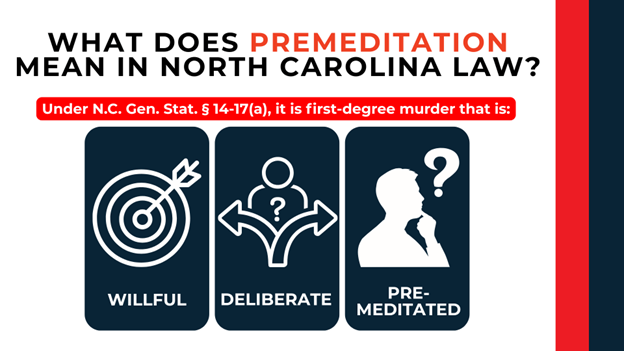
According to N.C. Gen. Stat. § 14-17(a), first-degree murder includes any murder that is “willful, deliberate, and premeditated.” This means:
- Willful: The defendant intended to kill the victim
- Deliberate: The defendant made a conscious decision to kill
- Premeditated: The defendant formed the intent to kill before committing the act
How Much Time Does Premeditation Require?
A common misconception is that premeditation requires extensive planning over days or weeks. In reality, North Carolina courts have held that premeditation can occur in a very brief period—even moments before the killing. What matters is that the defendant formed the intent to kill and then acted on that intent, regardless of how much time passed between the two.
The critical element is not the duration of time, but whether the defendant had an opportunity to reflect on their decision to kill, however brief that moment might have been.
Evidence of Premeditation
Prosecutors may point to various factors to establish premeditation, including:
- Prior threats or statements indicating intent to harm the victim
- Procurement of a weapon before the encounter
- Lying in wait for the victim
- The manner and severity of the attack
- Actions taken to avoid detection or cover up the crime
If the state cannot prove that the defendant formed the intent to kill before acting, the charge of first-degree murder based on premeditation and deliberation cannot be sustained. This is where the concept of “heat of passion” becomes legally significant.
What Does “Heat of Passion” Mean in North Carolina Homicide Cases?
A killing committed in the heat of passion occurs when a defendant acts under the influence of sudden, intense emotion triggered by adequate provocation. When a killing happens under these circumstances, it negates the element of malice required for a murder conviction.
Under North Carolina law, if a defendant kills another person without malice—but with an intentional act—due to heat of passion caused by adequate provocation, the offense is reduced to voluntary manslaughter rather than murder. This is a Class D felony under N.C. Gen. Stat. § 14-18.
Elements of Heat of Passion
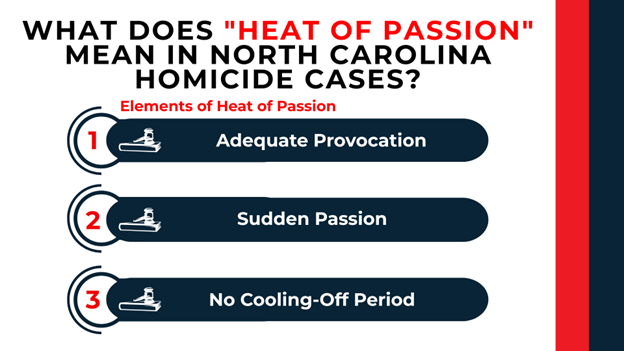
For a killing to qualify as having occurred in the heat of passion, several conditions must be present:
- Adequate provocation: Something must have happened that would cause a reasonable person to lose self-control
- Sudden passion: The defendant must have acted while under the influence of that passion, without time for reflection
- No cooling-off period: There must not have been sufficient time between the provocation and the killing for a reasonable person to regain control
Heat of passion does not excuse the killing—it remains unlawful. However, it reduces the severity of the offense because it demonstrates the absence of malice, which is a required element for murder.
What Constitutes Adequate Provocation?
North Carolina courts have recognized certain situations as potentially constituting adequate provocation, such as:
- Witnessing a spouse engaged in an act of adultery
- Being subjected to a serious assault
- Receiving information that would cause extreme emotional disturbance to a reasonable person
However, not every insult, argument, or offensive act qualifies as adequate provocation. The provocation must be of a nature that would cause a reasonable person to lose control, not merely anger or upset the particular defendant.
Words alone—no matter how offensive—generally do not constitute adequate provocation under North Carolina law. There typically must be some physical act or circumstance that would objectively justify the intense emotional response.
If the defendant had time to “cool off” after the provocation—meaning enough time for a reasonable person to regain composure—then the heat of passion defense does not apply. The killing would be treated as murder rather than voluntary manslaughter.
How Do Premeditation and Heat of Passion Differ?
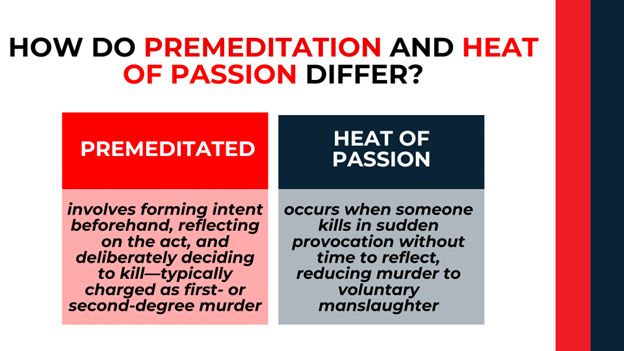
The fundamental difference between premeditation and heat of passion lies in the defendant’s state of mind and the circumstances surrounding the killing:
| Premeditated Killing | Heat of Passion Killing |
| Intent formed before the act | Intent formed in response to sudden provocation |
| Involves reflection and decision-making | Involves an immediate, emotional reaction |
| Defendant has time to consider their actions | No meaningful opportunity for reflection |
| Malice is present | Malice is negated by the circumstances |
| Typically charged as first or second-degree murder | Typically charged as voluntary manslaughter |
These distinctions are not merely academic—they determine the charges filed, the defenses available, and the potential penalties upon conviction.
What Is the Difference Between Voluntary and Involuntary Manslaughter?
While both voluntary and involuntary manslaughter involve unlawful killings without malice, they differ significantly in terms of intent and the nature of the underlying act.
Voluntary Manslaughter
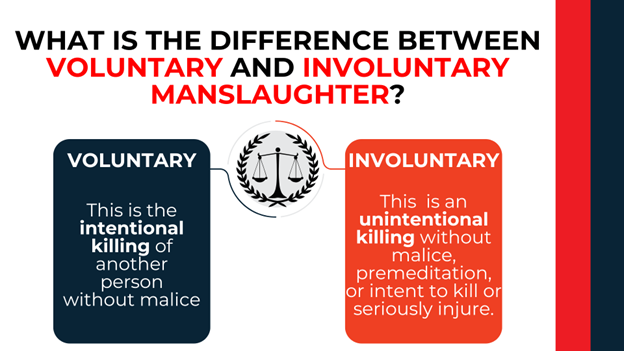
Voluntary manslaughter is the intentional killing of another person without malice. It includes:
- Killings committed in the heat of passion due to adequate provocation
- Killings committed with an imperfect right to self-defense (meaning the defendant was either the aggressor or used excessive force)
Under North Carolina law, to prove voluntary manslaughter, the state must establish:
- The defendant killed the victim by committing an intentional and unlawful act that is a felony or likely to cause death or great bodily harm
- The defendant’s act proximately caused the victim’s death
Voluntary manslaughter is a Class D felony.
Involuntary Manslaughter
Involuntary manslaughter is an unintentional killing without malice, premeditation, or intent to kill or seriously injure. It occurs when death results from:
- An unlawful act that is not a felony and not naturally dangerous to human life, or
- A culpably negligent act or omission
Examples of involuntary manslaughter include:
- Causing death through driving while impaired
- Participating in a fistfight and delivering a blow that causes death
- Committing an act of criminal negligence that results in death
The critical distinction is that involuntary manslaughter involves no intent to kill or cause serious injury. If the defendant intended the act that caused death, but that act was a felony or likely to cause death or serious injury, the offense is voluntary manslaughter—not involuntary manslaughter.
Involuntary manslaughter is a Class F felony, which is less serious than voluntary manslaughter.
Can a First-Degree Murder Charge Be Reduced to Manslaughter?
Yes. If evidence demonstrates that a killing charged as first-degree murder was actually committed in the heat of passion, the appropriate charge may be voluntary manslaughter rather than murder. This is because heat of passion negates the malice element required for a murder conviction.
Similarly, if the state cannot prove premeditation and deliberation, a first-degree murder charge may be reduced to second-degree murder. And if the evidence shows the defendant lacked intent to kill or inflict serious injury, the charge could potentially be further reduced to involuntary manslaughter.
Defense attorneys examine all the circumstances of the case to determine whether the elements required for the charged offense can be proven beyond a reasonable doubt. If not, they work to have charges reduced or dismissed accordingly.
What Role Does Self-Defense Play in These Cases?
Self-defense is another critical issue in homicide cases. If a defendant acted in lawful self-defense, the killing is justified, and the defendant should be found not guilty.
However, if the defendant acted in what is called imperfect self-defense, the killing may still result in a voluntary manslaughter conviction. Imperfect self-defense occurs when:
- The defendant was the aggressor in the confrontation, or
- The defendant used excessive force beyond what was reasonably necessary
Under North Carolina law, a defendant has no duty to retreat before using force when they are in a place where they have a lawful right to be. This is sometimes called the “stand your ground” principle. However, this protection does not apply if the defendant was the initial aggressor or used force that was not reasonably necessary under the circumstances.
If the state cannot prove beyond a reasonable doubt that the defendant either failed to act in self-defense, was the aggressor, or used excessive force, then the defendant may be acquitted entirely.
Why Do These Distinctions Matter?
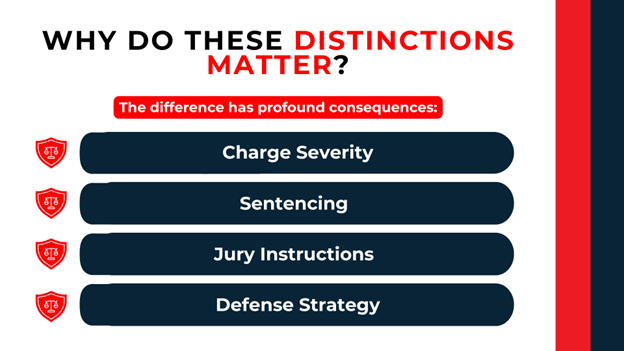
The difference between premeditated murder and a heat of passion killing has profound consequences:
- Charge severity: First-degree murder is a Class A felony, the most serious criminal classification in North Carolina. Voluntary manslaughter is a Class D felony, and involuntary manslaughter is a Class F felony.
- Sentencing: First-degree murder can result in life imprisonment without parole or, in certain circumstances, the death penalty. Manslaughter charges, while still very serious, carry significantly lesser penalties.
- Jury instructions: The way a jury is instructed on the elements of the offense can determine whether they convict on the charged offense or a lesser-included offense.
- Defense strategy: Understanding whether evidence supports premeditation, heat of passion, imperfect self-defense, or lack of intent is essential to building an effective defense.
What Should You Do If You Are Facing Homicide Charges?
If you or someone you care about has been charged with murder or manslaughter in North Carolina, early and experienced legal representation is critical. The distinctions between premeditated murder, heat of passion killings, and other forms of unlawful homicide are complex, and the stakes could not be higher.
Attorney Patrick Roberts has extensive experience handling serious criminal cases* in North Carolina, including homicide charges. He understands the nuances of North Carolina criminal law and works diligently to protect his clients’ rights at every stage of the process.
Do not wait to seek legal counsel. The earlier you have an attorney involved in your case, the better positioned you will be to challenge the prosecution’s evidence, explore potential defenses, and work toward the best possible outcome.*
Contact Patrick Roberts Law today to schedule a consultation and discuss your case in detail.
*Disclaimer: Each case is different and must be evaluated separately. Prior results achieved do not guarantee similar results can be achieved in future cases.
Former assistant district attorney
Contact Patrick Roberts
Facing criminal charges in North Carolina demands seasoned representation. Trust in the experience and dual perspective of Patrick Roberts. Reach out today for a confidential consultation.
-
Call Our Team
Calls answered 24/7









For more information on the selection criteria, go to www.martindale.com
*Each case is different and must be evaluated separately. Prior results achieved do not guarantee similar results can be achieved in future cases.