

When it comes to sexual offenses, understanding the difference between statutory rape vs. rape is crucial, especially if you or someone you know is facing criminal charges in North Carolina. These two crimes, while related, have distinct legal definitions, consequences, and defenses. At Patrick Roberts Law, we are dedicated to defending clients against these serious charges and are committed to providing clear, accurate information to help you navigate the complexities of North Carolina’s criminal justice system.
In this guide, we’ll explore the key differences between statutory rape and rape, explain how North Carolina law defines these offenses, and discuss what you need to know if you’re facing charges. Our goal is to leave you with as few unanswered questions as possible while ensuring the information is accessible and easy to understand.
What Is Statutory Rape in North Carolina?
Statutory rape is a specific type of sexual offense that involves sexual activity with a person who is below the legal age of consent. In North Carolina, it is defined under Chapter 14, Article 7B of the North Carolina General Statutes (N.C.G.S. § 14-27.23 through § 14-27.25). Individuals must be at least 16 to consent. This means that even if the minor appears to consent to the sexual activity, the law considers them incapable of giving legal consent due to their age.
Key Elements of Statutory Rape
- Age of Consent (N.C.G.S. § 14-27.25): In North Carolina, individuals can consent at 16. Sexual activity with anyone under 16 is considered statutory rape, regardless of whether the minor appeared to consent.
- Strict Liability: Statutory rape is often a strict liability crime. This means that the perpetrator’s intent or knowledge of the victim’s age is irrelevant. If the victim is underage, the act is illegal.
- Romeo and Juliet Laws: North Carolina law includes close-in-age exemptions (N.C. Gen. Stat. §§ 14-27.24, 14-27.25) for consensual relationships where the age difference is no more than four years. For example, an 18-year-old and a 15-year-old may qualify for reduced charges.
Example of Statutory Rape
A 21-year-old has consensual sex with a 15-year-old. Despite the minor’s apparent agreement, this is statutory rape. Because the age difference exceeds six years, the perpetrator could face a Class B1 felony (12–30 years in prison) under N.C. Gen. Stat. §§ 14-27.25

What Is Rape in North Carolina?
Rape, on the other hand, involves non-consensual sexual activity. It is also defined under Chapter 14, Article 7B of the North Carolina General Statutes (N.C.G.S. § 14-27.23 through § 14-27.25). Unlike statutory rape, the victim’s age is not the primary factor. Instead, the lack of consent is the defining element of the crime. Rape can involve force, threats, or the victim’s inability to consent due to factors like intoxication or unconsciousness.
Key Elements of Rape
- Lack of Consent (N.C.G.S. § 14-27.20(1a)): The victim does not agree to the sexual activity or is unable to give consent.
- Force or Coercion (N.C.G.S. § 14-27.21(a), § 14-27.22(a)): Rape often involves physical force, threats, or manipulation to compel the victim.
- Aggravating Factors (N.C.G.S. § 14-27.21(a)(1)-(3)): North Carolina law specifies three statutory aggravating factors that elevate forcible rape to first-degree status:
- Weapon Use (N.C.G.S. § 14-27.21(a)(1))
- Applies when the perpetrator “uses, threatens to use, or displays a dangerous or deadly weapon”
- Includes situations where the victim reasonably believes an object is a dangerous weapon
- No requirement that the weapon actually be used to inflict injury
- Serious Personal Injury (N.C.G.S. § 14-27.21(a)(2))
- Involves infliction of serious bodily harm to the victim or another person
- Courts have interpreted this to include both physical and psychological injuries that exceed the harm inherent in the offense itself
- May include injuries requiring medical attention or resulting in prolonged impairment
- Multiple Perpetrators (N.C.G.S. § 14-27.21(a)(3))
- Occurs when the offense is committed “aided and abetted by one or more other persons”
- Applies regardless of whether accomplices are charged or convicted
- Reflects the heightened trauma and reduced ability to resist when multiple assailants are involved
The presence of any single aggravating factor is sufficient to elevate the offense to first-degree status. These statutory factors play a critical role in charging decisions and significantly impact potential penalties, moving the offense to the more severe Class B1 felony classification with substantially longer prison terms.
Example of Rape
A person enters a home uninvited while the resident is sleeping and forces them to engage in sexual intercourse despite their verbal objections and resistance. This would constitute first-degree forcible rape under N.C.G.S. § 14-27.21, especially if the perpetrator displayed a weapon or was aided by another person.

Statutory Rape vs. Rape: Key Differences
Understanding the distinction between these two crimes is essential for building a strong defense. Here’s a detailed breakdown of the key differences:
Consent
- Statutory Rape: The minor cannot legally consent, even if they appear to agree.
- Rape: The victim does not consent or is unable to consent.
Age of Victim
- Statutory Rape: The victim is below the legal age of consent (under 16 in North Carolina).
- Rape: The victim can be any age.
Force or Coercion
- Statutory Rape: Not required; the act itself is illegal due to the victim’s age.
- Rape: Typically involves force, threats, or coercion.
Intent
- Statutory Rape: No intent required; strict liability based on age.
- Rape: Requires intent to engage in non-consensual activity.
Penalties
- Statutory Rape: Class B1 or C felony, depending on age difference.
Rape: Always a Class B1 felony (12–30 years), with harsher penalties for aggravating factors.

Penalties for Statutory Rape and Rape in North Carolina
Both statutory rape and rape are felony offenses in North Carolina, but the penalties vary depending on the circumstances of the case.
Statutory Rape Penalties
- Class B1 Felony (N.C.G.S. § 14-27.25(a)): Applies if the perpetrator is six or more years older than a victim under 16. Punishable by 12 years – life in prison.
- Class C Felony (N.C.G.S. § 14-27.25(b)): Applies if the perpetrator is 4–6 years older than a victim aged 13–15. Punishable by 5–19 years in prison.
Rape Penalties
- Class B1 Felony (N.C.G.S. § 14-27.21(b), § 14-27.22(b)): Rape is also a Class B1 felony in North Carolina, punishable by 12–30 years in prison. Aggravating factors can lead to even harsher sentences.
In addition to prison time, both crimes require the offender to register as a sex offender (Article 27A of Chapter 14), which can have long-lasting consequences on employment, housing, and personal relationships.

Defenses for Statutory Rape and Rape Charges
If you’re facing charges, it’s important to work with an experienced criminal defense attorney who can explore potential defenses. Some common defenses include:
For Statutory Rape
- Romeo and Juliet Exemptions: Proving the age difference is four years or less.
- Lack of Evidence: Challenging the prosecution’s evidence, such as proving the victim was not underage.
- Marital Exemption: North Carolina recognizes exceptions for consensual sex between married couples, even if one spouse is under 16.
Note: Statutory rape is a strict liability offense. Additionally, mistaken belief about the victim’s age is not a valid defense under North Carolina law.
For Rape
- Consent: Arguing that the sexual activity was consensual.
- False Accusations: Demonstrating that the allegations are false or motivated by ulterior motives.

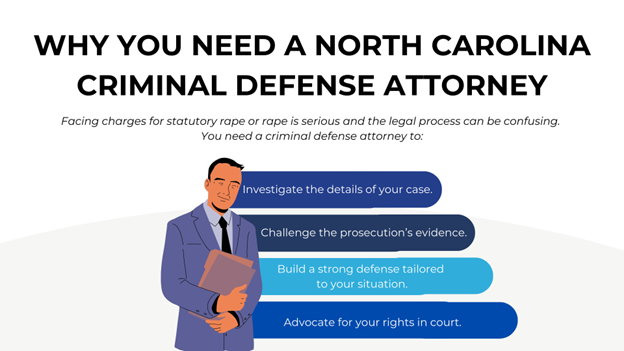
Why You Need a North Carolina Criminal Defense Attorney
Facing charges for statutory rape or rape is a life-altering situation. The stakes are high, and the legal process can be overwhelming. At Patrick Roberts Law, we have the experience to:
- Investigate the details of your case.
- Challenge the prosecution’s evidence.
- Build a strong defense tailored to your situation.
- Advocate for your rights in court.
Contact Patrick Roberts Law Today
If you or a loved one are facing charges for statutory rape or rape, you deserve a legal advocate with the experience and dedication to secure the best possible outcome. Attorney Patrick Roberts of Patrick Roberts Law has successfully defended numerous clients facing rape charges. Contact our firm today for a confidential consultation.
Former assistant district attorney
Contact Patrick Roberts
Facing criminal charges in North Carolina demands seasoned representation. Trust in the experience and dual perspective of Patrick Roberts. Reach out today for a confidential consultation.
-
Call Our Team
Calls answered 24/7








For more information on the selection criteria, go to www.martindale.com
*Each case is different and must be evaluated separately. Prior results achieved do not guarantee similar results can be achieved in future cases.