

A strangulation charge in North Carolina can be beaten. You can challenge the specific elements the prosecution is required to prove. You can raise a legally recognized defense such as self-defense. And you can expose weaknesses in the evidence — including inconsistent statements, lack of medical documentation, or the absence of physical injury. Under N.C.G.S. § 14-32.4(b), assault by strangulation is a Class H felony, which means the consequences of a conviction are severe and lasting. But a charge is not a conviction. The state carries the burden of proving every element beyond a reasonable doubt, and there are well-established ways to challenge each one.
This page breaks down exactly what the prosecution must prove, the defense strategies that apply under North Carolina law, and what to do right now to protect your case.
What Does the Prosecution Have to Prove?
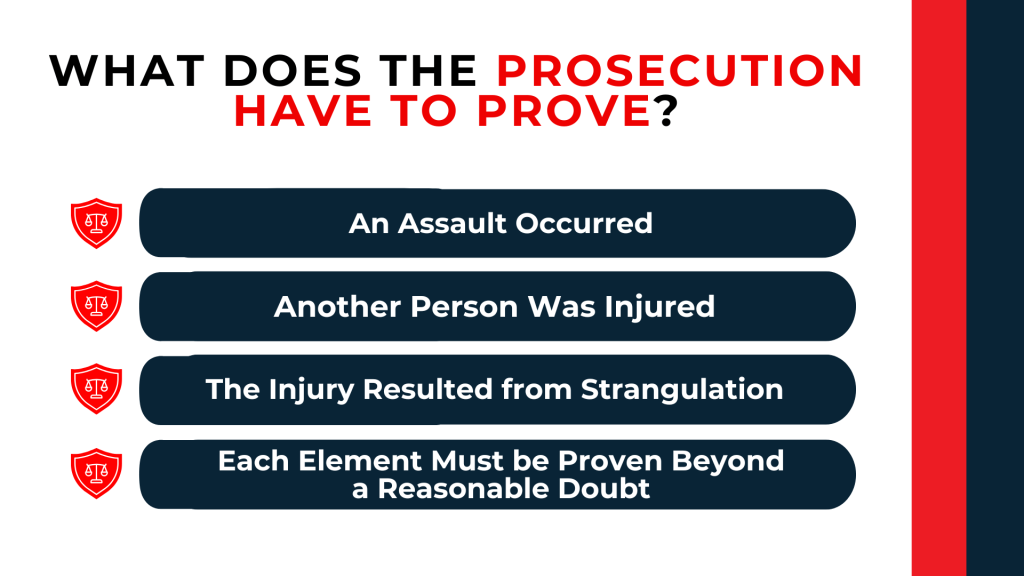
To get a conviction for assault by strangulation under N.C.G.S. § 14-32.4(b), the state must prove four elements beyond a reasonable doubt: that there was an assault, that it was committed on another person, that it caused physical injury, and that the injury was caused by strangulation. If the prosecution fails to prove any single element, the charge cannot stand.
Two of those four elements — “strangulation” and “physical injury” — are not defined anywhere in the statute itself. Their meaning comes from jury instructions and case law, and understanding how North Carolina courts interpret them is essential to building a defense.
The North Carolina Pattern Jury Instruction (N.C.P.I.—Crim. 208.61) defines strangulation as a form of suffocation caused by closure of the blood vessels or air passages of the neck resulting from external pressure, whether by hanging, cord or strap, or manual force. Critically, the instruction does not require proof that the airway was completely blocked or that the person was unable to breathe at all. Evidence that enough pressure was applied to cause difficulty breathing can be enough.
The physical injury threshold is also deliberately low. Drawing from the related definition in G.S. § 14-34.7(c), North Carolina courts treat “physical injury” as meaning cuts, scrapes, bruises, or other injury that does not rise to the level of serious injury. Courts have found this standard met by redness, soreness, petechiae (small broken blood vessels in the eyes or skin), blurred vision, and difficulty swallowing. They have also recognized that physical injury may exist even where no injuries are visible on the outside.
That low threshold matters for both sides. It means the prosecution doesn’t need dramatic evidence of harm to pursue the charge. But it also means the line between what qualifies and what doesn’t is factual, debatable, and often dependent on evidence that may not exist or may not hold up under a closer look.
What Defenses Actually Work Against a Strangulation Charge?
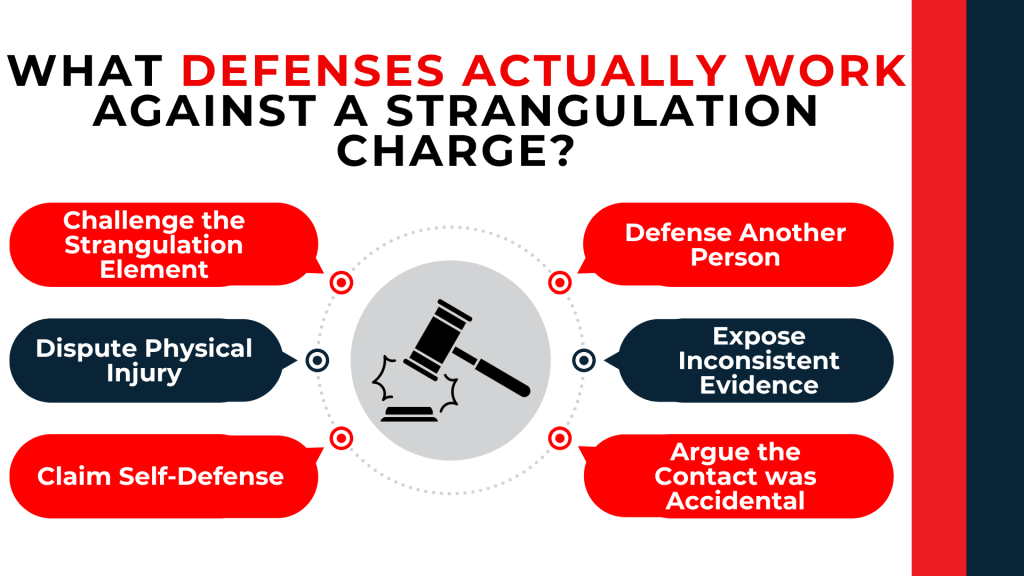
Every strangulation case depends on its facts, but the defense strategies that can succeed in North Carolina fall into recognizable categories. Each one targets a specific vulnerability in the prosecution’s case — either attacking an element the state must prove or raising a legal justification that defeats the charge entirely.
What If It Wasn’t Really Strangulation?
The legal definition of strangulation requires closure of blood vessels or air passages of the neck caused by external pressure. Not every instance of contact with someone’s neck meets that definition. A grab during a struggle that didn’t restrict breathing or blood flow, accidental contact during a physical struggle, or a push that happened to involve the neck area may not meet the element of strangulation as North Carolina law defines it.
This is a fact-intensive fight. The defense examines what actually happened — the physical details of the encounter, the positions of the people involved, the duration and nature of any contact. That evidence is then measured against the specific language of the jury instruction. If the evidence doesn’t establish that external pressure caused closure of blood vessels or air passages, the state hasn’t met its burden on this element.
What If There’s No Proof of Physical Injury?
Even though the injury threshold is low, it still has to be met. The prosecution must present evidence that the alleged victim suffered some form of physical injury — and that evidence needs to be more than an allegation alone.
If there are no photographs showing redness, bruising, or petechiae; no medical records documenting complaints of pain, difficulty breathing, or difficulty swallowing; and no physical evidence supporting the claim of injury, the state’s case on this element may rest entirely on testimony. That testimony can be challenged through cross-examination, prior inconsistent statements, and the absence of the kind of documentation you would expect to see if the injury actually occurred. The gap between what was alleged and what was documented is often where reasonable doubt lives in strangulation cases.
Self-Defense
North Carolina law recognizes a broad right to self-defense. Under N.C.G.S. § 14-51.3, a person is justified in using force — other than deadly force — when and to the extent that the person reasonably believes the force is necessary to defend against another person’s imminent use of unlawful force. North Carolina is a stand-your-ground state, meaning there is no duty to retreat from any place where the person is lawfully present.
In the context of a strangulation charge, self-defense applies when you were responding to an imminent physical threat and the contact with the alleged victim’s neck occurred as part of that response. The two requirements the defense must establish are that the belief in an imminent threat was reasonable and that the force used was proportionate to the threat perceived at the moment it was applied. Disproportionate force — a response far exceeding what the threat warranted — can defeat the claim even where the initial threat was real.
For situations involving a home, the castle doctrine under N.C.G.S. § 14-51.2 provides additional protection. When someone unlawfully and forcibly enters an occupied home, vehicle, or workplace, there is a rebuttable legal presumption that the occupant reasonably feared death or serious bodily harm. That presumption can strengthen a self-defense claim when the alleged incident occurred during a forced entry or home intrusion.
Defense of Another Person
The same statute that authorizes self-defense — N.C.G.S. § 14-51.3 — specifically extends to the defense of another person. If you used force because you reasonably believed it was necessary to protect someone else from the imminent use of unlawful force, that is a complete defense to the charge. The stand-your-ground principle applies equally. The standards are the same: reasonable belief in an imminent threat to the other person, and proportionality in the force used.
This defense arises in situations where you intervened to protect a child, a family member, or another person who was being physically threatened or attacked.
What If the Accuser’s Story Has Changed?
Many strangulation cases depend heavily — sometimes entirely — on the alleged victim’s account of what happened. When that account has changed between initial reports and later statements, or conflicts with physical evidence or witness testimony, those inconsistencies become powerful tools for the defense.
This is not a statutory defense in the way self-defense is. It is a reasonable-doubt strategy, and it is one of the most common paths to a good outcome in these cases. If the alleged victim’s description of events has shifted over time, or if their account is contradicted by evidence at the scene, your own documented injuries, or testimony from other witnesses, those contradictions can weaken the prosecution’s case. A skilled defense attorney will use them at every stage — from pretrial negotiations through trial.
What If the Contact Was Accidental?
The Fourth Circuit held in U.S. v. Rice, 36 F.4th 578 (4th Cir. 2022), that assault by strangulation under North Carolina law “can only be committed with an intentional, knowing or purposeful state of mind.” The court reasoned that a person cannot commit the act of strangling without knowing or intending it. The prosecution doesn’t need to prove you intended a specific injury, but it must prove the act itself was deliberate rather than accidental.
This matters because it creates a distinct defense in situations where any contact with the neck was unintentional — where the contact was accidental rather than purposeful. This is different from self-defense, which admits intentional action but justifies it. The accidental contact argument says the intentional act the statute requires never happened in the first place.
It is also worth noting what does not work as a defense. Because strangulation is a general-intent crime, voluntary intoxication is generally not available as a defense under North Carolina law. Even substantial evidence of heavy drinking will not support the defense if your conduct was otherwise purposeful, as the North Carolina Court of Appeals confirmed in State v. Tadlock, 299 N.C. App. 754 (2025).
What Should You Do Right Now?
If you’ve been arrested for assault by strangulation, there are immediate practical realities to be aware of. Under N.C.G.S. § 15A-534.1, if you are charged with a crime of domestic violence, you may be held for up to 48 hours before a judge sets pretrial release conditions. Those conditions commonly include staying away from the alleged victim’s home, school, and workplace, refraining from assaulting or harassing the alleged victim, and posting a secured bond. Violating those conditions — or violating a Domestic Violence Protective Order if one has been issued — is a separate criminal offense that can make the situation significantly worse.
The most important thing to understand is that the decisions made early in a strangulation case often determine how it ends. Roughly 98% of North Carolina felony convictions result from guilty pleas rather than jury trials, and for Class H felonies specifically, the jury trial rate is approximately 1%. That doesn’t mean trials don’t happen or don’t succeed. It means the vast majority of these cases are resolved through negotiation. The strength of your defense attorney’s preparation strongly influences whether the resolution is a dismissal, a reduction, or a conviction.
Do not make statements to law enforcement without an attorney present. Do not contact the alleged victim. Preserve any evidence that may support your defense — text messages, photographs, surveillance footage, and the names and contact information of anyone who witnessed what happened.
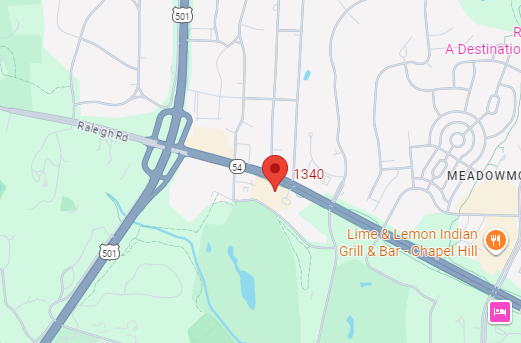
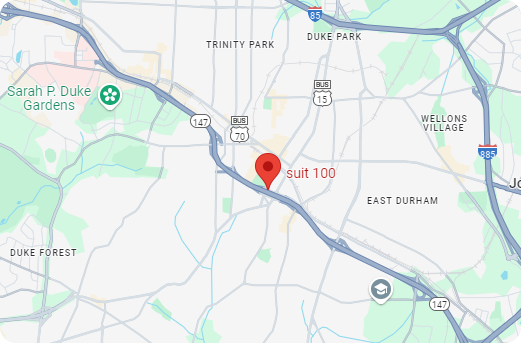
Patrick Roberts is a Raleigh criminal defense attorney and former prosecutor who served as an Assistant District Attorney in Wake, Johnston, and New Hanover counties. That background gives him a dual perspective as a former prosecutor who understands how the state builds and evaluates cases from the inside. He is a graduate of Gerry Spence’s Trial Lawyers College and the National Criminal Defense College Trial Practice Institute, and has handled thousands of criminal cases across North Carolina. Patrick Roberts Law serves clients from offices in Raleigh, Durham, Chapel Hill, and Cary. He provides a formidable defense in Wake County—specifically Raleigh, Cary, Apex, Holly Springs, Garner, and Fuquay-Varina and represents clients in high-stakes matters across every county in North Carolina.
Client Review
“Have you ever found yourself in a situation and didn’t know who to turn to? That was us when our young adult got into legal trouble for the first time in his life. As parents, we were overwhelmed and scared. We prayed for an experienced criminal defense attorney who would be honest, direct, yet compassionate — and God led us to Patrick Roberts, Esquire. We couldn’t have asked for better representation! Attorney Roberts is well-versed in the law and the Wake County Court System. He’s candid and doesn’t sugarcoat things — which was exactly what we needed. His years of experience exuded a strong sense of confidence. From day one, it was clear that he’s deeply committed to advocating for his clients, no matter how tough the situation. He’s a man of his word and asked us to trust his process.” – Verified client review via Avvo.com
Peer Endorsement
“I endorse this lawyer without reservation. Patrick is plain outstanding. The highest remark I can give a lawyer is that I would ask him to represent me were I charged with a crime. I would ask Patrick and know that I would be in the very best of hands.” – Verified peer endorsement via Avvo.com
Disclaimer: Testimonials and peer reviews are actual comments from clients and peers. They are for informational purposes only and do not guarantee or predict the outcome of your legal matter. Every case is unique and must be evaluated on its own merits.
If you or someone close to you is facing an assault by strangulation charge, the earlier a defense attorney is involved, the more options remain on the table. Contact Patrick Roberts Law to discuss your case.
To ensure the timely progression of all legal matters, the firm caps the number of active cases managed at any one time.

Disclaimer: The information on this website is for general informational purposes only. Nothing herein should be taken as legal advice for any individual case or situation. Contacting us via this website, email, or contact form does not create an attorney-client relationship. Case results depend on a variety of factors unique to each case; prior results do not guarantee a similar outcome.
Former assistant district attorney
Contact Patrick Roberts
Facing criminal charges in North Carolina demands seasoned representation. Trust in the experience and dual perspective of Patrick Roberts. Reach out today for a confidential consultation.
-
Call Our Team
Calls answered 24/7









For more information on the selection criteria, go to www.martindale.com
*Each case is different and must be evaluated separately. Prior results achieved do not guarantee similar results can be achieved in future cases.