

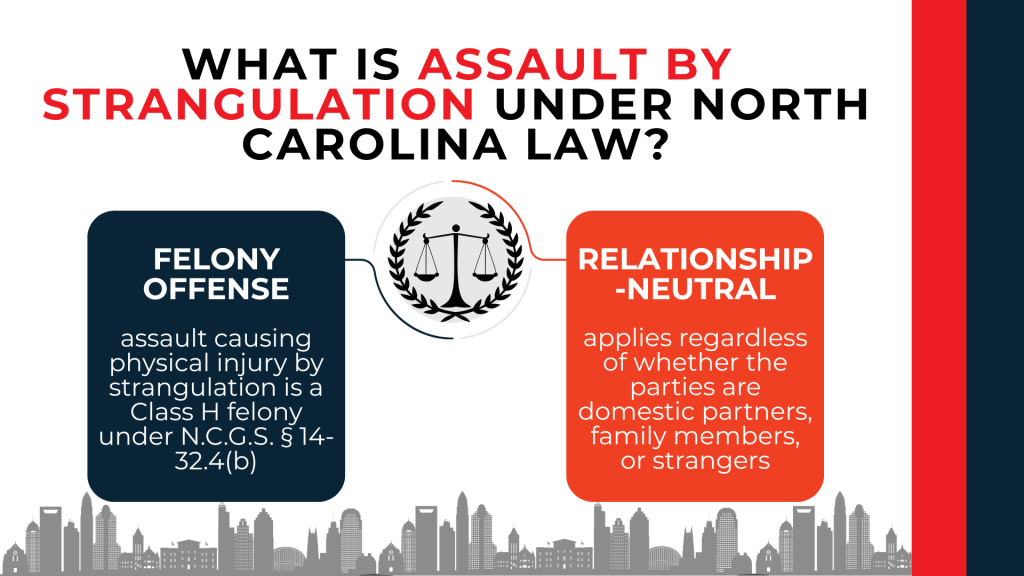
Assault by strangulation is a Class H felony in North Carolina under N.C.G.S. § 14-32.4(b). It is not a misdemeanor, not a lesser assault charge, and not something the court system treats as a routine domestic dispute. It is a standalone felony offense. A conviction carries up to 39 months in prison, a permanent criminal record, and collateral consequences that follow you for life.
Many people searching for information about this charge don’t yet realize how broadly North Carolina defines strangulation, how little injury the prosecution actually needs to prove, or how far the consequences extend beyond the sentence itself. This page covers what the statute requires, what the prosecution has to show, what the sentencing exposure looks like, what a felony conviction means for your future, and how these charges can be challenged.
What Is Assault by Strangulation Under North Carolina Law?
Under N.C.G.S. § 14-32.4(b), a person who assaults another person and inflicts physical injury by strangulation is guilty of a Class H felony, unless the conduct falls under another statute that provides greater punishment. The legislature created this offense as a distinct category because it treats strangulation as inherently dangerous conduct — dangerous enough to warrant felony treatment even when the physical injuries are relatively minor.
This is a critical distinction. If you are charged under this statute, you are not facing an elevated misdemeanor or a simple assault with added facts. You are facing a felony — with everything that comes with a felony conviction in North Carolina.
The charge applies regardless of the relationship between the parties. N.C.G.S. § 14-32.4(b) does not vary the offense class based on whether the accused and the alleged victim are in a domestic relationship, are strangers, or fall anywhere in between. While many strangulation charges arise in a domestic context, the statute itself is relationship-neutral.
What Does the Prosecution Have to Prove?
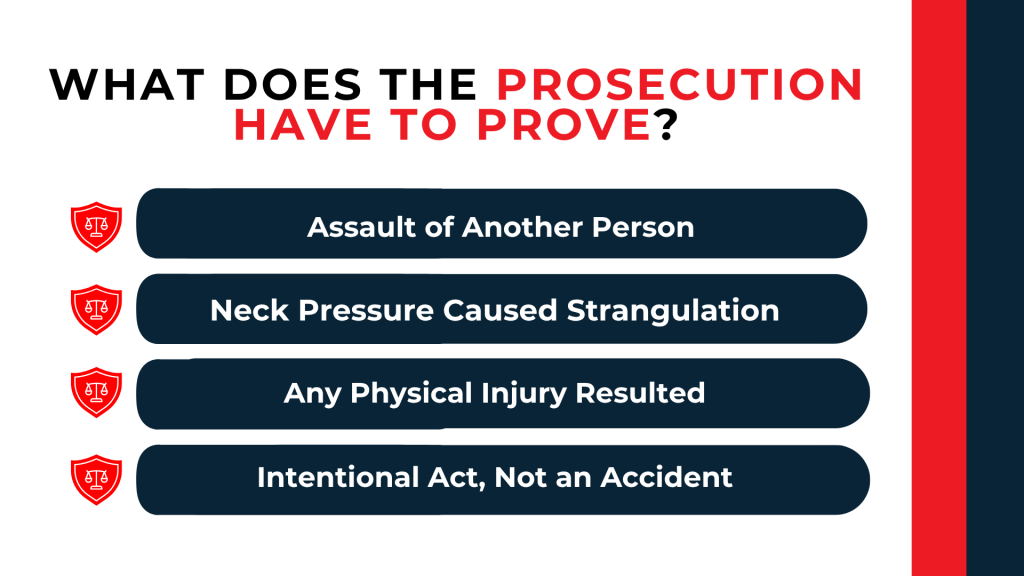
A conviction under N.C.G.S. § 14-32.4(b) requires the State to prove four elements: that there was an assault, that the assault was on another person, that the assault inflicted physical injury, and that the physical injury was caused by strangulation. Two of those elements — “strangulation” and “physical injury” — are not defined anywhere in the statute itself. How North Carolina courts have interpreted them is where most people’s understanding falls short.
The North Carolina Pattern Jury Instruction (N.C.P.I.—Crim. 208.61) defines strangulation as a form of suffocation characterized by closure of the blood vessels and/or air passages of the neck as a result of external pressure on the neck, whether brought about by hanging, a cord or similar object, or the manual assertion of pressure. What the instruction does not require is proof of complete airway closure or a complete inability to breathe. Evidence that sufficient pressure was applied to the throat to cause difficulty breathing is enough.
That means the State does not need to prove that anyone lost consciousness, that the airway was fully blocked, or that the situation reached the level of severity many people associate with the word “strangulation.” Pressure on the neck that restricts breathing, even partially, can satisfy the element.
The physical injury threshold is equally low. The statute requires only “physical injury,” which North Carolina courts and the UNC School of Government have interpreted using the related definition in G.S. § 14-34.7(c): cuts, scrapes, bruises, or other physical injury that does not constitute serious injury. Courts have found sufficient physical injury based on bruising, redness, petechiae (small broken blood vessels in the eyes or skin), soreness, blurred vision, and difficulty swallowing. Critically, courts have also recognized that physical injury may exist even where no injuries are externally visible. The complainant’s testimony about pain, difficulty breathing, or other symptoms can be enough on its own.
This is the knowledge gap that catches most people off guard. The prosecution does not need dramatic injuries. The bar is deliberately set low because the legislature intended the act of strangulation itself, paired with any physical consequence, to carry felony weight.
This is also a general-intent crime. In U.S. v. Rice, 36 F.4th 578 (4th Cir. 2022), the court held that assault by strangulation under this statute can only be committed with an intentional, knowing, or purposeful state of mind. The court reasoned that a person cannot strangle someone without knowing or intending it. The prosecution does not need to prove you intended a specific injury. It only needs to prove the conduct was deliberate rather than accidental.
What Are the Penalties for a Conviction?
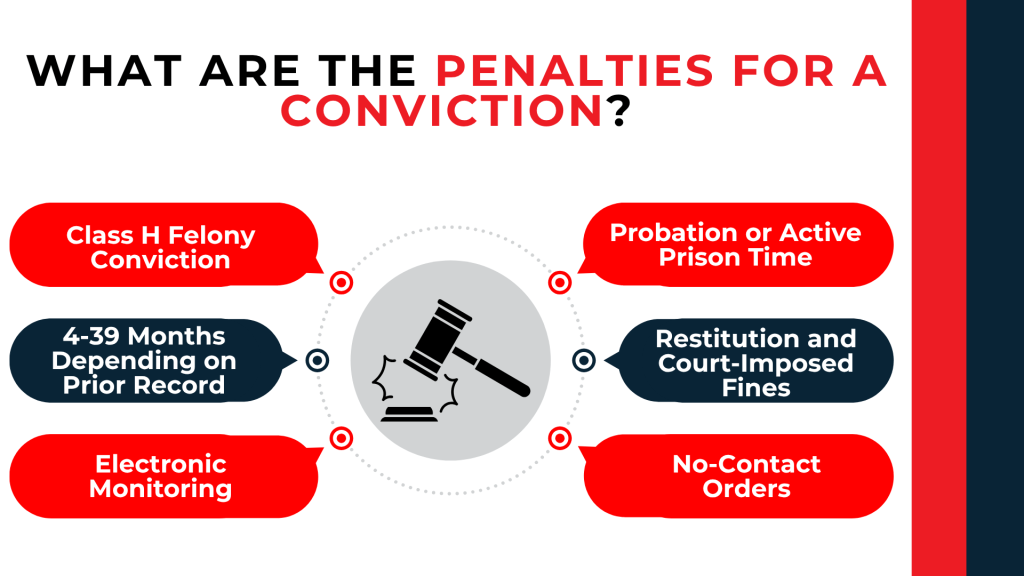
Assault by strangulation is sentenced under North Carolina’s Structured Sentencing Act. The sentence is determined by two factors: the offense class (Class H) and your prior record level. Prior record level ranges from Level I to Level VI based on a point system that assigns points for prior convictions. Each prior Class H or I felony adds two points, and each prior Class A1 or Class 1 misdemeanor adds one point.
At Prior Record Level I — a person with minimal or no criminal history — the presumptive sentencing range is a minimum of 5 to 6 months, with the mitigated range starting at 4 months. The absolute statutory maximum for any Class H felony is 39 months, which is a Level VI aggravated sentence. At lower prior record levels, community punishment (probation) and intermediate punishment (probation with additional conditions like electronic monitoring or short-term confinement) are available sentencing options. Active prison time becomes mandatory at Prior Record Level VI.
Probation conditions in cases involving domestic circumstances can include supervised probation, electronic monitoring, substance-abuse treatment, completion of an abuser-treatment program under G.S. § 15A-1343(b)(12), restitution, and a fine at the court’s discretion.
If you are facing this charge in a domestic context, there is an immediate procedural reality you need to understand. Under N.C.G.S. § 15A-534.1, if you are arrested for a crime of domestic violence, you can be held for up to 48 hours before a judge sets pretrial release conditions. Unlike most arrests where a magistrate can set bond quickly, this statute sends pretrial release decisions to a judge. That judge may set conditions including a secured appearance bond, no-contact provisions, and orders to stay away from the alleged victim’s home, school, and workplace. Roughly 98 percent of North Carolina felony convictions result from guilty pleas rather than jury trials. The jury trial rate for Class H felonies sits around one percent. That means the decisions made early in a case, including at the pretrial stage, carry enormous weight in shaping how the case turns out.
What Happens to Your Record and Your Life After a Felony Conviction?
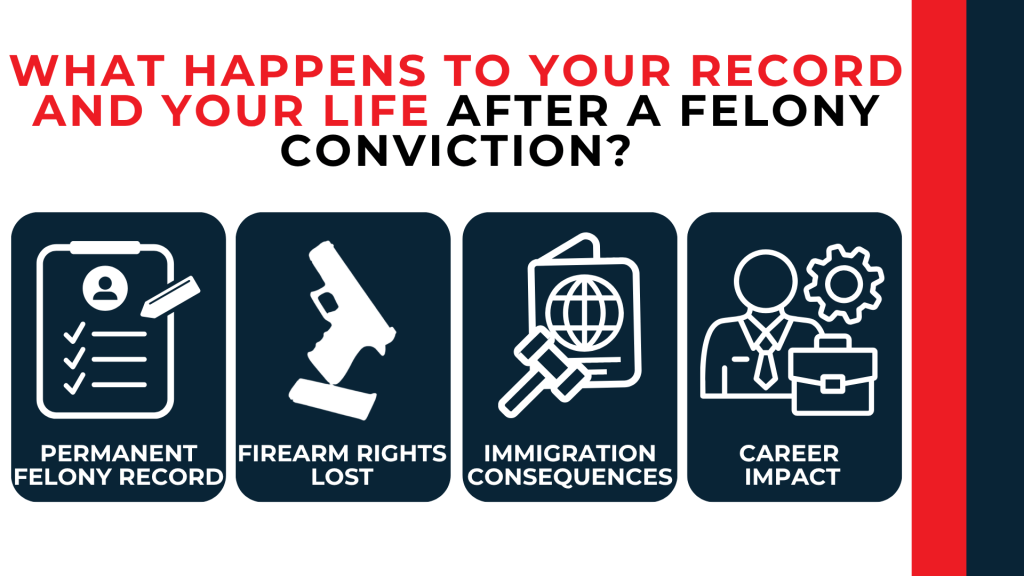
The sentence is only part of what a conviction means. A Class H felony conviction for assault by strangulation triggers consequences that extend well beyond the courtroom and, in many cases, last permanently.
A felony conviction imposes a federal firearms ban under 18 U.S.C. § 922(g)(1) and a state ban under G.S. § 14-415.1, preventing you from possessing, purchasing, or owning firearms. In cases involving a domestic relationship, the Lautenberg Amendment under 18 U.S.C. § 922(g)(9) can independently impose a lifetime ban on firearms and ammunition. A qualifying domestic violence protective order triggers its own separate federal firearms ban under § 922(g)(8).
For noncitizens, the consequences can be even more severe. The Fourth Circuit held in U.S. v. Rice, 36 F.4th 578 (4th Cir. 2022), that North Carolina’s assault by strangulation is categorically a “crime of violence.” United States v. Robinson, 92 F.4th 531 (4th Cir. 2024), confirmed that holding still applies. That classification means a conviction can be treated as an aggravated felony under federal immigration law when a sentence of one year or more is imposed. For immigration purposes, a suspended sentence counts. The result can be mandatory detention and near-automatic deportation. When the offense involves a victim in a qualifying domestic relationship, it separately qualifies as a deportable crime of domestic violence under 8 U.S.C. § 1227(a)(2)(E), which carries no minimum sentence requirement at all.
A conviction also creates professional licensing risks. Under G.S. § 93B-8.1, North Carolina licensing boards can deny a license when a conviction is directly related to the occupation or involves a crime that is violent or sexual in nature. A crime of violence categorization clearly fits within that standard.
Finally, an assault by strangulation conviction is generally not eligible for expungement under current North Carolina law. It also makes you ineligible for expungement of other offenses. The record is, for practical purposes, permanent.
Can Assault by Strangulation Charges Be Fought?
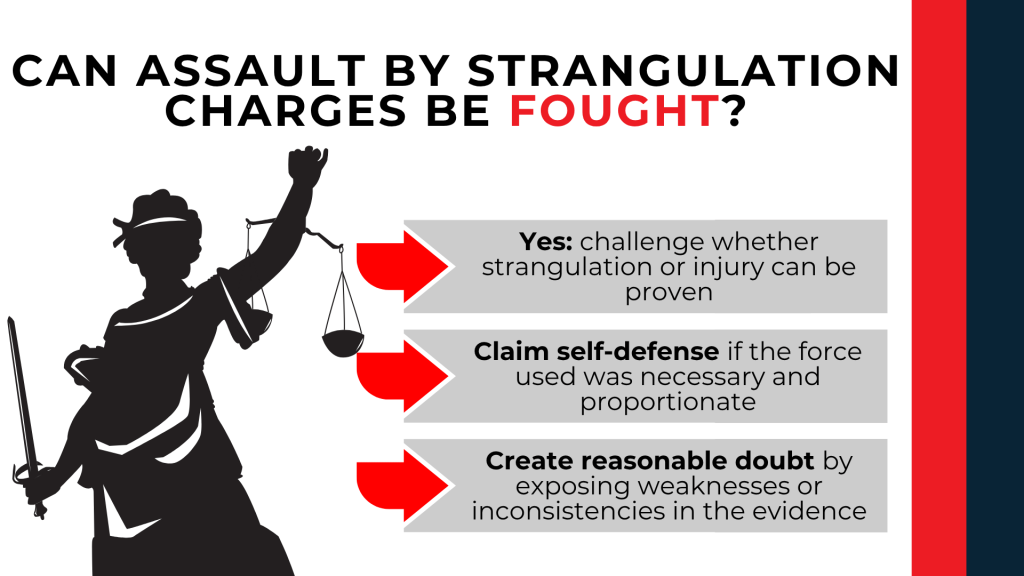
Yes — but the path depends entirely on the facts, and the facts need to be examined early.
The most common areas of real dispute in strangulation cases involve challenging the two elements the statute leaves undefined. The first is whether what happened actually constituted strangulation. The question is whether sufficient pressure was applied to the neck to meet the legal definition, as opposed to accidental contact, grabbing, or a struggle that involved the neck area without the kind of sustained external pressure the pattern jury instruction describes. The second is whether any physical injury actually resulted, particularly in cases where there are no visible marks, no medical treatment, and the State’s evidence consists primarily of the complainant’s testimony.
Both of these questions are heavily fact- and evidence-driven. Photographs taken at the scene or shortly after, medical records, the presence or absence of petechiae, the complainant’s statements to law enforcement versus later testimony, and any conflicting accounts from witnesses all directly affect whether the prosecution can prove these elements beyond a reasonable doubt.
Self-defense is the primary affirmative defense available under N.C.G.S. § 14-51.3. North Carolina law authorizes a person to use non-deadly force when and to the extent the person reasonably believes it is necessary to defend against another person’s imminent use of unlawful force. There is no duty to retreat — a person who is lawfully present in any location may stand their ground. The same standards apply to the defense of another person under the same statute.
The limits are imminence and proportionality. The threat being defended against must be imminent, not speculative, not future, and not already concluded. The force used must be proportionate to the threat as it existed at the moment force was applied. Grossly disproportionate force can defeat the claim even where the initial threat was real. In a strangulation prosecution, the practical question is whether the physical contact with the neck was a proportionate, necessary response to an imminent threat you reasonably perceived. The evidence must support that account.
One defense that is generally not available is voluntary intoxication. Because assault by strangulation is a general-intent crime, North Carolina law does not permit voluntary intoxication as a defense. The court in State v. Tadlock, 299 N.C. App. 754 (2025), affirmed that even evidence of heavy drinking does not entitle a defendant to a voluntary intoxication instruction. The court found that the defendant’s purposeful conduct showed he was not “utterly incapable” of forming intent. For a general-intent offense like strangulation, this defense is effectively unavailable.
Why Do You Need a Defense Attorney Now?
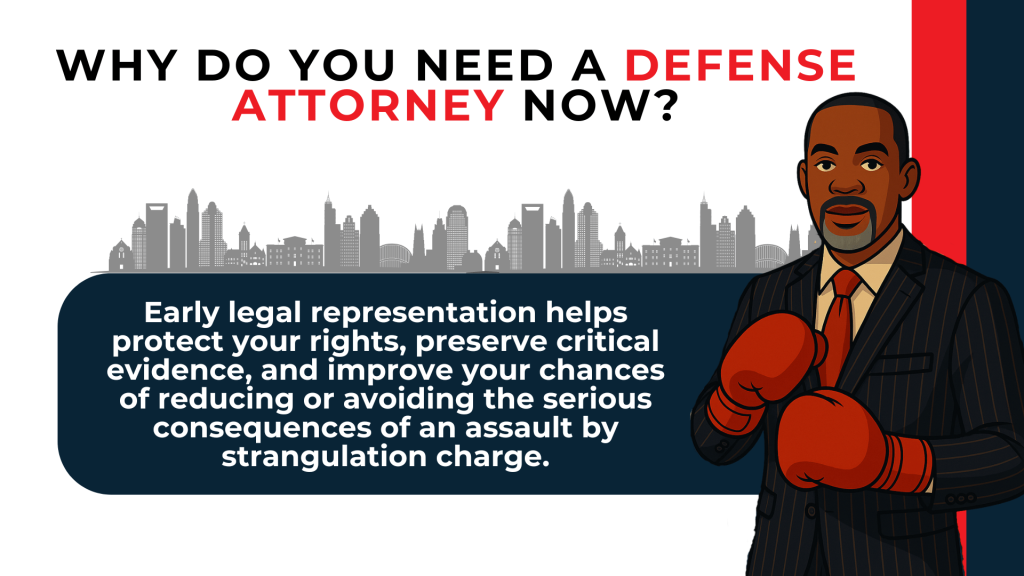
Everything about this charge rewards early action and penalizes delay. The 48-hour pretrial hold means bond and release conditions can be set before you have had any meaningful opportunity to consult with a lawyer. The evidence that will make or break the case — photographs of the alleged victim’s neck and eyes, medical records, the complainant’s initial statements, 911 recordings, body camera footage — begins to take shape in the first days after an arrest. Once the State’s narrative is locked in, challenging it becomes significantly harder.
The collateral consequences outlined above also mean that the difference between a conviction and another outcome is not just a matter of months served. It is the difference between a permanent felony record with firearms prohibitions, potential immigration consequences, and licensing barriers — and the possibility of a reduced charge, a dismissal, or an acquittal that avoids those outcomes entirely.
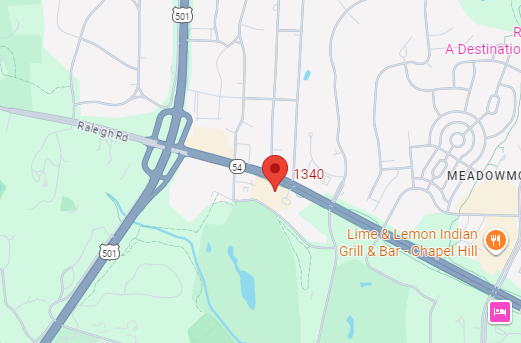
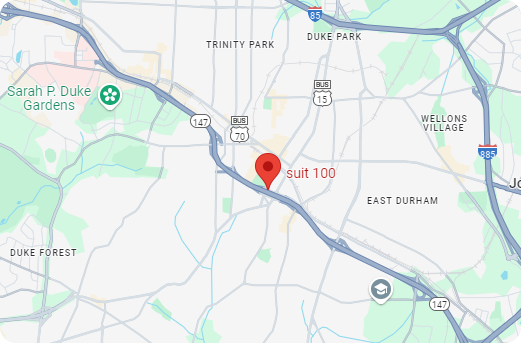
Patrick Roberts is a Raleigh criminal defense attorney and former Assistant District Attorney in Wake, Johnston, and New Hanover counties. That prosecutorial background matters in strangulation cases specifically because he understands how the State builds these cases from the inside — what evidence prosecutors rely on, where the weaknesses tend to be, and how charging decisions get made. He is a graduate of Gerry Spence’s Trial Lawyers College and the National Criminal Defense College Trial Practice Institute, with more than 24 years of experience and thousands of criminal cases handled across North Carolina. Patrick Roberts Law PLLC serves clients from offices in Raleigh, Durham, Chapel Hill, and Cary. His legal practice spans all North Carolina counties for high-stakes litigation, with a concentrated defense practice in Wake County—including Raleigh, Cary, Apex, Holly Springs, Garner, and Fuquay-Varina.
Client Review
“Patrick Roberts represented my son and we were blessed to meet such a God send. From the first meeting until present, Mr. Roberts has been transparent and thorough about every possible outcome. With his confidence and experience in criminal law, Mr. Roberts is able to give you the best outcome possible. I highly recommend Mr. Roberts he’s outstanding.” – Verified client review via Avvo.com
Peer Endorsement
“Patrick is a thoughtful and experienced attorney. When I have a client needing representation in the Raleigh area in his areas of practice, he would be my referral of choice ” – Verified peer endorsement via Avvo.com
Disclaimer: Testimonials and peer reviews are actual comments from clients and peers. They are for informational purposes only and do not guarantee or predict the outcome of your legal matter. Every case is unique and must be evaluated on its own merits.
If you are facing an assault by strangulation charge in North Carolina, or if someone close to you has been arrested, contact Patrick Roberts Law to discuss the case.
To preserve high standards of diligence and thorough management, the firm strictly regulates its active case volume.
Disclaimer: The information on this website is for general informational purposes only. Nothing herein should be taken as legal advice for any individual case or situation. Contacting us via this website, email, or contact form does not create an attorney-client relationship. Case results depend on a variety of factors unique to each case; prior results do not guarantee a similar outcome.
Former assistant district attorney
Contact Patrick Roberts
Facing criminal charges in North Carolina demands seasoned representation. Trust in the experience and dual perspective of Patrick Roberts. Reach out today for a confidential consultation.
-
Call Our Team
Calls answered 24/7









For more information on the selection criteria, go to www.martindale.com
*Each case is different and must be evaluated separately. Prior results achieved do not guarantee similar results can be achieved in future cases.