

Self-defense is a legally recognized defense to domestic violence charges in North Carolina. When it’s proven, it results in a complete acquittal. In fact, North Carolina law explicitly excludes acts of self-defense from the definition of domestic violence under N.C. Gen. Stat. § 50B-1. The legislature didn’t leave that to interpretation. It wrote self-defense out of the definition on purpose.
But there’s a gap between what actually happened in a confrontation and what a courtroom will accept as legal self-defense. That gap is where cases are won or lost. North Carolina law imposes specific requirements — imminent threat, reasonable belief, proportional force — that don’t always line up with how a real person experiences a real moment of danger. Roughly 81% of domestic violence incidents in North Carolina occur inside a home. That means the person facing charges and the person who called 911 often share a living space, a history, and a version of events that law enforcement has to sort through in minutes. The person who was defending themselves doesn’t always end up on the right side of that initial call.
This page covers what North Carolina law actually requires to prove self-defense in a domestic violence case. It explains how the state’s stand-your-ground and castle doctrine laws apply, what happens when the force used wasn’t perfectly proportional, and where the line falls between losing your right to this defense and preserving it.
Is self-defense a real defense to domestic violence charges in North Carolina?
Yes. North Carolina courts recognize what’s called “perfect self-defense” — a complete legal justification that, if proven, means you are not guilty. It isn’t a technicality, and it isn’t a sentencing argument. It is a defense to the charge itself.
The legal foundation is straightforward. Under N.C. Gen. Stat. § 14-51.3, a person is justified in using force when and to the extent they reasonably believe that force is necessary to defend themselves against another person’s imminent use of unlawful force. When the threat involves death or serious bodily harm, deadly force is permitted. North Carolina imposes no duty to retreat before using it.
What matters for someone searching this topic is that self-defense doesn’t activate automatically just because the facts support it. It has to be raised by the defense, supported with evidence, and argued under standards that North Carolina courts have spent decades refining. The distinction between “I had no choice” and a courtroom finding that the legal standard was met is not something that resolves itself.
What does North Carolina require you to prove?
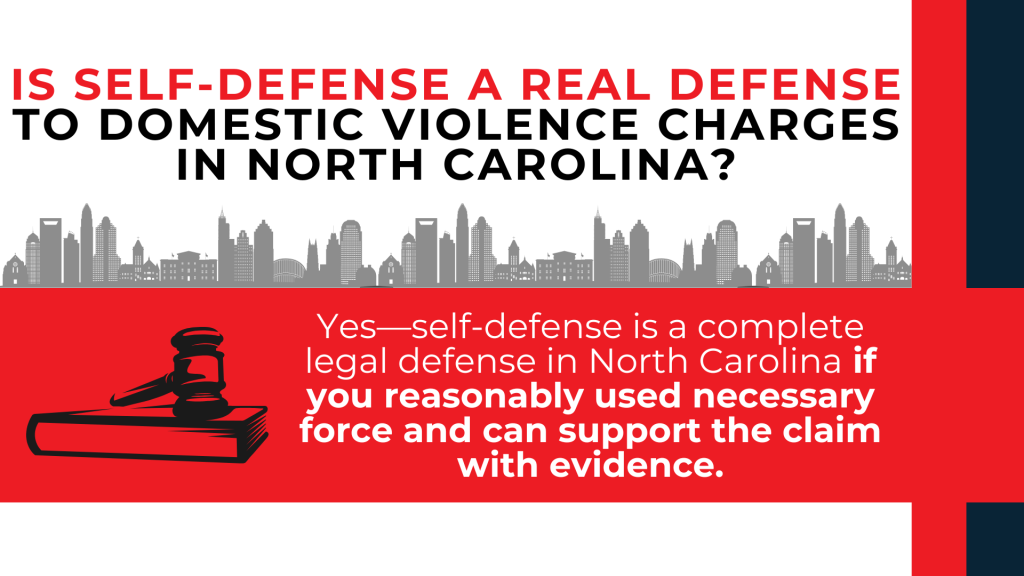
Perfect self-defense in North Carolina requires you to have held a reasonable belief that force was necessary to prevent imminent death or great bodily harm. Every word in that standard carries weight, and courts examine each one independently.
Reasonable means your belief is measured against what a reasonable person in your position would have perceived — not just what you personally felt. Your own fear, however genuine, has to be the kind of fear that an ordinary person facing the same circumstances would also have experienced. Evidence of prior abuse, prior threats, and the history of the relationship is admissible and relevant to this question. North Carolina courts have held that evidence of battered-spouse syndrome can be considered when evaluating whether your belief was reasonable. But that evidence supports the reasonableness question — it doesn’t replace it.
Necessary means there was no adequate alternative to the use of force at that moment. This doesn’t mean you had to exhaust every conceivable option. It means force couldn’t have been clearly avoided under the circumstances as they existed in real time.
Imminent is the element that gets scrutinized most heavily in domestic violence cases. The North Carolina Supreme Court drew the hardest line on it in State v. Norman, 324 N.C. 253, 378 S.E.2d 8 (1989). In that case, a battered wife shot her sleeping husband. The Supreme Court held she was not entitled to self-defense instructions because there was no evidence of imminent fear of death at the time of the killing. The abuse was real. The fear was real. But the legal definition of imminence required a threat that was happening right then — not one that had happened before or would happen again later.
Norman does not mean self-defense is unavailable in domestic violence cases. It means the timing of the threat matters as much as its severity. Building the defense requires showing what was happening at the specific moment force was used.
Do you have to prove you tried to leave or retreat first?
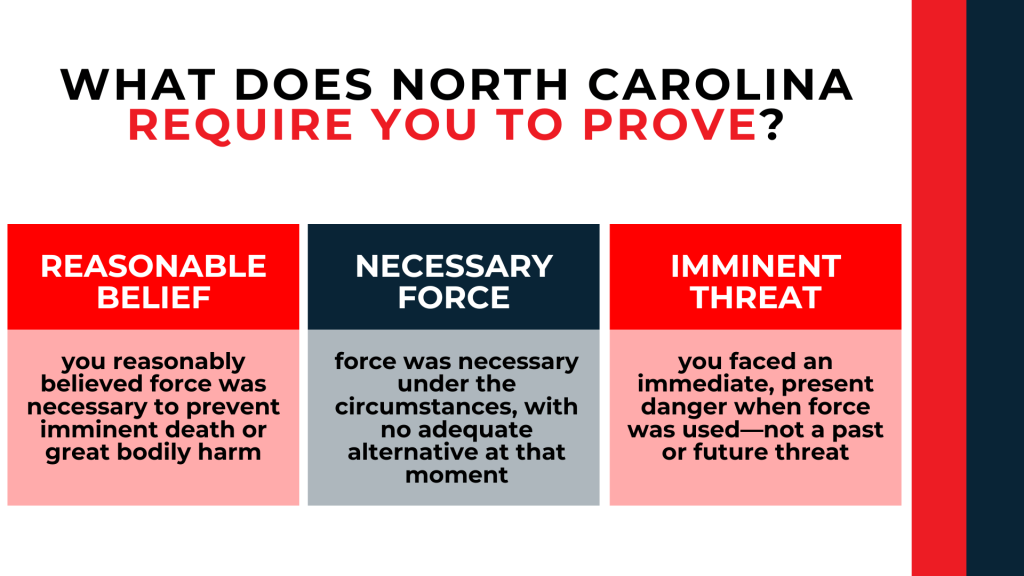
No. North Carolina is a stand-your-ground state, and this is one of the most significant protections available to someone raising self-defense in a domestic violence case.
Under N.C. Gen. Stat. § 14-51.3, enacted in 2011, a person has no duty to retreat from any place where they have a lawful right to be before using defensive force. That includes a shared apartment, a home they own, a vehicle, or any other location where their presence is legal. The prosecution cannot argue that you should have left the room, gone outside, or driven away. The law eliminated that requirement entirely.
This matters in domestic violence cases specifically because the confrontation almost always happens in a place both people have a right to occupy. The old question of “why didn’t you just leave?” has no legal relevance to a self-defense claim in North Carolina. The only questions are whether the threat was imminent, the belief was reasonable, and the force was necessary.
What if it happened in your own home?
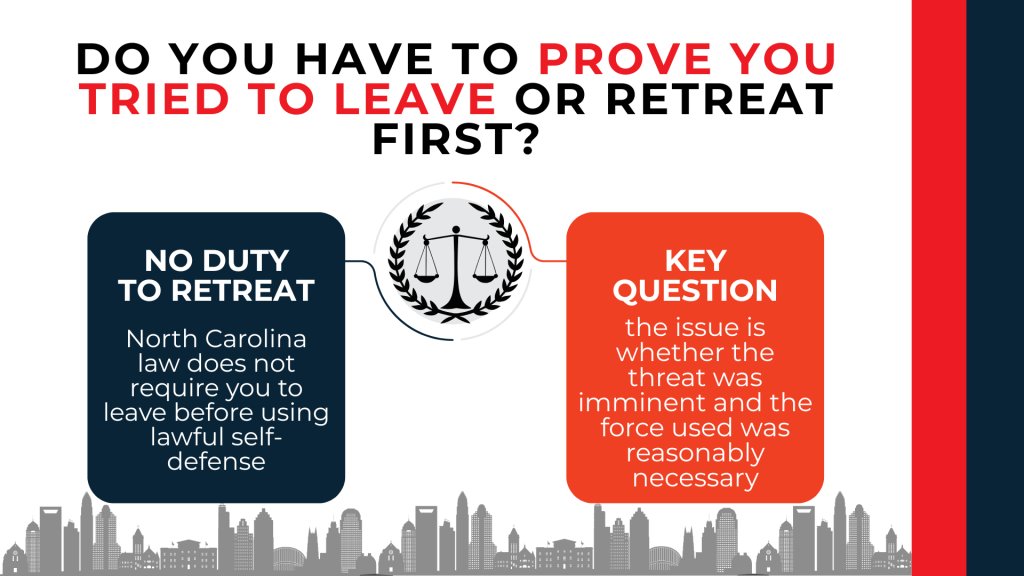
When a confrontation occurs inside a home, North Carolina’s castle doctrine under N.C. Gen. Stat. § 14-51.2 can add a separate layer of legal protection beyond the general self-defense statute.
The castle doctrine creates a presumption — meaning the court starts with the assumption — that you had a reasonable fear of imminent death or serious bodily harm when you used defensive force against someone who unlawfully and forcibly entered your home, vehicle, or workplace. Under normal self-defense, you carry the burden of proving that reasonable belief. Under the castle doctrine, the presumption flips the question: the State has to overcome it.
The North Carolina Supreme Court has reinforced this presumption in recent years. In State v. Phillips, 386 N.C. 513, 905 S.E.2d 23 (2024), the court held that the castle doctrine presumption can only be overcome by five specific circumstances listed in § 14-51.2(c). The State cannot pursue an excessive-force theory unless it first overcomes the presumption through one of those exceptions. In State v. Allison, 388 N.C. 664, 923 S.E.2d 485 (2025), the court reversed a second-degree murder conviction because the jury had not been instructed that curtilage is part of the “home” under the statute. As the court’s plain-language reading confirmed, the castle doctrine’s protections extend beyond a home’s four walls.
There is a critical limitation in domestic violence cases. The castle doctrine applies to someone who unlawfully enters the home. When the other person is a lawful occupant — a spouse, a partner, a roommate — the presumption may not apply in the same way. But when a domestic violence protective order or a pretrial no-contact order has been entered against the other person, and that person enters the home in violation of the order, the situation can change. Whether the entry was unlawful and forcible is one of the first things a defense attorney evaluates. So is whether the castle doctrine presumption applies in your specific situation.
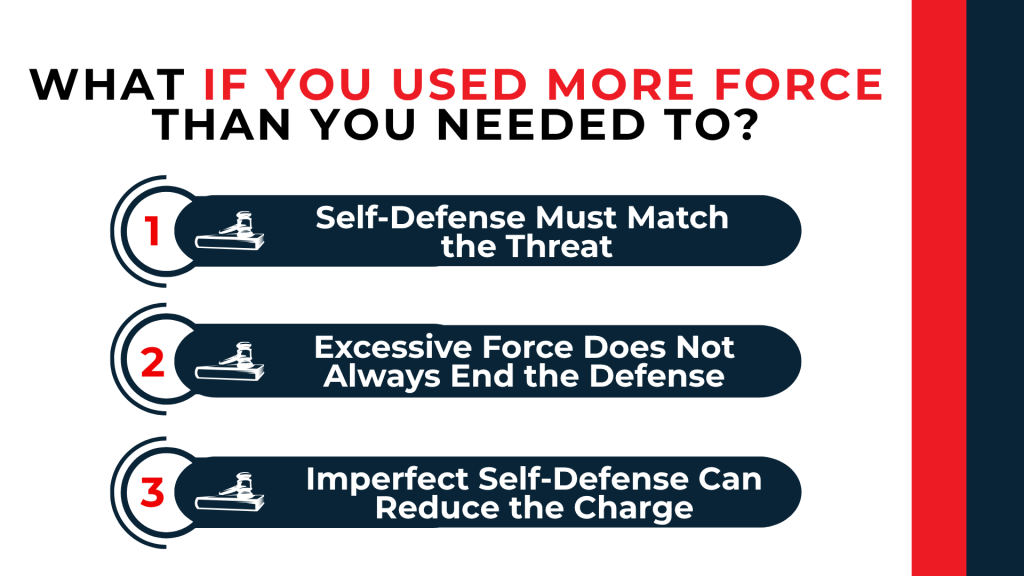
What if you used more force than you needed to?
Proportionality is a requirement of self-defense in North Carolina. The force used has to be proportionate to the threat — responding to a shove with a weapon, for example, creates a serious problem for a perfect self-defense claim. Even under the stand-your-ground statute, force far out of proportion can defeat the claim.
But North Carolina law doesn’t treat this as all-or-nothing. Sometimes you believed you were in danger and used force to defend yourself, but the belief was unreasonable or the force was excessive. In those situations, the court can recognize what’s called imperfect self-defense. Imperfect self-defense doesn’t result in an acquittal. What it does is reduce the seriousness of the charge and the potential sentence. The difference between a conviction on the original charge and a conviction on a reduced charge can be the difference between years in prison and a much different outcome.
This is why the proportionality question is not a reason to abandon a self-defense argument. It’s a reason to have the argument built carefully, by someone who understands how North Carolina courts evaluate what was proportionate under the specific circumstances of the confrontation.
Can you still claim self-defense if you started the argument?
This is one of the most common concerns, and the answer depends on the specific facts of the incident.
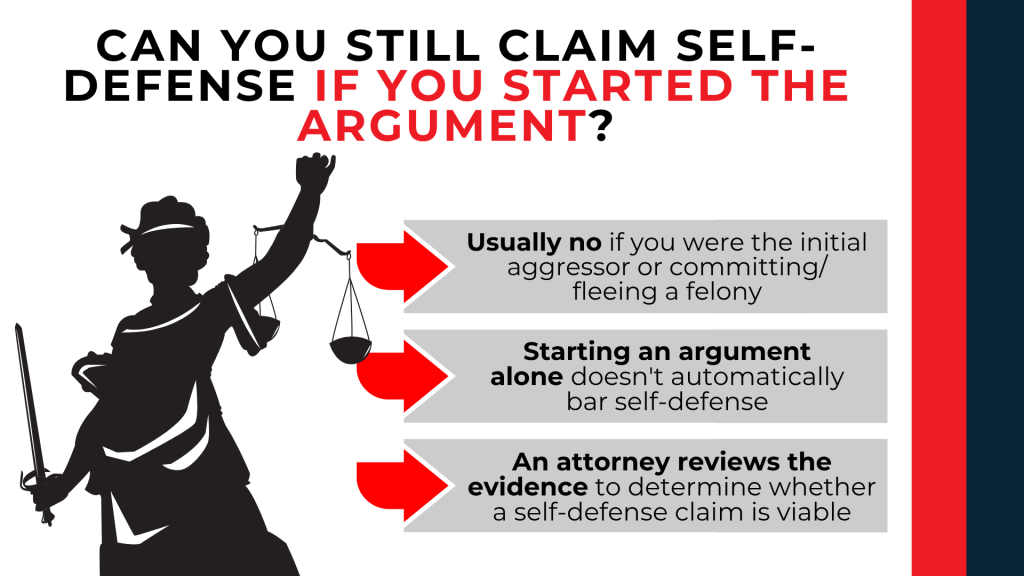
Under N.C. Gen. Stat. § 14-51.4, the right to use defensive force is generally unavailable to someone who was the initial aggressor or who was committing or fleeing from a felony at the time. Whether you qualify as the initial aggressor in a domestic violence case is a question that depends on the specific facts. Arguments escalate, and the line between verbal conflict and physical confrontation is often blurry looking back.
A defense attorney investigates who first used or threatened unlawful physical force in a specific incident. That investigation looks at 911 recordings, witness accounts, the sequence of injuries, and your own account of what happened. It is one of the first steps in evaluating whether self-defense is realistic.
Why do you need a lawyer — not just an explanation?
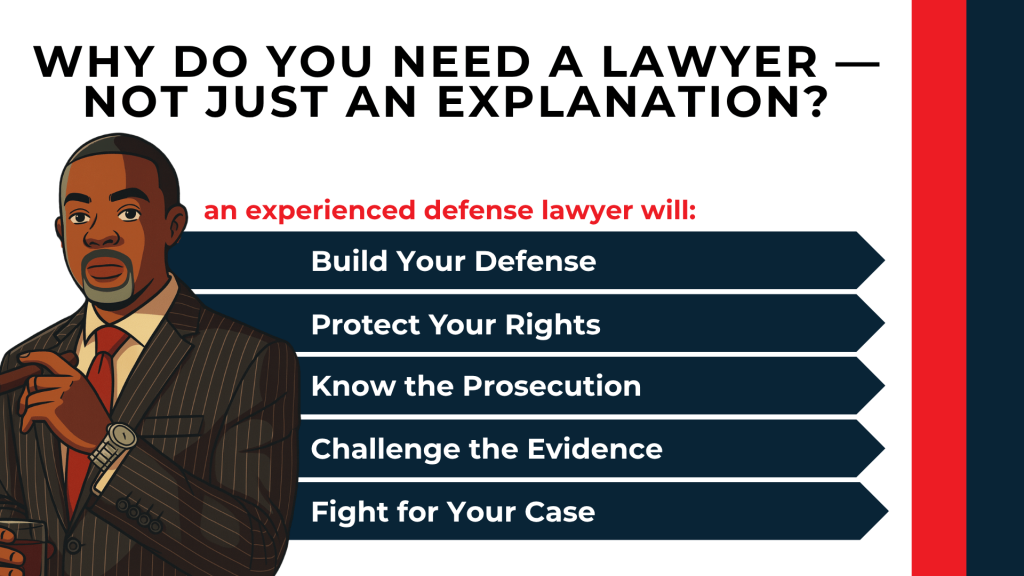
The most common mistake people make when they’ve been charged with domestic violence after defending themselves is assuming that telling the truth will be enough. It usually isn’t — not because the truth doesn’t matter, but because the legal system doesn’t process truth the way a conversation does. It processes evidence, standards, and procedure.
Building a self-defense case in a domestic violence prosecution requires assembling specific types of evidence the court will accept. That includes 911 call recordings that capture what was happening before officers arrived, photographs documenting injuries on you as well as the complainant, medical records, witness statements, prior police reports involving the complainant’s behavior, and sometimes expert testimony on the patterns in the relationship. It also requires understanding what to protect. Statements you make to police at the scene — before anyone has explained your rights, before the adrenaline has worn off — are frequently used by the prosecution to undercut the self-defense claim later. What you say in the first ten minutes can define what your attorney has to work around for the next ten months.
Patrick Roberts, a Raleigh criminal defense attorney and former assistant district attorney in Wake, Johnston, and New Hanover counties, has handled thousands of criminal cases across North Carolina. That prosecutorial background means he understands how the State builds domestic violence cases from the inside — how they evaluate evidence, where they see weakness in a self-defense claim, and where their own case is vulnerable to challenge. His approach at Patrick Roberts Law is built on that dual perspective: meticulous preparation paired with aggressive trial advocacy when the case demands it.
Client Review
“I recently hired A. Patrick Roberts as my lawyer, and I couldn’t be more pleased with the outcome of my case. He represented me in a domestic violence accusation, and thanks to his exceptional skills, my case was dismissed. From our first meeting, Patrick impressed me with his thorough understanding of the law and his strategic approach to my case. He not only provided clear and practical legal advice but also employed smart strategies that were beyond my expectations. His attention to detail and dedication to my defense made all the difference. If you’re looking for a lawyer who truly cares about his clients and knows how to navigate complex legal situations, I highly recommend A. Patrick Roberts. He is an outstanding lawyer, and I am incredibly grateful for his support.” – Verified client review via Avvo.com
Peer Endorsement
“Patrick Roberts is undoubtedly one of the best attorney advocates in the Triangle area. His experience as a former prosecutor is invaluable to any client seeking an attorney who knows the ropes. His honesty, integrity, and straightforwardness are qualities every client should seek in an attorney. I would, without hesitation, strongly recommend Mr. Roberts to anyone seeking an outstanding criminal defense lawyer.” – Verified peer endorsement via Avvo.com
Disclaimer: Testimonials and peer reviews are actual comments from clients and peers. They are for informational purposes only and do not guarantee or predict the outcome of your legal matter. Every case is unique and must be evaluated on its own merits.
Talk to a Defense Attorney
Evidence in domestic violence cases deteriorates quickly. Bruises fade. Recordings get overwritten. Witnesses’ memories shift. And statements made to police in the hours after an arrest become permanent parts of the record. If self-defense is the truth of what happened, the time to start building that defense is now — before the case takes shape around the prosecution’s version of events.
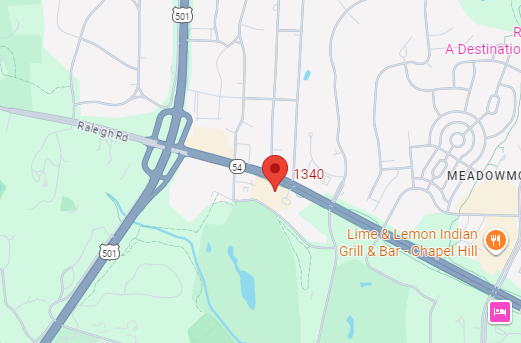
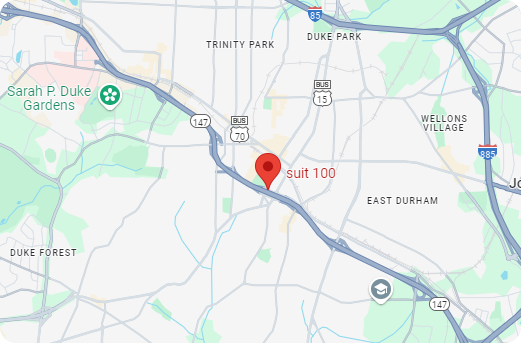
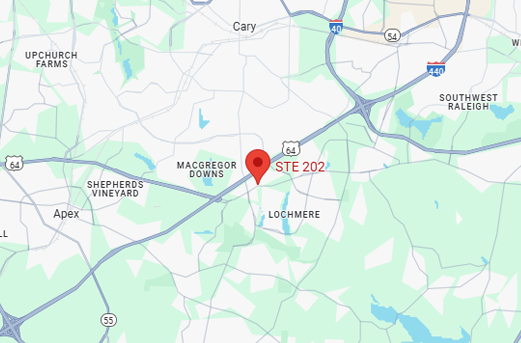
Patrick Roberts Law represents clients facing domestic violence charges throughout the Triangle from offices in Raleigh, Durham, Chapel Hill, and Cary. He offers comprehensive legal representation across every county in North Carolina for high-stakes cases, maintaining a core geographic focus on Wake County communities like Raleigh, Cary, Apex, Holly Springs, Garner, and Fuquay-Varina. To discuss your case, contact the firm at patrickroberts.law.
To ensure consistent and comprehensive attention, the firm limits the volume of active cases its staff handles.
Disclaimer: The information on this website is for general informational purposes only. Nothing herein should be taken as legal advice for any individual case or situation. Contacting us via this website, email, or contact form does not create an attorney-client relationship. Case results depend on a variety of factors unique to each case; prior results do not guarantee a similar outcome.
Former assistant district attorney
Contact Patrick Roberts
Facing criminal charges in North Carolina demands seasoned representation. Trust in the experience and dual perspective of Patrick Roberts. Reach out today for a confidential consultation.
-
Call Our Team
Calls answered 24/7









For more information on the selection criteria, go to www.martindale.com
*Each case is different and must be evaluated separately. Prior results achieved do not guarantee similar results can be achieved in future cases.