
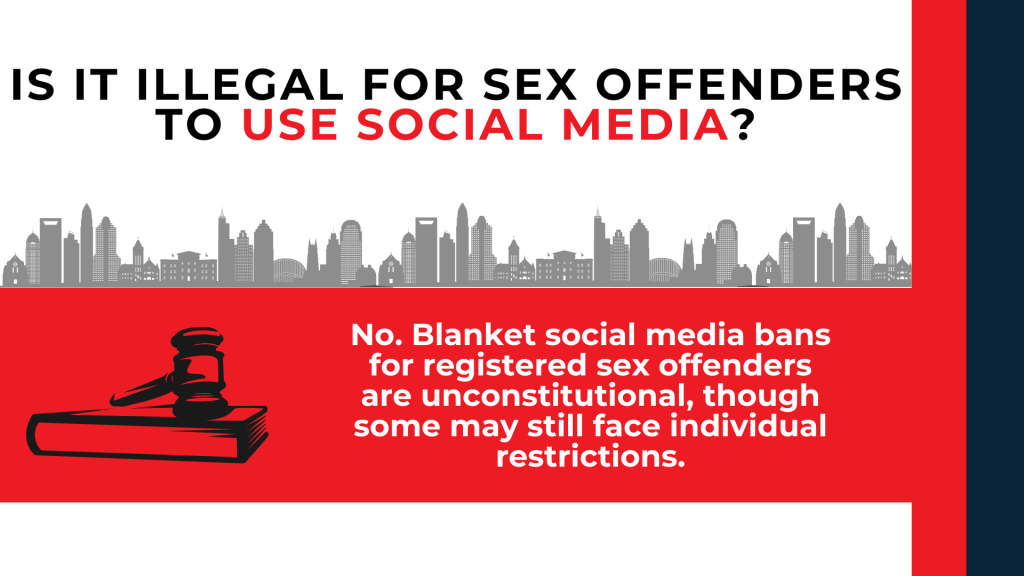
North Carolina cannot impose a blanket ban preventing registered sex offenders from using social media. The U.S. Supreme Court settled that question in 2017 when it struck down a North Carolina law that made it a felony for any registered sex offender to access sites like Facebook. But that ruling did not eliminate every restriction that might apply to a specific person. Whether you can lawfully use social media right now depends on your sentencing conditions, the terms of your supervision, and the platform you want to use.
This page breaks down what the law actually says, what your probation or post-release supervision may add on top of it, what the registry itself requires, and where the real risks of a violation come from. The goal is to help you stop guessing and start understanding exactly where you stand.
Is It Illegal for Sex Offenders to Use Social Media?
Not as a blanket rule. It used to be.
In 2008, North Carolina enacted N.C.G.S. § 14-202.5, which made it a felony for any registered sex offender to access a commercial social networking site where minors could create accounts. That law was broad. It covered Facebook, Twitter, and virtually every major platform. A registered sex offender named Lester Packingham was convicted under it after posting on Facebook about a dismissed traffic ticket — a post that had nothing to do with minors, sexual conduct, or any criminal activity.
The case went to the United States Supreme Court. In Packingham v. North Carolina, 582 U.S. 98 (2017), the Court held that the statute violated the First Amendment. The law was not narrowly tailored to serve the state’s interest in protecting children. It cut off access to what the Court called the modern public square — platforms people use to find jobs, read the news, engage in political speech, and communicate with family. The government has a legitimate interest in protecting minors from sexual predators. But a law that bars all registered sex offenders from all major social media platforms sweeps far too wide to survive constitutional review.
That means the old criminal statute no longer applies. But the Packingham decision did not say that sex offenders are free from all social media restrictions under all circumstances. It struck down one specific type of restriction: a blanket ban applied to every registered offender regardless of their individual circumstances.
What remains — and this is the part that matters most for anyone searching this question — is a web of individualized restrictions that can still limit what you do online.
Can My Probation or Post-Release Conditions Still Ban Me From Social Media?
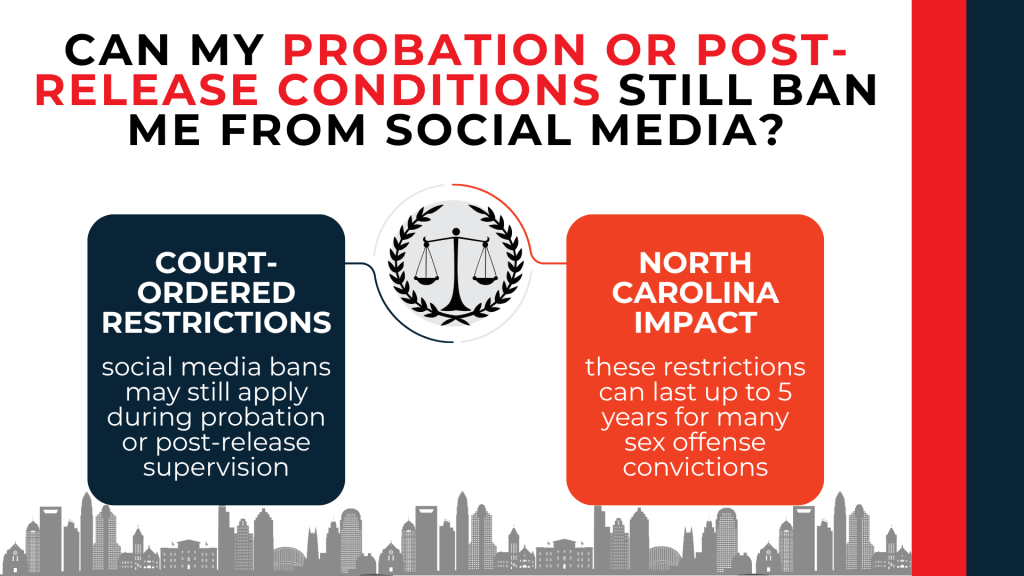
They can. This is the single most important thing to understand if you are currently under supervision.
The Packingham decision struck down a law of general application. It did not address a sentencing judge’s authority to impose individualized conditions on a specific defendant as part of probation or post-release supervision. As a general principle, people serving supervised sentences have more limited constitutional rights than the general public. Courts typically have authority to impose special conditions that are reasonably related to the offense and rehabilitation. A judge may order you not to use social media — or not to use it without a probation officer’s approval — if that restriction is connected to the nature of the conviction. Whether any particular condition would survive a legal challenge depends on the facts of the individual case.
This matters especially in North Carolina because of how long post-release supervision lasts for sex offense convictions. Under the state’s structured sentencing framework, sex offenses receive enhanced post-release supervision of 60 months — five full years — compared to 9 to 12 months for other felony offenses. During that entire period, you are bound by whatever conditions the court has set, and violating those conditions can have serious consequences.
If your conditions restrict internet or social media use, those restrictions govern your case regardless of the Packingham ruling. The constitutional analysis is different when the restriction is imposed on an individual as part of a criminal sentence rather than applied as a blanket ban against an entire class of people.
What About the Sex Offender Registry — Does Registration Itself Restrict My Social Media?
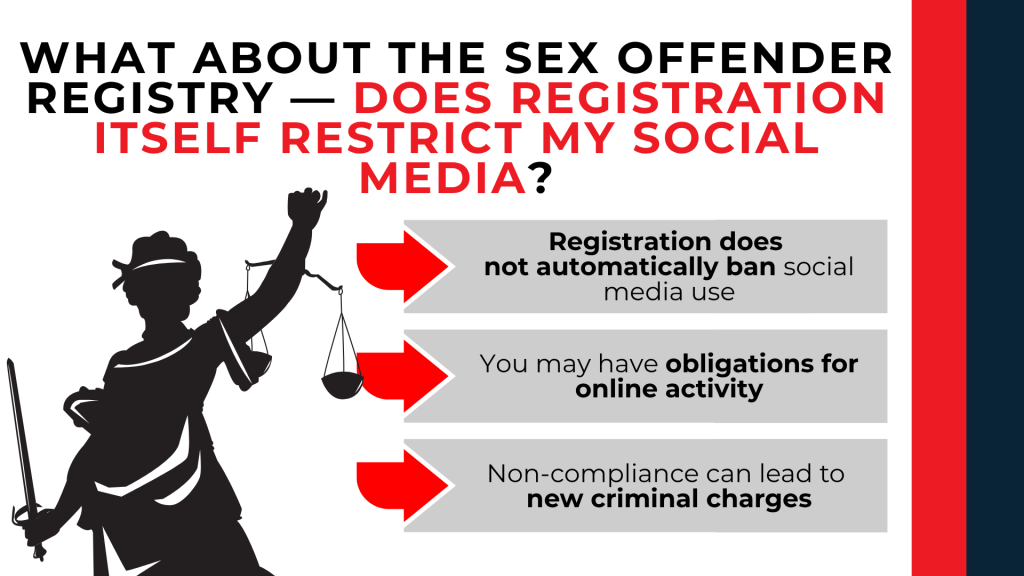
Registration under the North Carolina Sex Offender Registry, under N.C.G.S. § 14-208 et seq., does not automatically ban you from using social media. But the registry carries reporting obligations that directly affect how you use it.
North Carolina’s registration framework requires you to report information about your life to law enforcement on a regular basis. That includes obligations related to online identifiers. The specific requirements for what you must report, how quickly, and to whom are set out in the statutes and in any conditions attached to your individual case. Failing to comply with registration requirements can result in felony charges — a separate criminal risk entirely apart from whatever conditions your sentence imposes.
The standard registration period in North Carolina is 30 years, with lifetime registration required for recidivists, aggravated offenders, and sexually violent predators. If you are not classified in those enhanced categories, you can petition for termination of your registration requirement after 10 years under N.C.G.S. § 14-208.12A. With approximately 25,000 or more registered sex offenders in North Carolina, these requirements affect a large number of people across the state.
The bottom line is that registration does not ban you from social media. But it does carry obligations that connect your online activity to law enforcement oversight. Failing to meet those obligations creates legal risk that exists independently of your sentencing conditions.
Do Facebook, Instagram, and Other Platforms Ban Sex Offenders on Their Own?
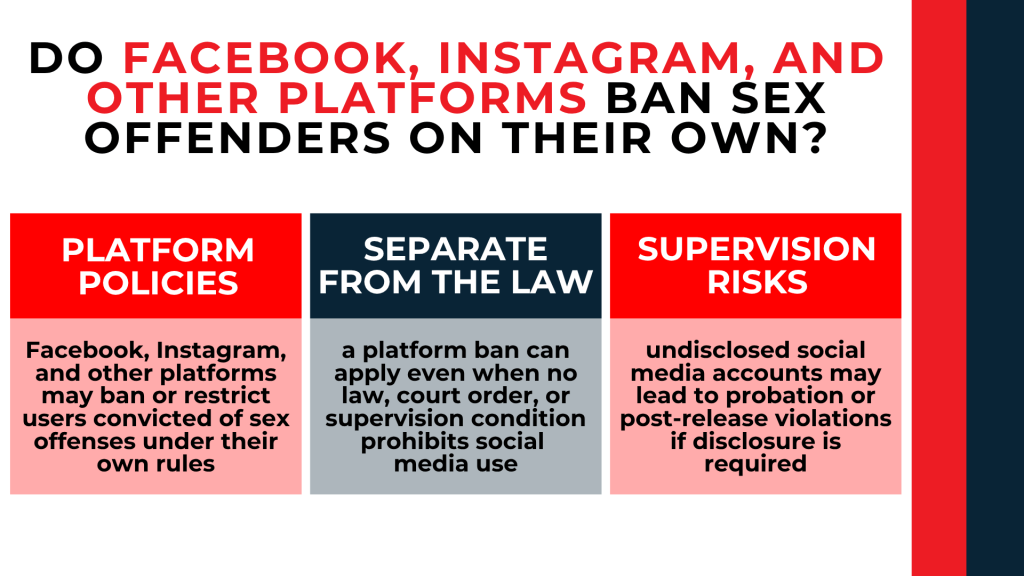
This is something many people overlook entirely. Even if no North Carolina law or court order prevents you from using social media, the platforms themselves may.
Major social media platforms are private companies that set their own terms of service. The First Amendment restricts government action — it does not prevent a private corporation from deciding who can use its product. Several major platforms, including Facebook and Instagram, have policies that may restrict or prohibit use by people convicted of sex offenses. A platform can remove your account under its own rules, and it can do so without the legal protections you would have in court.
Getting banned from a platform is not, by itself, a criminal event. No one goes to prison for violating a company’s terms of service. But if your probation or post-release conditions require you to disclose your online activity to your supervising officer, and you are maintaining accounts you have not disclosed, you may have a supervision violation. That is a criminal problem.
What Happens If I Violate a Social Media Restriction in North Carolina?
The consequences depend on what kind of restriction you violated.
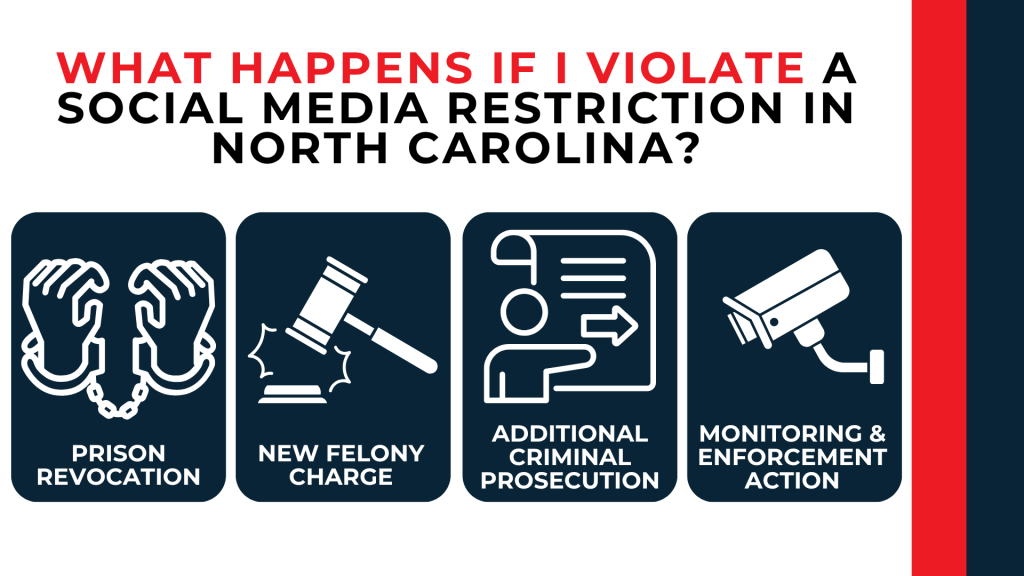
If you violate a court-imposed condition of probation or post-release supervision — for example, by using social media when your conditions prohibit it, or by failing to disclose an account to your probation officer — you face revocation proceedings. Revocation can result in activation of your suspended sentence, which may mean serving the remainder of your term in prison. The stakes of a revocation are severe. For sex offenses in North Carolina, 100% of Class B1 through Class D felony convictions receive mandatory active imprisonment, and average sentences for Class B1 felonies run approximately 236 to 315 months.
If you fail to comply with your registration obligations under N.C.G.S. § 14-208 et seq., you face new felony charges for a registration violation — a separate criminal case on top of whatever your original conviction was.
If you use social media to commit a new crime — contacting a minor, soliciting illegal activity, distributing prohibited material — you face prosecution under the law that applies. Under N.C.G.S. § 14-202.3, solicitation of a child by computer is a Class H felony that elevates to a Class G felony if either party appears at a meeting location. Under the child exploitation statutes in N.C.G.S. § 14-190.16 through § 14-190.17A, offenses involving production, distribution, or possession of child sexual abuse material are classified from Class H felonies up to Class C felonies. The most serious classifications carry mandatory active imprisonment.
North Carolina also actively monitors sex offenders through electronic surveillance. As of fiscal year 2022-2023, 581 sex offenders were enrolled in GPS electronic monitoring, with projections of 596 by the end of fiscal year 2023-2024. Compliance checks, device searches, and GPS data are all tools that supervising officers may use to detect violations — including unauthorized online activity.
Can I Get My Social Media Restrictions Removed or Modified?
In many cases, it may be possible — but not on your own.
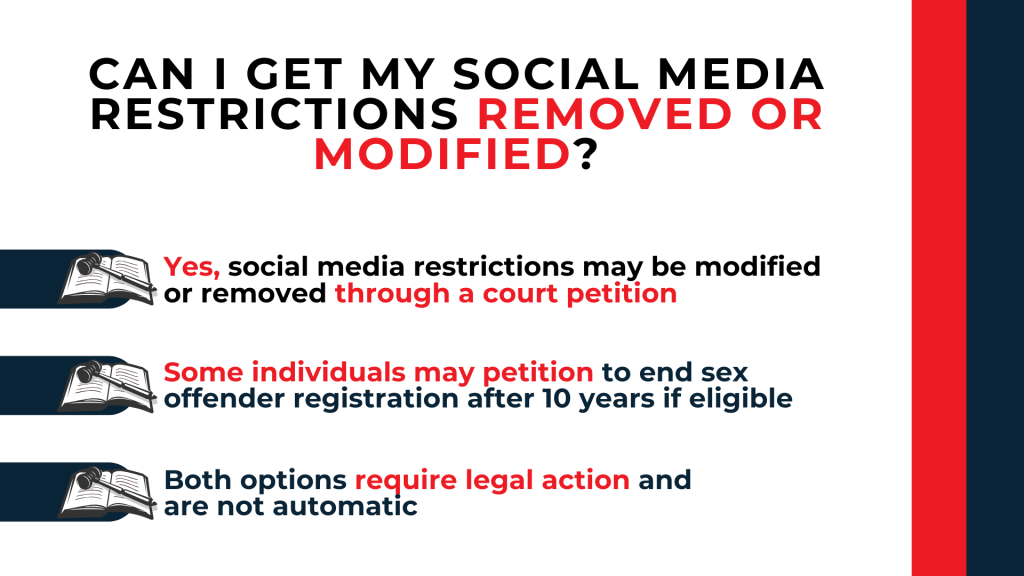
If your social media restriction is a condition of probation or post-release supervision, an attorney can petition the court to modify that condition. The strength of that argument depends on the facts of your case — including whether you have shown steady compliance, completed treatment, and whether the original offense involved internet-based conduct. Courts have discretion in evaluating these requests. A well-prepared petition from an attorney who understands how these conditions are handled in North Carolina courts is much stronger than a request you file on your own.
If your concern is the registry itself, North Carolina law provides a process for termination of your registration requirement. Under N.C.G.S. § 14-208.12A, if you are not classified as a recidivist, sexually violent predator, or aggravated offender, you may petition the superior court in your district after 10 years from the date of initial registration. An attorney can advise you on what termination of the registration requirement means for your specific obligations and circumstances.
Neither of these paths is automatic. Both require legal strategy, documentation, and an understanding of how North Carolina courts evaluate these requests in the context of sex offense cases.
Do I Need a Lawyer To Sort This Out?
The answer to “can sex offenders have social media” is not yes or no. It is: it depends on your conviction, your supervision conditions, your registration status, and which platform you want to use. Getting any one of those variables wrong can result in new criminal charges, revocation of your supervised release, or reincarceration.
Patrick Roberts at Patrick Roberts Law in Raleigh, North Carolina has spent more than 24 years handling criminal defense cases across North Carolina, including sex offense cases at every stage — from initial charges through post-conviction supervision issues. He has co-authored a legal book on defending internet sex crimes and has handled cases involving the exact intersection of technology, registration requirements, and constitutional rights that this question sits at.
Education & Advanced Training
An alumnus of Johns Hopkins University (#7 National University) and Duke University School of Law (#7 National Law School; #9 Criminal Law Program), Mr. Roberts has dedicated his career to honing his trial craft. He is a graduate of the prestigious Gerry Spence’s Trial Lawyers College and the National Criminal Defense College (NCDC) Trial Practice Institute, including the 2025 Cross-Examination Intensive.
Accolades & Peer Review
• Martindale-Hubbell AV Preeminent Rating: 5+ Consecutive Years
• Martindale-Hubbell Client Champion Platinum: 5+ Consecutive Years
• AVVO 10/10 “Superb” Rating: 15+ Consecutive Years
• The National Trial Lawyers: Top 100 Trial Lawyers
Mr. Roberts is a published author of two legal books and a lifetime member of the National Association of Criminal Defense Lawyers.
A Former Prosecutor’s Insight
Mr. Roberts’ defense strategy is informed by his tenure as an Assistant District Attorney in the Wake, Johnston, and New Hanover offices. This experience allows him to anticipate the tactics used by the state in complex sex crime litigation. As a former assistant district attorney in Wake, Johnston, and New Hanover counties, he understands how prosecutors evaluate supervision violations and how judges weigh requests to modify conditions.
Jurisdictional Admissions
Qualified to handle cases at the highest levels, he is admitted to the U.S. Supreme Court, the Fourth Circuit Court of Appeals, and all North Carolina federal districts. He remains the sole North Carolina representative listed by the National Child Abuse Defense & Resource Center as of 2026.
Client Review
“Mr. Roberts did his very best to explain my extenuating circumstances to the Judge and prosecuting attorneys in an effort to obtain the lowest sentence possible under the law, for me. He stood in the line of fire for me and my family that day.” – verified client review via Avvo.com
Peer Endorsement
“I endorse this lawyer. Patrick is a fantastic attorney who is dedicated to his clients’ interests and truly cares for his clients. He has the experience and trial skills necessary to achieve the results his clients need. I recommend anybody in need of a criminal defense attorney use him.” – verified Peer endorsement via Avvo.com
Disclaimer: Testimonials and peer reviews are for informational purposes only and do not guarantee or predict the outcome of your legal matter. Every case is unique and must be evaluated on its own merits. All endorsements featured on this site are actual comments from clients and peers.
If you are unsure whether your current social media use puts you at legal risk, or if you want to pursue modification of a restriction that no longer serves its purpose, that question deserves a specific answer based on your case — not a guess based on a Google search. Contact Patrick Roberts Law to discuss your situation.
The firm maintains a selective intake process to ensure that each client receives the focused professional attention their case requires.
Disclaimer: The information on this website is for general informational purposes only. Nothing herein should be taken as legal advice for any individual case or situation. Contacting us via this website, email, or contact form does not create an attorney-client relationship. Case results depend on a variety of factors unique to each case; prior results do not guarantee a similar outcome.
Former assistant district attorney
Contact Patrick Roberts
Facing criminal charges in North Carolina demands seasoned representation. Trust in the experience and dual perspective of Patrick Roberts. Reach out today for a confidential consultation.
-
Call Our Team
Calls answered 24/7






For more information on the selection criteria, go to www.martindale.com
*Each case is different and must be evaluated separately. Prior results achieved do not guarantee similar results can be achieved in future cases.