
North Carolina law does not use the phrase “sexual assault” as a single criminal charge. Instead, what most people mean when they search this question — non-consensual sexual contact or intercourse — is prosecuted under a set of specific, graduated offenses. These range from a Class A1 misdemeanor to a Class B1 felony. Each is defined by different elements, different levels of force, and different consequences. The distinction between these charges can mean the difference between a misdemeanor conviction and decades in prison.
This article covers what conduct North Carolina criminalizes as sexual assault, how consent works under the law, and what to do if you or someone you know is facing an accusation. It draws on current North Carolina statutes and case law.
What Does North Carolina Law Actually Consider “Sexual Assault”?
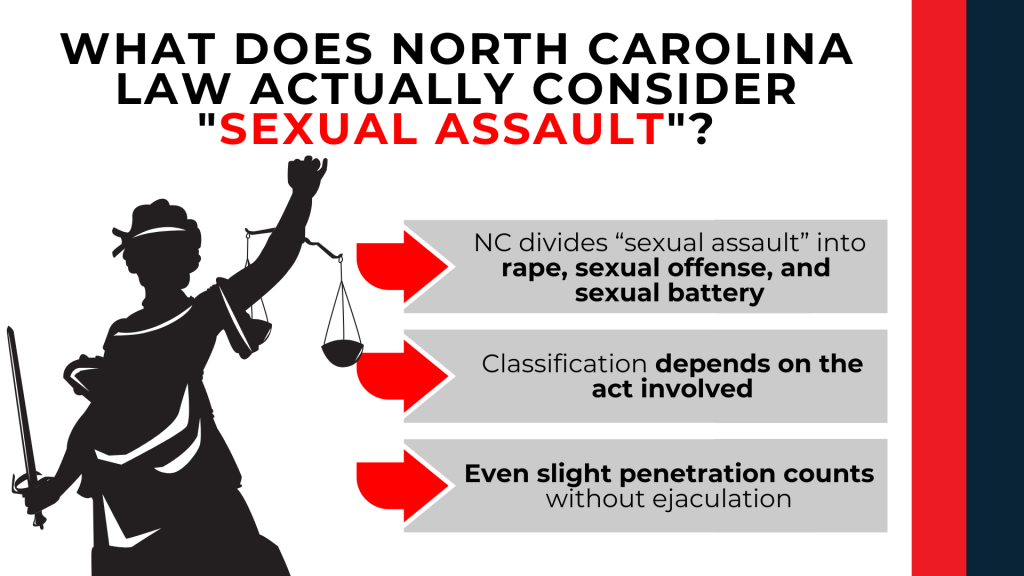
North Carolina’s criminal code splits what the public calls “sexual assault” into three categories of offenses: forcible rape, forcible sexual offense, and sexual battery. Each one is a separate charge with its own statutory elements, and the differences matter enormously.
Forcible rape under N.C.G.S. § 14-27.21 and § 14-27.22 involves vaginal intercourse by force and against the will of the victim. Forcible sexual offense under N.C.G.S. § 14-27.26 and § 14-27.27 covers sexual acts other than vaginal intercourse — committed by the same means. Sexual battery under N.C.G.S. § 14-27.33 covers non-consensual sexual contact carried out for the purpose of sexual arousal, gratification, or abuse.
These are not interchangeable charges. They carry different felony or misdemeanor classifications, different sentencing ranges, and different collateral consequences. Whether a particular act falls under one statute or another depends on the specific conduct alleged, the relationship between the parties, and the circumstances surrounding the encounter.
One important technical point: under N.C.G.S. § 14-27.36, penetration in North Carolina requires only the slightest entry into the vulva or labia. Ejaculation is not required.
What’s the Difference Between Sexual Battery, a Sexual Offense, and Rape?
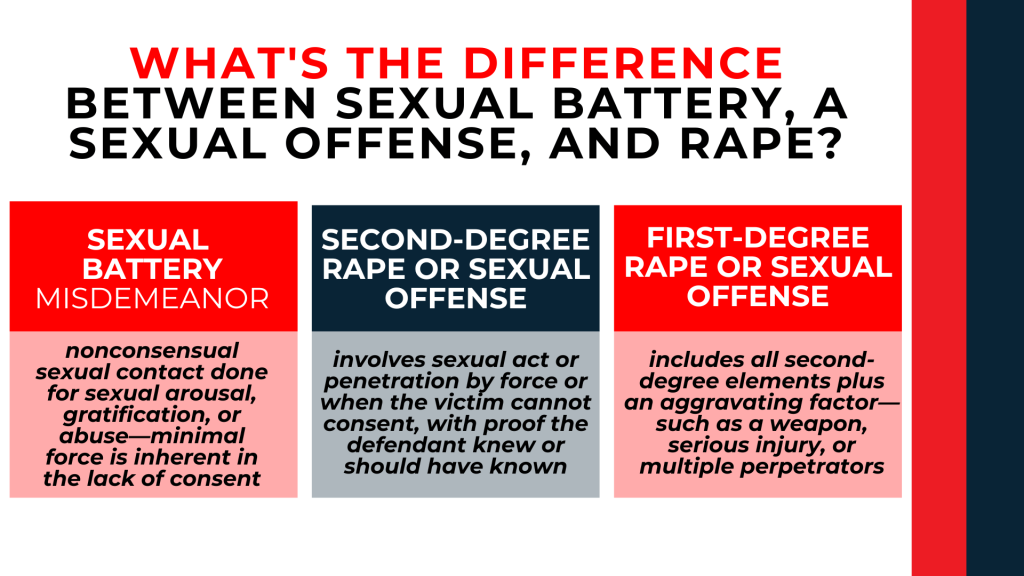
In North Carolina, the distinction between these offenses is determined by the type of contact, the degree of force involved, and the presence of specific aggravating factors.
What is Sexual Battery?
Sexual battery is a Class A1 misdemeanor. Under N.C.G.S. § 14-27.33, the state must prove that the defendant engaged in sexual contact with the victim without consent and that the contact was for the purpose of sexual arousal, gratification, or abuse. The North Carolina Supreme Court held in In re J.U., 384 N.C. 618 (2023) that nonconsensual sexual contact by its nature involves some degree of force.
What are Second-Degree Forcible Rape and Sexual Offense?
Second-degree forcible rape (N.C.G.S. § 14-27.22) and second-degree forcible sexual offense (N.C.G.S. § 14-27.27) are Class C felonies. These charges require proof that the act was committed either:
- By force and against the victim’s will, or
- Against a victim who was incapable of consenting due to mental incapacity, physical helplessness, or intoxication.
For incapacity-based charges, the state must also prove the defendant knew or reasonably should have known of the victim’s condition.
What are First-Degree Forcible Rape and Sexual Offense?
First-degree forcible rape (N.C.G.S. § 14-27.21) and first-degree forcible sexual offense (N.C.G.S. § 14-27.26) are Class B1 felonies. These require the same elements as second-degree charges, plus an additional aggravating factor, such as:
- The use or display of a dangerous weapon.
- The infliction of serious personal injury.
- Acting with the aid of one or more other persons.
How is “Force” Defined in These Crimes?
North Carolina courts analyze force through two approaches: actual physical force overcoming resistance, or constructive force through fear, coercion, or threats forcing submission.
The North Carolina Supreme Court recognized in State v. Etheridge, 319 N.C. 34 (1987) that constructive force can exist in relationships involving a significant power imbalance. However, the state must prove both force and lack of consent as separate elements for forcible offenses; a nonconsensual act alone is insufficient, as confirmed by the Court of Appeals in State v. Henderson, 233 N.C. App. 538 (2014).
| Charge | Statute | Class | Key Difference |
| Sexual Battery | § 14-27.33 | Class A1 Misdemeanor | Sexual contact without consent. |
| 2nd Degree Rape/Sex Offense | § 14-27.22 / .27 | Class C Felony | Use of force or victim incapacity. |
| 1st Degree Rape/Sex Offense | § 14-27.21 / .26 | Class B1 Felony | Use of weapon, serious injury, or multiple participants. |
How Does North Carolina Define Consent — and When Does the Law Say Someone Can’t Consent?
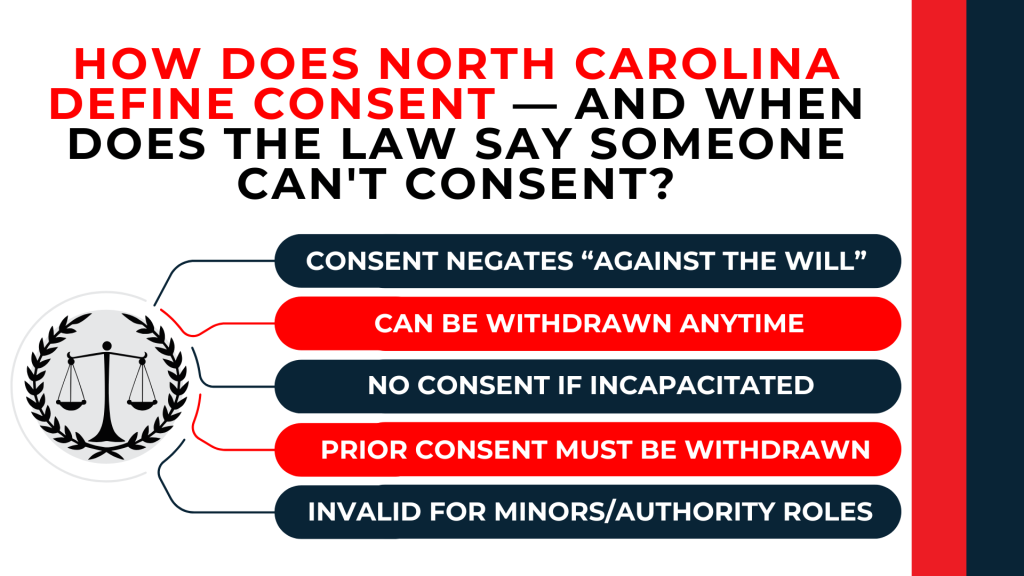
Consent is the central issue in most sexual assault cases, and North Carolina law treats it with more nuance than many expect. Consent removes the “against the will” element for forcible sex offenses, and the state bears the burden of proving a lack of consent beyond a reasonable doubt. Notably, physical resistance is not required to prove a lack of consent.
How Did the 2019 SAFE Child Act Change Consent Laws?
In 2019, North Carolina significantly updated its consent laws through the SAFE Child Act (Session Law 2019-245). Two specific changes are critical for understanding modern sexual assault definitions:
Can Consent Be Withdrawn Mid-Act?
Yes. Under the amended N.C.G.S. § 14-27.20(1a), “against the will” includes situations where consent was initially given but then withdrawn in a manner that would cause a reasonable person to believe consent had been revoked. This replaced the prior rule from State v. Way (1979), which held that consent could not be withdrawn once an act began. For offenses occurring before December 1, 2019, the old standard may still apply.
Does Voluntary Intoxication Impact Consent?
Yes. Under the amended N.C.G.S. § 14-27.20(2), a person is considered “mentally incapacitated” if they are rendered substantially incapable of appraising the nature of their conduct or of resisting the act. Previously, State v. Haddock (2008) held that voluntary intoxication was insufficient to establish incapacity, but that is no longer the law.
What Other Categories of Incapacity Exist?
North Carolina recognizes additional categories where consent is legally impossible:
- Physically Helpless: Under N.C.G.S. § 14-27.20(3), a person who is unconscious, asleep, or otherwise physically unable to communicate unwillingness cannot consent. In State v. Moorman, 320 N.C. 387 (1987), the North Carolina Supreme Court held that both force and lack of consent are implied by law when a victim is incapacitated or sleeping.
How Do Courts Handle Consent in Prior Relationships?
Where a prior consensual relationship exists, courts require particularly clear evidence of a lack of consent. In State v. Alston, 310 N.C. 399 (1984), the Supreme Court held that the state must show statements or actions by the victim that expressly and unequivocally indicated a withdrawal of consent for the specific act in question. The Court also determined that general fear stemming from a prior relationship is insufficient to establish the “force” element; force must be specific to the charged act.
When is Consent Never a Defense?
There are several scenarios where the law dictates that consent is legally irrelevant:
- Statutory Age: Consent is not a defense when the victim is under the statutory age of consent.
- Position of Authority: It is not a defense when the defendant is a substitute parent or custodian (N.C.G.S. § 14-27.31(c)) or school personnel where the victim is a student (N.C.G.S. § 14-27.32(d)).
- Marital Status: Marriage is explicitly not a defense to any sexual offense under N.C.G.S. § 14-27.34.
What Should You Do If You’ve Been Accused of Sexual Assault?
If you are facing a sexual assault accusation in North Carolina, it is very important to speak with an experienced criminal defense attorney before you speak with anyone else — especially law enforcement.
These cases are investigated aggressively. North Carolina is a one-party consent state for recordings under N.C.G.S. § 15A-287. That means pretext phone calls — where an accuser or witness records a conversation with you at law enforcement’s direction — are lawful. What you say during those conversations can become evidence in your case. Anything you say to investigators before consulting with a lawyer can shape the direction of your case.
As the sections above make clear, whether specific conduct qualifies as sexual assault under North Carolina law turns on the interaction between several factors. These include the type of contact alleged, how the state defines and proves force, and evolving consent standards that have changed as recently as 2019. These are fact-intensive distinctions that require experienced legal analysis.
Get an Experienced Raleigh Criminal Defense Attorney
Attorney Patrick Roberts has defended clients against sexual assault and sex offense allegations across North Carolina for over two decades. A former Assistant District Attorney in Wake, Johnston, and New Hanover counties, he understands how prosecutors build these cases because he once built them himself. That dual perspective — knowing what the state looks for and where its cases are vulnerable — shapes how he prepares every defense.
Mr. Roberts is a graduate of Duke University School of Law (Top 9 best criminal law program) and Johns Hopkins University (Top 7 rank in National Universities). He has completed rigorous trial advocacy programs, including Gerry Spence’s Trial Lawyers College, the National Criminal Defense College Trial Practice Institute, and the 2025 NCDC Cross-Examination Intensive. He has tried hundreds of bench and jury trials in both state and federal courts since 2007. He is admitted to practice before the U.S. Supreme Court, the Fourth Circuit Court of Appeals, and all federal district courts in North Carolina, and is a lifetime member of the National Association of Criminal Defense Lawyers. He is the only North Carolina attorney listed on the National Child Abuse Defense & Resource Center as of 2026.
Mr. Roberts served as a Commissioner of the North Carolina State Ethics Commission and as a member of the North Carolina Juvenile Justice Planning Committee. He is the co-author of two legal books and has been frequently quoted by national media outlets, including USA Today and Fox News.
His professional recognition includes an AV Preeminent peer rating from Martindale-Hubbell (held for over five consecutive years), Client Champion Platinum designation from Martindale-Hubbell (over five consecutive years), and a 10/10 “Superb” AVVO rating maintained for more than 15 years. He has been featured in Super Lawyers Magazine and on the cover of Attorney at Law Magazine.
Case Review
In 2025, Attorney Roberts’ client faced allegations of sexual assault involving a teenage stepdaughter. Under North Carolina’s strict sentencing guidelines for offenses involving minors, a conviction would have triggered a mandatory minimum of 144 months (12 years) in prison and lifetime registration on the North Carolina Sex Offender Registry.
Strategic Execution: Pre-Charge Intervention
The client acted early, securing the services of Attorney Patrick Roberts at the onset of the investigation. This allowed the defense to engage during the critical “pre-charge” window, managing the parallel pressures of a criminal inquiry and a NCDHHS Child Protective Services (CPS) assessment.
- Administrative Advocacy: By intervening before a formal indictment, the defense maintained oversight of the CPS investigation, ensuring the client’s constitutional rights were protected during sensitive agency inquiries.
- Evidentiary Deconstruction: Utilizing his background as a former Assistant District Attorney, Patrick Roberts performed a technical audit of the claims. He identified significant inconsistencies and a lack of corroborating evidence, which were presented to investigators to challenge the “substantiation” of the allegations.
- Procedural Resolution: The defense demonstrated that the State’s evidence did not meet the rigorous burden of proof required for a criminal prosecution. This proactive disclosure of evidentiary gaps influenced the State’s decision-making process before charges were ever filed.
The Outcome*: Case Closed Without Prosecution*
As a result of this comprehensive defense presentation, CPS declined to substantiate the allegations. The State subsequently closed the file without bringing formal criminal charges. The client avoided the life-altering consequences of a felony trial and maintained a clean criminal record.
Result: No Charges Filed.*
*Disclaimer: Each case is different and must be evaluated separately. Prior results achieved do not guarantee similar results can be achieved in future cases.
Client Review
“Our teenage son was recently accused of sexual assault in a dorm on a college campus. We believed in his innocence, did our research and hired A. Patrick Roberts and we were not disappointed. We knew from the consultation that we were in good hands. Mr. Roberts wasted no time obtaining the report and jumping into action. I will never forget the joy I felt in my heart when I received the call informing me that there would be no charges made against our son. His practice is very efficient and receptive in every way. He is the REAL DEAL!” — Verified client review on Avvo.com
Peer Endorsement
“I have known Patrick Roberts my entire legal career. He is a great representation of how a lawyer should be an advocate for justice and truth. He has great relationships with attorneys and judges alike across countless cities and counties.” — Martindale-Hubbell verified Peer Endorsement
Disclaimer: The testimonials are actual comments. Every case is different and depends on its own unique facts and legal circumstances. These results are illustrative of the matters the firm handles but do not guarantee, warrant, or predict a similar outcome in your legal matter.
Talk to a North Carolina Sexual Assault Defense Attorney Today
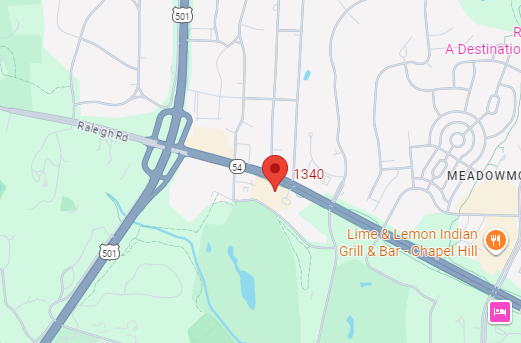
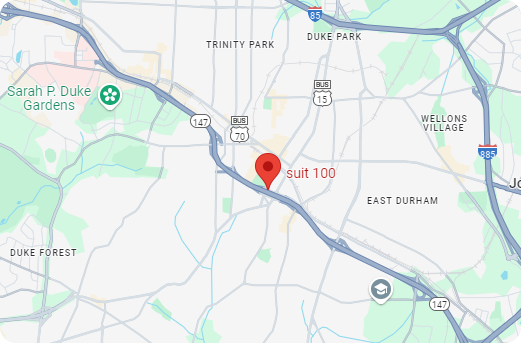
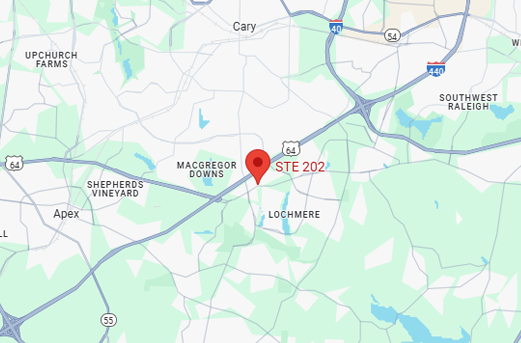
If you are facing an accusation or investigation related to sexual assault in North Carolina, Patrick Roberts Law is available for a confidential consultation. With offices in Raleigh, Durham, Chapel Hill, and Cary, the firm represents clients in state and federal courts throughout North Carolina.
Contact Patrick Roberts Law at https://www.patrickroberts.law/ or call the firm directly to discuss your situation.
To maintain the focus necessary for complex criminal matters, the law firm is currently accepting a restricted number of new cases.
Disclaimer: The information on this website is for general informational purposes only and does not constitute legal advice for any individual case or situation. Contacting us via this website, email, or contact form does not create an attorney-client relationship. Each case is different and must be evaluated separately; prior results do not guarantee a similar outcome.
Former assistant district attorney
Contact Patrick Roberts
Facing criminal charges in North Carolina demands seasoned representation. Trust in the experience and dual perspective of Patrick Roberts. Reach out today for a confidential consultation.
-
Call Our Team
Calls answered 24/7






For more information on the selection criteria, go to www.martindale.com
*Each case is different and must be evaluated separately. Prior results achieved do not guarantee similar results can be achieved in future cases.