

Getting a phone call from a loved one who has been arrested is one of the most stressful experiences a family can face. The immediate priority becomes getting them released as quickly as possible, but the bail process can feel confusing and overwhelming—especially if you have never navigated it before. Understanding how pretrial release works in North Carolina helps families make informed decisions and take the right steps to bring their loved one home.
North Carolina law establishes a framework for pretrial release that balances the defendant’s right to freedom before trial against the need to ensure they appear in court and do not pose a danger to the community. The type of release ordered by a judicial official determines what steps you must take to secure someone’s release. Some defendants are released on a simple written promise, while others must post significant financial security before they can leave custody. Recent legislative changes, particularly Iryna’s Law effective December 1, 2025, have added new requirements for defendants charged with violent offenses that make understanding the current legal landscape even more important.
How Does the Bail Process Work in North Carolina?
Before you can take steps to get someone released, it helps to understand how the process unfolds from arrest through the setting of release conditions.
What Happens After Someone Is Arrested?
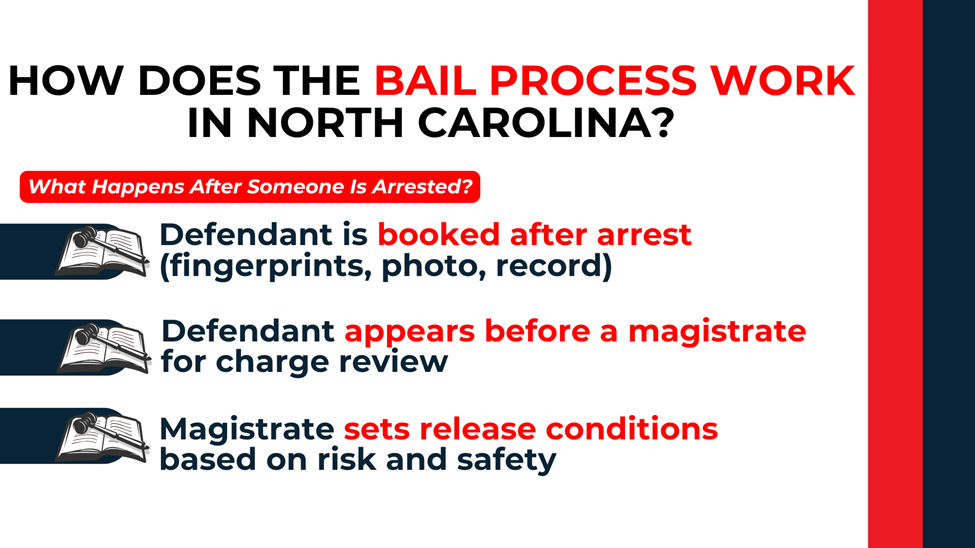
After an arrest, the defendant is taken to a local detention facility for booking. This process includes fingerprinting, photographing, and creating an official record of the arrest. Following booking, the defendant appears before a judicial official—typically a magistrate—who reviews the charges and determines conditions for pretrial release.
The judicial official considers information about the charges, the defendant’s background, and factors related to flight risk and community safety before deciding what conditions, if any, will allow the defendant to be released while the case is pending.
Who Decides the Conditions of Release?
Under N.C. Gen. Stat. § 15A-532, judicial officials have authority to determine conditions for release. In most cases, a magistrate sets initial release conditions shortly after booking. However, certain situations require a judge rather than a magistrate to make this determination.
For example, when a defendant is arrested for a new offense while already on pretrial release for another pending case, a judge must set the conditions for the new charge. Similarly, for certain domestic violence offenses, only a judge can determine release conditions during the first 48 hours after arrest. Under Iryna’s Law, defendants charged with violent offenses face additional requirements that may involve judicial review.
How Long Does the Process Take?
The timeline for setting release conditions and processing release varies based on the circumstances of the arrest, the charges involved, and the procedures of the specific detention facility. Procedures differ by county, so families should contact the detention facility directly to understand what to expect and how to proceed once conditions are set.
What Types of Release Conditions Can a Judge Set?
North Carolina law provides judicial officials with several options for pretrial release, ranging from release without any financial obligation to secured bonds requiring significant collateral.
What Is a Written Promise to Appear?
The least restrictive form of release is a written promise to appear. Under this condition, the defendant simply signs a document promising to attend all required court dates. No money or property is required. This option is typically available only for lower-level offenses where the defendant presents minimal flight risk and no danger to the community.
What Is the Difference Between a Secured and Unsecured Bond?
An unsecured bond sets a dollar amount that the defendant promises to pay if they fail to appear, but no money or property must be provided upfront for release. The defendant signs an agreement and is released, but becomes liable for the full amount if they miss court.
A secured bond requires actual financial backing before release. The defendant or someone acting on their behalf must provide cash, property, or a surety (such as a bail bondsman) to guarantee the bond amount. The defendant cannot be released until this security is in place.
What Is House Arrest with Electronic Monitoring?
North Carolina law allows house arrest with electronic monitoring as a condition of pretrial release. Under N.C. Gen. Stat. § 15A-531, this requires the defendant to remain at their residence except when authorized to leave for employment, counseling, education, or vocational training. The defendant wears a monitoring device that tracks compliance. When house arrest is imposed, the defendant must also execute a secured appearance bond.
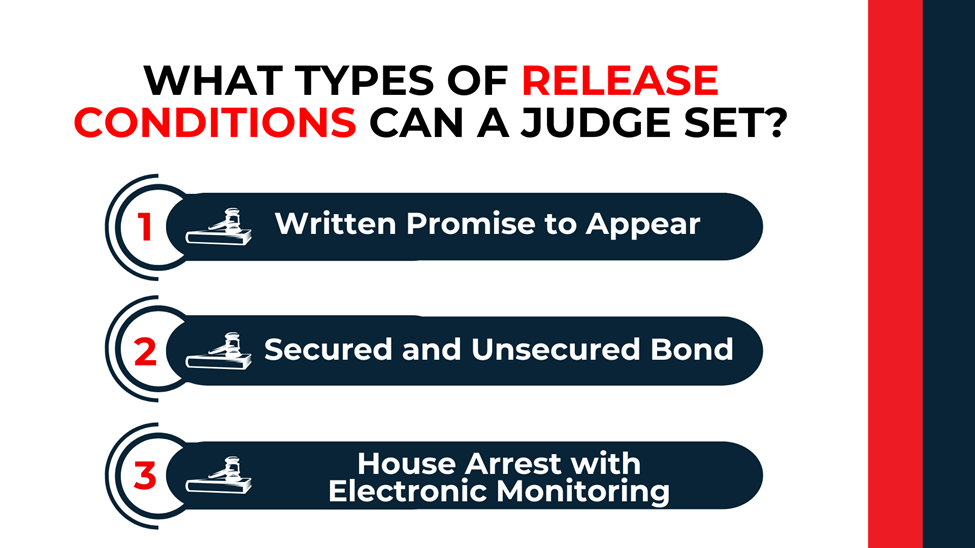
Under N.C. Gen. Stat. § 15A-534(a), judicial officials may impose one or more of the following conditions for pretrial release:
- Release on the defendant’s written promise to appear
- Release upon execution of an unsecured appearance bond in an amount specified by the judicial official
- Placement of the defendant in the custody of a designated person or organization agreeing to supervise them
- Requirement of an appearance bond secured by a cash deposit of the full amount, by a mortgage on real property, or by at least one solvent surety
- House arrest with electronic monitoring, which must be combined with a secured appearance bond
What Are the Different Ways to Post a Secured Bond?
When a judicial official requires a secured bond, you have several options for providing the required security. The right choice depends on your financial situation and the bond amount.
Can You Pay the Full Amount in Cash?
Yes. If you have access to sufficient funds, you can post the full bond amount in cash directly. This is sometimes called a “cash bond.” The procedures for posting a cash bond vary by county—contact the detention facility or clerk’s office to learn where payments are accepted and what forms of payment the specific facility allows.
If the defendant appears at all required court dates and no forfeiture is ordered, the cash is returned after the case concludes. The clerk’s office processes refunds and mails a check to the person who posted the bond. Court costs and fees may be deducted from the refund.
Can You Use Property to Secure a Bond?
Under N.C. Gen. Stat. § 58-74-5, a defendant may execute a mortgage on real or personal property to secure a bond. The mortgage is payable to the State of North Carolina and includes a power of sale that allows the clerk to sell the property if the defendant breaches the conditions of release.
Using property to secure a bond requires recording a deed of trust with the Register of Deeds in the county where the property is located. This process typically requires the assistance of an attorney to prepare the necessary documents. The clerk’s office must approve property bonds, and specific requirements vary by judicial district. Contact the clerk’s office in the county where the defendant is held to learn about local requirements for property bonds.
How Does Using a Bail Bondsman Work?
Most people who need to post a secured bond work with a bail bondsman. A bail bondsman is licensed by the North Carolina Department of Insurance to post bonds in exchange for compensation. The bondsman acts as surety, guaranteeing the defendant’s appearance and taking responsibility for the full bond amount if the defendant fails to appear.
When you contact a bail bondsman, you provide information about the defendant, including their name, date of birth, the charges, and the bond amount. The bondsman charges a premium—a fee for their service—and may require collateral depending on the bond amount and risk factors. Once the premium is paid and any required paperwork is completed, the bondsman posts the bond with the court, and the defendant can be released.
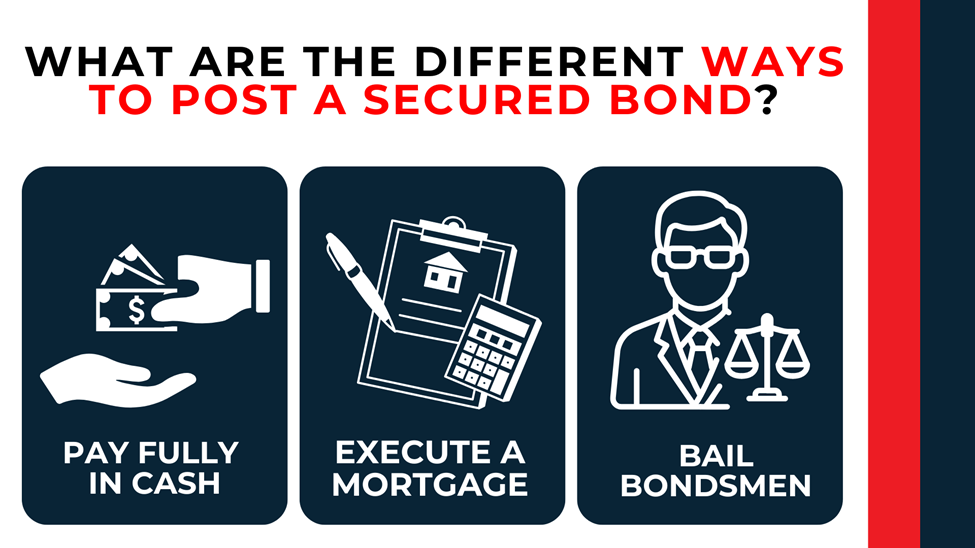
There are three primary ways to satisfy a secured bond requirement in North Carolina:
- Pay the full bond amount in cash directly to the court, which is refundable if the defendant appears at all court dates
- Provide a mortgage or deed of trust on real property with sufficient equity to cover the bond amount
Work with a licensed bail bondsman who posts the bond in exchange for a non-refundable premium
What Should You Know About Working with a Bail Bondsman?
If you decide to work with a bail bondsman, understanding the financial obligations and legal requirements helps you avoid surprises and protect your interests.
How Much Does a Bail Bondsman Charge?
Under N.C. Gen. Stat. § 58-71-95, a bail bondsman cannot charge a premium exceeding fifteen percent of the face amount of the bond. For example, on a $10,000 bond, the maximum premium would be $1,500. This premium is the bondsman’s fee for providing the service and is not refundable, regardless of the outcome of the case.
The bondsman may also require collateral—property or other assets pledged as additional security. Collateral requirements must be reasonable in relation to the bond amount.
What Happens to Collateral After the Case Ends?
North Carolina law protects people who provide collateral to bail bondsmen. Under N.C. Gen. Stat. § 58-71-95, collateral must be returned within 15 days after final termination of liability on the bond. The collateral must be returned in the same condition as when it was received.
Knowing and willfully failing to return collateral valued at more than $1,500 is a Class I felony under North Carolina law. If a bondsman fails to return your collateral after the case concludes, you have legal recourse.
How Do You Find a Licensed Bail Bondsman?
All bail bondsmen in North Carolina must be licensed by the Department of Insurance. The North Carolina Judicial Branch maintains a list of bondsmen authorized to write bonds in each county, available at nccourts.gov. A bondsman authorized in one county may not be authorized in another, so verify that any bondsman you contact is approved to write bonds in the county where the defendant is held.
When working with a bail bondsman, keep these key points in mind:
- The premium (up to 15% of the bond amount) is non-refundable and is the bondsman’s fee for service
- Collateral must be returned within 15 days after the bond obligation terminates
- All bondsmen must be licensed by the NC Department of Insurance
- A bondsman’s authorization to write bonds may be limited to specific counties
- You can verify a bondsman’s license status through the NC Department of Insurance or the NC Judicial Branch website

How Has Iryna’s Law Changed the Bail Process for Violent Offenses?
Session Law 2025-93, known as Iryna’s Law, took effect December 1, 2025, and significantly changed pretrial release procedures for defendants charged with violent offenses. Families trying to bail someone out on violent charges need to understand these new requirements.
What Qualifies as a “Violent Offense” Under the New Law?
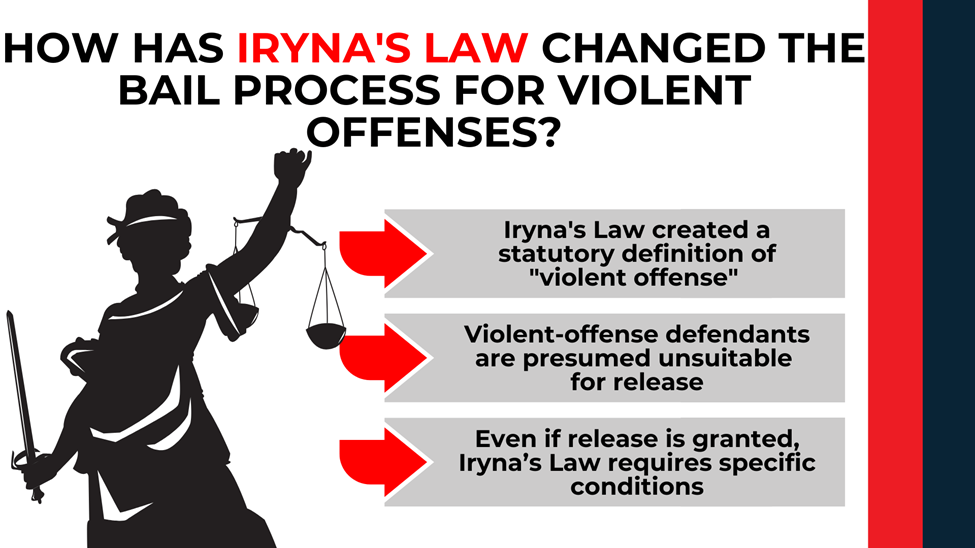
Iryna’s Law created a statutory definition of “violent offense” under N.C. Gen. Stat. § 15A-531(9). This includes Class A through G felonies that involve assault, physical force, or the threat of physical force as an essential element. It also includes felony sex offenses requiring registration, offenses listed in G.S. 15A-533(b) such as murder, rape, kidnapping, and armed robbery, and certain specific offenses including discharging a firearm into occupied property and fentanyl trafficking.
What Does the Rebuttable Presumption Against Release Mean?
For any defendant charged with a violent offense, there is now a rebuttable presumption that no condition of release will reasonably assure the defendant’s appearance and the safety of the community. This means the burden effectively shifts—rather than presuming release is appropriate, the law presumes detention unless the defendant can overcome that presumption.
The law also requires judicial officials to obtain and consider a criminal history report for all defendants when setting bond conditions.
What Release Conditions Apply If the Judge Grants Release?
Even when a judicial official determines that release is appropriate for a defendant charged with a violent offense, Iryna’s Law mandates specific conditions. For a first violent offense, the judicial official must impose a secured appearance bond or house arrest with electronic monitoring—less restrictive options like written promises or unsecured bonds are not available.
For defendants charged with a second or subsequent violent offense—either after a prior conviction or while on pretrial release for a prior violent offense—house arrest with electronic monitoring is required if available. This makes securing release significantly more difficult and more restrictive for repeat violent offense charges.
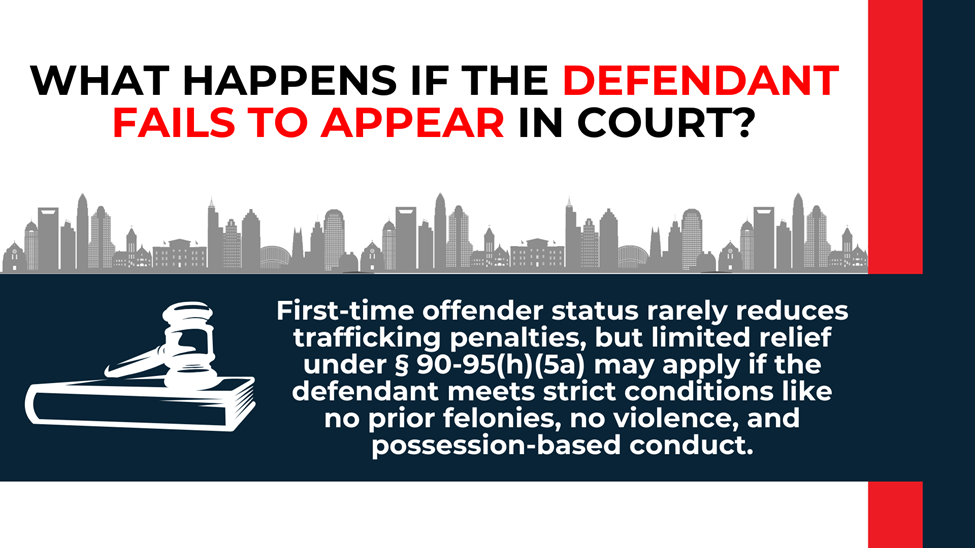
What Happens If the Defendant Fails to Appear in Court?
Understanding the consequences of failing to appear helps families appreciate the seriousness of the defendant’s obligations after release and the potential financial exposure for anyone who posted bond.
How Is a Bond Forfeiture Entered?
Under N.C. Gen. Stat. § 15A-544.3, when a defendant released on bail fails to appear as required, the court enters a forfeiture for the amount of the bail bond against both the defendant and each surety on the bond. The court sends notice of the forfeiture to the defendant and each surety at their address of record.
If a cash bond was posted, the State keeps the cash to satisfy the forfeiture. If property was used as security, the State may foreclose on the property. If a bail bondsman posted the bond, the bondsman becomes liable for the full amount and may pursue the defendant or any indemnitors (co-signers) for reimbursement.
Can a Forfeiture Be Set Aside?
North Carolina law provides specific grounds for setting aside a forfeiture before it becomes a final judgment. Under N.C. Gen. Stat. § 15A-544.5, a forfeiture may be set aside if the defendant’s failure to appear has been stricken and any arrest order recalled, if all charges have been finally disposed, if the defendant has been surrendered by a surety, if the defendant has been served with an order for arrest, if the defendant died, or if the defendant was incarcerated in certain facilities at the time of the failure to appear.
A motion to set aside must generally be filed within 150 days after notice of forfeiture is given. If no motion is filed and the forfeiture is not set aside, it becomes a final judgment that can be enforced like any civil judgment, including through liens on real property and execution against assets.
Why Does Having an Attorney Help with the Bail Process?
While families can navigate much of the bail process on their own, having an attorney involved can make a significant difference in the conditions imposed and the speed of release.
Can an Attorney Request Lower Bond or Different Conditions?
Yes. Under N.C. Gen. Stat. § 15A-534(e) and (f), bond conditions can be modified at various stages of the proceedings. A magistrate or clerk may modify orders before the first appearance before a district court judge. After that, judges may modify conditions at appropriate stages of the case. An attorney can file motions requesting bond reduction or modification of conditions.
How Does Legal Representation Affect Bond Hearings?
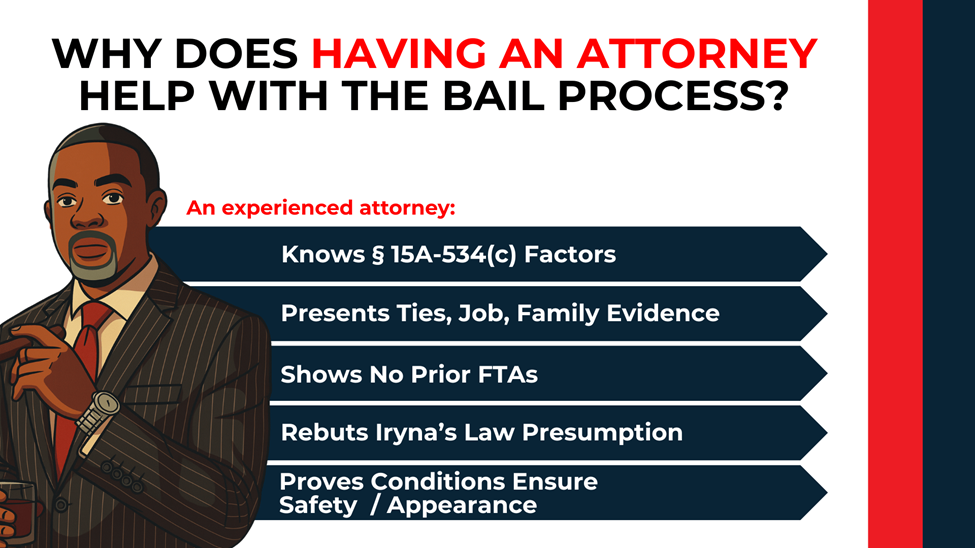
An attorney understands the specific factors judicial officials must consider under N.C. Gen. Stat. § 15A-534(c) and can present evidence addressing those factors—community ties, employment, family obligations, lack of prior failures to appear, and other considerations that support release or less restrictive conditions.
Under Iryna’s Law, rebutting the presumption against release for violent offenses requires presenting persuasive evidence that release conditions can reasonably assure appearance and community safety. An attorney experienced in bond hearings knows what evidence to gather and how to present arguments that address the court’s concerns.
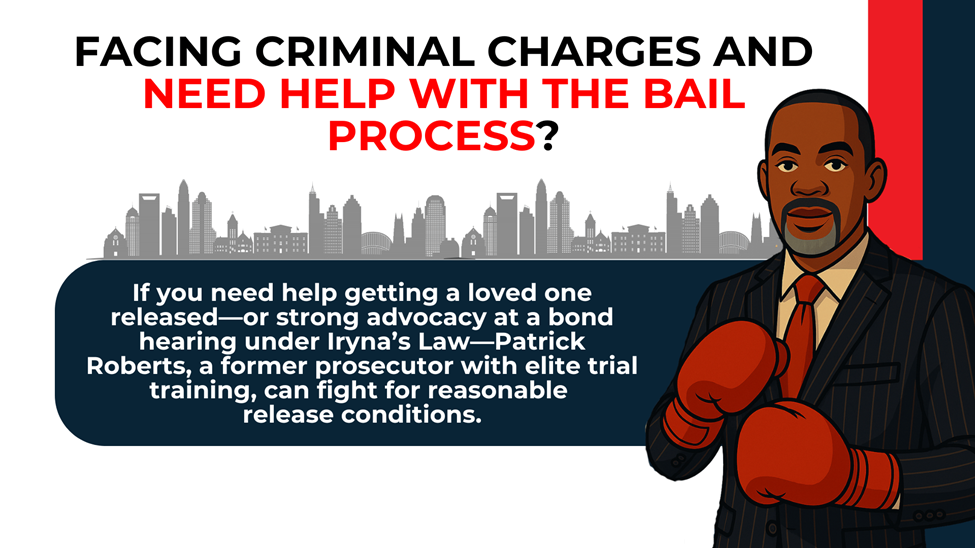
Facing Criminal Charges and Need Help with the Bail Process?
Getting someone released from jail is often just the first step in a criminal case. However, in 2026, the stakes have never been higher. Under Iryna’s Law (N.C. Gen. Stat. § 15A-534), North Carolina has shifted toward a “rebuttable presumption” against release for certain offenses. This means the court may lean toward detention unless an attorney can effectively present evidence to the contrary.
The Roberts Advantage: From Prosecutor to Defense
Attorney Patrick Roberts spent years as a prosecutor in three different North Carolina counties. This background provides a distinct advantage: he doesn’t just guess what the State will say; he knows exactly how they evaluate flight risk and community danger.
Attorney Patrick Roberts uses his training and strong legal standing to combat new challenges to your freedom. He is a respected voice in the courtroom who knows that a powerful defense starts with being effective and strategic from day one.
Admitted to Practice Before the U.S. Supreme Court: This prestigious credential signifies a level of legal standing recognized at the highest possible level of the American judiciary.
Admitted to practice in all federal district courts in NC and the Fourth Circuit: If a case moves from a state investigation into a federal indictment (which often happens in drug or white-collar cases), he doesn’t have to hand the case off to another lawyer. He can stay with the client from the local magistrate’s office all the way to a federal appeal.
Former N.C. State Ethics Commissioner: Appointed by the Governor to oversee the integrity of state officials, this role underscores Patrick’s deep commitment to ethical standards and his high standing within the North Carolina legal community.
2025 NCDC Cross-Examination Mastery: Recently sharpened his skills at the National Criminal Defense College, mastering the techniques needed to dismantle the State’s arguments for high bond or detention.
Gerry Spence Trial Lawyers College Graduate: Trained directly by legendary advocate Gerry Spence, focusing on humanizing defendants and persuasive storytelling.
Elite Peer & Client Recognition: Rated 10/10 “Superb” by AVVO for over 15 years and recognized as an AV Preeminent® Peer Rated Attorney (2026) by Martindale-Hubbell—the highest rating given by fellow lawyers for legal ability and ethics.
What Peers Say About Patrick Roberts:
“I have known him as both an Assistant District-Attorney and a private attorney. He’s one of the best I know—a great litigator and an awesome attorney.” – Fellow Attorney via Martindale-Hubbell, Oct 22, 2018
“Mr. Roberts demonstrates a high level of expertise, competence and professionalism. He is well prepared for trial and represents all clients well. Mr. Roberts is dependable and he represents the legal profession well. I am confident in his ability to represent his clients.” – Peer review via Martindale-Hubbell, Oct. 30. 2018
Frequently Asked Questions
How much does it cost to bail someone out of jail in North Carolina?
The cost depends on the type of bond set by the judicial official. If an unsecured bond or written promise to appear is ordered, no upfront payment is required. For a secured bond, you can pay the full amount in cash (which is refundable if the defendant appears at all court dates) or work with a bail bondsman who charges a non-refundable premium of up to 15% of the bond amount.
Do you get bail money back in North Carolina?
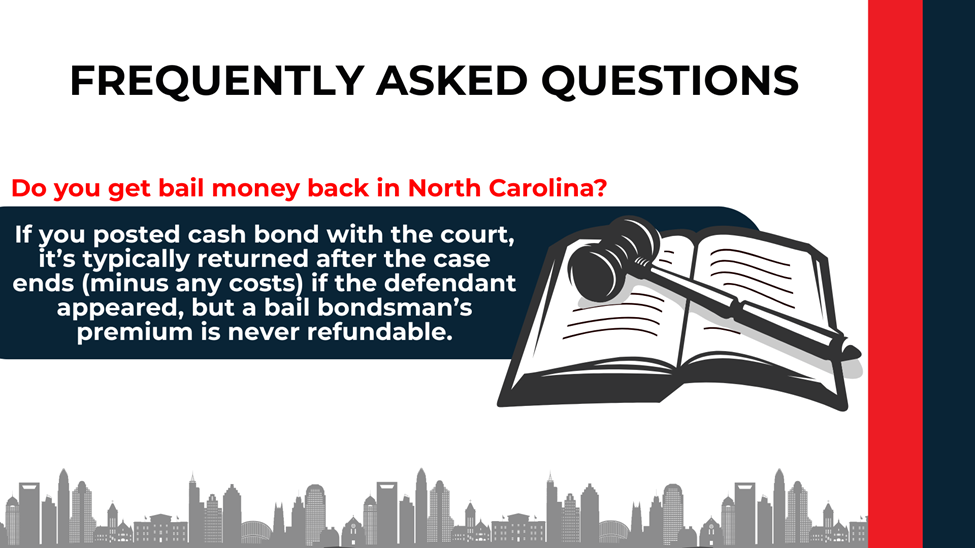
If you posted a cash bond directly with the court, the money is returned after the case concludes, provided the defendant appeared at all required court dates and no forfeiture was ordered. Court costs and fees may be deducted. If you paid a premium to a bail bondsman, that fee is not refundable—it is the bondsman’s compensation for posting the bond.
Can bail be denied in North Carolina?
Yes, in certain circumstances. Capital offenses are within the judge’s discretion to deny bail entirely. Under Iryna’s Law, defendants charged with violent offenses face a rebuttable presumption against release, meaning the judge may deny release if the presumption is not overcome. Defendants charged with offenses listed in G.S. 15A-533(b), such as murder, rape, and kidnapping, also face discretionary denial of release.
Can bond conditions be changed after they are set?
Yes. Bond conditions can be modified at various stages of the case. An attorney can file a motion requesting reduction of the bond amount or modification of other conditions. However, the judge also has authority to increase the bond, so filing a motion carries some risk if the circumstances do not clearly support a reduction.
What is the difference between bail and bond?
“Bail” refers to the amount of money or security that a defendant risks forfeiting if they fail to appear in court. “Bond” is the instrument or undertaking that secures the defendant’s promise to appear. When a judge “sets bail,” they establish both the dollar amount at stake and the type of bond required. In everyday conversation, these terms are often used interchangeably.
Disclaimer: The information on this website is for general purposes only and does not constitute legal advice or an attorney-client relationship. Every case is unique and past results do not guarantee future outcomes
Former assistant district attorney
Contact Patrick Roberts
Facing criminal charges in North Carolina demands seasoned representation. Trust in the experience and dual perspective of Patrick Roberts. Reach out today for a confidential consultation.
-
Call Our Team
Calls answered 24/7









For more information on the selection criteria, go to www.martindale.com
*Each case is different and must be evaluated separately. Prior results achieved do not guarantee similar results can be achieved in future cases.