

If you or someone in your family is facing a first offense sex crime charge in North Carolina, you may assume that having no prior criminal record will provide meaningful protection. In some areas of criminal law, that assumption holds. In sex crime cases, it largely does not. North Carolina treats sex offenses with a severity that applies regardless of whether the defendant has ever been in trouble before — and the consequences of even a first conviction extend well beyond the sentence itself.
This article explains what a first-time defendant actually faces under North Carolina law and where the legal opportunities for defense exist.
Does Having No Criminal Record Help in a Sex Crime Case?
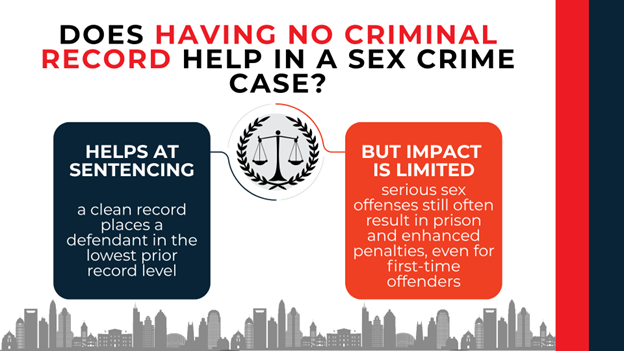
It helps at sentencing — but less than most people expect. North Carolina’s Structured Sentencing Act under N.C.G.S. § 15A-1340.10 et seq. calculates punishment based on two variables: the offense class and the defendant’s prior record level. A defendant with no criminal history starts at Prior Record Level I, which produces the lowest sentencing range within each offense class.
But for serious sex offenses, even the lowest range carries significant consequences. The NC Sentencing Commission reported that 100% of Class B1 through D felony sex offense convictions in FY 2024 received active imprisonment — meaning every defendant in those categories went to prison, regardless of prior record. For person offenses generally, 62% received active imprisonment, 28% intermediate punishment, and only 10% community punishment.
Under N.C.G.S. § 15A-1340.17(f), defendants convicted of Class B1 through E sex offenses face an enhanced maximum sentence. Post-release supervision for sex offenses is also longer than for other felony classes. A first offense does not exempt a defendant from any of these enhanced provisions.
What Sex Crime Charges Can a First-Time Defendant Face?
The charge depends on the alleged conduct, not the defendant’s criminal history. North Carolina’s sex offense statutes apply identically to first-time and repeat offenders.
Forcible offenses. First-degree forcible rape under N.C.G.S. § 14-27.21 is a Class B1 felony. Second-degree forcible rape under N.C.G.S. § 14-27.22 is a Class C felony. The State must prove force and lack of consent as separate elements. In State v. Alston, 310 N.C. 399, 312 S.E.2d 470 (1984), the NC Supreme Court held that force must be specific to the charged sexual act.
Age-based offenses. Statutory rape charges under N.C.G.S. §§ 14-27.23 through 14-27.25 range from Class C to Class B1 felony depending on the ages involved. These are strict liability offenses — State v. Breathette, 202 N.C. App. 697, 690 S.E.2d 1 (2010), holds that mistake of age is not a defense. Indecent liberties with children under N.C.G.S. § 14-202.1 is a Class F felony.
Sexual battery. N.C.G.S. § 14-27.33 defines sexual battery as a Class A1 misdemeanor — the least severe sex offense classification. Even this charge triggers mandatory sex offender registration.
Internet solicitation. N.C.G.S. § 14-202.3 criminalizes solicitation of a child by computer — a Class H felony that escalates to Class G if either party appears at a meeting location. In State v. Keller, 265 N.C. App. 526, 828 S.E.2d 578 (2019), the Court of Appeals held that continued engagement after learning a “child’s” age demonstrated predisposition, defeating an entrapment defense.

What Are the Collateral Consequences of a First Sex Crime Conviction?
The collateral consequences are where first-time defendants face the most significant and unexpected impact.
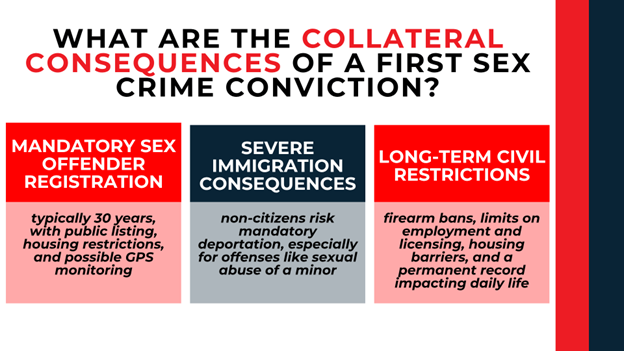
Sex offender registration under N.C.G.S. § 14-208 et seq. is mandatory for virtually all sex offense convictions. The standard registration period is 30 years. Lifetime registration applies to aggravated offenders and sexually violent predators. There are currently approximately 25,000 registered sex offenders in North Carolina, and registrants face residential restrictions under N.C.G.S. § 14-208.18, GPS monitoring in many cases, and public listing on the state registry.
Immigration consequences. For non-citizen defendants, Padilla v. Kentucky, 559 U.S. 356 (2010), requires defense counsel to advise of deportation risks before any plea. Sexual abuse of a minor is classified as an aggravated felony triggering mandatory removal.
Federal firearms prohibition, professional licensing bars, housing restrictions, and employment limitations persist long after a sentence is served. A first offense sex crime conviction creates a permanent record that affects every dimension of a person’s life.
What Defense Strategies Are Available to a First-Time Defendant?
The same defense tools available to any defendant apply with full force to first-time offenders — and in some cases, the absence of a criminal record strengthens the defense narrative.
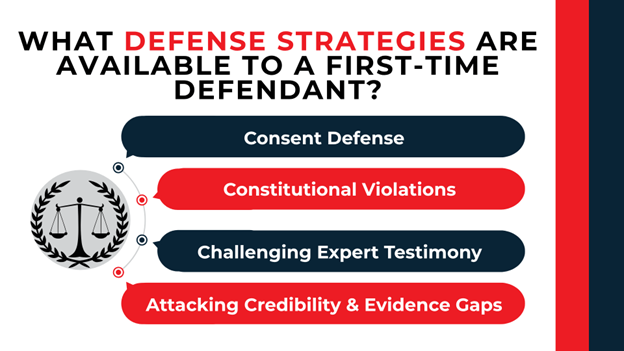
Consent. State v. Yelverton, 274 N.C. App. 348, 851 S.E.2d 434 (2020), affirmed consent as a complete defense to forcible offenses. Defense counsel investigates every communication and witness account to demonstrate consensual contact.
Constitutional challenges. Digital evidence obtained without a proper warrant is subject to suppression under Riley v. California, 573 U.S. 373 (2014). Statements obtained in violation of Miranda protections are challengeable. North Carolina’s mandatory recording requirement under N.C.G.S. § 15A-211 for serious sex offenses means unrecorded interrogations can be attacked as involuntary.
Expert testimony challenges. Under State v. Hall, 330 N.C. 808, 412 S.E.2d 883 (1992), prosecution expert testimony about victim behavior cannot be used to prove that abuse occurred. State v. Hammett, 361 N.C. 92, 637 S.E.2d 518 (2006), requires a physical evidence basis for any expert opinion that abuse occurred. Defense counsel files Daubert motions under State v. McGrady, 368 N.C. 880, 787 S.E.2d 1 (2016), and retains defense experts on suggestibility and false memory.
Credibility and corroboration. North Carolina does not require corroboration to convict on victim testimony alone — but the absence of corroboration is a powerful argument for reasonable doubt when presented to a jury.
What Do Clients and Peers Say About Attorney Patrick Roberts?
“From the first meeting until present, Mr. Roberts has been transparent and thorough about every possible outcome.” — Review originally posted by a verified client on Avvo.com.
“Very talented and intuitive criminal lawyer.” — Martindale-Hubbell Peer Review
Disclaimer: The testimonials and peer reviews on this site are for informational purposes. They do not constitute a guarantee, warranty, or prediction regarding the outcome of your legal matter. Every case is different and must be evaluated on its own merits.
Testimonials and peer endorsements found on this website are actual comments.
Case Review
Case Filed: Investigation into Alleged Indecent Liberties with a Child
Attorney: Patrick Roberts
Case Description: A client was under investigation for serious allegations involving child molestation and the suspected inappropriate photographing of a minor. Facing potential sex crime charges, the client required a strategic defense to navigate the complexities of both the legal system and the Department of Social Services (DSS). As an experienced sex crimes defense attorney, Patrick Roberts conducted an exhaustive independent investigation to challenge the state’s claims. By focusing on evidentiary inconsistencies and due process, the defense aimed to prevent the filing of formal criminal charges for sexual offenses and mitigate the devastating impact of such accusations on the client’s reputation.
Outcome: Dismissal. Furthermore, the State declined to file charges, ensuring the client faced no criminal prosecution.
*Disclaimer: Each case is different and must be evaluated separately. Prior results achieved do not guarantee similar results can be achieved in future cases

What Should a First-Time Defendant Consider?
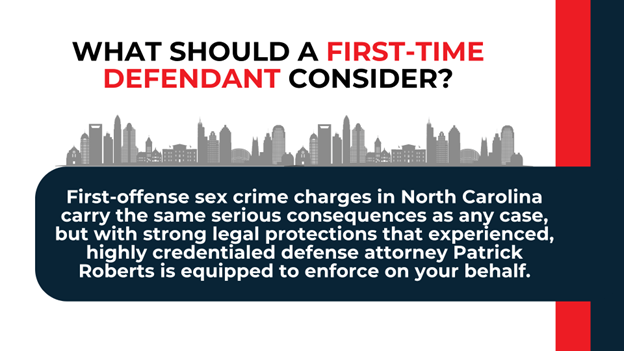
A first offense sex crime charge in North Carolina is prosecuted with the same statutory framework and the same potential consequences as any other sex crime case. The system does not provide automatic leniency for a clean record. What it does provide is constitutional protections, evidentiary standards, and procedural requirements that the State must satisfy — and experienced defense counsel ensures those standards are enforced.
Experienced Criminal Defense Attorney in NC
Attorney Patrick Roberts is a graduate of the Duke University School of Law (#6 National Rank; #7 Criminal Law Specialty) and provides a defense methodology rooted in the rigorous training of a B.A. in Engineering from The Johns Hopkins University (#7 National University). He served as an Assistant District Attorney, where he managed the prosecution of sex crimes, drug trafficking, and violent felonies.
His trial advocacy is supported by the Gerry Spence Trial Lawyers College, the NCDC Trial Practice Institute, and the 2025 NCDC Cross-Examination Intensive. Admitted to the Supreme Court of the United States and the U.S. Court of Appeals for the Fourth Circuit, Mr. Roberts is a Lifetime Member of the NACDL and a Former Commissioner of the North Carolina State Ethics Commission.
A co-author of two legal books, he has earned the AV Preeminent® Peer Rating and the Martindale-Hubbell Platinum Client Champion recognition for over five consecutive years, with a 10/10 Avvo rating maintained for over 15 years. His work has been featured in Super Lawyers Magazine and on the cover of Attorney-at-Law Magazine, and he has been quoted by national media outlets including USA Today and Fox News.
Contact Patrick Roberts Law and request an initial case evaluation. To ensure the exhaustive research and strategic precision required for a sophisticated defense, the firm accepts a limited number of cases each month. This selective approach allows Patrick Roberts to personally direct the deep-tier analysis and courtroom advocacy required to protect your constitutional rights.
Disclaimer: The information on this website is for general informational purposes only. Nothing herein should be taken as legal advice for any individual case or situation. Contacting us via this website, email, or contact form does not create an attorney-client relationship. Case results depend on a variety of factors unique to each case; prior results do not guarantee a similar outcome.
Former assistant district attorney
Contact Patrick Roberts
Facing criminal charges in North Carolina demands seasoned representation. Trust in the experience and dual perspective of Patrick Roberts. Reach out today for a confidential consultation.
-
Call Our Team
Calls answered 24/7









For more information on the selection criteria, go to www.martindale.com
*Each case is different and must be evaluated separately. Prior results achieved do not guarantee similar results can be achieved in future cases.