

Larceny vs. Theft: What’s the Difference in North Carolina?
If you’ve been charged with a property crime in North Carolina, you might be confused about the terms “larceny” and “theft.” Here’s what you need to know:
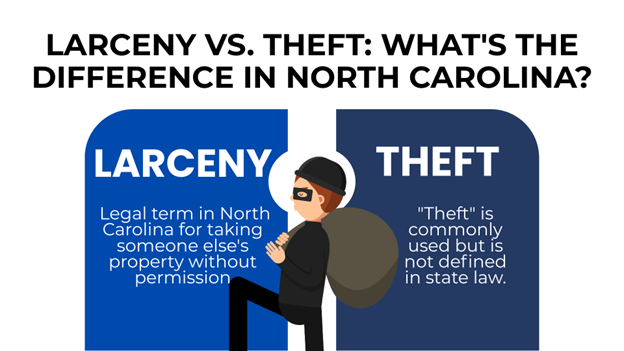
Larceny is the official legal term North Carolina uses in its laws for taking someone else’s property without permission. According to North Carolina law, larceny is typically a Class H felony unless stated otherwise (N.C.G.S. § 14-70).
Theft is the everyday term most people use, but you won’t find it specifically defined in North Carolina law books. Instead, the courts and legal documents use “larceny” for what most people call “theft.”
In simple terms: larceny is North Carolina’s legal word for theft.
What Are the Key Elements of Larceny in North Carolina?
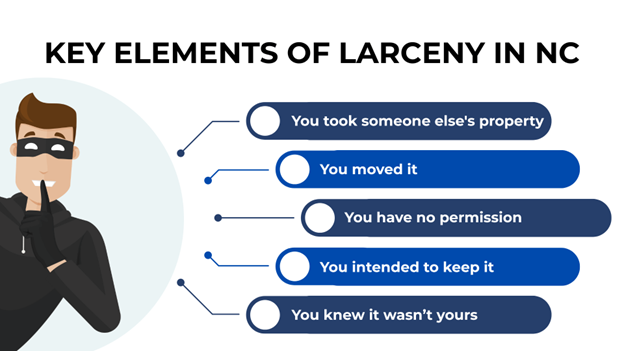
For someone to be found guilty of larceny in North Carolina, prosecutors must prove:
- You took property belonging to someone else
- You moved the property (even just a little bit)
- You didn’t have the owner’s permission
- You planned to keep the property permanently
- You knew the property wasn’t yours to take
Ways people commonly defend against larceny charges:
- Showing they thought they had permission to take the item
- Proving they planned to return the property
- Demonstrating they truly believed the property belonged to them
- Arguing about the value of the property (especially important if facing felony charges)
What Are the Types of Larceny in North Carolina?
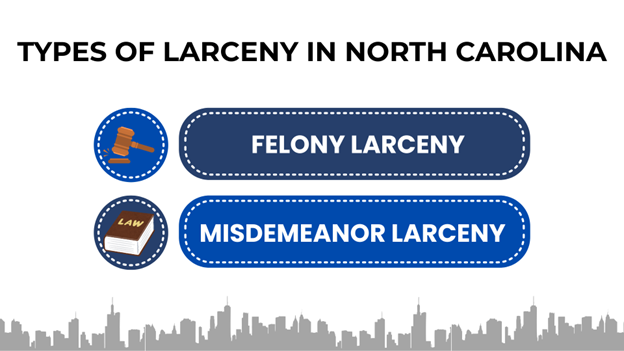
North Carolina law divides larceny into different categories:
- Felony Larceny: Taking property worth more than $1,000 (N.C.G.S. § 14-72(a))
- Misdemeanor Larceny: Taking property worth $1,000 or less (N.C.G.S. § 14-72(a))
However, some types of larceny are always felonies no matter the value (N.C.G.S. § 14-72(b)):
- Stealing directly from a person (N.C.G.S. § 14-72(b)(1))
- Stealing during a break-in (N.C.G.S. § 14-72(b)(2))
- Stealing explosives or guns (N.C.G.S. § 14-72(b)(3)-(4))
- Stealing records from the North Carolina State Archives (N.C.G.S. § 14-72(b)(5))
- Getting caught stealing after four prior larceny convictions (N.C.G.S. § 14-72(b)(6))
How Do Larceny and Burglary Differ?
Larceny and burglary are separate crimes that are often confused. Here’s how they differ:
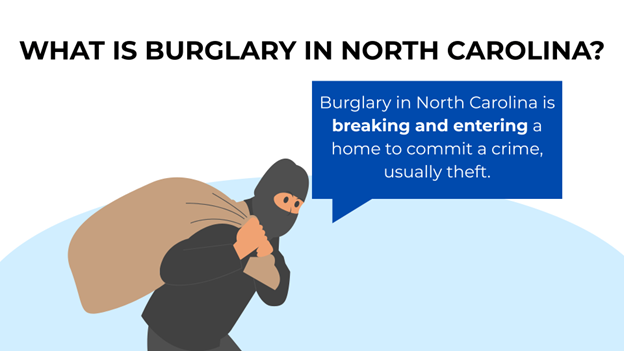
What Is Burglary in North Carolina?
In North Carolina, burglary means breaking and entering into someone’s home or sleeping area with plans to commit a crime (often theft) inside (N.C.G.S. § 14-51).
North Carolina has two types of burglary:
- First-degree burglary: Breaking into a home at night while people are inside (Class D felony) (N.C.G.S. § 14-52)
- Second-degree burglary: Breaking into a home at night when no one is there (Class G felony) (N.C.G.S. § 14-52)
What Are the Main Differences Between Larceny and Burglary?
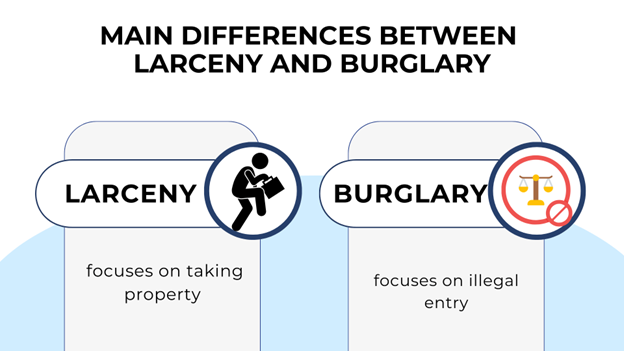
Larceny focuses on taking property (N.C.G.S. § 14-72):
- The main action is taking and carrying away someone else’s property
- Can happen anywhere
- The crime is complete once you take the property
- You must intend to keep the property permanently
Burglary focuses on illegal entry (N.C.G.S. § 14-51):
- The main action is breaking into and entering a building
- Must involve entering a home or other building
- The crime is complete as soon as you enter, even if you don’t steal anything
- You must have planned to commit a crime inside
What Related Crimes Exist in North Carolina?
North Carolina law also defines several similar crimes:
- Breaking or entering: Going into any building with plans to commit a crime (Class H felony) or wrongfully entering any building (Class 1 misdemeanor) (N.C.G.S. § 14-54)
- Receiving stolen goods: Knowingly accepting property you know was stolen (Class H felony) (N.C.G.S. § 14-71)
- Possessing stolen goods: Having stolen property in your possession while knowing it was stolen (Class H felony) (N.C.G.S. § 14-71.1)
What Are Common Defenses for Larceny and Burglary Charges?
Defenses People Use Against Larceny Charges
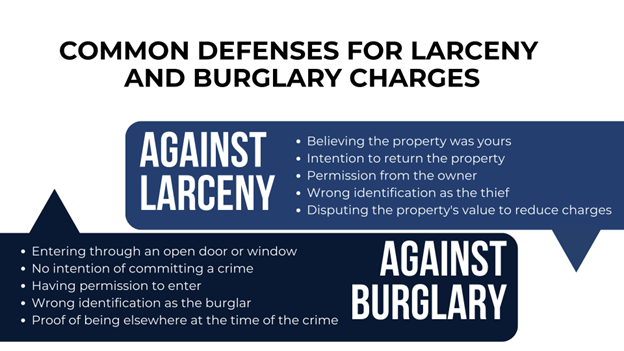
- “I thought it was mine”: Honestly believing you had a right to the property
- “I was going to give it back”: Not intending to keep the property forever
- “I had permission”: Having the owner’s consent to take the property
- “It wasn’t me”: Being wrongly identified as the person who committed the theft
- “It’s not worth that much”: Challenging how much the property is worth (which could reduce a felony to a misdemeanor under N.C.G.S. § 14-72(a))
Defenses People Use Against Burglary Charges
- “I didn’t break in”: Showing you entered through an already open door or window
- “I didn’t plan to commit a crime”: Proving you had no intention of committing a crime inside
- “I was allowed to be there”: Having permission to enter the building
- “It wasn’t me”: Being wrongly identified as the person who broke in
- “I was somewhere else”: Having proof you were in a different location when the crime happened
What Are the Special Types of Larceny in North Carolina?
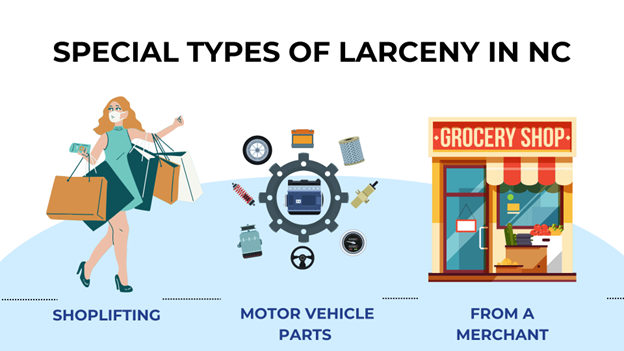
North Carolina law also identifies specific types of larceny that carry their own penalties:
How Is Shoplifting (Concealment of Merchandise) Treated Under North Carolina Law?
Under N.C.G.S. § 14-72.1, concealing merchandise in a store before paying for it is a type of larceny. The law considers hiding merchandise on your person as evidence of intentional shoplifting. Penalties increase with repeat offenses (N.C.G.S. § 14-72.1(e)).
What Are the Rules for Larceny of Motor Vehicle Parts?
Stealing car parts becomes a Class I felony if the repair costs exceed $1,000 or if the stolen part is a catalytic converter (N.C.G.S. § 14-72.8).
What Constitutes Larceny from a Merchant?
Under N.C.G.S. § 14-72.11, stealing from a store becomes a Class H felony in several situations, including:
- Taking items worth over $200 and using emergency exits to leave (N.C.G.S. § 14-72.11(1))
- Disabling anti-shoplifting devices (N.C.G.S. § 14-72.11(2))
- Stealing infant formula worth over $100 (N.C.G.S. § 14-72.11(4))
What Other Specialized Larceny Statutes Exist?
- Larceny of chose in action: Stealing financial documents like checks or stock certificates (N.C.G.S. § 14-75)
- Larceny by servants or employees: Stealing from an employer (N.C.G.S. § 14-74)
- Larceny of ungathered crops: Stealing crops still in the field (N.C.G.S. § 14-78)
- Larceny of ginseng: Specifically for stealing this valuable plant (N.C.G.S. § 14-79)
- Larceny of pine straw: Taking pine needles from land with posted notices (N.C.G.S. § 14-79.1)
- Larceny of law enforcement equipment: Stealing items from law enforcement vehicles (N.C.G.S. § 14-72.9)
Getting Legal Help for Larceny or Burglary Charges
If you’re facing larceny or burglary charges in North Carolina, it’s important to talk with a criminal defense attorney who knows state law well. These charges can lead to serious consequences, including jail time and a permanent criminal record that affects job opportunities.
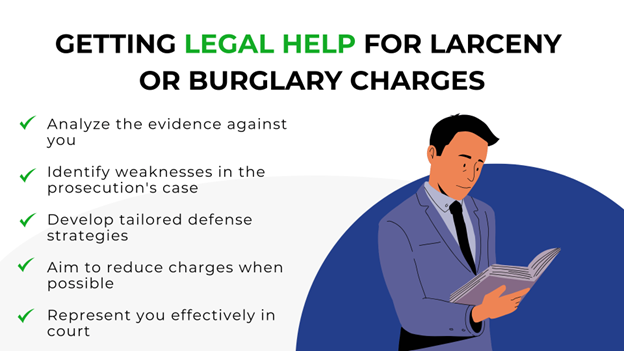
A good attorney can:
- Look closely at the evidence against you
- Find weaknesses in the prosecutor’s case
- Create defense strategies that fit your specific situation
- Work to get charges reduced when possible
- Represent you effectively in court
Every case has its own unique facts and circumstances. The right defense approach depends on the specific details of your situation and the evidence involved. An experienced attorney can help you understand your options and work toward the best possible outcome for your case.
Whether you’re facing larceny or burglary charges in North Carolina, the consequences can be life-altering. You need an experienced advocate who knows how to challenge the evidence and protect your rights. Attorney Patrick Roberts has helped countless clients* navigate serious theft-related charges. Call today for a confidential consultation and take the first step toward your defense.
*Disclaimer: Each case is different and must be evaluated on its individual facts. Attorney Roberts works hard to assess each case individually. Prior results do not guarantee any future outcome.
Former assistant district attorney
Contact Patrick Roberts
Facing criminal charges in North Carolina demands seasoned representation. Trust in the experience and dual perspective of Patrick Roberts. Reach out today for a confidential consultation.
-
Call Our Team
Calls answered 24/7






For more information on the selection criteria, go to www.martindale.com
*Each case is different and must be evaluated separately. Prior results achieved do not guarantee similar results can be achieved in future cases.