

Understanding North Carolina Drug Possession Laws
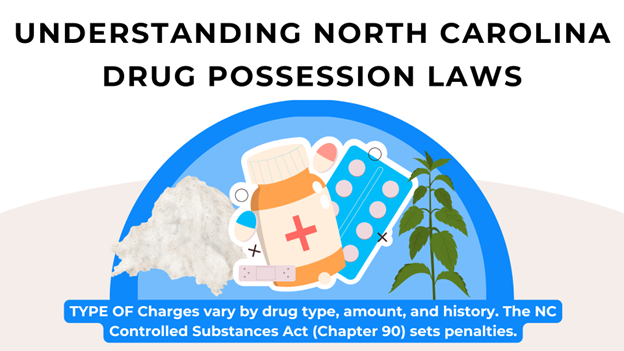
In North Carolina, drug possession charges can range from minor misdemeanors to serious felonies. If you’re facing charges, you might be wondering: “Is possession of drugs a felony in North Carolina?” The answer depends on several factors including the type of drug, how much you had, your past criminal record, and the circumstances of your case. The North Carolina Controlled Substances Act (found in Chapter 90 of state law) sets the rules for drug offenses and their penalties. Understanding these laws is important if you’re facing drug charges in North Carolina.
How North Carolina Classifies Drugs
North Carolina divides controlled substances into six categories (called “schedules”) based on their medical use, potential for abuse, and safety:
Schedule I Drugs
Schedule I drugs are considered the most dangerous. They have high abuse potential, no accepted medical use in the US, and are considered unsafe. Examples include heroin, LSD, ecstasy (MDMA), and certain opioids.
Possession of even small amounts of Schedule I drugs in North Carolina is typically charged as a Class I felony. This means that having just a small amount of these substances can result in felony charges.
Schedule II Drugs
Schedule II substances also have high abuse potential but may have some accepted medical uses with strict limitations. These include cocaine, methamphetamine, oxycodone, fentanyl, and other strong narcotics.
Under North Carolina law, simple possession of Schedule II drugs is usually charged as a Class 1 misdemeanor. However, it becomes a Class I felony if:
- You have more than a certain amount
- The drug is meth, cocaine, or fentanyl
- You have prior drug convictions
Schedule III Drugs
These drugs have less potential for abuse than Schedule I or II substances and accepted medical uses. Examples include certain steroids, ketamine, and some medications with limited amounts of narcotics.
Possession of Schedule III substances is typically a Class 1 misdemeanor but can become a Class I felony if you have more than 100 pills, capsules, or other units.
Schedule IV Drugs
Schedule IV includes substances with low abuse potential compared to Schedule III drugs and accepted medical uses. Examples include Valium, Xanax, and other similar medications.
Like Schedule III substances, possession of Schedule IV drugs is generally a Class 1 misdemeanor but can become a felony based on quantity or prior convictions.
Schedule V and VI Drugs
Schedule V includes preparations with small amounts of certain narcotics, mainly for cough medicine, anti-diarrhea medicine, or pain relief. Possession is a Class 2 misdemeanor.
Schedule VI primarily includes marijuana. Penalties for marijuana possession depend on how much you have:
- Less than 1/2 ounce: Class 3 misdemeanor
- 1/2 to 1.5 ounces: Class 1 misdemeanor
- More than 1.5 ounces: Class I felony

When Drug Possession Becomes a Felony in North Carolina
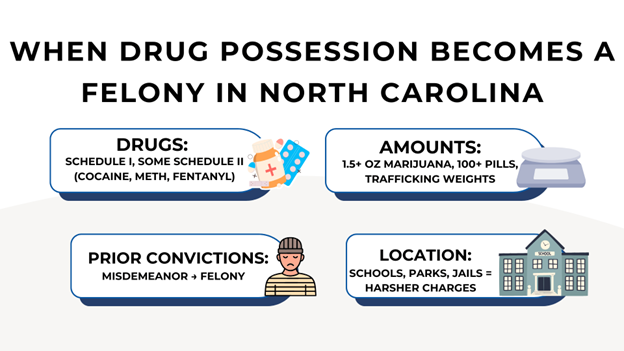
Several factors determine whether drug possession is charged as a felony in North Carolina:
Type of Drug
As explained above, possession of Schedule I drugs and certain Schedule II drugs (like cocaine, meth, and fentanyl) is more likely to result in felony charges, even for first-time offenders or small amounts.
Amount of Drugs
North Carolina law sets certain amounts that automatically make charges more serious. For example:
- More than 1.5 ounces of marijuana
- More than 100 pills of Schedule III or IV drugs
- Any amount that suggests you might be selling rather than just using
Drug Trafficking Amounts
Having large amounts of drugs can lead to trafficking charges, which are always felonies with mandatory prison time:
- Marijuana: 10+ pounds (Class H felony at minimum)
- Cocaine: 28+ grams (Class G felony at minimum)
- Meth: 28+ grams (Class F felony at minimum)
- Heroin/Opioids: 4+ grams (Class F felony at minimum)
- MDMA/Ecstasy: 100+ pills or 28+ grams (Class G felony at minimum)
Prior Criminal Record
Your criminal history greatly affects how possession charges are handled:
If you have previous drug convictions, what would normally be a misdemeanor charge can become a Class I felony.
Where the Drugs Were Found
The location where drugs are possessed can increase penalties:
- Possession on school property or childcare facilities, or within 1,000 feet of these places, carries harsher penalties
- Possession in a jail or prison is automatically a Class H felony
- Possession in public parks or within 1,000 feet of a park may lead to increased penalties
North Carolina Felony Classifications for Drug Possession
When drug possession is charged as a felony in North Carolina, the specific level depends on various factors:
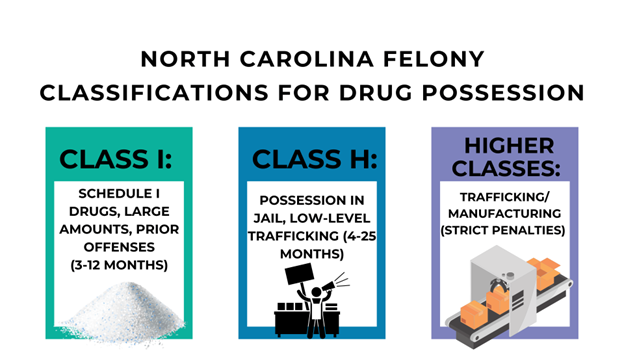
Class I Felony
The lowest level of felony in North Carolina, typically applies to:
- Possession of Schedule I drugs
- Possession of Schedule II-IV drugs when you have more than certain amounts
- Possession of more than 1.5 ounces of marijuana
- Misdemeanor possession charges increased due to prior convictions
Class I felonies are punishable by 3 -24 months in prison, depending on your prior criminal history.
Class H Felony
Applied to certain drug possession situations including:
- Possession in a jail or prison
- Lower-level trafficking offenses (like having 10-50 pounds of marijuana)
Class H felonies can result in 4 – 39 months in prison, depending on prior record.
Higher Felony Classifications
More serious drug charges, typically involving trafficking or manufacturing, can result in Class G, F, E, D, or even C felony charges, with correspondingly severe penalties including mandatory minimum sentences and substantial fines.
Consequences of Felony Drug Possession in North Carolina
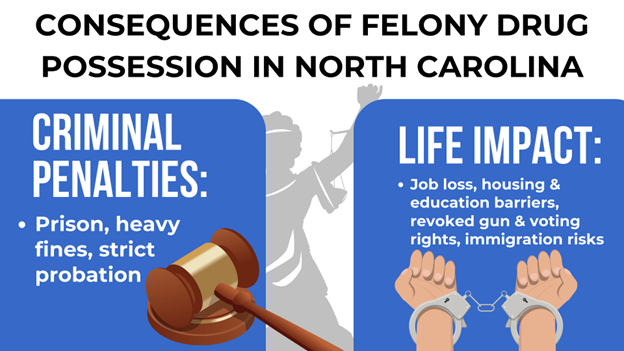
A felony drug conviction in North Carolina carries serious long-term consequences:
Criminal Penalties
- Prison time: Even Class I felonies can result in jail time, especially for those with prior criminal records
- Fines: Significant financial penalties, particularly for trafficking offenses
- Probation: Often with strict conditions including drug testing, treatment requirements, and community service
Other Life Consequences
Beyond the immediate legal penalties, a felony drug conviction can affect:
- Job opportunities: Many employers do background checks and may not hire people with felony drug convictions
- Housing options: Landlords often screen potential tenants for criminal histories
- Education opportunities: Eligibility for federal student aid may be affected
- Professional licenses: Many licensed professions have character requirements
- Immigration status: Non-citizens may face deportation issues
- Voting rights: Felony convictions affect voting rights while serving a sentence
- Gun rights: Loss of the right to own firearms
Options for First-Time Drug Offenders in North Carolina
North Carolina offers several programs designed to help first-time or low-level drug offenders avoid felony convictions:
Conditional Discharge Under G.S. 90-96
North Carolina’s conditional discharge law (G.S. 90-96) gives certain first-time drug offenders a chance to avoid conviction. When it applies, the court may:
- Put the case on hold without entering a judgment
- Place you on probation with specific conditions
- Dismiss the charges if you successfully complete probation
- Allow for removal of the arrest and charge from your record
This option is generally available to first-time offenders charged with simple possession who have no disqualifying prior convictions.
Drug Treatment Courts
Many North Carolina counties have specialized drug treatment courts that provide:
- Close supervision and monitoring
- Required substance abuse treatment
- Regular court appearances to check progress
- Opportunity for charge reduction or dismissal upon successful completion
These programs focus on addressing drug problems rather than simply punishing the offense.
Deferred Prosecution Agreements
In some cases, prosecutors may offer agreements where charges are put on hold while you complete certain requirements. If successful, charges are typically dismissed.
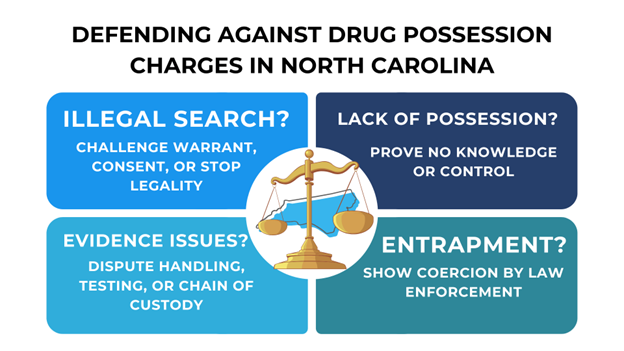
Defending Against Drug Possession Charges in North Carolina
If you’re facing potential felony drug possession charges in North Carolina, several defense strategies may help:
Constitutional Challenges
Many drug cases involve search and seizure issues that may violate your rights:
- Was there probable cause for a search warrant?
- Was a warrantless search justified?
- Did police exceed the scope of consent?
- Was the traffic stop that led to finding drugs lawful?
Challenging Actual Possession
For charges to stick, prosecutors must prove you knowingly possessed the drugs. Defenses may include:
- You didn’t know the drugs were there
- You didn’t have control over the area where drugs were found
- You only had brief or accidental contact with the substance
Challenging the Evidence
Technical defenses regarding how evidence was handled can be effective:
- Chain of custody problems
- Improper evidence handling or storage
- Lab testing errors or problems
- Misidentification of substances
Entrapment or Due Process Violations
In cases involving undercover officers or informants, questions of entrapment or due process violations may arise, particularly if police conduct was extreme or coercive.
Getting Legal Help for Drug Possession Charges in North Carolina
If you’re facing drug possession charges in North Carolina, whether you’ll be charged with a felony or misdemeanor depends on many factors specific to your case. North Carolina’s drug laws are complex, so it’s essential to work with an experienced criminal defense attorney who understands both the laws and how they’re applied in local courts.
A knowledgeable North Carolina criminal defense attorney can:
- Determine whether your charge qualifies as a felony
- Identify potential defenses specific to your case
- Check if you’re eligible for diversion programs or conditional discharge
- Negotiate with prosecutors for reduced charges when possible
- Represent you throughout all stages of the legal process
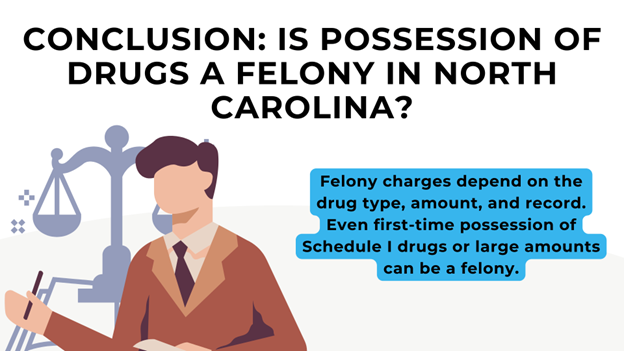
Conclusion: Is Possession of Drugs a Felony in North Carolina?
Whether possession of drugs is a felony in North Carolina depends on multiple case-specific factors. While possession of many drugs starts as a misdemeanor charge, numerous circumstances can raise these charges to felonies, including the type and amount of substance, prior convictions, location of the offense, and other factors.
Even for first-time offenders, possession of Schedule I drugs like heroin or MDMA, or possession of enough of any drug, can result in felony charges. The consequences of a felony drug conviction go far beyond possible jail time, affecting jobs, housing, education, and civil rights.
Given how serious drug charges are in North Carolina and their potentially life-changing consequences, anyone facing such charges should seek qualified legal help immediately. With proper legal assistance, many defendants can pursue alternatives that minimize the impact of drug charges on their future.
If you or a loved one are facing a charge for drug possession in North Carolina, you deserve a legal advocate with the experience and dedication to secure the best possible outcome. Attorney Patrick Roberts of Patrick Roberts Law has successfully defended numerous clients facing serious drug crimes. Contact our firm today for a confidential consultation.
Former assistant district attorney
Contact Patrick Roberts
Facing criminal charges in North Carolina demands seasoned representation. Trust in the experience and dual perspective of Patrick Roberts. Reach out today for a confidential consultation.
-
Call Our Team
Calls answered 24/7






For more information on the selection criteria, go to www.martindale.com
*Each case is different and must be evaluated separately. Prior results achieved do not guarantee similar results can be achieved in future cases.