
Law enforcement agencies across North Carolina conduct internet sting operations with substantial resources and coordination. According to the NC State Bureau of Investigation (2025), more than 200 law enforcement agencies participate in the NC Internet Crimes Against Children Task Force. If you’ve been arrested in one of these operations, you may believe you were entrapped. But proving entrapment under North Carolina law requires meeting specific legal standards that go far beyond simply showing that police initiated contact. Understanding what the entrapment defense actually requires—and what defeats it—is essential before building your case.
What Does the Entrapment Defense Require Under North Carolina Law?
North Carolina recognizes entrapment as an affirmative defense, but the legal requirements are stricter than many defendants expect. The defense involves a two-prong test that shifts burdens between the defendant and the State at different stages of analysis.
What Is Government Inducement?
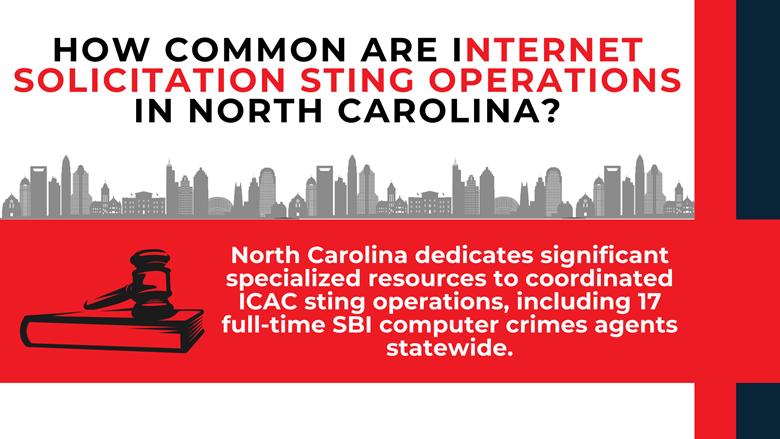
The first prong requires showing that the government induced the defendant to commit the offense. Inducement means more than simply providing an opportunity to commit a crime. It requires evidence that law enforcement used persuasion, fraudulent representations, threats, coercive tactics, harassment, or promises of reward beyond those inherent in the criminal activity itself. An undercover officer posing as a minor and initiating a conversation does not automatically constitute inducement. Courts look for evidence that the government overcame the defendant’s reluctance through persistent pressure.
What Does “Predisposition” Mean in Entrapment Cases?
The second prong—and the one where most entrapment defenses fail—requires proving the defendant was not predisposed to commit the offense. Predisposition means the defendant’s willingness or readiness to engage in criminal conduct before any government contact. As the NC Court of Appeals explained in State v. Morse, 194 N.C. App. 685, 671 S.E.2d 538 (N.C. App. 2009), active participation in sexual conversations and meeting planning demonstrates predisposition sufficient to defeat an entrapment claim.
Who Bears the Burden of Proof?
The burden-shifting framework works as follows:
- The defendant must first produce some evidence of government inducement to raise the defense
- Once raised, the burden shifts to the State to prove predisposition beyond a reasonable doubt
- Written notice of the entrapment defense must be filed within 20 working days of trial setting under N.C.G.S. § 15A-905(c)
- Failure to provide timely notice can result in waiver of the defense
- The jury ultimately decides whether the State has proven predisposition
The procedural notice requirement is absolute. Missing the 20-working-day deadline can prevent you from presenting your entrapment defense at trial, regardless of how strong the evidence supporting it may be.
How Do North Carolina Courts Analyze Predisposition Evidence?
North Carolina appellate courts have developed detailed frameworks for analyzing predisposition. Understanding how courts evaluate this evidence helps identify whether an entrapment defense is viable in your case.
What Evidence Defeats an Entrapment Claim?
In State v. Morse, the Court of Appeals found predisposition where the defendant actively participated in sexually explicit conversations and took steps to arrange a meeting with the believed minor. The court emphasized that the defendant’s eager engagement with the undercover officer—rather than reluctance that had to be overcome—demonstrated predisposition existing before government contact.
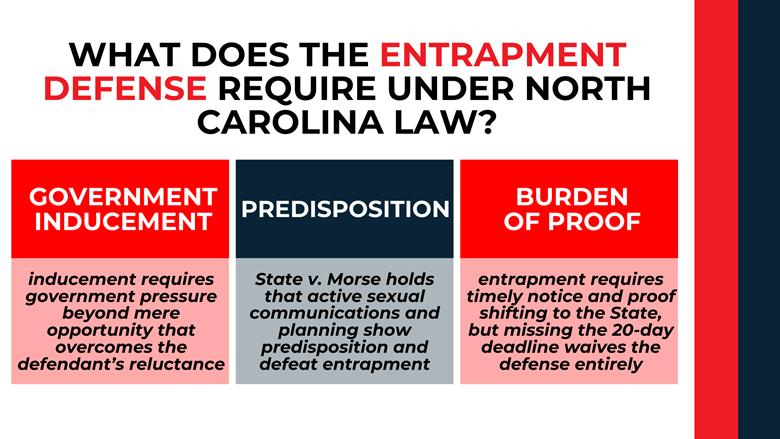
Courts examine several types of evidence when assessing predisposition:
- Initiation of sexual topics: Did the defendant or the officer first introduce sexual content into the conversation?
- Eagerness versus reluctance: Did the defendant show hesitation that the government had to overcome?
- Planning behavior: Did the defendant take concrete steps to arrange a meeting?
- Statements about preferences: Did the defendant make statements indicating interest in minors?
- Response to discouragement: Did the defendant persist despite the “minor” expressing reluctance?
- Speed of escalation: How quickly did the defendant move toward explicit content or meeting arrangements?
Can Continued Engagement After Learning “Child’s” Age Prove Predisposition?
Yes. In State v. Keller, 265 N.C. App. 526, 828 S.E.2d 578 (N.C. App. 2019), the Court of Appeals analyzed predisposition where the defendant continued engaging with the undercover officer after learning the believed “child’s” age. The court found that continued engagement after being informed of the minor’s age strongly indicates predisposition. A defendant who expresses initial interest, learns the person is supposedly underage, and continues the conversation has significantly undermined any entrapment claim.
What Role Do Chat Logs Play in Predisposition Analysis?
Chat logs are typically the most critical evidence in both directions. The prosecution will analyze logs for evidence of predisposition—eager participation, sexual initiation, planning behavior. The defense will examine the same logs for evidence of inducement—government pressure, persistent contact despite reluctance, escalation driven by the officer rather than the defendant. Preserving complete, unaltered chat records is essential for building either case.
How Common Are Internet Solicitation Sting Operations in North Carolina?
Understanding the scope of law enforcement’s sting operation capacity provides context for these cases. North Carolina dedicates substantial resources to internet crimes against children investigations.
Internet solicitation sting operations are highly common and increasingly frequent in North Carolina. According to recent 2026 reports from the North Carolina Judicial Branch and the State Bureau of Investigation (SBI), cyber tips related to internet crimes against children have surged significantly, nearly doubling from 26,771 in 2023 to an estimated 52,585 in 2025.
How Extensive Is Law Enforcement’s Sting Operation Capacity?
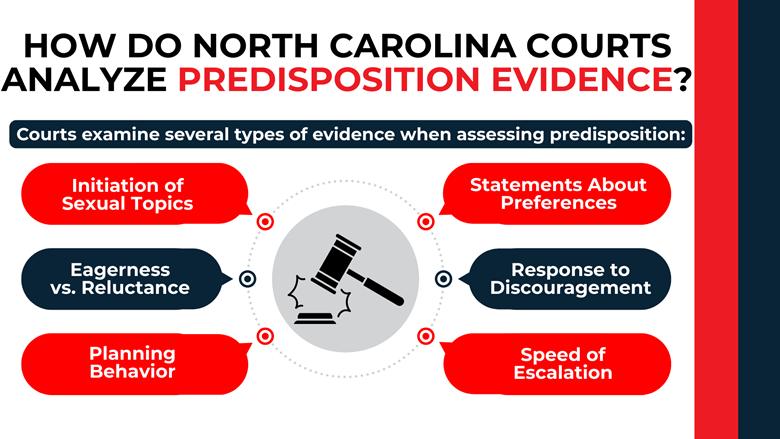
The NC ICAC Task Force coordinates sting operations across the state through a network of participating agencies. According to the NC State Bureau of Investigation (2025), 17 full-time SBI special agents work exclusively on computer crimes, stationed across eight field districts. This dedicated unit investigates technology-facilitated crimes against children and supports local agencies conducting sting operations.
What Resources Does the State Dedicate to These Investigations?
The scale of online exploitation reporting drives significant resource allocation. The National Center for Missing & Exploited Children (2024) received 20.5 million CyberTipline reports of suspected child sexual exploitation nationally in 2024. These reports generate investigative leads that flow to state and local agencies, including NC’s ICAC Task Force. The volume of reports means law enforcement agencies have developed sophisticated protocols for online investigations, including sting operations using trained officers posing as minors.
What Are the Procedural Requirements for Raising an Entrapment Defense?
Properly raising an entrapment defense requires meeting specific procedural requirements. Missing deadlines or failing to preserve evidence can eliminate the defense entirely.
When Must You Provide Notice of an Entrapment Defense?
Under N.C.G.S. § 15A-905(c), written notice of intent to raise an entrapment defense must be provided within 20 working days of trial setting. This is a strict deadline. The notice requirement allows the prosecution to prepare its predisposition evidence and prevents surprise defenses at trial. Defense counsel must calendar this deadline immediately upon receiving the trial date.
What Evidence Should Be Preserved For Trial?
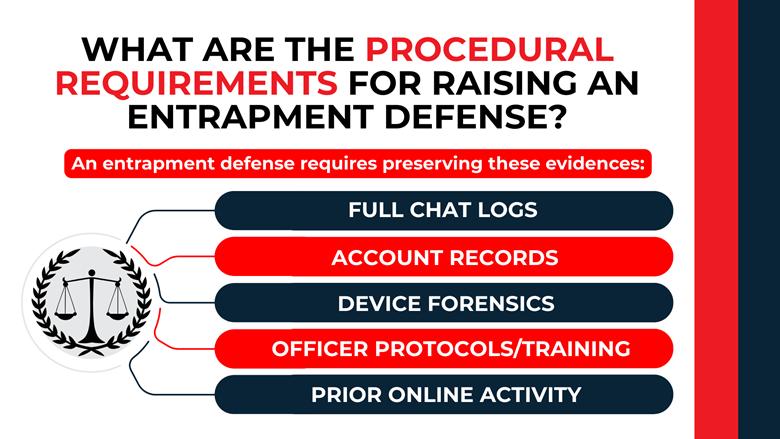
Building an entrapment defense requires comprehensive evidence preservation from the earliest possible moment:
- Complete chat logs: All communications between defendant and undercover officer, including timestamps and metadata
- Account creation records: Evidence of when and how initial contact was established
- Device forensics: Data showing what the defendant accessed, when, and in what sequence
- Officer protocols: Documentation of the sting operation procedures and guidelines
- Training materials: What instructions the undercover officer received about initiating contact
- Prior communications: Any evidence of the defendant’s online activity before the sting
How Do Fourth Amendment Protections Apply to Chat Logs?
Following Riley v. California, 573 U.S. 373 (2014), police generally cannot search cell phones or digital devices incident to arrest without a warrant. This protection extends to chat applications stored on seized devices. However, the undercover officer’s copies of the conversations—obtained through participation rather than search—typically do not require a warrant. Defense counsel should examine whether any evidence was obtained through searches exceeding warrant authorization or accessed without proper legal authority.
What Penalties Apply if an Entrapment Defense Fails?
Understanding the consequences of conviction helps assess the stakes of your defense strategy. Internet solicitation carries significant penalties and collateral consequences.
What Is The Difference Between Class H And Class G Solicitation Charges?
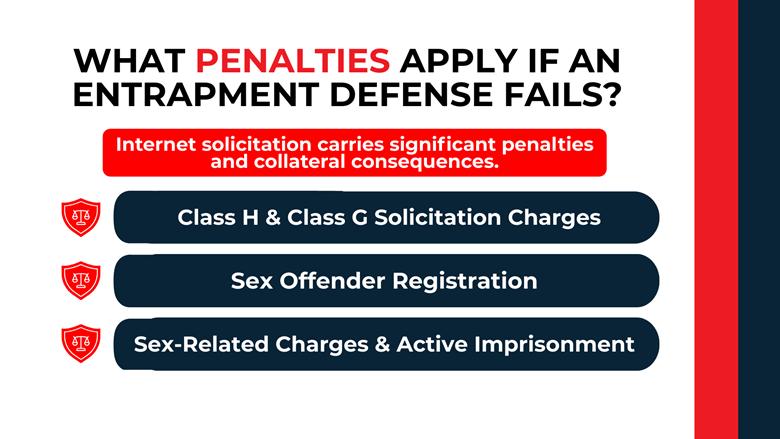
Under N.C.G.S. § 14-202.3, solicitation of a child by computer is normally a Class H felony. However, if either party appears at the meeting location, the offense becomes a Class G felony with enhanced penalties. This distinction means that defendants who traveled to meet the supposed minor face more serious charges than those arrested before any meeting occurred. The statute requires the defendant be at least 16 years old and at least 5 years older than the believed minor.
How Does Sex Offender Registration Affect Your Future?
Conviction under N.C.G.S. § 14-202.3 triggers mandatory sex offender registration. Under current NC law, the standard registration period is 30 years, with petition for termination available after 10 years for non-aggravated offenders. Registration requirements include:
- Regular verification of address with local sheriff’s office
- Restrictions on where you can live and work
- Public listing on the NC Sex Offender Registry
- Notification requirements when changing residence or employment
- Potential GPS monitoring depending on offense classification
These collateral consequences often affect defendants’ lives more severely than the prison sentence itself.
What Does The Sentencing Data Show For These Offenses?
Sentencing for internet solicitation depends on felony class, prior record level, and whether aggravating or mitigating factors apply under North Carolina’s Structured Sentencing Act. According to the NC Sentencing and Policy Advisory Commission FY 2024 Report, 62% of person offense convictions (which include sex-related charges) received active imprisonment sentences. The enhanced maximum sentence formula for Class B1-E sex offenses requiring registration equals 120% of the minimum plus 60 additional months.
What Happens During the Pretrial and Trial Process?
The path from arrest to resolution involves multiple stages with strategic implications for your defense.
How Often Do Solicitation Cases Go to Trial Versus Plea?
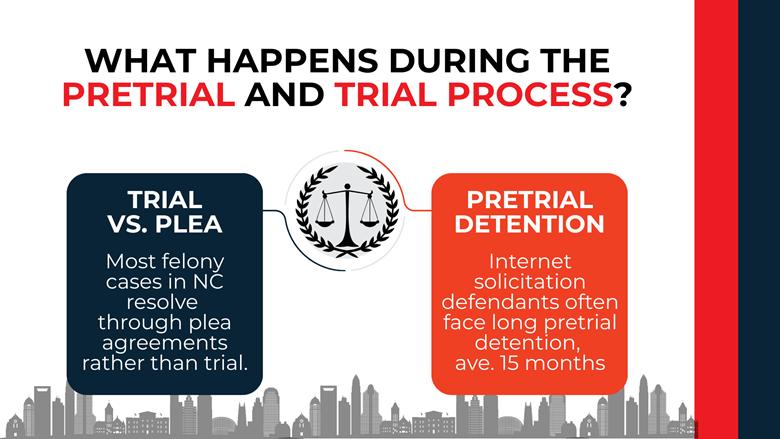
Most felony cases in North Carolina resolve through plea agreements rather than trial. According to the NC Sentencing and Policy Advisory Commission FY 2024 Report, 98% of all felony convictions resulted from guilty pleas rather than jury trials. However, the most serious sex offense cases (Class B1 felonies) have the highest jury trial rate at 15%, suggesting defendants facing severe consequences are more likely to contest charges at trial. An entrapment defense that has a reasonable chance of success may justify proceeding to trial rather than accepting a plea.
What Should You Expect During Pretrial Detention?
Defendants charged with internet solicitation often face extended pretrial detention. The NC Sentencing Commission FY 2024 data shows 93% of person offense convictions received credit for time served, reflecting substantial pretrial detention. The average pretrial credit for person offenses was 15 months. Sex offense cases require a district or superior court judge (not a magistrate) to grant pretrial release under N.C.G.S. § 15A-533(b), and release is discretionary rather than mandatory.
What Constitutional Protections Apply to Internet Sting Operations?
When facing internet-based investigations, several constitutional protections may impact the admissibility of evidence. Identifying potential violations of these rights is a critical step in building a legal defense.
Can Police Search Your Phone Without a Warrant?
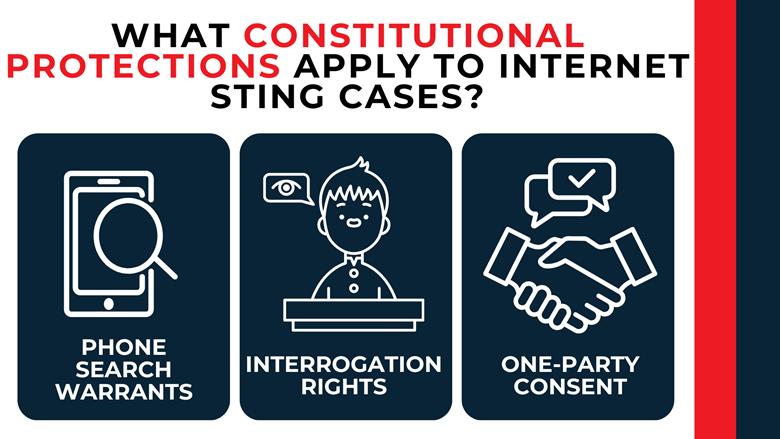
Following Riley v. California, 573 U.S. 373 (2014), police generally cannot search cell phone incidents to arrest without a warrant. The Supreme Court recognized that cell phones contain vast quantities of private information deserving Fourth Amendment protection. If police searched your phone’s contents without obtaining a warrant—or exceeded the scope of a warrant they did obtain—that evidence may be subject to suppression. Officers may secure a phone to prevent remote wiping while applying for a warrant, but they cannot examine its contents without judicial authorization.
What Are Your Rights During Interrogation?
Miranda warnings are required before custodial interrogation. Under N.C.G.S. § 15A-211, interrogations for Class A, B1, B2, and Class C sex offenses must be recorded. While internet solicitation is typically a Class H or G felony (below the mandatory recording threshold), any statements made during custodial questioning without proper Miranda warnings may be suppressible. The Supreme Court’s decision in J.D.B. v. North Carolina, 564 U.S. 261 (2011), established that a suspect’s age is relevant to the custody analysis—particularly important for younger defendants.
Are Pretext Calls Admissible in North Carolina?
Yes. North Carolina is a one-party consent state under N.C.G.S. § 15A-287, meaning recordings are lawful if one party to the conversation consents. This allows law enforcement to record conversations with defendants’ knowledge that the recording is occurring on the officer’s end. Pretext phone calls arranged by investigators—where a supposed victim or witness calls the defendant while police record—are admissible evidence. This differs from the chat log situation only in medium; both are permissible under NC law.
How Attorney Patrick Roberts Applies These Protections
Successfully navigating the constitutional complexities of internet sting cases requires more than just knowledge of the law—it requires a tactical understanding of how digital evidence is handled in both state and federal courts.
Attorney Patrick Roberts is uniquely positioned to handle these sensitive matters through a combination of local experience and national recognition:
- A Strategic Perspective from Both Sides: As a former prosecutor in three North Carolina counties, Mr. Roberts understands the internal protocols law enforcement uses during online investigations. He uses this insight to scrutinize every step of the state’s process—from the initial chat log to the final device seizure—to ensure no constitutional shortcuts were taken.
- Decades of Proven Excellence: His 10/10 “Superb” AVVO rating, held for over 15 consecutive years, is a testament to a career built on professional integrity and a history of handling over 1,000 cases with precision.
- National Resources & Federal Authority: As a Lifetime Member of the National Association of Criminal Defense Lawyers (NACDL), he stays at the forefront of evolving digital privacy laws. Furthermore, because internet sting cases often cross state lines or involve federal agencies, his admission to all Federal District Courts in North Carolina and the Fourth Circuit Court of Appeals ensures he can defend your rights in any jurisdiction where charges are brought.
Frequently Asked Questions
Can I claim entrapment if an undercover officer initiated contact with me?
Government initiation alone is not enough for entrapment. You must also prove you were not predisposed to commit the offense. Courts examine whether you showed reluctance, declined sexual topics, or only engaged after persistent government pressure. Active participation and eager engagement typically defeat entrapment claims even when the government makes first contact.
Does it matter that there was no actual child involved in my case?
No. Under N.C.G.S. § 14-202.3, the defendant’s belief that the person is underage is sufficient for conviction. The statute explicitly covers persons the defendant “believes to be” a minor, making fictitious minor sting operations legally valid. The absence of an actual victim does not provide a defense.
What happens if I miss the deadline to file notice of my entrapment defense?
Written notice must be provided within 20 working days of trial setting under N.C.G.S. § 15A-905(c). Missing this deadline could waive your right to present the defense at trial. This procedural requirement is strictly enforced, making early engagement with defense counsel essential.
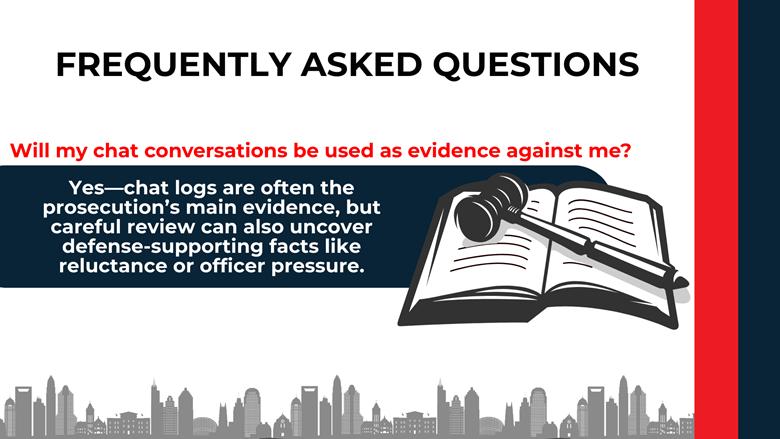
Will my chat conversations be used as evidence against me?
Yes. Chat logs are typically the prosecution’s primary evidence and will be analyzed for predisposition indicators. However, these same logs may also contain evidence supporting your defense, such as initial reluctance, government pressure, or officer-driven escalation. Comprehensive analysis of all communications is critical to defense strategy.
If I showed up to meet the “minor,” can I still claim entrapment?
Appearing at a meeting location significantly undermines an entrapment defense because it demonstrates willingness to complete the offense. It also elevates the charge from a Class H to a Class G felony under N.C.G.S. § 14-202.3. While entrapment may still be raised, conviction becomes substantially more likely when the defendant took concrete steps toward completing the planned meeting.
Conclusion
Because the standards for entrapment and constitutional suppression are so high, these cases require a defense focused on technical detail and veteran experience. Attorney Patrick Roberts brings a unique set of qualifications to these high-stakes challenges:
- Rigorous Trial Training: Patrick is a 2011 Graduate of the NCDC Trial Practice Institute, a two-week intensive program covering every aspect of defending those accused of crimes. He is also a Graduate of the Gerry Spence Trial Lawyer College, where he completed a three-week intensive training focused on all aspects of trial advocacy, from opening statements to closing arguments.
- Consistent Excellence: He has been rated 10/10 “Superb” by AVVO for more than 15 years, a factual reflection of his long-standing reputation for professional conduct and legal skill.
- National Resources & Federal Authority: As a Lifetime Member of the National Association of Criminal Defense Lawyers (NACDL), he is connected to the latest defense strategies nationwide. Furthermore, he is admitted to practice before the Fourth Circuit Court of Appeals and all Federal District Courts in North Carolina, ensuring a robust defense in both state and federal jurisdictions.
“I have always found Patrick to be well prepared and effective. He is intelligent, proactive, and thinks outside the box. He has a lot of experience in many different areas and this enables him to be particularly effective for his clients.” — Martindale-Hubbell Peer Review, October 19 2018*
Disclaimer: The testimonials and peer reviews on this site are for informational purposes. They do not constitute a guarantee, warranty, or prediction regarding the outcome of your legal matter. Every case is different and must be evaluated on its own merits.
*Testimonials and peer endorsements found on this website are actual comments.
Disclaimer: This information is for educational purposes and does not constitute legal advice. Prior training does not guarantee a similar outcome in any future legal matter.
Former assistant district attorney
Contact Patrick Roberts
Facing criminal charges in North Carolina demands seasoned representation. Trust in the experience and dual perspective of Patrick Roberts. Reach out today for a confidential consultation.
-
Call Our Team
Calls answered 24/7






For more information on the selection criteria, go to www.martindale.com
*Each case is different and must be evaluated separately. Prior results achieved do not guarantee similar results can be achieved in future cases.