
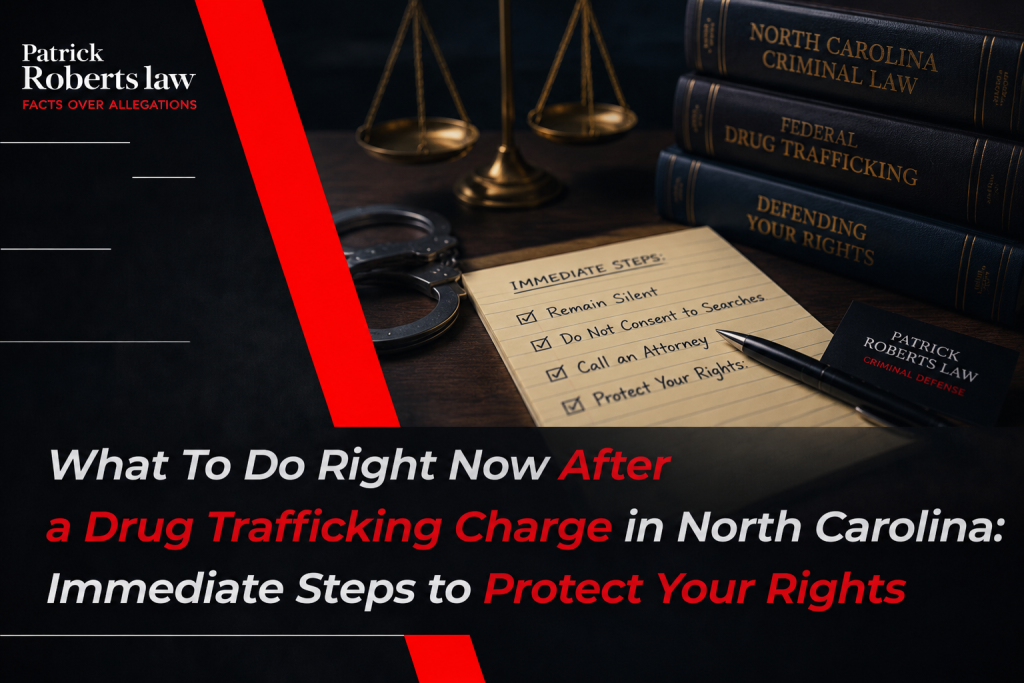
Just Charged With Drug Trafficking? Here Is What You Should Do Next
A drug trafficking charge can be overwhelming. In many cases, the first few hours and days after an arrest are when important decisions are made — decisions that may affect your freedom, your future, and the outcome of your case.
If you or someone you love has recently been charged with drug trafficking in North Carolina, you may be asking:
- What should I say to police?
- Should I answer questions?
- How do I get out of jail?
- Can the charges be reduced?
- What evidence does the state have?
- What type of lawyer do I need?
The most important thing to understand is this:
Do not try to handle a serious drug trafficking accusation alone.
Drug trafficking charges are among the most serious drug-related offenses under North Carolina law. Prosecutors often aggressively pursue these cases, and the consequences can include significant penalties, financial consequences, and long-term impacts on your future.
The decisions you make immediately after an arrest matter.
Before speaking with investigators, discussing your case with others, or making decisions that could affect your defense, speak with an experienced criminal defense attorney.
Patrick Roberts has dedicated his career to defending individuals accused of serious criminal offenses throughout North Carolina. If you have been charged with drug trafficking, contact us today or call Patrick Roberts Law at 919-746-7206 to understand your rights and learn what steps you should take next.
What Should I Do Immediately After Being Charged With Drug Trafficking?
After an arrest, many people make decisions based on fear or confusion. They may believe explaining their side of the story will convince police they are innocent.
Unfortunately, those conversations can sometimes create additional challenges.
Your first priority should be protecting your legal rights.
Step 1: Do Not Talk About Your Case Without an Attorney Present
One of the most important things you can do after a drug trafficking arrest is exercise your right to remain silent.
You are allowed to respectfully tell law enforcement:
“I want to speak with an attorney before answering any questions.”
You do not need to explain:
- Where you obtained something
- Who you were with
- Why you were present somewhere
- Who else may be involved
- Your personal explanation of what happened
Even statements that seem harmless may later be interpreted differently by prosecutors.
Police officers are gathering information for an investigation. They are not responsible for protecting your legal interests.
Before answering questions, contact a qualified defense attorney who can help protect your rights.
If you or a family member has been charged with drug trafficking in Raleigh, Wake County, or anywhere in North Carolina, contact us to discuss your situation with Patrick Roberts.
Step 2: Request a Drug Trafficking Lawyer Immediately
After a drug trafficking arrest, one of the most important decisions you can make is choosing the right legal representation.
Drug trafficking cases often involve complex issues, including:
- Search and seizure questions
- Controlled substance evidence
- Police investigations
- Confidential informants
- Surveillance
- Digital communications
- Alleged distribution activity
- Financial evidence
A knowledgeable defense attorney can review whether law enforcement followed proper procedures and whether the evidence actually supports the charges.
A drug trafficking lawyer can evaluate important questions such as:
- Was the search legal?
- Was evidence collected properly?
- Were your constitutional rights protected?
- Can prosecutors prove the required elements of the offense?
- Are there weaknesses in the state’s case?
Patrick Roberts represents individuals facing serious criminal accusations throughout North Carolina, including allegations involving drug trafficking offenses.
Do not wait until your court date to begin protecting your future. Call Patrick Roberts at 919-746-7206 or contact us to discuss your legal options.
Step 3: Do Not Consent to Searches Without Understanding Your Rights
After an arrest, law enforcement may ask permission to search:
- Your vehicle
- Your home
- Your phone
- Personal property
Many people assume allowing a search will make them appear cooperative.
However, agreeing to a search without understanding your rights may create challenges later.
You should remain respectful and do not physically interfere with officers, but you can clearly state that you do not consent to a search and want to speak with an attorney.
A defense attorney can later examine:
- Whether police had probable cause
- Whether a warrant was valid
- Whether proper procedures were followed
- Whether evidence may be challenged
The details surrounding a search can become a critical part of your defense.
Patrick Roberts can review the circumstances of your arrest and help you understand what legal options may be available. Contact us today to begin discussing your case.
Step 4: Preserve Evidence and Do Not Delete Information
After an arrest, many people panic.
They may delete text messages, remove social media posts, erase files, or contact people involved in the investigation.
This can create additional problems.
Instead, preserve information and allow your attorney to review it.
Important items to preserve include:
- Text messages
- Emails
- Phone records
- Photos or videos
- Social media information
- Receipts
- Documents
- Names of possible witnesses
Do not attempt to explain your situation publicly or contact individuals connected to the investigation.
Your attorney can determine what information may help your defense and how it should be handled.
If you are unsure what information matters in your case, speak with Patrick Roberts Law before taking action. Call 919-746-7206 or contact us for guidance.
Step 5: Gather Information Before Your First Meeting With a Lawyer
Your first consultation is an opportunity to provide your attorney with important details about what happened.
The more information your attorney has, the better they can evaluate your options.
Drug Trafficking Defense Consultation Checklist
Bring any available information related to your case.
Arrest Information
☐ Arrest paperwork
☐ Criminal summons or charging documents
☐ Bond paperwork
☐ Court date information
☐ Law enforcement agency involved
☐ Officer names if available
Details About the Arrest
☐ Date and location of arrest
☐ Where the arrest occurred
☐ Who was present
☐ Whether police searched property
☐ Whether you were questioned
☐ Whether you made any statements
Evidence Information
☐ Text messages
☐ Phone records
☐ Photos or videos
☐ Receipts
☐ Documents
☐ Witness information
☐ Any communication related to the allegations
Personal Background Information
☐ Employment history
☐ Education information
☐ Family responsibilities
☐ Community involvement
☐ Treatment history if relevant
☐ Prior legal history
This information helps your attorney understand the complete situation — not just the accusation.
What Happens After a Drug Trafficking Arrest in North Carolina?
After an arrest for drug trafficking, many people are unsure what happens next. The legal process can move quickly, and decisions made early may influence the direction of the case.
Understanding the next steps can help you make informed decisions instead of reacting out of fear or uncertainty.
While every case is different, a drug trafficking case in North Carolina may involve several important stages.
Step 1: The Arrest and Initial Processing
After an arrest, law enforcement begins the booking and processing procedure.
During this time, important information is collected, including:
- The charges filed
- Arrest records
- Personal information
- Bond recommendations
- Initial court information
At this stage, it is important to avoid discussing the facts of the case with anyone except your attorney.
Anything you say may potentially become part of the investigation.
Step 2: Understanding Bail and Bond After a Drug Trafficking Charge
One of the first concerns many families have after an arrest is:
“How do I get my loved one released?”
Bond decisions can depend on several factors, including:
- The severity of the allegations
- The amount and type of substance involved
- Prior criminal history
- Ties to the community
- Whether the court believes the person will appear for future hearings
- Any potential safety concerns
A judge may consider whether conditions of release are appropriate.
Possible bond conditions may include:
- Financial requirements
- Restrictions on travel
- No-contact conditions
- Reporting requirements
- Other court-ordered conditions
A criminal defense attorney can help you understand the bond process and what factors may impact release.
If someone you care about is currently facing a drug trafficking charge in North Carolina, do not wait to seek legal guidance. Call Patrick Roberts at 919-746-7206 or contact us to discuss your situation.
Step 3: Your Attorney Begins Reviewing the Case
Once retained, your attorney can begin analyzing the details behind the accusation.
A strong defense starts with understanding the facts.
Patrick Roberts may examine issues such as:
Was the Search Legal?
Many drug trafficking cases involve searches of:
- Vehicles
- Homes
- Personal belongings
- Electronic devices
The circumstances surrounding the search can be critical.
Questions may include:
- Did police have probable cause?
- Was a warrant required?
- Was consent properly obtained?
- Were constitutional rights protected?
Does the Evidence Actually Support the Charge?
A drug trafficking accusation requires more than simply claiming drugs were present.
Prosecutors must establish the legal elements required for the offense.
Your attorney may evaluate:
- Quantity of the substance involved
- Testing procedures
- Chain of custody
- Witness statements
- Communication records
- Circumstances surrounding possession
Was There an Allegation of Intent to Distribute?
In many drug cases, prosecutors attempt to show evidence of distribution or trafficking activity.
They may point to factors such as:
- Amount of alleged controlled substances
- Packaging materials
- Money
- Communications
- Location
- Other surrounding circumstances
A defense attorney can examine whether those facts truly support the accusation.
Why You Need an Experienced Drug Trafficking Attorney in North Carolina
A drug trafficking charge is not a minor offense.
These cases often involve aggressive prosecution, complex evidence, and serious potential consequences.
Having an attorney who understands criminal defense strategy can make a difference in how your case is approached.
Patrick Roberts has dedicated his career to defending individuals accused of serious criminal offenses throughout North Carolina.
His approach focuses on:
- Thorough investigation
- Strategic preparation
- Protecting constitutional rights
- Challenging unreliable evidence
- Preparing strong defense strategies
- Helping clients understand their options
When facing a serious accusation, experience matters.
About Patrick Roberts’ Criminal Defense Experience and Training
Patrick Roberts brings extensive training and courtroom experience to criminal defense matters throughout North Carolina.
He is:
- A lifetime member of the National Association of Criminal Defense Lawyers (NACDL)
- Trained in advanced cross-examination through a 2025 intensive with the National Criminal Defense College (NCDC)
- A graduate of the NCDC Trial Practice Institute, a rigorous two-week program focused on criminal defense trial skills
- A graduate of the Gerry Spence Trial Lawyer College, completing a three-week intensive program focused on trial advocacy
He is also recognized through:
- The National Child Abuse Defense & Resource Center as the only North Carolina lawyer featured on its membership listing
- Client Champion Platinum Attorney recognition with more than five consecutive years of recognition
- AVVO 10/10 “Superb” rating for more than 15 years
This level of preparation allows Patrick Roberts to approach serious criminal cases with a focus on strategy, preparation, and protecting the rights of the accused.
To learn more about his background and legal experience, visit About Patrick Roberts.
What Makes Patrick Roberts Law Different When Facing a Drug Trafficking Charge?
When someone is accused of drug trafficking, the charge itself does not tell the entire story.
Behind every case is a person, a family, and a future that may be affected.
Many clients and families are worried about:
- Losing employment opportunities
- Damage to their reputation
- Long-term criminal consequences
- Impact on family relationships
- Uncertainty about what happens next
Patrick Roberts Law understands the stress that comes with facing serious criminal allegations.
The focus is on helping clients understand their options and developing a defense strategy based on the specific circumstances of their case.
Every case deserves careful attention.
What Do Clients and Other Attorneys Say About Patrick Roberts?
When choosing a criminal defense attorney, many people want to know not only about qualifications but also how an attorney has represented others.
Patrick Roberts has received recognition from both clients and legal peers for his dedication, preparation, and commitment to criminal defense.
Peer endorsements and professional reviews highlight his reputation among other attorneys and clients.
You can learn more about professional feedback and attorney reviews through his Martindale peer review profile.
Facing a Drug Trafficking Charge? The Next Step Matters
After an arrest, many people wait because they feel overwhelmed or do not know where to begin.
Waiting, however, can mean losing valuable time.
Early legal guidance allows your attorney to begin evaluating:
- Evidence
- Search procedures
- Potential defenses
- Court strategy
- Possible outcomes
You do not have to face the uncertainty alone.
Patrick Roberts helps individuals throughout North Carolina understand their rights and legal options after serious criminal accusations.
If you or someone you love has been charged with drug trafficking, call Patrick Roberts Law today at 919-746-7206.
You can also contact us to request a consultation and begin discussing your case.
Serving Individuals Facing Drug Trafficking Charges Throughout North Carolina
Drug trafficking charges can happen anywhere, and individuals throughout North Carolina need access to experienced criminal defense representation.
Patrick Roberts represents clients throughout his Areas served, helping individuals and families understand their legal options after serious criminal allegations.
Whether your case involves allegations of possession, distribution, trafficking, or other felony offenses, getting legal advice early can help you make informed decisions.
Immediate Help After a Drug Trafficking Arrest
If you were recently charged with drug trafficking, the most important thing you can do is take action.
Do not:
- Discuss your case with investigators without an attorney
- Post about your case online
- Delete evidence or communications
- Wait until your court date to seek help
Instead:
- Protect your rights
- Preserve information
- Gather your documents
- Contact a criminal defense attorney
Call Patrick Roberts Law now at 919-746-7206 or contact us to discuss your situation.
Former assistant district attorney
Contact Patrick Roberts
Facing criminal charges in North Carolina demands seasoned representation. Trust in the experience and dual perspective of Patrick Roberts. Reach out today for a confidential consultation.
-
Call Our Team
Calls answered 24/7






For more information on the selection criteria, go to www.martindale.com
*Each case is different and must be evaluated separately. Prior results achieved do not guarantee similar results can be achieved in future cases.