
In North Carolina, there is no separate crime called “trafficking a Schedule VI controlled substance.” Schedule VI is simply the state’s classification for marijuana, hashish, and THC. The only one of those with its own trafficking law is marijuana. It’s charged under N.C. Gen. Stat. § 90-95(h) based on weight, not on the schedule number. This article explains what actually triggers a marijuana trafficking charge in NC, the weight tiers and mandatory prison terms attached to each, the two ways a person can get below those minimums, and how these cases are defended.
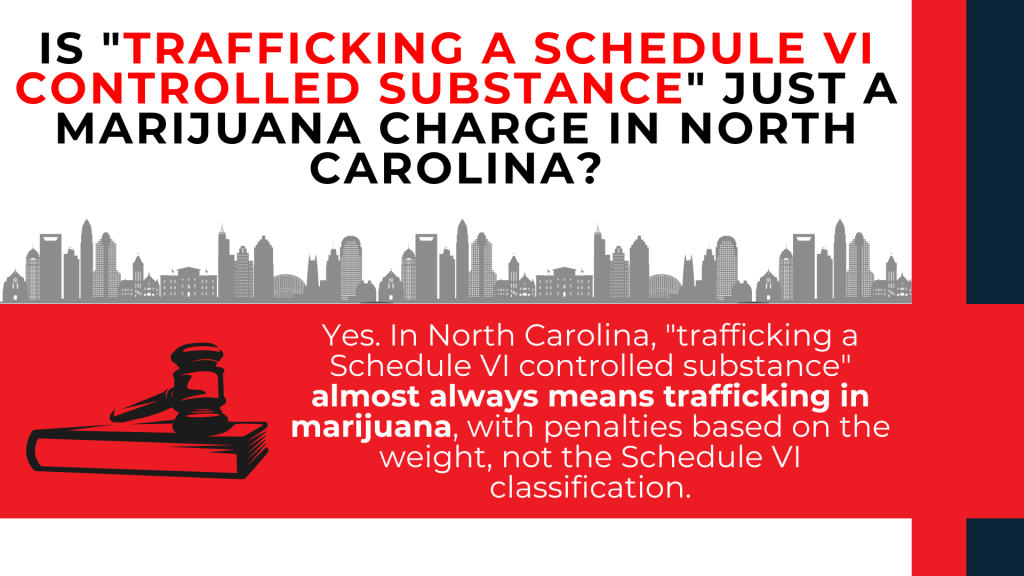
Is “trafficking a Schedule VI controlled substance” just a marijuana charge in North Carolina?
Yes — in practice, it almost always means trafficking in marijuana. Schedule VI is the lowest-tier drug classification under North Carolina law. It covers marijuana, the extracted resin of marijuana (commonly called hashish), and tetrahydrocannabinols, including synthetic THC.
Here’s the piece that trips people up. You can be charged and sentenced over a Schedule VI substance under the ordinary possession rules, where the schedule number matters. But “trafficking” is its own separate statute that doesn’t work by schedule at all. When someone is accused of trafficking a Schedule VI substance in NC, the actual charge on the paperwork is “trafficking in marijuana” under G.S. § 90-95(h)(1). The law also creates a parallel offense, “trafficking in synthetic cannabinoids,” for THC-type lab compounds. Everything that follows — whether it’s a felony, how serious the felony is, and how much prison time is on the table — is driven by one thing: weight.
So if you searched “Schedule VI” because that’s what you saw on a charging document or a bail sheet, you’re in the right place. But the number to focus on isn’t the schedule. It’s the pounds.
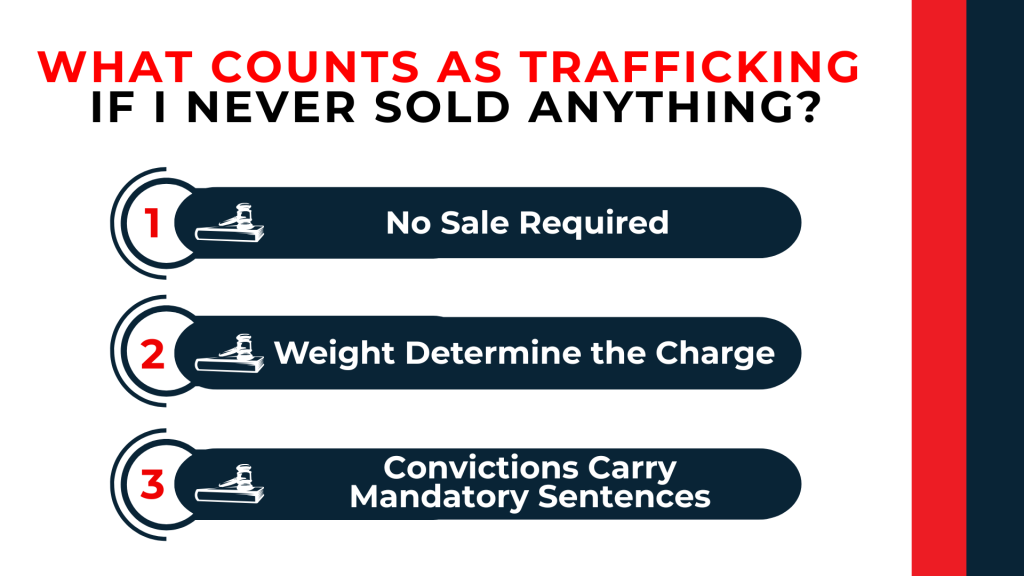
What counts as trafficking if I never sold anything?
You do not have to sell, deal, or intend to distribute anything to be charged with trafficking in North Carolina. Under G.S. § 90-95(h)(1), the crime is committed by anyone who “sells, manufactures, delivers, transports, or possesses” more than the threshold weight of marijuana.
Read that last word again: possesses. That’s the one that surprises people. The statute treats simple possession of a large enough quantity exactly the same as running a distribution operation. No buyer, no money changing hands, no text messages arranging a deal — none of that is required. If the weight is there, the trafficking charge is available to the prosecutor, full stop.
This is why, even if you think of yourself as “just a heavy user” or someone “just holding it,” you can find yourself facing a charge with the word trafficking in it. And a mandatory prison sentence sits behind it. The label describes the amount, not your conduct.
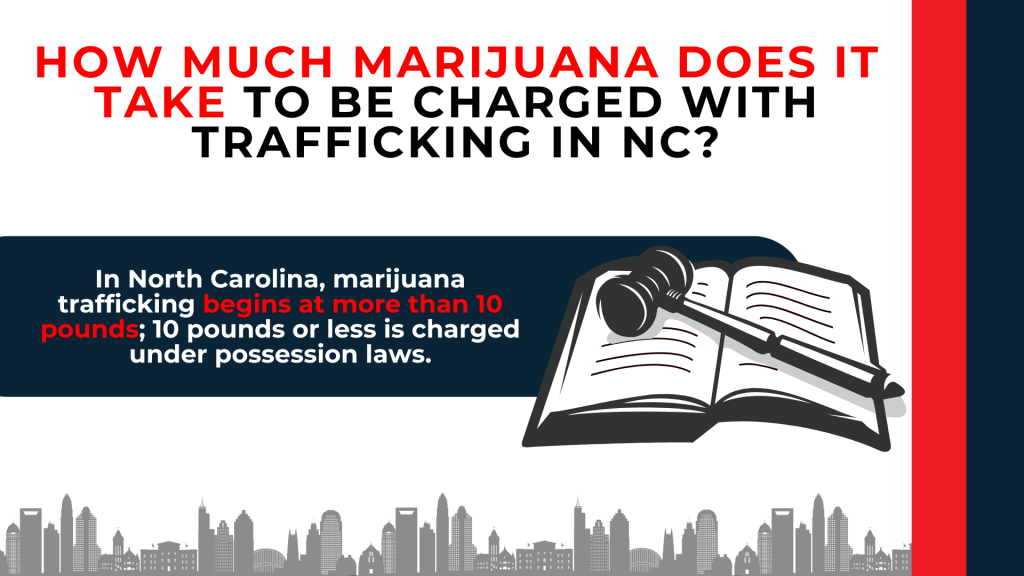
How much marijuana does it take to be charged with trafficking in NC?
Trafficking in marijuana starts at more than 10 pounds. Anything at or below that line is not trafficking. It falls under North Carolina’s ordinary possession and possession-with-intent laws, which are far less severe and do not carry mandatory prison time.
That 10-pound line is the entire dividing line between a serious-but-survivable drug case and a mandatory-minimum felony. Below it, depending on the amount, you’re looking at a misdemeanor or a lower-level felony where a judge has real discretion. Above it, the rules change completely — the judge’s hands get tied in ways described in the next two sections. For hashish and synthetic THC the numbers are different and much smaller, but for plant marijuana, 10 pounds is the number that matters.
What are the penalties for trafficking marijuana by weight in NC?
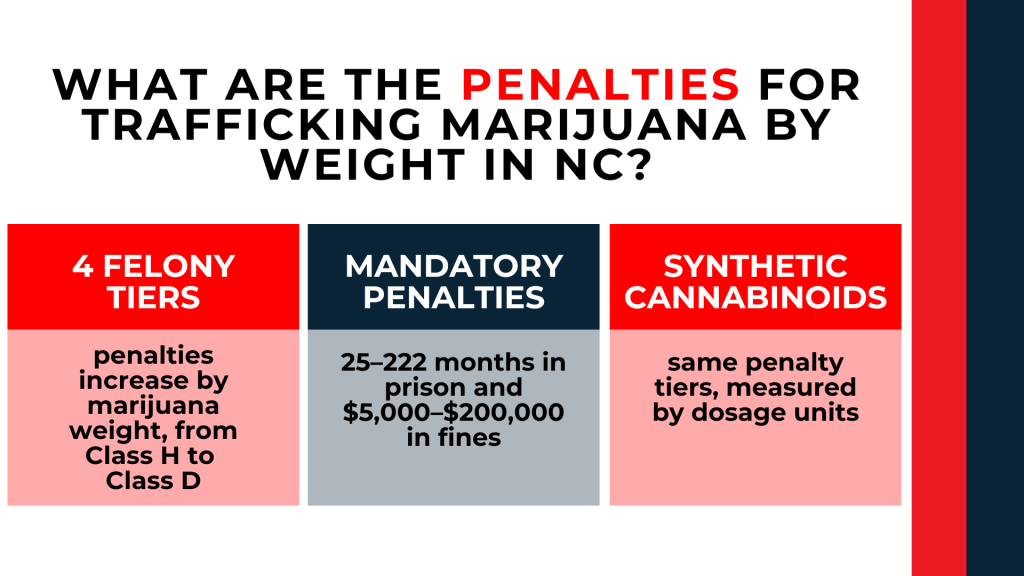
Marijuana trafficking is punished in four weight tiers. Each tier carries its own felony class, a mandatory minimum and maximum prison term, and a mandatory minimum fine. Here is what G.S. § 90-95(h)(1) sets out:
| Weight | Felony Class | Mandatory Prison Term | Mandatory Minimum Fine |
| More than 10 lbs, less than 50 lbs | Class H | 25–39 months | $5,000 |
| 50 lbs to less than 2,000 lbs | Class G | 35–51 months | $25,000 |
| 2,000 lbs to less than 10,000 lbs | Class F | 70–93 months | $50,000 |
| 10,000 lbs or more | Class D | 175–222 months | $200,000 |
To put the top tier in plain terms: 10,000 pounds or more is a Class D felony carrying a mandatory minimum of 175 months — roughly 14.5 years — with a $200,000 fine.
Trafficking prosecutions are not rare or theoretical in this state. North Carolina courts recorded 638 drug-trafficking convictions in fiscal year 2024.
A separate note for synthetic products: “trafficking in synthetic cannabinoids” runs on the same structure but measures dosage units, and the statute defines a dosage unit as 3 grams. Trafficking begins above 50 dosage units and escalates through the same Class H, G, F, and D tiers.
Can a judge give me probation or a suspended sentence instead of prison?
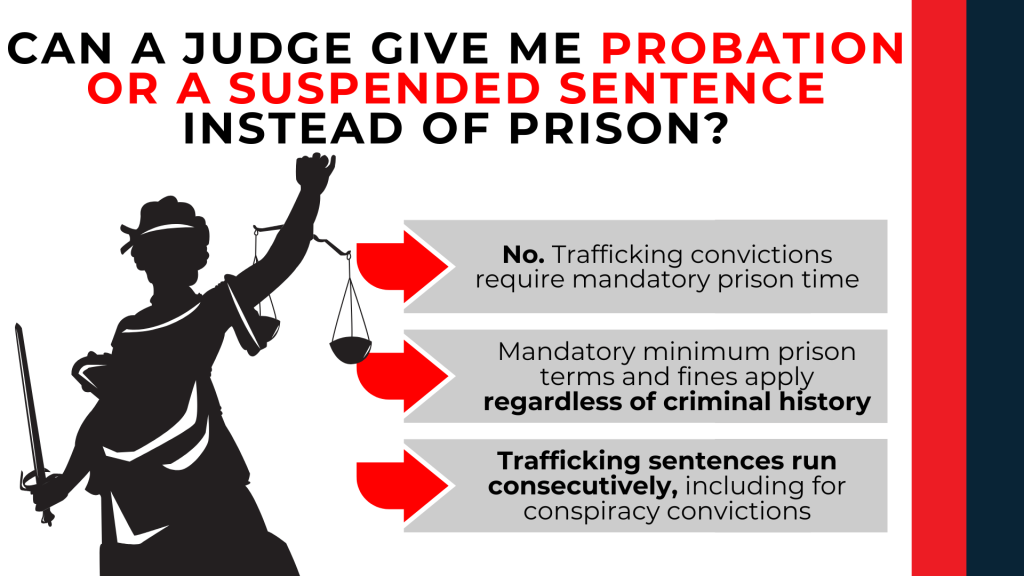
Generally, no. This is the hard truth about trafficking charges and the single most important thing to understand about them. Under G.S. § 90-95(h)(5), a person convicted of trafficking may not receive a suspended sentence or be placed on probation. The judge must impose the mandatory minimum prison term for the applicable weight tier.
Three features make this different from an ordinary drug case:
- The minimums are mandatory and fixed. They apply regardless of your prior record level. A first-time offender and someone with a long record face the same floor for the same weight. In normal NC felony sentencing, criminal history moves the number — here it does not.
- The fines are floors, not ceilings. The dollar figures in the table above are the minimum the judge can impose. They cannot be waived down as a matter of ordinary discretion.
- The sentence stacks. Under G.S. § 90-95(h)(6), a trafficking sentence runs consecutively with any other sentence you’re serving — meaning it’s added on top, not served at the same time.
One more point that matters: the same penalties apply to conspiracy to commit trafficking under G.S. § 90-95(i). You can face a full trafficking sentence for an agreement, even without ever personally holding the marijuana.
This is the part of the situation that does not resolve itself by waiting. A trafficking charge that sticks means active prison time by default.
What are statutory exceptions to mandatory prison time?
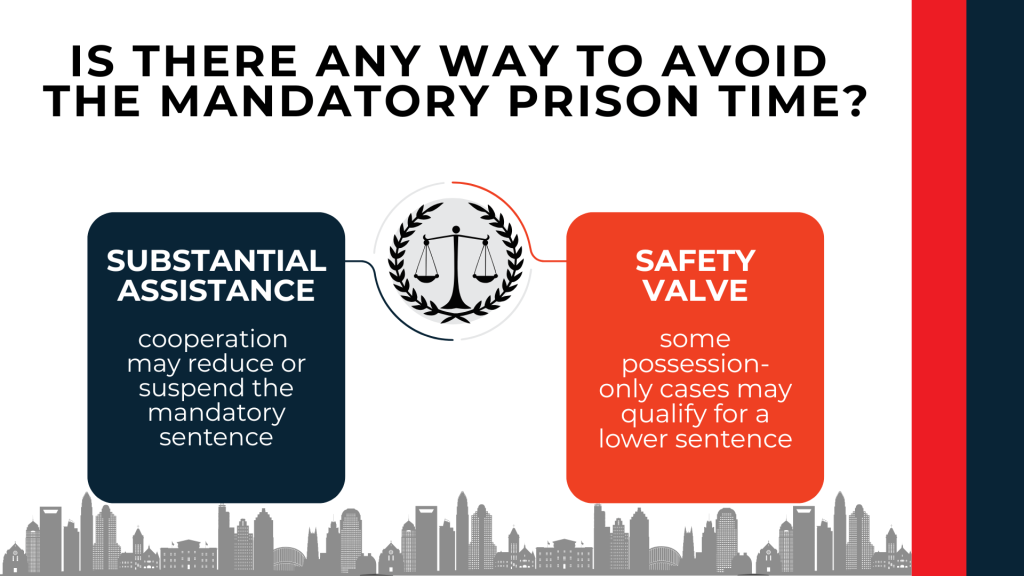
Yes. While North Carolina trafficking laws are rigid, the statute provides two specific legal exceptions to mandatory minimum sentences. These statutory mechanisms frequently form the foundation of a trafficking defense strategy, but both require defense counsel to build a strict evidentiary record for the court.
1. Substantial Assistance (G.S. § 90-95(h)(5))
Under G.S. § 90-95(h)(5), a judge is granted the authority to reduce the mandatory fine, impose a prison term below the minimum, or suspend the sentence entirely and grant probation. However, this exception only applies if the defendant has provided “substantial assistance” in identifying, arresting, or convicting accomplices, co-conspirators, or principals.
The judge must make a formal finding of this assistance on the court record. In practical terms, this is the cooperation pathway. Navigating this process requires strategic legal counsel, as attempting to provide statements or cooperate with law enforcement without an attorney carries significant legal risk and can severely compromise a case.
2. The “Safety Valve” for Possession-Only Cases (G.S. § 90-95(h)(5a))
North Carolina provides a second, narrower exception under G.S. § 90-95(h)(5a)—often referred to by legal professionals as the “safety valve.” This provision allows a judge to sentence a defendant below the mandatory minimum, aligning the penalty with the ordinary offense class and the defendant’s prior record level.
To utilize this exception, a judge must hold a hearing and formally find that the defendant meets a strict list of statutory conditions, including:
- The defendant accepted responsibility for the offense.
- The defendant has no prior felony convictions under G.S. § 90-95.
- No violence was used, and no weapon was involved in the offense.
- The trafficking charge is based solely on possession (meaning there is no substantial evidence that the defendant transported, sold, manufactured, or delivered the drug).
- The defendant admitted to a substance use disorder and successfully completed an approved treatment program.
- The court determines that imposing the mandatory minimum would constitute a “substantial injustice.”
This is a demanding legal threshold, and the defense must affirmatively establish every element. However, for individuals charged with trafficking purely based on the weight of the substance possessed, this statute can provide the critical difference between a mandatory prison term and a significantly mitigated sentence.
How can a marijuana trafficking charge actually be fought?
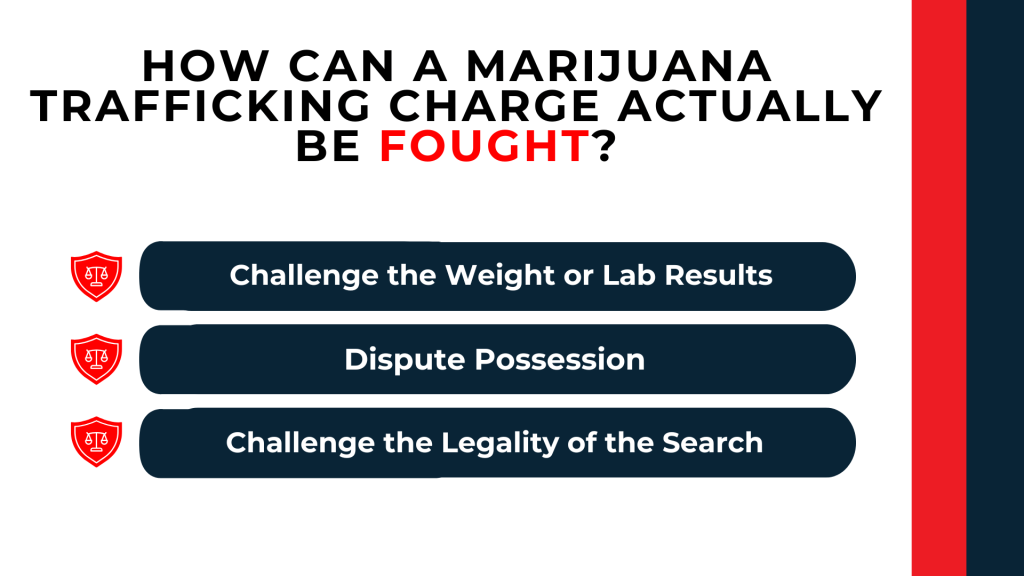
Because trafficking is defined entirely by weight and what the substance is, those two facts are the case — and both can be challenged. The state has to prove not just that you possessed something, but that it was marijuana and that it crossed the weight threshold. That gives a defense several real angles of attack.
Can I challenge the weight and the lab report?
The prosecution proves what the substance is, and often how much of it there is, through a state crime lab report. But that report doesn’t get into evidence automatically. Under G.S. § 90-95(g), the State can only use the lab report without calling the analyst to testify if it notifies you at least 15 business days before the proceeding and gives you a copy. And even then, you have the right to object at least five business days out and force the analyst into court. There’s a parallel notice-and-objection procedure for the chain of custody under G.S. § 90-95(g1). Missing or mishandled notice, a broken chain of custody, or questions about how the weight was measured (including what plant material or packaging was improperly included in the total) can all put the state’s core proof in doubt. When your entire tier — and your mandatory minimum — turns on which side of a weight line you fall, a few ounces of dispute can matter enormously.
Can the state prove you actually possessed it?
The statute punishes the person who possesses the marijuana — and possession is frequently the weakest link in the state’s case. Trafficking charges are often built on where the drugs were found (a car, a shared apartment, a package) rather than on the drugs being in someone’s hand. When more than one person has access to the space, whether the state can tie the marijuana specifically to you becomes a genuine fight, not a formality.
How did the police get the evidence?
How the evidence was gathered may also be worth examining. Depending on the facts, the circumstances of the stop, the search, and the seizure that produced the drugs can be something an experienced defense lawyer reviews closely.
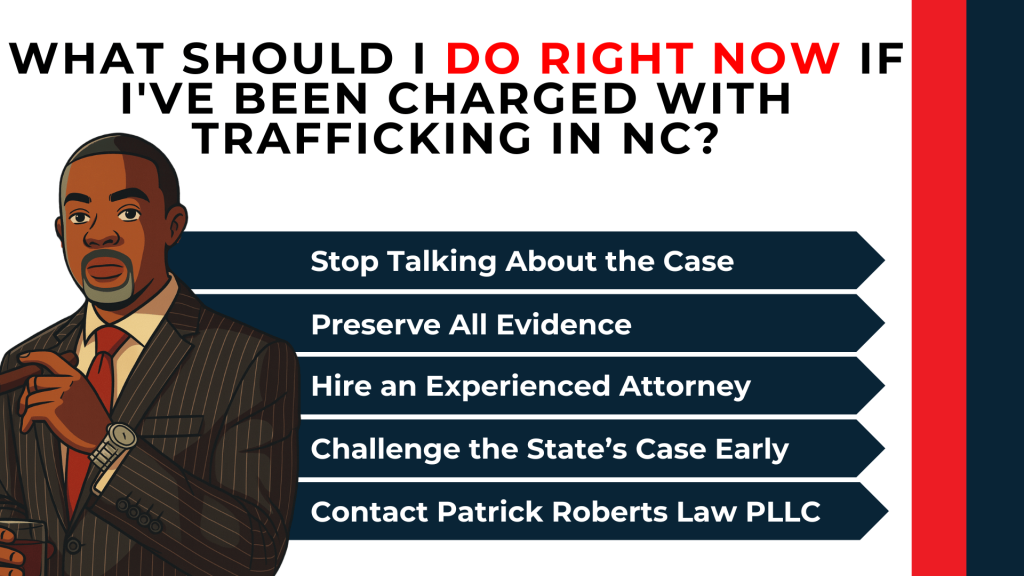
What should I do right now if I’ve been charged with trafficking in NC?
Three things, in order:
- Stop talking about the case. Don’t explain, minimize, or “clear things up” with police or anyone else. In a possession-based trafficking case, your own words are often the bridge the state uses to connect you to the drugs.
- Preserve everything and change nothing. Don’t delete texts, wipe phones, or move property. Write down — for your lawyer only — exactly what happened, while it’s fresh.
- Get a defense attorney who handles NC trafficking cases, now. These cases move, and the early decisions (bond, cooperation timing, preserving lab and search challenges) shape everything downstream. It’s worth remembering that roughly 98% of felony convictions in North Carolina come from guilty pleas. That means the leverage a lawyer builds before trial — through suppression motions and safety-valve or substantial-assistance groundwork — is usually where the outcome is actually won.
Dedicated Representation for Wake County and Triangle Communities
Based in Raleigh—with offices in Durham, Chapel Hill, and Cary—Attorney Patrick Roberts provides legal defense for state and federal felony and complex drug offenses across North Carolina. He brings over 24 years of legal practice, with an educational background from Johns Hopkins University and Duke University School of Law.
His career includes trying over 80 criminal jury trials to verdict across state and federal courts. As a former Assistant District Attorney in Wake, Johnston, and New Hanover counties, Attorney Roberts prosecuted drug trafficking cases alongside law enforcement interdiction teams. His trial practice spans both sides of the judicial process, ranging from state drug prosecutions to multi-defendant federal conspiracy cases in multi-week trials. This background informs his evaluation of state evidence, law enforcement procedures, and prosecution strategies.
Attorney Roberts is admitted to practice before the North Carolina State Courts, the U.S. District Courts for the Eastern, Middle, and Western Districts of North Carolina, the U.S. Court of Appeals for the Fourth Circuit, and the Supreme Court of the United States.
Client Review
“Mr.Roberts was a great attorney to work with. From the start he was confident and transparent with us. He told us he had other strategies as back up in case his main one didn’t go as planned. That showed us that he was prepared for any obstacle that was coming his way. We went to the first court hearing and waited, we then saw Mr. Roberts walk in with confidence and his head up high. He looked fearless and ready. That day we were the first ones out, we were in there for probably 10 minutes. The one thing that stuck with me that he said was “don’t be scared because I’m not scared.” He was good at communicating with us and keeping us informed with what was going on and when the next court dates would be. Overall he was a good attorney to work with, he dedicates and puts his time into your case and will work on it for however long he will need to whether it’s lengthy or not.” – Verified client review via Avvo.com
Peer Endorsement
“Patrick is a thoughtful and experienced attorney. When I have a client needing representation in the Raleigh area in his areas of practice, he would be my referral of choice.” – Verified peer endorsement via Avvo.com
Disclaimer: The client reviews and peer endorsements featured on this website reflect actual comments provided by clients and legal professionals. This information is intended for general informational purposes only and does not constitute a guarantee, warranty, or prediction regarding the outcome of any future legal matter. Every legal case presents unique facts and circumstances that must be evaluated independently on its own merits. The testimonials displayed here do not represent all reviews or endorsements received by the firm.
Case Review
- Accusation: Felony Level I Trafficking in Heroin, Simple Possession of Schedule IV Controlled Substance, and Simple Possession of Schedule VI Controlled Substance.
- Statutory Exposure: Mandatory minimum of 70 to 93 months in active state prison and a mandatory $50,000 fine for the trafficking count, plus up to 140 days for the misdemeanor possession counts.
- Defense Strategy: Upon obtaining and reviewing the official law enforcement checkpoint plan, Attorney Roberts identified key constitutional violations in how the stop was conducted and drafted a motion to suppress evidence on Fourth Amendment grounds.
- Final Result*: Felony Level I Heroin Trafficking charge dismissed prior to trial. Attorney Roberts negotiated a resolution allowing the client to plead to two misdemeanor possession counts with a sentence of probation.
*Disclaimer: Case outcomes depend upon a variety of factors unique to each case. Prior results do not guarantee or predict a similar outcome in any future legal matter.
Dedicated Representation for Wake County and Triangle Communities
If you or someone in your family is facing a trafficking charge, contact Patrick Roberts Law PLLC to talk through where your case falls on the weight tiers and which of the defenses above actually apply to your facts.
He provides legal representation for high-stakes cases across North Carolina, focusing locally on Wake County areas such as Raleigh, Cary, Apex, Holly Springs, Garner, and Fuquay-Varina.
The firm maintains a selective intake process to ensure that each client receives the focused professional attention their case requires.
This article is general legal information about North Carolina law, not legal advice. Reading it does not create an attorney-client relationship. Every case turns on its own facts — consult a licensed North Carolina attorney about your specific situation.
Former assistant district attorney
Contact Patrick Roberts
Facing criminal charges in North Carolina demands seasoned representation. Trust in the experience and dual perspective of Patrick Roberts. Reach out today for a confidential consultation.
-
Call Our Team
Calls answered 24/7






For more information on the selection criteria, go to www.martindale.com
*Each case is different and must be evaluated separately. Prior results achieved do not guarantee similar results can be achieved in future cases.