
A drug trafficking charge in North Carolina gets dismissed when the State can’t lawfully prove one of the pieces it needs to convict you — not because you talk a prosecutor into believing you’re innocent. That distinction is the whole game, and most people searching this question have it backward.
Below is what actually leads to a dismissal in a North Carolina trafficking case: the reframe you need first, the specific weaknesses that break these cases, a state-specific deadline that quietly decides a lot of them, what your options are if outright dismissal isn’t realistic, and the moves that damage your defense right now.
Can you really get a trafficking charge dismissed, or is that wishful thinking?
Yes, trafficking charges get dismissed — but you should hear the honest version, because false hope leads to bad decisions. According to the North Carolina Sentencing and Policy Advisory Commission, most drug cases end in a conviction: in North Carolina state courts, about 98% of felony convictions come from guilty pleas, not trials. That number scares people into pleading fast. It shouldn’t.
Here’s the other side. A meaningful share of drug prosecutions never reach a conviction at all. According to the Bureau of Justice Statistics (BJS) Federal Justice Statistics report, in the federal system, prosecutors declined to pursue roughly one in four drug matters referred to them, and about 7.8% of the drug cases they did charge were dismissed. Cases fall apart — but they fall apart because a defense lawyer forced the issue early, not because the defendant waited and hoped.
The realistic frame is this: dismissal is real, it is not automatic, and the battle is won or lost mostly in the weeks before a plea agreement is ever placed on the table.
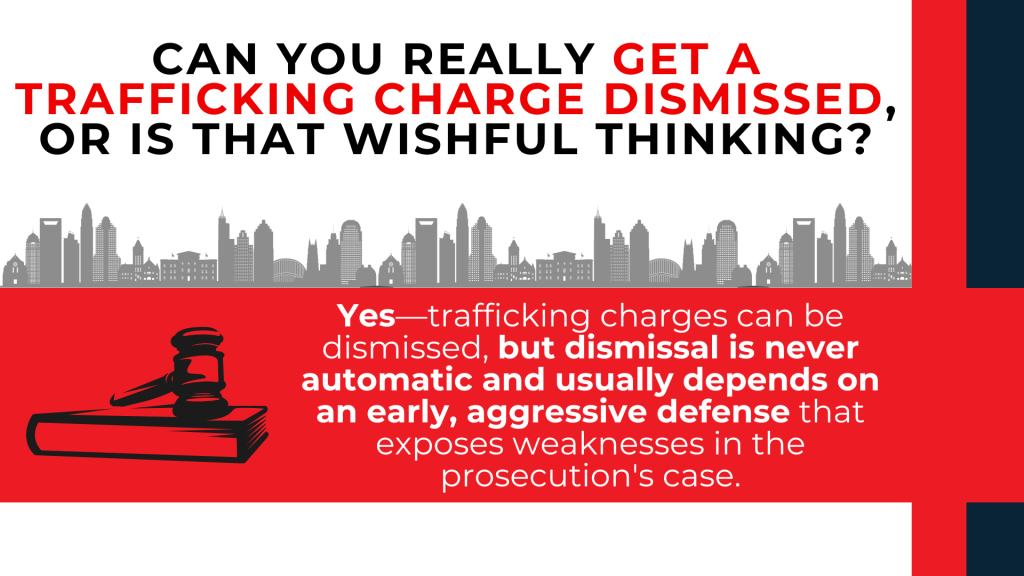
Doesn’t a dismissal depend on whether I actually did it?
No. A dismissal turns on whether the State can prove its case with legal, admissible evidence — not on whether you did what they say. This is the single most important thing to understand, so sit with it for a second.
To convict you of trafficking, the State has to prove several separate things: that the substance is what they claim, that it weighed what they claim, that it was legally yours, and that every piece of that evidence was obtained and handled lawfully. Each of those is a moving part. Each one can break.
When a part breaks — when the search was illegal, when they can’t prove the drugs were yours, when the weight is wrong, when the lab evidence can’t come in — the State’s case gets weaker or disappears. That’s what a dismissal looks like in practice. You don’t win by proving innocence. You win by making it impossible for the State to prove guilt the way the law requires.
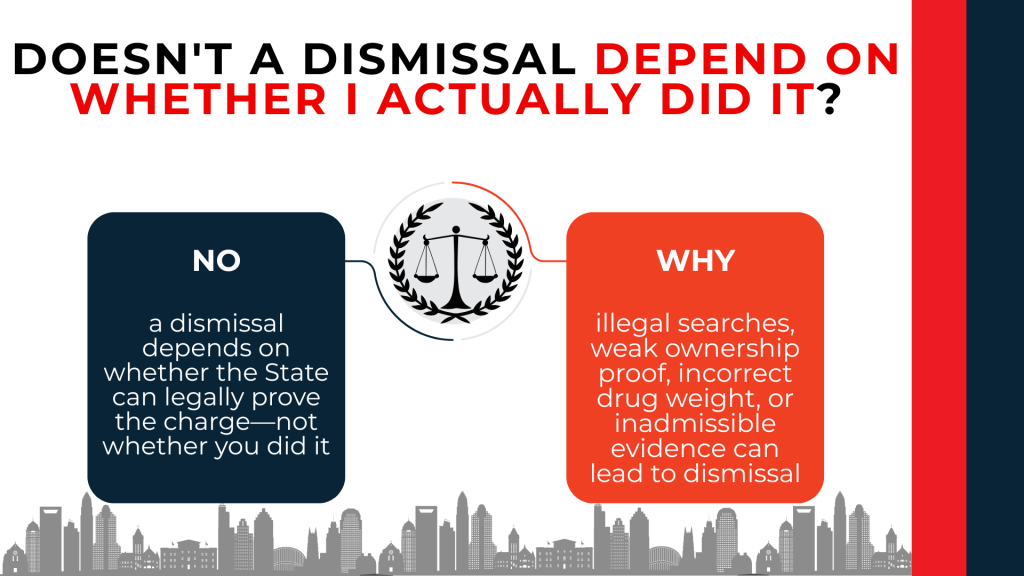
What actually gets a drug trafficking charge dismissed?
Trafficking charges break at specific, recurring pressure points. A good defense attorney goes through the file looking for each one.
- An illegal stop, search, or seizure
If police found the drugs through an unlawful stop or search, the evidence may be suppressed. That means the judge rules it can’t be used against you. When the drugs are the whole case, suppressing them can end the case.
This is where a lot of trafficking prosecutions die: the traffic stop that had no legal basis, the search of a car or home that went beyond what the officer was allowed to do, the “consent” that wasn’t really voluntary. If the way police got the evidence was illegal, the evidence — and frequently the charge — can go with it.
- The drugs weren’t legally yours
Being near drugs is not the same as legally possessing them. When drugs are found in a shared car, a shared apartment, or a space multiple people could access, the State has to prove you had control over them. Being in the room isn’t enough.
These “whose drugs were they” cases can be among the most winnable, because being nearby alone may not be enough. If someone else had equal access, or the drugs weren’t on you, that’s a real fight over something the State has to prove.
- The weight doesn’t add up
North Carolina trafficking is triggered entirely by weight. If the actual quantity falls below the trafficking threshold, it legally cannot be trafficking. It drops to a lesser possession or possession-with-intent charge that carries a far lighter potential sentence.
Under N.C. Gen. Stat. § 90‑95(h), the lines are hard numbers: 28 grams for cocaine, 4 grams for heroin or other opioids, 28 grams for methamphetamine, 4 grams for fentanyl, and more than 10 pounds for marijuana. Cross the line by a fraction and you’re facing a mandatory prison sentence. Fall below it and you’re in an entirely different, far less severe category. That makes the measurement itself something worth fighting — including how the substance was weighed. Keep in mind, though, that for most of these substances the statute reaches “any mixture containing” the drug. That means the weight that counts is often the whole mixture, not just the pure drug. And that’s exactly why the measurement needs a lawyer’s scrutiny rather than a guess.
- The State can’t prove what the substance is
The State has to prove the substance actually is the drug they say it is. That proof normally comes from a state crime lab report. If that report can’t come into evidence, the State has a serious problem — which leads directly to the next section.
- A confidential informant or controlled buy that falls apart
Many trafficking cases are built on an informant or a controlled purchase. When the informant can’t be produced, isn’t credible, or the buy wasn’t properly documented and supervised, the foundation of the case can crack. Cases that look strong on a police report can look very different once the informant piece is tested.
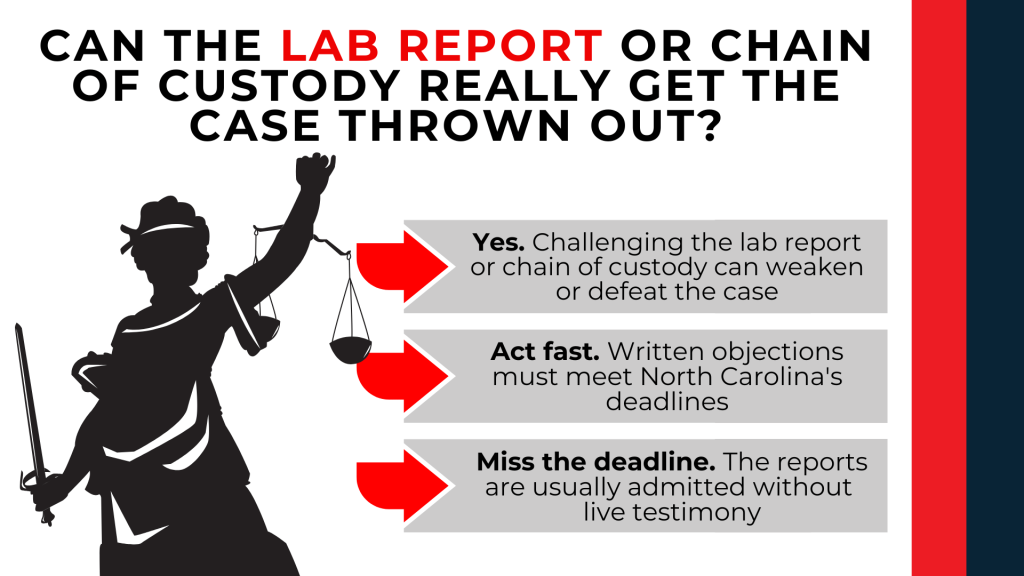
Can the lab report or chain of custody really get the case thrown out?
Yes — and this is one of the most powerful and most overlooked tools in a North Carolina trafficking case. It runs on a deadline most defendants never hear about.
Under § 90‑95(g), the State’s drug-analysis report is the document that proves the identity, nature, and quantity of the substance. It can be admitted into evidence without the analyst ever testifying. But only if the State gives you notice at least 15 business days before the proceeding. And only if you file a written objection at least 5 business days before it. Miss that objection deadline and the objection is waived — the report comes in automatically, unchallenged.
A similar trap applies to chain of custody, meaning the documented trail of who handled the evidence and when. Under § 90‑95(g1), the State can prove that chain with signed statements instead of live witnesses — again, unless you object in time.
Object properly, and you force the State to actually produce its analyst and its witnesses. They then have to prove — under oath, subject to cross-examination — that the substance is what they say, that it weighed what they say, and that nobody mishandled it along the way. That’s a much harder case for the State to make, and it’s how a lot of trafficking prosecutions quietly collapse. But it only happens if someone files the objection before the deadline runs out.
What if the charge can’t be dismissed outright — what else can happen?
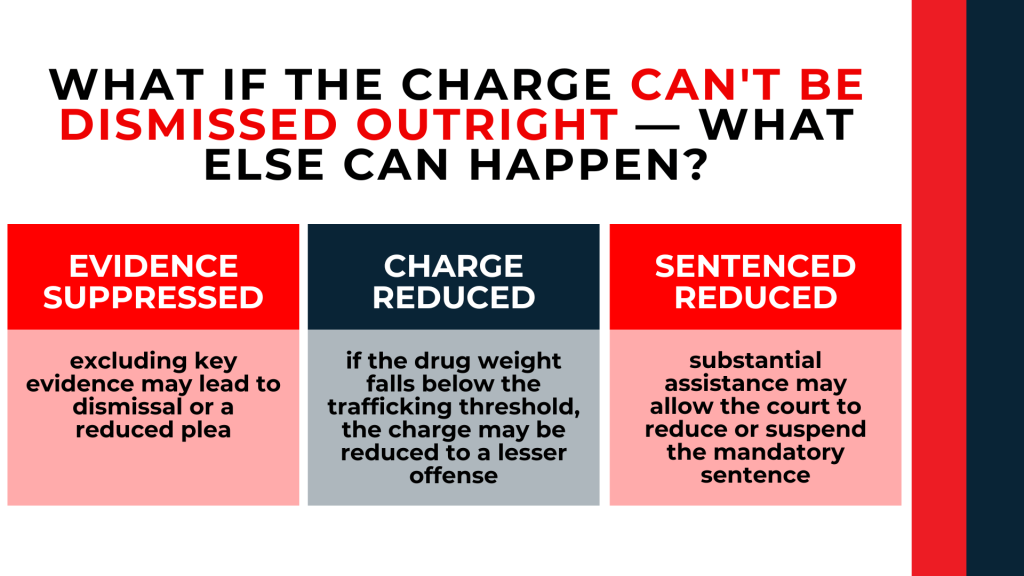
Plenty. “Dismissed” is the ceiling, not the only good outcome. Several results short of a full dismissal can still keep you out of prison and off a trafficking record.
What if suppression guts the case?
A successful motion to suppress doesn’t always produce an instant dismissal on paper. But when the core evidence is thrown out, the State often has no case left to try, and a dismissal or a dramatically reduced plea can follow.
Can the charge be reduced below the trafficking threshold?
Because trafficking is defined by weight, knocking the provable quantity below the statutory line moves you out of mandatory-minimum territory entirely and into ordinary possession or possession-with-intent. Those charges, unlike trafficking, may be eligible for probation or other alternatives.
Can substantial assistance lower the sentence?
North Carolina trafficking sentences are mandatory and normally cannot be suspended or probated. The main statutory exception is § 90‑95(h)(5). A judge may go below the mandatory minimum — or even suspend the sentence — if you’ve provided substantial assistance in identifying, arresting, or convicting others, and the judge puts that finding on the record. It isn’t right for everyone and carries real risks. For perspective on how central cooperation is to these cases, about 35% of North Carolina’s federally sentenced drug-trafficking defendants received a cooperation-based sentence reduction in one recent year. It’s a federal figure, but a sign of how often this path gets used. Whether it makes sense in your case is a decision to make with a lawyer, not alone.
What should I do right now to protect my chance of a dismissal?
The fastest way to lose a winnable case is to damage it in the first days. Avoid these:
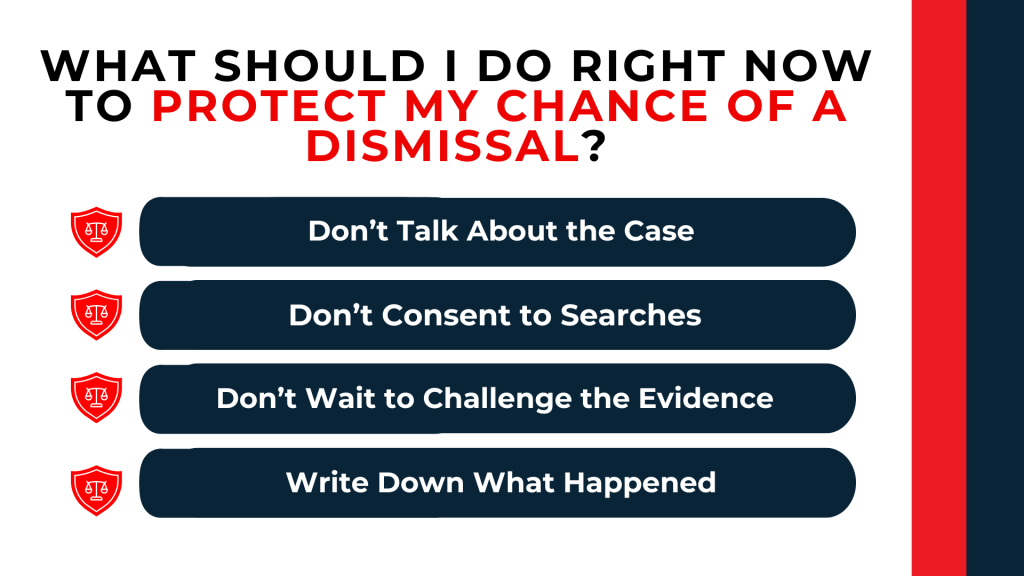
- Don’t talk about the case — to anyone but a lawyer. Not to police, not to friends, not on jail calls. Jail phone lines are recorded and routinely used as evidence. A statement made to “explain your side” can hand the State the piece it was missing.
- Don’t consent to searches, and don’t hand over your phone or passcodes. Consent can erase the illegal-search defense described above before your lawyer ever sees the file.
- Don’t wait to challenge the evidence. The objection deadlines for the lab report and chain of custody run on their own clock. The best defenses — the suppression motion, the weight challenge, the lab objections — are all built early, before any plea.
- Write down what happened while it’s fresh: how the stop started, what officers said, what they searched, who else was present. Those details are where suppression motions come from.
What to do next
- Stop discussing your case with anyone but a lawyer — including on recorded jail calls.
- Write down everything you remember about the stop, search, and arrest while the details are sharp.
- Get a trafficking-experienced attorney to review the file before your next court date — and before any objection deadline passes.
Strategic Evaluation of High-Stakes Case Files
At Patrick Roberts Law PLLC in Raleigh—with offices in Durham, Chapel Hill, and Cary—getting an early review of your case file is the most important step in your defense.
Patrick Roberts is a graduate of Duke University School of Law and holds a Bachelor’s degree from The Johns Hopkins University. Beyond his formal degrees, he has completed the most prestigious trial advocacy programs in the nation:
- Gerry Spence Trial Lawyers College: A 3-week intensive program covering every phase of a trial.
- NCDC Trial Practice Institute: A 2-week mastery course on comprehensive criminal defense.
- 2025 NCDC Cross-Examination Intensive: Advanced, hands-on training in high-stakes witness questioning.
Premier Peer Recognition & Ratings
Consistently ranked at the top of the legal profession for ethics and ability:
- National Association of Distinguished Counsel (2026)
- AV Preeminent Peer Rated (2026): The highest possible rating by Martindale-Hubbell, held for over 5 consecutive years.
- Client Champion Platinum (2026): Recognized for excellence in client service for over 5 straight years.
- AVVO Rating 10/10 “Superb”: Maintaining a perfect rating for more than 15 years.
Featured Professional: Recognized in Super Lawyers Magazine and featured on the cover of Attorney-at-Law Magazine.former Assistant District Attorney in Wake, Johnston, and New Hanover counties. Because he spent years working as a prosecutor, he knows how the State builds a drug trafficking case, and he knows where police investigations tend to fall apart. He also co-authored a legal book on search and seizure law—the exact area of law that decides whether the police had a legal right to stop you or search your property.
Over more than twenty years in practice, Mr. Patrick Roberts has handled thousands of criminal cases across North Carolina. The defenses our firm uses—like challenging illegal searches, double-checking lab drug weights, and fighting chain-of-custody errors—are based entirely on deep legal analysis and hard work on your file.
Attorney Roberts provides expert legal counsel across the full spectrum of North Carolina criminal law. He leverages a deep institutional knowledge built over more than 80 criminal jury trials taken to verdict.
His authoritative knowledge of drug defense is built upon specific professional milestones:
- Prosecutorial Insight: Worked alongside drug interdiction teams to build multi-layered conspiracy prosecutions.
- Trial Experience: Tried drug trafficking cases in state court and defended complex, multi-defendant federal drug conspiracies in trials lasting several weeks.
- Elite Jurisdictions: Admitted to practice before the U.S. Court of Appeals for the Fourth Circuit and the United States Supreme Court.
By knowing exactly how the prosecution builds its case from the ground up, Attorney Roberts is uniquely positioned to identify weaknesses in the state’s evidence and protect his clients’ constitutional rights.
Client Review
“I highly recommend this attorney to anyone needing experienced and knowledgeable legal representation. From the beginning, he clearly explained the steps necessary to address my situation and made sure I understood the process along the way. He kept me informed as progress was being made and was always professional, responsive, and prepared. Although the legal process can move slowly at times, I always felt confident that my case was being handled properly. When my court date finally arrived, he was exceptionally well prepared and navigated the courtroom procedures with confidence and skill. His experience and attention to detail ultimately helped lead to a very positive outcome in my case. I truly appreciated his guidance and representation throughout the entire process.” – Verified client review on Avvo.com
*Disclaimer: Each case is different and must be evaluated separately. Prior results achieved do not guarantee similar results can be achieved in future cases.
Peer Endorsement
“I endorse this lawyer. Patrick is a great trial lawyer and a person who I go to for legal advice in my own practice. Patrick is dedicated to his client’s and a master at criminal defense. I would not hesitate to hire him if I was in trouble and needed a lawyer.” – Verified Peer endorsement via Avvo.com.
Disclaimer: The client reviews and peer endorsements featured on this website reflect actual comments provided by clients and legal professionals. This information is intended for general informational purposes only and does not constitute a guarantee, warranty, or prediction regarding the outcome of any future legal matter. Every legal case presents unique facts and circumstances that must be evaluated independently on its own merits. The testimonials displayed here do not represent all reviews or endorsements received by the firm.
Case Summary
Attorney Roberts’ client was accused of multiple drug offenses, including Felony Level I Trafficking in Heroin, Simple Possession of a Schedule IV Controlled Substance, and Simple Possession of a Schedule VI Controlled Substance.
Under North Carolina law, the felony trafficking charge carried a mandatory minimum sentence of 70 to 93 months in state prison and a mandatory $50,000 fine. The secondary possession charges carried an additional potential penalty of up to 140 days in confinement.
Defense Strategy
The defense strategy centered on challenging the constitutional validity of the initial law enforcement encounter. Attorney Patrick Roberts obtained the internal law enforcement checkpoint plan to review whether the stop complied with strict constitutional requirements governing vehicle checkpoints.
Upon analyzing the documentation, Attorney Roberts identified clear constitutional violations in how the checkpoint was planned and executed. He then drafted a formal motion to suppress the evidence gathered during the stop, arguing that law enforcement violated his client’s Fourth Amendment rights.
Result
By confronting prosecutors with constitutional violations in their checkpoint plan, Attorney Patrick Roberts led the state to dismiss the Felony Level I Trafficking in Heroin charge prior to trial.
He then secured a favorable plea deal where his client pleaded to two minor misdemeanor possession counts and received probation—successfully* saving his client from a mandatory 70 to 93 months in active prison and a $50,000 fine.
Disclaimer: The case outcomes detailed above depend entirely on the specific legal and factual circumstances of this case. Prior results do not guarantee, warrant, or predict a similar outcome in any future legal matter.
View more case results.
Disclaimer: The case outcomes described on this profile represent specific legal matters handled by Attorney Patrick Roberts. These summaries are provided purely for informational purposes to illustrate his professional experience. Each legal matter involves unique facts, evidence, and legal variables; therefore, these descriptions do not guarantee, warrant, or predict a similar outcome in any future case.
Schedule a Case Evaluation with Attorney Patrick Roberts
If you or a family member is facing a drug trafficking charge in North Carolina, securing an immediate case file review is critical to protecting your constitutional rights. Statutory deadlines and procedural rules strictly govern when a defense attorney can file motions to suppress evidence or challenge a search warrant. Delaying this review can result in the waiver of vital legal defenses before the case ever reaches trial.
Contact Patrick Roberts Law to arrange a confidential consultation and ensure your case is evaluated while all legal remedies remain available. He defends clients in complex legal matters throughout North Carolina, centering his practice in Wake County cities and towns, including Raleigh, Cary, Apex, Holly Springs, Garner, and Fuquay-Varina.
The firm accepts a limited number of engagements to allow for the rigorous, case specific scrutiny necessary for high-stakes cases.
Disclaimer: This article is general legal information about North Carolina law, not legal advice. Every case turns on its own facts, and reading it does not create an attorney-client relationship. For advice about your specific situation, speak directly with a licensed North Carolina criminal defense attorney.
Former assistant district attorney
Contact Patrick Roberts
Facing criminal charges in North Carolina demands seasoned representation. Trust in the experience and dual perspective of Patrick Roberts. Reach out today for a confidential consultation.
-
Call Our Team
Calls answered 24/7






For more information on the selection criteria, go to www.martindale.com
*Each case is different and must be evaluated separately. Prior results achieved do not guarantee similar results can be achieved in future cases.