
In North Carolina, heroin trafficking is a charge built on weight, not on proof that anyone sold anything. Under N.C. Gen. Stat. § 90-95(h)(4), a person who possesses, transports, sells, manufactures, or delivers four grams or more of heroin — or any mixture that contains heroin — can be charged with trafficking. The charge holds even if there was no buyer, no scale, and no sale.
That catches most people off guard, because “trafficking” sounds like it should mean dealing. It doesn’t. Below is what the State actually has to prove, how much prison time each weight level carries, whether a judge can go below those numbers, how state and federal cases differ, and where these charges can be attacked.
What counts as heroin trafficking in North Carolina?
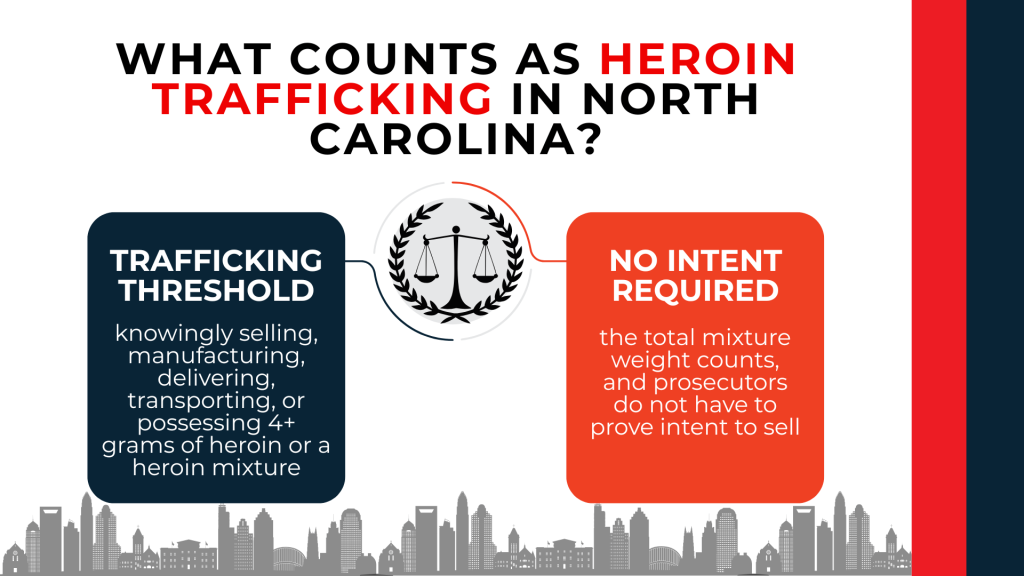
Trafficking is triggered the moment the weight hits four grams. The government does not have to show you sold it, planned to sell it, or profited from it. The statute lists five separate ways to commit the offense: you “sell, manufacture, deliver, transport, or possess” the threshold amount. Simple possession of enough heroin is legally the same trafficking charge as running a distribution ring.
Two details make this charge far broader than people expect:
- It’s the whole mixture, not the pure drug. The law counts “any mixture containing” heroin. If heroin is cut with filler, the filler counts toward your four grams. You can be charged with trafficking a quantity that is mostly not heroin.
- No intent to sell is required. Charges like possession with intent to sell or deliver under § 90-95(a)(1) turn on whether you meant to sell or deliver the drug. Trafficking skips that question entirely. Weight alone does the work.
The practical effect is significant: under the trafficking statute, a possession case can be charged as a top-tier felony without the State ever proving a transaction.
How much heroin does it take to be charged with trafficking?
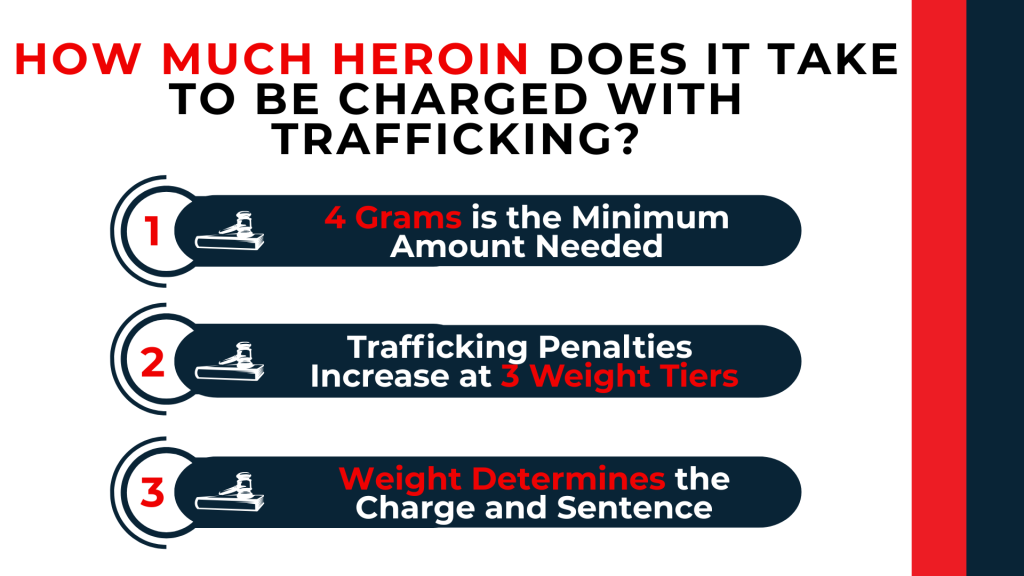
Four grams. That single threshold opens the door, and from there the charge escalates through three weight tiers, each one more serious than the last:
- 4 grams to less than 14 grams
- 14 grams to less than 28 grams
- 28 grams or more
Where your alleged quantity falls determines everything about the sentence — the felony class, the mandatory prison term, and the fine. Because the mixture counts, the difference between one tier and the next can come down to how the substance was weighed and what was in it. That makes the lab’s measurement one of the most important facts in the entire case.
How much prison time does heroin trafficking carry?
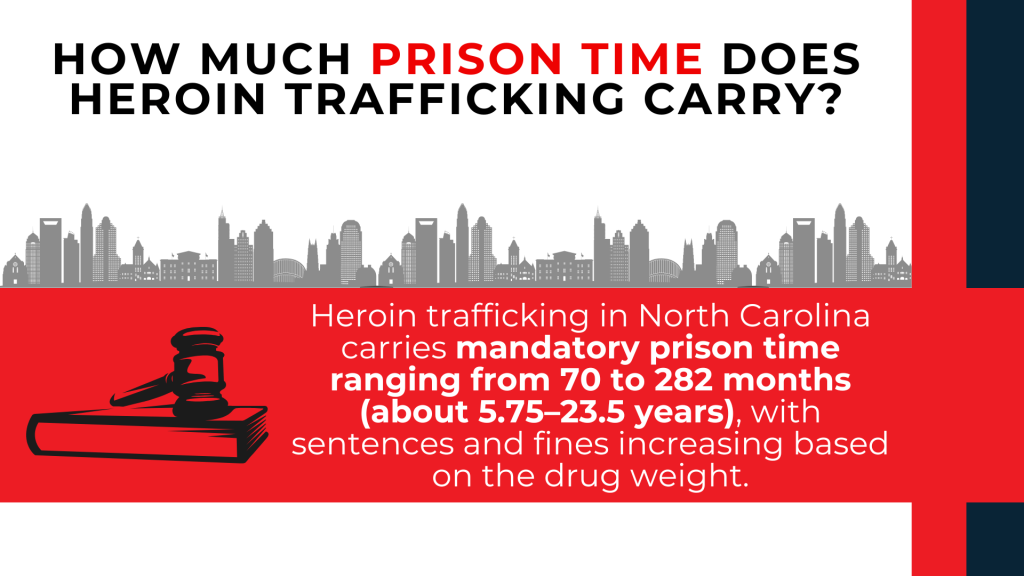
A lot — and it’s mandatory. Heroin trafficking in North Carolina carries a required active prison sentence at every tier, plus a fixed fine that climbs into the millions. Here is exactly what each level under § 90-95(h)(4) carries:
| Weight | Felony class | Mandatory prison term | Fine |
| 4 to <14 grams | Class F | 70–93 months (about 5.75–7.75 yrs) | $500,000 |
| 14 to <28 grams | Class E | 90–120 months (7.5–10 yrs) | $750,000 |
| 28 grams or more | Class C | 225–282 months (about 18.75–23.5 yrs) | $1,000,000 |
Two words there matter more than any other: mandatory and minimum. The low number in each range isn’t a starting point for negotiation. It’s the floor the judge is ordered to impose without a specific legal exception.
And if you’re charged with more than one trafficking count, § 90-95(h)(6) requires the sentences to run consecutively — stacked back to back, not served at the same time. Multiple counts can turn a single incident into decades.
Heroin sits high on North Carolina’s trafficking ladder. The state runs six trafficking tiers from Class H to Class C. Even the lowest heroin quantity lands at Class F — well above where marijuana, cocaine, or amphetamine trafficking begins.
Can a judge sentence me below the mandatory minimum?
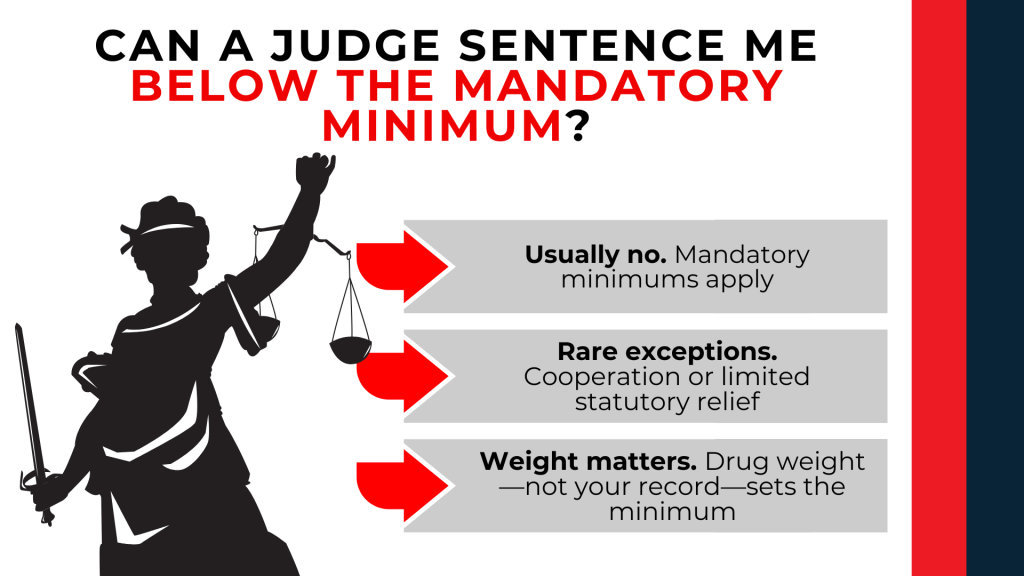
Usually no. By default, § 90-95(h)(5) bars the judge from suspending the sentence or granting probation — the mandatory term must be served. But there are narrow exceptions, and this is where an early, strategic defense earns its keep.
The main door below the minimum is substantial assistance — cooperating with law enforcement. If you provide, to the best of your knowledge, real help in identifying, arresting, or convicting accomplices, co-conspirators, or the people above you, the judge may reduce the fine, go below the minimum prison term, or suspend the sentence. But that only happens after the judge makes a specific finding on the record that you gave that assistance. There’s also a separate, tightly conditioned path under § 90-95(h)(5a) that can apply to lowest-tier, possession-only cases — including conspiracy. It applies only where the amount is no greater than the lowest trafficking category and the judge makes a strict list of findings: acceptance of responsibility, no prior § 90-95 felony, no weapon or violence, completion of a court-approved substance-abuse treatment program, that the minimum would be a substantial injustice, and that there is no substantial evidence the person ever engaged in the sale or transport-for-sale of the drug.
One point that surprises people: your clean record doesn’t help here. Unlike ordinary North Carolina felonies, trafficking minimums are fixed by drug weight and ignore prior record level entirely. A first-time defendant faces the same floor as a career offender.
Cooperation is not a small factor in these cases. In North Carolina’s federal courts, 35.1% of drug-trafficking defendants received a cooperation-based sentence reduction — well above the 20.3% national rate. Nationally, of the drug-trafficking defendants who faced a mandatory minimum, 44% were relieved of it through cooperation or safety-valve provisions. Whether and how to cooperate is one of the highest-stakes decisions in the case. It’s not one to make without a lawyer who has sat on both sides of it.
Will my case be in state or federal court — and does it matter?
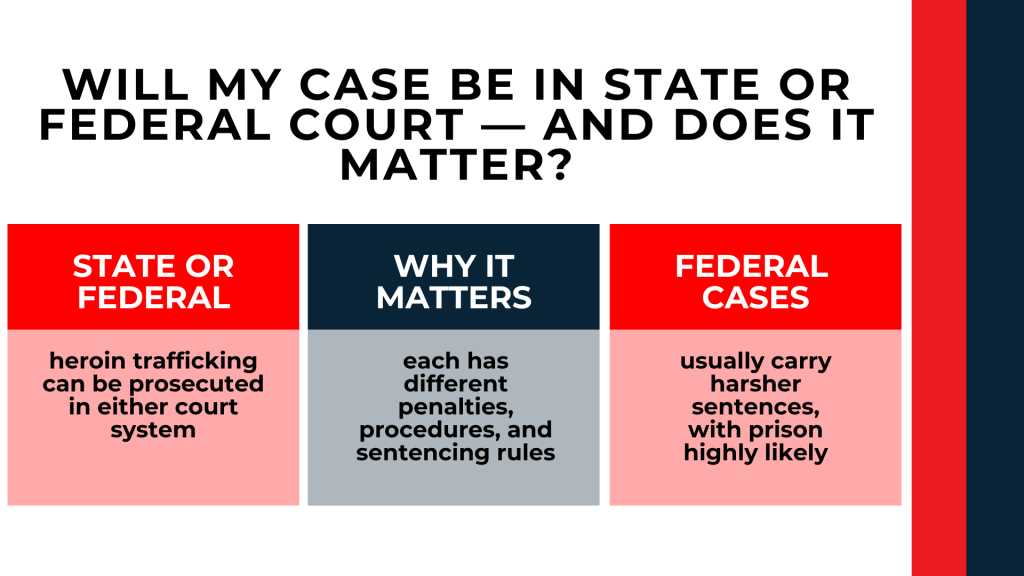
It matters enormously, and heroin trafficking can be prosecuted in either system. The two tracks carry different penalty structures, different procedures, and different odds — and the choice of court system is often outside your control.
North Carolina’s state courts handle the larger share. In FY2024 there were 638 drug-trafficking convictions in state court, compared with 476 North Carolina residents sentenced federally for drug trafficking. But federal exposure is real: drug trafficking was the single largest category of federal sentencings from North Carolina, 33.6% of the total. The Eastern District of North Carolina alone accounted for 827 federal sentencings — far more than the Middle or Western districts.
Federal outcomes are sobering. In North Carolina’s federal courts, 97.3% of drug-trafficking defendants received a prison-only sentence, and the average federal heroin sentence nationally was 62 months. Which system your case lands in shapes the penalties you face — which is exactly why you want a lawyer admitted in both.
Is it even possible to beat a heroin trafficking charge?
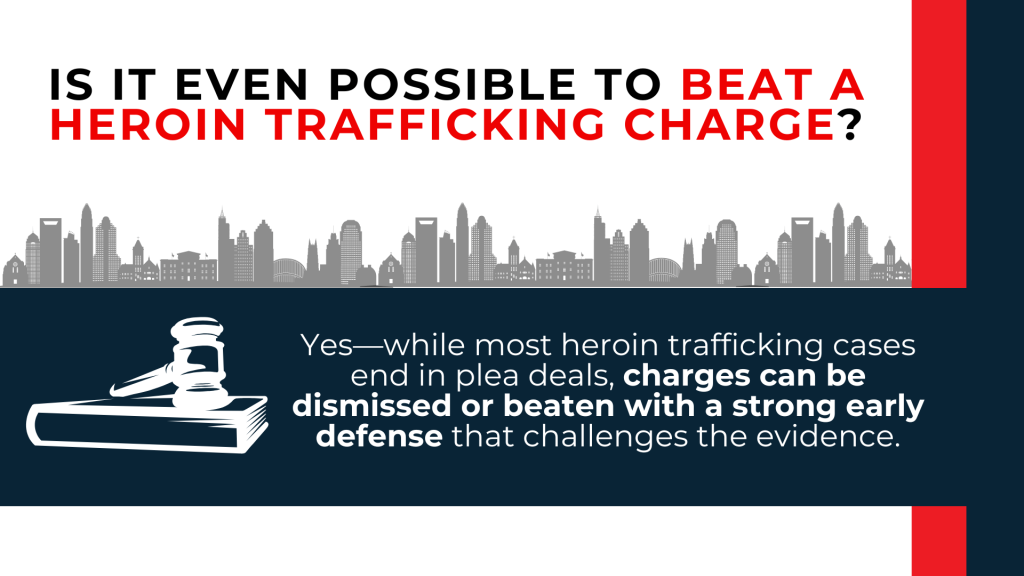
Yes, but you need to understand the landscape honestly. The overwhelming majority of these cases end in a plea, not a trial. In North Carolina’s state courts, 98% of felony convictions come from guilty pleas. In the state’s federal courts, 98.1% of drug-trafficking cases resolved by plea, with only nine going to trial.
But “most cases plead” is not the same as “cases can’t be won.” Charges get dismissed and never filed all the time. In federal drug matters nationally, prosecutors declined to pursue 23.8% before charges were even filed, and 7.8% of adjudicated federal drug cases were dismissed. The outcome turns less on the arrest and more on what the defense does with the evidence early — which is what the next section is about.
How can a heroin trafficking charge be challenged?
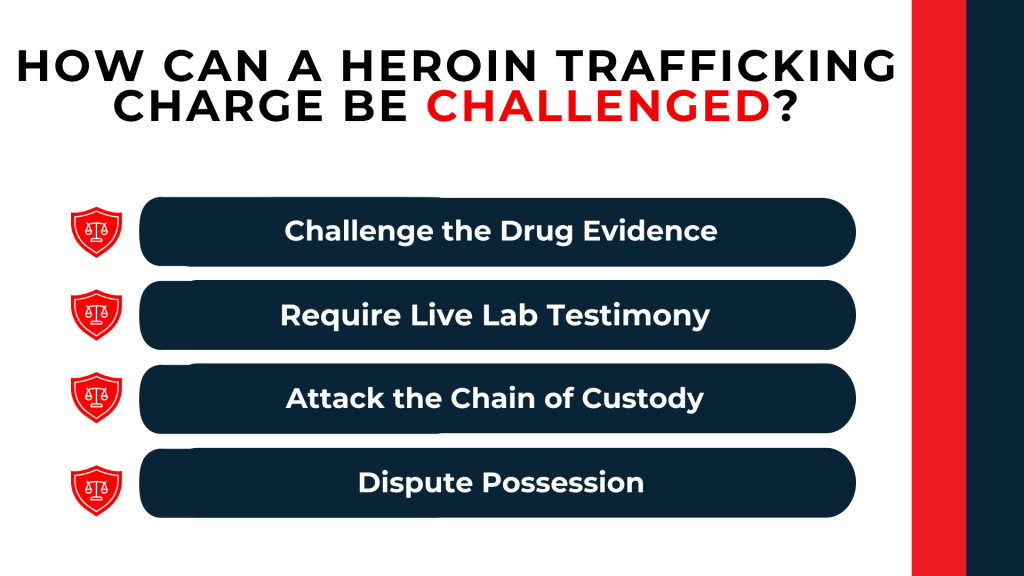
The charge rests on a chain of assumptions the State has to prove: that the substance is heroin, that it weighs enough, that it was handled properly, and that it was yours. Break any link and the trafficking charge can collapse or drop to something far less severe. Here’s where the pressure points are.
Is the substance actually heroin — and does it really weigh enough?
Every heroin trafficking charge depends on a lab establishing two things: identity and quantity. Because the weight threshold includes “any mixture containing” heroin, the exact composition and the exact number on the scale decide which tier you face — or whether you cross into trafficking at all. A quantity near a tier boundary, a disputed measurement, or a flawed analysis can be the difference between a Class F trafficking count and a lesser charge.
Can you make the State’s lab analyst testify?
Yes — and it’s a right you have to actively assert. Under § 90-95(g), the State can introduce a certified lab report as proof of what the substance is and how much it weighs without the analyst ever appearing in court. But that shortcut only holds if it notifies you at least 15 business days out and you fail to file a written objection at least five business days before the proceeding. Miss that deadline and the objection is waived; the paper report comes in unchallenged. File it in time, and the State has to put the analyst on the stand and prove its science through live, cross-examined testimony. That deadline is one of the first things a defense attorney should be watching.
Was the chain of custody clean?
The State also gets a shortcut on proving who handled the evidence. Under § 90-95(g1), a signed statement can serve as prima facie evidence that each person in the chain had custody and passed the evidence along in essentially the same condition. That means the statement is accepted as sufficient on its face. Again, that shortcut only holds if you don’t object in time. A timely objection forces the State to actually account for the evidence’s handling from seizure to lab. Gaps in that chain can undermine the entire case.
Was it actually your heroin?
The statute requires that you possessed, transported, sold, delivered, or manufactured the drug. Drugs are sometimes found in a shared car, home, or space used by multiple people. In that situation, whether the State can actually tie them to you — rather than to someone else with access — can be a live question in the case.
What should you do right now?
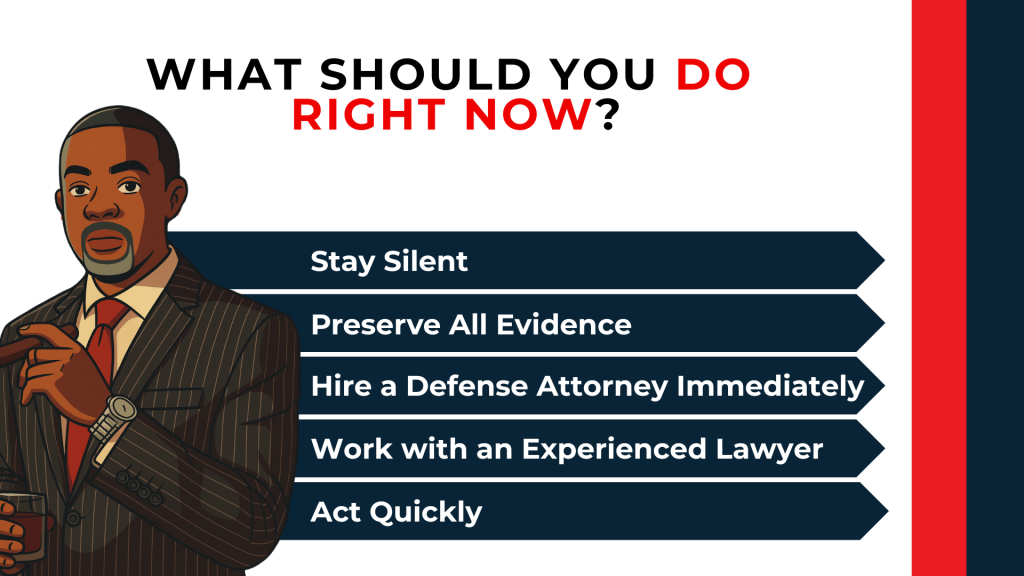
- Stop talking about the case — to police, to people around you, and on any recorded line. Ask for a lawyer and say nothing else about the facts.
- Preserve everything and assume nothing is minor. With mandatory minimums this steep, there is no version of this charge that’s safe to handle alone.
- Get an experienced trafficking defense attorney involved immediately. That keeps the lab-report and chain-of-custody deadlines under § 90-95(g) and (g1) protected, and it makes sure the court system and cooperation questions are handled strategically from day one.
A Defense Built on Over Two Decades of State and Federal Litigation
Attorney Patrick Roberts combines an educational background from Johns Hopkins University and Duke University School of Law with a career spent prosecuting drug trafficking offenses in Wake and Johnston counties. Backed by 24 years of criminal law experience, he provides expert legal defense for clients facing complex state and federal drug offenses throughout North Carolina. Having tried trafficking cases as a prosecutor and defended clients in multi-defendant federal drug conspiracy trials lasting several weeks, he understands exactly how the government builds its case. His past experience working alongside drug interdiction teams provides a direct advantage when evaluating the validity of search warrants, wiretap evidence, and confidential informant data. With a record of more than 80 criminal jury trials taken to verdict, Attorney Roberts holds active admissions before the U.S. Court of Appeals for the Fourth Circuit and the United States Supreme Court, ensuring his clients receive rigorous, high-level legal representation.
Education & Advanced Training
An alumnus of Johns Hopkins University (#7 National University) and Duke University School of Law (#7 National Law School; #9 Criminal Law Program), Mr. Roberts has dedicated his career to honing his trial craft. He is a graduate of the prestigious Gerry Spence’s Trial Lawyers College and the National Criminal Defense College (NCDC) Trial Practice Institute, including the 2025 Cross-Examination Intensive.
Accolades
• Martindale-Hubbell AV Preeminent Rating: 5+ Consecutive Years
• Martindale-Hubbell Client Champion Platinum: 5+ Consecutive Years
• AVVO 10/10 “Superb” Rating: 15+ Consecutive Years
• The National Trial Lawyers: Top 100 Trial Lawyers
Mr. Roberts is a published author of two legal books and a lifetime member of the National Association of Criminal Defense Lawyers.
Client Review
“Mr.Roberts was a great attorney to work with. From the start he was confident and transparent with us. He told us he had other strategies as back up in case his main one didn’t go as planned. That showed us that he was prepared for any obstacle that was coming his way. We went to the first court hearing and waited, we then saw Mr. Roberts walk in with confidence and his head up high. He looked fearless and ready. That day we were the first ones out, we were in there for probably 10 minutes. The one thing that stuck with me that he said was “don’t be scared because I’m not scared.” He was good at communicating with us and keeping us informed with what was going on and when the next court dates would be. Overall he was a good attorney to work with, he dedicates and puts his time into your case and will work on it for however long he will need to whether it’s lengthy or not.” – Verified client review via Avvo.com
Peer Endorsement
“I have known Patrick for years and have always been struck by his knowledge and dedication. I endorse him without hesitation or qualification.” – Verified peer endorsement via Avvo.com
Disclaimer: The client reviews and peer endorsements featured on this website reflect actual comments provided by clients and legal professionals. This information is intended for general informational purposes only and does not constitute a guarantee, warranty, or prediction regarding the outcome of any future legal matter. Every legal case presents unique facts and circumstances that must be evaluated independently on its own merits. The testimonials displayed here do not represent all reviews or endorsements received by the firm.
Case Review
Attorney Patrick Roberts was retained to represent a client facing an extensive, multi-count indictment involving severe drug trafficking and firearm offenses in North Carolina. The formal charges included:
- Trafficking in Opium or Heroin
- Possession of Heroin
- Possession with Intent to Manufacture, Sell, or Deliver Heroin
- Maintaining a Vehicle, Dwelling, or Place for Controlled Substances
- Possession of a Firearm by a Felon
- Possession of a Stolen Firearm
- Misdemeanor Possession of Marijuana
- Misdemeanor Possession of Marijuana Paraphernalia
The legal exposure in this matter was significant. Under North Carolina General Statutes, the Level I heroin trafficking count carried a non-negotiable mandatory minimum sentence of 70 to 93 months in state prison. The accompanying firearm and drug charges added a potential exposure of up to 126 additional months under North Carolina’s Structured Sentencing grid.
Fourth Amendment Challenge to Search Warrant Legality
Because the prosecution’s case depended entirely on physical items seized during a search of the client’s property, the defense focused on the legal validity of the search warrant itself.
Attorney Patrick Roberts filed a formal motion to suppress, challenging the constitutional sufficiency of the application affidavit submitted to the magistrate. The defense’s analysis demonstrated that the warrant failed to satisfy Fourth Amendment probable cause standards due to two critical legal deficiencies:
- Unsubstantiated Informant Information: The affidavit relied heavily on allegations from a confidential informant without establishing the source’s reliability, past track record, or veracity.
- Insufficiently Detailed Controlled Buys: Law enforcement failed to properly document, monitor, and detail the alleged controlled drug buys cited to corroborate the informant, leaving unaddressed gaps in the timeline and chain of custody.
The court evaluated the defense’s constitutional arguments and ruled that the affidavit lacked the requisite probable cause. Consequently, the search warrant was declared invalid, and all evidence gathered as a result of the search was suppressed under the exclusionary rule.
Complete Pre-Trial Dismissal* of All Counts
Following the suppression of the physical evidence, the State lost the evidentiary foundation necessary to sustain the prosecution. Facing a fatal legal defect, the prosecution formally dismissed* all charges against Attorney Roberts’ client prior to trial—completely eliminating the mandatory prison terms, firearm penalties, and misdemeanor charges.
View more case results.
*Disclaimer: The case outcomes detailed above depend entirely on the specific legal and factual circumstances of this case. Prior results do not guarantee, warrant, or predict a similar outcome in any future legal matter.
Review Your Legal Options with Attorney Patrick Roberts
If a heroin trafficking charge is on the table for you or someone in your family, the time to act is now, while those early deadlines and decisions are still open. Reach out to Patrick Roberts Law PLLC to talk through where your case stands.
Attorney Patrick Roberts provides a formidable defense in Wake County—specifically Raleigh, Cary, Apex, Holly Springs, Garner, and Fuquay-Varina.
The firm operates under a fixed capacity model, accepting new clients only when they can dedicate the necessary time and resources to their specific needs.
This article is general legal information about North Carolina law, not legal advice for any specific situation. Reading it or contacting the firm does not create an attorney-client relationship. Laws change and every case is different — consult a licensed North Carolina attorney about the facts of your case.
Former assistant district attorney
Contact Patrick Roberts
Facing criminal charges in North Carolina demands seasoned representation. Trust in the experience and dual perspective of Patrick Roberts. Reach out today for a confidential consultation.
-
Call Our Team
Calls answered 24/7






For more information on the selection criteria, go to www.martindale.com
*Each case is different and must be evaluated separately. Prior results achieved do not guarantee similar results can be achieved in future cases.