
In North Carolina, cocaine trafficking has almost nothing to do with selling. It’s about weight. If the State says you had 28 grams or more of cocaine, or any mixture containing cocaine, you can be charged with “trafficking.” That’s true even if you never sold, moved, or handed anything to anyone.
That single fact catches most people off guard, and it changes everything about how serious the charge is. Below, I’ll walk through what actually counts as trafficking here, the exact prison time and fines each weight level carries, why probation usually isn’t on the table, whether your case might end up in federal court, how the prosecution has to prove it, and — most importantly — where these cases can be challenged.
What actually counts as “cocaine trafficking” in North Carolina?
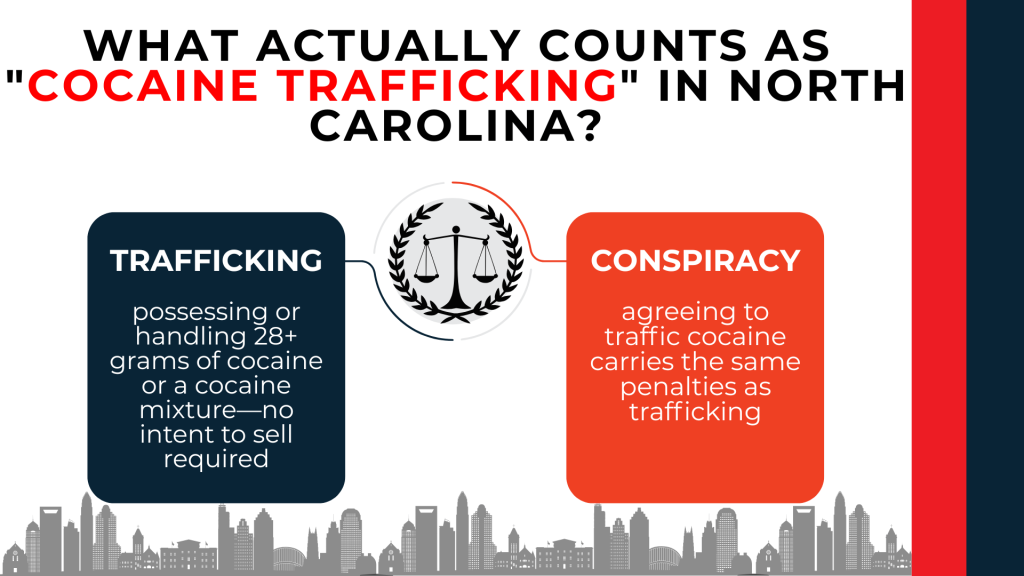
Trafficking in cocaine means selling, manufacturing, delivering, transporting, or simply possessing 28 grams or more of cocaine or any mixture containing it. That’s it. Under N.C. Gen. Stat. § 90-95(h)(3), possession alone at that weight is trafficking. You don’t have to be a dealer, and prosecutors don’t have to prove you intended to sell.
Two details do most of the damage here.
First is the word mixture. The statute counts “any mixture containing” cocaine toward the 28-gram threshold — not just the pure drug. So the total weight of whatever the substance is cut or combined with can count. That means the number that determines your charge may be much higher than the amount of actual cocaine involved.
Second is conspiracy. Under § 90-95(i), agreeing with someone else to commit cocaine trafficking carries the same penalties as trafficking itself. You can face a trafficking sentence based on an agreement, even if the drugs were never in your hands.
For context on where the line sits: below 28 grams, cocaine is charged as simple possession or other non-trafficking offenses. Those are different, and generally far less severe. At 28 grams, the same conduct becomes one of the most heavily punished crimes in the state.
How much prison time and money am I facing?
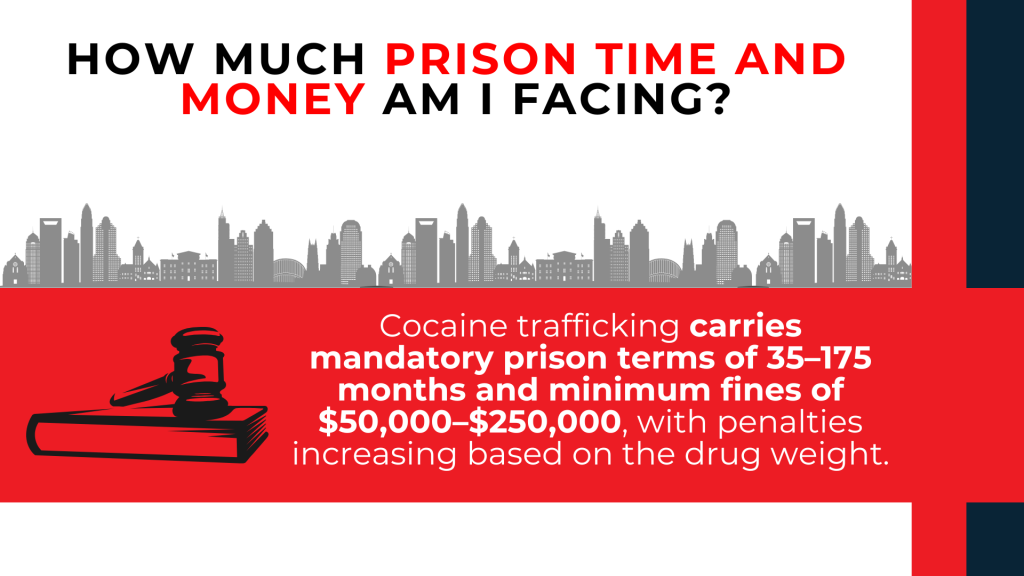
Cocaine trafficking carries mandatory active prison time and steep fines that climb with the weight. There are three tiers under § 90-95(h)(3), and each one sets a minimum sentence the judge must impose:
- 28 grams to under 200 grams — Class G felony. 35 months minimum, 51 months maximum, plus a fine of at least $50,000.
- 200 grams to under 400 grams — Class F felony. 70 months minimum, 93 months maximum, plus a fine of at least $100,000.
- 400 grams or more — Class D felony. 175 months minimum, 222 months maximum, plus a fine of at least $250,000.
“Minimum” here means what it says. 35 months at the lowest tier is roughly three years you would actually serve — not a ceiling a judge can sentence below on a good day. And if you’re charged with more than one trafficking count, § 90-95(h)(6) requires those sentences to run consecutively — stacked back to back, not served at the same time.
These aren’t rare charges. North Carolina state courts recorded 638 drug-trafficking convictions in FY2024, and trafficking penalties are prosecuted aggressively precisely because the sentences are locked in by statute.
Why can’t I just get probation or a reduced sentence?
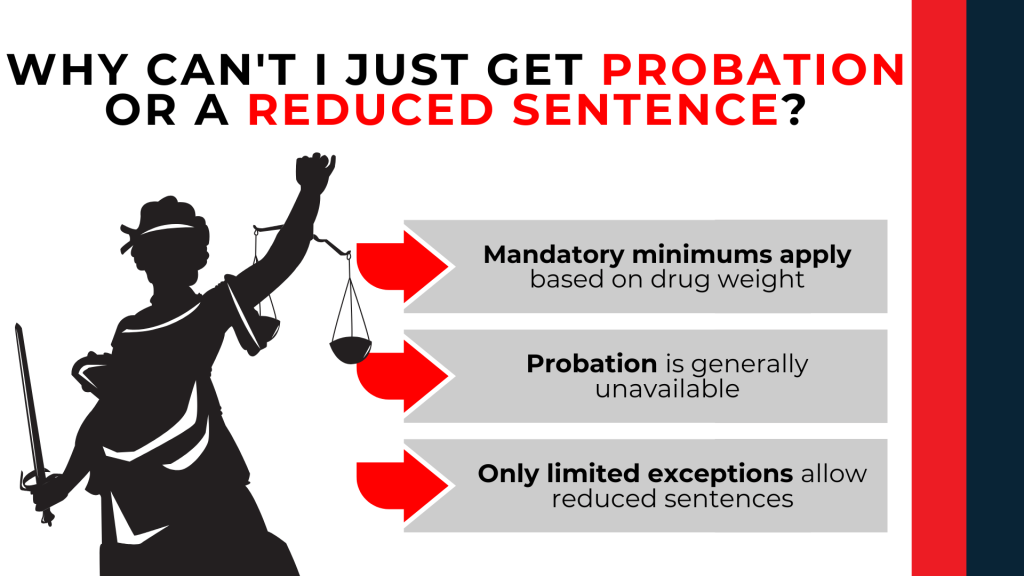
Because trafficking sentences are mandatory in a way ordinary felonies are not. For most North Carolina crimes, your prior record and the circumstances shape the sentence, and probation is often possible. Trafficking is different. § 90-95(h)(5) says that if you’re sentenced for trafficking, you generally cannot receive a suspended sentence or probation. The minimum is fixed by drug weight regardless of your criminal history. A first-time offender faces the same floor as someone with a record.
There is one real path below the minimum, and it’s worth understanding.
Substantial assistance. Under § 90-95(h)(5), a judge can reduce the fine, go below the minimum prison term, or suspend the sentence. But that happens only if you provide “substantial assistance” in the identification, arrest, or conviction of others involved. The judge also has to put that finding on the record. A separate provision, § 90-95(h)(5a), allows a reduction in certain possession-only trafficking cases where a list of conditions is met. Those conditions include that you accepted responsibility, have no prior felony under § 90-95, used no violence or weapon, and completed an approved substance-abuse treatment program.
This matters more than it might sound. In North Carolina’s federal drug-trafficking cases, 35.1% received a cooperation-based reduction — well above the 20.3% national rate. Whether cooperation is even in your interest is a strategic decision that depends entirely on the specifics of your case. It’s one to make with a lawyer before you say anything to anyone.
Will my case be in state or federal court — and does that change things?
It can be either, and the difference is significant. The weight tiers and mandatory minimums above come from North Carolina state law. But cocaine trafficking is also prosecuted federally — and federal outcomes tend to be harsher and harder to escape.
Federal drug trafficking is not a fringe outcome for North Carolinians. It was the single largest category of federal sentencings from NC in FY2024 — 476 of 1,415 people (33.6%), ahead of firearms offenses. Of those NC federal drug-trafficking defendants, 97.3% received a prison-only sentence, and the median sentence ran to 87 months — over seven years.
Which system picks up your case affects the timeline, the leverage, and what’s at stake. Federal cases in the Eastern District of NC alone carry a median of about 12.7 months from filing to disposition. The district also carries the heaviest felony caseload in the Fourth Circuit. If your case is federal, you need a lawyer admitted to practice in federal court — not every criminal defense lawyer is.

How does the prosecution actually prove cocaine trafficking?
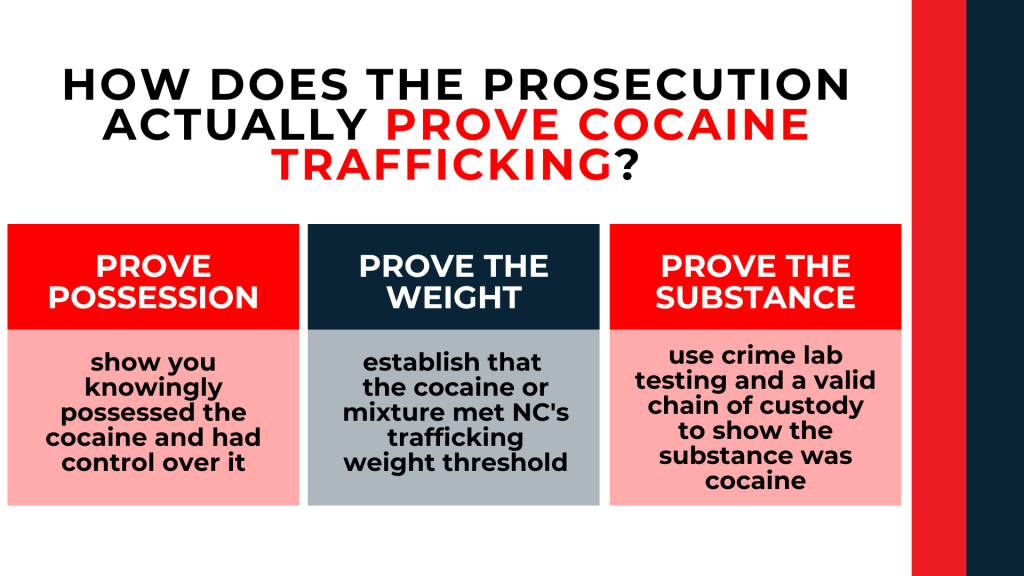
To convict you of trafficking by possession, the State has to prove three things: that you possessed the cocaine, that the weight met a trafficking tier, and that the substance actually was cocaine. Each of those is something the State must establish under specific rules.
Possession. The statute reaches anyone who sells, manufactures, delivers, transports, or possesses the threshold weight. Where the charge rests on possession, the State has to prove the cocaine was yours to possess.
Weight. Because the statute counts any mixture, how the substance was weighed and what got included in that number can be challenged directly.
Lab analysis and chain of custody. The State proves the substance is cocaine through a crime-lab report. Under § 90-95(g), that report can come into evidence without the analyst testifying. But that’s true only if the State gives you proper notice and you don’t object in time. If your attorney files a timely written objection, the State has to produce the analyst and prove the identity, nature, and quantity of the substance under the normal rules of evidence. The same goes for the chain of custody under § 90-95(g1) — the paper trail showing who handled the evidence and when. Missing that objection deadline gives up a real defense.
Can a cocaine trafficking charge be beaten or reduced?
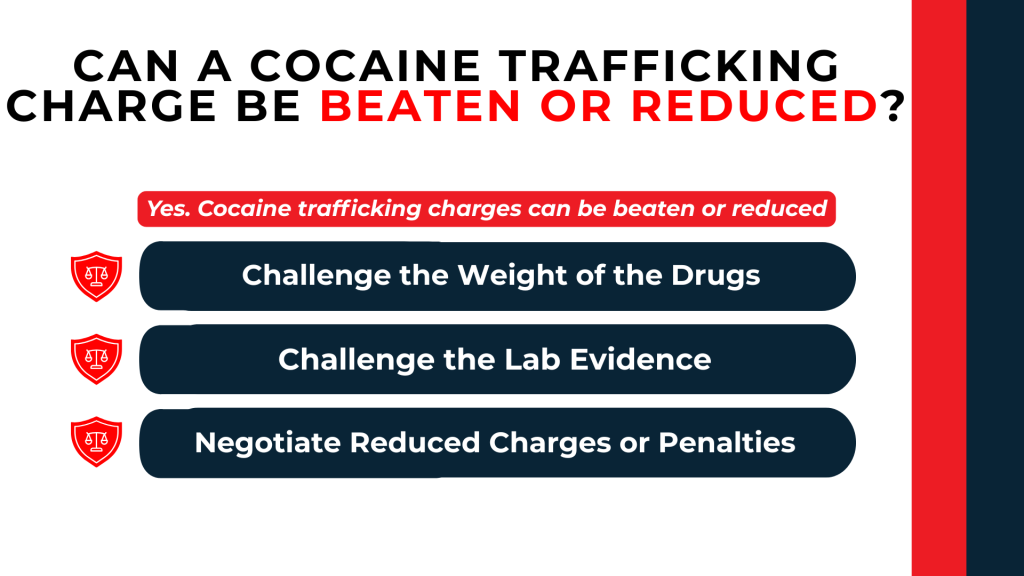
Yes — trafficking charges are challenged and reduced regularly, and the fact that the penalties are mandatory makes attacking the charge itself even more important. The main lines of defense flow from what the State has to prove.
Can the weight and lab evidence be challenged?
The weight determines the tier — and the tier determines the mandatory minimum. Challenging how the substance was weighed, what was counted as part of the “mixture,” and how the lab tested it can move a case down a tier or undermine it entirely. And as noted above, forcing the analyst to appear by objecting to the lab report on time is a concrete, statute-based tool.
Can negotiating or cooperating improve the outcome?
The reality is that most of these cases resolve short of trial. In NC state courts, 98% of felony convictions come by guilty plea. In NC federal drug-trafficking cases, 98.1% resolve by plea and only about 2% go to trial. That’s exactly why the leverage your attorney builds — a weak link in the weight or lab proof — matters. Those pressure points are what turn a mandatory-minimum charge into a negotiated outcome, whether through a substantial-assistance reduction or a plea to a lesser offense.
What should I do right now?
Three things, in order:
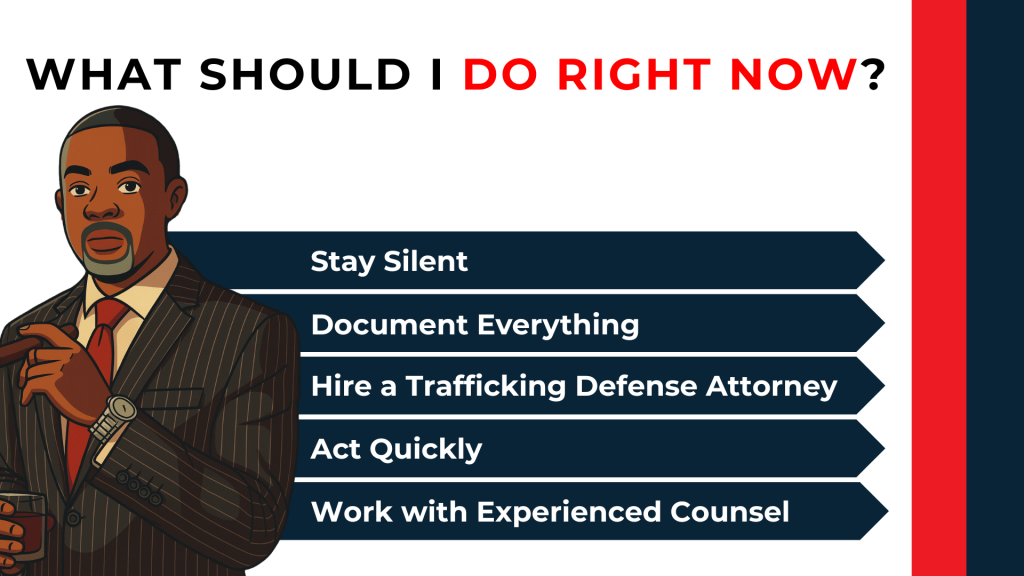
- Stop talking about your case. Don’t explain, minimize, or “clear things up” with police, and don’t discuss it over jail phones or text — those conversations become evidence. Cooperation may or may not help you, but that’s a decision to make with a lawyer, not before one.
- Preserve everything. Note what happened around your arrest — who was present, what was said, what officers did, and how the substance was handled and weighed. Details fade fast, and they can matter to your defense.
- Get a trafficking-experienced attorney involved immediately — especially if your case could be federal. Deadlines like the lab-report objection window start running early, and missing them gives up real defenses.
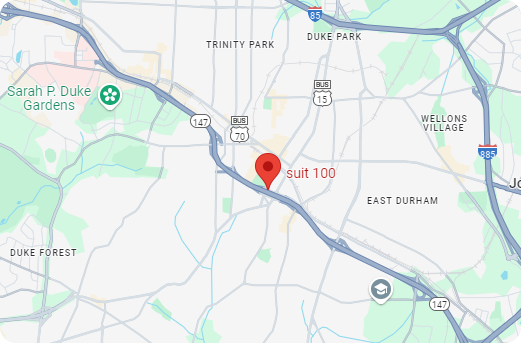
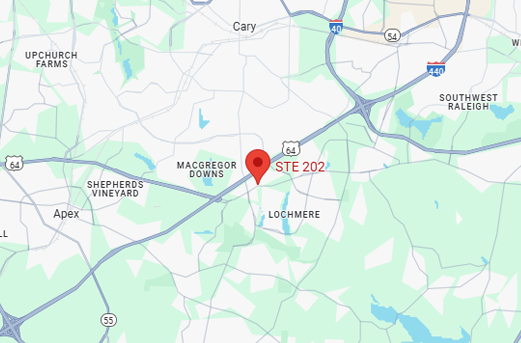
At Patrick Roberts Law PLLC in Raleigh — with offices in Durham, Chapel Hill, and Cary — this is the exact terrain we work in. Patrick Roberts spent years as an Assistant District Attorney in Wake, Johnston, and New Hanover counties, so he knows from the inside how the State builds a trafficking case: how weight and mixture are charged, and where the lab and chain-of-custody proof tends to be vulnerable. Over 24-plus years of practice, he’s handled these cases in both systems and is admitted before the North Carolina courts and the U.S. District Courts for the Eastern, Middle, and Western Districts of North Carolina, the Fourth Circuit Court of Appeals, and the United States Supreme Court — which matters directly if your case lands in federal court.
The weight and lab-report challenges and the cooperation strategy described above aren’t theoretical here — they’re the day-to-day of the practice. If you’re facing a cocaine trafficking charge, call to discuss where the pressure points in your case are, before the deadlines close them off.
Client Review
“Our family turned to Attorney Patrick Roberts during an incredibly difficult chapter in our lives. Although our daughter lived in Raleigh, we are based in Central New Jersey, which meant countless hours on the road and a constant struggle to stay on top of the legal process from several states away. From the moment we met Mr. Roberts, he brought a sense of steadiness and reassurance that made an overwhelming situation feel manageable. He took the time to explain his credentials, his experience, and the steps he would take to defend our daughter, who had been accused of multiple violations stemming from a domestic incident. His confidence was never arrogant—just the calm, professional assurance of someone who knows the law, knows the system, and knows how to protect the people who depend on him.
What truly set Mr. Roberts apart was how integral he became in helping us navigate the North Carolina legal system while ensuring every rule, requirement, and regulation was followed precisely. Managing a case from out of state is no small task, but he made sure we were informed, prepared, and supported at every turn. His communication was clear, timely, and compassionate, and he treated our daughter with dignity and respect throughout the entire process. Mr. Roberts is kind, professional, and exceptionally competent. His dedication to restoring normalcy to our daughter’s life was evident in everything he did, and our family is deeply grateful for his guidance and advocacy. We would highly recommend Attorney Patrick Roberts to anyone in need of skilled, trustworthy, and compassionate legal representation. He is exactly the type of attorney you want standing beside you when everything feels uncertain.” – Verified Client review via Avvo.com
Peer Endorsement
“I endorse this lawyer. Patrick is a great trial lawyer and a person who I go to for legal advice in my own practice. Patrick is dedicated to his clients and a master at criminal defense. I would not hesitate to hire him if I was in trouble and needed a lawyer.” – Verified peer endorsement via Avvo.com
Disclaimer: The client reviews and peer endorsements featured on this website reflect actual comments provided by clients and legal professionals. This information is intended for general informational purposes only and does not constitute a guarantee, warranty, or prediction regarding the outcome of any future legal matter. Every legal case presents unique facts and circumstances that must be evaluated independently on its own merits. The testimonials displayed here do not represent all reviews or endorsements received by the firm.
Case Review
Case Summary & Result
- Accusation: Felony Level I Trafficking in Heroin, Simple Possession of Schedule IV Controlled Substance, and Simple Possession of Schedule VI Controlled Substance.
- Statutory Exposure: Mandatory minimum of 70 to 93 months in active state prison and a mandatory $50,000 fine for the trafficking count, plus up to 140 days for the misdemeanor possession counts.
- Defense Strategy: Upon obtaining and reviewing the official law enforcement checkpoint plan, Attorney Roberts identified key constitutional violations in how the stop was conducted and drafted a motion to suppress evidence on Fourth Amendment grounds.
- Result*: Felony Level I Heroin Trafficking charge dismissed prior to trial. Attorney Roberts negotiated a resolution allowing the client to plead to two misdemeanor possession counts with a sentence of probation.
*Disclaimer: Case outcomes depend upon a variety of factors unique to each case. Prior results do not guarantee or predict a similar outcome in any future legal matter.
Evaluating Your Legal Options Following a Drug Trafficking Arrest
Statutory mandatory minimums for cocaine trafficking charges in North Carolina create severe legal exposure, but an arrest is not a conviction. As outlined above, defense outcomes depend heavily on identifying procedural or constitutional defects early in the prosecution process. Whether through challenging search warrant validity, disputing total mixture weight, filing timely objections to crime lab reports, or negotiating statutory sentence reductions, critical evidentiary standards must be met by the State.
Because procedural deadlines—such as the statutory window under N.C. Gen. Stat. § 90-95(g) to object to crime lab analyses—begin running shortly after formal charging, delaying legal action can result in the forfeiture of key constitutional defenses.
Consult with Defense Attorney Patrick Roberts
If you or a family member are facing state or federal cocaine trafficking charges in North Carolina, obtaining a direct evaluation of your case facts is an essential first step. Patrick Roberts Law PLLC provides objective legal defense for high-exposure drug prosecutions across North Carolina state and federal courts. Schedule a confidential consultation with Attorney Patrick Roberts to review the evidence, evaluate applicable procedural deadlines, and discuss your available legal options.
This article is general legal information about North Carolina law, not legal advice, and reading it does not create an attorney-client relationship. Every case turns on its own facts — consult a licensed North Carolina attorney about your specific situation.
Former assistant district attorney
Contact Patrick Roberts
Facing criminal charges in North Carolina demands seasoned representation. Trust in the experience and dual perspective of Patrick Roberts. Reach out today for a confidential consultation.
-
Call Our Team
Calls answered 24/7







For more information on the selection criteria, go to www.martindale.com
*Each case is different and must be evaluated separately. Prior results achieved do not guarantee similar results can be achieved in future cases.