
In North Carolina, there is no criminal charge that carries the exact name “aggravated drug trafficking.” What people usually mean by that phrase is one of three things: a high-weight trafficking charge under N.C. Gen. Stat. § 90-95(h), an ordinary drug charge pushed into a harsher category by an aggravating factor like a school zone or a sale to a minor, or a federal drug-trafficking case. Federal cases use “aggravating factor” language and are prosecuted heavily in this state.
This article explains what trafficking actually means under North Carolina law, what makes a drug case more serious, the prison time and fines involved, the difference between a state and a federal case, whether a charge means a conviction, the defenses that apply, and what to do right now.
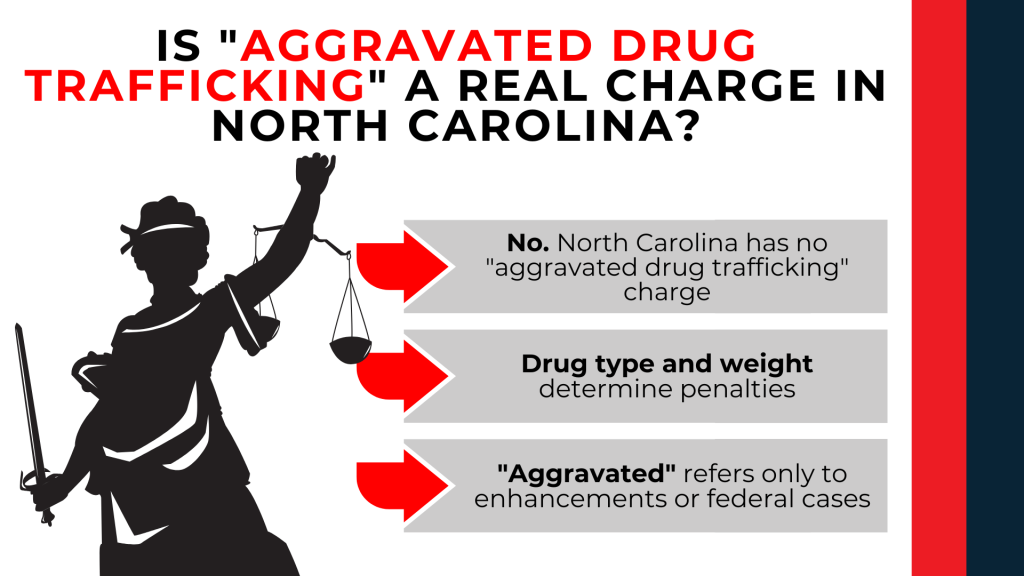
Is “aggravated drug trafficking” a real charge in North Carolina?
Not by that name. North Carolina’s drug statute creates an offense simply called “trafficking.” The seriousness is built into the weight of the drug and a handful of add-on factors rather than into a separate “aggravated” label.
So if you’re holding a charging document that says “aggravated” or that references an aggravating factor, you are almost certainly looking at one of these:
- A trafficking charge under § 90-95(h), where the quantity alone determines how severe the felony is.
- A standard drug charge with an enhancement — for example, an offense near a school or a sale to a minor — that bumps the felony class up.
- A federal charge, where prosecutors and the sentencing guidelines talk in terms of aggravating factors and role adjustments.
The label matters less than the substance. Whatever word is on the paperwork, the questions that decide your future are: how much of what drug, where, and in which court.
What makes a drug case “trafficking” — and what makes it worse?
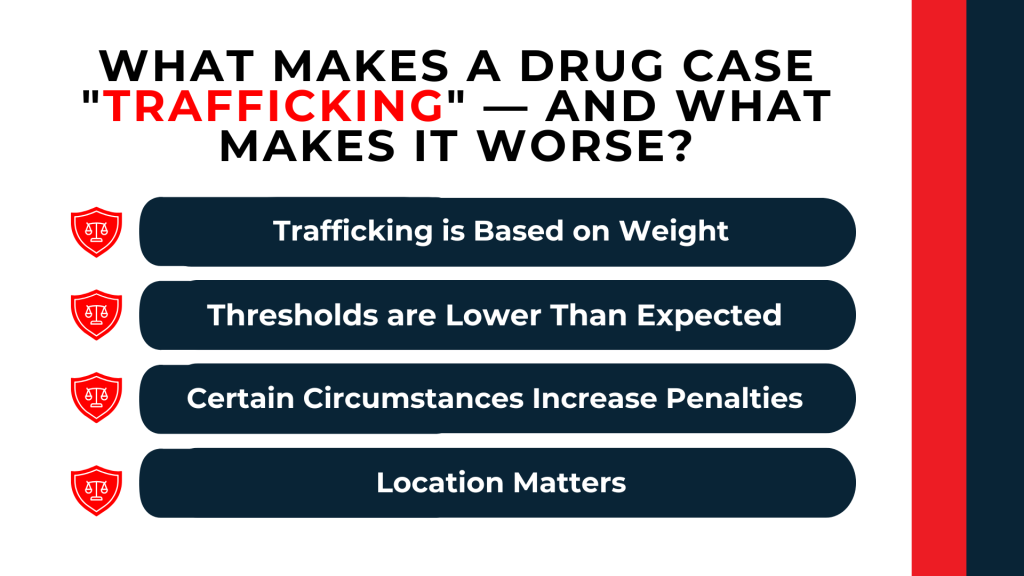
Trafficking in North Carolina is triggered by the weight of the drug alone. You do not have to have sold anything, intended to sell anything, or be a “trafficker” in any ordinary sense. Under § 90-95(h), simply possessing the threshold amount is enough to be charged with trafficking.
That’s the part that catches most people off guard. The statute lists trafficking as anyone who “sells, manufactures, delivers, transports, or possesses” a set quantity. Possession is on that list. The thresholds are lower than people expect — for example, 28 grams of cocaine (about an ounce) or 4 grams of an opioid or heroin.
On top of the weight tiers, § 90-95(e) contains enhancements — facts that raise the felony class and the punishment. These are the closest thing North Carolina has to “aggravating” a drug offense:
- Selling or delivering to a minor or a pregnant person. A person 18 or older who sells or delivers to someone more than 13 but under 16, or to a pregnant female, is punished as a Class D felon. If the recipient is 13 or younger, they’re punished as a Class C felon (§ 90-95(e)(5)).
- Committing the offense near a school or child care center. A person 21 or older who commits the offense on or within 1,000 feet of a school or licensed child care center is punished as a Class E felon (§ 90-95(e)(8)).
- Committing the offense near a public park. A person 21 or older, on or within 1,000 feet of a public park, is punished as a Class E felon (§ 90-95(e)(10)).
- Possession inside a jail or prison. Possessing a controlled substance in a penal institution or local confinement facility is a Class H felony (§ 90-95(e)(9)).
The takeaway: what you’re facing isn’t just about what you had. It’s about how much, where you were standing, and who was involved.
How much prison time does trafficking carry in North Carolina?
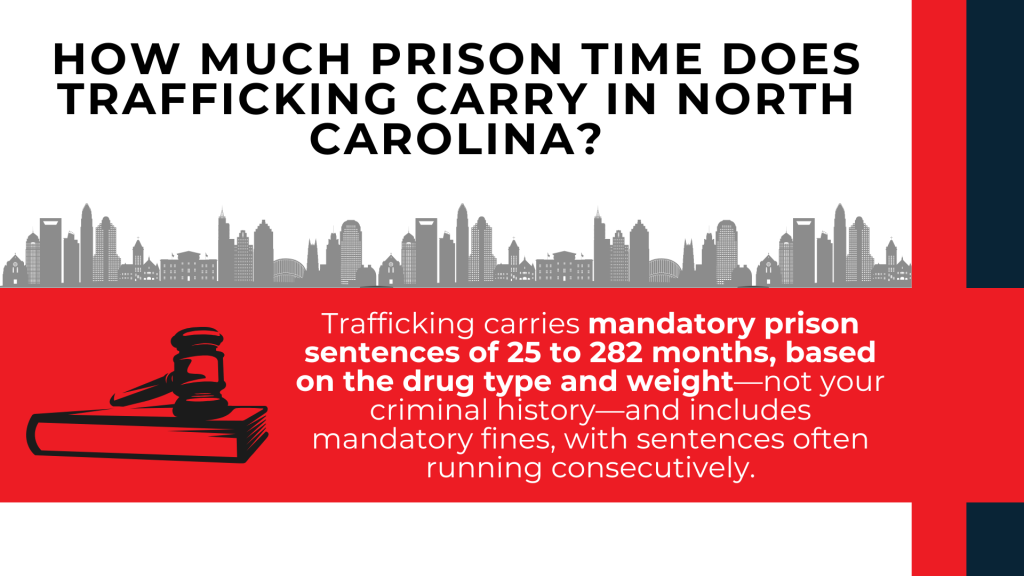
Trafficking carries mandatory minimum prison sentences. That means the judge is required to impose an active prison term set by the statute. Those minimums are fixed by the drug and the weight, not by your criminal history. This is the single most important thing to understand about a trafficking charge. It’s what separates it from nearly every other felony in the state.
Ordinary North Carolina felonies are sentenced on a grid that factors in your prior record. Trafficking ignores that. A first-time offender and a person with a long record face the same statutory floor.
The six trafficking tiers run like this:
| Felony class | Mandatory sentence range |
| Class H | 25–39 months |
| Class G | 35–51 months |
| Class F | 70–93 months |
| Class E | 90–120 months |
| Class D | 175–222 months |
| Class C | 225–282 months |
Where you land depends on the substance and amount. A few real examples from the statute:
- Cocaine, 28 to under 200 grams: Class G, 35 to 51 months, plus a fine of at least $50,000 (§ 90-95(h)(3)a).
- Opioid or heroin, 4 to under 14 grams: Class F, 70 to 93 months, with a $500,000 fine if the drug is heroin (§ 90-95(h)(4)a). Even the smallest heroin tier means a minimum of nearly six years.
- Fentanyl or carfentanil, 28 grams or more: Class C, 225 to 282 months and a mandatory $1,000,000 fine (§ 90-95(h)(4c)c) — the harshest drug penalty in the state, an 18-plus-year floor.
- Marijuana, 10,000 pounds or more: Class D, 175 to 222 months and a $200,000 fine (§ 90-95(h)(1)d). Marijuana trafficking starts at more than 10 pounds (Class H, a 25-month minimum) and climbs from there.
The statute does two more things that make trafficking sentences stack up fast. First, the fines are mandatory. Second, under § 90-95(h)(6), trafficking sentences run consecutively — one after another — with any other sentence you’re serving, rather than at the same time.
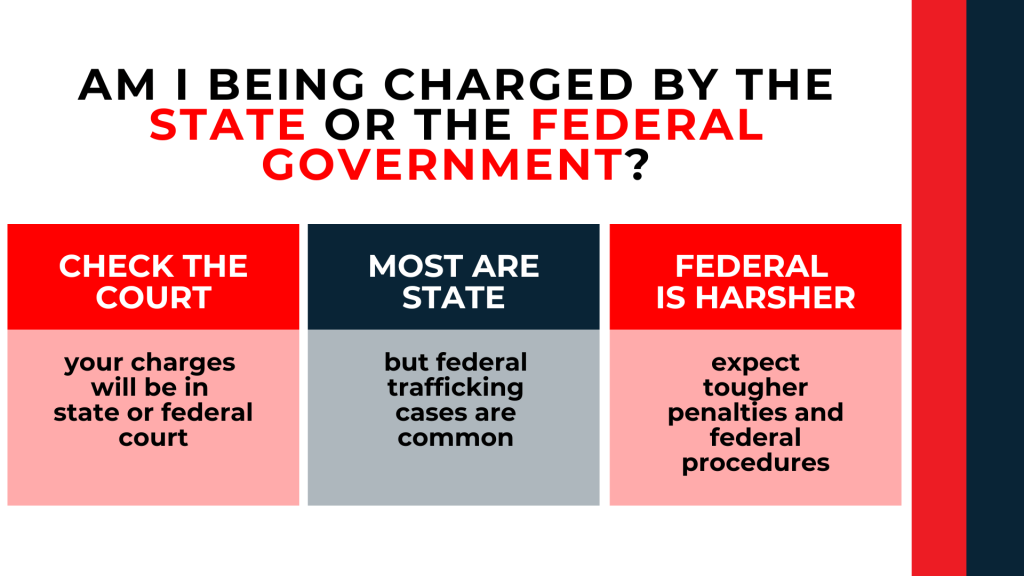
Am I being charged by the state or the federal government?
You could be facing either, and it changes almost everything — the rules, the timeline, and how much time you’re looking at. The charging document will name the court, but many people can’t tell at a glance, and the difference is worth understanding immediately.
North Carolina prosecutes most trafficking cases in state court, but federal drug-trafficking prosecution here is heavy. Drug trafficking was the single largest category of federal sentencings among North Carolinians in FY2024 — 33.6%, ahead of firearms at 25.1%. And that activity is concentrated: the Eastern District of North Carolina alone carried 827 sentenced cases, compared with 305 in the Western and 283 in the Middle.
What you’re facing federally is severe. For North Carolina residents sentenced federally for drug trafficking, the median sentence was 87 months and the mean was 110 months — roughly seven to nine years. On top of that, 97.3% received a prison-only sentence. If your case is federal, you need a lawyer admitted to practice in federal court, not only state court.
Does a trafficking charge mean I’ll be convicted?
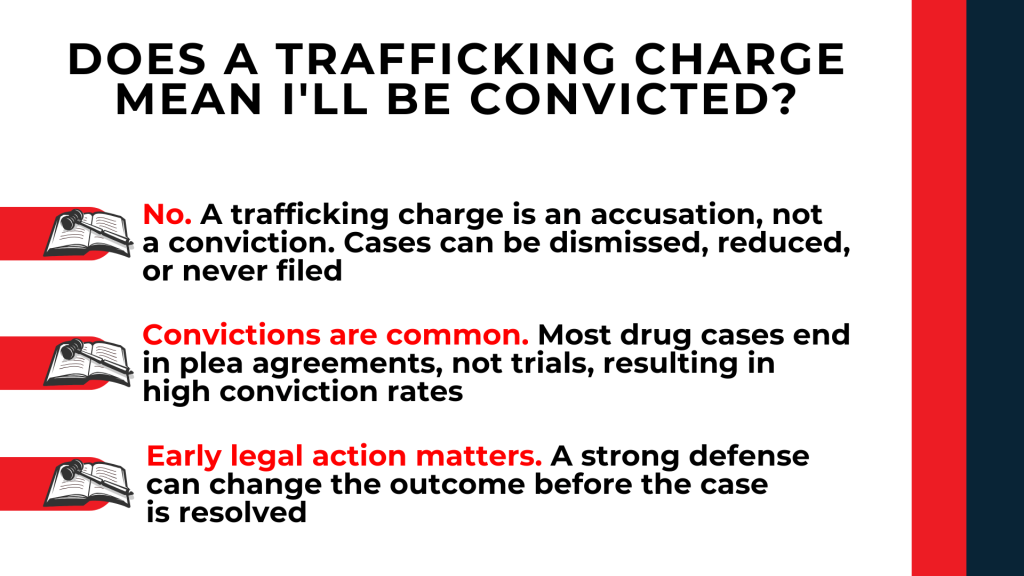
No. A charge is an accusation, not a conviction. Cases fall apart, get dismissed, or never get charged in the first place more often than the fear in the moment suggests.
At the federal level, prosecutors declined to pursue 23.8% of drug matters referred to them — nearly one in four dropped before charges were even filed. Of the federal drug cases that were adjudicated, 7.8% were dismissed. Those are outcomes that good, early defense work helps produce.
It’s also true that the odds tighten once a case is charged and moving: 91.9% of adjudicated federal drug defendants were ultimately convicted. The overwhelming majority of cases resolve by negotiation rather than trial. In North Carolina state courts, 98% of felony convictions came through guilty pleas. In federal court here, 98.1% of drug-trafficking cases were resolved by plea and only 9 went to trial.
The honest read: this is a serious charge with real conviction risk, but the outcome is not fixed at arrest. What happens between now and resolution — the challenges your lawyer raises, the leverage they build — is what moves it.
What defenses can reduce or beat a trafficking charge?
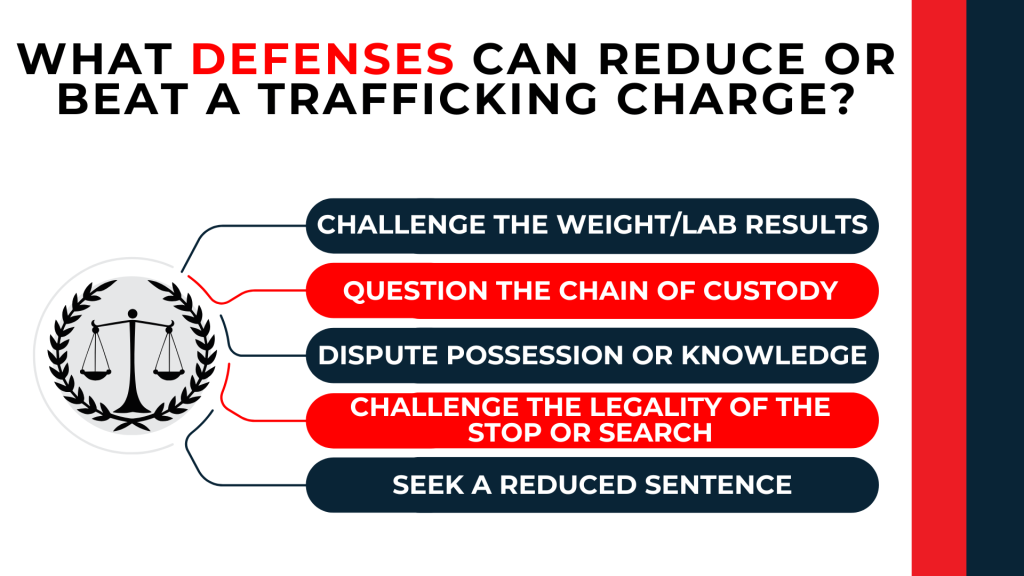
Because trafficking comes down entirely to weight and possession, the defense usually attacks exactly those things — what the substance was, how much there really was, whether you knowingly possessed it, and how the government got it. There is also a statutory path to a sentence below the mandatory minimum.
Challenging the weight and the lab analysis
Weight is the whole case. If the amount comes in under the threshold, or the substance isn’t what the state claims, the trafficking charge can collapse into something far less serious.
The state proves the drug’s identity and weight through a certified crime-lab report. Under § 90-95(g), that report can be admitted without the analyst ever coming to court — but only if the defense fails to object. If your attorney files a written objection at least five business days before the proceeding, the state has to bring the analyst in to testify and be cross-examined. That objection is routine, and it matters.
Challenging the chain of custody
Section 90-95(g1) lets the state establish who handled the evidence through signed statements instead of live witnesses — again, unless the defense objects in time. Forcing the state to account for every hand the evidence passed through can expose gaps in how it was stored, labeled, and tracked.
Can they prove the drugs were mine?
The statute requires that you possess the drug. In practice, disputing whether the drug was actually yours — and whether you knew it was there — is often where a trafficking case is weakest. Drugs found in a shared car, a shared home, or a space others had access to may not be probably yours.
Was the search legal?
How the drugs came to light — the traffic stop, the search of a car, home, or phone — is frequently the most productive line of attack in a drug case. Scrutinizing whether officers had legal grounds for the stop and search is central to how these cases are defended.
Can I get a sentence below the mandatory minimum?
Even where a conviction is likely, the mandatory minimum is not always the end of the story. Under § 90-95(h)(5), a judge can go below the statutory floor if you provide substantial assistance — meaningful help identifying, arresting, or convicting others involved. North Carolina relies on this heavily: 35.1% of the state’s federal drug-trafficking defendants received a cooperation-based reduction, well above the national rate of 20.3%.
Section 90-95(h)(5a) adds a separate path for people charged with trafficking based on possession alone. The judge can sentence below the mandatory term if a detailed list of conditions is met. Those conditions include accepting responsibility, no prior felony under this statute, no violence or weapon involved, a documented substance use disorder with completed treatment, and a finding that the minimum would be a substantial injustice.
What should I do right now?
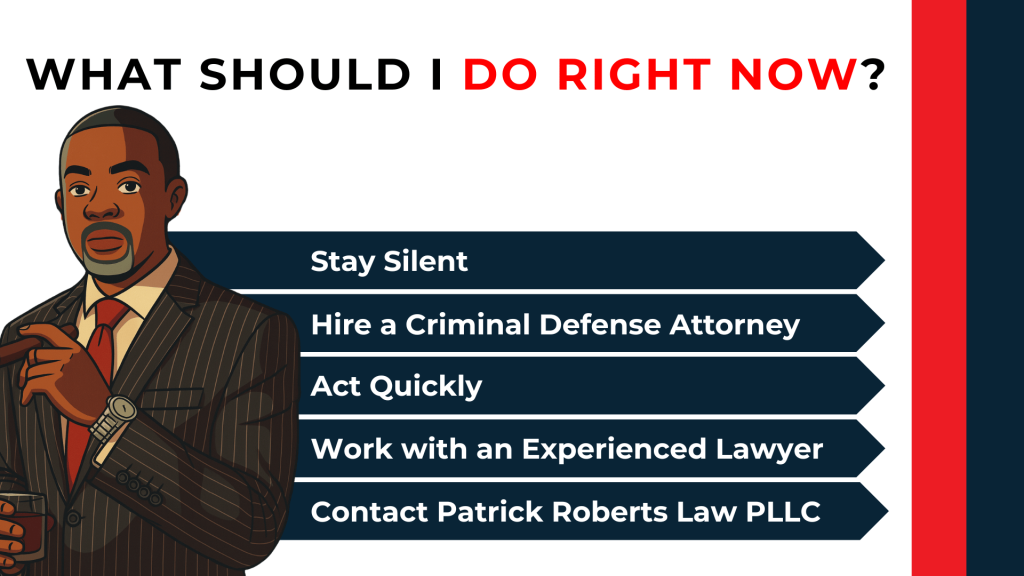
Two steps, in order:
- Invoke your right to counsel and let a lawyer speak for you before you discuss the case with anyone.
- Get a criminal defense lawyer involved immediately. Make sure that lawyer is admitted in the court where your case sits — especially if it’s federal.
Verifiable Courtroom Authority and Legal Qualifications
Defending a drug trafficking charge requires early, informed legal action before critical statutory deadlines expire—whether that involves challenging a search warrant, scrutinizing drug weights, demanding lab report compliance, or enforcing strict chain-of-custody protocols. Attorney Patrick Roberts brings 24 years of criminal litigation experience to these high-stakes matters, offering expert representation for clients facing state and federal drug offenses across North Carolina.
A former Assistant District Attorney in Wake, Johnston, and New Hanover counties, Attorney Roberts prosecuted drug trafficking cases and worked directly alongside drug interdiction teams to build complex, conspiracy-level prosecutions. Having constructed these cases from the inside, he relies on this specific prosecutorial expertise to identify vulnerabilities in the State’s evidence and build precise defense strategies. His extensive litigation record includes more than 80 completed jury trials across state and federal jurisdictions, featuring 6 federal jury trials (including complex drug trafficking and mail/wire fraud cases) and 3 state court drug trafficking jury trials. His federal expertise includes defending clients in multi-defendant drug conspiracy trials that spanned several weeks.
Attorney Roberts holds a legal education from Duke University School of Law and an undergraduate degree from Johns Hopkins University. His courtroom advocacy and trial expertise are further refined by advanced training from the National Criminal Defense College (NCDC) Trial Practice Institute—including its Cross-Examination Intensive—and Gerry Spence’s Trial Lawyers College.
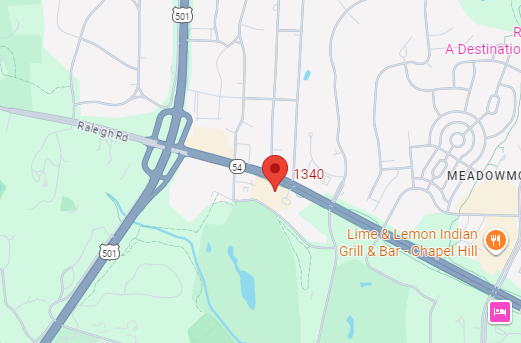
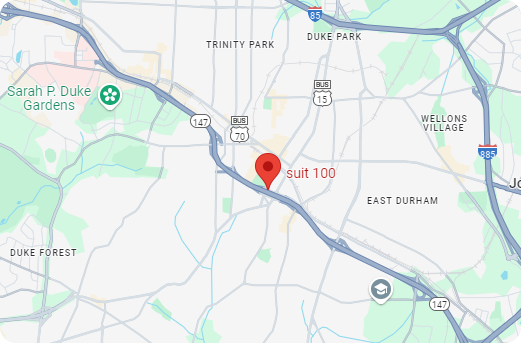
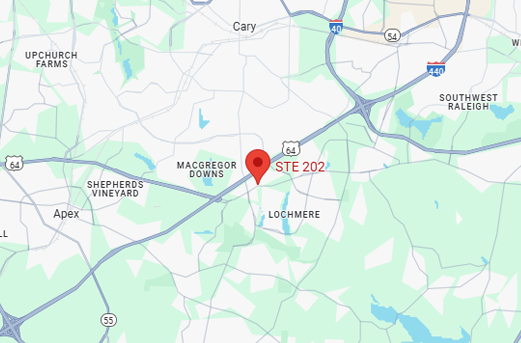
His practice covers the entire state, with primary offices in Raleigh, Durham, Chapel Hill, and Cary. Because drug offenses frequently cross into federal jurisdiction, Attorney Roberts brings federal court expertise as an attorney admitted to practice before all three federal districts in North Carolina (Eastern, Middle, and Western), the U.S. Court of Appeals for the Fourth Circuit, and the Supreme Court of the United States.
Courtroom & Litigation Experience
- Comprehensive Trial Record: 80+ completed jury trials across state and federal jurisdictions.
- Federal Court Litigation: 6 Federal jury trials, including cases involving Drug Trafficking and Mail/Wire Fraud.
- State Drug Offenses: 3 State Court Drug Trafficking jury trials.
- Prosecutorial Background: Former Assistant District Attorney in Wake, Johnston, and New Hanover Counties.
- Complex Cases: Expertise defending multi-defendant federal drug conspiracies in trials lasting several weeks.
Bar Admissions & Federal Jurisdictions
- State of North Carolina: All State District and Superior Courts
- U.S. District Courts: Eastern, Middle, and Western Districts of North Carolina
- U.S. Court of Appeals: Fourth Circuit
- Supreme Court of the United States
Client Review
I cannot speak highly enough of Mr.Patrick Roberts, from the moment we connected via the telephone he demonstrated confidence, support, and a great analytical mind, which provided my family with much-needed support during one of the most difficult periods in our lives. Mr. Roberts took the time to understand our situation, he ran through various scenarios on how he thought he could win our case, which he did! What sets Mr. Roberts apart is his legal expertise, in-depth knowledge of the judicial procedure, and genuine compassion and commitment to you as a client. He truly cares about his clients, he goes above and beyond to ensure your needs are met, I am incredibly grateful for Mr. Roberts and highly recommend his service to anyone needing legal representation. – Verified client review via Avvo.com
Peer Endorsement
“I endorse this lawyer. Patrick is a great trial lawyer and a person who I go to for legal advice in my own practice. Patrick is dedicated to his clients and a master at criminal defense. I would not hesitate to hire him if I was in trouble and needed a lawyer.” – Verified peer endorsement via Avvo.com
Disclaimer: The client reviews and peer endorsements featured on this website reflect actual comments provided by clients and legal professionals. This information is intended for general informational purposes only and does not constitute a guarantee, warranty, or prediction regarding the outcome of any future legal matter. Every legal case presents unique facts and circumstances that must be evaluated independently on its own merits. The testimonials displayed here do not represent all reviews or endorsements received by the firm.
Case Review
Attorney Patrick Roberts’ client was indicted on multiple severe counts, including:
- Level I Trafficking in Opium or Heroin
- Felony Possession and Intent to Distribute Heroin
- Possession of a Firearm by a Felon & Possession of a Stolen Firearm
- Maintaining a Dwelling/Vehicle for Controlled Substances
- Misdemeanor Marijuana and Paraphernalia counts
Facing: Mandatory minimum of 70 to 93 months in prison for trafficking, plus up to 126 additional months for the remaining charges under North Carolina sentencing guidelines.
The Defense
Attorney Patrick Roberts challenged the constitutionality of the search warrant that yielded the physical evidence. The defense demonstrated that the search warrant affidavit lacked Fourth Amendment probable cause due to two critical defects:
- Unreliable Informant: Unsubstantiated claims from a source with no established credibility or track record.
- Flawed Controlled Buys: Poorly documented law enforcement observations with unaddressed gaps in timing and supervision.
The Outcome
The court ruled the search warrant invalid and suppressed all physical evidence under the exclusionary rule. Without admissible evidence, the State was forced to dismiss* all charges prior to trial, completely relieving the client of all mandatory prison terms and criminal penalties.
*Disclaimer: Case outcomes depend upon a variety of factors unique to each case. Prior results do not guarantee or predict a similar outcome in any future legal matter.
Analyze Your Legal Defenses with Attorney Patrick Roberts
If you or someone in your family is facing a trafficking charge, contact Patrick Roberts Law PLLC to talk through where your case stands and what can be challenged. He defends clients in complex legal matters throughout North Carolina, centering his practice in Wake County cities and towns, including Raleigh, Cary, Apex, Holly Springs, Garner, and Fuquay-Varina
To maintain a high standard of service and thorough oversight for each client, the firm manages a restricted caseload.
This article provides general legal information about North Carolina drug trafficking law. It is not legal advice, does not address the specific facts of any individual case, and does not create an attorney-client relationship. For advice about your situation, consult a licensed North Carolina attorney.
Former assistant district attorney
Contact Patrick Roberts
Facing criminal charges in North Carolina demands seasoned representation. Trust in the experience and dual perspective of Patrick Roberts. Reach out today for a confidential consultation.
-
Call Our Team
Calls answered 24/7






For more information on the selection criteria, go to www.martindale.com
*Each case is different and must be evaluated separately. Prior results achieved do not guarantee similar results can be achieved in future cases.