

When you’re accused of taking something that isn’t yours in North Carolina, understanding the exact terms used in court matters a lot. While most people say “stealing,” the courts use the term “larceny.” Knowing this difference could help you better understand what you’re facing.
How Is Stealing Defined in North Carolina Law?
Stealing is the everyday word we use when someone takes something that doesn’t belong to them without permission. It’s the term you’ll hear in regular conversation, but it’s not what you’ll see in legal documents or hear in a courtroom. When charges are filed in North Carolina, you won’t be accused of “stealing” – you’ll face specific charges like larceny, embezzlement, or robbery.

What Constitutes Larceny Under North Carolina Statutes?
Larceny is the official legal term used in North Carolina courts for taking someone else’s property without their permission, with the plan to keep it permanently.
According to North Carolina law (General Statute § 14-70), the state doesn’t separate minor larceny from major larceny like some states do. Instead, larceny is usually treated as a Class H felony, unless other laws say differently.
What Are the Essential Elements of Larceny in North Carolina?
For you to be convicted of larceny in North Carolina, prosecutors need to prove:
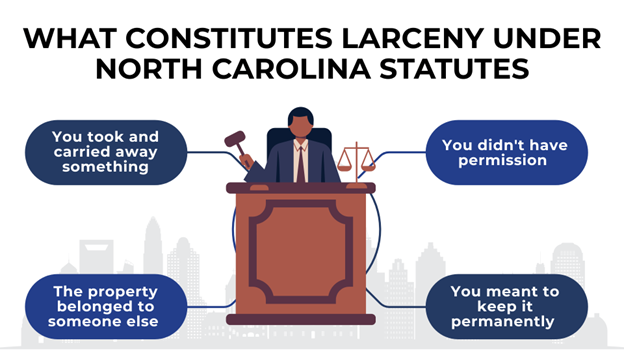
- You took and carried away something – You physically removed property from where it was
- The property belonged to someone else – It wasn’t your property
- You didn’t have permission – The owner didn’t say you could take it
- You meant to keep it permanently – You weren’t planning to return it
What Are Effective Defenses Against North Carolina Larceny Charges?
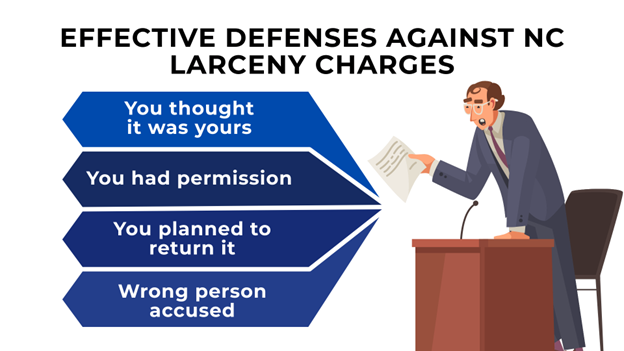
- You thought it was yours – You honestly believed you had a right to the property
- You had permission – The owner allowed you to take the property
- You planned to return it – You didn’t intend to keep the property forever
- Wrong person accused – You weren’t the one who took the property
What Are the Types of Larceny Offenses in North Carolina?
North Carolina has several different types of larceny charges:
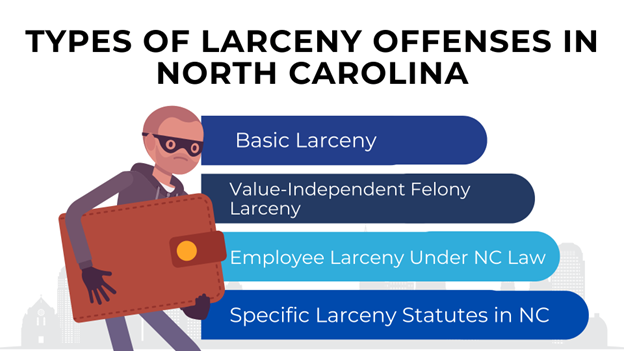
1. How Is Basic Larceny Classified in North Carolina? (G.S. § 14-72)
- Misdemeanor Larceny: Taking property worth $1,000 or less is a Class 1 misdemeanor (less serious)
- Felony Larceny: Taking property worth more than $1,000 is a Class H felony (more serious)
Helpful defense tip: If you can challenge how much the property is worth, sometimes a felony charge can be reduced to a misdemeanor.
2. When Is Larceny a Felony Regardless of Value?
Under North Carolina law (G.S. § 14-72(b)), certain types of larceny are Class H felonies no matter how much the property is worth:
- Taking property directly from a person
- Taking property during a break-in
- Taking explosives or devices that can start fires
- Taking guns
- Taking official records or papers from the North Carolina State Archives
Helpful defense tip: For these charges, focus on proving that the specific circumstances (like “taking directly from a person”) didn’t actually happen.
3. How Is Employee Larceny Treated Under North Carolina Law? (G.S. § 14-74)
This law specifically deals with employees who take things from their employers:
- Class H felony if the value is less than $100,000
- Class C felony (much more serious) if the value is $100,000 or more
Helpful defense tip: If you can show you had permission to use the property or thought you did, this can be a strong defense.
4. What Are the Specific Larceny Statutes in North Carolina?
North Carolina has created specific laws for taking certain items:
- Taking motor vehicle parts (G.S. § 14-72.8)
- Taking ginseng plants (G.S. § 14-79)
- Taking pine needles or pine straw (G.S. § 14-79.1)
- Taking items from stores (G.S. § 14-72.11)
Helpful defense tip: These special laws often require specific things to be proven, which can give you more ways to defend yourself.
What Does the Law Say About Receiving and Possessing Stolen Property?
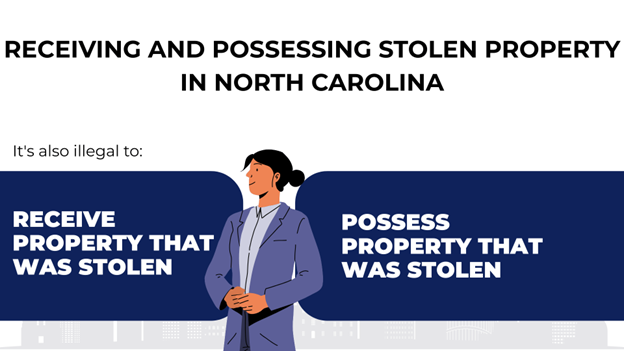
Under North Carolina law (G.S. § 14-71 and § 14-71.1), it’s also illegal to:
- Receive property that was stolen
- Possess property that was stolen
To be convicted, prosecutors must prove you knew or should have known the property was stolen.
Helpful defense tip: Proving you didn’t know the goods were stolen is key to defending against these charges.
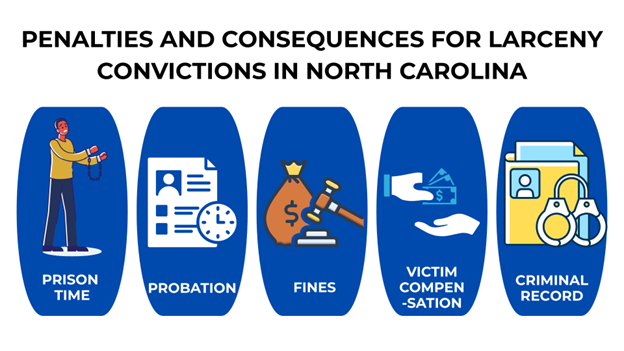
What Are the Penalties and Consequences for Larceny Convictions?
What happens if you’re convicted of larceny depends on how the crime is classified:
- Class 1 Misdemeanor (property worth $1,000 or less): Jail time is possible
- Class H Felony (property worth over $1,000 or special cases): Prison time is possible
- Class C Felony (employee theft over $100,000): Potentially years in prison
Other consequences might include:
- Probation
- Fines
- Paying back the victims
- Having a criminal record that makes it harder to get jobs or housing
What Are Common Examples of Larceny Offenses in North Carolina?
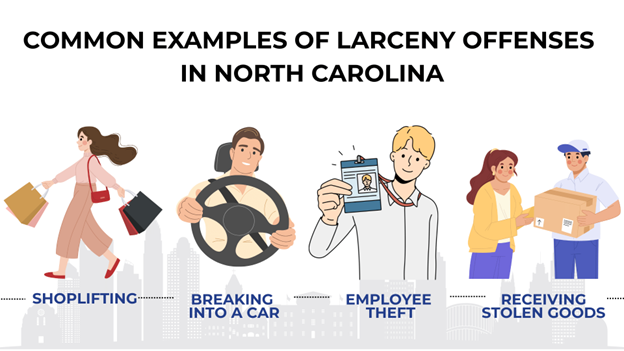
To better understand these laws, here are some examples:
- Shoplifting: Taking a $50 shirt from a store would be misdemeanor larceny
- Breaking into a car: Taking a $500 stereo from a car you broke into would be felony larceny (regardless of value)
- Employee theft: A cashier stealing $200 from the register would be employee larceny
- Receiving stolen goods: Buying a laptop from someone for $50 when you know it’s worth $1,000 and was probably stolen
How Can a North Carolina Criminal Defense Attorney Help With Larceny Charges?
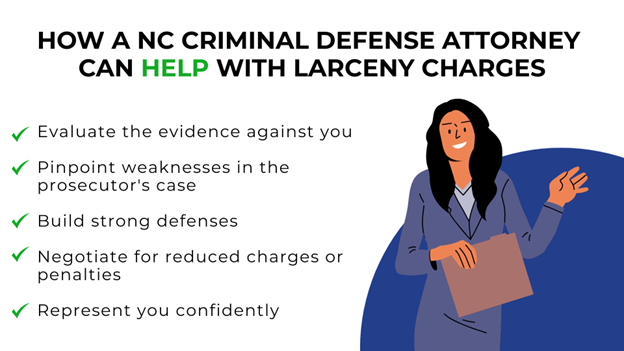
If you’re facing larceny charges in North Carolina, a good defense lawyer can:
- Look closely at all the evidence against you
- Find weaknesses in the prosecutor’s case
- Build defenses based on the specific elements they must prove
- Negotiate for lesser charges or penalties
- Represent you in court if your case goes to trial
Conclusion: Navigating Larceny Charges in North Carolina
While “stealing” is the word most people use, “larceny” is the actual crime in North Carolina courts, with specific elements that must be proven. North Carolina’s larceny laws can be complicated, with different classifications that can greatly affect the punishment you might face.
The difference between misdemeanor and felony charges can be huge for your future. Even a misdemeanor can affect job opportunities, while a felony conviction has much more serious and lasting consequences.
A larceny charge in North Carolina can carry serious consequences. Whether you or someone you care about has been accused, you need a defense attorney who understands what’s at stake. Attorney Patrick Roberts has a proven track record* of fighting for clients facing larceny charges. Reach out today to schedule a confidential consultation.
*Disclaimer: Each case is different and must be evaluated on its individual facts. Attorney Roberts works hard to assess each case individually. Prior results do not guarantee any future outcome.
Former assistant district attorney
Contact Patrick Roberts
Facing criminal charges in North Carolina demands seasoned representation. Trust in the experience and dual perspective of Patrick Roberts. Reach out today for a confidential consultation.
-
Call Our Team
Calls answered 24/7






For more information on the selection criteria, go to www.martindale.com
*Each case is different and must be evaluated separately. Prior results achieved do not guarantee similar results can be achieved in future cases.