
Being arrested on a violent offense charge in North Carolina has always been serious. But as of December 1, 2025, defendants facing these charges encounter a fundamentally different pretrial landscape. New legislation—commonly referred to as Iryna’s Law—has restructured how courts approach bail determinations for violent offenses, creating a legal presumption that defendants charged with these crimes should remain in custody while their cases are pending. Understanding these changes is essential for anyone facing violent offense charges or their families trying to navigate the path toward pretrial release.
What Is Iryna’s Law and When Did These Changes Take Effect?
Why Did North Carolina Enact Stricter Pretrial Release Rules?
Iryna’s Law represents a significant shift in North Carolina’s approach to pretrial detention for defendants charged with violent crimes. The legislation creates new presumptions and procedural requirements designed to address concerns about community safety and court appearance rates among defendants facing serious charges. The law fundamentally changes the starting point for bail hearings—rather than beginning with an assumption that release conditions can be set, courts now begin with a presumption against release for qualifying offenses.
When Do These New Rules Apply to Pending Cases?
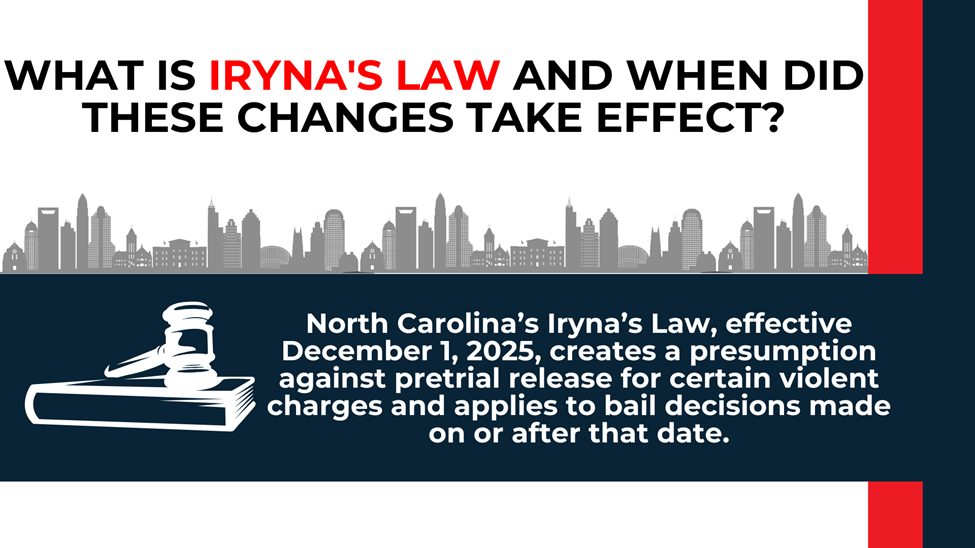
The new rules took effect on December 1, 2025. They apply to anyone who appears before a judicial official for a pretrial release determination on or after that date. This means the timing of your court appearance—not the date of your alleged offense or arrest—determines whether these rules govern your bail hearing.
Do These Rules Apply Retroactively to Existing Release Conditions?
If your pretrial release conditions were established before December 1, 2025, these new rules do not automatically change your situation. The law applies prospectively to bail determinations made on or after the effective date. However, if your release conditions come up for review or modification after the effective date, the new framework may apply to that subsequent determination.
Which Criminal Charges Qualify as “Violent Offenses” Under the New Law?
What Felony Classifications Trigger the New Bail Rules?
The statute defines “violent offense” broadly. Any Class A through Class G felony qualifies if assault, physical force, or the threat of physical force is a required element of the crime. This classification-based approach captures a wide range of serious felonies without requiring the legislature to name each offense individually.
Which Specific Crimes Are Named in the Statute?
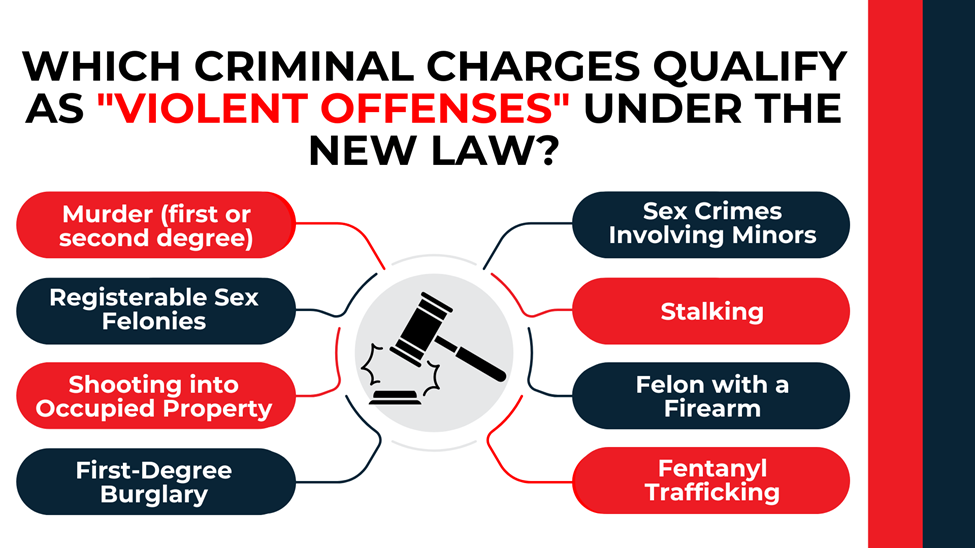
Beyond the classification-based definition, the law specifically identifies certain offenses that trigger the new bail rules regardless of their felony class. The qualifying offenses include:
- First-degree and second-degree murder
- Any felony requiring sex offender registration, regardless of whether the defendant is currently registered
- Shooting into occupied property
- First-degree burglary
- Certain sexual offenses involving minors
- Stalking
- Possession of a firearm by a felon
- Fentanyl trafficking
Do Attempt Charges Also Fall Under These Rules?
Yes. The statute explicitly includes attempts to commit any qualifying violent offense. This means defendants charged with attempted murder, attempted first-degree burglary, or attempts to commit other qualifying crimes face the same presumption against release as those charged with completed offenses.
How Does the New Presumption Against Release Work?
What Does “Rebuttable Presumption” Mean in This Context?
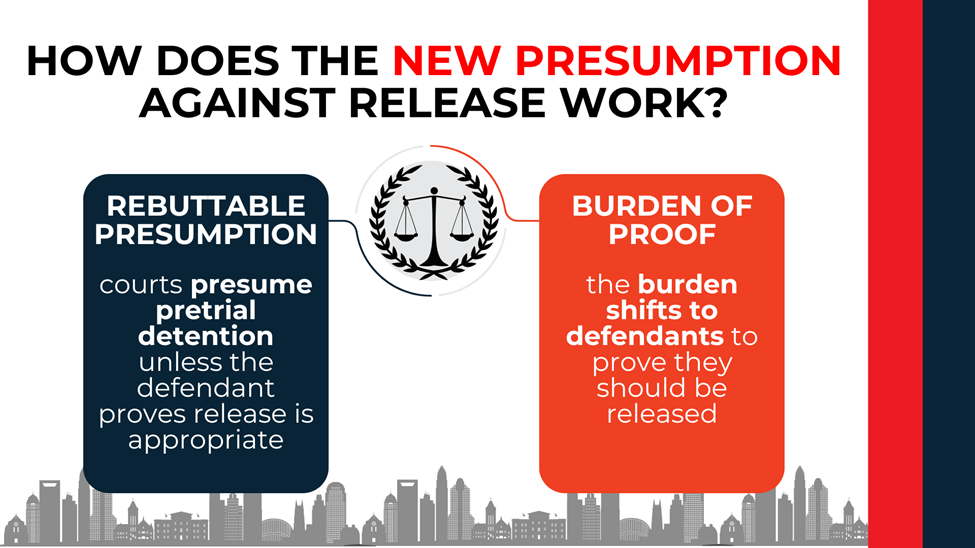
Under the new law, there is a “rebuttable presumption” that no release conditions can adequately ensure both the defendant’s appearance at court and the safety of the community. A rebuttable presumption is a legal assumption that stands unless challenged with sufficient evidence. The court starts from the position that pretrial detention is appropriate, and the defendant must present reasons why release should be granted despite that presumption.
Who Bears the Burden of Proof at a Bail Hearing?
This represents perhaps the most significant practical change under Iryna’s Law. Previously, defendants facing violent charges could often expect courts to set bail conditions that would allow release. Now, the burden has shifted. The defendant—typically through defense counsel—must affirmatively convince the judge that release is appropriate despite the presumption favoring detention.
What Must a Judge Find Before Granting Release?
To grant pretrial release for a violent offense charge, a judge must affirmatively decide that release is appropriate despite the statutory presumption. This requires more than a finding that standard release conditions would be adequate. The judge must determine that circumstances justify overcoming the presumption, and then must impose strict conditions as required by the statute.
What Release Conditions Apply If a Judge Grants Pretrial Release?
What Conditions Are Required for a First Violent Offense Charge?
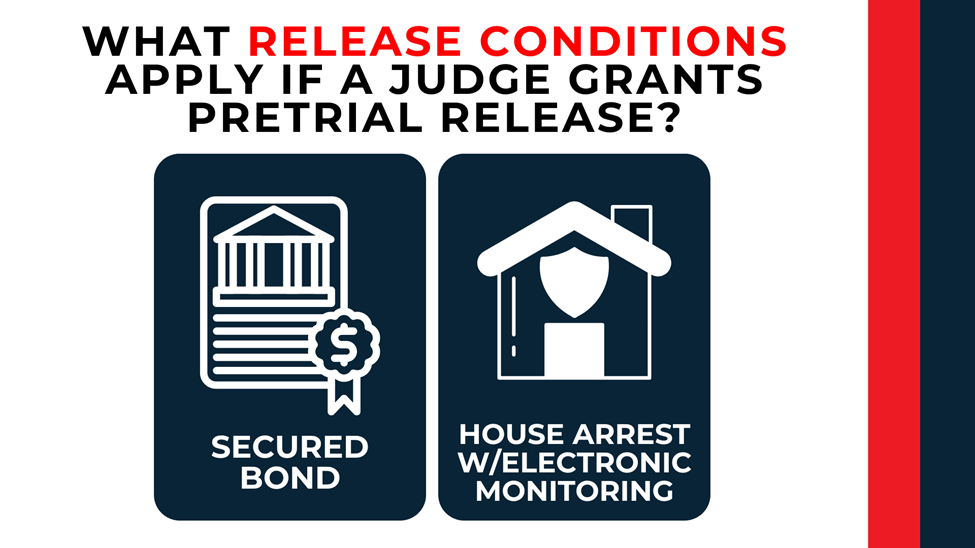
If a judge grants release on a first violent offense charge, the law mandates specific conditions. The court cannot simply release the defendant on their written promise to appear. Instead, the judge must require one of the following:
- A secured bond, meaning cash or a surety bond through a bail bondsman
- House arrest with electronic monitoring
These are the only permissible options for a first violent offense charge. The choice between them rests with the judge based on the circumstances of the case.
How Do the Rules Change for Second or Subsequent Violent Offense Charges?
The conditions become more restrictive for defendants facing a second or subsequent violent offense charge. If the judge grants release in these cases, the court must impose house arrest with electronic monitoring, provided that electronic monitoring is available in that jurisdiction. A secured bond alone is not sufficient for repeat violent offense charges—the monitoring requirement is mandatory.
Are Unsecured Bonds Still an Option for Violent Offenses?
No. Under Iryna’s Law, unsecured bonds and release on a written promise to appear are no longer available for defendants charged with violent offenses. This eliminates options that previously allowed some defendants to secure release without posting cash or obtaining a surety bond.
What Procedural Changes Should Defendants Expect?
Why Must a Judge—Rather Than a Magistrate—Set Bail Conditions?
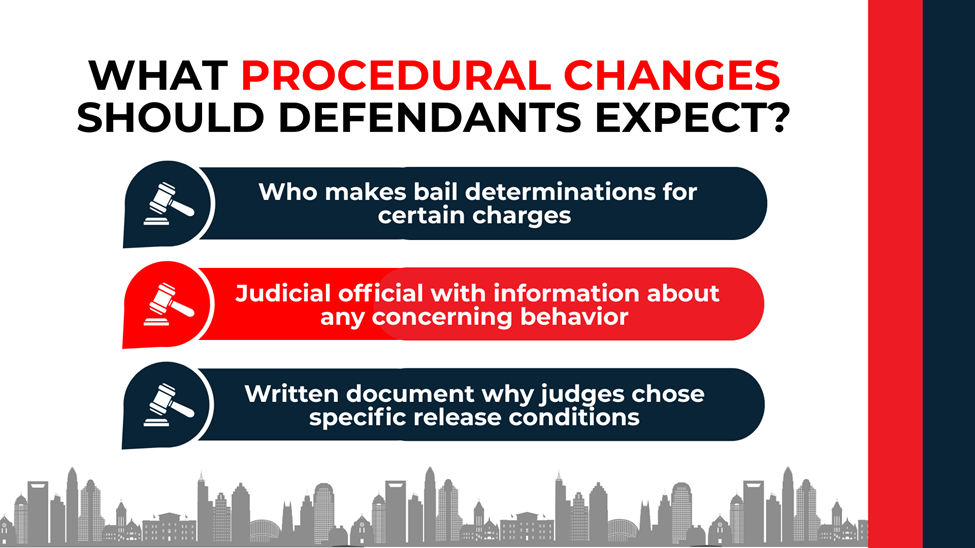
One significant procedural change involves who makes bail determinations for certain charges. Under the new law, a judge—not a magistrate—must determine whether to grant pretrial release for the most serious offenses, including:
- Murder
- Forcible rape
- Forcible sexual offense
- Sexual offenses involving children
- Armed robbery
- First-degree burglary
- Assault with a deadly weapon with intent to kill inflicting serious injury
- Kidnapping, human trafficking
- First-degree arson
Additionally, if you are arrested for any new offense while already out on pretrial release for another case, a judge must set your bail conditions on the new charge.
For other violent offenses covered by the new presumption, a magistrate may still conduct the initial bail determination—but must apply the rebuttable presumption against release and impose the required conditions (secured bond or electronic monitoring) if release is granted.
What Information Will Law Enforcement Report to the Court?
The law requires law enforcement officers to provide the judicial official with information about any concerning behavior they observed before, during, or after the arrest. This reporting requirement means judges will have more information about the circumstances of the arrest when making release decisions. The following information may be presented to the court:
- Statements made by the defendant before, during, or after arrest
- Observations about the defendant’s behavior or demeanor
- Circumstances of the alleged offense as observed by officers
- Any other conduct law enforcement deems relevant to the bail determination
Why Are Written Findings Now Required?
Judges must now document in writing why they chose specific release conditions. These written findings must address the statutory factors regarding flight risk and danger to the community. This requirement creates a record that can be reviewed and ensures judges are applying the statutory framework in each case.
What Happens If You’re Arrested for a New Offense While Out on Bond?
How Does a Pending Case Affect Bail on a New Charge?
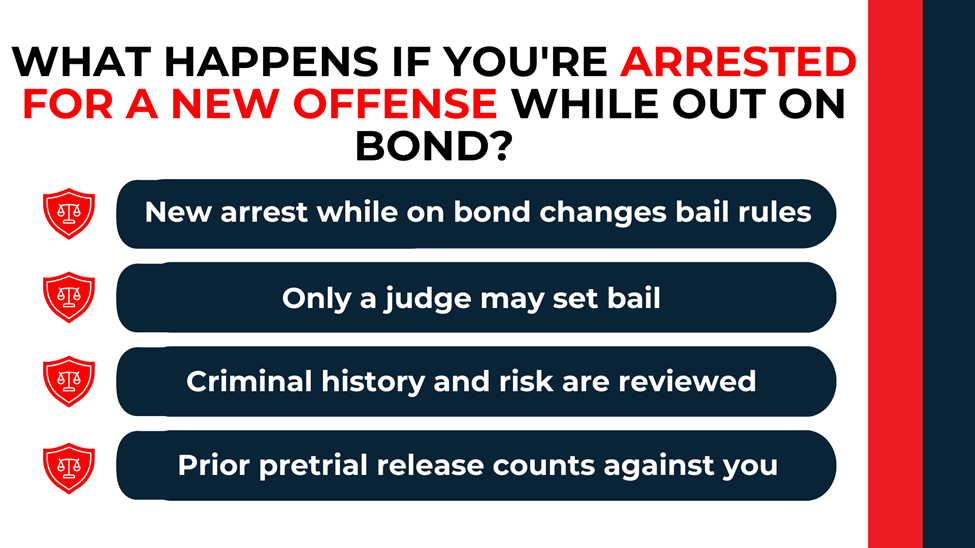
If you are arrested for any new offense while already released on bond for another case, the bail determination process changes. A judge—not a magistrate—must set your bail conditions on the new charge. The judge will review your criminal history and any risk assessment information. The fact that you were already on pretrial release when the new alleged offense occurred will be a factor in the court’s analysis.
What Is the 48-Hour Rule for Judicial Review?
When someone is arrested on a new charge while out on bond, they may be held for up to 48 hours while waiting for a judge to conduct the bail determination. This holding period allows time for a judge to review the case rather than having a magistrate set immediate conditions. If no judge acts within the 48-hour window, a magistrate may then set conditions. This rule balances the requirement for judicial review against constitutional limits on pretrial detention without judicial involvement.
How Can Experienced Defense Representation Help Under These New Rules?
Why Does Understanding the Prosecution’s Perspective Matter?
Navigating Iryna’s Law effectively requires understanding how prosecutors approach violent offense cases. A defense attorney who has seen these matters from the prosecution’s side understands what arguments are likely to be persuasive to a judge and what factors prosecutors will emphasize when opposing release. This perspective helps in preparing for bail hearings and anticipating the State’s position.
What Should You Look for in a Defense Attorney for Violent Offense Charges?
Violent offense charges under the new bail rules require an attorney prepared to advocate aggressively at the pretrial stage. The shift in burden means defense counsel must be ready to present compelling reasons for release from the outset. Look for an attorney with experience handling serious felony matters and the trial skills to advocate effectively in contested hearings.

Frequently Asked Questions
Does Iryna’s Law affect charges that were filed before December 1, 2025?
The law applies based on when you appear before a judicial official for a pretrial release determination, not when charges were filed. If your bail hearing occurs on or after December 1, 2025, the new rules govern that determination.
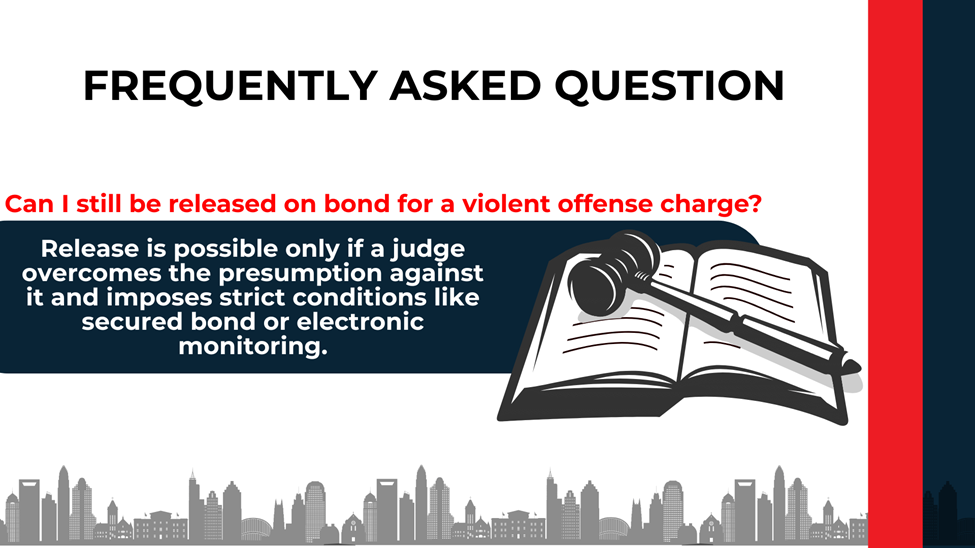
Can I still be released on bond for a violent offense charge?
Yes, release is still possible, but the path is more difficult. A judge must affirmatively find that release is appropriate despite the presumption against it, and then must impose either a secured bond or house arrest with electronic monitoring.
What if electronic monitoring isn’t available in my county?
For first violent offense charges, the judge can require a secured bond as an alternative. For second or subsequent charges, the statute requires electronic monitoring “if available” in the jurisdiction. If unavailable, the court must determine appropriate conditions consistent with the law.
Does a prior violent offense from years ago count as a “prior” under these rules?
The statute addresses “second or subsequent” violent offense charges but does not specify a time limitation. The application to specific prior records should be discussed with a defense attorney familiar with the jurisdiction’s interpretation of the law.
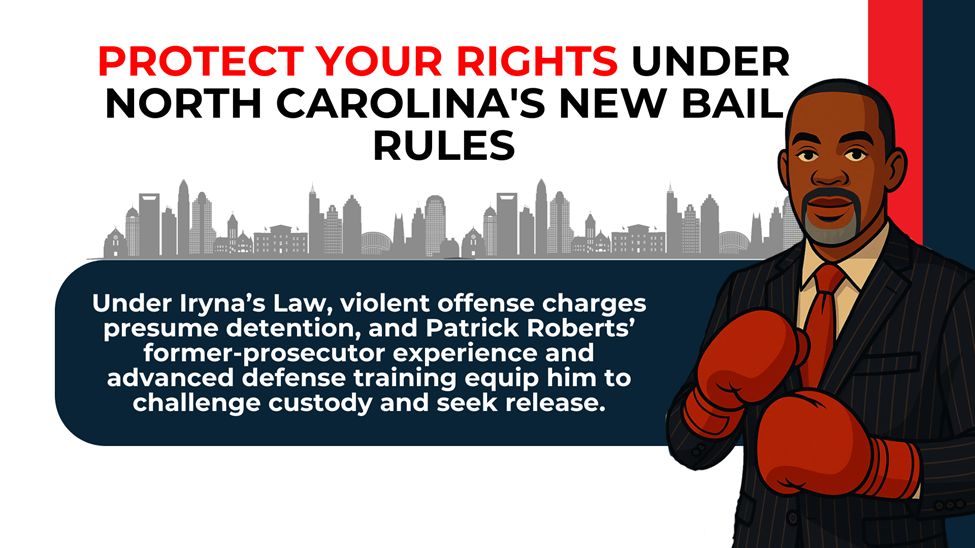
Protect Your Rights Under North Carolina’s New Bail Rules
Facing violent offense charges under Iryna’s Law means confronting a system that now presumes you should remain in custody. Overcoming that presumption requires presenting a compelling case to a judge—and that requires an attorney who understands how prosecutors think about these cases.
Attorney Patrick Roberts spent years as a prosecutor handling domestic violence cases and other serious felonies before becoming a defense attorney. That prosecutorial background means he knows how the State builds these cases and where the opportunities for effective advocacy exist. His trial skills training through the National Criminal Defense College, including advanced cross-examination techniques, and his graduation from Gerry Spence’s Trial Lawyers College—where he trained directly with Gerry Spence—shape his approach to contested hearings.
For defendants facing sex offense charges affected by these new rules, his specialized training through the National Association of Criminal Defense Lawyers’ sex-crimes defense program and the National Child Abuse Defense and Resource Center provides additional depth. Contact Patrick Roberts Law to discuss your case and explore your options for pretrial release under North Carolina’s new bail rules.
Disclaimer: The information on this website is for general information purposes only. Nothing on this site should be taken as legal advice for any individual case or situation. Case results depend upon a variety of factors unique to each case. Prior results do not guarantee a similar outcome.
Former assistant district attorney
Contact Patrick Roberts
Facing criminal charges in North Carolina demands seasoned representation. Trust in the experience and dual perspective of Patrick Roberts. Reach out today for a confidential consultation.
-
Call Our Team
Calls answered 24/7












For more information on the selection criteria, go to www.martindale.com
*Each case is different and must be evaluated separately. Prior results achieved do not guarantee similar results can be achieved in future cases.