

What Constitutes Attempted Murder in North Carolina?
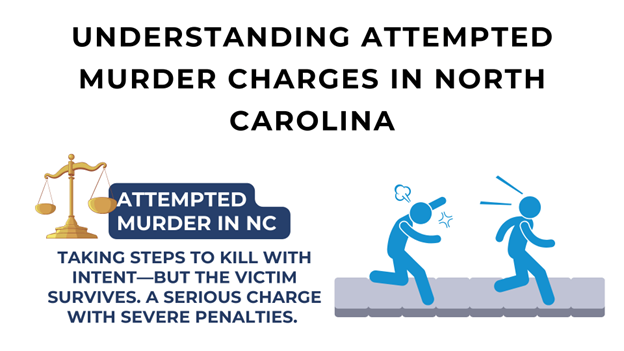
Attempted murder is one of the most serious crimes someone can be charged with in North Carolina. If you’re facing these charges, understanding what they mean is extremely important. In North Carolina, attempted murder means taking clear steps toward killing someone with the intent to cause their death, even though the person survives. The law treats this very seriously because the only difference between attempted murder and actual murder is that the victim lived.
What Prosecutors Must Prove in an Attempted Murder Case
For someone to be found guilty of attempted murder in North Carolina, prosecutors must prove several things beyond a reasonable doubt:
Intent to Kill
The prosecutor must show that the person specifically meant to kill someone else. This is different from just wanting to hurt or scare them. To prove this, prosecutors often use:
- Things the person said before, during, or after the incident
- The type of actions taken against the victim
- What kind of weapon was used, if any
- Any past threats or statements about wanting to kill the victim
Taking Clear Action
Besides proving intent, prosecutors must show that the person took a direct action toward killing the victim. This action must go beyond just planning or preparing. It must be a substantial step toward committing the murder.
Examples might include:
- Shooting a gun at someone
- Stabbing or hitting someone with a weapon
- Poisoning food or drink meant for the victim
- Doing something that would likely cause death, like cutting a car’s brake lines
The Victim Survived
For attempted murder charges to apply, the victim must have survived. If the victim dies, the charges would be for murder instead of attempted murder.

What Are the Penalties for Attempted Murder in North Carolina?
North Carolina law (General Statute § 14-2.5 “Punishment for attempt to commit a felony or misdemeanor”) says that attempt crimes are usually punished one level lower than the completed crime. Here’s what that means for attempted murder:
How Is Attempted First-Degree Murder Punished?
First-degree murder in North Carolina (G.S. § 14-17(a)) is a Class A felony. According to G.S. § 14-2.5, “an attempt to commit a Class A or Class B1 felony is a Class B2 felony.” This means attempted first-degree murder is a Class B2 felony.
If convicted of attempted first-degree murder, you could face:
- Serious prison time
- No chance of probation instead of prison
- A permanent felony record
First-degree murder (and attempted first-degree murder) involves what G.S. § 14-17(a) describes as a “willful, deliberate, and premeditated killing,” which means planning the killing ahead of time. It also includes murder “committed in the perpetration or attempted perpetration of any arson, rape or a sex offense, robbery, kidnapping, burglary, or other felony committed or attempted with the use of a deadly weapon.”
What Penalties Apply to Attempted Second-Degree Murder?
According to G.S. § 14-17(b), second-degree murder is usually classified as a Class B1 felony. Per G.S. § 14-2.5, an attempt to commit a Class B1 felony is classified as a Class B2 felony. Therefore, since second degree murder is typically a Class B1 felony, most attempted second-degree murders are a Class B2 felony.
If convicted of attempted second-degree murder, you could face:
- Serious prison time
- Limited possibility of probation, depending on your past record
- A permanent felony record
Second-degree murder, as defined in G.S. § 14-17(b), means the person acted “with malice” but without the premeditation and deliberation required for first-degree murder. The law recognizes both clear intent to kill and what the statute describes as “an inherently dangerous act or omission, done in such a reckless and wanton manner as to manifest a mind utterly without regard for human life and social duty and deliberately bent on mischief.”
Which Factors Can Worsen Attempted Murder Penalties?
Several things can make the punishment for attempted murder more severe:
Domestic Violence Cases
Under North Carolina law (G.S. § 14-17(a1)), if you try to kill someone you have a domestic relationship with, and you have past domestic violence convictions against that same person, “there shall be a rebuttable presumption that the murder is a ‘willful, deliberate, and premeditated killing'” and therefore first-degree murder. This same presumption would apply to attempted murder cases.
This applies if the victim is:
- Your spouse or ex-spouse
- Someone you live with or have lived with as a couple
- Someone you’re dating or have dated
- Someone you have a child with
Past Criminal Record
North Carolina courts look at your criminal history when deciding your sentence. If you have many past convictions, you’ll likely get a longer sentence even for the same crime.

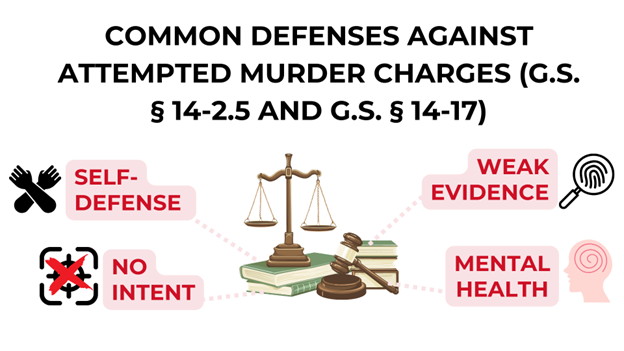
What Defenses Can Be Used Against Attempted Murder Charges? (G.S. § 14-2.5 and G.S. § 14-17)
If you’re facing attempted murder charges in North Carolina, several legal defenses might be available depending on your situation.
Self-Defense or Defense of Others
North Carolina recognizes your right to use reasonable force, including deadly force in some cases, to protect yourself or others from serious harm. For this defense to work, you typically need to show:
- You reasonably believed you or someone else was in immediate danger of death or serious injury
- The force you used was necessary to prevent that harm
- You didn’t use more force than needed in the situation
- You didn’t start the fight or provoke the other person
Lack of Intent to Kill
Since attempted murder requires specific intent to kill, evidence that you didn’t have this intent can be a defense. Your lawyer might argue that you:
- Only meant to frighten or injure, not to kill
- Acted recklessly but without specifically intending to cause death
- Were too intoxicated or had mental health issues that prevented you from forming the intent to kill
Not Enough Evidence
The prosecution must prove all elements of attempted murder beyond a reasonable doubt. If there isn’t enough evidence of intent to kill or of a substantial step toward murder, this can be a defense. Common arguments include:
- Your actions were unclear and didn’t clearly show intent to kill
- The evidence is circumstantial and could be interpreted innocently
- Witness testimony is unreliable or contradictory
- Physical evidence doesn’t support the prosecution’s theory
Mental Health Issues
In some cases, mental illness may affect a person’s ability to form the specific intent required for attempted murder charges. North Carolina law recognizes several mental health-related defenses:
- Insanity: You were legally insane when the offense happened
- Diminished capacity: Your mental condition prevented you from forming specific intent
Why You Need an Experienced Lawyer
Given how serious attempted murder charges are and the harsh penalties you could face, having an experienced lawyer is crucial. A good North Carolina criminal defense attorney can:
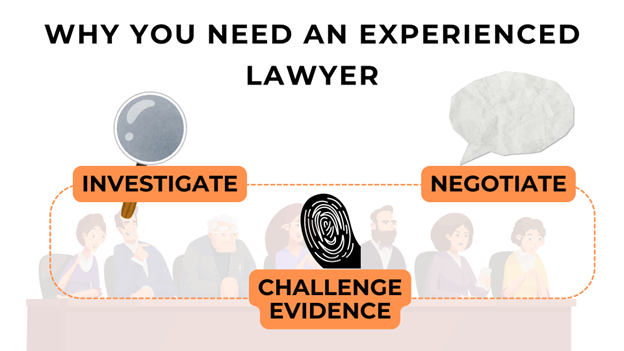
Investigate Your Case Thoroughly
A skilled defense lawyer will look into all aspects of your case, including:
- Talking to witnesses
- Examining crime scene evidence and police reports
- Consulting with experts in relevant fields
- Finding inconsistencies or weaknesses in the prosecution’s case
Challenge Evidence and Police Procedures
An experienced attorney will examine the evidence and procedures used in your case, looking for:
- Violations of your rights during arrest or questioning
- Improper handling or testing of physical evidence
- Failure to follow proper police procedures
- Possible bias in witness statements or identifications
Negotiate with Prosecutors
In some cases, negotiating with prosecutors may be in your best interest. A skilled attorney can:
- Present factors that might justify reduced charges
- Negotiate plea deals that reduce penalties
- Argue for alternative sentencing when possible
How Does an Attempted Murder (Class B2 or Class C Felony) Conviction Affect Your Future?
The consequences of an attempted murder conviction go far beyond just prison time. Those convicted face many long-term effects that can impact almost every part of their lives.
Criminal Record and Background Checks
A felony conviction for attempted murder will show up on background checks, potentially affecting:
- Job opportunities (many employers won’t hire people with violent felony convictions)
- Housing applications (landlords may deny housing to those with violent criminal histories)
- Professional licenses (many professions require background checks)
- Educational opportunities (some programs restrict admission of people with violent convictions)
Loss of Civil Rights
Felony convictions in North Carolina result in the loss of certain civil rights:
- Loss of the right to own or possess firearms
- Loss of voting rights while in prison (though rights can be restored after completing the sentence)
- Possible disqualification from jury service
Immigration Consequences
For non-citizens, an attempted murder conviction may have severe immigration consequences:
- Possible deportation
- Ineligibility to become a U.S. citizen
- Denial of reentry into the United States
- Loss of visas or green cards

Conclusion: What to Do If You’re Facing Attempted Murder Charges Under G.S. § 14-2.5
Attempted murder charges in North Carolina are among the most serious legal problems a person can face. The combination of complex legal elements, severe penalties, and life-changing consequences makes these cases particularly challenging.
Remember that every case is different, and your specific situation will determine the most effective defense strategies and possible outcomes. With a knowledgeable lawyer and an understanding of North Carolina’s attempted murder laws, you can ensure you receive fair treatment under the law and the strongest possible defense against these serious charges.
If you or a loved one are facing attempted murder charges, you deserve a legal advocate with the experience and dedication to secure the best possible outcome. Attorney Patrick Roberts of Patrick Roberts Law has successfully defended numerous clients facing allegations of homicide crimes. Contact our firm today for a confidential consultation.
Former assistant district attorney
Contact Patrick Roberts
Facing criminal charges in North Carolina demands seasoned representation. Trust in the experience and dual perspective of Patrick Roberts. Reach out today for a confidential consultation.
-
Call Our Team
Calls answered 24/7






For more information on the selection criteria, go to www.martindale.com
*Each case is different and must be evaluated separately. Prior results achieved do not guarantee similar results can be achieved in future cases.