
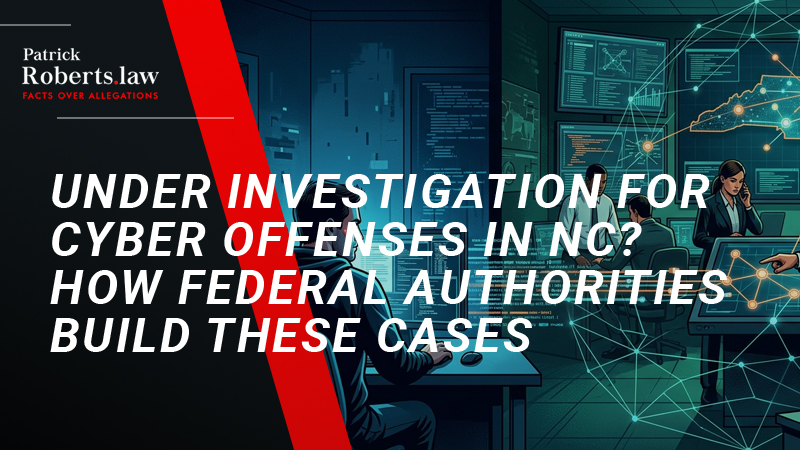
Federal cyber crime enforcement in North Carolina has reached unprecedented levels, marked by proactive digital surveillance, multi-agency task force operations, and severe judicial outcomes. A prime example of this environment is the August 2026 sentencing of a Charlotte man to 15 years (180 months) in federal prison, followed by 30 years of supervised release and $23,000 in mandatory restitution, following a guilty plea to digital child exploitation distribution charges under federal jurisdiction.
Initiation of Investigations & Forensic Mechanics
Unlike traditional criminal matters, modern federal cyber cases originate from automated monitoring systems. Major tech platforms utilize perceptual hashing algorithms (e.g., PhotoDNA) to scan cloud accounts, messaging applications, and file uploads, generating automated CyberTiplines to the National Center for Missing & Exploited Children (NCMEC). These reports are routed directly to federal task forces (including the FBI, HSI, and NC SBI), where agents correlate subscriber records, IP logs, IMEI/MAC device identifiers, and metadata to link online personas to physical locations.
Why Cases Land in State vs. Federal Court
- How Federal Jurisdiction Is Triggered: Because almost all modern digital communications, cloud platforms, social media apps (like Snapchat or Meta), and internet service providers cross state or international lines, the federal government nearly always has the legal basis to claim jurisdiction under the Commerce Clause. However, having jurisdiction does not mean federal prosecutors adopt every case.
- State Court Prosecution (North Carolina): Many digital exploitation cases remain in North Carolina state court, where they are prosecuted under N.C.G.S. § 14-190 (Sexual Exploitation of a Minor) by local District Attorneys. These cases often involve lower file volumes, local law enforcement investigations, or initial offenses where federal authorities choose not to adopt the case.
- When Federal Authorities Step In: Federal prosecutors (the U.S. Attorney’s Office) typically adopt a case when:
- The investigation was directly spearheaded by federal agencies like the FBI or Homeland Security Investigations (HSI).
- The offense involves production, extensive distribution across state/international borders, or high-volume file sharing.
- The case involves complex multi-account networks, encryption, or commercial trading.
Key Differences Between State and Federal Charges
| Feature | North Carolina State Court | Federal Court |
| Statute | Sexual Exploitation of a Minor (1st, 2nd, 3rd Degree) | 18 U.S.C. § 2251, § 2252A, etc. |
| Sentencing Structure | NC Structured Sentencing (Felony Classes C, E, H) | Federal Sentencing Guidelines & Statutory Mandatory Minimums |
| Bail / Pre-trial Release | Handled via local magistrate or state judge bonds | Highly restrictive; federal detention hearings with strong presumptions against release |
| Parole / Time Served | Earned time credits available under state law | No federal parole; defendants must serve at least 85% of their sentence |
Key Legal & Evidentiary Challenges
Defendants in federal court face significantly higher procedural and penal hurdles than those in state court:
- Statutory Penalties: Mandatory minimums under statutes such as 18 U.S.C. § 2252A range from 5 to 15 years, with strict Federal Sentencing Guidelines enhancements based on file volume, victim age, and multi-account network usage.
- Complex Forensic Data: Prosecutions rely heavily on timestamped metadata, IP access logs, and thousands of extracted media files that non-technical juries often find overwhelmingly persuasive.
- Financial Restitution: Frameworks such as the Amy, Vicky, and Andy Act impose significant joint-and-several financial liabilities that persist beyond term completion.
Strategic Defense Considerations
Navigating a federal digital investigation requires targeted early-stage interventions:
- Exercise of Fifth Amendment Rights: Refusing informal interviews, “knock and talk” operations, or statements regarding account ownership.
- Independent Digital Forensics: Deploying defense experts to audit government reports for automated background downloads, unprompted cloud syncing, shared Wi-Fi access, third-party network compromise, or timestamp/hash discrepancies.
- Fourth Amendment Warrants & Mitigation: Evaluating whether federal agents exceeded warrant scope or relied on stale data, alongside early pre-trial mitigation (including psychological evaluations and sentencing departure petitions).
How Attorney Patrick Roberts Can Help
Navigating a federal or state cyber offense investigation demands immediate intervention from a highly knowledgeable defense attorney. Admitted to practice in all state and federal courts across North Carolina (Eastern, Middle, and Western Districts), the U.S. Court of Appeals for the Fourth Circuit, and the United States Supreme Court, Attorney Patrick Roberts possesses the jurisdictional authority and strategic depth to represent clients at every tier of the legal system.
Academic Background & Trial Credentials
- Juris Doctor (J.D.): Duke University School of Law (Ranked #7 National Law School and #9 Criminal Law Program by U.S. News & World Report )
- Undergraduate Degree: The Johns Hopkins University
- Advanced Trial Advocacy Training: Graduate of the National Criminal Defense College (NCDC) and Gerry Spence’s Trial Lawyers College
- Prosecutorial & Defense Experience: Former prosecutor across three North Carolina counties with over two decades of criminal trial practice
Experience in Sex Crimes Defense Law
Attorney Patrick Roberts has established himself as an expert in sex crime defense law, backed by a deep history of handling high-stakes, highly sensitive digital and physical offense allegations:
- 250+ Felony Sex Crime Cases: Substantiated expertise reflected in having handled more than 250 felony sex crime cases across North Carolina.
- ICAC & Cyber Crime Mastery: Extensive experience defending complex cases involving the Internet Crimes Against Children (ICAC) Task Force and advanced digital forensics.
- Federal & State Task Force Practice: Routinely handles cases brought directly by federal investigative agencies (such as the FBI and HSI) or the North Carolina State Bureau of Investigation (SBI) ICAC Task Force.
- Independent Forensic Auditing: A track record retaining and collaborating with independent digital forensic experts and data analysts to thoroughly audit and challenge government electronic evidence, search warrant parameters, and metadata logs.
As a former prosecutor and seasoned defense attorney, Attorney Roberts understands the technical mechanics of NCMEC CyberTiplines, IP logging, and ICAC task force operations. Whether your case involves negotiating early pre-trial mitigation to keep charges in state court or mounting a technical forensic challenge against federal evidence, early representation is critical.
To stay current with evolving legal and technical standards, he attended the Defending Digital Sex Crimes Bootcamp in Orlando, Florida, in July 2026—a two-day intensive program focused on defending possession and distribution cases involving digital evidence.
Recent Case Review: State Court Jurisdiction
- Charges:
- 4 Counts of Second-Degree Sexual Exploitation of a Minor (N.C.G.S. § 14-190.17)
- 6 Counts of Third-Degree Sexual Exploitation of a Minor (N.C.G.S. § 14-190A)
- Case Summary: The North Carolina State Bureau of Investigation (SBI) and local law enforcement initiated an investigation after digital monitoring flagged online activity linked to a specific IP address. Based on this data, authorities secured and executed a search warrant at the client’s residence. During the search, investigators recovered multiple digital items suspected of containing illicit material, and the client made admissions to law enforcement officers on site. Facing these severe allegations, the client retained Attorney Patrick Roberts to manage their legal defense.
- Defense Strategy: The defense focused on a mitigation-based approach during pre-trial negotiations. Rather than disputing the physical evidence or the on-site statements, Attorney Patrick Roberts compiled and presented comprehensive mitigating factors to the District Attorney’s office to provide context regarding the client’s background, lack of prior criminal history, and psychological profile.
- Result: Probation. Attorney Patrick Roberts successfully* negotiated a resolution with the prosecution that avoided active prison time. The client received a strictly probationary sentence and was subsequently granted legal authorization to transfer their probation supervision to a new state of residency.
(*Disclaimer: The results of specific cases reported are not meant to be a prediction or guarantee of a similar outcome in any future matter. Each legal case is unique and subject to distinct factual and legal circumstances.)
Peer Endorsements & Client Review
Peer Endorsement
“I endorse this lawyer. Patrick is a great trial lawyer and a person who I go to for legal advice in my own practice. Patrick is dedicated to his clients and a master at criminal defense. I would not hesitate to hire him if I was in trouble and needed a lawyer.”-Verified Peer Endorsement via Avvo.com
Client Review
“I highly recommend this attorney to anyone needing experienced and knowledgeable legal representation. From the beginning, he clearly explained the steps necessary to address my situation and made sure I understood the process along the way. He kept me informed as progress was being made and was always professional, responsive, and prepared.” – Verified Client Review via Avvo.com
Disclaimer: Testimonials and peer reviews are actual comments from clients and peers. They are for informational purposes only and do not guarantee or predict the outcome of your legal matter. Every case is unique and must be evaluated on its own merits.
Schedule a Confidential Legal Consultation
If you learn that you are under investigation or if law enforcement officers execute a search warrant, exercise your right to remain silent and seek qualified counsel before providing statements or answering questions.
- Law Firm: Patrick Roberts Law PLLC
- Website: patrickroberts.law
- Direct Office Phone: (919) 746-7206
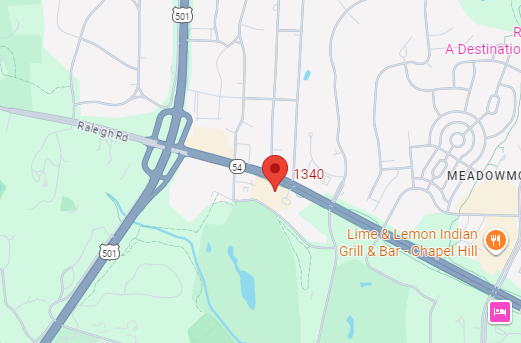
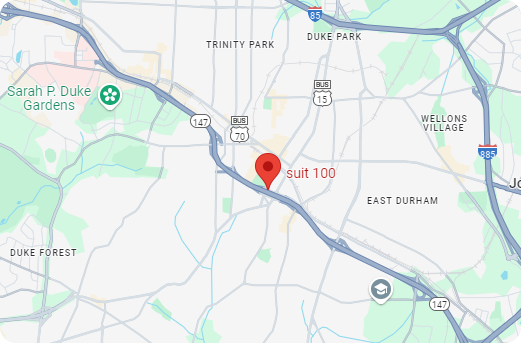
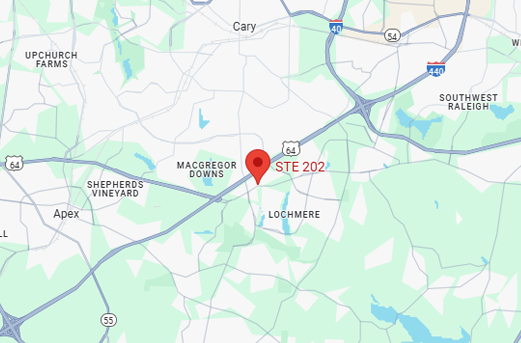
- Office Locations: Raleigh, Cary, Durham, and Chapel Hill
Attorney Patrick Roberts defends clients in complex legal matters throughout North Carolina, centering his practice in Wake County cities and towns, including Raleigh, Cary, Apex, Holly Springs, Garner, and Fuquay-Varina.
To maintain a high standard of service and thorough oversight for each client, we manage a restricted caseload.
For individuals navigating state charges, felony classifications, or registry exposure, Attorney Roberts provides the interactive North Carolina Sex-Offense Search Tool to help evaluate charge severity and statutory penalties.
Legal Disclaimer: The information provided on this page is for educational and informational purposes only and does not constitute formal legal advice. Accessing this material, submitting a query, or contacting Patrick Roberts Law does not create an attorney-client relationship.
Former assistant district attorney
Contact Patrick Roberts
Facing criminal charges in North Carolina demands seasoned representation. Trust in the experience and dual perspective of Patrick Roberts. Reach out today for a confidential consultation.
-
Call Our Team
Calls answered 24/7






For more information on the selection criteria, go to www.martindale.com
*Each case is different and must be evaluated separately. Prior results achieved do not guarantee similar results can be achieved in future cases.