

Yes. In North Carolina, assault by strangulation is a Class H felony under N.C.G.S. § 14-32.4(b). It is not a misdemeanor, not a lesser assault charge, and not something that can be informally resolved. A strangulation charge carries potential prison time, a permanent felony record, and consequences that reach into nearly every corner of your life. Those consequences affect your right to own a firearm, your ability to hold a professional license, and — for noncitizens — your right to remain in the United States.
This page explains what North Carolina law actually considers strangulation, how little injury the prosecution needs to prove, what the penalties look like, and what a felony conviction means for your future. If you or someone close to you is facing this charge, the information below covers what you need to understand right now.
What Does North Carolina Law Consider “Strangulation”?
Most people hear the word “strangulation” and picture someone being choked unconscious. North Carolina law sets the bar far lower than that.
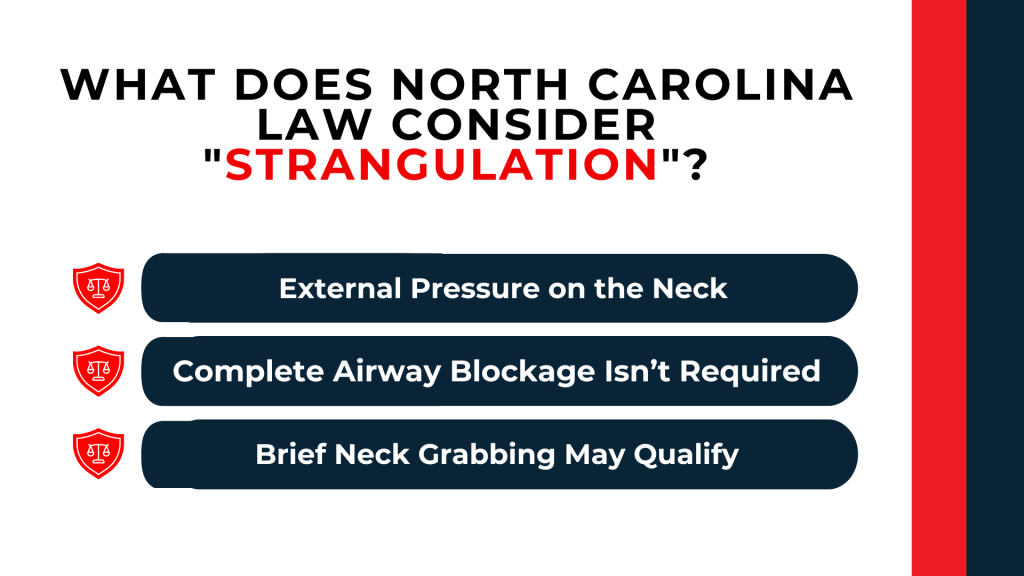
The statute itself — N.C.G.S. § 14-32.4(b) — does not define the term. The definition comes from North Carolina’s pattern jury instruction, N.C.P.I.—Crim. 208.61. It describes strangulation as a form of suffocation caused by closure of the blood vessels or air passages of the neck from external pressure on the neck — whether from hanging, a cord or similar object, or manual pressure. The instruction does not require proof that the airway was completely closed or that the person was unable to breathe at all. Evidence that enough pressure was applied to the throat to cause difficulty breathing is enough.
This means that what many people would describe as “grabbing someone by the neck” or “putting a hand on their throat” during an argument can meet the legal definition of strangulation. That is true even if the other person never lost consciousness, never stopped breathing entirely, and walked away from the encounter.
How Much Injury Does the Prosecution Actually Need to Prove?
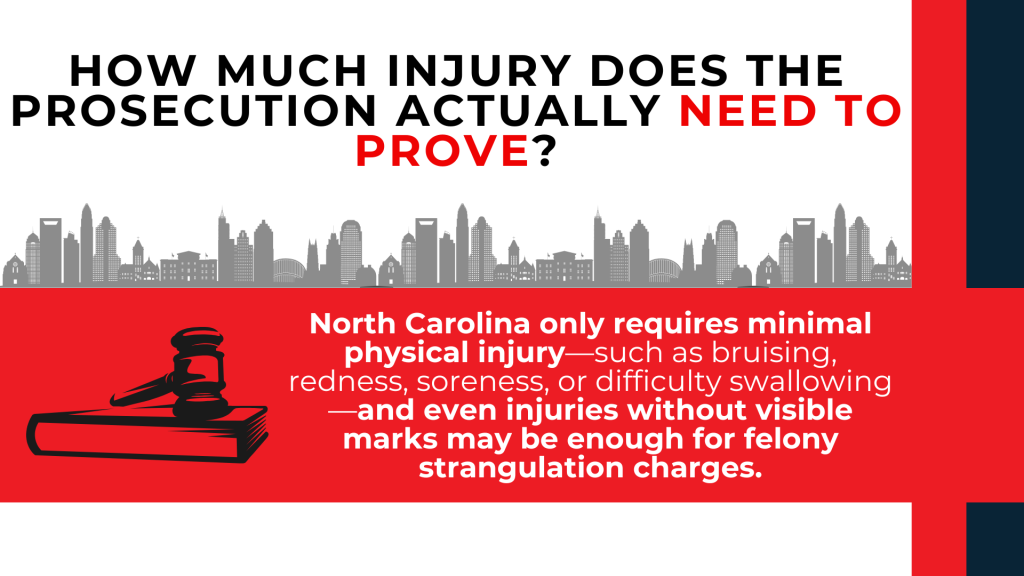
This is where the charge becomes more serious than most people expect. The statute requires “physical injury,” but that phrase is not defined in § 14-32.4(b) itself. Courts look to the related definition in G.S. § 14-34.7(c), which defines physical injury as cuts, scrapes, bruises, or other physical injury that does not count as serious injury.
That threshold is deliberately low. According to analysis from the UNC School of Government, North Carolina courts have found sufficient physical injury from cuts and bruises, petechiae (small broken blood vessels in the eyes or skin), redness on the neck, soreness, blurred vision, and difficulty swallowing. Courts have also recognized that physical injury can exist even where no injuries are externally visible.
The legislature designed it this way. The statute requires only “physical injury” — not “serious injury” and not “serious bodily injury,” which are the standards for higher assault charges. The act of strangulation itself, combined with even minimal evidence of injury, is what North Carolina treats as grounds for felony prosecution.
Why Is Strangulation Charged as a Felony Instead of a Misdemeanor?
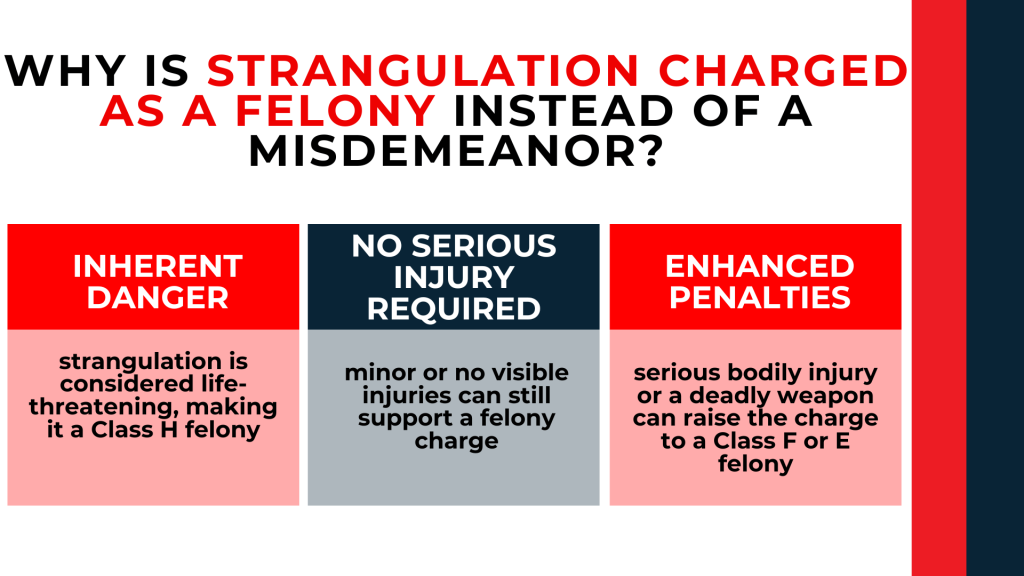
North Carolina has a layered system of assault charges, and strangulation sits well above where most people assume their situation falls. Simple assault and simple battery are Class 2 misdemeanors under G.S. § 14-33(a). Assault inflicting serious injury — which requires a higher level of harm including hospitalization, significant pain, or blood loss — is a Class A1 misdemeanor under G.S. § 14-33(c)(1). Assault on a female, one of the most commonly charged domestic violence offenses, is also a Class A1 misdemeanor.
Assault by strangulation under G.S. § 14-32.4(b) bypasses the misdemeanor tier entirely and goes straight to a Class H felony — even when the physical injury is minor. And it can go higher. If the same conduct causes serious bodily injury, the charge escalates to a Class F felony under G.S. § 14-32.4(a). Serious bodily injury means injury that creates a substantial risk of death, serious permanent disfigurement, coma, a long-lasting condition that causes extreme pain, permanent or long-lasting loss or impairment of the function of a bodily member or organ, or prolonged hospitalization. If a deadly weapon is involved and serious injury results, it can reach a Class E felony under G.S. § 14-32(b).
The practical takeaway is that a strangulation charge is not treated like a fight that got out of hand. North Carolina law treats the act of applying pressure to someone’s neck as far more dangerous than other forms of assault, and the charges reflect that.
What Are the Penalties for a Strangulation Conviction in North Carolina?
North Carolina sentences felonies using a grid that combines the offense class with your prior record level. That level is calculated on a point system under G.S. § 15A-1340.14. Each prior Class H or I felony adds two points, and each prior Class A1 or Class 1 misdemeanor adds one point.
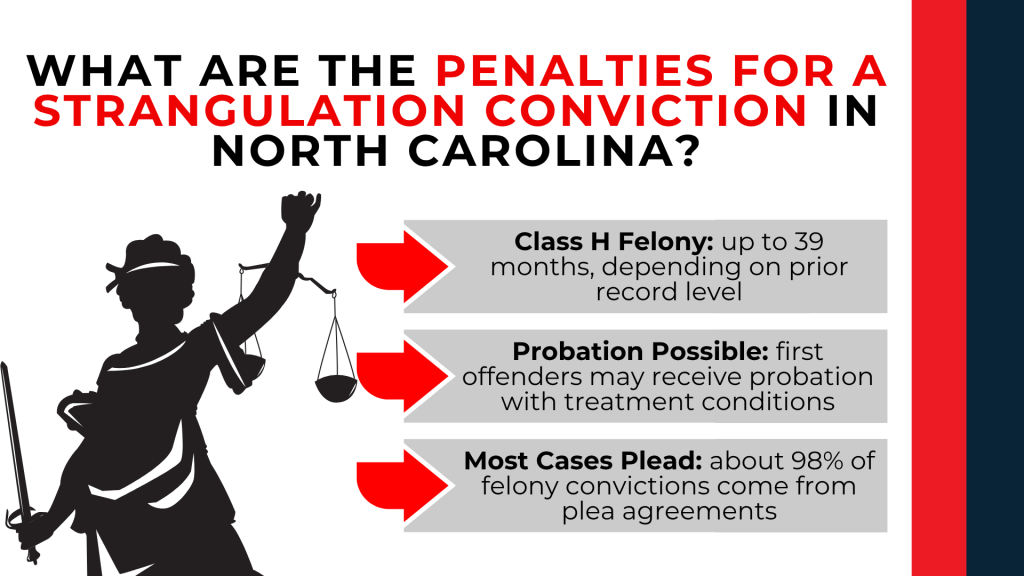
For a Class H felony with no significant criminal history — Prior Record Level I — the presumptive sentencing range is a 5 to 6 month minimum, with a mitigated range starting at 4 months. The statutory maximum for any Class H felony, even at the highest prior record level with aggravating factors, is 39 months under G.S. § 15A-1340.17. At lower prior record levels, the court can impose community punishment (probation) or intermediate punishment (probation with additional conditions like electronic monitoring, confinement, or treatment programs). At higher record levels, active prison time becomes mandatory.
Common probation conditions in domestic violence-related strangulation cases include supervised probation, substance abuse treatment, completion of an abuser treatment program under G.S. § 15A-1343(b)(12), and restitution.
Two statistics from the NC Sentencing and Policy Advisory Commission’s FY2024 report put these numbers in context. Across all North Carolina felonies in FY2024, roughly 40% of sentences were active prison time, 36% were intermediate punishment, and 24% were community punishment. And approximately 98% of all felony convictions that year resulted from guilty pleas — only 498 out of 26,577 felony convictions came from jury trials. For Class G, H, and I felonies specifically, the jury trial rate drops to approximately 1%. That does not mean trial is never the right path. But the overwhelming majority of these cases are resolved through negotiation, which makes the quality of that negotiation critical.
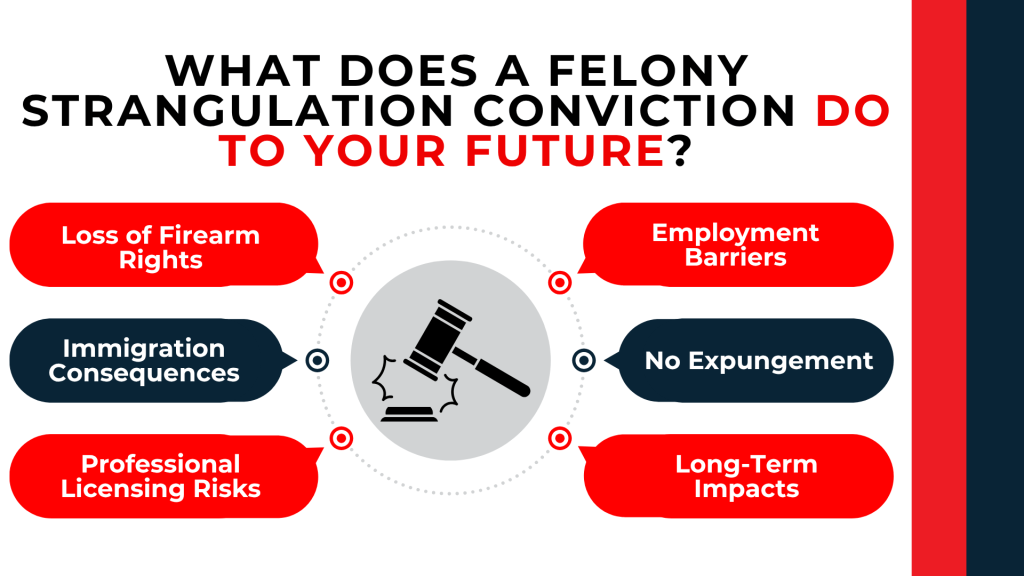
What Does a Felony Strangulation Conviction Do to Your Future?
The sentence is only part of the picture. A conviction for assault by strangulation under G.S. § 14-32.4(b) triggers consequences that last far longer than any period of prison time or probation.
The most immediate is the loss of firearm rights. A felony conviction triggers the federal firearms prohibition under 18 U.S.C. § 922(g)(1), which bars possession of any firearm or ammunition. North Carolina state law under G.S. § 14-415.1 separately bars a convicted felon from possessing, purchasing, owning, or controlling a firearm. In domestic violence cases, additional federal prohibitions under the Lautenberg Amendment, 18 U.S.C. § 922(g)(9), and under § 922(g)(8) for persons subject to qualifying protective orders, impose their own lifetime bans.
For noncitizens, the consequences can be even more severe. The Fourth Circuit held in U.S. v. Rice, 36 F.4th 578 (4th Cir. 2022), that North Carolina assault by strangulation is categorically a “crime of violence” because it can only be committed with an intentional, knowing, or purposeful state of mind. That holding was confirmed as binding in United States v. Robinson, 92 F.4th 531 (4th Cir. 2024). A crime-of-violence classification can trigger treatment as an aggravated felony under federal immigration law when a sentence of one year or more is imposed — including suspended sentences. That carries mandatory detention and near-automatic removal. When the offense involves a victim in a qualifying domestic relationship, it is separately deportable as a crime of domestic violence under 8 U.S.C. § 1227(a)(2)(E), with no one-year sentence requirement.
Professional licensing is also at risk. Under G.S. § 93B-8.1, North Carolina licensing boards may deny a license based on a criminal conviction when the crime is violent or sexual in nature. A conviction that federal courts have classified as a crime of violence falls clearly within that standard. Some professions face additional risk. The Nursing Practice Act under G.S. § 90-171.48, for example, expressly lists Article 8 assaults (which includes § 14-32.4) among offenses affecting fitness to practice.
Finally, a conviction for assault by strangulation is generally not eligible for expungement under current North Carolina law. It also makes you ineligible for expungement of other offenses on your record. This is a permanent mark.
Why Do You Need a Defense Attorney Now — Not Later?
A strangulation charge is a felony that carries prison time, lifetime firearms prohibitions, potential deportation for noncitizens, professional licensing consequences, and a conviction that cannot be expunged. Those consequences begin adding up the moment the charge is filed — and the earlier a defense attorney is involved, the more options remain available.
The sentencing data makes one thing clear: in a system where approximately 98% of felony cases resolve by plea, the quality of your attorney’s negotiation matters enormously. An attorney who understands how the prosecution builds and evaluates these cases is often a decisive factor in the outcome.
Patrick Roberts is a Raleigh criminal defense attorney and former Assistant District Attorney who has handled thousands of criminal cases across North Carolina over more than 24 years of practice. That prosecutorial background means he understands how strangulation cases are charged, what evidence the state relies on, and where the weaknesses in that evidence tend to be. He is a graduate of the Trial Lawyers College, the National Criminal Defense College, and Duke University School of Law, and his offices in Raleigh, Durham, Chapel Hill, and Cary serve clients across North Carolina. He handles high-stakes legal matters throughout North Carolina, with a primary focus on Wake County municipalities including Raleigh, Cary, Apex, Holly Springs, Garner, and Fuquay-Varina.
Client Review
“When our son was arrested on sexual assault and rape charges, I was lost. I searched and found Patrick Roberts. I was impressed with his resume so we met with him and hired him. Now our son’s case is over. It has taken a long time to get to the end of this experience, but I thank God for sending Patrick Roberts our way!” – verified client review via Avvo.com
Peer Endorsement
“I attended the Trial Lawyers College with Patrick. If I was facing serious criminal charges anywhere in North Carolina, he would be my first call.” – Verified peer endorsement via Avvo.com
Disclaimer: Testimonials and peer reviews are actual comments from clients and peers. They are for informational purposes only and do not guarantee or predict the outcome of your legal matter. Every case is unique and must be evaluated on its own merits.
If you or someone you care about is facing a strangulation charge, the time to act is now. Contact Patrick Roberts Law to discuss your case.
The firm maintains a selective intake process to ensure that each client receives the focused professional attention their case requires.
Disclaimer: The information on this website is for general informational purposes only. Nothing herein should be taken as legal advice for any individual case or situation. Contacting us via this website, email, or contact form does not create an attorney-client relationship. Case results depend on a variety of factors unique to each case; prior results do not guarantee a similar outcome.
Former assistant district attorney
Contact Patrick Roberts
Facing criminal charges in North Carolina demands seasoned representation. Trust in the experience and dual perspective of Patrick Roberts. Reach out today for a confidential consultation.
-
Call Our Team
Calls answered 24/7









For more information on the selection criteria, go to www.martindale.com
*Each case is different and must be evaluated separately. Prior results achieved do not guarantee similar results can be achieved in future cases.