

The age of consent in North Carolina is 16 years old. But that single number doesn’t tell you what you actually need to know — because North Carolina does not treat all situations the same. The charges you could face, and how severe those charges are, depend on the specific ages of both people involved and the age gap between them.
This page breaks down the specific statutes and the age brackets that trigger different felony classes under North Carolina law. If any part of this applies to your situation or someone you care about, the specifics matter more than most people realize. Attorney Patrick Roberts in Raleigh, North Carolina has defended clients against sex crime charges across the state for over two decades.
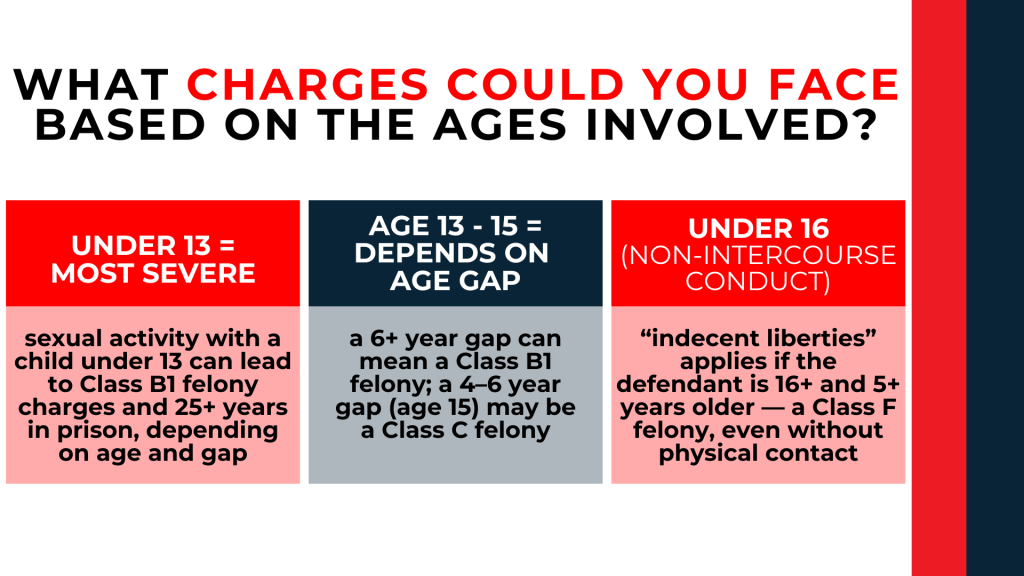
What Charges Could You Face Based on the Ages Involved?
North Carolina categorizes sexual activity with minors under a tiered system of statutes. These are strict liability offenses, meaning the prosecution does not have to prove force or a lack of consent. Instead, the state only needs to prove that the act occurred and that the ages of both parties fall within the specific statutory brackets.
The severity of the charge increases based on two primary factors: the age of the minor and the age gap between the minor and the defendant.
What Happens When the Minor is Under 13?
North Carolina applies its most severe penalties when a child is under the age of 13.
- Statutory Rape of a Child by an Adult: Under N.C.G.S. § 14-27.23, if the defendant is 18 or older and the child is under 13, the charge is a Class B1 felony. This carries a mandatory minimum sentence of 300 months (25 years).
- First-Degree Statutory Rape: Under N.C.G.S. § 14-27.24, if the defendant is at least 12 years old and at least 4 years older than a victim under 13, the charge is also a Class B1 felony.
What are the Brackets When the Minor is 15 or Younger?
For victims aged 15 or younger, N.C.G.S. § 14-27.25 creates two distinct tiers based on the age differential:
- Large Age Gap (6+ Years): If the defendant is at least 12 years old and 6 or more years older than the victim, it is a Class B1 felony.
- Small Age Gap (4–6 Years): If the victim is 15 and the defendant is more than 4 but less than 6 years older, it is a Class C felony.
How Does the Law Define Indecent Liberties With Children?
When a minor is under 16 and the conduct involves sexual touching or indecent behavior, N.C.G.S. § 14-202.1 applies. This charge is a Class F felony and requires the defendant to be 16 or older and at least 5 years older than the child.
North Carolina courts interpret “indecent liberties” broadly. In State v. Every, 157 N.C. App. 200 (2003), the Court of Appeals held that physical contact is not strictly required. Exposing a child to sexual activity or engaging in sexually explicit conversations can constitute a violation if the purpose was sexual arousal or gratification.
Why is Precision in Age Calculation Critical?
In these cases, exact dates of birth are the determining factor for which statute applies and the subsequent felony classification. Because the difference between a Class B1 felony (25-year minimum) and a lower-class felony often rests on a single year of age difference, charging errors based on miscalculations are a significant concern.
Statutory Age Brackets Summary
| Victim Age | Defendant Age/Gap | Statute | Felony Class |
| Under 13 | 18+ years old | § 14-27.23 | Class B1 |
| Under 13 | 12+ (4+ yrs older) | § 14-27.24 | Class B1 |
| Under 16 | 12+ (6+ yrs older) | § 14-27.25 | Class B1 |
| 15 Years Old | 4 to 6 yrs older | § 14-27.25 | Class C |
| Under 16 | 16+ (5+ yrs older) | § 14-202.1 | Class F |
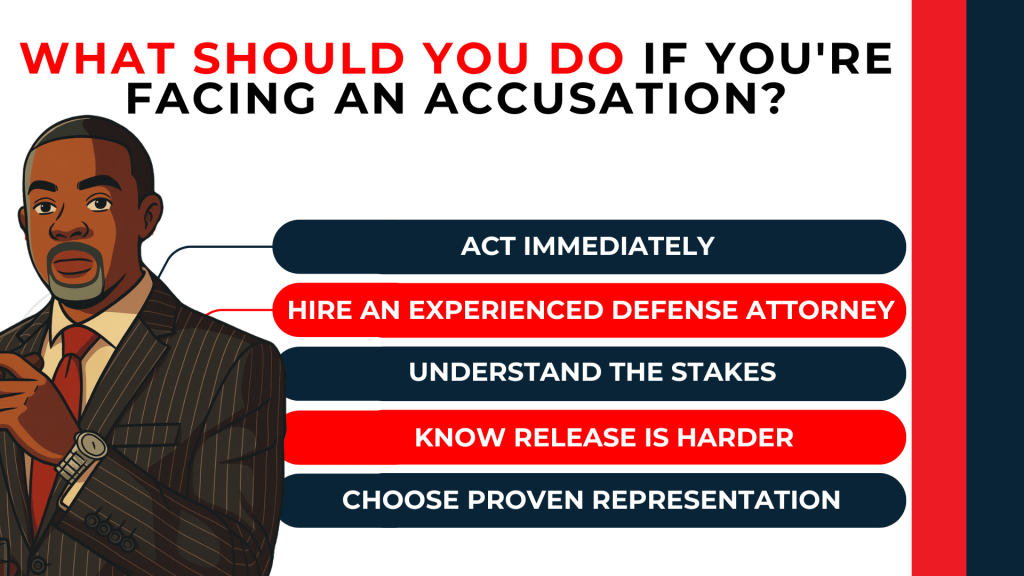
What Should You Do If You’re Facing an Accusation?
If you are trying to understand how North Carolina’s age-of-consent laws apply to a specific situation, the statutes above should make one thing clear. The difference between “not chargeable” and “Class B1 felony” can come down to a matter of months in the age gap between two people. These statutes are strict liability — the state does not have to prove intent, and the lines are drawn by the ages alone.
That precision is exactly why early involvement of an experienced defense attorney matters. The median time from charging to sentencing for a Class B1 felony in North Carolina is 30 months. Defendants in this category spend an average of 27 months in pretrial detention. Under N.C.G.S. § 15A-533(b), sex offense charges require a district or superior court judge — not a magistrate — to authorize pretrial release. The window to shape how a case is investigated and charged is narrow, and it begins closing immediately.
Decades of Experience in North Carolina Sex Crimes Defense
Attorney Patrick Roberts has defended clients against sex crime charges across North Carolina for over 24 years. He is a graduate of Duke University School of Law (Top 9 best criminal law program) and Johns Hopkins University (Top 7 rank in National Universities) who completed Gerry Spence’s Trial Lawyers College, the National Criminal Defense College Trial Practice Institute, and the 2025 NCDC Cross-Examination Intensive. He is a former Assistant District Attorney in Wake, Johnston, and New Hanover counties — experience that gives him direct insight into how prosecutors build and evaluate these cases. He is the co-author of a legal book on defending internet sex crimes and is the only North Carolina lawyer listed on the National Child Abuse Defense & Resource Center as of 2026.
Mr. Roberts holds an AV Preeminent peer rating from Martindale-Hubbell, a 10/10 “Superb” rating on Avvo, and has been recognized as a Client Champion Platinum by Martindale-Hubbell for over five consecutive years. He is admitted to practice before the U.S. Supreme Court, the Fourth Circuit Court of Appeals, and all federal district courts in North Carolina, and is a lifetime member of the National Association of Criminal Defense Lawyers.
Case Review
Charge: Statutory Rape
Description
In this North Carolina case, Attorney Patrick Roberts represented a client accused of having sexual relations with a minor. The state’s evidence was primarily based on the accuser identifying the client during a police interview.
Strategy
Mr. Roberts’ defense strategy involved a critical analysis of the accuser’s statements and the identification of specific trial issues that could undermine the prosecution’s case. By highlighting these credibility concerns and procedural weaknesses to the Assistant District Attorney, the defense demonstrated the risks of pursuing the original charges in court.
Outcome
As a result of these negotiations, the prosecution dismissed the statutory rape charge. The client entered a plea to a misdemeanor and received a sentence of probation, which successfully prevented the requirement for sex offender registration.
Disclaimer: Each case is different and must be evaluated separately. Prior results achieved do not guarantee similar results can be achieved in future cases.
Client Review
“We hired Patrick to defend our son against very serious felony charges that we knew to be false. It was the scariest thing to put our trust in someone to help us, especially living out of state, but we were so fortunate that we found Patrick. He showed a tremendous attention to detail, hired experts to examine and refute the evidence, and used brilliant strategies to poke holes in the case. After four long years, and many highs and lows, Patrick did what he promised: he took care of our son. Felony charges were reduced to a misdemeanor with no jail time. We will always be grateful to Patrick and his firm for giving our son his life back.” — Verified client review on Avvo.com
Peer Endorsement
“Patrick is an extremely talented lawyer who has the highest ethical standards. He works extremely hard for his clients and is a very skilled adversary in court.” — Martindale-Hubbell verified Peer Endorsement
Disclaimer: The testimonials are actual comments. Every case is different and depends on its own unique facts and legal circumstances. These results are illustrative of the matters the firm handles but do not guarantee, warrant, or predict a similar outcome in your legal matter.
If you or someone you care about is facing accusations involving North Carolina’s age-of-consent laws, contact Patrick Roberts Law in Raleigh for a confidential consultation. The earlier an experienced defense attorney is involved, the more options remain available.
By accepting only a select number of cases, the firm ensures the caliber of defense that complex criminal litigation demands.
Disclaimer: The information on this website is for general informational purposes only and does not constitute legal advice for any individual case or situation. Contacting us via this website, email, or contact form does not create an attorney-client relationship. Each case is different and must be evaluated separately; prior results do not guarantee a similar outcome.
Former assistant district attorney
Contact Patrick Roberts
Facing criminal charges in North Carolina demands seasoned representation. Trust in the experience and dual perspective of Patrick Roberts. Reach out today for a confidential consultation.
-
Call Our Team
Calls answered 24/7








For more information on the selection criteria, go to www.martindale.com
*Each case is different and must be evaluated separately. Prior results achieved do not guarantee similar results can be achieved in future cases.