
Being accused of child grooming in North Carolina is a serious situation, but it helps to understand that “grooming” is not a standalone criminal charge under NC law. Instead, prosecutors charge the underlying behavior using existing statutes that carry significant felony penalties. With more than 200 law enforcement agencies participating in North Carolina’s Internet Crimes Against Children (ICAC) Task Force according to the NC State Bureau of Investigation (2025), these investigations are well-funded and aggressively pursued. Understanding which charges actually apply is the first step toward building an effective defense.
What Exactly Is a “Child Grooming” Charge in North Carolina?
Does North Carolina Have Aa Specific Grooming Statute?
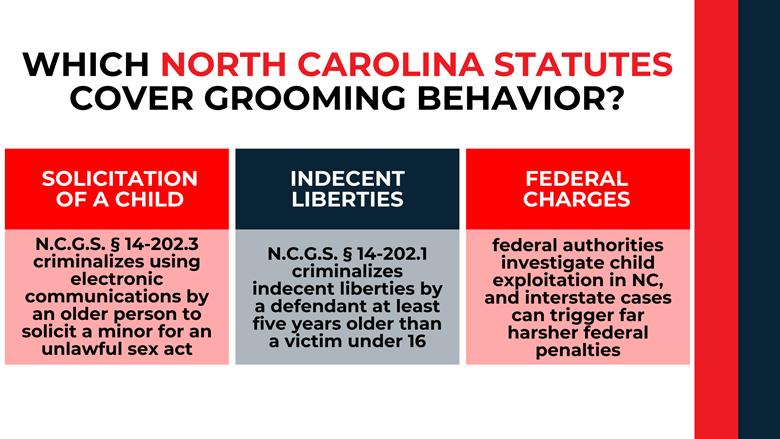
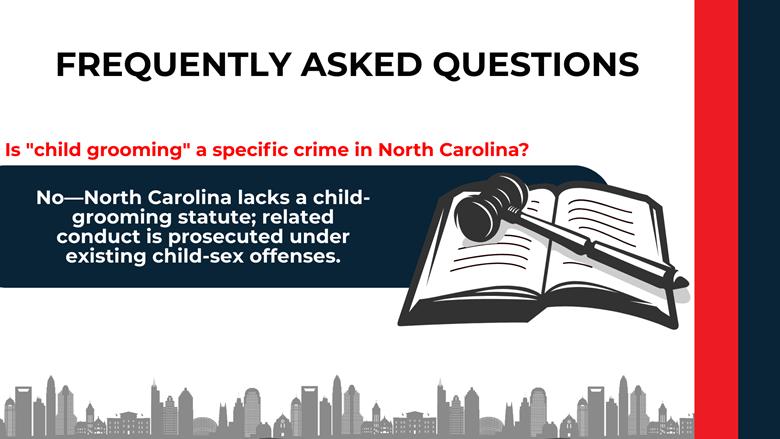
No. North Carolina does not have a criminal statute specifically titled “child grooming.” Unlike some states that have enacted standalone grooming laws, NC prosecutors rely on existing statutes to charge behaviors associated with grooming. When someone says they face a “grooming charge,” they are actually facing prosecution under laws like solicitation of a child by computer (N.C.G.S. § 14-202.3) or indecent liberties with a child (N.C.G.S. § 14-202.1).
This distinction matters for defense purposes. The specific statute on the charging document determines what the State must prove, what penalties apply, and which defense strategies are available.
What Behaviors Are Considered Grooming Under NC Law?
The term “grooming” generally describes a pattern where an adult builds trust with a minor for the purpose of eventual sexual contact or exploitation. Law enforcement uses the term broadly to encompass conduct that NC law addresses through specific criminal statutes.
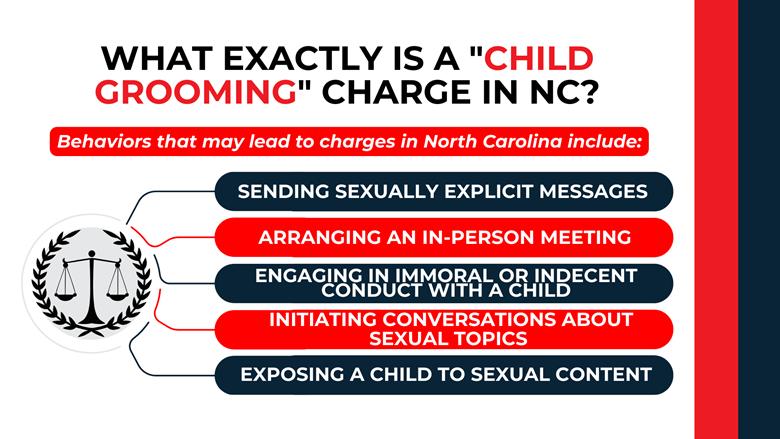
Behaviors that may lead to charges in North Carolina include:
- Sending sexually explicit messages to someone believed to be under 16 through electronic devices, apps, or social media platforms
- Initiating conversations about sexual topics with a minor or believed minor for the purpose of arranging an in-person meeting
- Engaging in immoral or indecent conduct with a child under 16 for the purpose of sexual arousal or gratification, even without physical touching
- Arranging or attempting to arrange a meeting with a minor after sexual communication online
- Exposing a child to sexual content or activity as a means of normalizing sexual behavior
Each behavior maps to a specific NC statute with elements the prosecution must prove beyond a reasonable doubt.
How Do Prosecutors Decide Which Charges to Bring?
Charging decisions depend on the specific conduct alleged, the ages involved, and whether technology was used. If the alleged grooming occurred through electronic communication, prosecutors typically charge under the solicitation statute. If the conduct involved in-person behavior with a child, indecent liberties is the more common charge.
The National Center for Missing & Exploited Children (2024) received 20.5 million reports of suspected child sexual exploitation through its CyberTipline nationally. This massive reporting volume means electronic communications flagged by platforms often trigger the investigations that lead to grooming-related charges in North Carolina.
Which North Carolina Statutes Cover Grooming Behavior?
What Is Solicitation of a Child by Computer?
Under N.C.G.S. § 14-202.3, it is a crime for a person who is 16 or older and at least five years older than the believed minor to use a computer or electronic device to solicit, entice, or advise a child to meet for the purpose of committing an unlawful sex act. This is the statute most frequently applied to online grooming behavior.
The offense is a Class H felony under NC’s structured sentencing guidelines. If either party actually appears at the proposed meeting location, the charge elevates to a Class G felony with greater sentencing exposure. No actual minor victim is required for prosecution the defendant’s belief that the person is underage is sufficient. This allows law enforcement sting operations using undercover officers posing as minors, which NC courts have consistently upheld as a valid enforcement method.
What Are Indecent Liberties With a Child?
N.C.G.S. § 14-202.1 criminalizes taking indecent liberties when the defendant is 16 or older and at least five years older than the victim, who must be under 16. This Class F felony covers a broader range of grooming conduct than the solicitation statute.
NC courts interpret “indecent liberties” expansively. In State v. Every, 157 N.C. App. 200, 578 S.E.2d 642 (N.C. App. 2003), the Court of Appeals held that physical touching is not an element of this offense. Exposing a child to sexual activity, engaging in sexually explicit conversations, or masturbating in a child’s presence can all qualify. The prosecution must prove the conduct was performed “for the purpose of arousing or gratifying sexual desire” the element that distinguishes criminal behavior from non-criminal conduct.
During a six-month period in 2023, the National Children’s Alliance documented 3,127 children reported for sexual abuse at North Carolina’s Children’s Advocacy Centers, reflecting the scale of enforcement activity across the state.
Can Grooming Lead to Federal Charges?
Yes. Federal authorities actively investigate child exploitation in North Carolina. Federal prosecution carries significantly harsher penalties. The U.S. Sentencing Commission (FY 2024) reports a 99.2% prison rate for federal sexual abuse offenses with an average sentence of 221 months. Cases involving interstate communication, internet platforms headquartered outside NC, or connections to broader exploitation networks may draw federal attention.
What Penalties Do Grooming-Related Charges Carry?
What Is the Sentence for Solicitation of a Child by Computer?
Solicitation under § 14-202.3 is a Class H felony in its base form. Under NC’s structured sentencing guidelines, the penalty range depends on the defendant’s prior record level. For defendants with minimal criminal history, the presumptive range includes the possibility of community or intermediate punishment. If either party appeared at a proposed meeting location, the Class G felony enhancement increases the available sentencing range.
What Penalties Apply to Indecent Liberties Convictions?
Indecent liberties carries a Class F felony classification with more significant sentencing exposure. The NC Sentencing and Policy Advisory Commission (FY 2024) reports that for person offenses overall, 62% received active prison sentences, 28% received intermediate punishment, and 10% received community punishment.
According to the NC Department of Adult Correction (FY 2023-2024), 29% of Class F felony probation entries were for “other sexual offenses,” making it the single most common Class F crime on probation. This data indicates that while active imprisonment is possible, probation with strict conditions is a realistic outcome for some Class F sex offense convictions depending on the circumstances and the defendant’s prior record.
How Does Sex Offender Registration Affect Sentencing Consequences?
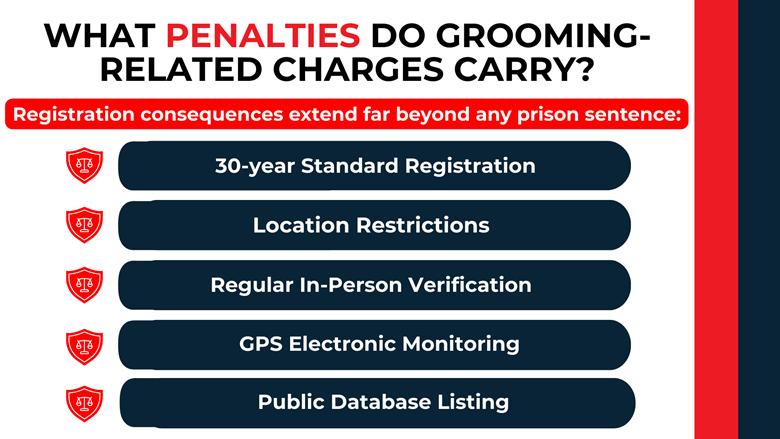
Both solicitation and indecent liberties convictions trigger mandatory sex offender registration under N.C.G.S. § 14-208 et seq. Registration consequences extend far beyond any prison sentence:
- 30-year standard registration on the NC Sex Offender Registry, with the possibility of petitioning for removal after 10 years under N.C.G.S. § 14-208.12A
- Location restrictions under N.C.G.S. § 14-208.18 prohibiting presence near schools, daycare centers, and places where children gather
- Regular in-person verification with local law enforcement, including address and employment reporting requirements
- GPS electronic monitoring in qualifying cases the NC Department of Adult Correction reported 581 sex offenders enrolled in GPS monitoring in FY 2022-2023
- Public database listing through the NC SBI Sex Offender Registry, accessible to anyone with internet access
These obligations affect housing, employment, and daily life for decades after any sentence ends.
How Do Police Investigate Grooming Allegations?
What Role Do Online Sting Operations Play?
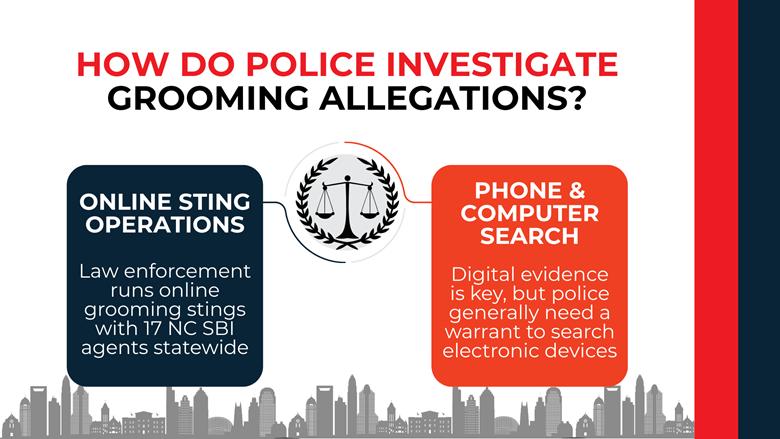
Law enforcement agencies conduct proactive sting operations targeting online grooming. The NC SBI Computer Crimes Unit assigns 17 full-time special agents across eight field districts specifically to investigate internet crimes against children. These agents coordinate with the broader ICAC Task Force.
In a typical operation, an undercover officer creates a profile on a social media platform or chat application posing as a minor. If an adult initiates sexually explicit communication or proposes a meeting, law enforcement documents the exchange and may arrange an arrest at a designated location. The legality of these operations is well-established in NC courts, but the investigative tactics also create the factual foundation for entrapment defenses.
Can Police Search Phones and Computers Without A Warrant?
Digital evidence is central to grooming investigations. Following Riley v. California, 573 U.S. 373 (2014), police generally cannot search cell phones or digital devices without a warrant, even during a lawful arrest. NC courts require warrants that specifically authorize forensic examination of electronic devices.
Under N.C.G.S. § 15A-248, search warrants must be executed within 48 hours of issuance. Officers may seize and secure a phone to prevent destruction of evidence while obtaining a warrant. Consent to search a home does not automatically extend to digital devices found inside. These protections create important defense opportunities when evidence is obtained through improper procedures.
What Defenses Apply to Grooming-Related Charges?
What Is the Entrapment Defense for Sting Operation Cases?
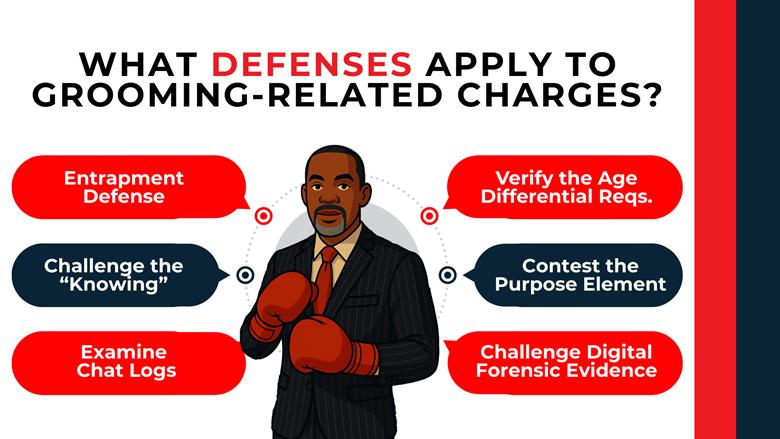
Entrapment is the most significant defense in solicitation cases involving sting operations. The defense requires proving two elements: (1) government inducement of the criminal conduct and (2) lack of predisposition on the defendant’s part.
In State v. Keller, 265 N.C. App. 526, 828 S.E.2d 578 (N.C. App. 2019), the Court of Appeals found that a defendant’s continued engagement after learning the “child’s” age demonstrated predisposition that defeated the entrapment claim. Evidence of initial reluctance, statements declining sexual contact with minors, and persistent government pressure can support the defense. Written notice of an entrapment defense is required within 20 working days of the trial setting date under N.C.G.S. § 15A-905(c).
How Can the Evidence Be Challenged?
Beyond entrapment, several strategies target the prosecution’s case:
- Challenge the “knowing” element the State must prove the defendant knowingly engaged in prohibited conduct with awareness of the other person’s stated age
- Examine chat logs for government initiation if law enforcement introduced sexual topics first, this supports inducement under State v. Morse, 194 N.C. App. 685, 671 S.E.2d 538 (N.C. App. 2009)
- Verify the age differential requirement both § 14-202.3 and § 14-202.1 require the defendant to be at least five years older than the victim or believed victim, and charging errors occur
- Contest the purpose element for indecent liberties the State must prove conduct was “for the purpose of arousing or gratifying sexual desire,” and ambiguous behavior may not meet this standard
- Challenge digital forensic evidence metadata, timestamps, and account authentication may raise questions about who actually sent specific messages
Research compiled by End Violence Against Women International (2016) places the false reporting rate for sexual assault between 2-8% based on peer-reviewed studies. Additionally, the National Registry of Exonerations (2024) reports that 10% of all exonerations nationally involve sexual assault and 9% involve child sex abuse. These figures underscore the critical importance of thorough defense investigation in every case.
What Constitutional Protections Apply?
The Fifth Amendment provides protections during grooming investigations. Any custodial interrogation requires proper Miranda warnings, and statements obtained without them may be suppressed. NC is a one-party consent state under N.C.G.S. § 15A-287, meaning pretext phone calls where one party consents to recording are lawful, a tactic commonly used in grooming investigations to gather incriminating statements.
Exercising the right to remain silent cannot be used against a defendant at trial. Consulting an attorney before any interaction with law enforcement is critical to preserving these protections.
What Happens After an Arrest on Grooming Charges?
How Does Pretrial Release Work for Sex Offense Charges?
Under N.C.G.S. § 15A-533(b), certain sex offenses require a district or superior court judge not a magistrate to authorize pretrial release. This requirement can mean additional time in custody before a judge reviews the case.
The NC Sentencing Commission (FY 2024) reports that 93% of person offense convictions reflected credit for pretrial detention, with an average of 15 months of pretrial credit. This data confirms that pretrial detention is common for defendants facing sex-related charges in North Carolina.
Attorney Patrick Roberts is a North Carolina criminal defense lawyer whose practice heavily emphasizes defending those accused of serious sex offenses. His background as a former prosecutor provides a unique perspective on the strategies used by the state, which is particularly relevant when navigating the strict pretrial requirements of North Carolina law.
Attorney Patrick Roberts: Qualifications & Experience
Attorney Patrick Roberts offers a formidable defense rooted in two decades of high-stakes litigation and a profound understanding of the North Carolina legal system.
- Veteran Prosecutorial Perspective: With over 20 years of experience, Mr. Roberts began his career as a prosecutor in three North Carolina counties. This background is a strategic cornerstone of his practice; having spent years building cases for the State, he possesses an in-depth understanding of prosecutorial methods and the specific evidentiary standards required for serious felony charges.
- Rigorous Advocacy Training: Mr. Roberts is a graduate of the National Criminal Defense College (NCDC) and Gerry Spence’s Trial Lawyers College. These institutions are recognized for their rigorous focus on advanced trial advocacy, equipping him with the skills to effectively communicate a client’s story and challenge the prosecution’s narrative before a jury.
How Long Do These Cases Take To Resolve?
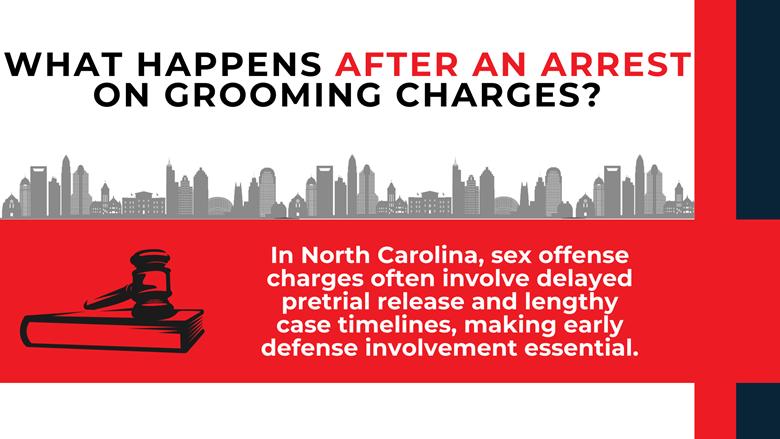
Sex offense cases move slowly through the NC court system. Digital forensic analysis, review of electronic communications, and the complexity of these investigations all contribute to extended timelines. Defendants often live under the weight of pending charges for months before resolution, with potential restrictions on employment, housing, and personal relationships during that period. Early engagement with a defense attorney allows the defense to begin building its case during this critical window.
What Are the Long-Term Consequences of a Conviction?
How Does the Sex Offender Registry Work?
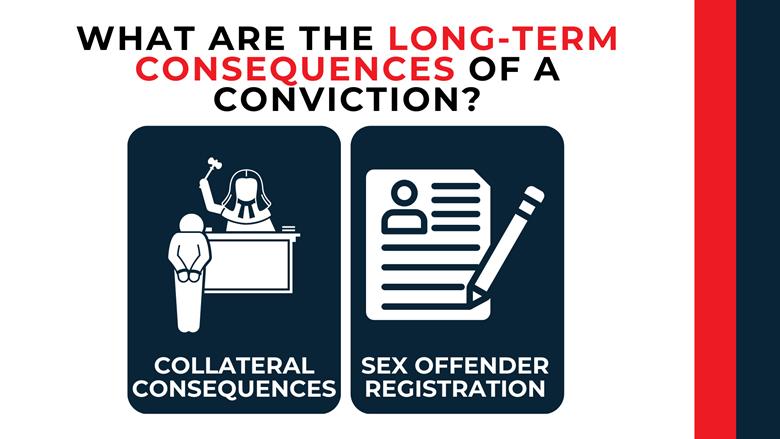
The NC Sex Offender Registry currently lists approximately 28,200+ registered individuals statewide as of January 2026, according to the NC State Bureau of Investigation. Standard registration lasts 30 years under N.C.G.S. § 14-208.7, though defendants may petition for early termination after 10 years under N.C.G.S. § 14-208.12A if they do not qualify as a recidivist, sexually violent predator, or aggravated offender.
The public nature of the registry means that neighbors, employers, and anyone with internet access can view the registrant’s information. This creates lasting personal and professional consequences well beyond the period of criminal supervision.
What Collateral Consequences Should Defendants Expect?
A conviction for solicitation or indecent liberties triggers consequences that extend across every area of a defendant’s life:
- Immigration consequences are severe sexual abuse of a minor qualifies as an aggravated felony under federal immigration law, triggering mandatory deportation for non-citizens as addressed in Padilla v. Kentucky, 559 U.S. 356 (2010)
- Employment restrictions affect careers in education, healthcare, law enforcement, and any field involving contact with minors or requiring background checks
- Professional licensing boards may revoke or deny licenses based on sex offense convictions under “good moral character” standards
- Housing limitations result from both registry restrictions near schools and private landlord screening practices
- Child custody proceedings are significantly affected because courts must consider sex offense convictions in custody determinations
- Post-conviction options exist through a Motion for Appropriate Relief (MAR) under N.C.G.S. § 15A-1411 for constitutional violations, ineffective assistance of counsel, or newly discovered evidence
Defense strategy must account for these collateral impacts from the earliest stages of a case to protect a defendant’s future.
Frequently Asked Questions
Is “child grooming” a specific crime in North Carolina?
No. North Carolina does not have a standalone statute criminalizing “child grooming.” Behaviors described as grooming are prosecuted under existing laws such as solicitation of a child by computer (N.C.G.S. § 14-202.3) and indecent liberties with a child (N.C.G.S. § 14-202.1). The specific charges filed depend on the alleged conduct and whether electronic communication was involved.
Can I be charged with solicitation if the “minor” was actually an undercover officer?
Yes. N.C.G.S. § 14-202.3 covers situations where the defendant “believes” the other person is underage, and no actual minor victim is required. However, sting operation cases open the door to an entrapment defense if law enforcement induced the conduct and the defendant was not predisposed to commit the offense.
Does mistake of age work as a defense to indecent liberties?
No. In State v. Breathette, 202 N.C. App. 697, 690 S.E.2d 1 (N.C. App. 2010), the Court of Appeals confirmed that mistake of age is not a defense to indecent liberties. However, verifying the exact ages of both parties remains critical because the required five-year age differential creates a potential basis for challenging improperly filed charges.
Will I have to register as a sex offender if convicted?
Yes. Both solicitation of a child by computer and indecent liberties require mandatory registration under the NC Sex Offender Registry for a minimum of 30 years. Early termination may be available after 10 years through a petition under N.C.G.S. § 14-208.12A, but only if the defendant does not qualify as a recidivist or aggravated offender.
Should I talk to the police if I’m being investigated for grooming?
You have the right to remain silent under the Fifth Amendment, and exercising that right cannot be used against you at trial. Grooming investigations frequently involve law enforcement attempting to collect statements before formal charges are filed. Consulting an attorney before any contact with investigators protects your constitutional rights and prevents potentially harmful admissions.
Secure Your Future with a Robust Defense
A “child grooming” accusation in North Carolina carries devastating criminal consequences, even though “grooming” is not a specific charge in the state statutes. Instead, prosecutors utilize charges such as Solicitation of a Child by Computer and Indecent Liberties with a Child to pursue these allegations. These are high-level felonies that carry mandatory sex offender registration and collateral consequences that can permanently dismantle your personal and professional life.
When the stakes are this high, understanding the specific evidence the State must prove—and identifying the constitutional defenses available to you—is the only way to protect your rights.
Don’t leave your freedom to chance. Attorney Patrick Roberts is highly qualified to handle these sensitive cases. As of December 2025, he is theonly North Carolina lawyer listed by the National Child Abuse Defense & Resource Center. Furthermore, his commitment is recognized by Martindale-Hubbell, having earned the Client Champion Platinum award for 2026—a distinction he has maintained for more than five consecutive years based on verified client acclaim.
The respect Patrick commands in the legal community is best summarized by a colleague’s 2018 endorsement:
“Patrick is my #1 referral for my own clients facing criminal issues… His expertise in the field and experience in the courtroom are the reasons he is my top recommendation. He is trustworthy, reliable, and highly esteemed by his peers.” – Peer review via Martindale-Hubbell on October 29, 2018
Disclaimer: The testimonials and peer reviews on this site are for informational purposes. They do not constitute a guarantee, warranty, or prediction regarding the outcome of your legal matter. Every case is different and must be evaluated on its own merits.
*Testimonials and peer endorsements found on this website are actual comments.
Facing allegations of this nature is a serious matter with lifelong consequences. At Patrick Roberts Law, we believe every individual deserves a fair trial and a dedicated defense. If you are navigating charges in North Carolina, contact us for a confidential consultation to ensure your legal rights are fully protected.
Disclaimer: The information on this website is for general information purposes only. Nothing on this site should be taken as legal advice for any individual case or situation. Case results depend upon a variety of factors unique to each case. Prior results do not guarantee a similar outcome.
Former assistant district attorney
Contact Patrick Roberts
Facing criminal charges in North Carolina demands seasoned representation. Trust in the experience and dual perspective of Patrick Roberts. Reach out today for a confidential consultation.
-
Call Our Team
Calls answered 24/7






For more information on the selection criteria, go to www.martindale.com
*Each case is different and must be evaluated separately. Prior results achieved do not guarantee similar results can be achieved in future cases.