
Few criminal accusations carry the immediate devastation of child pornography charges. In Cary—a community where nearly 70% of adults hold college degrees and many work in positions requiring security clearances at employers like Lockheed Martin, SAS Institute, or Epic Games—these charges threaten to destroy everything you’ve built before you ever see the inside of a courtroom. Your career, your family relationships, your standing in the community, and your freedom all hang in the balance.
North Carolina prosecutes these offenses under its sexual exploitation of a minor statutes, which establish different degrees of criminal liability depending on whether you allegedly possessed, distributed, or produced the material in question. Understanding exactly what you’re facing—and how Wake County prosecutors approach these cases—is essential to mounting an effective defense. Attorney Patrick Roberts, a former prosecutor who handled sex crime cases before dedicating his practice to criminal defense, brings the perspective of having seen these cases from both sides of the courtroom. That prosecutorial background means he understands precisely how investigators build these cases and where vulnerabilities in the state’s evidence may exist.
What Is Third Degree Sexual Exploitation of a Minor Under North Carolina Law?
How Does North Carolina Define “Possession” of Illegal Material?
Under N.C. Gen. Stat. § 14-190.17A, a person commits third degree sexual exploitation of a minor by possessing material that contains a visual representation of a minor engaging in sexual activity—but only if they know the character or content of that material. This knowledge requirement is critical. The statute doesn’t criminalize accidentally encountering illegal content; it targets those who knowingly possess it.
The definition of “material” under N.C. Gen. Stat. § 14-190.13 extends beyond traditional photographs and videos to include digital and computer-generated visual depictions, including content created or modified through artificial intelligence. In Cary’s technology-driven community, where residents work with sophisticated digital tools daily, understanding this broad definition matters. Material stored on work laptops provided by Research Triangle employers, personal devices synced to cloud storage, and even AI-generated content all fall within the statute’s reach.
What Exactly Qualifies as “Sexual Activity” Under the Statute?
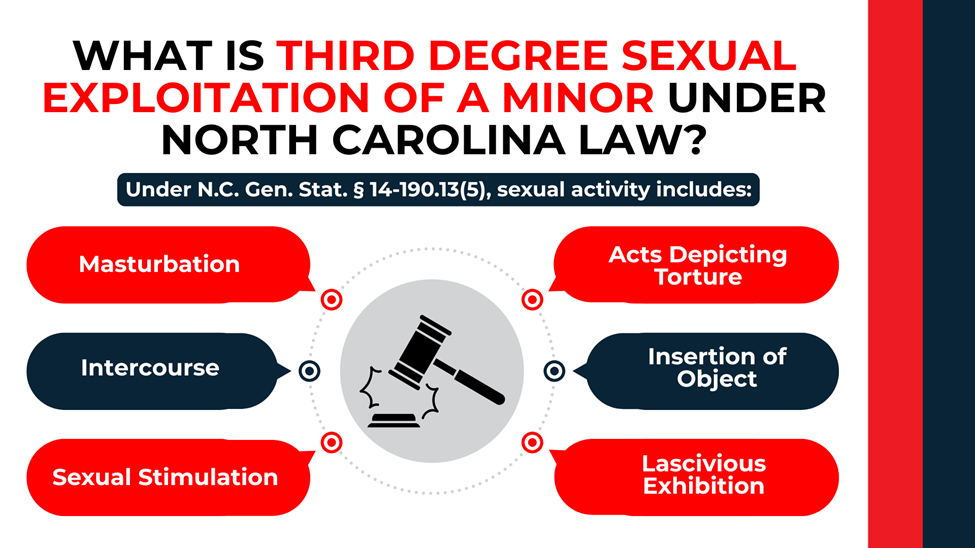
North Carolina’s definition of sexual activity encompasses conduct that many people don’t immediately recognize as falling within the statute. Under N.C. Gen. Stat. § 14-190.13(5), sexual activity includes:
- Masturbation, whether alone or with another person or animal
- Vaginal, anal, or oral intercourse
- Touching of genitals, pubic area, buttocks, or female breasts in an act of apparent sexual stimulation or abuse
- Acts depicting torture, physical restraint, or flagellation involving nudity or revealing attire
- Insertion of objects into another person’s body (excluding recognized medical procedures)
- Lascivious exhibition of genitals or pubic area
Wake County prosecutors apply this definition broadly. Attorney Patrick Roberts’ specialized sex-crimes defense training through the National Association of Criminal Defense Lawyers—where he maintains lifetime membership and regularly attends advanced seminars—provides the foundation for challenging how prosecutors characterize the content at issue in your case.
Does the Age of the Person in the Images Matter?
The statute defines a minor as any individual under 18 years old who is not married or judicially emancipated. Critically, N.C. Gen. Stat. § 14-190.17A explicitly states that mistake of age is not a defense. Even if you genuinely believed the person depicted was an adult, that belief provides no legal protection.
Furthermore, the statute allows the trier of fact—judge or jury—to infer that a depicted participant is a minor based on the material’s title, text, visual representations, or other characteristics. This inference provision gives Wake County prosecutors significant latitude in proving age without requiring definitive identification of the depicted individual.
How Do Cary Police Investigate Child Pornography Cases?
What Role Does Cary’s Cyber Intelligence Unit Play in These Investigations?
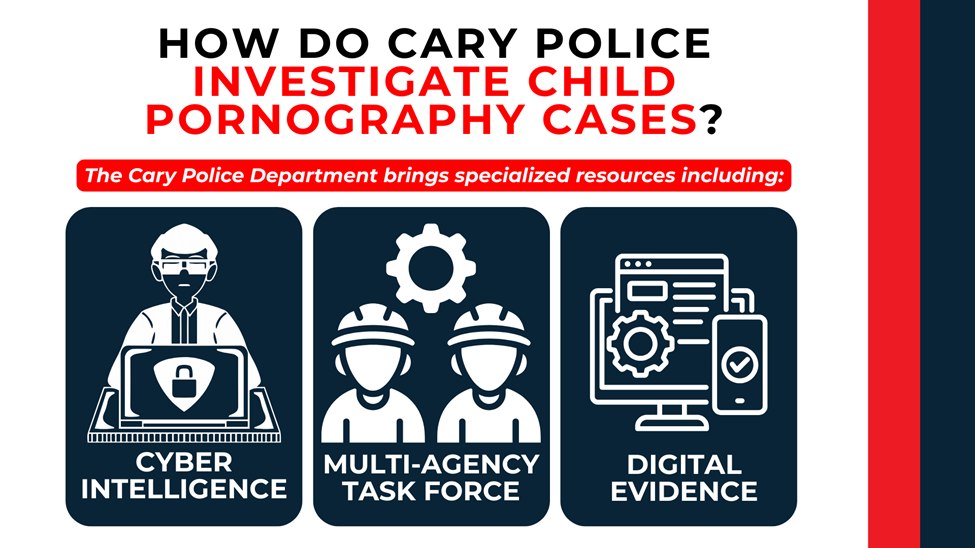
Cary Police Department operates the only dedicated cyber intelligence unit among the Triangle’s four major police departments. While Raleigh, Durham, and Chapel Hill lack equivalent specialized capabilities, CPD maintains a team focused specifically on identifying online offenders and investigating child exploitation cases. This unit doesn’t simply respond to reports—it proactively identifies potential offenders through sophisticated digital investigation techniques.
For Cary residents, this means these cases often begin before you have any idea you’re under investigation. Patrick Roberts’ years prosecuting sex crime cases gave him direct insight into how law enforcement builds these investigations from the ground up, knowledge that proves invaluable when examining the methods used to target his clients.
How Do Multi-Agency Task Forces Operate in Wake County?
Child exploitation investigations in Cary frequently involve coordination between multiple agencies. CPD’s Special Victims Unit works alongside the North Carolina State Bureau of Investigation’s Cyber Crimes Unit, which brings statewide resources to bear on these cases. Federal involvement through Internet Crimes Against Children task forces, Operation Southern Impact, and the Invictus Project means your case may involve investigators from agencies you’ve never heard of.
This multi-agency approach creates both challenges and opportunities for defense. While it means more resources directed at prosecution, it also means more potential points of failure in evidence handling, chain of custody, and constitutional compliance.
What Types of Digital Evidence Do Investigators Typically Seize?
When executing search warrants in child pornography investigations, law enforcement casts a wide net. Investigators typically seize:
- Personal computers, laptops, and tablets
- Smartphones and other mobile devices
- External hard drives and USB storage devices
- Cloud storage account contents
- Work computers and employer-provided devices
- Gaming consoles with internet connectivity
- Network routers and storage devices
For professionals working at SAS Institute, Epic Games, MetLife, or defense contractors throughout Research Triangle Park, the seizure of work devices creates immediate employment complications. IT departments at major Cary employers sometimes discover and report suspected contraband, triggering investigations that begin with workplace cooperation rather than traditional police work.
What Are the Differences Between First, Second, and Third Degree Sexual Exploitation Charges?
When Does Possession Become a More Serious Charge?
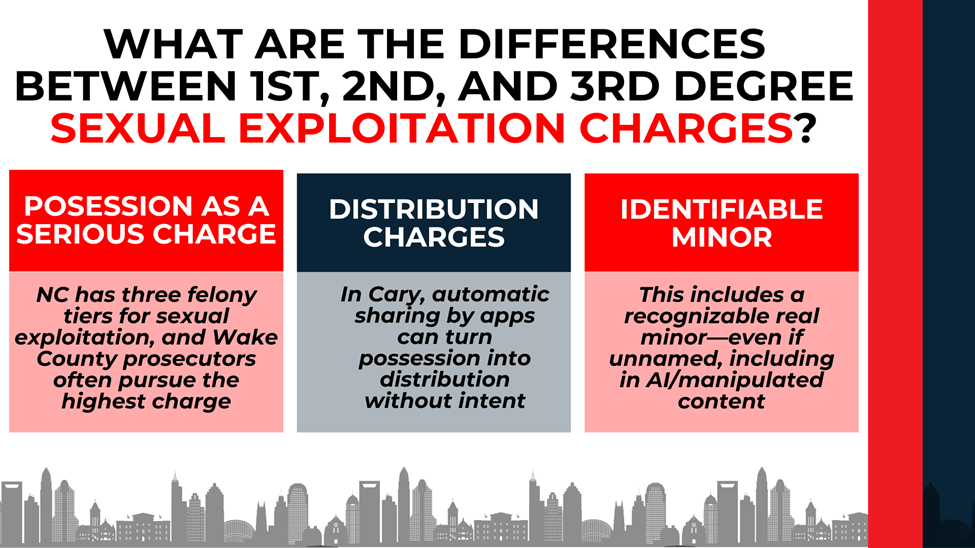
North Carolina establishes three distinct levels of criminal liability for sexual exploitation offenses. Third degree sexual exploitation—simple possession—constitutes a Class H felony under N.C. Gen. Stat. § 14-190.17A. Second degree sexual exploitation under N.C. Gen. Stat. § 14-190.17, which covers distribution, receipt, purchase, or exchange of such material, is classified as a Class E felony carrying substantially more severe consequences. First degree sexual exploitation under N.C. Gen. Stat. § 14-190.16—involving production of material or using a minor to create it—constitutes a Class C or Class D felony depending on specific circumstances.
Wake County prosecutors scrutinize cases for any evidence that would support charging at a higher degree. Understanding these distinctions helps you appreciate what’s at stake and why aggressive defense matters from the earliest stages.
How Can a Simple Possession Case Escalate to Distribution Charges?
Many Cary residents don’t realize that modern technology can transform a possession case into a distribution charge without any intentional sharing. Peer-to-peer file sharing software, which some people use unknowingly, often automatically shares files with other users. Cloud storage services may sync content across devices or make files accessible in ways users don’t anticipate. Social media platforms and messaging applications sometimes cache or share content automatically.
Mr. Roberts brings specialized training in defending against charges that may overstate a defendant’s actual conduct, being the only North Carolina attorney listed on the NCADRC website at falseallegation.org as of December 2025. His NCADRC child-abuse defense training addresses precisely these situations where technical realities may contradict prosecution theories.
What Does “Identifiable Minor” Mean for First Degree Charges?
Certain first degree charges under N.C. Gen. Stat. § 14-190.16 requires that an “identifiable minor” be involved. The statute defines this as an individual who was a minor when the material was created or when the source image was taken, and who is recognizable by face, likeness, or other distinguishing characteristics. Notably, the prosecution doesn’t need to prove the actual identity of the minor—only that the depicted person is recognizable as a real individual.
This definition has particular relevance for cases involving digitally manipulated or AI-generated content that incorporates images of real minors.
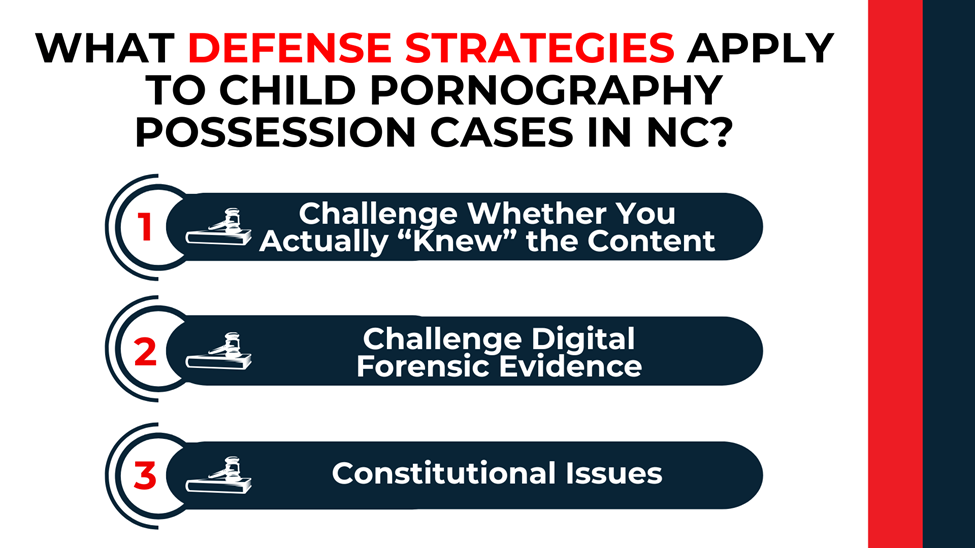
What Defense Strategies Apply to Child Pornography Possession Cases in North Carolina?
Can You Challenge Whether You Actually “Knew” the Content?
The knowledge requirement in N.C. Gen. Stat. § 14-190.17A provides the foundation for several defense approaches. You must have known the character or content of the material to be guilty under the statute. This creates opportunities to challenge possession cases where:
- Multiple people had access to the device where material was found
- Malware or unauthorized access may have placed content on a device
- Files were downloaded automatically by software without user knowledge
- Cached or temporary files existed without the user’s awareness
In Cary households where family members share computers or teenagers have access to home networks, these scenarios arise regularly. The advanced cross-examination techniques Patrick Roberts developed through his National Criminal Defense College training prove essential when challenging forensic analysts’ assumptions about who accessed specific files.
How Do Defense Attorneys Challenge Digital Forensic Evidence?
Digital forensics forms the backbone of most child pornography prosecutions, but forensic evidence is only as reliable as the methods used to collect and analyze it. To provide a robust defense, an attorney must scrutinize every technical detail.
Attorney Patrick Roberts leverages two decades of criminal defense experience, having tried hundreds of bench and jury trials in state and federal courts in North Carolina, to dissect these complex cases. This extensive courtroom history allows him to employ unique defense strategies and creative defense techniques when examining:
- Chain of Custody: Whether proper protocols were maintained for seized devices to prevent tampering or data corruption.
- Software Validity: How forensic software identified and categorized files, and whether those algorithms are prone to “false positives.”
- Metadata Accuracy: Whether metadata accurately reflects intentional user access patterns or automated system processes.
- Cached vs. Accessed Data: Whether deleted files were actually viewed by the user or merely cached by a web browser without the user’s knowledge.
- Temporal Interpretation: How timestamps and access records were interpreted by investigators.
Attorney Patrick Roberts’ NACDL training in sex-crimes defense includes instruction on challenging digital evidence—a rapidly evolving area where defense attorneys must stay current with both technology and legal standards. By combining specialized training with a history of high-stakes litigation, Mr. Roberts ensures that digital evidence is never taken at face value.
What Constitutional Issues Arise in These Cases?
The Fourth Amendment’s protections against unreasonable searches and seizures apply forcefully to digital device searches. Law enforcement must generally obtain warrants before searching computers, phones, or cloud storage accounts. When warrants are deficient, overbroad, or improperly executed, evidence may be subject to suppression.
Wake County courts regularly hear suppression motions in these cases. An attorney familiar with how Wake County judges approach Fourth Amendment issues can identify and exploit weaknesses in the state’s evidence gathering.
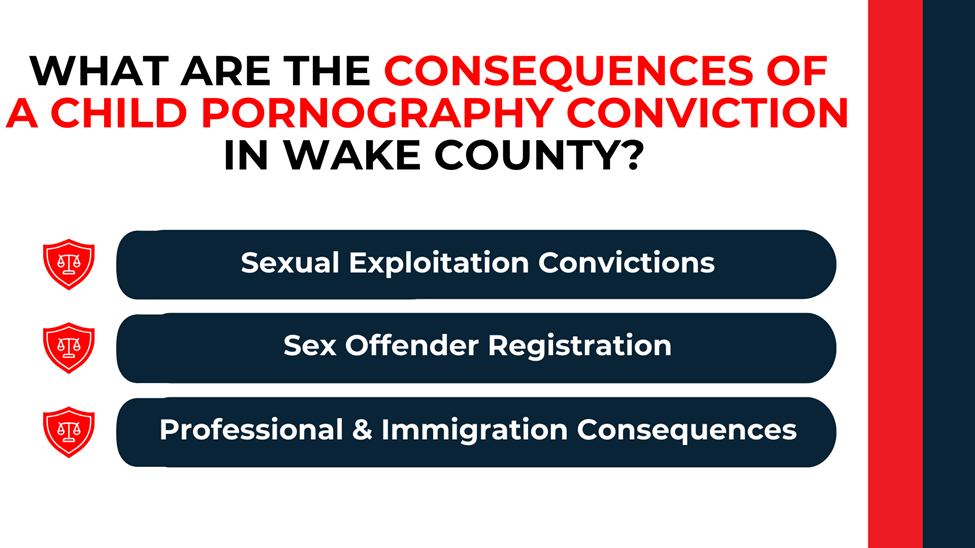
What Are the Consequences of a Child Pornography Conviction in Wake County?
What Prison Sentences Apply to Sexual Exploitation Convictions?
Sentencing in North Carolina depends on the offense class and the defendant’s prior record level. Third degree sexual exploitation is a Class H felony, while second degree constitutes a Class E felony and first degree ranges from Class C to Class D. Each classification carries different presumptive sentencing ranges that Wake County Superior Court judges apply based on individual circumstances. Prior convictions, aggravating factors, and mitigating circumstances all influence the ultimate sentence.
How Does Sex Offender Registration Affect Your Life in Cary?
Beyond incarceration, a sexual exploitation conviction requires registration as a sex offender. In Cary—a community consistently ranked among America’s safest and most family-oriented—this registration carries profound social consequences. Neighbors receive notification. Residential restrictions may apply. Employment becomes extraordinarily difficult. The stigma in a community where families specifically chose to raise children because of Cary’s reputation for safety can be isolating and permanent.
What Professional and Immigration Consequences Should You Expect?
For Cary’s professional workforce, conviction consequences extend far beyond the criminal justice system. Security clearances held by defense industry employees at Lockheed Martin and throughout Research Triangle Park face immediate revocation. Professional licenses in healthcare, finance, education, and other fields are subject to suspension or permanent loss. The median household income of $129,399 that supports a Cary family can vanish overnight.
For the 22% of Cary residents who are foreign-born—many working in the technology sector on employment visas—a sexual exploitation conviction triggers severe immigration consequences including deportation. Patrick Roberts’ prosecutorial background gave him direct experience with the full scope of consequences these convictions carry, informing his approach to defending clients whose entire futures depend on the outcome.
Why Does Your Choice of Defense Attorney Matter in These Cases?
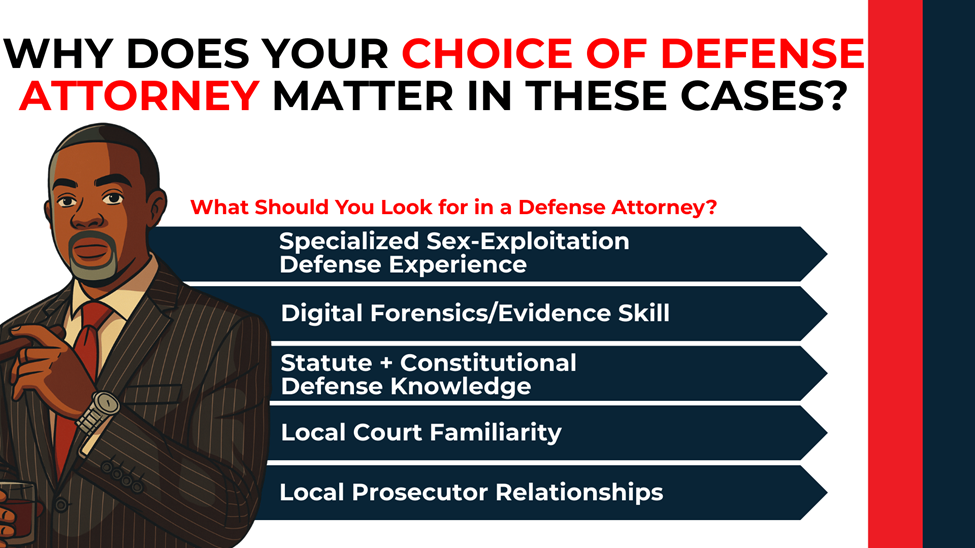
What Should You Look for in a Sex Crimes Defense Attorney?
Sexual exploitation cases require defense counsel with specific knowledge and training that general criminal defense attorneys may lack. The intersection of complex statutory definitions, digital forensics, constitutional protections, and specialized prosecution units demands an attorney who has invested in focused professional development. Familiarity with Wake County court procedures, relationships with local prosecutors, and understanding of how cases move through the system all contribute to effective representation.
How Does Prosecutorial Experience Benefit Your Defense?
An attorney who has prosecuted these cases understands the investigation and charging process from the inside. Attorney Patrick Roberts leverages his experience handling sex crime prosecutions prior to transitioning to defense work, providing his clients with an effective and informed perspective on how investigators develop cases and what evidence prosecutors consider most valuable. This background allows him to identify where critical weaknesses in the state’s case may exist.
Combined with his specialized training from Gerry Spence’s Trial Lawyers College—where he studied the methods of one of America’s most successful trial attorneys—this experience shapes his fearless and powerful approach to defending Cary residents facing serious allegations. By anticipating the prosecution’s maneuvers, Mr. Roberts provides a strategic defense rooted in two decades of courtroom experience.*
*Disclaimer: Each case is different and must be evaluated separately. Prior results achieved do not guarantee similar results can be achieved in future cases.
Frequently Asked Questions
Will my employer find out about child pornography charges in Cary?
Arrest records are generally public information accessible through Wake County court systems. Many employers conduct ongoing background monitoring, and security clearance holders face immediate reporting requirements. If your work device was seized or your employer reported the initial concern, they likely already know.
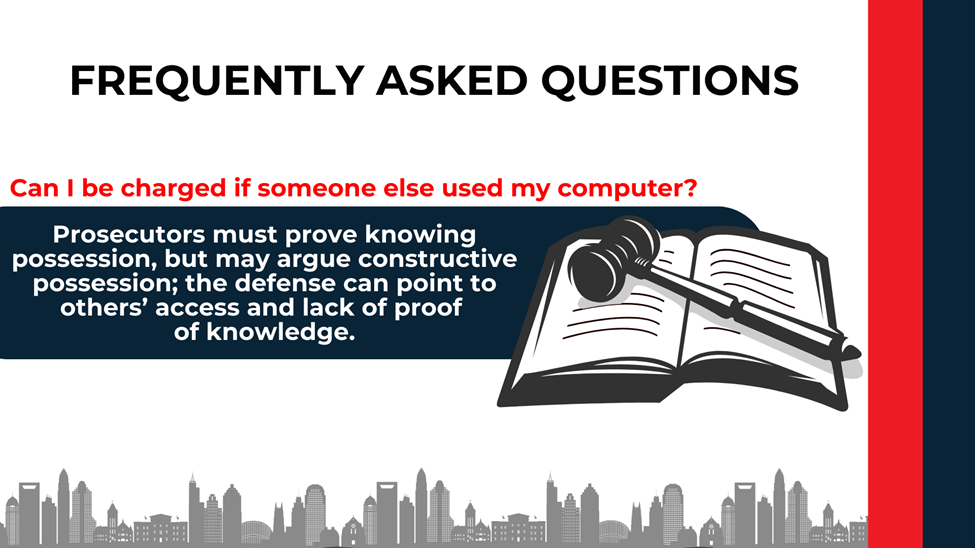
Can I be charged if someone else used my computer?
Proving you knowingly possessed the material is the prosecution’s burden. However, prosecutors may argue that as the device owner, you had constructive possession. Defense strategies focus on demonstrating that others had access and that evidence doesn’t establish your personal knowledge of the content.
How long do these cases typically take in Wake County courts?
Sexual exploitation cases often involve extensive digital forensics that take months to complete. From arrest through trial, cases frequently extend beyond a year, sometimes significantly longer when complex evidence or multiple agencies are involved.
Is there any way to avoid sex offender registration?
Registration requirements attach to convictions for sexual exploitation offenses. Avoiding registration typically requires avoiding conviction entirely, whether through dismissal, acquittal, or in some circumstances, negotiated outcomes that result in conviction for a non-registrable offense.
What should I do if the police want to search my devices?
You have the right to refuse consent to searches. Law enforcement may still obtain a warrant, but declining consent preserves your ability to challenge the search later. Contact an attorney immediately—before answering questions or consenting to anything.
Protecting Your Future Starts With the Right Defense
Child pornography charges in Wake County require defense counsel who combine specialized training with practical courtroom experience. Attorney Patrick Roberts leverages two decades of criminal defense experience, having tried hundreds of bench and jury trials in state and federal courts in North Carolina. This extensive history allows him to develop unique and creative defense strategies tailored to the complexities of digital evidence.
His qualifications extend to the highest levels of the judiciary; he is admitted to practice before the Fourth Circuit Court of Appeals and in all federal district courts in North Carolina. This federal admission is critical, as many digital crimes are prosecuted at the federal level where the rules of evidence and sentencing guidelines are distinct and rigorous.
Beyond his technical credentials, Mr. Roberts is highly respected by his peers and clients alike, maintaining a legacy of effective and powerful advocacy:
- AV Preeminent Peer Rated by Martindale-Hubbell (2026): Recognized for the highest level of professional excellence for more than 5 straight years.
- Client Champion Platinum (Martindale-Hubbell): Awarded for his commitment to client service for more than 5 straight years.
- 10/10 “Superb” Rating on Avvo: A distinction he has maintained for more than 15 years.
“Patrick is an experienced and knowledgeable criminal attorney. I highly recommend him if you’re seeking competent and professional representation in a state or federal criminal matter.” Peer Review via AVVO/Martindale-Hubbell on October 24, 2018
Disclaimer: The testimonials and peer reviews on this site are for informational purposes. They do not constitute a guarantee, warranty, or prediction regarding the outcome of your legal matter. Every case is different and must be evaluated on its own merits.
*Testimonials and peer endorsements found on this website are actual comments.
Combined with his background as a prosecutor who handled sex crimes, his lifetime NACDL membership with ongoing sex-crimes defense training, and his distinction as the only North Carolina attorney listed on falseallegation.org’s NCADRC registry as of December 2025, Mr. Roberts provides a fearless foundation for defending Cary residents. His training at Gerry Spence’s Trial Lawyers College further sharpens his ability to present a strategic defense in the face of serious allegations.
If you’re under investigation or have been charged with sexual exploitation of a minor anywhere in Wake County, the time to act is now. Contact Patrick Roberts Law to schedule a confidential consultation about your case and your options.

Disclaimer: Each case is different and must be evaluated separately. Prior results achieved do not guarantee similar results can be achieved in future cases.
Former assistant district attorney
Contact Patrick Roberts
Facing criminal charges in North Carolina demands seasoned representation. Trust in the experience and dual perspective of Patrick Roberts. Reach out today for a confidential consultation.
-
Call Our Team
Calls answered 24/7






For more information on the selection criteria, go to www.martindale.com
*Each case is different and must be evaluated separately. Prior results achieved do not guarantee similar results can be achieved in future cases.