
A first-degree statutory rape charge in North Carolina carries consequences that extend far beyond the courtroom. For residents of Cary and the Research Triangle area—where nearly 70% of adults hold college degrees and many work in careers requiring security clearances or professional licenses—an accusation alone can dismantle decades of professional achievement before a trial ever begins.
Under N.C. Gen. Stat. § 14-27.24, first-degree statutory rape is classified as a Class B1 felony, one of the most serious charges in North Carolina’s criminal code. The statute applies when a person engages in vaginal intercourse with a child under age 13, and the defendant is at least 12 years old and at least four years older than the alleged victim. Unlike many criminal charges, this offense carries no requirement that prosecutors prove force, threat, or lack of consent—the age of the alleged victim alone establishes the criminal nature of the conduct.
If you or someone you love faces this accusation in Wake County, understanding the legal framework—and securing experienced defense counsel immediately—may be the most important decision you make.
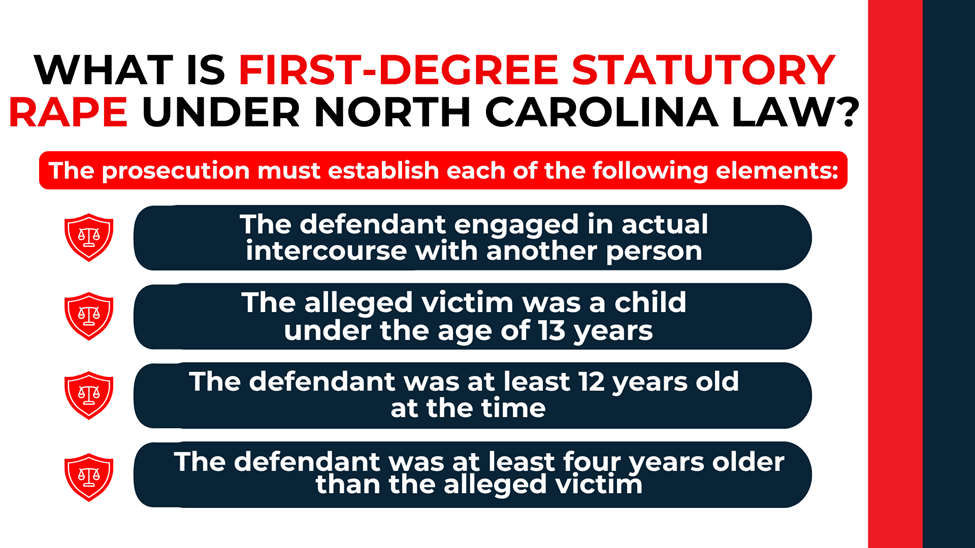
What Is First-Degree Statutory Rape Under North Carolina Law?
North Carolina’s statutory rape laws create a tiered system of offenses based on the ages of both the defendant and the alleged victim. Patrick Roberts’ years prosecuting sex-offense cases in North Carolina provide him with direct insight into how the state constructs these prosecutions—knowledge that now serves his defense clients in Cary and throughout Wake County.
What Are the Specific Elements Prosecutors Must Prove?
To secure a conviction for first-degree statutory rape, the Wake County District Attorney’s office must prove each element beyond a reasonable doubt. The statutory elements include:
- The defendant engaged in vaginal intercourse with another person
- The alleged victim was a child under the age of 13 years at the time of the alleged conduct
- The defendant was at least 12 years old at the time
- The defendant was at least four years older than the alleged victim
The statute contains no consent element. North Carolina law conclusively presumes that a child under 13 cannot consent to sexual activity, making the alleged victim’s apparent willingness legally irrelevant to the charge.
How Does This Charge Differ from Other Statutory Rape Offenses?
North Carolina law creates a more serious offense under N.C. Gen. Stat. § 14-27.23 when the defendant is at least 18 years old and the alleged victim is under 13. This charge—statutory rape of a child by an adult—carries a substantial mandatory minimum prison term and the possibility of life imprisonment without parole in cases involving egregious aggravation.
Critically, first-degree statutory rape under § 14-27.24 is explicitly designated as a lesser included offense of statutory rape of a child by an adult. This means prosecutors may initially charge the more serious offense, or a jury may convict on the lesser charge even when the greater offense was charged. Understanding this relationship is essential when building a defense strategy in Wake County courts.
A separate statute, N.C. Gen. Stat. § 14-27.25, addresses situations involving alleged victims who are 15 years old or younger. The felony classification under that statute depends on the age gap between defendant and alleged victim, with different consequences for those more than four but less than six years older versus those six or more years older.
What Role Does the Age Difference Play in These Cases?
The four-year age gap requirement distinguishes first-degree statutory rape from other sexual offenses involving minors. North Carolina’s statutory scheme creates different felony classifications based on age differentials, making the precise ages of both parties critical to determining which charges apply.
Cary Police Department’s Special Victims Unit investigators and Wake County prosecutors pay careful attention to establishing exact birth dates for both the defendant and alleged victim, as even small differences can affect which statute applies and what consequences are possible.
What Consequences Follow a First-Degree Statutory Rape Conviction?
A conviction under § 14-27.24 triggers severe criminal consequences along with collateral effects that touch nearly every aspect of life. The specialized sex-crimes defense training Patrick Roberts has completed through the National Association of Criminal Defense Lawyers equips him to help clients understand the full scope of what they face—and fight against it at every stage.
How Does North Carolina Classify This Offense?
Class B1 represents the second-most-serious felony classification in North Carolina’s structured sentencing system. Convictions at this level result in substantial terms of imprisonment, with the specific sentence depending on the defendant’s prior record level and other factors considered by the court.
For professionals living in Cary—software engineers at SAS Institute, financial analysts at MetLife, defense contractors at Lockheed Martin—the prospect of significant incarceration represents only the beginning of the devastation a conviction brings.
What Happens to Parental Rights After a Conviction?
North Carolina law includes a provision that directly addresses parental rights following a statutory rape conviction. Under § 14-27.24(c), a person convicted under this section has no rights to custody of or rights of inheritance from any child born as a result of the commission of the rape. The convicted person also loses any rights related to the child under North Carolina’s adoption statutes (Chapter 48) or juvenile code (Subchapter 1 of Chapter 7B).
This statutory consequence operates automatically upon conviction, requiring no separate court proceeding to terminate parental rights.
What Collateral Consequences Extend Beyond the Courtroom?
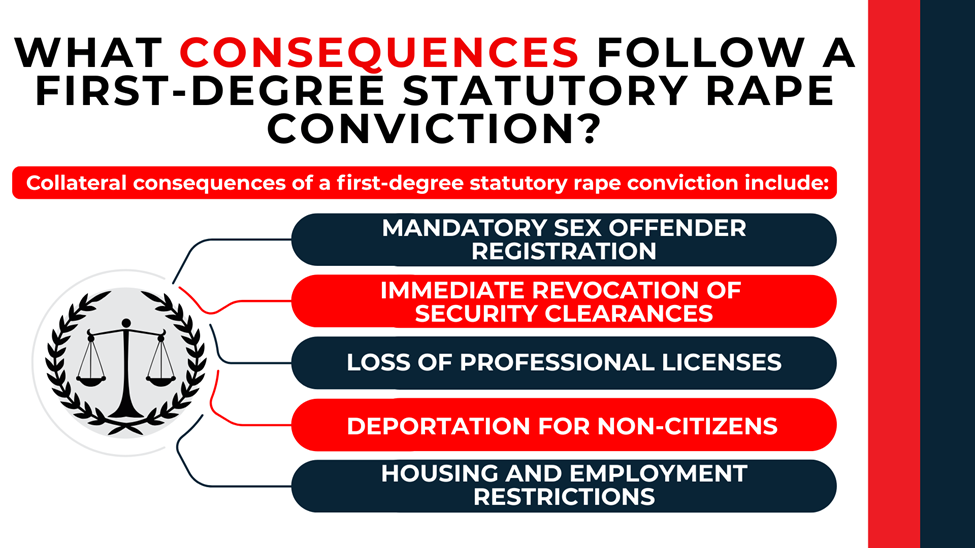
The consequences extending beyond incarceration often prove equally devastating for Cary residents and their families. Collateral consequences of a first-degree statutory rape conviction typically include:
- Mandatory sex offender registration, which creates public records accessible to employers, neighbors, and anyone conducting a background check
- Immediate revocation of security clearances, ending careers at defense contractors like Lockheed Martin and government-adjacent employers throughout the Research Triangle
- Loss of professional licenses in fields including medicine, law, education, finance, and real estate
- Deportation for non-citizens, regardless of how long they have lived in the United States—a significant concern given that 22% of Cary’s population is foreign-born
- Housing and employment restrictions that persist for life, even after completion of any sentence
The median household income in Cary exceeds $129,000—financial stability that can vanish when a conviction makes continued employment impossible.
How Do Cary Police and Wake County Prosecutors Handle These Cases?
Understanding how these cases develop from initial allegation through arrest and prosecution helps defendants and their families prepare for what lies ahead. Having previously served as a prosecutor handling these exact cases, Patrick Roberts brings firsthand knowledge of the tactics, timelines, and decision-making processes that shape investigations.
What Is the Role of Cary Police Department’s Special Victims Unit?
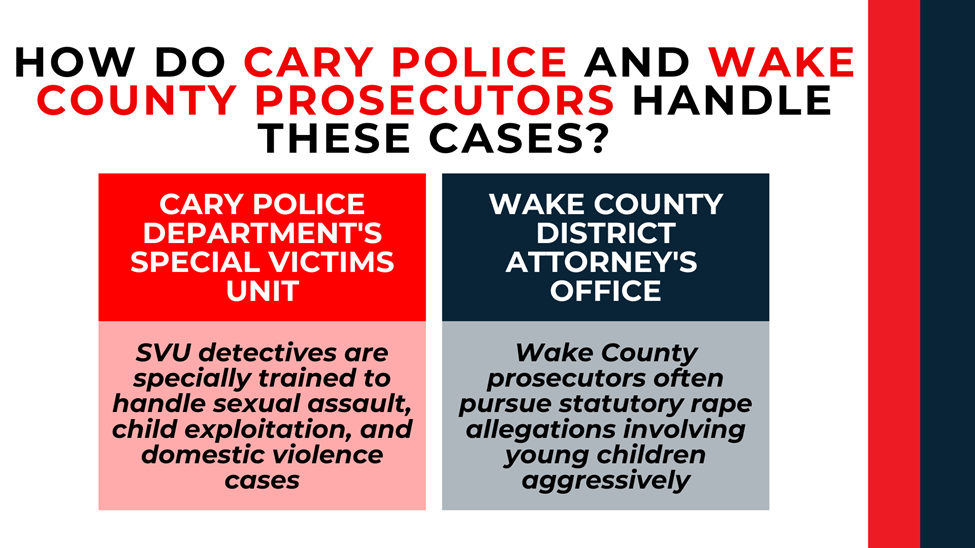
Cary Police Department maintains a dedicated Special Victims Unit within its Investigations Division. SVU detectives receive specialized training in handling sexual assault allegations, child exploitation cases, and domestic violence matters. When an allegation surfaces—whether through a report from a parent, school official, medical provider, or the alleged victim—SVU investigators typically take the lead.
These investigations often involve forensic interviews conducted at specialized child advocacy centers, medical examinations, and digital evidence collection from phones and computers. The thoroughness of CPD’s approach means that by the time charges are filed, prosecutors often believe they have assembled substantial evidence.
How Does the Wake County District Attorney’s Office Approach These Prosecutions?
All criminal cases arising from Cary are prosecuted by the Wake County District Attorney’s office in North Carolina’s 10th Judicial District. The DA’s office includes prosecutors who focus specifically on sex-crime cases and coordinate closely with Cary PD throughout investigations.
Wake County prosecutors generally approach statutory rape allegations involving young children with particular aggressiveness. The combination of the alleged victim’s age and the severity of the charge creates cases where prosecutors rarely offer significant plea concessions without substantial defensive pressure.
What Should You Expect During the Investigation Process?
Investigations may unfold over weeks or months before an arrest occurs. Some defendants learn they are under investigation when police request an interview; others first learn of the accusation at the moment of arrest.
If you become aware that you are under investigation—or if you have been arrested—anything you say to investigators can be used against you. The decision to speak with police without defense counsel present is almost always a mistake, regardless of how confident you feel in your innocence.
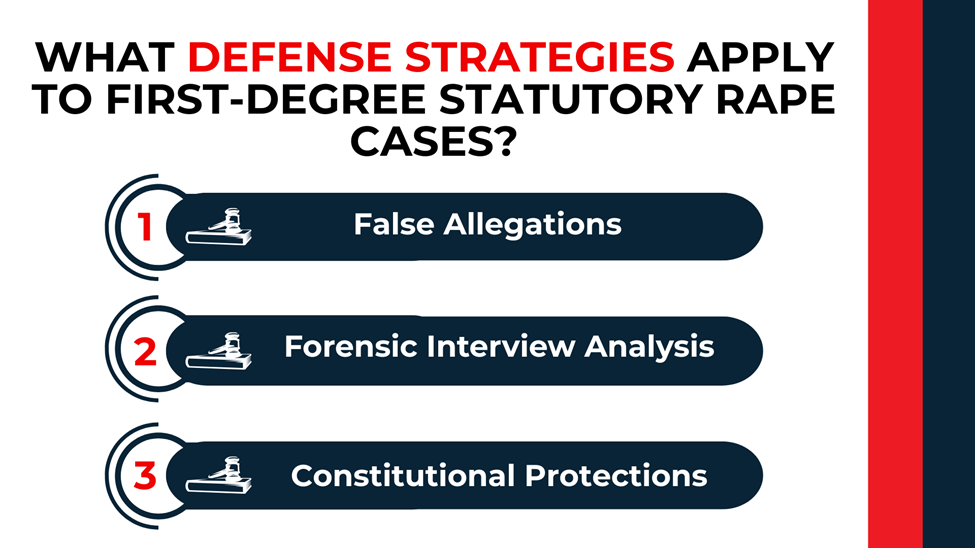
What Defense Strategies Apply to First-Degree Statutory Rape Cases?
Building an effective defense requires careful analysis of the evidence, the circumstances of the allegation, and the credibility of witnesses. Attorney Patrick Roberts’ training through the National Child Abuse Defense and Resource Center—As of December 2025, he is the only North Carolina attorney listed on their falseallegation.org registry—provides him with specialized techniques for challenging unreliable accusations and exposing weaknesses in the state’s case.
Can False Allegations Form the Basis of a Defense?
North Carolina’s statutory rape law is a strict liability offense with respect to the alleged victim’s age—meaning a defendant’s reasonable belief that the alleged victim was older generally does not constitute a defense. However, cases where the defendant genuinely believed no sexual contact occurred, or where the allegation itself is fabricated, present different defensive considerations.
False allegations do occur, arising from misunderstandings, coaching by adults involved in custody disputes, pressure from authority figures during suggestive interviews, or other circumstances that contaminate a child’s account. Effective defense requires thorough investigation into how the allegation emerged and developed.
How Can Forensic Interview Analysis Challenge the State’s Case?
Forensic interviews of alleged child victims are typically video-recorded and become central evidence in statutory rape prosecutions. These interviews should follow established protocols designed to minimize suggestions and allow children to describe events in their own words.
When interviewers deviate from proper protocols—using leading questions, repeating questions until they receive desired answers, or introducing information the child had not mentioned—the reliability of the resulting statements comes into question. Defense strategies that may be applicable in Wake County statutory rape cases include:
- Challenging the reliability of forensic interviews through expert testimony on memory, suggestibility, and proper interview protocols
- Investigating the source and development of the allegation to identify potential contamination or coaching
- Examining physical evidence—or the absence of expected physical evidence—through independent forensic analysis
- Identifying inconsistencies in the alleged victim’s statements across multiple interviews or disclosures
What Constitutional Protections Apply to Your Case?
Every defendant retains fundamental constitutional protections including the right to remain silent, the right to counsel, the right to confront and cross-examine witnesses, and the requirement that prosecutors prove every element beyond a reasonable doubt. In Wake County Superior Court, these rights provide the framework for mounting a vigorous defense—but only if you exercise them.
Why Does Your Choice of Defense Attorney Matter?
Statutory rape cases involving young children present unique challenges that require specific knowledge and skills. Not every criminal defense attorney has the training or experience to handle these matters effectively.
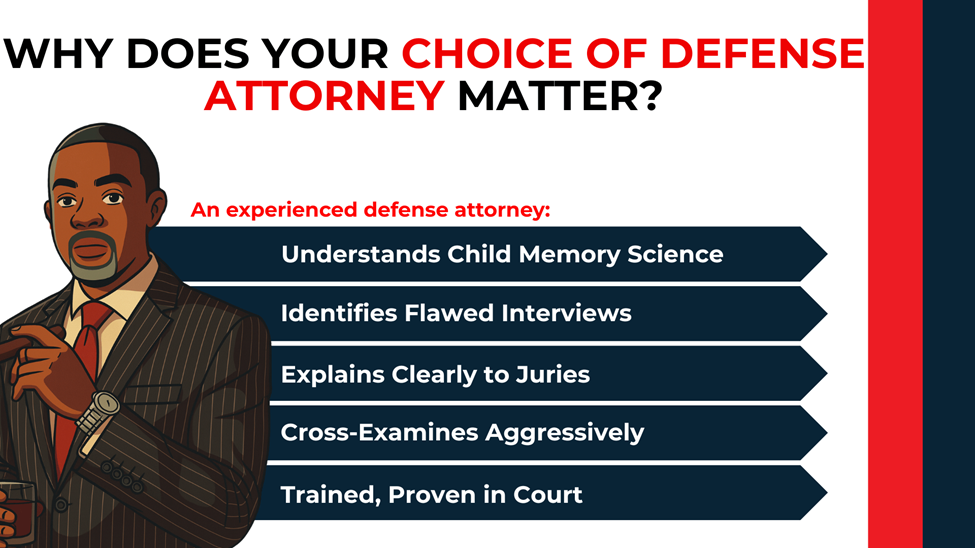
What Should You Look for in a Defense Attorney for These Charges?
Effective defense of statutory rape charges requires an attorney who understands the scientific literature on children’s memory and suggestibility, recognizes proper and improper forensic interview techniques, and can present complex information to a jury compellingly.
The advanced cross-examination techniques Attorney Patrick Roberts developed through his training at the National Criminal Defense College prove essential when challenging the state’s witnesses. NCDC’s intensive program focuses on practical courtroom skills that directly translate to more effective advocacy in Wake County courtrooms.
With two decades of criminal defense experience, Attorney Patrick Roberts brings a level of seasoned judgment that only comes from having tried hundreds of bench and jury trials in both state and federal courts across North Carolina. This extensive trial record provides a foundation for the unique defense strategies and creative defense techniques he employs to protect his clients’ futures.
How Does Prosecutorial Experience Strengthen Your Defense?
Patrick brings an effective “insider” perspective to every case, having spent years building criminal files as a former prosecutor. This background provides a powerful advantage: he understands the “prosecutor’s playbook” and can anticipate how the State will evaluate evidence and weigh charging decisions. This dual-sided insight allows him to identify vulnerabilities in the prosecution’s case—such as gaps in witness credibility or forensic protocol—giving his clients a fearless and strategic edge from the very start.
How Can Patrick Roberts Help If You’re Facing These Charges in Cary?
Facing a first-degree statutory rape accusation is terrifying. Your freedom, your family, your career, and your reputation all hang in the balance. In Cary—where professional success defines so many lives—the stakes could not be higher.
What Makes Attorney Patrick Roberts’ Background Relevant to Your Case?
Attorney Patrick Roberts combines prosecutorial experience in sex-crime cases with intensive defense training from the nation’s leading organizations. As a lifetime member of the National Association of Criminal Defense Lawyers, he maintains current knowledge through ongoing seminar participation. His training at Gerry Spence’s Trial Lawyers College—where he learned directly from one of America’s most accomplished trial attorneys—shapes how he connects with juries and humanizes clients facing devastating accusations.
This combination of experience and training serves clients throughout Cary, Wake County, and the greater Research Triangle area.
Mr. Roberts’ commitment to excellence is reflected in his admission to practice before the U.S. Supreme Court, the Fourth Circuit Court of Appeals, and all federal district courts in North Carolina. This prestigious level of standing signifies a lawyer who is respected at the highest level of the American judiciary. Whether fighting for a dismissal in Raleigh or arguing a complex appeal, Patrick Roberts provides a fearless and powerful defense tailored to secure the most favorable outcome available.*
*Disclaimer: Each case is different and must be evaluated separately. Prior results achieved do not guarantee similar results can be achieved in future cases.
The Standard of Excellence Recognized by Peers
This commitment to the highest levels of the American judiciary is not just reflected in Attorney Roberts’ bar admissions, it is felt in the courtrooms where he practices daily. It is one thing to hold prestigious credentials; it is another to earn the unwavering trust of fellow attorneys and judges who witness his advocacy firsthand. In the legal community, a lawyer is best measured by the respect of their adversaries and the confidence of their colleagues.
What Peers and Colleagues are Saying*
“A Skilled Adversary in Court” “Patrick is an extremely talented lawyer who has the highest ethical standards. He works extremely hard for his clients and is a very skilled adversary in court.” — Peer Review by a fellow attorney on October 29, 2018 via Martindale-Hubbell
“My #1 Referral for Criminal Matters” “Patrick Roberts is my top recommendation for clients facing state or federal criminal issues. His expertise in the field, experience in the courtroom, and professionalism are unrivaled. If I were ever facing charges, I would want Patrick to go to bat for me.” — Rated by a counsel on October 29, 2018 via Martindale-Hubbell
*Testimonials and peer endorsements found on this website are actual comments.
DISCLAIMER: The testimonials and peer reviews on this site are for informational purposes. They do not constitute a guarantee, warranty, or prediction regarding the outcome of your legal matter. Every case is different and must be evaluated on its own merits.
How Do You Take the First Step Toward Building Your Defense?
If you or someone you love has been accused of first-degree statutory rape, the time to act is now. Early intervention by experienced defense counsel can influence how investigations unfold, preserve evidence that might otherwise be lost, and begin building the strongest possible defense.
Contact Patrick Roberts Law to schedule a confidential consultation about your case.
Frequently Asked Questions
What is the difference between first-degree statutory rape and statutory rape of a child by an adult?
Both offenses involve an alleged victim under age 13, but statutory rape of a child by an adult under § 14-27.23 requires the defendant to be at least 18 years old and carries more severe mandatory consequences. First-degree statutory rape under § 14-27.24 applies when the defendant is at least 12 and at least four years older than the alleged victim, regardless of whether the defendant has reached adulthood. The first-degree charge is a lesser included offense of the adult charge.
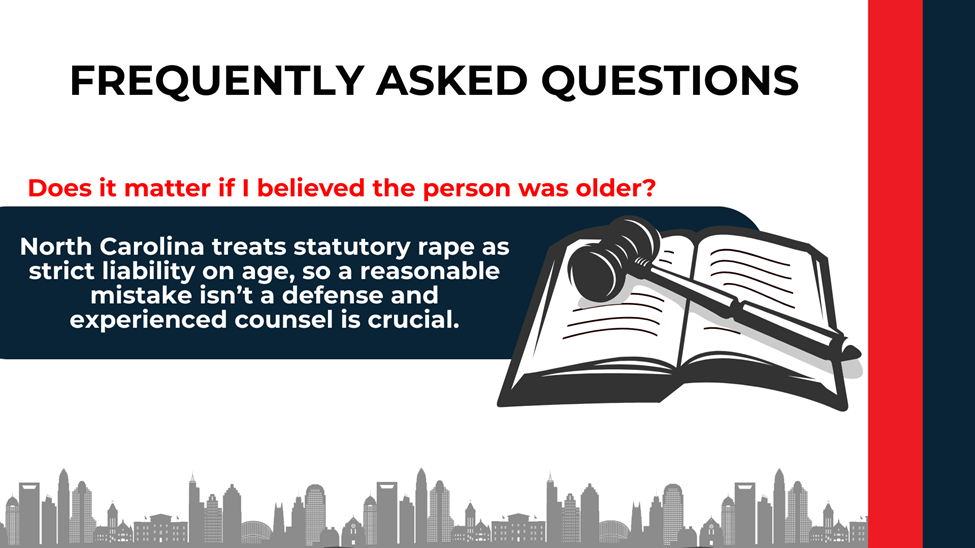
Does it matter if I believed the person was older?
North Carolina treats statutory rape as a strict liability offense regarding the alleged victim’s age. A defendant’s belief about the alleged victim’s age—even if that belief seemed reasonable—generally does not provide a defense to the charge. This is one reason why these cases require experienced defense counsel who can identify other viable defense strategies.
Where will my case be prosecuted if I’m arrested in Cary?
Criminal cases arising in Cary are prosecuted through the Wake County court system. Initial appearances occur in Wake County District Court, while felony trials take place in Wake County Superior Court at the Justice Center in Raleigh. Having defense counsel familiar with Wake County procedures, prosecutors, and judges provides advantages throughout the process.
Will I have to register as a sex offender if convicted?
Yes. A conviction for first-degree statutory rape triggers mandatory sex offender registration in North Carolina. This registration creates public records that affect housing options, employment opportunities, and many other aspects of daily life for years or decades following conviction.
How quickly should I contact a defense attorney?
Immediately. If you learn you are under investigation—or have been arrested—contact experienced defense counsel before speaking with police or anyone else about the allegations. Early involvement allows your attorney to protect your rights during the investigation phase and begin building your defense while evidence is still available.
Disclaimer: The information on this website is for general information purposes only. Nothing on this site should be taken as legal advice for any individual case or situation. Case results depend upon a variety of factors unique to each case. Prior results do not guarantee a similar outcome.
Former assistant district attorney
Contact Patrick Roberts
Facing criminal charges in North Carolina demands seasoned representation. Trust in the experience and dual perspective of Patrick Roberts. Reach out today for a confidential consultation.
-
Call Our Team
Calls answered 24/7








For more information on the selection criteria, go to www.martindale.com
*Each case is different and must be evaluated separately. Prior results achieved do not guarantee similar results can be achieved in future cases.