

Facing domestic violence charges in Cary, North Carolina creates immediate and overwhelming uncertainty. Perhaps the person who called the police now regrets it. Perhaps the allegations stem from a misunderstanding or a moment of heightened emotion during an argument. Whatever the circumstances, one question dominates your thoughts: can these charges just go away?
The answer is more complicated than most Cary residents expect. In North Carolina, domestic violence charges are prosecuted by the state through the Wake County District Attorney’s office—not by the person who made the allegations. This means the alleged victim cannot simply “drop charges,” even if they want to. Understanding how the prosecution process actually works, what factors influence case outcomes, and what defense strategies may apply to your situation requires guidance from a defense attorney who knows how these cases are built from the inside. Attorney Patrick Roberts’ background as a former prosecutor who handled domestic violence cases gives him direct insight into the strategies and priorities that shape how the Wake County DA’s office approaches these matters.
What Does “Getting Charges Dropped” Actually Mean in a Domestic Violence Case?
Who Decides Whether Domestic Violence Charges Move Forward?
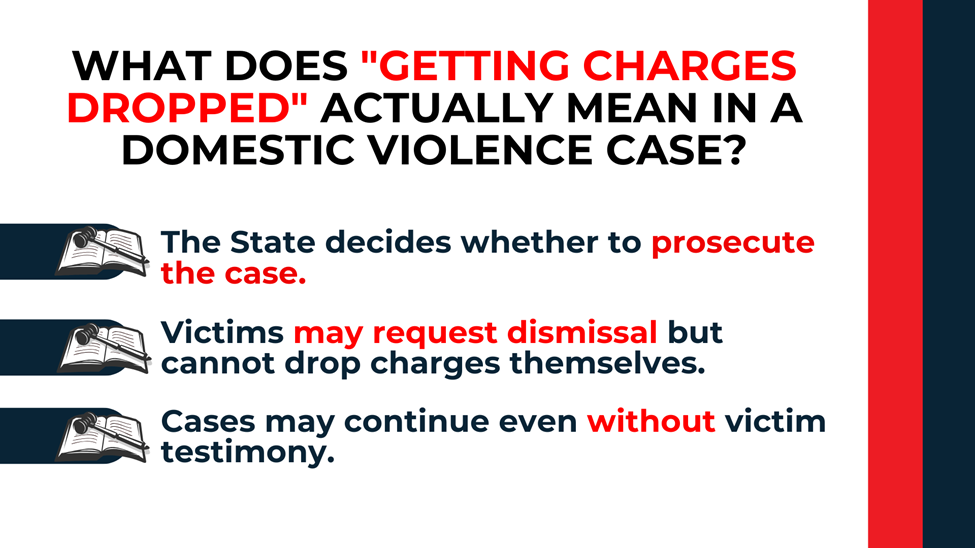
When Cary Police Department officers respond to a domestic disturbance call, their investigation can set criminal charges in motion regardless of whether anyone wants to “press charges.” In North Carolina, the decision to prosecute belongs to the state. The Wake County District Attorney’s office reviews the evidence, determines what charges to file, and decides whether to proceed—independent of the alleged victim’s preferences.
This structure exists because domestic violence is treated as an offense against the community, not just against an individual. Prosecutors in the 10th Judicial District, which includes all of Wake County and Cary, can and do move forward with cases even when the alleged victim asks them not to.
Can an Alleged Victim Request That Charges Be Dismissed?
An alleged victim can certainly communicate their wishes to the prosecutor. They can provide a written statement indicating they do not want the case to proceed. They can decline to participate in the prosecution. But none of these actions compels the Wake County DA to dismiss charges.
Prosecutors consider victim cooperation as one factor among many. A reluctant or recanting victim may make conviction more difficult, but it does not make prosecution impossible. Wake County prosecutors are experienced in handling cases where victims become uncooperative, and they have developed methods to proceed without active victim participation when they believe the evidence supports the charges.
What Happens When the Alleged Victim Refuses to Testify?
When an alleged victim refuses to testify, prosecutors evaluate what other evidence exists. Cary Police Department’s Special Victims Unit, which handles domestic violence investigations, typically collects multiple forms of evidence during their response: 911 call recordings, photographs of injuries or property damage, statements from neighbors or other witnesses, and the defendant’s own statements made at the scene.
This evidence-based prosecution approach means a case can proceed to trial even without the alleged victim’s testimony. Prosecutors may use prior statements, recorded calls, or circumstantial evidence to establish their case. Defense counsel who understands this prosecutorial strategy—who has seen it from the state’s side—can evaluate your specific situation and identify where the prosecution’s case may have weaknesses.
How Does North Carolina Define Domestic Violence Charges?
What Relationships Qualify as “Personal Relationships” Under NC Law?
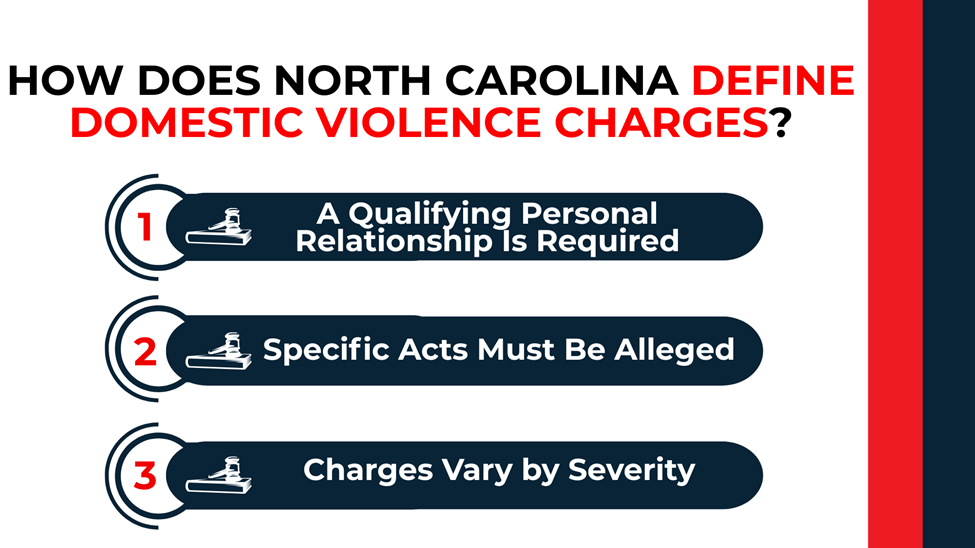
North Carolina’s domestic violence laws apply only when the parties have a specific type of relationship. Under G.S. 50B-1(b), a “personal relationship” includes:
- Current or former spouses
- Persons of opposite sex who live together or have lived together as if married
- Parents and children, including those acting in loco parentis, or grandparents and grandchildren
- Persons who have a child in common
- Current or former household members
- Persons of opposite sex who are or have been in a dating relationship
The statute defines a dating relationship as one where the parties are romantically involved over time and on a continuous basis. Casual acquaintances or ordinary social interactions do not qualify. If the alleged conduct occurred between parties without one of these relationships, domestic violence charges may not be appropriate—though other criminal charges might still apply.
What Conduct Can Lead to Domestic Violence Charges?
Under G.S. 50B-1(a), domestic violence means committing one or more of the following acts against someone with whom you have a personal relationship: attempting to cause bodily injury or intentionally causing bodily injury; placing the person or their family member in fear of imminent serious bodily injury or continued harassment that inflicts substantial emotional distress; or committing certain sexual offenses defined elsewhere in North Carolina law.
Related criminal charges often accompany or substitute for general domestic violence allegations. These include domestic criminal trespass under G.S. 14-134.3, assault by strangulation under G.S. 14-32.4(b), and stalking under G.S. 14-277.3A. For professionals living in Cary—where nearly 70% of adults hold bachelor’s degrees and many work in positions requiring security clearances—any of these charges can devastate a career even before trial.
Attorney Patrick Roberts’ lifetime membership in the National Association of Criminal Defense Lawyers reflects his ongoing commitment to staying current on defense strategies for these complex cases.
Are All Domestic Violence Offenses Charged the Same Way?
Domestic violence-related charges range from misdemeanors to serious felonies. Simple assault involving a personal relationship is typically a Class A1 misdemeanor, but assault with a deadly weapon or inflicting serious injury can elevate the charge. Violations of Domestic Violence Protective Orders under G.S. 50B-4.1 start as Class A1 misdemeanors but become Class H felonies upon a third offense or when committed with a deadly weapon.
Wake County operates a specialized Domestic Violence Court that coordinates case handling and applies consistent procedures. This specialized court environment means that judges and prosecutors handling your case have specific experience with these matters—making experienced defense representation essential.
What Factors Influence Whether Domestic Violence Charges Might Be Reduced or Dismissed?
How Does the Strength of Evidence Affect Case Outcomes?
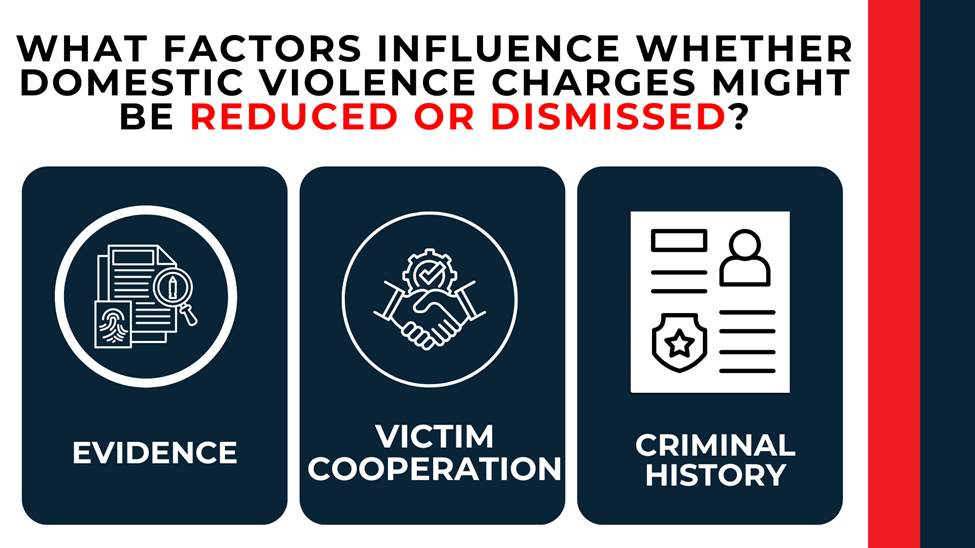
The evidence supporting the charges remains the most significant factor in case outcomes. Prosecutors assess physical evidence such as photographs of injuries, damaged property, or recovered weapons. They review digital evidence, which can include text messages, emails, and social media communications. In Cary’s tech-driven community, where many residents work at companies like SAS Institute or Epic Games, work devices and corporate communication platforms sometimes become evidence sources.
Key factors that influence prosecutorial decision-making include:
- The consistency of the alleged victim’s statements across time
- The presence or absence of physical injuries documented at the scene
- Whether independent witnesses observed the incident
- The defendant’s statements to police at the time of arrest
- Any prior history between the parties documented in police reports or court records
- The existence of prior protective orders or convictions
Because these cases often turn on the credibility of a single statement or a missing piece of physical evidence, Attorney Patrick Roberts utilizes the advanced techniques honed at the National Criminal Defense College. His intensive training in cross-examination allows him to rigorously test the consistency of alleged victim statements and expose critical gaps in the State’s evidence that might otherwise go unnoticed.
Does the Alleged Victim’s Cooperation Matter?
Victim cooperation influences but does not control case outcomes. When an alleged victim actively cooperates with prosecution—appearing for interviews, testifying at hearings, providing consistent statements—the prosecution’s path becomes smoother. When cooperation disappears, prosecutors must decide whether remaining evidence justifies proceeding.
Victim recantation—changing a prior statement to minimize or deny the alleged conduct—rarely results in automatic dismissal. Prosecutors and judges understand that recantation is common in domestic violence cases and may reflect pressure, reconciliation, or other factors rather than the truth of what occurred. The original statements, especially if recorded or given to responding officers, often remain admissible evidence.
What Role Does the Defendant’s History Play?
A defendant’s prior criminal history and any previous domestic violence involvement significantly affect how prosecutors approach the current case. Under G.S. 15A-534.1, the judge setting pretrial release conditions must review the defendant’s criminal history report. Prior domestic violence convictions or protective order violations suggest a pattern that prosecutors weigh heavily.
First-time defendants without prior history may find prosecutors more willing to consider alternative resolutions. However, this depends on the specific allegations’ severity and the evidence supporting them. Even first-time defendants in Wake County face aggressive prosecution when the alleged conduct involves serious injury, weapons, or children.
Can Procedural Issues Affect the Case?
Constitutional violations during investigation or arrest can create opportunities to challenge the prosecution’s case. Fourth Amendment issues may arise if officers conducted searches without proper consent or warrants. Fifth Amendment violations occur when police obtain statements after the defendant invoked the right to remain silent or requested an attorney.
At the Wake County Justice Center in Raleigh, where all Cary criminal cases are prosecuted, experienced defense attorneys raise these issues through pretrial motions. Successful challenges can result in evidence suppression, potentially weakening the prosecution’s case to the point where dismissal or significant reduction becomes appropriate.
What Defense Strategies Can Lead to Favorable Outcomes in Wake County DV Cases?
How Can Self-Defense Claims Affect a Domestic Violence Case?
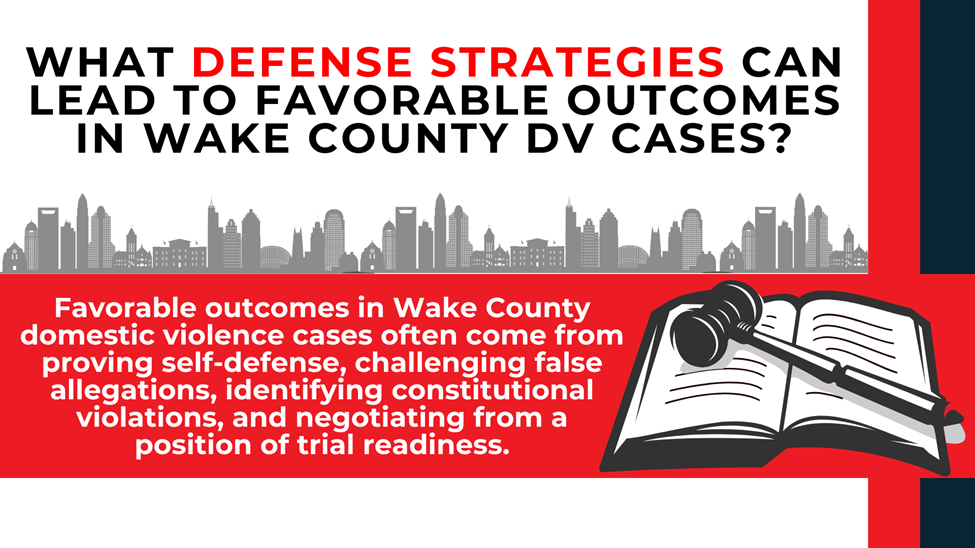
North Carolina law specifically excludes acts of self-defense from the definition of domestic violence under G.S. 50B-1(a). If you were defending yourself against the other party’s aggression, this constitutes a complete defense to domestic violence charges—but establishing self-defense requires careful presentation of the evidence.
Defense strategies in self-defense cases focus on demonstrating that the defendant reasonably believed force was necessary to prevent imminent harm and that the force used was proportional to the threat. Evidence supporting self-defense might include the defendant’s injuries, witness observations of who initiated physical contact, or a documented history of the alleged victim’s violent behavior.
What If the Allegations Are False or Exaggerated?
False accusations occur in domestic violence cases, often arising during contentious custody disputes or relationship breakdowns. When allegations stem from fabrication or significant exaggeration, the defense focuses on exposing inconsistencies and demonstrating the accuser’s motive to lie.
Attorney Patrick Roberts’ training through the National Child Abuse Defense and Resource Center—an organization focused specifically on defending against false accusations—provides methods for analyzing forensic interviews and identifying unreliable allegations. As of December 2025, he is the only attorney in North Carolina listed on the NCADRC website at falseallegation.org, reflecting his commitment to this specialized defense approach. These skills apply directly to domestic violence cases where false or exaggerated allegations may have originated from custody battles or relationship retaliation.
Can Constitutional Violations Lead to Dismissed Charges?
When law enforcement violates constitutional rights during investigation or arrest, the resulting evidence may be suppressed. If suppression eliminates the prosecution’s ability to prove the charges, dismissal becomes possible.
Common constitutional issues in domestic violence cases include warrantless entries into the home without valid consent or exigent circumstances, continued questioning after a defendant requests an attorney, and coerced statements obtained through improper interrogation tactics. Identifying these issues requires detailed review of body camera footage, arrest reports, and officer testimony.
When Might Negotiated Resolutions Be Appropriate?
Not every domestic violence case proceeds to trial. Negotiated resolutions—including plea agreements to reduced charges, deferred prosecution agreements, or participation in court-approved programs—may serve both the defendant’s interests and the court’s objectives.
Under G.S. 15A-1343(b)(12), defendants found responsible for domestic violence and sentenced to probation must attend and complete an abuser treatment program approved by the Domestic Violence Commission. Proactive enrollment in such programs before sentencing can demonstrate accountability and may influence case outcomes.
The trial advocacy training Attorney Patrick Roberts received at Gerry Spence’s Trial Lawyers College—where graduates learn methods for connecting with juries and humanizing clients—ensures he can take cases to trial when necessary. This trial readiness creates leverage in negotiations, as prosecutors know they cannot pressure a defendant into unfavorable agreements when defense counsel is prepared to fight. He doesn’t settle because he has to; he negotiates from a position of strength.
Attorney Patrick Roberts is not only battle-tested in local North Carolina courtrooms, but he is also admitted to practice before the U.S. Supreme Court. This prestigious credential signifies a level of legal standing recognized at the highest possible level of the American judiciary. Furthermore, his admission to the Fourth Circuit Court of Appeals and all Federal District Courts in North Carolina ensures that he can protect your rights regardless of whether your case is in state or federal jurisdiction.
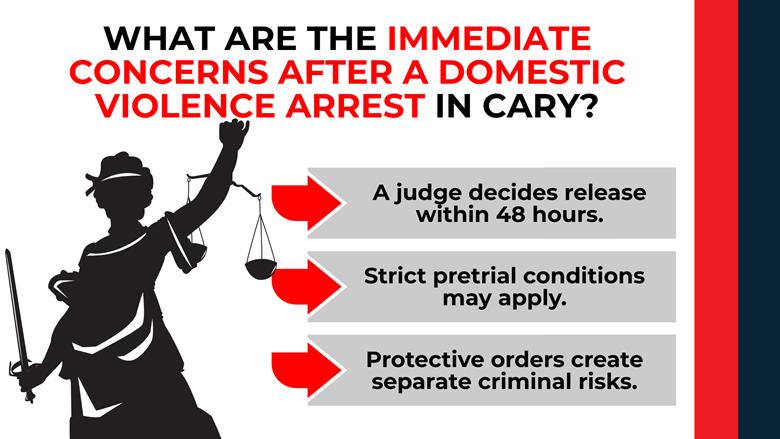
What Are the Immediate Concerns After a Domestic Violence Arrest in Cary?
What Happens During the 48-Hour Hold Period?
North Carolina’s G.S. 15A-534.1 establishes special pretrial release procedures for domestic violence arrests. When Cary police arrest someone for assault, stalking, communicating a threat, or certain felonies involving a person with whom they have a personal relationship, a judge—not a magistrate—must determine pretrial release conditions.
This determination must occur within 48 hours of arrest. During this period, the judge reviews the defendant’s criminal history and assesses whether immediate release poses a danger to the alleged victim or others. For Cary residents accustomed to resolving problems quickly, this mandatory waiting period creates significant disruption to work, family obligations, and daily life.
What Pretrial Conditions Might Be Imposed?
Under G.S. 15A-534.1(a)(2), a judge may impose conditions including requirements to stay away from the alleged victim’s home, school, or workplace; prohibitions on assaulting, molesting, or wounding the alleged victim; restrictions on removing or damaging property; and limitations on child visitation to court-ordered times. The judge may also require alcohol abstention verified through continuous monitoring.
For Cary professionals working at companies like MetLife or Lockheed Martin—employers that require security clearances—these conditions create immediate complications. Even pretrial restrictions can trigger employment reviews and clearance investigations.
How Do Protective Orders Affect the Defendant?
Beyond criminal charges, alleged victims can obtain Domestic Violence Protective Orders under Chapter 50B. Emergency or ex parte orders can be issued before the defendant even knows an order has been sought. These orders may prohibit contact, exclude the defendant from a shared residence, and restrict firearm possession.
Violating a protective order constitutes a separate criminal offense under G.S. 50B-4.1. A first violation is a Class A1 misdemeanor; a third violation becomes a Class H felony. Defendants must understand that protective order violations will complicate any existing criminal case and generate additional charges—even if contact with the protected person seems harmless or was initiated by them.
Why Does Your Choice of Defense Attorney Matter in a Cary Domestic Violence Case?
How Does Prosecutorial Experience Benefit the Defense?
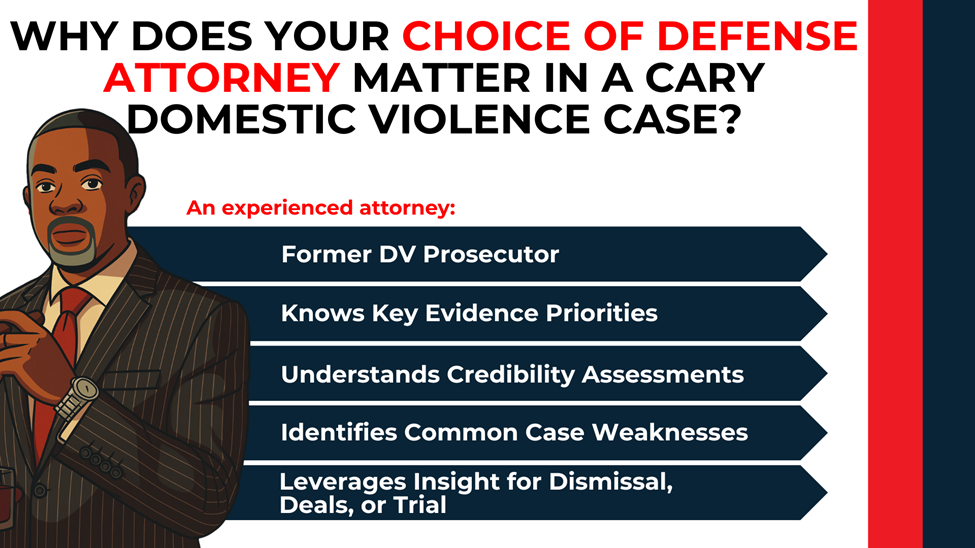
An attorney who has prosecuted domestic violence cases understands how the state builds its case from the inside. Attorney Patrick Roberts’ background as a former prosecutor who handled domestic violence matters—including assault charges, protective orders, and violation cases—means he knows what evidence prosecutors prioritize, how they evaluate witness credibility, and where their cases typically have vulnerabilities.
This prosecutorial perspective proves invaluable whether pursuing dismissal, negotiating resolution, or preparing for trial. Understanding the opposition’s playbook allows defense counsel to anticipate strategies and prepare effective responses rather than reacting to prosecution moves.
Why Are Trial Skills Essential Even If You Want Charges Dropped?
Prosecutors negotiate differently when they face an advocate who is genuinely prepared for trial. With two decades of criminal defense experience having tried hundreds of bench and jury trials in state and federal courts in North Carolina, Attorney Patrick Roberts brings a level of seasoned authority that cannot be overlooked.
The Power of Trial Readiness
This respected standing is reflected in his AV Preeminent® rating from Martindale-Hubbell, the highest possible peer review rating for professional excellence and ethical standards. His reputation for being fearless and powerful in the courtroom is cemented by the feedback of his colleagues:
“Thinks Outside the Box” “I have always found Patrick to be well prepared and effective. He is intelligent, proactive, and thinks outside the box. His vast experience across different legal areas enables him to be particularly effective for his clients.” — Peer Review via Martindale-Hubbell, October 19, 2018
The intensive trial advocacy training he completed at Gerry Spence’s Trial Lawyers College—methods focused on connecting with juries and presenting compelling narratives—ensures that his unique defense strategies are both thorough and effective.
For Cary residents with professional careers, families, and community standing at stake, having an attorney who utilizes creative defense techniques to take a case to verdict provides both protection and leverage. Prosecutors recognize when they face an opponent who will not accept unfavorable outcomes simply to avoid trial.
Strategic Leverage for Cary Professionals
For Cary residents with professional careers, families, and community standing at stake, “business as usual” isn’t enough. Having a powerful advocate who can take the case to verdict provides both protection and leverage.
By employing unique defense strategies and creative defense techniques, Mr. Roberts ensures that the prosecution recognizes they are facing an opponent who will not accept unfavorable outcomes simply to avoid trial.
Frequently Asked Questions
Can the alleged victim drop domestic violence charges in North Carolina?
No. In North Carolina, the decision to prosecute domestic violence charges belongs to the Wake County District Attorney’s office, not the alleged victim. While prosecutors may consider the victim’s wishes as one factor, they can and often do proceed with cases even when victims request dismissal.
How long do domestic violence cases take in Wake County?
Case duration varies significantly based on complexity, evidence, and court scheduling. Simple misdemeanor cases may resolve within a few months, while felony charges or cases proceeding to trial can extend for a year or longer. Cases involving protective orders often have overlapping civil and criminal proceedings.
Will I have to stay away from my Cary home during the case?
Possibly. Judges can order defendants to stay away from shared residences as a condition of pretrial release. Protective orders can also exclude defendants from the home. These restrictions may remain in effect throughout the case, creating significant housing disruption.
Can domestic violence charges affect my professional license?
Yes. Many professional licenses in North Carolina require disclosure of criminal charges and convictions. For Cary residents in regulated professions—healthcare, finance, education, law—domestic violence charges can trigger licensing board reviews regardless of case outcome.
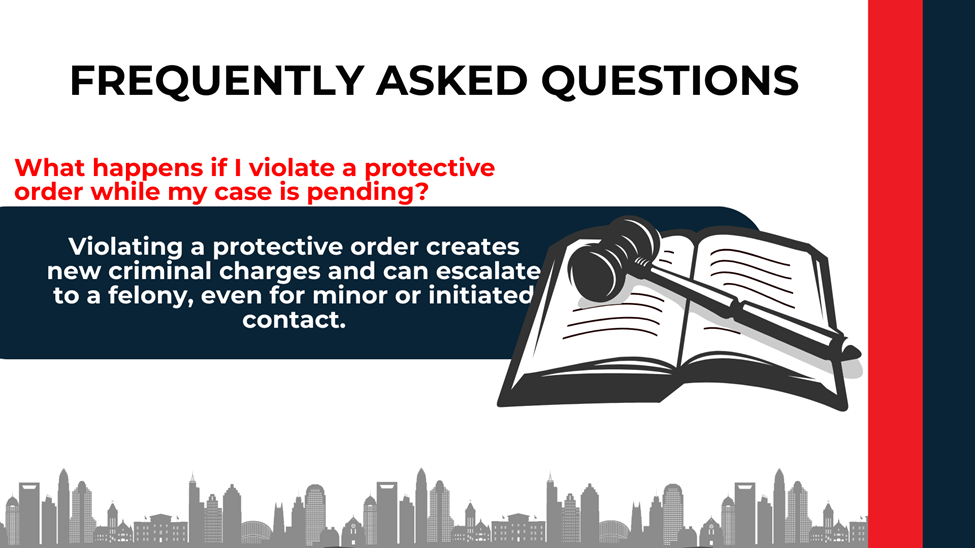
What happens if I violate a protective order while my case is pending?
Protective order violations generate additional criminal charges under G.S. 50B-4.1 and significantly complicates the underlying case. Even seemingly minor contact—including responding to messages initiated by the protected person—can constitute a violation. A third violation elevates the offense to a Class H felony.
Protecting Your Future After a Domestic Violence Arrest in Cary
Domestic violence charges threaten your freedom, your family relationships, and the professional career you’ve built. The Wake County District Attorney’s office approaches these cases aggressively, and the consequences of conviction extend far beyond the courtroom.
Attorney Patrick Roberts understands how prosecutors build domestic violence cases because he has built them himself. His experience prosecuting these matters—combined with ongoing training through the National Criminal Defense College and the Trial Lawyers College—positions him to meticulously analyze the state’s evidence and pursue the most favorable outcome* available under the law for your situation.
If you’re facing domestic violence charges in Cary or elsewhere in Wake County, contact Patrick Roberts Law to discuss your case. Every situation is different, and early consultation allows for strategic planning when options remain available.

Disclaimer: The information on this website is for general purposes only and does not constitute legal advice or an attorney-client relationship.
*Each case is different and must be evaluated separately. Prior results achieved do not guarantee similar results can be achieved in future cases.
Former assistant district attorney
Contact Patrick Roberts
Facing criminal charges in North Carolina demands seasoned representation. Trust in the experience and dual perspective of Patrick Roberts. Reach out today for a confidential consultation.
-
Call Our Team
Calls answered 24/7









For more information on the selection criteria, go to www.martindale.com
*Each case is different and must be evaluated separately. Prior results achieved do not guarantee similar results can be achieved in future cases.