Blog / Blog

How to Choose a Top-Rated Raleigh Drug Defense Attorney

Attorney reviews documents with a client beside a gavel and scales of justice.

If you are facing felony drug charges in Raleigh, NC, choosing a criminal defense attorney is one of the most important decisions you will make. Charges involving drug possession, possession with intent to sell or deliver (PWISD), or trafficking can carry serious consequences, including substantial fines and prison sentences.

But how do you know whether a lawyer's reputation reflects meaningful experience or simply effective advertising?

The best approach is to compare attorneys using objective information, including courtroom experience, relevant case results, professional credentials, client reviews, and communication practices. At Patrick Roberts Law, we encourage individuals facing criminal charges in Wake County to ask informed questions before choosing representation.

What Qualifications Should a Raleigh Felony Drug Defense Attorney Have?

A top-rated criminal defense attorney should offer more than positive online reviews. Look for experience directly related to the charges you face, particularly when the allegations involve serious felonies.

Consider these important qualifications:

  • Felony drug defense experience: Has the attorney handled PWISD, trafficking, and other serious drug offenses?
  • Wake County courtroom experience: Does the attorney regularly practice in Wake County District Court and Superior Court?
  • Trial and litigation experience: Has the attorney handled jury trials, suppression hearings, and contested criminal proceedings?
  • Knowledge of drug evidence: Can the attorney evaluate unlawful searches, constructive possession, drug testing, and chain-of-custody issues?
  • Communication and availability: Will the attorney personally handle important decisions and explain developments throughout your case?
  • Transparent fees: Does the firm clearly explain its legal fees, payment arrangements, and representation agreement?

For example, if drugs were discovered in a vehicle occupied by several people, an attorney familiar with constructive possession may recognize important questions about whether prosecutors can establish knowing possession.

When comparing qualifications, prioritize experience relevant to your particular allegations rather than relying on years in practice alone.

How to Verify Attorney Ratings on Avvo, Martindale-Hubbell, and Google

Third-party directories can help you evaluate an attorney's professional reputation, but each platform measures different aspects of legal representation.

Avvo: Compare Professional Ratings and Client Experiences

Avvo provides attorney profiles containing professional background information, client reviews, and available peer endorsements.

The Avvo Rating uses a 1–10 scale based on professional factors such as experience, credentials, recognition, and disciplinary history. Client reviews appear separately and do not directly determine the numerical rating.

Example: If an attorney has a 9.0 Avvo Rating but only two client reviews, consider both pieces of information independently. The professional score may reflect credentials and experience, while the limited review history provides less information about day-to-day client communication.

Read the individual reviews instead of relying only on the overall score. Look for details about responsiveness, preparation, and whether the attorney explained legal options clearly.

Martindale-Hubbell: Verify Peer Recognition

Martindale-Hubbell offers attorney profiles and professional peer-review ratings.

Its AV Preeminent designation represents the organization's highest peer-review rating for professional excellence and ethical standards. Other designations include Distinguished and Notable.

Example: If an attorney advertises an AV Preeminent rating, search for the attorney's profile and confirm the designation. Also examine the attorney's practice areas and experience with cases resembling yours.

A peer rating may provide useful evidence of professional recognition, but it does not establish how a particular criminal case will conclude.

Google Reviews: Look for Consistent Client Feedback

Google Business Profiles provide another opportunity to review experiences reported by former clients.

When comparing attorneys, consider the number of reviews, publication dates, and recurring themes. Comments about communication, professionalism, case preparation, and responsiveness are often more useful than broad statements about an attorney being the best.

Example: A detailed review describing how an attorney explained court procedures and maintained communication may tell you more about the client experience than a five-star rating without written feedback.

Remember that reviews reflect individual experiences and should not be treated as guarantees of legal outcomes.

Where Can You Verify a Raleigh Criminal Defense Attorney's Credentials?

Before hiring a lawyer, confirm that the attorney is licensed and eligible to practice in North Carolina.

The following resources can help you independently evaluate professional credentials.

North Carolina State Bar: Use the official attorney directory to check an attorney's license status, eligibility to practice, and available disciplinary information.

North Carolina State Bar Board of Legal Specialization: Review the criminal law specialization requirements and verify whether an attorney holds an applicable board certification. Board certification is a distinct credential and should not be confused with awards or directory ratings.

North Carolina Bar Association: The Lawyer Referral Service can help individuals locate participating attorneys for an initial consultation.

Professional Recognition Organizations: If an attorney advertises recognition from Super Lawyers, Martindale-Hubbell, or another organization, confirm the award directly through the issuing organization's website.

These resources allow you to cross-check marketing claims against professional records before making a decision.

How Should You Evaluate Published Felony Drug Case Results?

Case results can demonstrate an attorney's experience with particular charges and defense strategies. However, the details surrounding an outcome matter more than the headline.

When reviewing published results, look for the original criminal charge, whether the case involved a contested hearing or trial, the defense issues raised, and the final disposition.

For example, a trafficking charge dismissed following a successful suppression motion may demonstrate experience challenging search procedures. A negotiated reduction may demonstrate a different skill set involving evidence evaluation and plea discussions.

A dismissal, acquittal, reduced charge, and probationary sentence are not interchangeable outcomes.

Patrick Roberts Law publishes representative criminal defense case results that prospective clients can examine when evaluating the firm's experience.

Remember that previous results depend on individual circumstances and do not guarantee similar outcomes in future cases.

Warning Signs When Comparing Drug Defense Attorneys

A strong online reputation does not eliminate the need to evaluate an attorney carefully.

Be cautious if a firm promises a guaranteed dismissal, refuses to explain its fee agreement, cannot identify who will handle your case, or provides only vague answers about relevant felony drug experience.

Other concerns include pressure to hire immediately without discussing the allegations, unverifiable professional awards, and an unwillingness to explain how communication will work during representation.

These warning signs do not automatically establish that an attorney is unqualified, but they deserve clarification before you sign an agreement.

Initial Consultation Checklist for Choosing a Drug Defense Attorney

Use the following questions when comparing attorneys in Raleigh and Wake County:

  1. How many felony drug possession, PWISD, or trafficking cases have you handled?
  2. Have you personally tried felony drug cases before a jury in Wake County?
  3. How do you evaluate unlawful searches, constructive possession, and laboratory evidence?
  4. Can you describe relevant case outcomes without disclosing confidential client information?
  5. Who will personally represent me at hearings, negotiations, and trial?
  6. How frequently will I receive updates, and how can I contact my attorney?
  7. What are the total legal fees, payment terms, and possible additional expenses?
  8. What immediate steps would you recommend based on my current charges?

Compare the answers from multiple attorneys using the same questions. Clear explanations and relevant experience are more meaningful than promotional claims alone.

Evaluating Patrick Roberts Law for Felony Drug Defense in Raleigh

Patrick Roberts Law provides criminal defense representation for individuals facing serious felony allegations throughout Raleigh, Wake County, and surrounding North Carolina communities.

Attorney Patrick Roberts is a graduate of Duke University School of Law and a former assistant district attorney who previously prosecuted criminal cases in three counties. He brings more than 24 years of criminal law experience and has completed advanced trial advocacy training through the Gerry Spence Trial Lawyers College and the National Criminal Defense College.

His professional background includes serious criminal litigation, and the firm publishes representative outcomes involving different criminal allegations.

Prospective clients can independently review his Raleigh drug trafficking defense practice, examine the firm's published case results, and verify applicable professional recognition.

The firm's experience may make it a suitable option to consider, but choosing an attorney should ultimately depend on your specific charges, legal needs, and assessment during the consultation.

For additional guidance, read our 7 Criteria to Evaluate a Criminal Defense Firm in Wake County, NC.

Schedule a Consultation With Patrick Roberts Law

Finding a top-rated Raleigh drug defense attorney requires careful research, particularly when felony charges could affect your freedom, employment, and future.

Compare professional credentials, examine relevant criminal case experience, verify online ratings, and ask detailed questions before choosing representation.

If you are facing drug possession, PWISD, or trafficking allegations in Raleigh or Wake County, Patrick Roberts Law can discuss your charges and available legal options.

Call 919-746-7206 or contact Patrick Roberts Law to request a free consultation. Calls are answered 24/7.

Disclaimer: This article provides general information and does not constitute legal advice. Attorney ratings, client reviews, professional honors, and past case results do not guarantee any particular outcome. Every criminal case depends on its individual facts and applicable law.
Posted in:

Related Posts

Facing a Possession With Intent to Sell or Deliver Charge

Possession With Intent to Sell or Deliver in NC | PWISD Defense

In North Carolina, a charge of possession with intent to sell or deliver (PWISD)—commonly referred to as possession with intent to distribute (PWID)—is a serious felony offense under N.C.G.S. § 90-95. Unlike simple possession, a PWISD allegation requires the state to prove beyond a reasonable doubt both knowing possession of a controlled substance and a specific intent to sell, transfer, or deliver it. Because prosecutors frequently attempt to infer intent from circumstantial factors such as packaging, digital scales, cash denominations, or phone records obtained during a traffic stop or home search, understanding the statutory requirements and scrutinizing police procedure are essential to protecting your constitutional rights. At Patrick Roberts Law, we help people facing serious drug charges understand the evidence, the potential consequences, and the choices ahead. If you have been arrested in Raleigh or elsewhere in Wake County, it is important to address the charge promptly rather than assume the prosecution can prove its case. Call 919-746-7206 to discuss your situation or contact our firm online for a confidential consultation. What Does Possession With Intent to Sell or Deliver Mean in North Carolina? North Carolina General Statute § 90-95(a)(1) prohibits possessing a controlled substance with the intent to manufacture, sell, or deliver it, except as authorized by law. The state must establish that the accused knowingly possessed a controlled substance and had the intent required for the charged offense. A completed sale is not necessary for a possession-with-intent charge. North Carolina charging documents and pattern jury instructions specifically use the term “possession with intent to sell or deliver,” abbreviated PWISD. While people often search for the federal phrase “possession with intent to distribute” (PWID), North Carolina statute requires the state to specifically prove intent to sell or deliver, and the exact allegations on your warrant or indictment control the case. How Prosecutors Try to Prove Possession The drugs do not always have to be found in a person’s pocket. Prosecutors may rely on either actual or constructive possession: • Actual possession: The substance is found on the person or in their immediate physical custody. • Constructive possession: The substance is not physically held by the person, but evidence allegedly shows that the person knew of it and had the power and intent to control it. Cases involving a borrowed car, shared home, or room accessed by several people deserve close scrutiny. Being nearby does not, by itself, establish constructive possession. The surrounding circumstances and any additional evidence matter. What Evidence Can Suggest an Intent to Sell or Deliver? Because intent is a state of mind, prosecutors often ask jurors to infer it from circumstances. Depending on the investigation, the evidence may include: • The amount and manner of packaging of the substance • Baggies, scales, or materials associated with dividing drugs • Cash or records alleged to reflect transactions • Texts, messages, or calls interpreted as arranging sales • Witness or informant accounts • The absence or presence of circumstances consistent with personal use These facts do not automatically prove intent. Under North Carolina case law, the quantity of a substance alone is frequently insufficient to establish intent without corroborating evidence such as packaging, digital scales, or communication logs. A scale or cash can also have an innocent explanation. The defense should evaluate what each piece of evidence actually shows and whether the state’s interpretation is supported. Does the Type or Amount of Drug Matter? Yes. North Carolina places controlled substances into schedules, and the schedule can affect the felony classification. Quantity may also influence how prosecutors interpret intent. However, possession with intent and drug trafficking are not interchangeable: trafficking under § 90-95(h) is tied to specified substances and statutory weight thresholds, while a PWISD allegation focuses on possession and intent. In a close case, laboratory analysis, weighing methods, the substance identified, and whether the tested material is attributable to the accused may be important issues. The evidence should be reviewed before accepting the quantity or classification stated in an arrest report. Simple Possession, PWISD, Sale or Delivery, and Trafficking • Simple possession: An allegation of unlawful possession, without the additional intent element required for PWISD. • PWISD: An allegation of possession together with intent to sell or deliver; an actual transfer need not be proven. • Sale or delivery: An allegation that a controlled substance was actually sold or transferred. In North Carolina, an actual sale carries higher felony penalties than delivery or PWISD. Additionally, under § 90-95(b)(2), the transfer of less than 5 grams of marijuana for no remuneration does not legally constitute delivery. • Trafficking: A separate offense generally triggered by statutory quantity thresholds for particular controlled substances, even when no sale is shown. The distinction affects the charges, potential sentence, and possible defense. A case may also involve more than one allegation, which makes a careful review of the charging documents especially important. Potential Felony Penalties in North Carolina Possession with intent to sell or deliver is a felony. Under § 90-95(b), PWISD or delivery involving Schedule I or II substances is classified as a Class H felony (though an actual sale is elevated to a Class G felony). For Schedules III through VI (including marijuana), PWISD or delivery is a Class I felony, whereas an actual sale is a Class H felony. Heightened statutory penalties apply to specific offenses involving fentanyl, carfentanil, or methamphetamine manufacturing, and statutory drug trafficking carries mandatory minimum sentences. A conviction does not mean everyone receives the same sentence. North Carolina’s structured-sentencing rules consider the offense class and prior record level, along with any applicable statutory provisions. Some cases may result in community or intermediate punishment, while others involve imprisonment. The specific charge and individual history must be assessed before estimating exposure. Searches, Traffic Stops, and Constitutional Rights The circumstances of the investigation often matter as much as the substance seized. Legal questions may include: • Was the traffic stop supported by a lawful basis, and was it prolonged improperly? • Was a search warrant valid, or did a recognized exception permit a warrantless search? • If police relied on consent, was that consent voluntary and within its lawful scope? • Were statements obtained in compliance with applicable constitutional protections? Evidence obtained in violation of constitutional rules may be subject to a motion to suppress, depending on the facts and applicable exceptions. An unlawful search is not established merely because officers lacked a warrant; context matters. Evidence Commonly Examined in a PWISD Case A case file may include body-camera footage, police reports, photographs, laboratory results, phone records, cash inventories, witness statements, and documentation describing how seized substances were collected and stored. It may be necessary to compare those records for inconsistencies or missing details. Reviewing evidence also means examining what is absent. For instance, a report may describe suspected dealing without documenting a transaction, or messages may be quoted without the surrounding conversation that gives them meaning. Potential Defenses and Legal Challenges There is no single strategy that fits every accusation. Depending on the record, a defense may address: • Whether the state can prove knowing possession, especially in a shared space • Whether circumstances support an inference of intent to sell or deliver • The legality of the stop, search, seizure, or questioning • The identity, testing, weight, or custody of the substance • Conflicting testimony, incomplete records, or an unreliable informant Not every concern leads to dismissal or exclusion of evidence. A useful defense begins with the actual discovery materials and the law applicable to the specific allegations. What Should You Do After a PWISD Arrest? • Avoid discussing the facts with law enforcement without consulting a lawyer; you may clearly assert your right to remain silent and request counsel. • Do not delete messages, alter records, or discard potentially relevant materials. • Preserve documents and write down what you remember about the encounter while it is fresh. • Follow court orders and attend scheduled hearings. • Seek legal advice promptly, particularly if police seized a phone or other device. These steps cannot guarantee an outcome, but they can help prevent avoidable complications while the evidence is evaluated. Other Consequences to Consider Beyond the sentence imposed by a court, a drug felony conviction may affect employment prospects, housing applications, professional licensing, and, for noncitizens, immigration status. Some effects depend on the exact offense and individual circumstances. These concerns deserve attention early, rather than after a plea or trial. Frequently Asked Questions About PWID Charges Is possession with intent to sell or deliver a felony in North Carolina? Generally, yes. The usual classification depends on the controlled-substance schedule and statutory exceptions. The charges and offense date should be reviewed to identify the provision that applies. Can the state prove intent without showing an actual drug sale? Yes. The state can rely on circumstantial evidence, including packaging, quantity, or communications. The question is whether the overall evidence proves the charged intent beyond a reasonable doubt. Can I be charged if the drugs were found in someone else’s car? Possibly, but simply being a passenger or being near the drugs does not automatically establish possession. Prosecutors must prove the required knowledge and control through the circumstances of the case. Can police search my vehicle without a warrant? Sometimes. A warrantless vehicle search may be lawful under certain exceptions. Whether an exception applies depends on the facts, including the basis for the stop, any probable cause, and any consent. Is PWISD the same as drug trafficking? No. PWISD concerns possession coupled with intent to sell or deliver. North Carolina trafficking charges generally depend on specified statutory drug quantities and carry a separate penalty framework. What if this is my first drug charge? A first offense can still be serious. Your prior record may affect sentencing, but it does not determine whether the state can prove the offense. An attorney can review the evidence and explain the options available in your particular case. Experienced Legal Defense for PWISD Charges When facing serious felony charges like Possession With Intent to Sell or Deliver, the quality of your legal representation can be the decisive factor in the outcome of your case. Attorney Patrick Roberts brings over two decades of courtroom experience to the defense of complex drug trafficking and possession allegations, utilizing a deep background that includes four years as a former Assistant District Attorney and extensive service in private practice. His expertise is rooted in a comprehensive understanding of the state’s evidentiary requirements, specifically regarding constructive possession, digital forensics, and constitutional search and seizure standards. By meticulously auditing the prosecution’s case for procedural weaknesses and utilizing a defense strategy honed through more than 75 jury trials—including those involving state and federal drug trafficking charges—Mr. Roberts provides the rigorous advocacy necessary to challenge the government’s evidence, protect his clients' rights, and mitigate the severe long-term consequences associated with a felony drug conviction. • Martindale-Hubbell AV Preeminent Rating: Consistently recognized with the highest peer-review rating for legal ability and ethical standards from 2018 through 2026. • National Association of Distinguished Counsel: Selected to the "Nation's Top 1 Percent" of attorneys for six years, including 2025 and 2026. • Duke University School of Law Graduate • Former Prosecutor Perspective: Completed extensive professional training in cross-examination at the National District Attorneys Association (2007) and served as an Assistant District Attorney (2003–2007) managing felony drug and DWI dockets. Client Review I cannot speak highly enough of Mr. Patrick Roberts, from the moment we connected via the telephone he demonstrated, confidence, support, and a great analytical mind, which provided my family with much-needed support during one of the most difficult periods in our lives. Mr. Roberts, took the time to understand our situation, he ran through various scenarios on how he thought he could win our case, which he did! What sets Mr. Roberts apart is his legal expertise, in-depth knowledge of the judicial procedure, and genuine compassion and commitment to you as a client. — Review by a verified client via Avvo Peer Endorsement I have had the challenge of working with Atty Roberts when he served as Asst. District Atty in Wake Co. and have worked closely with him as fellow defense counsel. As an ADA, I found him to be professional, reasonable and fair in every regard. He represented the State of North Carolina with integrity. As private counsel, his intelligence and knowledge of procedure and law has been even more impressive. Attorney Roberts is not your 'run of the mill' lawyer. While he's sharp and knows his stuff, he is also approachable and relates well with clients, colleagues, judges and courthouse personnel. He never, never walks away from a challenge. In the courtroom, his experience as both prosecutor and criminal defense attorney provides him with a unique perspective and ability to process each matter he handles quickly, efficiently and effectively. I highly recommend Attorney Roberts and place full confidence in his abilities. — Peer endorsement by a fellow North Carolina trial attorney via Avvo Disclaimer: The client reviews and peer endorsements displayed are authentic testimonials and comments provided by clients and fellow attorneys. Every case is unique and must be evaluated individually; past client experiences and case results do not guarantee, promise, or predict similar outcomes in any future matter. Case Results • Felony Heroin Trafficking and Controlled Substance Possession: After an encounter at a checkpoint, an individual was charged with felony trafficking in heroin and possession of controlled substances. By obtaining the law enforcement checkpoint plan and filing a motion to suppress based on constitutional violations, the defense successfully prompted the prosecution to dismiss the felony trafficking charge, resulting in a plea to misdemeanor possession with a sentence of probation. ○ Outcome: Felony trafficking charge dismissed; pleaded to two misdemeanor possession counts and received probation. • Major Cocaine Trafficking Charges: An individual faced three counts of trafficking over 400 grams of cocaine, which carried mandatory minimum sentences of 175 months per count based on recordings and investigative reports. Defense counsel negotiated a plea agreement that allowed for a probationary argument by highlighting the individual's stable employment and lack of a criminal record, ultimately persuading the court to impose probation instead of prison time. ○ Outcome: Probation secured. Click here for more case results. Disclaimer: Case outcomes depend upon a variety of factors unique to each case. Prior results do not guarantee or predict a similar outcome in any future legal matter. Protecting Your Rights Against PWISD Charges A charge of Possession With Intent to Sell or Deliver is a serious matter that requires immediate and rigorous legal scrutiny. If you are facing these allegations, it is critical to evaluate the state’s evidence and ensure your constitutional rights are fully protected. Patrick Roberts Law PLLC provides comprehensive defense representation for clients facing drug-related felonies across North Carolina. With a strong, established presence in Wake County—including Raleigh, Cary, Apex, Holly Springs, Garner, and Fuquay-Varina—we are prepared to challenge the state's case, from the legality of police procedures to the sufficiency of evidence regarding possession and intent. Do not leave your future to chance. To discuss your legal options and develop a defense strategy tailored to the specific facts of your case, contact Patrick Roberts Law PLLC today at www.patrickroberts.law to schedule a confidential consultation. To maintain the quality of its defense and provide each client with individualized attention, the firm limits the number of cases it accepts at any given time. Disclaimer: The information provided on this website is for general informational and educational purposes only and does not constitute formal legal advice. Reading this article or contacting Patrick Roberts Law does not create an attorney-client relationship. Federal and state criminal laws, sentencing guidelines, and statutory mandatory minimums are complex and subject to change, and outcomes depend entirely upon the unique facts and circumstances of each individual case.

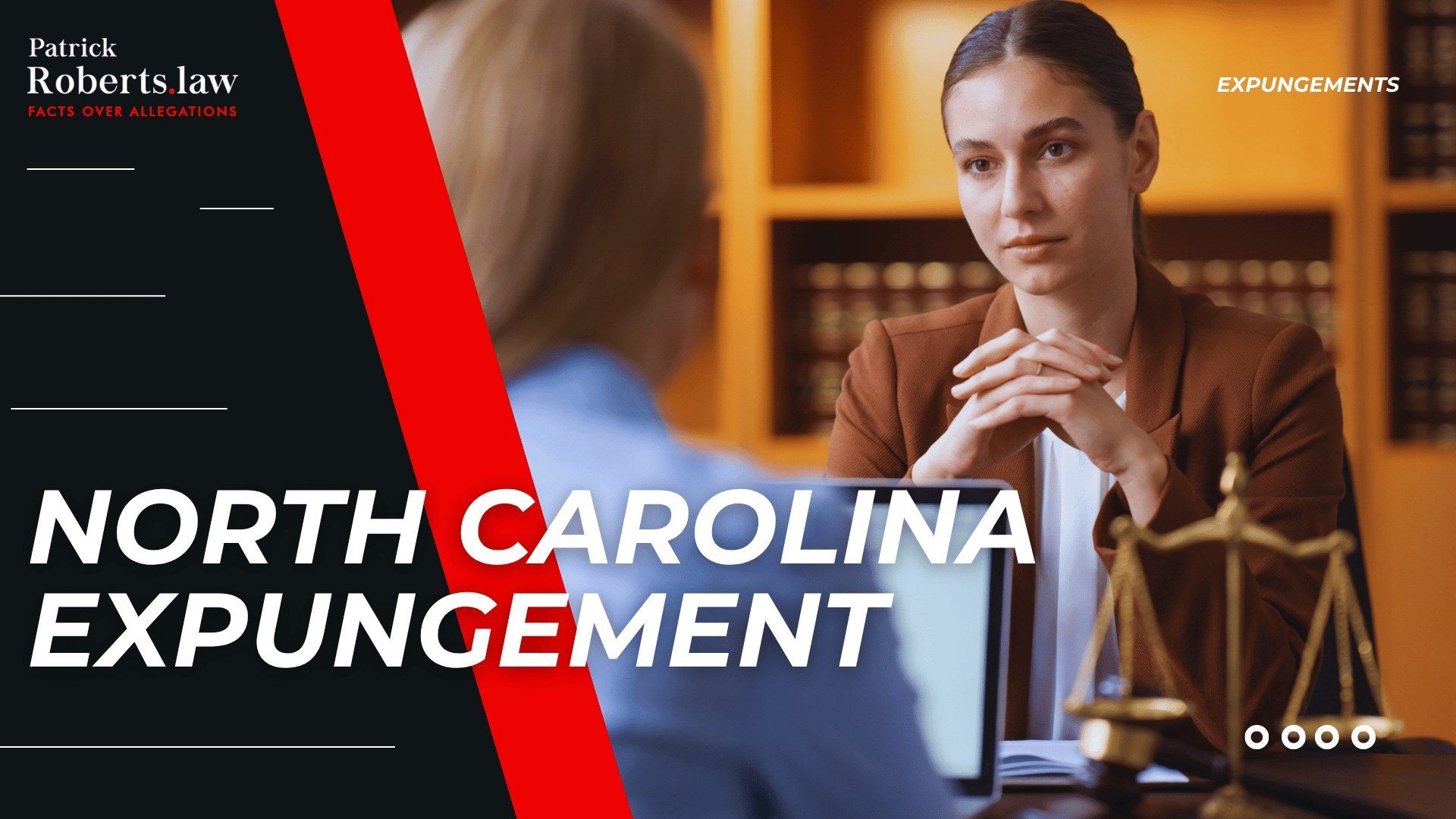
Woman in a brown blazer meeting with a client across a desk beside brass scales, with the words “North Carolina Expungement.”

North Carolina Expungement

Patrick Roberts Law is a North Carolina criminal defense firm based in Raleigh, with additional offices in Durham, Chapel Hill, and Cary. Expungement is part of the criminal defense work the firm handles across the state. If you have an old charge, dismissal, or conviction on your North Carolina record, you may want to know whether it can be cleared. Patrick Roberts Law can review your record and tell you which statute applies to your situation. The firm handles the petition from filing through the court hearing. North Carolina courts issued 1,418,282 expunctions in fiscal year 2024–2025, so record clearing here is common and well-established. What it is not is simple: eligibility, waiting periods, and the effect of an expunction are set almost entirely by statute: N.C. Gen. Stat. Chapter 15A, Article 5. The specific track that fits your record determines everything. We start by identifying that track. Expungement Matters We Handle North Carolina has no general "sealing" statute. Every form of record relief comes from a specific eligibility grant in N.C. Gen. Stat. §§ 15A-145 to 15A-160. The relief divides into two broad tracks: expunction of non-convictions (dismissals and not-guilty findings) and expunction of convictions. We work across both tracks and the provisions within each. Dismissed Charges and Not-Guilty Findings We represent clients seeking to expunge charges that were dismissed or that ended in a finding of not guilty or not responsible under N.C. Gen. Stat. § 15A-146(a), (a1). This is often the most direct relief available. Where a single charge is dismissed or an acquittal is entered on all related charges, expunction is mandatory and no waiting period applies. Unlike conviction expunctions, it is also not barred by prior convictions or prior expunctions. This matters in North Carolina, where over a recent ten-year span 80.6% of criminal charges ended with no finding of guilt. Relief becomes discretionary rather than mandatory where some charges in the case resulted in conviction on the same day, or where the case has not reached final disposition. Separately, effective December 1, 2025, dismissals entered because a defendant was found incapable to proceed under G.S. § 15A-1008 are excluded from expunction under § 15A-146 (S.L. 2025-93). We identify which of these situations applies before filing. Are Dismissals and Acquittals Ever Expunged Automatically? Some qualifying dismissals and acquittals are now expunged automatically, without any petition, under N.C. Gen. Stat. § 15A-146(a4), as restructured by S.L. 2024-35. The courts are directed to clear eligible non-conviction dispositions roughly 180 to 210 days after final disposition. This is the largest expunction stream in the state ( 1,381,128 automatic expunctions were issued in fiscal year 2024–2025) but it does not reach everything. A felony charge dismissed as part of a plea agreement is not eligible for automatic expunction and still requires a petition. Automatic expunctions also bypass the clerk-notification duties of § 15A-150, which can leave records at downstream agencies out of date. We help clients confirm whether an automatic expunction actually reached every record. We file a petition where the automatic process does not apply. Older Nonviolent Convictions: The Second Chance Act We represent clients petitioning to expunge nonviolent misdemeanor and nonviolent felony convictions under N.C. Gen. Stat. § 15A-145.5. This is the state's main adult "second chance" pathway, and it carries no age limit. The waiting periods are measured from the later of the conviction or completion of the sentence, including probation and post-release supervision: • One nonviolent misdemeanor: 3 years (reduced from 5 by S.L. 2025-71, effective July 9, 2025) • Multiple nonviolent misdemeanors: 7 years after the last conviction • One nonviolent felony: 10 years • A G.S. 14-54(a) breaking-or-entering felony: 15 years • Two or three nonviolent felonies: 20 years after the most recent listed conviction The gatekeeper term "nonviolent" is defined in § 15A-145.5(a) and expressly excludes Class A–G felonies, Class A1 misdemeanors, assault-element offenses, and certain sex-related and stalking offenses, among others. Even where the waiting period is met, relief can be barred by a disqualifying prior conviction, an outstanding warrant or pending charge, unpaid restitution, or a prior § 15A-145.5 expunction. You must also show good moral character during the waiting period. This is a demanding path: only 3,599 nonviolent-conviction expunctions were issued statewide in fiscal year 2024–2025. We build the petition to meet each requirement. Young-Offender and First-Offender Expunctions We represent clients seeking the enhanced relief North Carolina gives to people who committed an offense at a young age. This relief generally requires first-offender status and shorter waiting periods than the adult track. These provisions include N.C. Gen. Stat. § 15A-145 (under-18 misdemeanors and underage-alcohol offenses; 2-year wait), § 15A-145.2 (drug first offenders not over 21; 12-month wait, program completion required), § 15A-145.3 (toxic-vapor first offenders; 12-month wait), § 15A-145.4 (under-18 nonviolent felonies other than Class A–G; 4-year wait), and § 15A-145.8A ("Raise the Age" parity relief for 16- and 17-year-olds convicted before December 1, 2019, on completion of sentence). These provisions require no prior misdemeanor or felony conviction and no subsequent conviction during the waiting period. The drug and toxic-vapor pathways also require completion of a court-ordered program (or a waiver). We confirm which age-based section fits and whether the first-offender conditions are met. Can You Expunge a Charge Tied to Being a Victim or Mistaken Identity? We also represent clients whose culpability is reduced by victim status or innocence, under the targeted provisions of Article 5. These include N.C. Gen. Stat. § 15A-145.6 (prostitution convictions; 3-year wait; no filing fee), § 15A-145.9 (convictions arising from human-trafficking victimization; no waiting period, discretionary, no fee), § 15A-147 (charges resolved through identity theft or mistaken identity), and § 15A-149 (expunction following a pardon of innocence). Trafficking relief is discretionary even when the threshold criteria are met, and the court must find that the offense was a direct result of the victimization. These pathways typically require a hearing with notice to the district attorney, and we handle that process. What Does an Expunction Actually Do, and What Are Its Limits? A granted expunction restores you, in law, to the status you held before the charge or conviction. Under N.C. Gen. Stat. § 15A-153, you may lawfully deny the expunged matter in most contexts. Employers and educational institutions may not require you to disclose an expunged arrest, charge, or conviction. We make sure clients understand the limits as well. Under §§ 15A-151 and 15A-151.5, expunged convictions remain in a confidential file that district attorneys can use for prior-record-level calculation, habitual-offender indictment, offense-level enhancement, G.S. 90-96 eligibility, and Rule 404(b)/609 purposes. Section 15A-152 creates civil liability for the unlawful dissemination of expunged criminal-history information. And an expunction under North Carolina law does not erase federal immigration consequences, which are governed by federal definitions of "conviction." We explain exactly what relief will and will not do for your specific record before you file. Legal Guidance for North Carolina Expungement For individuals seeking to clear their criminal records, navigating the complex statutory landscape of North Carolina law requires precise legal guidance to ensure compliance with Chapter 15A, Article 5. Attorney Patrick Roberts offers this, drawing on over two decades of legal experience that includes service as a former Assistant District Attorney and extensive work in criminal defense litigation.  Mr. Roberts possesses the experience necessary to identify specific eligibility tracks under the Second Chance Act and other relevant statutes. By combining his deep knowledge of the North Carolina court system with a commitment to meticulous case preparation, Mr. Roberts helps clients effectively evaluate their unique records to secure the relief to which they are entitled under the law. • Martindale-Hubbell AV Preeminent Rating: Consistently maintained this peer-nominated rating for eight consecutive years (2018–2026), reflecting the highest level of professional excellence and ethical standards. • National Criminal Defense College Graduate: Completed the Trial Practice Institute, an intensive training program dedicated to mastering advanced criminal defense litigation skills. • Nation’s Top 1 Percent Selection: Recognized by the National Association of Distinguished Counsel for excellence in legal practice in multiple years • Former Prosecutor Perspective: Served as an Assistant District Attorney across three North Carolina jurisdictions (2003–2007), providing the specific insight required to navigate the state's complex, strict statutory standards for record expunction. • Policy Appointment: Appointed to the North Carolina Juvenile Justice Planning Committee by Governor Pat McCrory, offering a systemic understanding of how criminal records are regulated and managed within the state's legal framework. • Advanced Technical Training: Graduate of the White Collar Criminal Defense College at Stetson University, providing the technical forensic framework necessary to audit evidence and interpret eligibility tracks for statutory petition-based relief. Client Review Patrick is an outstanding legal advocate...I retained and worked with Patrick and his team for four years and my expectations were without a doubt satisfied. Patrick will always be my first choice for legal defense... — Review by a verified client via Avvo Peer Endorsement I attended the Trial Lawyers College with Patrick. If I was facing serious criminal charges anywhere in North Carolina, he would be my first call. — Peer endorsement by a fellow North Carolina trial attorney via Avvo Disclaimer: The client reviews and peer endorsements displayed are authentic testimonials and comments provided by clients and fellow attorneys. Every case is unique and must be evaluated individually; past client experiences and case results do not guarantee, promise, or predict similar outcomes in any future matter. Case Results Seeing how a lawyer has handled real cases gives you a clearer idea of what to expect for your own. Below are examples of past cases resolved by Attorney Patrick Roberts: • Obtaining Property by False Pretenses Charges: An individual faced eight counts of obtaining property by false pretenses due to mistaken identity stemming from sharing a name with the actual offender. Defense counsel presented this evidence, resulting in the dismissal of all felony charges. ○ Outcome: Dismissed • Sex Offender Registry Removal: The client sought legal assistance regarding their status on the sex offender registry. Legal counsel successfully secured the removal of the client’s name from the registry after the mandatory statutory registration period was completed. ○ Outcome: Client's name expunged from the sex offender registry after the period ended. • Statutory Sex Offense Charges: The client was originally charged with multiple felony statutory sex offenses. Attorney Patrick Roberts negotiated a plea agreement to a single misdemeanor charge of sexual battery, and subsequently secured the client's removal from the sex offender registry after the required ten-year registration period. ○ Outcome: Plea negotiated to misdemeanor sexual battery with 10-year registration, followed by successful* removal from the sex offender registry on the first petition. *Disclaimer: Case outcomes depend upon a variety of factors unique to each case. Prior results do not guarantee or predict a similar outcome in any future legal matter. Navigating Your Path to Record Expungement Clearing a criminal record requires a precise understanding of North Carolina's complex statutory requirements. Whether you are seeking relief under the Second Chance Act or evaluating eligibility for dismissed charges, Patrick Roberts Law offers the experienced legal counsel necessary to navigate these specific procedural pathways. We provide comprehensive representation across all North Carolina counties, with a dedicated focus on serving clients throughout Wake County, including Raleigh, Cary, Apex, Holly Springs, Garner, and Fuquay-Varina. To determine if your specific situation meets the criteria for an expunction, we invite you to contact our office for a professional evaluation of your record. Visit our website at www.patrickroberts.law to discuss your legal options with our firm. Our firm utilizes a selective intake process to ensure full commitment of necessary time and resources to complex legal challenges. Disclaimer: This article is general legal information, not legal advice. Reading it does not create an attorney-client relationship. North Carolina expunction law is almost entirely statutory and subject to legislative change, and how these rules apply depends on the specific facts of your case. For guidance on your situation, consult a licensed North Carolina attorney.

Can North Carolina Ban Images of People Who Don't Exist?

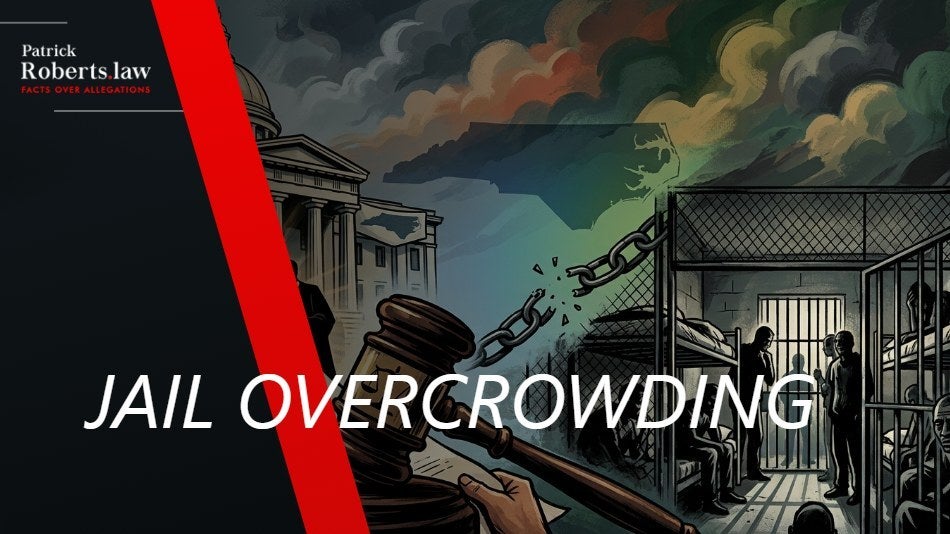
Is North Carolina’s Iryna’s Law Unconstitutional? Inside the Jail Overcrowding Crisis

By Patrick Roberts Law, PLLC What Is Happening with North Carolina's Pretrial System? A sweeping pretrial release reform statute (House Bill 307 / Iryna’s Law) has caused severe overcrowding across North Carolina detention facilities, pushing the Wake County Detention Center system far past its physical capacity. By replacing traditional judicial discretion with mandatory secured bonds and rebuttable presumptions against release for broad charge categories, hundreds of legally innocent defendants remain detained pretrial. Legal scholars and defense attorneys argue that these overcrowded, unsanitary conditions raise serious Eighth Amendment challenges regarding cruel and unusual punishment and excessive bail. Why Is the Wake County Detention System at a Breaking Point? The Wake County Detention Center system is severely overcrowded because Iryna’s Law drastically restricts pretrial release options, holding hundreds of legally innocent defendants in custody before trial. In August 2026, the Wake County Detention Center system reported housing over 1,800 detainees (peaking above 1,900) in facilities designed for a maximum operational capacity of 1,574 beds. Investigative reporting from WRAL News and official records from the Wake County Sheriff’s Office confirm that this surge forced detention staff to convert multipurpose rooms into housing and set up temporary sleeping arrangements in common floor areas to accommodate the overflow. This operational strain stems directly from House Bill 307, officially known as Iryna’s Law, enacted as Session Law 2025-93, which took effect across North Carolina on December 1, 2025. By establishing mandatory restrictions and rebuttable presumptions against pretrial release for broad categories of criminal charges, the statute has led to a historic spike in the number of individuals held without bond or under unattainable secured bonds while awaiting trial. For defendants, families, and criminal defense practitioners in Raleigh and across North Carolina, this systemic bottleneck raises a critical constitutional question: Does prolonged pretrial detention in severely overcrowded, understaffed facilities violate the Eighth Amendment? What Is Iryna’s Law, and How Does It Change Pretrial Release? Iryna’s Law (HB 307) is a North Carolina pretrial release statute that restricts judicial discretion by creating a legal presumption against release and requiring mandatory secured bonds or detention holds for broad charge categories. What Was the Intent Behind the Legislation? North Carolina lawmakers drafted Iryna’s Law following the high-profile August 2025 homicide of Iryna Zarutska on a Charlotte light rail train. The primary statutory goal was to enhance public safety by tightening bail eligibility for individuals accused of violent offenses or those identified as repeat violent offenders. How Does HB 307 Mandate Detention under N.C.G.S. § 15A-534 and § 15A-531? Under N.C. Gen. Stat. § 15A-534, as amended by House Bill 307 (Session Law 2025-93), written promises to appear were repealed statewide as a permissible release condition for any offense. In addition, under § 15A-534(b1) and the expanded "violent offense" definition in N.C.G.S. § 15A-531(9), judicial officials (magistrates and judges) face a statutory presumption that no condition of release will reasonably assure appearance or public safety, barring unsecured bonds and custody releases for: Any felony offense requiring registration on the North Carolina Sex Offender Registry. Offenses involving Possession of a Firearm by a Felon (N.C.G.S. § 14-415.1). Designated repeat violent felony offenses. Under this strict framework, the burden shifts to the defense to produce competent evidence overcoming the statutory presumption of detention, and judges must issue written findings of fact under § 15A-534(d) explaining why any authorized release conditions adequately assure court appearance and public safety. Pre-Iryna's Law (Prior Framework) Post-Iryna's Law (HB 307 / S.L. 2025-93) Presumption of release on least restrictive conditions Rebuttable presumption of detention (§ 15A-534(b1)) Written promise to appear & unsecured bonds allowed Written promises repealed; secured bond or electronic monitoring mandatory for qualifying offenses Informal bond modification hearings Evidentiary burden on defense How Severe Is Jail Overcrowding Across North Carolina? Jail overcrowding under Iryna’s Law is a statewide crisis affecting urban centers, coastal counties, and rural communities throughout North Carolina. While the Wake County Detention Center in Raleigh faces a severe urban bottleneck, operational crises are reported across the state: Wake County (Raleigh): Wake County Sheriff's Office census data indicates that the number of individuals held without bail surged from 140 in November 2025 to over 530 by late August 2026, driving total detention counts between 1,778 and 1,931 against a rated capacity of 1,574 beds. Mecklenburg County (Charlotte): Records analyzed by WCNC Charlotte show Mecklenburg County Detention Center held nearly 2,200 individuals in space rated for 1,907, generating multimillion-dollar budget overruns in food, overtime, and medical services. Non-Triangle Counties (Robeson, Carteret, Scotland): According to NCDHHS jail inspection data and NC Health News, more than one-third of North Carolina county detention facilities exceeded capacity in 2026, including Robeson County (over 500 inmates in a 410-bed jail) and Carteret County (146 inmates in a 117-bed facility). Does Jail Overcrowding Violate the Eighth Amendment? Overcrowded jail conditions may violate the Eighth and Fourteenth Amendments when severe space shortages, lack of sanitation, and inadequate medical care turn pretrial detention into unconstitutional punishment for individuals legally presumed innocent. The Eighth Amendment to the United States Constitution provides that: "Excessive bail shall not be required, nor excessive fines imposed, nor cruel and unusual punishments inflicted." Legal scholars and constitutional defense attorneys evaluate the impact of Iryna's Law under two primary legal doctrines: 1. When Does Bail Become Unconstitutional Pretrial Punishment? In United States v. Salerno, 481 U.S. 739 (1987), the U.S. Supreme Court held that pretrial detention is constitutional only when it serves a regulatory purpose (such as community safety or ensuring court appearance) rather than a punitive one. When statutory presumptions lead to the categorical detention of individuals charged with non-violent underlying facts—or who lack the financial means to pay high secured bonds—defense attorneys argue that the bail structure functions as unconstitutional pretrial punishment. 2. How Do Conditions of Confinement Apply Under Bell v. Wolfish? Pretrial detainees are protected by the Due Process Clause of the Fourteenth Amendment and the Eighth Amendment's protections against cruel and unusual punishment. In Bell v. Wolfish (1979), the Supreme Court ruled that conditions of pretrial confinement must not amount to punishment. Within the U.S. Court of Appeals for the Fourth Circuit (which exercises jurisdiction over federal appeals from North Carolina), courts analyze whether severe overcrowding, lack of sanitation, restricted access to medical care, or sleeping on floors violates constitutional standards. How Can an Experienced Criminal Defense Lawyer Help You Get Released? An experienced criminal defense attorney can overcome the statutory presumption against release by presenting clear evidence of community ties, offering enforceable release plans, and filing constitutional bond modification motions. Under HB 307, magistrate decisions are no longer routine administrative hurdles; overcoming a statutory presumption against release requires an immediate, strategic legal response. 1. How Do You Overcome the Rebuttable Presumption Against Release? Because Iryna’s Law shifts the burden of proof onto the defense, an attorney works rapidly to assemble a persuasive evidentiary portfolio before the first formal bond motion. This includes gathering verified employment records, character affidavits, proof of local residency, and clean histories of past court compliance to demonstrate that the defendant poses neither a flight risk nor a danger to the community. 2. What Structured Alternatives to Detention Can a Defense Attorney Present? Judges are often hesitant to grant release under Iryna’s Law without concrete safeguards. An attorney presents tailored, enforceable release plans—such as Continuous Alcohol Monitoring (CAM), GPS electronic monitoring, supervised third-party custody, or residential treatment placement—addressing specific judicial safety concerns while securing the individual’s release. 3. How Can Lawyers Challenge Unconstitutional Confinement Conditions? Where severe overcrowding, unsanitary quarters, or lack of medical care are present in local facilities like the Wake County Detention Center, defense counsel can file formal motions for bond modification based on Eighth Amendment and Fourteenth Amendment Due Process grounds. Documenting these harmful conditions gives the court strong legal justification to reduce bond or order release on conditions. 4. How Does an Attorney Prevent Your Case from Getting Stuck in the System? With overcrowded dockets and backlogged jails, unrepresented individuals risk languishing in detention for months waiting for a court date. A dedicated criminal defense lawyer files emergency motions for bond modification, requests expedited hearings, and ensures the case moves forward quickly through the 10th Judicial District court system. What Are the Most Effective Defense Strategies Under Iryna's Law? The most effective defense strategies involve early evidence gathering, offering actionable monitoring alternatives, and filing constitutional motions challenging detention conditions. Overcoming the Statutory Presumption: Compile documentary evidence prior to the bond hearing, including verified employment records, proof of local residency, character affidavits, and clean compliance records for past court appearances. Proposing Structured Release Conditions: Offer actionable alternatives—such as electronic monitoring (CAM/GPS), third-party custody arrangements, or specialized treatment programs—to address judicial safety concerns directly. Filing Motions Based on Confinement Conditions: Where severe overcrowding or medical neglect is documented, file formal motions for bond modification citing Eighth Amendment and Due Process concerns regarding the conditions of pretrial holding. Frequently Asked Questions About Iryna’s Law & Wake County Pretrial Release What is Iryna’s Law (HB 307) in North Carolina? Iryna’s Law (House Bill 307 / Session Law 2025-93) is a North Carolina pretrial release reform statute that took effect on December 1, 2025. It restricts the options judicial officials (magistrates and judges) have for granting bail. The law repealed written promises to appear across the board for all criminal offenses, barred unsecured bonds for qualifying violent and repeat offenses, and created a statutory rebuttable presumption against pretrial release requiring secured bonds or electronic house arrest if release is granted. Why are Wake County jails so overcrowded right now? Wake County Detention Centers are severely overcrowded because Iryna’s Law drastically limits pretrial release options. As a result, hundreds of individuals charged with offenses like firearm possession or registrable sex offenses are held without bond or with high secured bonds while awaiting trial, causing the local jail population to exceed physical capacity. Does Iryna’s Law apply to non-violent charges or firearm offenses? Yes. Although designed to target violent crime, Iryna’s Law broadly defines "violent offenses" to include charges such as Possession of a Firearm by a Felon ( N.C.G.S. § 14-415.1) and any felony requiring registration on the NC Sex Offender Registry, forcing individuals facing these charges to meet strict legal burdens to obtain bond. How does jail overcrowding violate the Eighth Amendment? Under the Eighth Amendment and Fourteenth Amendment Due Process principles ( Bell v. Wolfish), pretrial detainees who are legally presumed innocent cannot be subjected to conditions that amount to punishment. When severe overcrowding forces detainees to sleep on floors in unsanitary quarters with compromised medical access, defense attorneys can argue the confinement violates constitutional protections against excessive bail and cruel and unusual punishment. Can you still get a bond if you are held under Iryna’s Law in Wake County? Yes, but the burden of proof is on the defendant. Instead of an informal bail setting, a defense attorney must present formal evidence—such as verified employment, community ties, lack of flight risk, and structured release plans (e.g., GPS electronic monitoring)—to overcome the statutory presumption against release during a bond modification hearing in Wake County District Court. Strategic Legal Advocacy for Overcoming Iryna’s Law Detention Mandates As North Carolina’s courts grapple with the systemic pressures introduced by "Iryna’s Law," securing pretrial release has become a complex legal challenge requiring aggressive advocacy and strategic preparation. Attorney Patrick Roberts provides the depth of experience necessary to challenge restrictive detention mandates. With a career spanning over two decades, Mr. Roberts leverages his background as a former Assistant District Attorney and his extensive record handling hundreds of complex felony cases to dismantle the state’s justifications for continued incarceration. His practice emphasizes the development of robust, evidence-based release plans that effectively demonstrate community ties and mitigate the risks cited by the prosecution. Recognized by his peers with an AV Preeminent rating from Martindale-Hubbell and frequently consulted for his expertise in navigating North Carolina’s evolving criminal procedure and constitutional law, Mr. Roberts offers the focused representation required to advocate for clients impacted by the current jail overcrowding crisis. AV Preeminent Rating (2018–2026): Consistently awarded the highest peer-review rating for professional excellence and ethical standards by Martindale-Hubbell. National Association of Distinguished Counsel (NADC) Selection: Recognized among the "Nation's Top 1 Percent" of attorneys in 2015, 2016, 2017, 2018, 2025, and 2026. Attorney-At-Law Magazine "Attorney of the Month": Featured as the 2022 cover story subject for professional distinction and leadership in the field of criminal defense. Former Prosecutor Perspective (2003–2007): Brings critical insight into state sentencing and detention policies from four years of service as an Assistant District Attorney across three North Carolina prosecutorial districts. Legislative Planning Experience: Served as a committee member on the North Carolina Juvenile Justice Planning Committee under the Governor's Crime Commission, providing experience with the regulatory and planning bodies that shape state criminal justice frameworks. Client Review "I recently hired A. Patrick Roberts as my lawyer, and I couldn't be more pleased with the outcome of my case. He represented me in a domestic violence accusation, and thanks to his exceptional skills, my case was dismissed. From our first meeting, Patrick impressed me with his thorough understanding of the law and his strategic approach to my case. He not only provided clear and practical legal advice but also employed smart strategies that were beyond my expectations. His attention to detail and dedication to my defense made all the difference. If you're looking for a lawyer who truly cares about his clients and knows how to navigate complex legal situations, I highly recommend A. Patrick Roberts. He is an outstanding lawyer, and I am incredibly grateful for his support." — Review by a verified client via Avvo Peer Endorsement "I endorse Andy. He is a highly skilled attorney that is well respected in the legal community." — Peer endorsement by a fellow North Carolina trial attorney via Avvo Disclaimer: The client reviews and peer endorsements displayed are authentic testimonials and comments provided by clients and fellow attorneys. Every case is unique and must be evaluated individually; past client experiences and case results do not guarantee, promise, or predict similar outcomes in any future matter. Case Results Understanding the specific outcomes a lawyer has delivered helps you feel confident in your decision. Below are examples of past cases resolved by Attorney Patrick Roberts: Out-of-State Probation Violation Allegations: The client faced probation violation charges while residing out-of-state. Mr. Roberts demonstrated to the court that the violations were due to miscommunication between the client and probation officers, leading the court to dismiss the violation and terminate the client's probation. Outcome: Dismissed Felony Probation Violation Linked to Armed Robbery: The client was accused of a felony probation violation related to prior charges of Robbery with a Dangerous Weapon. Defense counsel persuaded the court to maintain probation rather than impose an active sentence, resulting in an extension of probation with mandatory drug treatment. Outcome: Probation extended with drug treatment Common Law Robbery Charge: The client faced accusations of common law robbery involving a BB pistol and a potential prison sentence of 31 to 47 months. Defense counsel presented psychiatric records detailing severe mental health disorders, which persuaded the prosecution to dismiss the felony charge. The client subsequently pleaded to a reduced charge of larceny. Outcome: Common Law Robbery charge dismissed; pleaded to reduced charge of larceny, received 24 months of probation and seven days in jail Disclaimer: Case outcomes depend upon a variety of factors unique to each case. Prior results do not guarantee or predict a similar outcome in any future legal matter. Protecting Your Rights Amidst North Carolina’s Pretrial Detention Crisis The implementation of House Bill 307 has fundamentally altered the landscape of pretrial release in North Carolina, often resulting in prolonged detention for those accused of felonies. Successfully challenging these new, restrictive bond mandates requires a sophisticated legal strategy that proactively addresses the court’s presumption against release. At Patrick Roberts Law PLLC, we build comprehensive, evidence-based release plans designed to overcome these systemic obstacles. Whether you are facing charges within our primary practice areas of Wake County—including Raleigh, Cary, Apex, Holly Springs, Garner, and Fuquay-Varina—or require representation for high-stakes litigation in any county across North Carolina, our firm provides the focused defense necessary to advocate for your liberty. If you or a loved one are affected by these shifting pretrial standards, contact us to discuss your options. Visit www.patrickroberts.law to learn more about our approach to complex criminal defense and to schedule a consultation. Disclaimer: This article is provided for informational and educational purposes only and does not constitute formal legal advice, nor does it establish an attorney-client relationship. Pretrial release laws and detention conditions vary based on individual case facts. If you or a family member are facing criminal charges in North Carolina, consult a qualified criminal defense attorney licensed in the State of North Carolina.