Blog / Drug Trafficking

Possession With Intent to Sell or Deliver in NC | PWISD Defense

Facing a Possession With Intent to Sell or Deliver Charge
In North Carolina, a charge of possession with intent to sell or deliver (PWISD)—commonly referred to as possession with intent to distribute (PWID)—is a serious felony offense under N.C.G.S. § 90-95. Unlike simple possession, a PWISD allegation requires the state to prove beyond a reasonable doubt both knowing possession of a controlled substance and a specific intent to sell, transfer, or deliver it. Because prosecutors frequently attempt to infer intent from circumstantial factors such as packaging, digital scales, cash denominations, or phone records obtained during a traffic stop or home search, understanding the statutory requirements and scrutinizing police procedure are essential to protecting your constitutional rights.
At Patrick Roberts Law, we help people facing serious drug charges understand the evidence, the potential consequences, and the choices ahead. If you have been arrested in Raleigh or elsewhere in Wake County, it is important to address the charge promptly rather than assume the prosecution can prove its case.
Call 919-746-7206 to discuss your situation or contact our firm online for a confidential consultation.

What Does Possession With Intent to Sell or Deliver Mean in North Carolina?

North Carolina General Statute § 90-95(a)(1) prohibits possessing a controlled substance with the intent to manufacture, sell, or deliver it, except as authorized by law. The state must establish that the accused knowingly possessed a controlled substance and had the intent required for the charged offense. A completed sale is not necessary for a possession-with-intent charge.
North Carolina charging documents and pattern jury instructions specifically use the term “possession with intent to sell or deliver,” abbreviated PWISD. While people often search for the federal phrase “possession with intent to distribute” (PWID), North Carolina statute requires the state to specifically prove intent to sell or deliver, and the exact allegations on your warrant or indictment control the case.

How Prosecutors Try to Prove Possession

The drugs do not always have to be found in a person’s pocket. Prosecutors may rely on either actual or constructive possession:
• Actual possession: The substance is found on the person or in their immediate physical custody.
• Constructive possession: The substance is not physically held by the person, but evidence allegedly shows that the person knew of it and had the power and intent to control it.
Cases involving a borrowed car, shared home, or room accessed by several people deserve close scrutiny. Being nearby does not, by itself, establish constructive possession. The surrounding circumstances and any additional evidence matter.

What Evidence Can Suggest an Intent to Sell or Deliver?

Because intent is a state of mind, prosecutors often ask jurors to infer it from circumstances. Depending on the investigation, the evidence may include:
• The amount and manner of packaging of the substance
• Baggies, scales, or materials associated with dividing drugs
• Cash or records alleged to reflect transactions
• Texts, messages, or calls interpreted as arranging sales
• Witness or informant accounts
• The absence or presence of circumstances consistent with personal use
These facts do not automatically prove intent. Under North Carolina case law, the quantity of a substance alone is frequently insufficient to establish intent without corroborating evidence such as packaging, digital scales, or communication logs. A scale or cash can also have an innocent explanation. The defense should evaluate what each piece of evidence actually shows and whether the state’s interpretation is supported.

Does the Type or Amount of Drug Matter?

Yes. North Carolina places controlled substances into schedules, and the schedule can affect the felony classification. Quantity may also influence how prosecutors interpret intent. However, possession with intent and drug trafficking are not interchangeable: trafficking under § 90-95(h) is tied to specified substances and statutory weight thresholds, while a PWISD allegation focuses on possession and intent.
In a close case, laboratory analysis, weighing methods, the substance identified, and whether the tested material is attributable to the accused may be important issues. The evidence should be reviewed before accepting the quantity or classification stated in an arrest report.

Simple Possession, PWISD, Sale or Delivery, and Trafficking

• Simple possession: An allegation of unlawful possession, without the additional intent element required for PWISD.
• PWISD: An allegation of possession together with intent to sell or deliver; an actual transfer need not be proven.
• Sale or delivery: An allegation that a controlled substance was actually sold or transferred. In North Carolina, an actual sale carries higher felony penalties than delivery or PWISD. Additionally, under § 90-95(b)(2), the transfer of less than 5 grams of marijuana for no remuneration does not legally constitute delivery.
• Trafficking: A separate offense generally triggered by statutory quantity thresholds for particular controlled substances, even when no sale is shown.
The distinction affects the charges, potential sentence, and possible defense. A case may also involve more than one allegation, which makes a careful review of the charging documents especially important.

Potential Felony Penalties in North Carolina

Possession with intent to sell or deliver is a felony. Under § 90-95(b), PWISD or delivery involving Schedule I or II substances is classified as a Class H felony (though an actual sale is elevated to a Class G felony). For Schedules III through VI (including marijuana), PWISD or delivery is a Class I felony, whereas an actual sale is a Class H felony. Heightened statutory penalties apply to specific offenses involving fentanyl, carfentanil, or methamphetamine manufacturing, and statutory drug trafficking carries mandatory minimum sentences.
A conviction does not mean everyone receives the same sentence. North Carolina’s structured-sentencing rules consider the offense class and prior record level, along with any applicable statutory provisions. Some cases may result in community or intermediate punishment, while others involve imprisonment. The specific charge and individual history must be assessed before estimating exposure.

Searches, Traffic Stops, and Constitutional Rights

The circumstances of the investigation often matter as much as the substance seized. Legal questions may include:
• Was the traffic stop supported by a lawful basis, and was it prolonged improperly?
• Was a search warrant valid, or did a recognized exception permit a warrantless search?
• If police relied on consent, was that consent voluntary and within its lawful scope?
• Were statements obtained in compliance with applicable constitutional protections?
Evidence obtained in violation of constitutional rules may be subject to a motion to suppress, depending on the facts and applicable exceptions. An unlawful search is not established merely because officers lacked a warrant; context matters.

Evidence Commonly Examined in a PWISD Case

A case file may include body-camera footage, police reports, photographs, laboratory results, phone records, cash inventories, witness statements, and documentation describing how seized substances were collected and stored. It may be necessary to compare those records for inconsistencies or missing details.
Reviewing evidence also means examining what is absent. For instance, a report may describe suspected dealing without documenting a transaction, or messages may be quoted without the surrounding conversation that gives them meaning.

Potential Defenses and Legal Challenges

There is no single strategy that fits every accusation. Depending on the record, a defense may address:
• Whether the state can prove knowing possession, especially in a shared space
• Whether circumstances support an inference of intent to sell or deliver
• The legality of the stop, search, seizure, or questioning
• The identity, testing, weight, or custody of the substance
• Conflicting testimony, incomplete records, or an unreliable informant
Not every concern leads to dismissal or exclusion of evidence. A useful defense begins with the actual discovery materials and the law applicable to the specific allegations.

What Should You Do After a PWISD Arrest?

• Avoid discussing the facts with law enforcement without consulting a lawyer; you may clearly assert your right to remain silent and request counsel.
• Do not delete messages, alter records, or discard potentially relevant materials.
• Preserve documents and write down what you remember about the encounter while it is fresh.
• Follow court orders and attend scheduled hearings.
• Seek legal advice promptly, particularly if police seized a phone or other device.
These steps cannot guarantee an outcome, but they can help prevent avoidable complications while the evidence is evaluated.

Other Consequences to Consider

Beyond the sentence imposed by a court, a drug felony conviction may affect employment prospects, housing applications, professional licensing, and, for noncitizens, immigration status. Some effects depend on the exact offense and individual circumstances. These concerns deserve attention early, rather than after a plea or trial.

Frequently Asked Questions About PWID Charges

Is possession with intent to sell or deliver a felony in North Carolina?

Generally, yes. The usual classification depends on the controlled-substance schedule and statutory exceptions. The charges and offense date should be reviewed to identify the provision that applies.

Can the state prove intent without showing an actual drug sale?

Yes. The state can rely on circumstantial evidence, including packaging, quantity, or communications. The question is whether the overall evidence proves the charged intent beyond a reasonable doubt.

Can I be charged if the drugs were found in someone else’s car?

Possibly, but simply being a passenger or being near the drugs does not automatically establish possession. Prosecutors must prove the required knowledge and control through the circumstances of the case.

Can police search my vehicle without a warrant?

Sometimes. A warrantless vehicle search may be lawful under certain exceptions. Whether an exception applies depends on the facts, including the basis for the stop, any probable cause, and any consent.

Is PWISD the same as drug trafficking?

No. PWISD concerns possession coupled with intent to sell or deliver. North Carolina trafficking charges generally depend on specified statutory drug quantities and carry a separate penalty framework.

What if this is my first drug charge?

A first offense can still be serious. Your prior record may affect sentencing, but it does not determine whether the state can prove the offense. An attorney can review the evidence and explain the options available in your particular case.

Experienced Legal Defense for PWISD Charges

When facing serious felony charges like Possession With Intent to Sell or Deliver, the quality of your legal representation can be the decisive factor in the outcome of your case. Attorney Patrick Roberts brings over two decades of courtroom experience to the defense of complex drug trafficking and possession allegations, utilizing a deep background that includes four years as a former Assistant District Attorney and extensive service in private practice. His expertise is rooted in a comprehensive understanding of the state’s evidentiary requirements, specifically regarding constructive possession, digital forensics, and constitutional search and seizure standards. By meticulously auditing the prosecution’s case for procedural weaknesses and utilizing a defense strategy honed through more than 75 jury trials—including those involving state and federal drug trafficking charges—Mr. Roberts provides the rigorous advocacy necessary to challenge the government’s evidence, protect his clients' rights, and mitigate the severe long-term consequences associated with a felony drug conviction.
• Martindale-Hubbell AV Preeminent Rating: Consistently recognized with the highest peer-review rating for legal ability and ethical standards from 2018 through 2026.
• National Association of Distinguished Counsel: Selected to the "Nation's Top 1 Percent" of attorneys for six years, including 2025 and 2026.
• Duke University School of Law Graduate
• Former Prosecutor Perspective: Completed extensive professional training in cross-examination at the National District Attorneys Association (2007) and served as an Assistant District Attorney (2003–2007) managing felony drug and DWI dockets.

Client Review

I cannot speak highly enough of Mr. Patrick Roberts, from the moment we connected via the telephone he demonstrated, confidence, support, and a great analytical mind, which provided my family with much-needed support during one of the most difficult periods in our lives.
 Mr. Roberts, took the time to understand our situation, he ran through various scenarios on how he thought he could win our case, which he did!
 What sets Mr. Roberts apart is his legal expertise, in-depth knowledge of the judicial procedure, and genuine compassion and commitment to you as a client.
— Review by a verified client via Avvo

Peer Endorsement

I have had the challenge of working with Atty Roberts when he served as Asst. District Atty in Wake Co. and have worked closely with him as fellow defense counsel. As an ADA, I found him to be professional, reasonable and fair in every regard. He represented the State of North Carolina with integrity. As private counsel, his intelligence and knowledge of procedure and law has been even more impressive. Attorney Roberts is not your 'run of the mill' lawyer. While he's sharp and knows his stuff, he is also approachable and relates well with clients, colleagues, judges and courthouse personnel. He never, never walks away from a challenge. In the courtroom, his experience as both prosecutor and criminal defense attorney provides him with a unique perspective and ability to process each matter he handles quickly, efficiently and effectively. I highly recommend Attorney Roberts and place full confidence in his abilities.
— Peer endorsement by a fellow North Carolina trial attorney via Avvo
Disclaimer: The client reviews and peer endorsements displayed are authentic testimonials and comments provided by clients and fellow attorneys. Every case is unique and must be evaluated individually; past client experiences and case results do not guarantee, promise, or predict similar outcomes in any future matter.

Case Results

• Felony Heroin Trafficking and Controlled Substance Possession: After an encounter at a checkpoint, an individual was charged with felony trafficking in heroin and possession of controlled substances. By obtaining the law enforcement checkpoint plan and filing a motion to suppress based on constitutional violations, the defense successfully prompted the prosecution to dismiss the felony trafficking charge, resulting in a plea to misdemeanor possession with a sentence of probation.
â—‹ Outcome: Felony trafficking charge dismissed; pleaded to two misdemeanor possession counts and received probation.
• Major Cocaine Trafficking Charges: An individual faced three counts of trafficking over 400 grams of cocaine, which carried mandatory minimum sentences of 175 months per count based on recordings and investigative reports. Defense counsel negotiated a plea agreement that allowed for a probationary argument by highlighting the individual's stable employment and lack of a criminal record, ultimately persuading the court to impose probation instead of prison time.
â—‹ Outcome: Probation secured.
Click here for more case results.
Disclaimer: Case outcomes depend upon a variety of factors unique to each case. Prior results do not guarantee or predict a similar outcome in any future legal matter.

Protecting Your Rights Against PWISD Charges

A charge of Possession With Intent to Sell or Deliver is a serious matter that requires immediate and rigorous legal scrutiny. If you are facing these allegations, it is critical to evaluate the state’s evidence and ensure your constitutional rights are fully protected. Patrick Roberts Law PLLC provides comprehensive defense representation for clients facing drug-related felonies across North Carolina. With a strong, established presence in Wake County—including Raleigh, Cary, Apex, Holly Springs, Garner, and Fuquay-Varina—we are prepared to challenge the state's case, from the legality of police procedures to the sufficiency of evidence regarding possession and intent.
Do not leave your future to chance. To discuss your legal options and develop a defense strategy tailored to the specific facts of your case, contact Patrick Roberts Law PLLC today at www.patrickroberts.law to schedule a confidential consultation.
To maintain the quality of its defense and provide each client with individualized attention, the firm limits the number of cases it accepts at any given time.
Disclaimer: The information provided on this website is for general informational and educational purposes only and does not constitute formal legal advice. Reading this article or contacting Patrick Roberts Law does not create an attorney-client relationship. Federal and state criminal laws, sentencing guidelines, and statutory mandatory minimums are complex and subject to change, and outcomes depend entirely upon the unique facts and circumstances of each individual case.
Posted in:

Related Posts

image

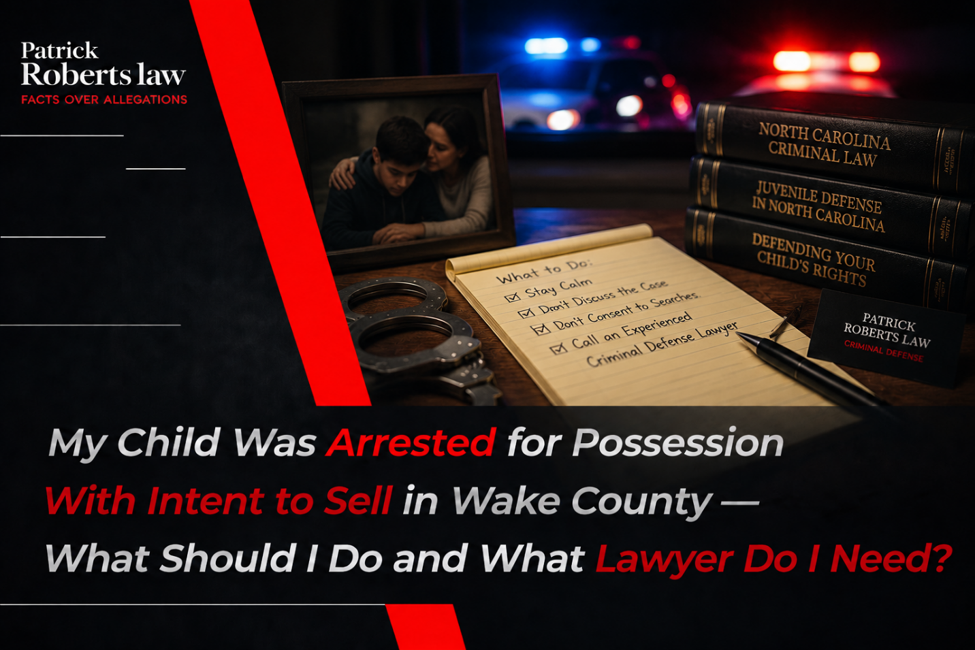
My Child Was Arrested for Possession With Intent to Sell in Wake County — What Should I Do and What Lawyer Do I Need?

When your child is arrested for possession with intent to sell, it can feel like everything changes instantly. Parents often have the same questions: What happens next? Will my child go to jail? Will this affect their future? Do they need a drug charge lawyer or another type of attorney? A possession with intent to sell accusation is a serious criminal matter in North Carolina. Even when the person accused is a teenager or young adult, the consequences can impact education, employment opportunities, driving privileges, and future opportunities. The first steps you take after an arrest can make a significant difference. Understanding the process, protecting your child’s rights, and working with an experienced criminal defense attorney can help your family make informed decisions during an uncertain time. Patrick Roberts has dedicated his career to defending individuals accused of serious criminal offenses throughout North Carolina. If your child has been arrested in Raleigh, Wake County, or surrounding communities, having experienced legal guidance early can help protect their future. Contact us today to learn how a Drug charge lawyer in Raleigh, NC can help your family understand your options and take the next step toward building a strong defense. What Should I Do Immediately After My Child Is Arrested for Possession With Intent to Sell in Wake County? The moments after an arrest are often filled with fear, confusion, and pressure to make quick decisions. Many parents want to immediately explain the situation or contact law enforcement to “fix” the misunderstanding. However, one of the most important things you can do is protect your child’s legal rights. Immediate steps parents should take include: 1. Do Not Allow Your Child to Discuss the Case Without Legal Advice Your child has the right to remain silent. This applies even if they believe explaining what happened will make the situation better. Statements made during an investigation can be used against them later. A well-intentioned explanation may unintentionally provide information prosecutors can use to strengthen their case. Encourage your child to remain respectful but avoid answering detailed questions until they have spoken with an attorney. 2. Find Out Exactly What Your Child Has Been Charged With Parents often hear terms like “drug charges” or “selling drugs,” but the actual charge matters. A possession with intent to sell accusation may involve allegations related to: Possession of controlled substances Possession of drug paraphernalia Intent to distribute or sell controlled substances Drug trafficking offenses Related criminal charges involving money, communications, or other evidence The level of the charge depends on factors such as: The type of substance involved The amount allegedly possessed The evidence collected Whether prosecutors believe there was intent to sell Whether the case is handled in juvenile or adult court Understanding the exact accusation is the first step toward creating a defense strategy. 3. Do Not Wait to Speak With a Drug Charge Lawyer Many families wait because they hope the situation will resolve itself or believe hiring a lawyer means admitting guilt. That is not how the criminal justice system works. A defense attorney’s role is not to judge your child. Their role is to investigate the allegations, protect constitutional rights, challenge weaknesses in the prosecution’s case, and pursue the best possible outcome. A Raleigh drug charge lawyer can review: How police conducted the investigation Whether searches and seizures were lawful Whether statements were obtained properly Whether evidence supports the accusation Whether alternative resolutions may be available Early involvement can provide more opportunities than waiting until the case has already progressed. Does My Child Need a Drug Possession Lawyer or Drug Trafficking Lawyer? One of the most common questions parents ask is whether they need a general criminal defense attorney or someone specifically experienced with drug-related charges. The answer depends on the circumstances of the case. A drug possession lawyer helps defend individuals accused of possessing illegal substances, including cases involving alleged possession of controlled substances or drug paraphernalia. A drug distribution attorney or drug trafficking lawyer may be needed when prosecutors claim the person intended to sell, distribute, or move larger quantities of controlled substances. In North Carolina, possession with intent to sell allegations can carry more serious consequences than simple possession because prosecutors are claiming there was an intent beyond personal use. Patrick Roberts handles serious criminal accusations throughout North Carolina, including cases involving: Possession charges Possession with intent to sell or distribute Drug trafficking allegations Serious felony offenses Federal crimes attorney representation when federal jurisdiction applies If your child is facing allegations involving drug trafficking offenses, having an attorney who understands complex criminal defense strategies is critical. Is My Child’s Case Handled in Juvenile Court or Adult Court in North Carolina? Whether your child is treated as a juvenile or adult depends on several factors, including their age, the type of offense, and North Carolina law. Many parents assume that anyone under 18 automatically goes through juvenile court. However, certain serious offenses may result in a juvenile being prosecuted differently. Juvenile Drug Charges in Wake County Juvenile court focuses differently than adult criminal court. The goal is often rehabilitation, accountability, and helping young people avoid future involvement with the justice system. Possible outcomes may include: Diversion programs Counseling or treatment programs Educational requirements Community service Probation Other court-supervised options A strong defense strategy may involve showing the court that your child has support, accountability, and a plan moving forward. Adult Drug Charges Involving Young People Depending on the circumstances, some young people may face adult criminal proceedings. Adult convictions can create long-term consequences, including: Permanent criminal records Difficulty obtaining employment Challenges with college admissions Professional licensing issues Loss of certain opportunities This is why parents should seek legal guidance as soon as possible. What Happens After a Drug Arrest in Wake County, NC? After an arrest, the legal process can move quickly. Generally, the next steps may include: Arrest and Processing Law enforcement will process the charges and create records related to the arrest. First Appearance or Bond Hearing A judge may determine conditions for release, including bond requirements. Factors considered may include: The seriousness of the allegations Prior criminal history Flight risk Safety concerns Community ties Investigation and Defense Preparation A defense attorney may begin reviewing: Police reports Search warrants Body camera footage Witness statements Lab reports Digital evidence This stage is where important defense decisions begin. Should I Hire a Private Criminal Defense Lawyer or Use a Public Defender? Many families wonder whether hiring private counsel is necessary or whether a public defender can handle the case. A public defender provides important legal representation for individuals who qualify financially. They are dedicated professionals who represent many people facing criminal charges. However, some families choose private representation because they want additional resources, accessibility, and a more personalized approach. A private criminal defense attorney may provide: More time dedicated specifically to the case Direct communication with the attorney handling the matter Additional investigation resources Strategic planning tailored to the individual circumstances Experience handling complex felony-level allegations The right choice depends on your family’s situation, but the most important decision is ensuring your child has qualified legal representation. How Can Diversion, Treatment, or Alternative Programs Help After a Drug Arrest? A drug-related arrest does not always mean the only possible outcome is a conviction. Depending on the facts of the case, your child’s background, the evidence involved, and the court’s evaluation, there may be opportunities to pursue alternatives that focus on accountability and rehabilitation. For some young people, the goal is not simply fighting the charge in court — it is protecting their future. A skilled drug charge lawyer can evaluate whether options such as diversion programs, treatment programs, or other resolutions may apply. Possible Alternatives to Traditional Criminal Penalties Depending on the circumstances, potential options may include: Diversion programs designed to help eligible individuals avoid a conviction Substance abuse assessments or treatment programs Educational programs Counseling services Community service requirements Probation-based resolutions Negotiated outcomes that reduce the long-term impact of the charge Every case is different. A program that may be available for one person may not apply to another based on the substance involved, the amount alleged, prior history, and other factors. What Evidence Will a Raleigh Drug Charge Lawyer Review in a Possession With Intent to Sell Case? When prosecutors accuse someone of possession with intent to sell, they must rely on evidence to support that allegation. The fact that someone possessed a controlled substance does not automatically prove they intended to sell it. A defense attorney will examine the details surrounding the arrest, including: The Circumstances of the Search Questions may include: Did police have legal authority to search? Was a warrant required? Was consent properly obtained? Were constitutional rights violated? Evidence obtained improperly may become an important issue in the defense. The Amount and Type of Substance Alleged The type and quantity of a substance can influence the severity of the accusation. However, prosecutors may rely on several factors when claiming intent to distribute, including: Quantity of the substance Packaging materials Large amounts of cash Communications or messages Statements made during the investigation Other surrounding circumstances A defense strategy focuses on examining whether the evidence actually supports the accusation. Whether the Evidence Supports Intent to Sell The difference between possession and possession with intent to sell can significantly impact the case. A drug distribution attorney understands that prosecutors must prove more than possession. They must establish evidence supporting the allegation that the person intended to distribute the substance. Why Experience Matters When Your Child Is Facing Serious Criminal Allegations When your child’s future is at risk, experience matters. Parents want an attorney who understands not only the law but also what is at stake — their child’s education, reputation, opportunities, and future. Patrick Roberts has dedicated his career to defending individuals accused of serious criminal offenses throughout North Carolina. His experience includes: Lifetime membership in the National Association of Criminal Defense Lawyers (NACDL) Advanced cross-examination training through the 2025 intensive program with the National Criminal Defense College (NCDC) Graduate of the National Criminal Defense College Trial Practice Institute, a rigorous two-week criminal defense trial program Graduate of the Gerry Spence Trial Lawyer College after completing a three-week intensive trial advocacy program The only North Carolina lawyer featured on the National Child Abuse Defense & Resource Center Client Champion Platinum Attorney recognition (2026) with more than five consecutive years of recognition AV Preeminent Peer Rated Attorney recognition (2026) for more than five years Rated 10/10 “Superb” by AVVO for more than 15 years This level of training and recognition provides clients with strategic, prepared representation when facing serious accusations. To learn more about Patrick Roberts’ background and approach to criminal defense, visit About Patrick Roberts. What Should Parents Ask During the First Consultation With a Drug Charge Lawyer? The first conversation with an attorney is an important opportunity to understand your child’s situation and available options. Parents should consider asking: “What charges is my child actually facing?” Understanding the exact charge is critical. Drug-related accusations can vary significantly in severity. “Will my child be prosecuted as a juvenile or adult?” This can affect: Court procedures Possible penalties Long-term consequences Available defense strategies “What weaknesses do you see in the prosecution’s case?” A defense attorney should carefully evaluate: Evidence collection Police procedures Witness information Search and seizure issues Whether intent can actually be proven “Are diversion or treatment options available?” Depending on the circumstances, alternative resolutions may be possible. “What can we do right now to protect my child’s future?” A strong defense begins with preparation. Families should understand what steps they can take immediately. What Makes Patrick Roberts Different From Other Criminal Defense Attorneys in North Carolina? Facing a criminal accusation involving your child is one of the most stressful situations a family can experience. Parents are not only worried about the current charge. They are thinking about: Will this affect college? Will this follow my child into adulthood? Will one mistake define their future? How can we protect them right now? Patrick Roberts approaches criminal defense with the understanding that every case represents a person, not just a charge. His focus is on developing a defense strategy based on the specific facts, challenging weaknesses in the prosecution’s case, and helping families understand every available option. His professional recognition includes endorsements from peers and clients. Reviews and peer feedback highlight his commitment to preparation, communication, and effective courtroom advocacy. You can review peer endorsements and attorney ratings for Patrick Roberts through his profile on Martindale. Serving Families Facing Drug Charges Throughout Wake County and North Carolina Families throughout Raleigh and surrounding communities need reliable legal guidance when facing serious criminal allegations. Patrick Roberts represents clients throughout his Areas served and provides criminal defense representation for individuals facing complex charges. Whether your child is facing allegations involving possession, distribution, trafficking, or other serious criminal matters, getting legal advice early can help your family understand the path forward. Contact a Raleigh Drug Charge Lawyer Today A drug arrest involving your child can feel overwhelming, but you do not have to navigate the process without guidance. The decisions made immediately after an arrest can influence what happens next. Patrick Roberts helps families understand their legal options, protect their rights, and develop a strategy focused on achieving the strongest possible outcome. Call Patrick Roberts today at 919-746-7206 to discuss your child’s case. You can also contact us to schedule a consultation and learn how a Raleigh criminal defense attorney can help. Frequently Asked Questions About Juvenile Drug Arrests in Wake County, NC Can a minor be charged with possession with intent to sell in North Carolina? Yes. A minor can face serious consequences for allegations involving possession with intent to sell. Depending on the child’s age, offense, and circumstances, the case may proceed through juvenile court or potentially adult court. Speaking with a drug charge lawyer early can help families understand what process applies. What should parents do after a teenager is arrested for selling drugs in Raleigh, NC? Parents should avoid allowing their child to discuss the facts of the case without legal advice, determine the exact charges, and contact a criminal defense attorney as soon as possible. Early legal involvement allows an attorney to review evidence, protect rights, and explore possible defense options. What is the difference between a drug possession lawyer and a drug trafficking lawyer? A drug possession lawyer typically handles accusations involving possession of controlled substances or related offenses. A drug trafficking lawyer handles more serious allegations involving larger quantities, distribution claims, or trafficking-related charges. The correct attorney depends on the specific facts and allegations involved. Can drug charges be dismissed in Wake County, NC? Dismissal depends on the circumstances of the case. Factors may include problems with evidence, improper searches, constitutional violations, witness issues, or other weaknesses in the prosecution’s case. A criminal defense attorney can review the facts and determine what strategies may be available. Does my child need a private lawyer if they qualify for a public defender? A public defender may provide representation for eligible individuals. However, some families choose private counsel because they want additional resources, direct communication, and a defense strategy tailored specifically to their child’s situation. The most important step is ensuring your child receives qualified legal representation.

drug-trafficking-charge-defense-north-carolina-patrick-roberts-law.web

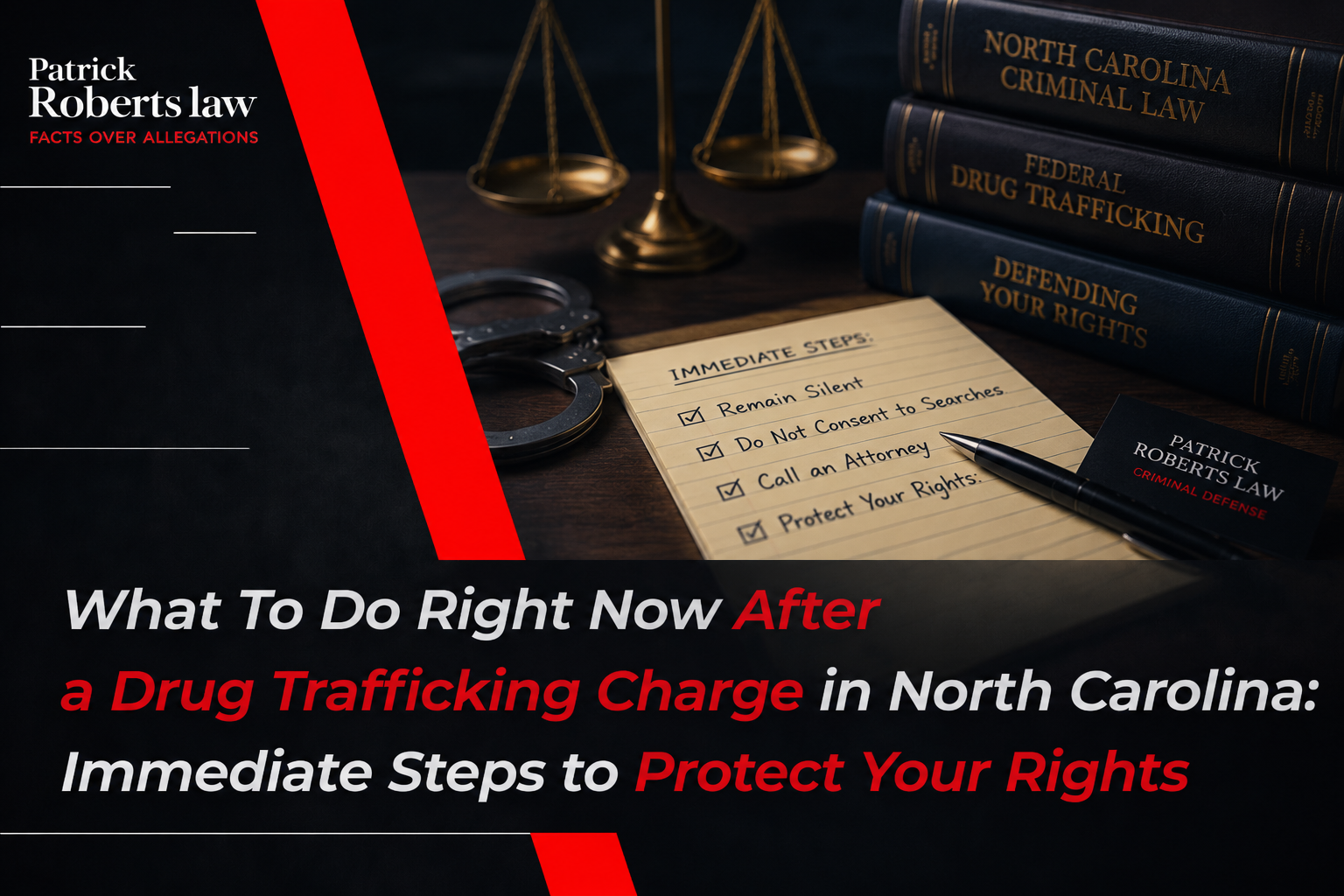
What To Do Right Now After a Drug Trafficking Charge in North Carolina: Immediate Steps to Protect Your Rights

Just Charged With Drug Trafficking? Here Is What You Should Do Next A drug trafficking charge can be overwhelming. In many cases, the first few hours and days after an arrest are when important decisions are made — decisions that may affect your freedom, your future, and the outcome of your case. If you or someone you love has recently been charged with drug trafficking in North Carolina, you may be asking: What should I say to police? Should I answer questions? How do I get out of jail? Can the charges be reduced? What evidence does the state have? What type of lawyer do I need? The most important thing to understand is this: Do not try to handle a serious drug trafficking accusation alone. Drug trafficking charges are among the most serious drug-related offenses under North Carolina law. Prosecutors often aggressively pursue these cases, and the consequences can include significant penalties, financial consequences, and long-term impacts on your future. The decisions you make immediately after an arrest matter. Before speaking with investigators, discussing your case with others, or making decisions that could affect your defense, speak with an experienced criminal defense attorney. Patrick Roberts has dedicated his career to defending individuals accused of serious criminal offenses throughout North Carolina. If you have been charged with drug trafficking, contact us today or call Patrick Roberts Law at 919-746-7206 to understand your rights and learn what steps you should take next. What Should I Do Immediately After Being Charged With Drug Trafficking? After an arrest, many people make decisions based on fear or confusion. They may believe explaining their side of the story will convince police they are innocent. Unfortunately, those conversations can sometimes create additional challenges. Your first priority should be protecting your legal rights. Step 1: Do Not Talk About Your Case Without an Attorney Present One of the most important things you can do after a drug trafficking arrest is exercise your right to remain silent. You are allowed to respectfully tell law enforcement: “I want to speak with an attorney before answering any questions.” You do not need to explain: Where you obtained something Who you were with Why you were present somewhere Who else may be involved Your personal explanation of what happened Even statements that seem harmless may later be interpreted differently by prosecutors. Police officers are gathering information for an investigation. They are not responsible for protecting your legal interests. Before answering questions, contact a qualified defense attorney who can help protect your rights. If you or a family member has been charged with drug trafficking in Raleigh, Wake County, or anywhere in North Carolina, contact us to discuss your situation with Patrick Roberts. Step 2: Request a Drug Trafficking Lawyer Immediately After a drug trafficking arrest, one of the most important decisions you can make is choosing the right legal representation. Drug trafficking cases often involve complex issues, including: Search and seizure questions Controlled substance evidence Police investigations Confidential informants Surveillance Digital communications Alleged distribution activity Financial evidence A knowledgeable defense attorney can review whether law enforcement followed proper procedures and whether the evidence actually supports the charges. A drug trafficking lawyer can evaluate important questions such as: Was the search legal? Was evidence collected properly? Were your constitutional rights protected? Can prosecutors prove the required elements of the offense? Are there weaknesses in the state’s case? Patrick Roberts represents individuals facing serious criminal accusations throughout North Carolina, including allegations involving drug trafficking offenses. Do not wait until your court date to begin protecting your future. Call Patrick Roberts at 919-746-7206 or contact us to discuss your legal options. Step 3: Do Not Consent to Searches Without Understanding Your Rights After an arrest, law enforcement may ask permission to search: Your vehicle Your home Your phone Personal property Many people assume allowing a search will make them appear cooperative. However, agreeing to a search without understanding your rights may create challenges later. You should remain respectful and do not physically interfere with officers, but you can clearly state that you do not consent to a search and want to speak with an attorney. A defense attorney can later examine: Whether police had probable cause Whether a warrant was valid Whether proper procedures were followed Whether evidence may be challenged The details surrounding a search can become a critical part of your defense. Patrick Roberts can review the circumstances of your arrest and help you understand what legal options may be available. Contact us today to begin discussing your case. Step 4: Preserve Evidence and Do Not Delete Information After an arrest, many people panic. They may delete text messages, remove social media posts, erase files, or contact people involved in the investigation. This can create additional problems. Instead, preserve information and allow your attorney to review it. Important items to preserve include: Text messages Emails Phone records Photos or videos Social media information Receipts Documents Names of possible witnesses Do not attempt to explain your situation publicly or contact individuals connected to the investigation. Your attorney can determine what information may help your defense and how it should be handled. If you are unsure what information matters in your case, speak with Patrick Roberts Law before taking action. Call 919-746-7206 or contact us for guidance. Step 5: Gather Information Before Your First Meeting With a Lawyer Your first consultation is an opportunity to provide your attorney with important details about what happened. The more information your attorney has, the better they can evaluate your options. Drug Trafficking Defense Consultation Checklist Bring any available information related to your case. Arrest Information ☐ Arrest paperwork ☐ Criminal summons or charging documents ☐ Bond paperwork ☐ Court date information ☐ Law enforcement agency involved ☐ Officer names if available Details About the Arrest ☐ Date and location of arrest ☐ Where the arrest occurred ☐ Who was present ☐ Whether police searched property ☐ Whether you were questioned ☐ Whether you made any statements Evidence Information ☐ Text messages ☐ Phone records ☐ Photos or videos ☐ Receipts ☐ Documents ☐ Witness information ☐ Any communication related to the allegations Personal Background Information ☐ Employment history ☐ Education information ☐ Family responsibilities ☐ Community involvement ☐ Treatment history if relevant ☐ Prior legal history This information helps your attorney understand the complete situation — not just the accusation. What Happens After a Drug Trafficking Arrest in North Carolina? After an arrest for drug trafficking, many people are unsure what happens next. The legal process can move quickly, and decisions made early may influence the direction of the case. Understanding the next steps can help you make informed decisions instead of reacting out of fear or uncertainty. While every case is different, a drug trafficking case in North Carolina may involve several important stages. Step 1: The Arrest and Initial Processing After an arrest, law enforcement begins the booking and processing procedure. During this time, important information is collected, including: The charges filed Arrest records Personal information Bond recommendations Initial court information At this stage, it is important to avoid discussing the facts of the case with anyone except your attorney. Anything you say may potentially become part of the investigation. Step 2: Understanding Bail and Bond After a Drug Trafficking Charge One of the first concerns many families have after an arrest is: “How do I get my loved one released?” Bond decisions can depend on several factors, including: The severity of the allegations The amount and type of substance involved Prior criminal history Ties to the community Whether the court believes the person will appear for future hearings Any potential safety concerns A judge may consider whether conditions of release are appropriate. Possible bond conditions may include: Financial requirements Restrictions on travel No-contact conditions Reporting requirements Other court-ordered conditions A criminal defense attorney can help you understand the bond process and what factors may impact release. If someone you care about is currently facing a drug trafficking charge in North Carolina, do not wait to seek legal guidance. Call Patrick Roberts at 919-746-7206 or contact us to discuss your situation. Step 3: Your Attorney Begins Reviewing the Case Once retained, your attorney can begin analyzing the details behind the accusation. A strong defense starts with understanding the facts. Patrick Roberts may examine issues such as: Was the Search Legal? Many drug trafficking cases involve searches of: Vehicles Homes Personal belongings Electronic devices The circumstances surrounding the search can be critical. Questions may include: Did police have probable cause? Was a warrant required? Was consent properly obtained? Were constitutional rights protected? Does the Evidence Actually Support the Charge? A drug trafficking accusation requires more than simply claiming drugs were present. Prosecutors must establish the legal elements required for the offense. Your attorney may evaluate: Quantity of the substance involved Testing procedures Chain of custody Witness statements Communication records Circumstances surrounding possession Was There an Allegation of Intent to Distribute? In many drug cases, prosecutors attempt to show evidence of distribution or trafficking activity. They may point to factors such as: Amount of alleged controlled substances Packaging materials Money Communications Location Other surrounding circumstances A defense attorney can examine whether those facts truly support the accusation. Why You Need an Experienced Drug Trafficking Attorney in North Carolina A drug trafficking charge is not a minor offense. These cases often involve aggressive prosecution, complex evidence, and serious potential consequences. Having an attorney who understands criminal defense strategy can make a difference in how your case is approached. Patrick Roberts has dedicated his career to defending individuals accused of serious criminal offenses throughout North Carolina. His approach focuses on: Thorough investigation Strategic preparation Protecting constitutional rights Challenging unreliable evidence Preparing strong defense strategies Helping clients understand their options When facing a serious accusation, experience matters. About Patrick Roberts’ Criminal Defense Experience and Training Patrick Roberts brings extensive training and courtroom experience to criminal defense matters throughout North Carolina. He is: A lifetime member of the National Association of Criminal Defense Lawyers (NACDL) Trained in advanced cross-examination through a 2025 intensive with the National Criminal Defense College (NCDC) A graduate of the NCDC Trial Practice Institute, a rigorous two-week program focused on criminal defense trial skills A graduate of the Gerry Spence Trial Lawyer College, completing a three-week intensive program focused on trial advocacy He is also recognized through: The National Child Abuse Defense & Resource Center as the only North Carolina lawyer featured on its membership listing Client Champion Platinum Attorney recognition with more than five consecutive years of recognition AVVO 10/10 “Superb” rating for more than 15 years This level of preparation allows Patrick Roberts to approach serious criminal cases with a focus on strategy, preparation, and protecting the rights of the accused. To learn more about his background and legal experience, visit About Patrick Roberts. What Makes Patrick Roberts Law Different When Facing a Drug Trafficking Charge? When someone is accused of drug trafficking, the charge itself does not tell the entire story. Behind every case is a person, a family, and a future that may be affected. Many clients and families are worried about: Losing employment opportunities Damage to their reputation Long-term criminal consequences Impact on family relationships Uncertainty about what happens next Patrick Roberts Law understands the stress that comes with facing serious criminal allegations. The focus is on helping clients understand their options and developing a defense strategy based on the specific circumstances of their case. Every case deserves careful attention. What Do Clients and Other Attorneys Say About Patrick Roberts? When choosing a criminal defense attorney, many people want to know not only about qualifications but also how an attorney has represented others. Patrick Roberts has received recognition from both clients and legal peers for his dedication, preparation, and commitment to criminal defense. Peer endorsements and professional reviews highlight his reputation among other attorneys and clients. You can learn more about professional feedback and attorney reviews through his Martindale peer review profile. Facing a Drug Trafficking Charge? The Next Step Matters After an arrest, many people wait because they feel overwhelmed or do not know where to begin. Waiting, however, can mean losing valuable time. Early legal guidance allows your attorney to begin evaluating: Evidence Search procedures Potential defenses Court strategy Possible outcomes You do not have to face the uncertainty alone. Patrick Roberts helps individuals throughout North Carolina understand their rights and legal options after serious criminal accusations. If you or someone you love has been charged with drug trafficking, call Patrick Roberts Law today at 919-746-7206. You can also contact us to request a consultation and begin discussing your case. Serving Individuals Facing Drug Trafficking Charges Throughout North Carolina Drug trafficking charges can happen anywhere, and individuals throughout North Carolina need access to experienced criminal defense representation. Patrick Roberts represents clients throughout his Areas served, helping individuals and families understand their legal options after serious criminal allegations. Whether your case involves allegations of possession, distribution, trafficking, or other felony offenses, getting legal advice early can help you make informed decisions. Immediate Help After a Drug Trafficking Arrest If you were recently charged with drug trafficking, the most important thing you can do is take action. Do not: Discuss your case with investigators without an attorney Post about your case online Delete evidence or communications Wait until your court date to seek help Instead: Protect your rights Preserve information Gather your documents Contact a criminal defense attorney Call Patrick Roberts Law now at 919-746-7206 or contact us to discuss your situation.

Facing Federal Drug Trafficking Charges

Facing Federal Drug Trafficking Charges? Know What Comes Next

A federal drug trafficking charge or target letter—prosecuted under statutes like 21 U.S.C. § 841 and § 846 in the U.S. District Court for the Eastern District of North Carolina—carries severe statutory mandatory minimum sentences ranging from 5 or 10 years to life in federal prison. Federal agencies often spend months building cases through wiretaps, controlled buys, and grand jury subpoenas before making an arrest or unsealing an indictment. Securing experienced defense counsel during the earliest stages of an investigation is essential to asserting your Fifth Amendment right to remain silent, challenging unconstitutional searches, and preventing critical missteps that could increase sentencing exposure. Patrick Roberts Law helps people facing serious drug allegations understand the charges, evaluate the evidence, and prepare for the decisions ahead. If you are being investigated or have been charged, call 919-746-7206 or contact our office to discuss your situation confidentially. What Is Federal Drug Trafficking? Federal law prohibits knowingly or intentionally manufacturing, distributing, dispensing, or possessing a controlled substance with intent to distribute or dispense it, except as authorized by law. These offenses are commonly prosecuted under 21 U.S.C. § 841. A person can face a distribution-related charge even when police do not claim to have witnessed a completed sale. Investigators may point to seized substances, packaging, communications, cash, or other circumstances as evidence of an intent to distribute. None of those details should be viewed in isolation. What the evidence actually proves, and whether it was obtained lawfully, matters. How Are Federal Drug Charges Different From State Charges? Some drug cases are prosecuted under North Carolina law, while others are brought by federal prosecutors. A case involving local conduct can still be charged federally; crossing a state line is not a universal requirement for federal jurisdiction. Federal and state authorities may also investigate related conduct, and a case initially handled locally can be referred for federal prosecution. Federal proceedings follow the Federal Rules of Criminal Procedure and federal sentencing law. A case arising in Raleigh or Wake County is prosecuted by the U.S. Attorney’s Office in the U.S. District Court for the Eastern District of North Carolina (EDNC), rather than under North Carolina General Statutes (N.C.G.S. § 90-95) in Wake County Superior Court. The procedural rules, discovery deadlines, available motions, plea negotiations, and mandatory minimum penalties differ substantially between the two court systems and must be evaluated in the correct forum. For information about allegations prosecuted under state law, see our pages on drug crimes and drug trafficking in Raleigh. Which Agencies Investigate These Cases? In the Raleigh area and across Eastern North Carolina, federal drug investigations frequently involve the Drug Enforcement Administration (DEA), Federal Bureau of Investigation (FBI), Homeland Security Investigations (HSI), the North Carolina State Bureau of Investigation (NC SBI), or joint task forces working alongside local agencies such as the Raleigh Police Department and Wake County Sheriff’s Office. Agents utilize multi-jurisdictional surveillance, Title III wiretaps, financial records, search warrants, confidential informants, and controlled buys to build evidence. The number of agencies involved does not determine guilt. A defense review considers what each agency did, how information was collected, and whether witnesses or records support the government’s account. Why Drug Type and Quantity Matter The controlled substance identified in the charge and the quantity legally attributable to the accused can affect the statutory sentencing range. Certain thresholds under federal law may trigger five- or ten-year mandatory minimums, while other charges do not carry those minimums. Prior qualifying convictions and particular aggravating circumstances may also change the sentencing analysis. That makes laboratory testing, measurement methods, the identity of the substance, and the evidence connecting a person to the alleged amount important issues. The amount found during a search is not necessarily the only quantity the government may attempt to attribute to someone, especially in a conspiracy case. What Penalties Can a Federal Conviction Carry? Depending on the charge, a federal drug trafficking conviction may result in imprisonment, fines, supervised release, and forfeiture proceedings. A criminal record can also affect employment, professional opportunities, housing, and other parts of daily life. Federal judges consider the governing statutes and the advisory U.S. Sentencing Guidelines. The outcome depends on case-specific factors, including the conviction offense, criminal history, conduct established at sentencing, and any legally available relief from a mandatory minimum. No one can responsibly calculate your likely sentence from the charge label alone. Conspiracy and Other Related Allegations Federal prosecutors sometimes add a conspiracy charge under 21 U.S.C. § 846. The prosecution generally must prove an unlawful agreement and the defendant’s knowing, voluntary participation; it does not have to prove that the planned distribution was completed. Mere association with someone suspected of trafficking, without more, is not enough to establish knowing participation. Depending on the facts, an indictment may also include firearms or money-laundering allegations. Each additional count raises separate legal questions and potential consequences, so it is important to review the actual indictment instead of assuming every allegation will be treated the same way. How the Evidence Can Be Challenged A federal case may depend on a combination of physical evidence and testimony. Common examples include seized drugs, lab reports, phone messages, financial transactions, surveillance records, and statements from cooperating witnesses. An effective review asks not only what the government has, but how reliable and admissible it is. Searches and seizures Did officers have a valid warrant or a recognized legal exception, and did the search stay within lawful limits? Statements and questioning Were constitutional protections respected when the accused was questioned? Testing and chain of custody Do laboratory records reliably identify the substance, and was the evidence handled and documented properly? Knowledge and intent Does the evidence establish the mental state required for the offense? Witness credibility Are informants or cooperating witnesses providing reliable accounts, and do they have incentives to shift blame? Possible defenses depend on the facts. A successful challenge to a search or a particular item of evidence does not automatically end a prosecution, but it can change which evidence the government may use. What Should You Do if Federal Agents Contact You? You do not need to wait for an arrest to speak with a defense attorney. If agents approach you, stay calm, do not physically interfere, and ask to speak with counsel before answering substantive questions. Do not lie to investigators, destroy records, delete messages, or ask anyone else to alter evidence. Those actions can create additional legal problems. Keep any paperwork you receive, including subpoenas, warrants, and notices of court dates. Share that information privately with your lawyer so you can understand your obligations and respond appropriately. If you are arrested, ask for counsel and follow the court’s instructions. Frequently Asked Questions About Federal Drug Trafficking Is federal drug trafficking a felony? Federal trafficking offenses under 21 U.S.C. § 841 are generally felony offenses carrying potentially serious penalties. The precise exposure depends on the subsection charged and the facts proved. Can a drug case in Wake County become federal? Yes. State and federal agencies may work together, and federal prosecutors can bring charges when federal law applies. Interstate transportation is not a required element of every federal trafficking offense. Does every federal trafficking charge carry a mandatory minimum? No. Some offenses carry mandatory minimum terms based on the substance, quantity, and other statutory factors; others do not. The specific count and any applicable enhancements or exceptions must be reviewed. Can someone be charged with conspiracy without selling drugs? Yes. A federal drug conspiracy charge focuses on an alleged agreement to violate federal drug law and knowing participation in it. Prosecutors do not have to prove that a planned sale actually occurred. What if the drugs were found in a shared home or vehicle? Where an item was found is only part of the analysis. Prosecutors must establish the required connection and mental state for the charged offense. Access by multiple people, control over the area, and other surrounding evidence may be relevant. Should I talk to federal agents before hiring a lawyer? You can ask to speak with a lawyer before answering questions about suspected criminal activity. An attorney can help you assess a request for an interview and determine how to address any legal obligations, including subpoenas. Experienced Federal Criminal Defense Counsel When facing high-stakes federal drug trafficking charges, the caliber of your legal counsel often dictates the trajectory of your case. Attorney Patrick Roberts offers a depth of experience rooted in over two decades of dedicated criminal defense and former service as an Assistant District Attorney. Admitted to practice in all U.S. District Courts in North Carolina, the Fourth Circuit Court of Appeals, and the U.S. Supreme Court, Mr. Roberts possesses the specific federal courtroom expertise required to challenge sophisticated government investigations, from wiretaps and digital forensics to conspiracy allegations. Having tried more than 75 cases to jury verdict in state and federal courts, and with a career-long focus on complex criminal litigation, Mr. Roberts provides the meticulous evidence scrutiny and strategic advocacy necessary to protect the rights of those navigating the complexities of the federal justice system. • Martindale-Hubbell AV Preeminent Rating: Held this peer-nominated rating for eight consecutive years, recognizing the highest level of professional excellence and ethical standards in legal practice. • National Association of Distinguished Counsel (NADC) Selection: Named to the Nation’s Top 1 Percent of attorneys annually, including recognitions for 2025 and 2026. • Duke University School of Law Graduate: Earned a Juris Doctor (J.D.) in 2000 • Former Prosecutor Perspective: Served as an Assistant District Attorney across three North Carolina jurisdictions, providing critical insight into the investigative tactics and prosecutorial strategies often utilized in state and federal criminal cases. • National Criminal Defense College (NCDC) Alumnus: Graduated from the Trial Practice Institute, completing an intensive, nationally recognized training program in complex trial advocacy and litigation. Client Review Mr. Roberts is the best lawyer he handled my son’s case with such care and concern for my son's future and the outcome was great for all the hard work he did thanks so much Mr. Roberts, if you need a criminal lawyer please get him you won’t be disappointed. — Review by a verified client via Avvo Peer Endorsement I attended the Trial Lawyers College with Patrick. If I was facing serious criminal charges anywhere in North Carolina, he would be my first call. — Peer endorsement by a fellow North Carolina trial attorney via Avvo Disclaimer: The client reviews and peer endorsements displayed are authentic testimonials and comments provided by clients and fellow attorneys. Every case is unique and must be evaluated individually; past client experiences and case results do not guarantee, promise, or predict similar outcomes in any future matter. Case Results • Felony Drug Trafficking and Possession Charges: Following a challenge to the law enforcement checkpoint plan used to stop the client, Mr. Roberts filed a motion to suppress, leading the prosecution to dismiss the felony trafficking count. ○ Outcome: Felony trafficking charge dismissed; client pleaded to two misdemeanor possession counts and received probation. • Multiple Counts of Cocaine Trafficking: Facing mandatory minimum prison sentences for multiple counts of trafficking, Attorney Patrick Roberts successfully* negotiated a plea agreement by emphasizing the client’s steady employment and lack of a prior criminal record. ○ Outcome: Probation secured, avoiding all prison time. • Trafficking and Firearm Possession Charges: The defense challenged the legal validity of the search warrant, arguing that it relied on unreliable informant data and lacked sufficient detail regarding alleged drug purchases; the court subsequently ruled the warrant lacked probable cause. ○ Outcome: Case completely dismissed. Click here for more case results. Disclaimer: Case outcomes depend upon a variety of factors unique to each case. Prior results do not guarantee or predict a similar outcome in any future legal matter. Protecting Your Rights in Federal Court If you are under investigation for or have been charged with a federal drug offense, the complexity of federal procedures and the severity of mandatory minimum sentencing necessitate immediate, experienced legal intervention. Patrick Roberts Law PLLC strategic defense representation for individuals facing charges in the U.S. District Court for the Eastern District of North Carolina. While our practice handles high-stakes legal matters throughout North Carolina, we maintain a primary focus on defending clients within Wake County, including Raleigh, Cary, Apex, Holly Springs, Garner, and Fuquay-Varina. To discuss your defense options and protect your rights during this critical time, please contact us at www.patrickroberts.law to schedule a confidential consultation. We limit the volume of active cases to ensure that our staff can provide consistent, comprehensive attention to every matter we handle. Disclaimer: The information provided on this website is for general informational and educational purposes only and does not constitute formal legal advice. Reading this article or contacting Patrick Roberts Law does not create an attorney-client relationship. Federal and state criminal laws, sentencing guidelines, and statutory mandatory minimums are complex and subject to change, and outcomes depend entirely upon the unique facts and circumstances of each individual case. For legal advice regarding your specific matter, please consult with a qualified, licensed attorney.