Blog / Drug Crimes & Violations

Blog

All Drug Crimes & Violations Criminal Defense Criminal Defense Lawyer Felony Charges Lawyer Sex Defense Drug Charges Sex Defense Lawyer Murder Charges Rape Case Statutory Rape Charges Drug Trafficking Violent Crime Domestic Violence Child Exploitation Charges Expungements Indecent Liberties North Carolina Criminal Law Sexual Assault North Carolina Law Blog Criminal Law Fentanyl Crimes indecent liberties with a minor Sex Crimes Sex Crimes Defense Sex Offender Registry Sexual exploitantion of minors False Accusations Meth Trafficking Age of Consent Aggravated Sexual Assault AI Artificial Intelligence Child Enticement Charges child grooming Child Rape Constitutional Rights & Warrants Criminal Defense & Travel Law Criminal Justice Cybercrime Defense Data Privacy Digital Evidence Entrapment defense Family Law Federal Offenses Indecent Exposure Legal Defense Strategies Legal Resources Legal Updates Misdemeanors Misdemeanors Lawyer Possession with intent to sell Sex Crimes & Registry Sex Crimes Defense Strategies Sex Offender Registration Requirements Sex Offender Registry Compliance Sex Offense Defense Sexting Laws solicitation of a child by computer Solicitation of a Minor Charge State vs. Federal Laws Statute of Limitations Statutory Sex Offense
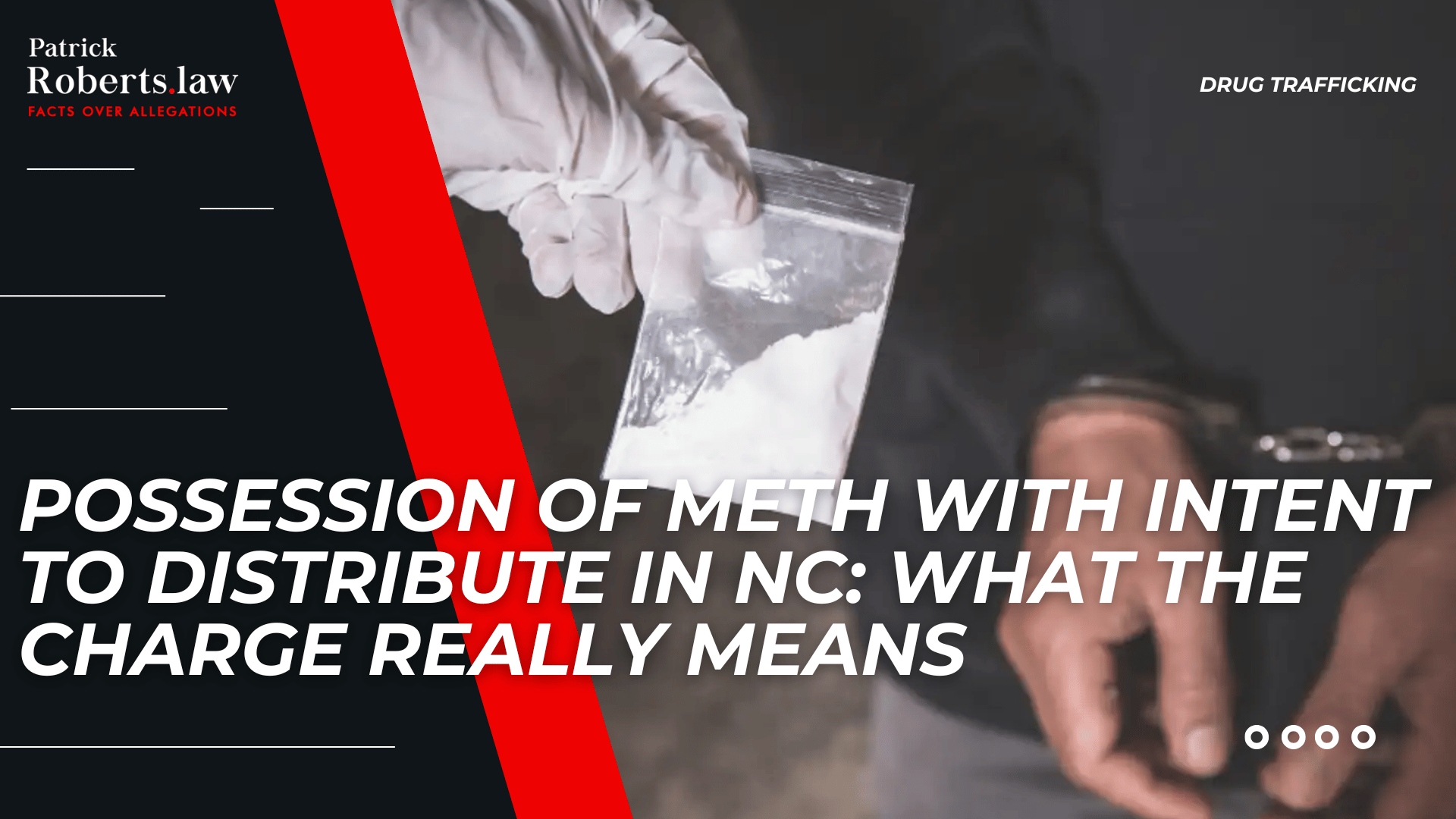
Gloved hand holding a bag of meth introduces North Carolina meth intent-to-distribute charges.

Possession of Meth With Intent to Distribute in North Carolina: What the Charge Really Means

In North Carolina, what people call "possession of meth with intent to distribute" is charged as possession with intent to sell or deliver methamphetamine — PWISD for short. It falls under N.C. Gen. Stat. § 90-95(a)(1), and it's a Class H felony. But the single fact that changes everything is weight. At 28 grams, the same meth stops being a PWISD case and becomes trafficking. Trafficking carries mandatory prison time, no matter who you are. This article breaks down what the state actually has to prove, how "intent" gets established when nothing was ever sold, the line between simple possession, intent to sell, and trafficking, how much prison time is really on the table, and the specific ways these cases get dismissed, suppressed, or knocked down to something smaller. Is "possession of meth with intent to distribute" the same as what I'm charged with in North Carolina? Almost certainly, yes — "intent to distribute" is federal and everyday language for what North Carolina calls possession with intent to sell or deliver a controlled substance. The charge lives in § 90-95(a)(1), and under § 90-95(b)(1), PWISD meth is a Class H felony. Here's the first thing worth holding onto: a charge is an accusation, not a conviction. The label on the paperwork is the prosecutor's opening position, not the final answer. Drug cases are also not rare or exotic in this state. Non-trafficking drug offenses were the single largest category of felony convictions in North Carolina in FY2024, about 30% of all of them. Prosecutors handle these constantly, which means there are well-worn paths to reducing and beating them, too. What decides your outcome is the machinery underneath the charge — the proof, the weight, and the search — not the scary phrase at the top of the page. How do  prosecutors establish "Intent to Sell or Deliver" without a completed sale Under North Carolina law (N.C. Gen. Stat. § 90-95(a)(1)), a person can be charged with Possession with Intent to Sell or Deliver (PWISD) even if no actual transaction occurred. Because direct evidence of intent is rarely available, prosecutors rely on circumstantial evidence to convince a jury that the drugs were meant for distribution rather than personal use. Circumstantial Factors Used to Infer Intent Prosecutors typically present a combination of surrounding facts to infer distribution intent, including: Quantity: Possessing an amount exceeding what a typical user retains for personal consumption. Packaging: Drugs divided into multiple individual baggies or uniform units rather than kept in a single bulk container. Paraphernalia Associated with Distribution: The presence of digital scales, measuring spoons, cutting agents, or unused packaging materials. Currency: Carrying large amounts of cash, particularly in small, organized denominations. Electronic Communications: Text messages, call logs, or social media records that reference prices, meeting locations, or transaction terms. Absence of Personal-Use Paraphernalia: The lack of pipes, syringes, or other consumption items, which prosecutors argue indicates the substance was not intended for personal consumption. Challenging Circumstantial Evidence of Intent Because an intent charge relies on inferences rather than direct proof, every piece of circumstantial evidence can be challenged, reinterpreted, or subjected to evidentiary objections. Common defense strategies include establishing alternative, non-distribution explanations for the state's evidence: Cash: Demonstrating that currency originated from legitimate sources, such as employment wages, bank withdrawals, or rental payments. Packaging: Showing that drugs were purchased in pre-packaged quantities from a seller rather than packaged by the defendant for resale. Quantity: Presenting evidence consistent with bulk purchasing for personal use to reduce costs or minimize trips. Dismantling even one or two of the state's primary circumstantial factors can significantly weaken a PWISD charge, creating leverage to seek a charge reduction to simple possession or a dismissal of the intent element prior to trial. What's the difference between simple possession, intent to sell, and trafficking meth? These are three separate charges with three very different consequences. Which one you actually face turns on the evidence and the weight — not just on what the officer wrote down. Getting moved from one tier to the next is often the whole ballgame. Simple possession of meth — having it for personal use, with no evidence of intent to sell. Under § 90-95(d)(2), possession of methamphetamine is a Class I felony. Possession with intent to sell or deliver (PWISD) — possession plus the circumstantial intent evidence described above. Under § 90-95(b)(1), this is a Class H felony — one step up. Trafficking meth — triggered purely by weight, 28 grams or more, regardless of whether you ever intended to sell anything. This is where the penalties jump dramatically. Notice the fork. The gap between simple possession (Class I) and PWISD (Class H) is fought over intent — the softer, more contestable evidence. The gap between PWISD and trafficking is fought over weight — a number on a lab report. That difference in what has to be proven is exactly what a defense strategy is organized around. At what point does a meth charge become "trafficking" — and why does that change everything? The moment the alleged amount hits 28 grams, meth becomes trafficking under § 90-95(h)(3b). At that point intent stops mattering, because trafficking is measured by weight alone. This is the most important threshold in the entire statute. It's why the number on the state's scale can matter more than anything you said or did. The meth trafficking tiers run like this: 28 grams to under 200 grams — Class F felony, mandatory 70 to 93 months and a fine of at least $50,000 200 grams to under 400 grams — Class E felony, mandatory 90 to 120 months and a fine of at least $100,000 400 grams or more — Class C felony, mandatory 225 to 282 months and a fine of at least $250,000 What makes trafficking far worse than PWISD is the word mandatory. North Carolina's trafficking tiers are fixed by drug weight and apply regardless of your prior record level. A first-time offender and someone with a long history draw the same minimum. There's generally no probation and no suspended sentence at these levels. Trafficking is also common enough in this state to be taken seriously: North Carolina courts recorded 638 drug-trafficking convictions in FY2024. All of which is why fighting the weight — the reliability of the measurement, what got included in it, the lab's methods — is often the single highest-value thing a defense can do. How much prison time am I actually facing? It depends entirely on which of the three charges sticks and, for the non-trafficking charges, on your prior record. So the honest answer is that the range is wide and heavily influenceable. That's good news, because it means the sentence is not fixed the day you're charged. For PWISD meth as a Class H felony and simple possession as a Class I felony, North Carolina uses structured sentencing. That system sets the punishment according to the offense class and your prior record level. Someone with no record is in a very different position from someone with a long one. These classes also carry real room for outcomes short of lengthy active prison time. Because prior record drives the number, mitigating and negotiating around it is a core part of the work. For trafficking, the math flips. The mandatory minimums above are locked to weight and ignore your record entirely. That's exactly why keeping a case below the trafficking line, or below a higher trafficking tier, can be worth years of someone's life. The difference between 27 grams and 28 grams is the difference between a contestable Class H felony and a mandatory 70-month sentence. Can a meth intent-to-sell charge be beaten or reduced? Yes — these cases are dismissed, suppressed, and reduced regularly. They depend on evidence that is often gathered in legally vulnerable ways, or built on inferences that don't hold up. No lawyer can promise a result, but there are real, recurring levers. The stop or search was illegal Most drug evidence comes from a traffic stop, a search of a car, a home, or a person. If the stop wasn't lawful, the search exceeded its bounds, or the warrant was defective, your attorney may move to suppress that evidence. If the drugs are kept out, the case can collapse with them. This is often the highest-impact challenge in a meth case. What if the intent evidence is weak? Because intent is circumstantial, it's contestable. If the state's "dealer" story rests on ambiguous packaging, a debatable quantity, or cash with an innocent explanation, that supports knocking PWISD down to simple possession. That drops the charge from a Class H to a Class I felony. Can the weight or lab work be challenged? The 28-gram trafficking line makes measurement everything. The composition of what was weighed, the accuracy and calibration of the testing, and the State Crime Laboratory's chain of custody and analysis can all be contested. Pulling a case below a weight threshold can move it out of trafficking entirely. The drugs weren't really "yours" Sometimes meth is found in a shared car, a shared home, or a space others had access to — rather than physically on you. In those situations, whether the drugs were really yours to control can be genuinely contested. Being near drugs that others could access is not the same as possessing them, and these cases can turn on that distinction. One piece of realism to plan around: the overwhelming majority of felony convictions in North Carolina — about 98% — come from guilty pleas, not trials. That's not a reason to give up; it's the reason skilled negotiation matters so much. Suppression motions, weaknesses in intent, and weight challenges are the leverage that turns a bad plea into a good one — or into a dismissal. What should I do in the next few days — and how does a former prosecutor help? The early days shape the case, so the priorities are simple: Stop talking about the case — not to police, not over jail phones, not on social media. The state builds intent out of statements, and silence protects you. Get counsel involved immediately — early enough to preserve evidence, address custody and release, and open negotiations before an indictment locks the case in. Write down everything you remember about the stop, the search, and who had access to the location. The details that fuel suppression and possession defenses fade fast. Moving quickly also matters because the process is long and often carries pretrial custody. Here's the reality: in FY2019, superior court felonies took a median of about 259 days — roughly eight and a half months — to resolve. And as of 2015, 82% of the people in North Carolina jails were awaiting trial rather than serving a sentence. That's a long time to be fighting from behind, and a reason to have an advocate working on release and strategy from day one. Review Your Legal Options with Attorney Patrick Roberts Patrick Roberts is a former Assistant District Attorney who prosecuted cases in Wake, Johnston, and New Hanover counties and has more than 24 years of experience in criminal law. That matters here specifically: he has built the exact intent-and-weight cases the state is now trying to build against you, so he knows how prosecutors decide a case is "dealing" rather than personal use, where their circumstantial theories are thinnest, and how lab weight and chain-of-custody get challenged from the inside. With offices in Raleigh, Durham, Chapel Hill, and Cary, the firm handles meth PWISD and trafficking cases across the Triangle and North Carolina. Attorney Patrick Roberts delivers high-level expertise in North Carolina criminal law, offering strategic defense built on a foundation of more than 80 criminal jury trials taken to verdict and hundreds of bench trials. Client Review “I endorse this lawyer. Patrick is a great trial lawyer and a person who I go to for legal advice in my own practice. Patrick is dedicated to his clients and a master at criminal defense. I would not hesitate to hire him if I was in trouble and needed a lawyer.” - Verified Client Review via Avvo.com Peer Endorsement “I attended the Trial Lawyers College with Patrick. If I was facing serious criminal charges anywhere in North Carolina, he would be my first call.” - Verified Peer Endorsement via Avvo.com Disclaimer: The client reviews and peer endorsements featured on this website reflect actual comments provided by clients and legal professionals. This information is intended for general informational purposes only and does not constitute a guarantee, warranty, or prediction regarding the outcome of any future legal matter. Every legal case presents unique facts and circumstances that must be evaluated independently on its own merits. The testimonials displayed here do not represent all reviews or endorsements received by the firm. Evaluate Your State or Federal Meth Defense Facing a PWISD or methamphetamine trafficking charge in North Carolina involves strict statutory penalties, but an arrest is not a final conviction. Defense outcomes depend heavily on identifying constitutional and procedural vulnerabilities early in the judicial process. Whether through challenging the legality of the initial traffic stop or search warrant, disputing circumstantial evidence of intent, or contesting crime lab weight measurements, the State bears the burden of proving every legal element beyond a reasonable doubt. Because critical procedural deadlines—such as statutory windows to object to State Crime Laboratory reports—begin running shortly after formal charges are filed, early legal evaluation is essential to preserving your available defenses. Consult with Criminal Defense Attorney Patrick Roberts If you or a family member are facing methamphetamine charges in North Carolina, obtaining a direct, objective evaluation of your case facts is a critical first step. Patrick Roberts Law PLLC provides legal defense for high-exposure drug prosecutions across state and federal courts in North Carolina. Schedule a confidential consultation with Attorney Patrick Roberts to review the evidence, evaluate constitutional search-and-seizure issues, and discuss your legal options. Based in Wake County, Mr. Roberts serves clients in Raleigh, Cary, Apex, Holly Springs, Garner, and Fuquay-Varina, while also managing complex legal matters in every county across North Carolina. To maintain the quality of its defense and provide each client with individualized attention, the firm limits the number of cases it accepts at any given time. This article is general legal information about North Carolina law, not legal advice, and reading it does not create an attorney-client relationship. Every case turns on its own facts; for advice about your specific situation, consult a licensed North Carolina criminal defense attorney.
Hands exchanging a bag of marijuana introduce North Carolina Schedule VI trafficking charges.

Trafficking a Schedule VI Controlled Substance in North Carolina: What the Charge Actually Means

In North Carolina, there is no separate crime called "trafficking a Schedule VI controlled substance." Schedule VI is simply the state's classification for marijuana, hashish, and THC. The only one of those with its own trafficking law is marijuana. It's charged under N.C. Gen. Stat. § 90-95(h) based on weight, not on the schedule number. This article explains what actually triggers a marijuana trafficking charge in NC, the weight tiers and mandatory prison terms attached to each, the two ways a person can get below those minimums, and how these cases are defended. Is "trafficking a Schedule VI controlled substance" just a marijuana charge in North Carolina? Yes — in practice, it almost always means trafficking in marijuana. Schedule VI is the lowest-tier drug classification under North Carolina law. It covers marijuana, the extracted resin of marijuana (commonly called hashish), and tetrahydrocannabinols, including synthetic THC. Here's the piece that trips people up. You can be charged and sentenced over a Schedule VI substance under the ordinary possession rules, where the schedule number matters. But "trafficking" is its own separate statute that doesn't work by schedule at all. When someone is accused of trafficking a Schedule VI substance in NC, the actual charge on the paperwork is "trafficking in marijuana" under G.S. § 90-95(h)(1). The law also creates a parallel offense, "trafficking in synthetic cannabinoids," for THC-type lab compounds. Everything that follows — whether it's a felony, how serious the felony is, and how much prison time is on the table — is driven by one thing: weight. So if you searched "Schedule VI" because that's what you saw on a charging document or a bail sheet, you're in the right place. But the number to focus on isn't the schedule. It's the pounds. What counts as trafficking if I never sold anything? You do not have to sell, deal, or intend to distribute anything to be charged with trafficking in North Carolina. Under G.S. § 90-95(h)(1), the crime is committed by anyone who "sells, manufactures, delivers, transports, or possesses " more than the threshold weight of marijuana. Read that last word again: possesses. That's the one that surprises people. The statute treats simple possession of a large enough quantity exactly the same as running a distribution operation. No buyer, no money changing hands, no text messages arranging a deal — none of that is required. If the weight is there, the trafficking charge is available to the prosecutor, full stop. This is why, even if you think of yourself as "just a heavy user" or someone "just holding it," you can find yourself facing a charge with the word trafficking in it. And a mandatory prison sentence sits behind it. The label describes the amount, not your conduct. How much marijuana does it take to be charged with trafficking in NC? Trafficking in marijuana starts at more than 10 pounds. Anything at or below that line is not trafficking. It falls under North Carolina's ordinary possession and possession-with-intent laws, which are far less severe and do not carry mandatory prison time. That 10-pound line is the entire dividing line between a serious-but-survivable drug case and a mandatory-minimum felony. Below it, depending on the amount, you're looking at a misdemeanor or a lower-level felony where a judge has real discretion. Above it, the rules change completely — the judge's hands get tied in ways described in the next two sections. For hashish and synthetic THC the numbers are different and much smaller, but for plant marijuana, 10 pounds is the number that matters. What are the penalties for trafficking marijuana by weight in NC? Marijuana trafficking is punished in four weight tiers. Each tier carries its own felony class, a mandatory minimum and maximum prison term, and a mandatory minimum fine. Here is what G.S. § 90-95(h)(1) sets out: Weight Felony Class Mandatory Prison Term Mandatory Minimum Fine More than 10 lbs, less than 50 lbs Class H 25–39 months $5,000 50 lbs to less than 2,000 lbs Class G 35–51 months $25,000 2,000 lbs to less than 10,000 lbs Class F 70–93 months $50,000 10,000 lbs or more Class D 175–222 months $200,000 To put the top tier in plain terms: 10,000 pounds or more is a Class D felony carrying a mandatory minimum of 175 months — roughly 14.5 years — with a $200,000 fine. Trafficking prosecutions are not rare or theoretical in this state. North Carolina courts recorded 638 drug-trafficking convictions in fiscal year 2024. A separate note for synthetic products: "trafficking in synthetic cannabinoids" runs on the same structure but measures dosage units, and the statute defines a dosage unit as 3 grams. Trafficking begins above 50 dosage units and escalates through the same Class H, G, F, and D tiers. Can a judge give me probation or a suspended sentence instead of prison? Generally, no. This is the hard truth about trafficking charges and the single most important thing to understand about them. Under G.S. § 90-95(h)(5), a person convicted of trafficking may not receive a suspended sentence or be placed on probation. The judge must impose the mandatory minimum prison term for the applicable weight tier. Three features make this different from an ordinary drug case: The minimums are mandatory and fixed. They apply regardless of your prior record level. A first-time offender and someone with a long record face the same floor for the same weight. In normal NC felony sentencing, criminal history moves the number — here it does not. The fines are floors, not ceilings. The dollar figures in the table above are the minimum the judge can impose. They cannot be waived down as a matter of ordinary discretion. The sentence stacks. Under G.S. § 90-95(h)(6), a trafficking sentence runs consecutively with any other sentence you're serving — meaning it's added on top, not served at the same time. One more point that matters: the same penalties apply to conspiracy to commit trafficking under G.S. § 90-95(i). You can face a full trafficking sentence for an agreement, even without ever personally holding the marijuana. This is the part of the situation that does not resolve itself by waiting. A trafficking charge that sticks means active prison time by default. What are statutory exceptions to mandatory prison time? Yes. While North Carolina trafficking laws are rigid, the statute provides two specific legal exceptions to mandatory minimum sentences. These statutory mechanisms frequently form the foundation of a trafficking defense strategy, but both require defense counsel to build a strict evidentiary record for the court. 1. Substantial Assistance (G.S. § 90-95(h)(5)) Under G.S. § 90-95(h)(5), a judge is granted the authority to reduce the mandatory fine, impose a prison term below the minimum, or suspend the sentence entirely and grant probation. However, this exception only applies if the defendant has provided "substantial assistance" in identifying, arresting, or convicting accomplices, co-conspirators, or principals. The judge must make a formal finding of this assistance on the court record. In practical terms, this is the cooperation pathway. Navigating this process requires strategic legal counsel, as attempting to provide statements or cooperate with law enforcement without an attorney carries significant legal risk and can severely compromise a case. 2. The "Safety Valve" for Possession-Only Cases (G.S. § 90-95(h)(5a)) North Carolina provides a second, narrower exception under G.S. § 90-95(h)(5a)—often referred to by legal professionals as the "safety valve." This provision allows a judge to sentence a defendant below the mandatory minimum, aligning the penalty with the ordinary offense class and the defendant's prior record level. To utilize this exception, a judge must hold a hearing and formally find that the defendant meets a strict list of statutory conditions, including: The defendant accepted responsibility for the offense. The defendant has no prior felony convictions under G.S. § 90-95. No violence was used, and no weapon was involved in the offense. The trafficking charge is based solely on possession (meaning there is no substantial evidence that the defendant transported, sold, manufactured, or delivered the drug). The defendant admitted to a substance use disorder and successfully completed an approved treatment program. The court determines that imposing the mandatory minimum would constitute a "substantial injustice." This is a demanding legal threshold, and the defense must affirmatively establish every element. However, for individuals charged with trafficking purely based on the weight of the substance possessed, this statute can provide the critical difference between a mandatory prison term and a significantly mitigated sentence. How can a marijuana trafficking charge actually be fought? Because trafficking is defined entirely by weight and what the substance is, those two facts are the case — and both can be challenged. The state has to prove not just that you possessed something, but that it was marijuana and that it crossed the weight threshold. That gives a defense several real angles of attack. Can I challenge the weight and the lab report? The prosecution proves what the substance is, and often how much of it there is, through a state crime lab report. But that report doesn't get into evidence automatically. Under G.S. § 90-95(g), the State can only use the lab report without calling the analyst to testify if it notifies you at least 15 business days before the proceeding and gives you a copy. And even then, you have the right to object at least five business days out and force the analyst into court. There's a parallel notice-and-objection procedure for the chain of custody under G.S. § 90-95(g1). Missing or mishandled notice, a broken chain of custody, or questions about how the weight was measured (including what plant material or packaging was improperly included in the total) can all put the state's core proof in doubt. When your entire tier — and your mandatory minimum — turns on which side of a weight line you fall, a few ounces of dispute can matter enormously. Can the state prove you actually possessed it? The statute punishes the person who possesses the marijuana — and possession is frequently the weakest link in the state's case. Trafficking charges are often built on where the drugs were found (a car, a shared apartment, a package) rather than on the drugs being in someone's hand. When more than one person has access to the space, whether the state can tie the marijuana specifically to you becomes a genuine fight, not a formality. How did the police get the evidence? How the evidence was gathered may also be worth examining. Depending on the facts, the circumstances of the stop, the search, and the seizure that produced the drugs can be something an experienced defense lawyer reviews closely. What should I do right now if I've been charged with trafficking in NC? Three things, in order: Stop talking about the case. Don't explain, minimize, or "clear things up" with police or anyone else. In a possession-based trafficking case, your own words are often the bridge the state uses to connect you to the drugs. Preserve everything and change nothing. Don't delete texts, wipe phones, or move property. Write down — for your lawyer only — exactly what happened, while it's fresh. Get a defense attorney who handles NC trafficking cases, now. These cases move, and the early decisions (bond, cooperation timing, preserving lab and search challenges) shape everything downstream. It's worth remembering that roughly 98% of felony convictions in North Carolina come from guilty pleas. That means the leverage a lawyer builds before trial — through suppression motions and safety-valve or substantial-assistance groundwork — is usually where the outcome is actually won. Dedicated Representation for Wake County and Triangle Communities Based in Raleigh—with offices in Durham, Chapel Hill, and Cary— Attorney Patrick Roberts provides legal defense for state and federal felony and complex drug offenses across North Carolina. He brings over 24 years of legal practice, with an educational background from Johns Hopkins University and Duke University School of Law. His career includes trying over 80 criminal jury trials to verdict across state and federal courts. As a former Assistant District Attorney in Wake, Johnston, and New Hanover counties, Attorney Roberts prosecuted drug trafficking cases alongside law enforcement interdiction teams. His trial practice spans both sides of the judicial process, ranging from state drug prosecutions to multi-defendant federal conspiracy cases in multi-week trials. This background informs his evaluation of state evidence, law enforcement procedures, and prosecution strategies. Attorney Roberts is admitted to practice before the North Carolina State Courts, the U.S. District Courts for the Eastern, Middle, and Western Districts of North Carolina, the U.S. Court of Appeals for the Fourth Circuit, and the Supreme Court of the United States. Client Review “Mr.Roberts was a great attorney to work with. From the start he was confident and transparent with us. He told us he had other strategies as back up in case his main one didn't go as planned. That showed us that he was prepared for any obstacle that was coming his way. We went to the first court hearing and waited, we then saw Mr. Roberts walk in with confidence and his head up high. He looked fearless and ready. That day we were the first ones out, we were in there for probably 10 minutes. The one thing that stuck with me that he said was "don't be scared because I'm not scared." He was good at communicating with us and keeping us informed with what was going on and when the next court dates would be. Overall he was a good attorney to work with, he dedicates and puts his time into your case and will work on it for however long he will need to whether it's lengthy or not.” - Verified client review via Avvo.com Peer Endorsement “Patrick is a thoughtful and experienced attorney. When I have a client needing representation in the Raleigh area in his areas of practice, he would be my referral of choice.” - Verified peer endorsement via Avvo.com Disclaimer: The client reviews and peer endorsements featured on this website reflect actual comments provided by clients and legal professionals. This information is intended for general informational purposes only and does not constitute a guarantee, warranty, or prediction regarding the outcome of any future legal matter. Every legal case presents unique facts and circumstances that must be evaluated independently on its own merits. The testimonials displayed here do not represent all reviews or endorsements received by the firm. Case Review Accusation: Felony Level I Trafficking in Heroin, Simple Possession of Schedule IV Controlled Substance, and Simple Possession of Schedule VI Controlled Substance. Statutory Exposure: Mandatory minimum of 70 to 93 months in active state prison and a mandatory $50,000 fine for the trafficking count, plus up to 140 days for the misdemeanor possession counts. Defense Strategy: Upon obtaining and reviewing the official law enforcement checkpoint plan, Attorney Roberts identified key constitutional violations in how the stop was conducted and drafted a motion to suppress evidence on Fourth Amendment grounds. Final Result*: Felony Level I Heroin Trafficking charge dismissed prior to trial. Attorney Roberts negotiated a resolution allowing the client to plead to two misdemeanor possession counts with a sentence of probation. See other case results *Disclaimer: Case outcomes depend upon a variety of factors unique to each case. Prior results do not guarantee or predict a similar outcome in any future legal matter. Dedicated Representation for Wake County and Triangle Communities If you or someone in your family is facing a trafficking charge, contact Patrick Roberts Law PLLC to talk through where your case falls on the weight tiers and which of the defenses above actually apply to your facts. He provides legal representation for high-stakes cases across North Carolina, focusing locally on Wake County areas such as Raleigh, Cary, Apex, Holly Springs, Garner, and Fuquay-Varina. The firm maintains a selective intake process to ensure that each client receives the focused professional attention their case requires. This article is general legal information about North Carolina law, not legal advice. Reading it does not create an attorney-client relationship. Every case turns on its own facts — consult a licensed North Carolina attorney about your specific situation.

Close-up of a hand exchanging a small bag of suspected cocaine introducing North Carolina trafficking charges.

Charged With Cocaine Trafficking in North Carolina? Here's What You're Actually Facing

In North Carolina, cocaine trafficking has almost nothing to do with selling. It's about weight. If the State says you had 28 grams or more of cocaine, or any mixture containing cocaine, you can be charged with "trafficking." That's true even if you never sold, moved, or handed anything to anyone. That single fact catches most people off guard, and it changes everything about how serious the charge is. Below, I'll walk through what actually counts as trafficking here, the exact prison time and fines each weight level carries, why probation usually isn't on the table, whether your case might end up in federal court, how the prosecution has to prove it, and — most importantly — where these cases can be challenged. What actually counts as "cocaine trafficking" in North Carolina? Trafficking in cocaine means selling, manufacturing, delivering, transporting, or simply possessing 28 grams or more of cocaine or any mixture containing it. That's it. Under N.C. Gen. Stat. § 90-95(h)(3), possession alone at that weight is trafficking. You don't have to be a dealer, and prosecutors don't have to prove you intended to sell. Two details do most of the damage here. First is the word mixture. The statute counts "any mixture containing" cocaine toward the 28-gram threshold — not just the pure drug. So the total weight of whatever the substance is cut or combined with can count. That means the number that determines your charge may be much higher than the amount of actual cocaine involved. Second is conspiracy. Under § 90-95(i), agreeing with someone else to commit cocaine trafficking carries the same penalties as trafficking itself. You can face a trafficking sentence based on an agreement, even if the drugs were never in your hands. For context on where the line sits: below 28 grams, cocaine is charged as simple possession or other non-trafficking offenses. Those are different, and generally far less severe. At 28 grams, the same conduct becomes one of the most heavily punished crimes in the state. How much prison time and money am I facing? Cocaine trafficking carries mandatory active prison time and steep fines that climb with the weight. There are three tiers under § 90-95(h)(3), and each one sets a minimum sentence the judge must impose: 28 grams to under 200 grams — Class G felony. 35 months minimum, 51 months maximum, plus a fine of at least $50,000. 200 grams to under 400 grams — Class F felony. 70 months minimum, 93 months maximum, plus a fine of at least $100,000. 400 grams or more — Class D felony. 175 months minimum, 222 months maximum, plus a fine of at least $250,000. "Minimum" here means what it says. 35 months at the lowest tier is roughly three years you would actually serve — not a ceiling a judge can sentence below on a good day. And if you're charged with more than one trafficking count, § 90-95(h)(6) requires those sentences to run consecutively — stacked back to back, not served at the same time. These aren't rare charges. North Carolina state courts recorded 638 drug-trafficking convictions in FY2024, and trafficking penalties are prosecuted aggressively precisely because the sentences are locked in by statute. Why can't I just get probation or a reduced sentence? Because trafficking sentences are mandatory in a way ordinary felonies are not. For most North Carolina crimes, your prior record and the circumstances shape the sentence, and probation is often possible. Trafficking is different. § 90-95(h)(5) says that if you're sentenced for trafficking, you generally cannot receive a suspended sentence or probation. The minimum is fixed by drug weight regardless of your criminal history. A first-time offender faces the same floor as someone with a record. There is one real path below the minimum, and it's worth understanding. Substantial assistance. Under § 90-95(h)(5), a judge can reduce the fine, go below the minimum prison term, or suspend the sentence. But that happens only if you provide "substantial assistance" in the identification, arrest, or conviction of others involved. The judge also has to put that finding on the record. A separate provision, § 90-95(h)(5a), allows a reduction in certain possession-only trafficking cases where a list of conditions is met. Those conditions include that you accepted responsibility, have no prior felony under § 90-95, used no violence or weapon, and completed an approved substance-abuse treatment program. This matters more than it might sound. In North Carolina's federal drug-trafficking cases, 35.1% received a cooperation-based reduction — well above the 20.3% national rate. Whether cooperation is even in your interest is a strategic decision that depends entirely on the specifics of your case. It's one to make with a lawyer before you say anything to anyone. Will my case be in state or federal court — and does that change things? It can be either, and the difference is significant. The weight tiers and mandatory minimums above come from North Carolina state law. But cocaine trafficking is also prosecuted federally — and federal outcomes tend to be harsher and harder to escape. Federal drug trafficking is not a fringe outcome for North Carolinians. It was the single largest category of federal sentencings from NC in FY2024 — 476 of 1,415 people (33.6%), ahead of firearms offenses. Of those NC federal drug-trafficking defendants, 97.3% received a prison-only sentence, and the median sentence ran to 87 months — over seven years. Which system picks up your case affects the timeline, the leverage, and what's at stake. Federal cases in the Eastern District of NC alone carry a median of about 12.7 months from filing to disposition. The district also carries the heaviest felony caseload in the Fourth Circuit. If your case is federal, you need a lawyer admitted to practice in federal court — not every criminal defense lawyer is. How does the prosecution actually prove cocaine trafficking? To convict you of trafficking by possession, the State has to prove three things: that you possessed the cocaine, that the weight met a trafficking tier, and that the substance actually was cocaine. Each of those is something the State must establish under specific rules. Possession. The statute reaches anyone who sells, manufactures, delivers, transports, or possesses the threshold weight. Where the charge rests on possession, the State has to prove the cocaine was yours to possess. Weight. Because the statute counts any mixture, how the substance was weighed and what got included in that number can be challenged directly. Lab analysis and chain of custody. The State proves the substance is cocaine through a crime-lab report. Under § 90-95(g), that report can come into evidence without the analyst testifying. But that's true only if the State gives you proper notice and you don't object in time. If your attorney files a timely written objection, the State has to produce the analyst and prove the identity, nature, and quantity of the substance under the normal rules of evidence. The same goes for the chain of custody under § 90-95(g1) — the paper trail showing who handled the evidence and when. Missing that objection deadline gives up a real defense. Can a cocaine trafficking charge be beaten or reduced? Yes — trafficking charges are challenged and reduced regularly, and the fact that the penalties are mandatory makes attacking the charge itself even more important. The main lines of defense flow from what the State has to prove. Can the weight and lab evidence be challenged? The weight determines the tier — and the tier determines the mandatory minimum. Challenging how the substance was weighed, what was counted as part of the "mixture," and how the lab tested it can move a case down a tier or undermine it entirely. And as noted above, forcing the analyst to appear by objecting to the lab report on time is a concrete, statute-based tool. Can negotiating or cooperating improve the outcome? The reality is that most of these cases resolve short of trial. In NC state courts, 98% of felony convictions come by guilty plea. In NC federal drug-trafficking cases, 98.1% resolve by plea and only about 2% go to trial. That's exactly why the leverage your attorney builds — a weak link in the weight or lab proof — matters. Those pressure points are what turn a mandatory-minimum charge into a negotiated outcome, whether through a substantial-assistance reduction or a plea to a lesser offense. What should I do right now? Three things, in order: Stop talking about your case. Don't explain, minimize, or "clear things up" with police, and don't discuss it over jail phones or text — those conversations become evidence. Cooperation may or may not help you, but that's a decision to make with a lawyer, not before one. Preserve everything. Note what happened around your arrest — who was present, what was said, what officers did, and how the substance was handled and weighed. Details fade fast, and they can matter to your defense. Get a trafficking-experienced attorney involved immediately — especially if your case could be federal. Deadlines like the lab-report objection window start running early, and missing them gives up real defenses. At Patrick Roberts Law PLLC in Raleigh — with offices in Durham, Chapel Hill, and Cary — this is the exact terrain we work in. Patrick Roberts spent years as an Assistant District Attorney in Wake, Johnston, and New Hanover counties, so he knows from the inside how the State builds a trafficking case: how weight and mixture are charged, and where the lab and chain-of-custody proof tends to be vulnerable. Over 24-plus years of practice, he's handled these cases in both systems and is admitted before the North Carolina courts and the U.S. District Courts for the Eastern, Middle, and Western Districts of North Carolina, the Fourth Circuit Court of Appeals, and the United States Supreme Court — which matters directly if your case lands in federal court. The weight and lab-report challenges and the cooperation strategy described above aren't theoretical here — they're the day-to-day of the practice. If you're facing a cocaine trafficking charge, call to discuss where the pressure points in your case are, before the deadlines close them off. Client Review “Our family turned to Attorney Patrick Roberts during an incredibly difficult chapter in our lives. Although our daughter lived in Raleigh, we are based in Central New Jersey, which meant countless hours on the road and a constant struggle to stay on top of the legal process from several states away. From the moment we met Mr. Roberts, he brought a sense of steadiness and reassurance that made an overwhelming situation feel manageable. He took the time to explain his credentials, his experience, and the steps he would take to defend our daughter, who had been accused of multiple violations stemming from a domestic incident. His confidence was never arrogant—just the calm, professional assurance of someone who knows the law, knows the system, and knows how to protect the people who depend on him. What truly set Mr. Roberts apart was how integral he became in helping us navigate the North Carolina legal system while ensuring every rule, requirement, and regulation was followed precisely. Managing a case from out of state is no small task, but he made sure we were informed, prepared, and supported at every turn. His communication was clear, timely, and compassionate, and he treated our daughter with dignity and respect throughout the entire process. Mr. Roberts is kind, professional, and exceptionally competent. His dedication to restoring normalcy to our daughter’s life was evident in everything he did, and our family is deeply grateful for his guidance and advocacy. We would highly recommend Attorney Patrick Roberts to anyone in need of skilled, trustworthy, and compassionate legal representation. He is exactly the type of attorney you want standing beside you when everything feels uncertain.” - Verified Client review via Avvo.com Peer Endorsement “I endorse this lawyer. Patrick is a great trial lawyer and a person who I go to for legal advice in my own practice. Patrick is dedicated to his clients and a master at criminal defense. I would not hesitate to hire him if I was in trouble and needed a lawyer.” - Verified peer endorsement v ia Avvo.com Disclaimer: The client reviews and peer endorsements featured on this website reflect actual comments provided by clients and legal professionals. This information is intended for general informational purposes only and does not constitute a guarantee, warranty, or prediction regarding the outcome of any future legal matter. Every legal case presents unique facts and circumstances that must be evaluated independently on its own merits. The testimonials displayed here do not represent all reviews or endorsements received by the firm. Case Review Case Summary & Result Accusation: Felony Level I Trafficking in Heroin, Simple Possession of Schedule IV Controlled Substance, and Simple Possession of Schedule VI Controlled Substance. Statutory Exposure: Mandatory minimum of 70 to 93 months in active state prison and a mandatory $50,000 fine for the trafficking count, plus up to 140 days for the misdemeanor possession counts. Defense Strategy: Upon obtaining and reviewing the official law enforcement checkpoint plan, Attorney Roberts identified key constitutional violations in how the stop was conducted and drafted a motion to suppress evidence on Fourth Amendment grounds. Result*: Felony Level I Heroin Trafficking charge dismissed prior to trial. Attorney Roberts negotiated a resolution allowing the client to plead to two misdemeanor possession counts with a sentence of probation. *Disclaimer: Case outcomes depend upon a variety of factors unique to each case. Prior results do not guarantee or predict a similar outcome in any future legal matter. Evaluating Your Legal Options Following a Drug Trafficking Arrest Statutory mandatory minimums for cocaine trafficking charges in North Carolina create severe legal exposure, but an arrest is not a conviction. As outlined above, defense outcomes depend heavily on identifying procedural or constitutional defects early in the prosecution process. Whether through challenging search warrant validity, disputing total mixture weight, filing timely objections to crime lab reports, or negotiating statutory sentence reductions, critical evidentiary standards must be met by the State. Because procedural deadlines—such as the statutory window under N.C. Gen. Stat. § 90-95(g) to object to crime lab analyses—begin running shortly after formal charging, delaying legal action can result in the forfeiture of key constitutional defenses. Consult with Defense Attorney Patrick Roberts If you or a family member are facing state or federal cocaine trafficking charges in North Carolina, obtaining a direct evaluation of your case facts is an essential first step. Patrick Roberts Law PLLC provides objective legal defense for high-exposure drug prosecutions across North Carolina state and federal courts. Schedule a confidential consultation with Attorney Patrick Roberts to review the evidence, evaluate applicable procedural deadlines, and discuss your available legal options. This article is general legal information about North Carolina law, not legal advice, and reading it does not create an attorney-client relationship. Every case turns on its own facts — consult a licensed North Carolina attorney about your specific situation.

Gloved officer holds seized drug package behind crime scene tape introducing aggravated drug trafficking charges.

Aggravated Drug Trafficking in North Carolina: What the Charge Means and What You're Facing

In North Carolina, there is no criminal charge that carries the exact name "aggravated drug trafficking." What people usually mean by that phrase is one of three things: a high-weight trafficking charge under N.C. Gen. Stat. § 90-95(h), an ordinary drug charge pushed into a harsher category by an aggravating factor like a school zone or a sale to a minor, or a federal drug-trafficking case. Federal cases use "aggravating factor" language and are prosecuted heavily in this state. This article explains what trafficking actually means under North Carolina law, what makes a drug case more serious, the prison time and fines involved, the difference between a state and a federal case, whether a charge means a conviction, the defenses that apply, and what to do right now. Is "aggravated drug trafficking" a real charge in North Carolina? Not by that name. North Carolina's drug statute creates an offense simply called "trafficking." The seriousness is built into the weight of the drug and a handful of add-on factors rather than into a separate "aggravated" label. So if you're holding a charging document that says "aggravated" or that references an aggravating factor, you are almost certainly looking at one of these: A trafficking charge under § 90-95(h), where the quantity alone determines how severe the felony is. A standard drug charge with an enhancement — for example, an offense near a school or a sale to a minor — that bumps the felony class up. A federal charge, where prosecutors and the sentencing guidelines talk in terms of aggravating factors and role adjustments. The label matters less than the substance. Whatever word is on the paperwork, the questions that decide your future are: how much of what drug, where, and in which court. What makes a drug case "trafficking" — and what makes it worse? Trafficking in North Carolina is triggered by the weight of the drug alone. You do not have to have sold anything, intended to sell anything, or be a "trafficker" in any ordinary sense. Under § 90-95(h), simply possessing the threshold amount is enough to be charged with trafficking. That's the part that catches most people off guard. The statute lists trafficking as anyone who "sells, manufactures, delivers, transports, or possesses" a set quantity. Possession is on that list. The thresholds are lower than people expect — for example, 28 grams of cocaine (about an ounce) or 4 grams of an opioid or heroin. On top of the weight tiers, § 90-95(e) contains enhancements — facts that raise the felony class and the punishment. These are the closest thing North Carolina has to "aggravating" a drug offense: Selling or delivering to a minor or a pregnant person. A person 18 or older who sells or delivers to someone more than 13 but under 16, or to a pregnant female, is punished as a Class D felon. If the recipient is 13 or younger, they're punished as a Class C felon (§ 90-95(e)(5)). Committing the offense near a school or child care center. A person 21 or older who commits the offense on or within 1,000 feet of a school or licensed child care center is punished as a Class E felon (§ 90-95(e)(8)). Committing the offense near a public park. A person 21 or older, on or within 1,000 feet of a public park, is punished as a Class E felon (§ 90-95(e)(10)). Possession inside a jail or prison. Possessing a controlled substance in a penal institution or local confinement facility is a Class H felony (§ 90-95(e)(9)). The takeaway: what you're facing isn't just about what you had. It's about how much, where you were standing, and who was involved. How much prison time does trafficking carry in North Carolina? Trafficking carries mandatory minimum prison sentences. That means the judge is required to impose an active prison term set by the statute. Those minimums are fixed by the drug and the weight, not by your criminal history. This is the single most important thing to understand about a trafficking charge. It's what separates it from nearly every other felony in the state. Ordinary North Carolina felonies are sentenced on a grid that factors in your prior record. Trafficking ignores that. A first-time offender and a person with a long record face the same statutory floor. The six trafficking tiers run like this: Felony class Mandatory sentence range Class H 25–39 months Class G 35–51 months Class F 70–93 months Class E 90–120 months Class D 175–222 months Class C 225–282 months Where you land depends on the substance and amount. A few real examples from the statute: Cocaine, 28 to under 200 grams: Class G, 35 to 51 months, plus a fine of at least $50,000 (§ 90-95(h)(3)a). Opioid or heroin, 4 to under 14 grams: Class F, 70 to 93 months, with a $500,000 fine if the drug is heroin (§ 90-95(h)(4)a). Even the smallest heroin tier means a minimum of nearly six years. Fentanyl or carfentanil, 28 grams or more: Class C, 225 to 282 months and a mandatory $1,000,000 fine (§ 90-95(h)(4c)c) — the harshest drug penalty in the state, an 18-plus-year floor. Marijuana, 10,000 pounds or more: Class D, 175 to 222 months and a $200,000 fine (§ 90-95(h)(1)d). Marijuana trafficking starts at more than 10 pounds (Class H, a 25-month minimum) and climbs from there. The statute does two more things that make trafficking sentences stack up fast. First, the fines are mandatory. Second, under § 90-95(h)(6), trafficking sentences run consecutively — one after another — with any other sentence you're serving, rather than at the same time. Am I being charged by the state or the federal government? You could be facing either, and it changes almost everything — the rules, the timeline, and how much time you're looking at. The charging document will name the court, but many people can't tell at a glance, and the difference is worth understanding immediately. North Carolina prosecutes most trafficking cases in state court, but federal drug-trafficking prosecution here is heavy. Drug trafficking was the single largest category of federal sentencings among North Carolinians in FY2024 — 33.6%, ahead of firearms at 25.1%. And that activity is concentrated: the Eastern District of North Carolina alone carried 827 sentenced cases, compared with 305 in the Western and 283 in the Middle. What you're facing federally is severe. For North Carolina residents sentenced federally for drug trafficking, the median sentence was 87 months and the mean was 110 months — roughly seven to nine years. On top of that, 97.3% received a prison-only sentence. If your case is federal, you need a lawyer admitted to practice in federal court, not only state court. Does a trafficking charge mean I'll be convicted? No. A charge is an accusation, not a conviction. Cases fall apart, get dismissed, or never get charged in the first place more often than the fear in the moment suggests. At the federal level, prosecutors declined to pursue 23.8% of drug matters referred to them — nearly one in four dropped before charges were even filed. Of the federal drug cases that were adjudicated, 7.8% were dismissed. Those are outcomes that good, early defense work helps produce. It's also true that the odds tighten once a case is charged and moving: 91.9% of adjudicated federal drug defendants were ultimately convicted. The overwhelming majority of cases resolve by negotiation rather than trial. In North Carolina state courts, 98% of felony convictions came through guilty pleas. In federal court here, 98.1% of drug-trafficking cases were resolved by plea and only 9 went to trial. The honest read: this is a serious charge with real conviction risk, but the outcome is not fixed at arrest. What happens between now and resolution — the challenges your lawyer raises, the leverage they build — is what moves it. What defenses can reduce or beat a trafficking charge? Because trafficking comes down entirely to weight and possession, the defense usually attacks exactly those things — what the substance was, how much there really was, whether you knowingly possessed it, and how the government got it. There is also a statutory path to a sentence below the mandatory minimum. Challenging the weight and the lab analysis Weight is the whole case. If the amount comes in under the threshold, or the substance isn't what the state claims, the trafficking charge can collapse into something far less serious. The state proves the drug's identity and weight through a certified crime-lab report. Under § 90-95(g), that report can be admitted without the analyst ever coming to court — but only if the defense fails to object. If your attorney files a written objection at least five business days before the proceeding, the state has to bring the analyst in to testify and be cross-examined. That objection is routine, and it matters. Challenging the chain of custody Section 90-95(g1) lets the state establish who handled the evidence through signed statements instead of live witnesses — again, unless the defense objects in time. Forcing the state to account for every hand the evidence passed through can expose gaps in how it was stored, labeled, and tracked. Can they prove the drugs were mine? The statute requires that you possess the drug. In practice, disputing whether the drug was actually yours — and whether you knew it was there — is often where a trafficking case is weakest. Drugs found in a shared car, a shared home, or a space others had access to may not be probably yours. Was the search legal? How the drugs came to light — the traffic stop, the search of a car, home, or phone — is frequently the most productive line of attack in a drug case. Scrutinizing whether officers had legal grounds for the stop and search is central to how these cases are defended. Can I get a sentence below the mandatory minimum? Even where a conviction is likely, the mandatory minimum is not always the end of the story. Under § 90-95(h)(5), a judge can go below the statutory floor if you provide substantial assistance — meaningful help identifying, arresting, or convicting others involved. North Carolina relies on this heavily: 35.1% of the state's federal drug-trafficking defendants received a cooperation-based reduction, well above the national rate of 20.3%. Section 90-95(h)(5a) adds a separate path for people charged with trafficking based on possession alone. The judge can sentence below the mandatory term if a detailed list of conditions is met. Those conditions include accepting responsibility, no prior felony under this statute, no violence or weapon involved, a documented substance use disorder with completed treatment, and a finding that the minimum would be a substantial injustice. What should I do right now? Two steps, in order: Invoke your right to counsel and let a lawyer speak for you before you discuss the case with anyone. Get a criminal defense lawyer involved immediately. Make sure that lawyer is admitted in the court where your case sits — especially if it's federal. Verifiable Courtroom Authority and Legal Qualifications Defending a drug trafficking charge requires early, informed legal action before critical statutory deadlines expire—whether that involves challenging a search warrant, scrutinizing drug weights, demanding lab report compliance, or enforcing strict chain-of-custody protocols. Attorney Patrick Roberts brings 24 years of criminal litigation experience to these high-stakes matters, offering expert representation for clients facing state and federal drug offenses across North Carolina. A former Assistant District Attorney in Wake, Johnston, and New Hanover counties, Attorney Roberts prosecuted drug trafficking cases and worked directly alongside drug interdiction teams to build complex, conspiracy-level prosecutions. Having constructed these cases from the inside, he relies on this specific prosecutorial expertise to identify vulnerabilities in the State's evidence and build precise defense strategies. His extensive litigation record includes more than 80 completed jury trials across state and federal jurisdictions, featuring 6 federal jury trials (including complex drug trafficking and mail/wire fraud cases) and 3 state court drug trafficking jury trials. His federal expertise includes defending clients in multi-defendant drug conspiracy trials that spanned several weeks. Attorney Roberts holds a legal education from Duke University School of Law and an undergraduate degree from Johns Hopkins University. His courtroom advocacy and trial expertise are further refined by advanced training from the National Criminal Defense College (NCDC) Trial Practice Institute—including its Cross-Examination Intensive—and Gerry Spence’s Trial Lawyers College. His practice covers the entire state, with primary offices in Raleigh, Durham, Chapel Hill, and Cary. Because drug offenses frequently cross into federal jurisdiction, Attorney Roberts brings federal court expertise as an attorney admitted to practice before all three federal districts in North Carolina (Eastern, Middle, and Western), the U.S. Court of Appeals for the Fourth Circuit, and the Supreme Court of the United States. Courtroom & Litigation Experience Comprehensive Trial Record: 80+ completed jury trials across state and federal jurisdictions. Federal Court Litigation: 6 Federal jury trials, including cases involving Drug Trafficking and Mail/Wire Fraud. State Drug Offenses: 3 State Court Drug Trafficking jury trials. Prosecutorial Background: Former Assistant District Attorney in Wake, Johnston, and New Hanover Counties. Complex Cases: Expertise defending multi-defendant federal drug conspiracies in trials lasting several weeks. Bar Admissions & Federal Jurisdictions State of North Carolina: All State District and Superior Courts U.S. District Courts: Eastern, Middle, and Western Districts of North Carolina U.S. Court of Appeals: Fourth Circuit Supreme Court of the United States Client Review I cannot speak highly enough of Mr.Patrick Roberts, from the moment we connected via the telephone he demonstrated confidence, support, and a great analytical mind, which provided my family with much-needed support during one of the most difficult periods in our lives. Mr. Roberts took the time to understand our situation, he ran through various scenarios on how he thought he could win our case, which he did! What sets Mr. Roberts apart is his legal expertise, in-depth knowledge of the judicial procedure, and genuine compassion and commitment to you as a client. He truly cares about his clients, he goes above and beyond to ensure your needs are met, I am incredibly grateful for Mr. Roberts and highly recommend his service to anyone needing legal representation. - Verified client review via Avvo.com Peer Endorsement “I endorse this lawyer. Patrick is a great trial lawyer and a person who I go to for legal advice in my own practice. Patrick is dedicated to his clients and a master at criminal defense. I would not hesitate to hire him if I was in trouble and needed a lawyer." - Verified peer endorsement via Avvo.com Disclaimer: The client reviews and peer endorsements featured on this website reflect actual comments provided by clients and legal professionals. This information is intended for general informational purposes only and does not constitute a guarantee, warranty, or prediction regarding the outcome of any future legal matter. Every legal case presents unique facts and circumstances that must be evaluated independently on its own merits. The testimonials displayed here do not represent all reviews or endorsements received by the firm. Case Review Attorney Patrick Roberts’ client was indicted on multiple severe counts, including: Level I Trafficking in Opium or Heroin Felony Possession and Intent to Distribute Heroin Possession of a Firearm by a Felon & Possession of a Stolen Firearm Maintaining a Dwelling/Vehicle for Controlled Substances Misdemeanor Marijuana and Paraphernalia counts Facing: Mandatory minimum of 70 to 93 months in prison for trafficking, plus up to 126 additional months for the remaining charges under North Carolina sentencing guidelines. The Defense Attorney Patrick Roberts challenged the constitutionality of the search warrant that yielded the physical evidence. The defense demonstrated that the search warrant affidavit lacked Fourth Amendment probable cause due to two critical defects: Unreliable Informant: Unsubstantiated claims from a source with no established credibility or track record. Flawed Controlled Buys: Poorly documented law enforcement observations with unaddressed gaps in timing and supervision. The Outcome The court ruled the search warrant invalid and suppressed all physical evidence under the exclusionary rule. Without admissible evidence, the State was forced to dismiss* all charges prior to trial, completely relieving the client of all mandatory prison terms and criminal penalties. See other case results. *Disclaimer: Case outcomes depend upon a variety of factors unique to each case. Prior results do not guarantee or predict a similar outcome in any future legal matter. Analyze Your Legal Defenses with Attorney Patrick Roberts If you or someone in your family is facing a trafficking charge, contact Patrick Roberts Law PLLC to talk through where your case stands and what can be challenged.  He defends clients in complex legal matters throughout North Carolina, centering his practice in Wake County cities and towns, including Raleigh, Cary, Apex, Holly Springs, Garner, and Fuquay-Varina To maintain a high standard of service and thorough oversight for each client, the firm manages a restricted caseload. This article provides general legal information about North Carolina drug trafficking law. It is not legal advice, does not address the specific facts of any individual case, and does not create an attorney-client relationship. For advice about your situation, consult a licensed North Carolina attorney.

Courtroom scene with defendant and attorney introduces heroin trafficking charges and defense options in North Carolina.

Heroin Trafficking Charges in North Carolina: What You're Facing and How the Charge Can Be Fought

In North Carolina, heroin trafficking is a charge built on weight, not on proof that anyone sold anything. Under N.C. Gen. Stat. § 90-95(h)(4), a person who possesses, transports, sells, manufactures, or delivers four grams or more of heroin — or any mixture that contains heroin — can be charged with trafficking. The charge holds even if there was no buyer, no scale, and no sale. That catches most people off guard, because "trafficking" sounds like it should mean dealing. It doesn't. Below is what the State actually has to prove, how much prison time each weight level carries, whether a judge can go below those numbers, how state and federal cases differ, and where these charges can be attacked. What counts as heroin trafficking in North Carolina? Trafficking is triggered the moment the weight hits four grams. The government does not have to show you sold it, planned to sell it, or profited from it. The statute lists five separate ways to commit the offense: you "sell, manufacture, deliver, transport, or possess " the threshold amount. Simple possession of enough heroin is legally the same trafficking charge as running a distribution ring. Two details make this charge far broader than people expect: It's the whole mixture, not the pure drug. The law counts "any mixture containing" heroin. If heroin is cut with filler, the filler counts toward your four grams. You can be charged with trafficking a quantity that is mostly not heroin. No intent to sell is required. Charges like possession with intent to sell or deliver under § 90-95(a)(1) turn on whether you meant to sell or deliver the drug. Trafficking skips that question entirely. Weight alone does the work. The practical effect is significant: under the trafficking statute, a possession case can be charged as a top-tier felony without the State ever proving a transaction. How much heroin does it take to be charged with trafficking? Four grams. That single threshold opens the door, and from there the charge escalates through three weight tiers, each one more serious than the last: 4 grams to less than 14 grams 14 grams to less than 28 grams 28 grams or more Where your alleged quantity falls determines everything about the sentence — the felony class, the mandatory prison term, and the fine. Because the mixture counts, the difference between one tier and the next can come down to how the substance was weighed and what was in it. That makes the lab's measurement one of the most important facts in the entire case. How much prison time does heroin trafficking carry? A lot — and it's mandatory. Heroin trafficking in North Carolina carries a required active prison sentence at every tier, plus a fixed fine that climbs into the millions. Here is exactly what each level under § 90-95(h)(4) carries: Weight Felony class Mandatory prison term Fine 4 to <14 grams Class F 70–93 months (about 5.75–7.75 yrs) $500,000 14 to <28 grams Class E 90–120 months (7.5–10 yrs) $750,000 28 grams or more Class C 225–282 months (about 18.75–23.5 yrs) $1,000,000 Two words there matter more than any other: mandatory and minimum. The low number in each range isn't a starting point for negotiation. It's the floor the judge is ordered to impose without a specific legal exception. And if you're charged with more than one trafficking count, § 90-95(h)(6) requires the sentences to run consecutively — stacked back to back, not served at the same time. Multiple counts can turn a single incident into decades. Heroin sits high on North Carolina's trafficking ladder. The state runs six trafficking tiers from Class H to Class C. Even the lowest heroin quantity lands at Class F — well above where marijuana, cocaine, or amphetamine trafficking begins. Can a judge sentence me below the mandatory minimum? Usually no. By default, § 90-95(h)(5) bars the judge from suspending the sentence or granting probation — the mandatory term must be served. But there are narrow exceptions, and this is where an early, strategic defense earns its keep. The main door below the minimum is substantial assistance — cooperating with law enforcement. If you provide, to the best of your knowledge, real help in identifying, arresting, or convicting accomplices, co-conspirators, or the people above you, the judge may reduce the fine, go below the minimum prison term, or suspend the sentence. But that only happens after the judge makes a specific finding on the record that you gave that assistance. There's also a separate, tightly conditioned path under § 90-95(h)(5a) that can apply to lowest-tier, possession-only cases — including conspiracy. It applies only where the amount is no greater than the lowest trafficking category and the judge makes a strict list of findings: acceptance of responsibility, no prior § 90-95 felony, no weapon or violence, completion of a court-approved substance-abuse treatment program, that the minimum would be a substantial injustice, and that there is no substantial evidence the person ever engaged in the sale or transport-for-sale of the drug. One point that surprises people: your clean record doesn't help here. Unlike ordinary North Carolina felonies, trafficking minimums are fixed by drug weight and ignore prior record level entirely. A first-time defendant faces the same floor as a career offender. Cooperation is not a small factor in these cases. In North Carolina's federal courts, 35.1% of drug-trafficking defendants received a cooperation-based sentence reduction — well above the 20.3% national rate. Nationally, of the drug-trafficking defendants who faced a mandatory minimum, 44% were relieved of it through cooperation or safety-valve provisions. Whether and how to cooperate is one of the highest-stakes decisions in the case. It's not one to make without a lawyer who has sat on both sides of it. Will my case be in state or federal court — and does it matter? It matters enormously, and heroin trafficking can be prosecuted in either system. The two tracks carry different penalty structures, different procedures, and different odds — and the choice of court system is often outside your control. North Carolina's state courts handle the larger share. In FY2024 there were 638 drug-trafficking convictions in state court, compared with 476 North Carolina residents sentenced federally for drug trafficking. But federal exposure is real: drug trafficking was the single largest category of federal sentencings from North Carolina, 33.6% of the total. The Eastern District of North Carolina alone accounted for 827 federal sentencings — far more than the Middle or Western districts. Federal outcomes are sobering. In North Carolina's federal courts, 97.3% of drug-trafficking defendants received a prison-only sentence, and the average federal heroin sentence nationally was 62 months. Which system your case lands in shapes the penalties you face — which is exactly why you want a lawyer admitted in both. Is it even possible to beat a heroin trafficking charge? Yes, but you need to understand the landscape honestly. The overwhelming majority of these cases end in a plea, not a trial. In North Carolina's state courts, 98% of felony convictions come from guilty pleas. In the state's federal courts, 98.1% of drug-trafficking cases resolved by plea, with only nine going to trial. But "most cases plead" is not the same as "cases can't be won." Charges get dismissed and never filed all the time. In federal drug matters nationally, prosecutors declined to pursue 23.8% before charges were even filed, and 7.8% of adjudicated federal drug cases were dismissed. The outcome turns less on the arrest and more on what the defense does with the evidence early — which is what the next section is about. How can a heroin trafficking charge be challenged? The charge rests on a chain of assumptions the State has to prove: that the substance is heroin, that it weighs enough, that it was handled properly, and that it was yours. Break any link and the trafficking charge can collapse or drop to something far less severe. Here's where the pressure points are. Is the substance actually heroin — and does it really weigh enough? Every heroin trafficking charge depends on a lab establishing two things: identity and quantity. Because the weight threshold includes "any mixture containing" heroin, the exact composition and the exact number on the scale decide which tier you face — or whether you cross into trafficking at all. A quantity near a tier boundary, a disputed measurement, or a flawed analysis can be the difference between a Class F trafficking count and a lesser charge. Can you make the State's lab analyst testify? Yes — and it's a right you have to actively assert. Under § 90-95(g), the State can introduce a certified lab report as proof of what the substance is and how much it weighs without the analyst ever appearing in court. But that shortcut only holds if it notifies you at least 15 business days out and you fail to file a written objection at least five business days before the proceeding. Miss that deadline and the objection is waived; the paper report comes in unchallenged. File it in time, and the State has to put the analyst on the stand and prove its science through live, cross-examined testimony. That deadline is one of the first things a defense attorney should be watching. Was the chain of custody clean? The State also gets a shortcut on proving who handled the evidence. Under § 90-95(g1), a signed statement can serve as prima facie evidence that each person in the chain had custody and passed the evidence along in essentially the same condition. That means the statement is accepted as sufficient on its face. Again, that shortcut only holds if you don't object in time. A timely objection forces the State to actually account for the evidence's handling from seizure to lab. Gaps in that chain can undermine the entire case. Was it actually your heroin? The statute requires that you possessed, transported, sold, delivered, or manufactured the drug. Drugs are sometimes found in a shared car, home, or space used by multiple people. In that situation, whether the State can actually tie them to you — rather than to someone else with access — can be a live question in the case. What should you do right now? Stop talking about the case — to police, to people around you, and on any recorded line. Ask for a lawyer and say nothing else about the facts. Preserve everything and assume nothing is minor. With mandatory minimums this steep, there is no version of this charge that's safe to handle alone. Get an experienced trafficking defense attorney involved immediately. That keeps the lab-report and chain-of-custody deadlines under § 90-95(g) and (g1) protected, and it makes sure the court system and cooperation questions are handled strategically from day one. A Defense Built on Over Two Decades of State and Federal Litigation Attorney Patrick Roberts combines an educational background from Johns Hopkins University and Duke University School of Law with a career spent prosecuting drug trafficking offenses in Wake and Johnston counties. Backed by 24 years of criminal law experience, he provides expert legal defense for clients facing complex state and federal drug offenses throughout North Carolina. Having tried trafficking cases as a prosecutor and defended clients in multi-defendant federal drug conspiracy trials lasting several weeks, he understands exactly how the government builds its case. His past experience working alongside drug interdiction teams provides a direct advantage when evaluating the validity of search warrants, wiretap evidence, and confidential informant data. With a record of more than 80 criminal jury trials taken to verdict, Attorney Roberts holds active admissions before the U.S. Court of Appeals for the Fourth Circuit and the United States Supreme Court, ensuring his clients receive rigorous, high-level legal representation. Education & Advanced Training An alumnus of Johns Hopkins University (#7 National University) and Duke University School of Law (#7 National Law School; #9 Criminal Law Program), Mr. Roberts has dedicated his career to honing his trial craft. He is a graduate of the prestigious Gerry Spence’s Trial Lawyers College and the National Criminal Defense College (NCDC) Trial Practice Institute, including the 2025 Cross-Examination Intensive. Accolades • Martindale-Hubbell AV Preeminent Rating: 5+ Consecutive Years • Martindale-Hubbell Client Champion Platinum: 5+ Consecutive Years • AVVO 10/10 “Superb” Rating: 15+ Consecutive Years • The National Trial Lawyers: Top 100 Trial Lawyers Mr. Roberts is a published author of two legal books and a lifetime member of the National Association of Criminal Defense Lawyers. Client Review “Mr.Roberts was a great attorney to work with. From the start he was confident and transparent with us. He told us he had other strategies as back up in case his main one didn't go as planned. That showed us that he was prepared for any obstacle that was coming his way. We went to the first court hearing and waited, we then saw Mr. Roberts walk in with confidence and his head up high. He looked fearless and ready. That day we were the first ones out, we were in there for probably 10 minutes. The one thing that stuck with me that he said was "don't be scared because I'm not scared." He was good at communicating with us and keeping us informed with what was going on and when the next court dates would be. Overall he was a good attorney to work with, he dedicates and puts his time into your case and will work on it for however long he will need to whether it's lengthy or not.” - Verified client review via Avvo.com Peer Endorsement “I have known Patrick for years and have always been struck by his knowledge and dedication. I endorse him without hesitation or qualification.” - Verified peer endorsement via Avvo.com Disclaimer: The client reviews and peer endorsements featured on this website reflect actual comments provided by clients and legal professionals. This information is intended for general informational purposes only and does not constitute a guarantee, warranty, or prediction regarding the outcome of any future legal matter. Every legal case presents unique facts and circumstances that must be evaluated independently on its own merits. The testimonials displayed here do not represent all reviews or endorsements received by the firm. Case Review Attorney Patrick Roberts was retained to represent a client facing an extensive, multi-count indictment involving severe drug trafficking and firearm offenses in North Carolina. The formal charges included: Trafficking in Opium or Heroin Possession of Heroin Possession with Intent to Manufacture, Sell, or Deliver Heroin Maintaining a Vehicle, Dwelling, or Place for Controlled Substances Possession of a Firearm by a Felon Possession of a Stolen Firearm Misdemeanor Possession of Marijuana Misdemeanor Possession of Marijuana Paraphernalia The legal exposure in this matter was significant. Under North Carolina General Statutes, the Level I heroin trafficking count carried a non-negotiable mandatory minimum sentence of 70 to 93 months in state prison. The accompanying firearm and drug charges added a potential exposure of up to 126 additional months under North Carolina’s Structured Sentencing grid. Fourth Amendment Challenge to Search Warrant Legality Because the prosecution’s case depended entirely on physical items seized during a search of the client’s property, the defense focused on the legal validity of the search warrant itself. Attorney Patrick Roberts filed a formal motion to suppress, challenging the constitutional sufficiency of the application affidavit submitted to the magistrate. The defense’s analysis demonstrated that the warrant failed to satisfy Fourth Amendment probable cause standards due to two critical legal deficiencies: Unsubstantiated Informant Information: The affidavit relied heavily on allegations from a confidential informant without establishing the source’s reliability, past track record, or veracity. Insufficiently Detailed Controlled Buys: Law enforcement failed to properly document, monitor, and detail the alleged controlled drug buys cited to corroborate the informant, leaving unaddressed gaps in the timeline and chain of custody. The court evaluated the defense’s constitutional arguments and ruled that the affidavit lacked the requisite probable cause. Consequently, the search warrant was declared invalid, and all evidence gathered as a result of the search was suppressed under the exclusionary rule. Complete Pre-Trial Dismissal* of All Counts Following the suppression of the physical evidence, the State lost the evidentiary foundation necessary to sustain the prosecution. Facing a fatal legal defect, the prosecution formally dismissed* all charges against Attorney Roberts’ client prior to trial—completely eliminating the mandatory prison terms, firearm penalties, and misdemeanor charges. View more case results. *Disclaimer: The case outcomes detailed above depend entirely on the specific legal and factual circumstances of this case. Prior results do not guarantee, warrant, or predict a similar outcome in any future legal matter. Review Your Legal Options with Attorney Patrick Roberts If a heroin trafficking charge is on the table for you or someone in your family, the time to act is now, while those early deadlines and decisions are still open. Reach out to Patrick Roberts Law PLLC to talk through where your case stands. Attorney Patrick Roberts provides a formidable defense in Wake County—specifically Raleigh, Cary, Apex, Holly Springs, Garner, and Fuquay-Varina. The firm operates under a fixed capacity model, accepting new clients only when they can dedicate the necessary time and resources to their specific needs. This article is general legal information about North Carolina law, not legal advice for any specific situation. Reading it or contacting the firm does not create an attorney-client relationship. Laws change and every case is different — consult a licensed North Carolina attorney about the facts of your case.

Judge's gavel and attorney consultation introduce North Carolina drug trafficking dismissal defenses.

How to Get a Drug Trafficking Charge Dismissed in North Carolina

A drug trafficking charge in North Carolina gets dismissed when the State can't lawfully prove one of the pieces it needs to convict you — not because you talk a prosecutor into believing you're innocent. That distinction is the whole game, and most people searching this question have it backward. Below is what actually leads to a dismissal in a North Carolina trafficking case: the reframe you need first, the specific weaknesses that break these cases, a state-specific deadline that quietly decides a lot of them, what your options are if outright dismissal isn't realistic, and the moves that damage your defense right now. Can you really get a trafficking charge dismissed, or is that wishful thinking? Yes, trafficking charges get dismissed — but you should hear the honest version, because false hope leads to bad decisions. According to the North Carolina Sentencing and Policy Advisory Commission, most drug cases end in a conviction: in North Carolina state courts, about 98% of felony convictions come from guilty pleas, not trials. That number scares people into pleading fast. It shouldn't. Here's the other side. A meaningful share of drug prosecutions never reach a conviction at all. According to the Bureau of Justice Statistics (BJS) Federal Justice Statistics report,  in the federal system, prosecutors declined to pursue roughly one in four drug matters referred to them, and about 7.8% of the drug cases they did charge were dismissed. Cases fall apart — but they fall apart because a defense lawyer forced the issue early, not because the defendant waited and hoped. The realistic frame is this: dismissal is real, it is not automatic, and the battle is won or lost mostly in the weeks before a plea agreement is ever placed on the table. Doesn't a dismissal depend on whether I actually did it? No. A dismissal turns on whether the State can prove its case with legal, admissible evidence — not on whether you did what they say. This is the single most important thing to understand, so sit with it for a second. To convict you of trafficking, the State has to prove several separate things: that the substance is what they claim, that it weighed what they claim, that it was legally yours, and that every piece of that evidence was obtained and handled lawfully. Each of those is a moving part. Each one can break. When a part breaks — when the search was illegal, when they can't prove the drugs were yours, when the weight is wrong, when the lab evidence can't come in — the State's case gets weaker or disappears. That's what a dismissal looks like in practice. You don't win by proving innocence. You win by making it impossible for the State to prove guilt the way the law requires. What actually gets a drug trafficking charge dismissed? Trafficking charges break at specific, recurring pressure points. A good defense attorney goes through the file looking for each one. An illegal stop, search, or seizure If police found the drugs through an unlawful stop or search, the evidence may be suppressed. That means the judge rules it can't be used against you. When the drugs are the whole case, suppressing them can end the case. This is where a lot of trafficking prosecutions die: the traffic stop that had no legal basis, the search of a car or home that went beyond what the officer was allowed to do, the "consent" that wasn't really voluntary. If the way police got the evidence was illegal, the evidence — and frequently the charge — can go with it. The drugs weren't legally yours Being near drugs is not the same as legally possessing them. When drugs are found in a shared car, a shared apartment, or a space multiple people could access, the State has to prove you had control over them. Being in the room isn't enough. These "whose drugs were they" cases can be among the most winnable, because being nearby alone may not be enough. If someone else had equal access, or the drugs weren't on you, that's a real fight over something the State has to prove. The weight doesn't add up North Carolina trafficking is triggered entirely by weight. If the actual quantity falls below the trafficking threshold, it legally cannot be trafficking. It drops to a lesser possession or possession-with-intent charge that carries a far lighter potential sentence. Under N.C. Gen. Stat. § 90‑95(h), the lines are hard numbers: 28 grams for cocaine, 4 grams for heroin or other opioids, 28 grams for methamphetamine, 4 grams for fentanyl, and more than 10 pounds for marijuana. Cross the line by a fraction and you're facing a mandatory prison sentence. Fall below it and you're in an entirely different, far less severe category. That makes the measurement itself something worth fighting — including how the substance was weighed. Keep in mind, though, that for most of these substances the statute reaches "any mixture containing" the drug. That means the weight that counts is often the whole mixture, not just the pure drug. And that's exactly why the measurement needs a lawyer's scrutiny rather than a guess. The State can't prove what the substance is The State has to prove the substance actually is the drug they say it is. That proof normally comes from a state crime lab report. If that report can't come into evidence, the State has a serious problem — which leads directly to the next section. A confidential informant or controlled buy that falls apart Many trafficking cases are built on an informant or a controlled purchase. When the informant can't be produced, isn't credible, or the buy wasn't properly documented and supervised, the foundation of the case can crack. Cases that look strong on a police report can look very different once the informant piece is tested. Can the lab report or chain of custody really get the case thrown out? Yes — and this is one of the most powerful and most overlooked tools in a North Carolina trafficking case. It runs on a deadline most defendants never hear about. Under § 90‑95(g), the State's drug-analysis report is the document that proves the identity, nature, and quantity of the substance. It can be admitted into evidence without the analyst ever testifying. But only if the State gives you notice at least 15 business days before the proceeding. And only if you file a written objection at least 5 business days before it. Miss that objection deadline and the objection is waived — the report comes in automatically, unchallenged. A similar trap applies to chain of custody, meaning the documented trail of who handled the evidence and when. Under § 90‑95(g1), the State can prove that chain with signed statements instead of live witnesses — again, unless you object in time. Object properly, and you force the State to actually produce its analyst and its witnesses. They then have to prove — under oath, subject to cross-examination — that the substance is what they say, that it weighed what they say, and that nobody mishandled it along the way. That's a much harder case for the State to make, and it's how a lot of trafficking prosecutions quietly collapse. But it only happens if someone files the objection before the deadline runs out. What if the charge can't be dismissed outright — what else can happen? Plenty. "Dismissed" is the ceiling, not the only good outcome. Several results short of a full dismissal can still keep you out of prison and off a trafficking record. What if suppression guts the case? A successful motion to suppress doesn't always produce an instant dismissal on paper. But when the core evidence is thrown out, the State often has no case left to try, and a dismissal or a dramatically reduced plea can follow. Can the charge be reduced below the trafficking threshold? Because trafficking is defined by weight, knocking the provable quantity below the statutory line moves you out of mandatory-minimum territory entirely and into ordinary possession or possession-with-intent. Those charges, unlike trafficking, may be eligible for probation or other alternatives. Can substantial assistance lower the sentence? North Carolina trafficking sentences are mandatory and normally cannot be suspended or probated. The main statutory exception is § 90‑95(h)(5). A judge may go below the mandatory minimum — or even suspend the sentence — if you've provided substantial assistance in identifying, arresting, or convicting others, and the judge puts that finding on the record. It isn't right for everyone and carries real risks. For perspective on how central cooperation is to these cases, about 35% of North Carolina's federally sentenced drug-trafficking defendants received a cooperation-based sentence reduction in one recent year. It's a federal figure, but a sign of how often this path gets used. Whether it makes sense in your case is a decision to make with a lawyer, not alone. What should I do right now to protect my chance of a dismissal? The fastest way to lose a winnable case is to damage it in the first days. Avoid these: Don't talk about the case — to anyone but a lawyer. Not to police, not to friends, not on jail calls. Jail phone lines are recorded and routinely used as evidence. A statement made to "explain your side" can hand the State the piece it was missing. Don't consent to searches, and don't hand over your phone or passcodes. Consent can erase the illegal-search defense described above before your lawyer ever sees the file. Don't wait to challenge the evidence. The objection deadlines for the lab report and chain of custody run on their own clock. The best defenses — the suppression motion, the weight challenge, the lab objections — are all built early, before any plea. Write down what happened while it's fresh: how the stop started, what officers said, what they searched, who else was present. Those details are where suppression motions come from. What to do next Stop discussing your case with anyone but a lawyer — including on recorded jail calls. Write down everything you remember about the stop, search, and arrest while the details are sharp. Get a trafficking-experienced attorney to review the file before your next court date — and before any objection deadline passes. Strategic Evaluation of High-Stakes Case Files At Patrick Roberts Law PLLC in Raleigh—with offices in Durham, Chapel Hill, and Cary—getting an early review of your case file is the most important step in your defense. Patrick Roberts is a graduate of Duke University School of Law and holds a Bachelor’s degree from The Johns Hopkins University. Beyond his formal degrees, he has completed the most prestigious trial advocacy programs in the nation: Gerry Spence Trial Lawyers College: A 3-week intensive program covering every phase of a trial. NCDC Trial Practice Institute: A 2-week mastery course on comprehensive criminal defense. 2025 NCDC Cross-Examination Intensive: Advanced, hands-on training in high-stakes witness questioning. Premier Peer Recognition & Ratings Consistently ranked at the top of the legal profession for ethics and ability: National Association of Distinguished Counsel (2026) AV Preeminent Peer Rated (2026): The highest possible rating by Martindale-Hubbell, held for over 5 consecutive years. Client Champion Platinum (2026): Recognized for excellence in client service for over 5 straight years. AVVO Rating 10/10 "Superb": Maintaining a perfect rating for more than 15 years. Featured Professional: Recognized in Super Lawyers Magazine and featured on the cover of Attorney-at-Law Magazine.former Assistant District Attorney in Wake, Johnston, and New Hanover counties. Because he spent years working as a prosecutor, he knows how the State builds a drug trafficking case, and he knows where police investigations tend to fall apart. He also co-authored a legal book on search and seizure law—the exact area of law that decides whether the police had a legal right to stop you or search your property. Over more than twenty years in practice, Mr. Patrick Roberts has handled thousands of criminal cases across North Carolina. The defenses our firm uses—like challenging illegal searches, double-checking lab drug weights, and fighting chain-of-custody errors—are based entirely on deep legal analysis and hard work on your file. Attorney Roberts provides expert legal counsel across the full spectrum of North Carolina criminal law. He leverages a deep institutional knowledge built over more than 80 criminal jury trials taken to verdict. His authoritative knowledge of drug defense is built upon specific professional milestones: Prosecutorial Insight: Worked alongside drug interdiction teams to build multi-layered conspiracy prosecutions. Trial Experience: Tried drug trafficking cases in state court and defended complex, multi-defendant federal drug conspiracies in trials lasting several weeks. Elite Jurisdictions: Admitted to practice before the U.S. Court of Appeals for the Fourth Circuit and the United States Supreme Court. By knowing exactly how the prosecution builds its case from the ground up, Attorney Roberts is uniquely positioned to identify weaknesses in the state’s evidence and protect his clients' constitutional rights. Client Review “I highly recommend this attorney to anyone needing experienced and knowledgeable legal representation. From the beginning, he clearly explained the steps necessary to address my situation and made sure I understood the process along the way. He kept me informed as progress was being made and was always professional, responsive, and prepared. Although the legal process can move slowly at times, I always felt confident that my case was being handled properly. When my court date finally arrived, he was exceptionally well prepared and navigated the courtroom procedures with confidence and skill. His experience and attention to detail ultimately helped lead to a very positive outcome in my case. I truly appreciated his guidance and representation throughout the entire process.” - Verified client review on Avvo.com *Disclaimer: Each case is different and must be evaluated separately. Prior results achieved do not guarantee similar results can be achieved in future cases. Peer Endorsement "I endorse this lawyer. Patrick is a great trial lawyer and a person who I go to for legal advice in my own practice. Patrick is dedicated to his client's and a master at criminal defense. I would not hesitate to hire him if I was in trouble and needed a lawyer." - Verified Peer endorsement via Avvo.com. Disclaimer: The client reviews and peer endorsements featured on this website reflect actual comments provided by clients and legal professionals. This information is intended for general informational purposes only and does not constitute a guarantee, warranty, or prediction regarding the outcome of any future legal matter. Every legal case presents unique facts and circumstances that must be evaluated independently on its own merits. The testimonials displayed here do not represent all reviews or endorsements received by the firm. Case Summary Attorney Roberts’ client was accused of multiple drug offenses, including Felony Level I Trafficking in Heroin, Simple Possession of a Schedule IV Controlled Substance, and Simple Possession of a Schedule VI Controlled Substance. Under North Carolina law, the felony trafficking charge carried a mandatory minimum sentence of 70 to 93 months in state prison and a mandatory $50,000 fine. The secondary possession charges carried an additional potential penalty of up to 140 days in confinement. Defense Strategy The defense strategy centered on challenging the constitutional validity of the initial law enforcement encounter. Attorney Patrick Roberts obtained the internal law enforcement checkpoint plan to review whether the stop complied with strict constitutional requirements governing vehicle checkpoints. Upon analyzing the documentation, Attorney Roberts identified clear constitutional violations in how the checkpoint was planned and executed. He then drafted a formal motion to suppress the evidence gathered during the stop, arguing that law enforcement violated his client's Fourth Amendment rights. Result By confronting prosecutors with constitutional violations in their checkpoint plan, Attorney Patrick Roberts led the state to dismiss the Felony Level I Trafficking in Heroin charge prior to trial. He then secured a favorable plea deal where his client pleaded to two minor misdemeanor possession counts and received probation—successfully* saving his client from a mandatory 70 to 93 months in active prison and a $50,000 fine. Disclaimer: The case outcomes detailed above depend entirely on the specific legal and factual circumstances of this case. Prior results do not guarantee, warrant, or predict a similar outcome in any future legal matter. View more case results. Disclaimer: The case outcomes described on this profile represent specific legal matters handled by Attorney Patrick Roberts. These summaries are provided purely for informational purposes to illustrate his professional experience. Each legal matter involves unique facts, evidence, and legal variables; therefore, these descriptions do not guarantee, warrant, or predict a similar outcome in any future case. Schedule a Case Evaluation with Attorney Patrick Roberts If you or a family member is facing a drug trafficking charge in North Carolina, securing an immediate case file review is critical to protecting your constitutional rights. Statutory deadlines and procedural rules strictly govern when a defense attorney can file motions to suppress evidence or challenge a search warrant. Delaying this review can result in the waiver of vital legal defenses before the case ever reaches trial. Contact Patrick Roberts Law to arrange a confidential consultation and ensure your case is evaluated while all legal remedies remain available.  He defends clients in complex legal matters throughout North Carolina, centering his practice in Wake County cities and towns, including Raleigh, Cary, Apex, Holly Springs, Garner, and Fuquay-Varina. The firm accepts a limited number of engagements to allow for the rigorous, case specific scrutiny necessary for high-stakes cases. Disclaimer: This article is general legal information about North Carolina law, not legal advice. Every case turns on its own facts, and reading it does not create an attorney-client relationship. For advice about your specific situation, speak directly with a licensed North Carolina criminal defense attorney.
Judge's gavel introduces North Carolina possession with intent to distribute charges and defense overview.

Possession With Intent to Distribute in North Carolina: What the Charge Means and How It's Defended

In North Carolina, "possession with intent to distribute" is charged as possession with intent to sell or deliver — often shortened to PWISD. It is a felony under N.C. Gen. Stat. § 90-95(a)(1). The critical thing to understand is that the State does not have to prove you sold anything to anyone; it only has to prove you intended to. That single word — intent — is what elevates the offense, and it's also where most of these cases can be fought. This article breaks down what the charge actually means, how it differs from simple possession, how prosecutors try to prove intent when nobody witnessed a sale, the penalties you're looking at, where the line into trafficking sits, and the defenses that apply. It closes with the immediate steps that protect you. What does "possession with intent to sell or deliver" mean in North Carolina? It means the State alleges you had a controlled substance and planned to hand it off to someone else — whether by selling it, giving it away, or delivering it. The claim is that you meant to pass it on rather than keep it for yourself. Under § 90-95(a)(1), it is unlawful to "manufacture, sell or deliver, or possess with intent to manufacture, sell or deliver, a controlled substance." That last clause is your charge. Notice what's not required. There's no completed sale. No money changing hands. No buyer. The charge is about your alleged state of mind at the moment police found the drugs. The prosecutor is asking a court to look at the circumstances and conclude what you were going to do next. This is a common category of felony charge in the state, not some rare or exotic accusation. In fiscal year 2024, non-trafficking drug offenses — the category that includes possession with intent to sell or deliver — made up 30% of all felony convictions in North Carolina, the single largest category, out of more than 27,000 felony convictions. You are not the first person to face this, and there is a well-worn path for defending it. How is this different from a simple possession charge? The difference is intent, and it raises the level of the offense — though how far depends on the drug. Simple possession under § 90-95(a)(3) means you had a controlled substance for your own use. For some substances — marijuana, for example — simple possession is a misdemeanor. Adding the State's claim that you intended to sell or deliver turns it into a felony under (a)(1). For others — cocaine, heroin, and methamphetamine — simple possession is already a felony under § 90-95(d). The intent allegation pushes it to a higher felony class still. That's why the intent element matters so much. It's the reason your charge is more serious than it would otherwise be. Take that element away and, in many cases, what's left is a less severe offense. Here's the strategic flip side: the element that makes your charge worse is also the weakest part of the State's case. A prosecutor can usually show you possessed something — the drugs are sitting in an evidence bag. Showing what you intended to do with them is a different and much harder job. How can they charge me with intent if nobody saw me sell anything? Because in practice prosecutors rarely have a witnessed sale, so intent is usually argued from the surrounding circumstances rather than from a transaction anyone observed. In most of these cases, no one saw a sale at all; the intent is inferred. The circumstances prosecutors commonly point to: Quantity. More than a personal-use amount, they'll argue, suggests it was meant for sale. Packaging. Multiple small baggies or individually portioned amounts, rather than one container. Scales, cutting agents, or packaging materials found nearby. Cash, especially a large amount or many small bills. Phone messages or contacts they read as arranging sales. Each of these is an argument, not a fact. A quantity consistent with a heavy personal habit is not proof of dealing. Cash has innocent explanations. A scale can belong to someone who buys in bulk for personal use. Because intent is inferred rather than observed, it can be contested — and that is often the heart of the defense. How much prison time am I facing? It depends on which drug is involved, because the felony class is tied to the substance's schedule. Unlike trafficking, PWISD carries no mandatory minimum tied to weight, which means outcomes vary rather than being fixed by the amount involved. Under § 90-95(b), possession with intent to sell or deliver is punished as follows: Schedule I or II substances (heroin, cocaine, methamphetamine, MDMA, oxycodone, and similar) — a Class H felony. Fentanyl or carfentanil — elevated to a Class F felony under § 90-95(b)(1b). Schedule III through VI substances (marijuana is Schedule VI in North Carolina) — a Class I felony. What those classes actually translate into depends on your prior record level — your criminal history — under North Carolina's structured sentencing framework (§ 15A-1340.17). This is the key contrast with trafficking. Trafficking sentences are mandatory active prison terms fixed by weight, regardless of record, while PWISD sentences flex with your history and the facts. For someone with little or no record, the sentence you'd realistically face at the lower felony classes is very different from the statute's maximum. These offenses are not subject to trafficking's mandatory active terms. A few things can push the class higher. Under § 90-95(e), a defendant 21 or older who commits the offense within 1,000 feet of a school or child care center, or a public park, is punished as a Class E felon. Where the alleged conduct happened can matter as much as what it involved. When does this become a trafficking charge instead? The moment the weight crosses a statutory threshold, an intent-based PWISD charge becomes trafficking. That is a different offense, with mandatory minimum prison terms and heavy fines. This is the line you want to know which side of you're on. Trafficking under § 90-95(h) is triggered by amount, not intent, and the minimums are severe. 28 grams of cocaine starts at 35 months minimum. Just 4 grams of heroin or another opioid starts at 70 months. And more than 10 pounds of marijuana starts at 25 months. These minimums apply regardless of your record. If your charge is PWISD rather than trafficking, you are below those thresholds. Keeping it there, or putting the weight into question, can be part of the defense. Trafficking is its own subject; the point here is simply to locate your charge on the ladder. Can a possession with intent to sell or deliver charge be beaten? Often, yes. Because the State has to prove both that you possessed the drugs and that you intended to distribute them, there are multiple independent points of attack. Defeating either element can dismantle the felony. These cases are frequently resolved or reduced well before trial. Can they really prove I intended to sell? The most direct defense goes at the weakest link: intent. Where the quantity, packaging, and circumstances are equally consistent with personal use, the State's inference is far weaker than it may first appear. A defense attorney will often reframe the same evidence the prosecutor is using — arguing the facts show a user, not a seller. Challenging the stop and search A defense attorney will examine whether the stop and search complied with the Fourth Amendment — whether police had justification to stop you, whether they searched with a warrant or a valid exception, and whether they stayed within the scope of any consent. Where they didn't, there may be grounds to challenge whether that evidence can be used at all. If the evidence is kept out, the case is often left with little to stand on. What if the drugs weren't found on me? Where drugs are found on your person, possession is straightforward for the State to argue. Where they're found in a shared car, a house, or a space you didn't exclusively control, the State is relying on the theory that you nonetheless had the power and intent to control them. That theory can be contested when others had equal access and nothing ties the drugs specifically to you. Challenging the lab analysis and chain of custody The State usually proves what the substance is with a lab report. Under § 90-95(g), that report can come into evidence without the analyst testifying — but only if the defense fails to object in time. The State must give at least 15 business days' notice, and the defense must object at least 5 business days before the proceeding. A timely objection forces the analyst into court, where the testing and the chain of custody under § 90-95(g1) can be challenged directly. Missing that deadline hands the State an easy win; catching it preserves real leverage. What should I do right now? Three steps, in order: Stop talking about the case — to the police and to everyone else. Politely decline to answer questions and ask for a lawyer. Don't sign or agree to anything without a lawyer present. Get a defense attorney involved immediately, before charging decisions and plea options harden. The earlier a lawyer engages, the more room there is to contest the intent inference and shape the outcome while it's still fluid. That's where the experience of Patrick Roberts Law PLLC in Raleigh matters. Patrick Roberts is a former Assistant District Attorney who prosecuted cases in Wake, Johnston, and New Hanover counties — which means he knows from the inside exactly how the State assembles an intent case out of quantity, packaging, and cash, because he used to build them. That perspective is directly relevant to the defenses that decide these cases: knowing where the intent inference breaks down and how to force the State's lab evidence into the open. With more than two decades of North Carolina criminal defense experience and offices serving Raleigh, Durham, Chapel Hill, and Cary, the firm defends PWISD charges in the courts where your case will actually be heard. Attorney Patrick Roberts utilizes his high-level criminal law expertise to safeguard the rights of the accused, drawing upon an extensive trial history that includes more than 80 criminal jury trials taken to verdict and hundreds of bench trials in state and federal jurisdictions. He is qualified to handle cases at the highest levels, he is admitted to the U.S. Supreme Court, the Fourth Circuit Court of Appeals, and all North Carolina federal districts. Mr. Roberts is an alumnus of Johns Hopkins University (#7 National Universities) and Duke University School of Law (#7 in Best Law Schools; #9 Criminal Law Program), Mr. Roberts has dedicated his career to honing his trial craft. He is a graduate of the prestigious Gerry Spence’s Trial Lawyers College and the National Criminal Defense College (NCDC) Trial Practice Institute, including the 2025 Cross-Examination Intensive. He is a lifetime member of the National Association of Criminal Defense Lawyers and remains the sole North Carolina representative listed by the National Child Abuse Defense & Resource Center as of 2026. Accolades, Client Testimonials & Peer Review • Martindale-Hubbell AV Preeminent Rating: 8 Consecutive Years • Martindale-Hubbell Client Champion Platinum: 8 Consecutive Years • AVVO 10/10 “Superb” Rating: 15 Consecutive Years • The National Trial Lawyers: Top 100 Trial Lawyers Client Review “Mr. Roberts was amazing! Had a very difficult case & the outcome didn’t look bright at all. I was looking at some serious time. But he was able to get me probation* (which wasn’t on the table at all before he got involved) He was honest, to the point & laid out everything that could be a possibility. Never gave false hope, just the facts & logically what we could do to possibly get this in my favor. I would recommend Mr. Roberts to anyone seeking REAL guidance, honest & qualifications to back it up. “- Verified client review on Avvo.com Peer Endorsement "I endorse this lawyer. Patrick is a great trial lawyer and a person who I go to for legal advice in my own practice. Patrick is dedicated to his clients and a master at criminal defense. I would not hesitate to hire him if I was in trouble and needed a lawyer." - Verified Peer endorsement via Avvo.com. Disclaimer: Testimonials and peer reviews are actual comments from clients and peers. They are for informational purposes only and do not guarantee or predict the outcome of your legal matter. Every case is unique and must be evaluated on its own merits. Case Review A client of Attorney Patrick Roberts faced a mandatory active prison sentence of 70 to 93 months for trafficking in opium or heroin, alongside potential consecutive sentences of up to 126 months for additional charges including felony possession of a firearm by a felon and maintaining a dwelling for controlled substances. The defense team filed a targeted constitutional challenge against the sufficiency of the search warrant, demonstrating that the affidavit lacked probable cause due to unreliable informant data and inadequate operational controls during alleged drug purchases. The court agreed with Attorney Roberts' arguments and suppressed the resulting evidence. Lacking the physical evidence necessary to sustain the burden of proof, the State subsequently dismissed* all charges against the client. *Disclaimer: Each case is different and must be evaluated separately. Prior results achieved do not guarantee similar results can be achieved in future cases. View more case results. Schedule a Case Evaluation with Attorney Patrick Roberts If you're facing a possession with intent to sell or deliver charge, contact Patrick Roberts Law PLLC to discuss your situation before you talk to anyone else. While representing clients in critical legal matters across all North Carolina counties, Attorney Patrick Roberts’ practice maintains a strong presence in Wake County, specifically serving Raleigh, Cary, Apex, Holly Springs, Garner, and Fuquay-Varina. To maintain the focus necessary for complex criminal matters, the firm is accepting a restricted number of new cases. Disclaimer: This article is general legal information, not legal advice. Reading it does not create an attorney-client relationship. Drug offense cases turn on their specific facts, and you should consult a licensed North Carolina attorney about your particular situation.

Cover Image: Defending Drug Charges Involving K-9 Searches in North Carolina

Defending Drug Charges Involving K-9 Searches in North Carolina

The use of narcotics-detection dogs, commonly referred to as K-9 units, is a staple of law enforcement activity across North Carolina. From the I-95 corridor to local traffic stops in Wake or Mecklenburg County, K-9 searches often serve as the bridge between a routine roadside interaction and a felony drug indictment. However, the presence of a K-9 does not grant law enforcement unfettered authority. The intersection of the Fourth Amendment and K-9 sniffs is governed by a complex web of United States Supreme Court precedents and North Carolina appellate rulings. For individuals facing drug charges stemming from a K-9 alert, understanding the constitutional limits placed on police is the first step toward a successful defense. This guide examines the legal framework, the common pitfalls of K-9 deployments, and the strategic avenues available for challenging the evidence in court. Is a K-9 Sniff Considered a "Search" Under the Fourth Amendment? One of the most frequent misconceptions regarding K-9 units is what legally constitutes a "search." Under current Fourth Amendment jurisprudence, the answer depends heavily on the location of the sniff. Public Airspace and Traffic Stops The North Carolina Supreme Court ruled in State v. Bullock (2017) that an officer does not unlawfully violate the Fourth Amendment during a traffic stop by completing routine tasks—such as checking a driver's license, running warrant checks, and ordering the driver out of the vehicle—before deploying a narcotics-detection dog. The legal framework aligns with federal precedent establishing that a dog sniff of the exterior of a vehicle in public airspace during a lawful stop does not constitute a "search." However, the boundaries are strict: the North Carolina Court of Appeals clarified in State v. Miller (2019) and State v. Bedient (2016) that if an officer stalls, pauses routine paperwork, or prolongs the detention even briefly after the initial purpose of the stop is completed, the sniff becomes unlawful unless independent reasonable suspicion exists. The Curtilage of the Home The rules change drastically when a K-9 is brought to a private residence within North Carolina. Following federal standards, state courts maintain that the area immediately surrounding and associated with the home—known as the "curtilage"—enjoys the highest level of Fourth Amendment protection. Operating a drug-sniffing dog on the front porch or within the curtilage of a home to investigate its contents constitutes a search. Because this space is treated with the same privacy expectations as the home itself, law enforcement officers in North Carolina must secure a valid search warrant or demonstrate a recognized emergency exception before deploying a K-9 unit on a suspect's private residential property. How Long Can Police Detain You for a K-9 Unit to Arrive? The most significant legal battleground in North Carolina K-9 cases is the duration of the stop. This is governed by the landmark case Rodriguez v. United States (2015). The "Rodriguez Rule" states that a police officer may not extend a completed traffic stop for any amount of time to conduct a K-9 sniff, absent reasonable suspicion of criminal activity beyond the initial traffic violation. The "Mission" of the Traffic Stop When an officer pulls a vehicle over for a speeding violation or a broken taillight, the "mission" of the stop is limited to: Checking the driver’s license. Checking the vehicle registration and proof of insurance. Determining if there are outstanding warrants for the driver. Issuing a warning or a citation. Once these tasks are completed, or should have been completed with "reasonable diligence," the authority for the stop ends. If an officer finishes writing a ticket but makes the driver wait five minutes for a K-9 unit to arrive without a specific reason to suspect drug trafficking, any evidence found during that search may be suppressed. What Constitutes "Unlawful Prolongation"? North Carolina courts scrutinize the timeline of a stop second-by-second. Factors that defense attorneys look for include: Stalling tactics: Did the officer ask repetitive questions unrelated to the traffic stop to buy time? Delaying the computer check:  Did the officer wait to run the driver's license until the K-9 unit was nearby? The "De Facto" arrest: Was the driver told they were free to leave, or were they ordered to stand by the patrol car while waiting for the dog? Establishing Probable Cause: When Does the Alert Justify a Search? If a K-9 performs a "hit" or "alert" on a vehicle, law enforcement claims this provides the "probable cause" necessary to search the interior of the vehicle without a warrant under the "automobile exception." However, an alert is only as reliable as the dog and the handler. The "Reliability" Standard Following the foundational principles applied in North Carolina courts, the state must prove a K-9 is reliable for its alert to constitute probable cause. Reliability within North Carolina’s legal framework is typically evaluated through a totality-of-the-circumstances approach focusing on: Training records and certifications. The dog's performance in controlled testing environments. The handler's ability to accurately interpret the dog's signals. False Positives and Residual Odors Drug dogs are trained to detect the odor of narcotics, not the physical presence of the drugs themselves. This distinction is vital. A dog may alert to "residual odor"—the scent left behind by a person who previously smoked marijuana in the car or handled cash that was once near narcotics. In North Carolina, the defense often argues that a "hit" without the recovery of drugs proves the dog’s unreliability or the presence of a false positive, which can weaken the prosecution's case. Challenging the K-9 Search: A Step-by-Step Defense Strategy Defending against drug charges involving a K-9 requires a methodical deconstruction of the police encounter. A defense attorney will typically follow these steps to identify constitutional violations: Step 1: Analyze the Initial Stop The search is only legal if the initial stop was legal. If the officer did not have "reasonable suspicion" that a traffic violation or crime occurred, the entire interaction is "fruit of the poisonous tree." We examine dashcam and bodycam footage to verify if the alleged speeding or swerving actually happened. Step 2: Calculate the "Rodriguez" Timeline We create a minute-by-minute chronology of the stop. 0:00: Vehicle pulled over. 2:00: Officer requests ID. 8:00: Officer finishes the citation. 12:00: K-9 unit arrives and begins the sniff. In this scenario, if the officer had no other reason to suspect drugs at the 8-minute mark, the 4-minute delay is unconstitutional. Step 3: Evaluate the Dog’s Behavior Not every movement a dog makes is a legal "alert." A dog might scratch at a door because it wants a toy or because the handler gave a subconscious physical cue (known as "cueing"). The video is reviewed to see if the handler led the dog or signaled it to sit or bark at a specific spot. Step 4: Review K-9 Training and Field Logs We subpoena the "longitudinal" records of the dog. If the dog has a high rate of "false alerts" (signaling drugs when none are found) in the field, we argue that the dog is not a reliable "neutral mobile magistrate" and its alert did not provide probable cause. Step 5: File a Motion to Suppress If any of the above steps reveal a violation of rights, the defense files a Motion to Suppress. If the judge grants this motion, the evidence (the drugs found) cannot be used against the defendant. Without the drugs, the prosecution's case usually collapses, leading to a dismissal of charges. The Impact of Marijuana Legalization and Decriminalization Trends The legal landscape regarding K-9s is currently shifting due to the changing status of marijuana and hemp. The "Hemp vs. Marijuana" Dilemma In North Carolina, industrial hemp is legal, while marijuana remains illegal. The problem? Most K-9s currently in service are trained to alert to THC, and they cannot distinguish between the scent of legal hemp and illegal marijuana. Furthermore, as other states move toward legalization, North Carolina courts are beginning to grapple with whether the "odor of marijuana" alone still provides probable cause for a full vehicle search. While North Carolina appellate courts have been slow to strip police of this power, a skilled defense attorney can use the "indistinguishable odor" argument to challenge the validity of a K-9 alert. Common Questions Regarding K-9 Searches in North Carolina Can I refuse a K-9 sniff? You cannot physically interfere with a K-9 sniff of the exterior of your car during a valid stop. However, you should never give consent to a search. If the officer asks, "Do you mind if I run the dog around the car?" or "Can we search the vehicle?", the answer should always be a polite but firm: "I do not consent to any searches." This preserves your right to challenge the search in court later. What if the dog jumped inside my car? If the K-9 enters the interior of the vehicle through an open window or door before it has officially alerted on the outside, this may constitute an illegal search. The dog is considered an "instrument of the state," and its entry into the private interior of the car without prior probable cause is a Fourth Amendment violation. Do police have to show me the dog's certification? Not at the scene of the stop. However, your attorney has the right to demand those certifications during the discovery phase of your legal proceedings. What happens if the K-9 was wrong? If the K-9 alerts and the police search your car but find nothing, your rights may still have been violated, but there is no "evidence" to suppress because nothing was found. If they did find something else (like a firearm you aren't supposed to have), the fact that the dog was "wrong" about the drugs can be used to challenge the legality of the search that uncovered the firearm. Why Technical Knowledge Matters in K-9 Cases Narcotics cases involving K-9s are rarely about whether the drugs were there; they are about whether the police followed the rules of the Constitution to find them. These cases are won or lost on technicalities—the timing of a radio call, the angle of a dog’s tail, or the specific wording of a training manual. The state has significant resources, including specialized K-9 units and expert handlers. To level the playing field, a defense must be rooted in a deep understanding of: The Science of Olfaction: Understanding how scent "cones" move and how environmental factors like wind or heat affect a dog's performance. The Law of Seizure: Knowing exactly when a "stop" becomes a "detention." Data Analysis: Scrutinizing K-9 records for patterns of bias or inaccuracy. Potential Outcomes of Challenging a K-9 Search When a defense attorney successfully challenges a K-9 search, several outcomes are possible: Evidence Suppression: The most common goal. The judge rules the search was illegal and the drugs cannot be mentioned at trial. Charge Reduction: The prosecution may realize their case is weak and offer a plea to a much lesser offense (e.g., from Trafficking to Simple Possession). Dismissal: If the suppressed evidence was the entirety of the state's case, the District Attorney will be forced to dismiss all charges. Protecting Your Rights in North Carolina A drug charge can carry life-altering consequences, including mandatory minimum prison sentences and a permanent criminal record. In North Carolina, the "Automobile Exception" gives police significant power, but that power is not absolute. The K-9 unit is a tool, but it is a tool that must be used within the strict confines of the law. If you were arrested following a K-9 alert, the focus must shift immediately to the conduct of the officers and the history of the dog. By examining the legality of the stop, the duration of the detention, and the reliability of the K-9’s alert, it is possible to build a robust defense that protects your future and upholds your constitutional protections. Every second of the police encounter matters, and every detail of the dog’s training counts. Navigating the complexities of North Carolina drug laws and Fourth Amendment jurisprudence requires a meticulous approach to evidence and a commitment to holding law enforcement accountable to the standards set by the highest courts in the land. Hire an Experienced Criminal Lawyer Near You Attorney Patrick Roberts is a Raleigh criminal defense attorney who has handled thousands of cases across North Carolina, with offices in Raleigh, Durham, Chapel Hill, and Cary. He provides a deep level of authority and experience to the defense of complex drug interdiction and K-9 search cases. As a former prosecutor in Wake and Johnston Counties, he worked directly with drug interdiction teams to build conspiracy-level prosecutions. This background gives him firsthand knowledge of how the government constructs its cases, allowing him to identify vulnerabilities in the prosecution's evidence to better defend his clients. Selected to Super Lawyers for his professional achievement, Mr. Roberts has tried drug trafficking cases in state court and has managed the defense of multi-defendant drug conspiracy cases in Federal court that have lasted for weeks. His legal credentials include admission to practice before the 4th Circuit Federal Court of Appeals and the United States Supreme Court, ensuring his clients receive qualified representation throughout the entire legal process. Education & Trial Advocacy Mr. Roberts earned his bachelor’s degree from Johns Hopkins University, which is ranked #7 among National Universities. He is a graduate of Duke University School of Law, currently ranked #7 for best law schools and #9 for its criminal law program. In addition to his academic background, he has completed several of the nation's most rigorous trial advocacy programs: Gerry Spence’s Trial Lawyers College National Criminal Defense College (NCDC) Trial Practice Institute 2025 NCDC Cross-Examination Intensive Professional Recognition & Memberships For his work in the legal field, Mr. Roberts has earned several long-standing distinctions: AV Preeminent Peer Rating (Martindale-Hubbell): Held for over 5 consecutive years. Client Champion Platinum (Martindale-Hubbell): Maintained for over 5 consecutive years. AVVO "Superb" Rating (10/10): Maintained for more than 15 years. Top 100 Trial Lawyers: Recognized by The National Trial Lawyers. He is a lifetime member of the National Association of Criminal Defense Lawyers and has co-authored two legal books, including a guide focused on defending internet sex crimes. Professional Perspective Mr. Roberts brings a dual perspective to complex legal matters. He served as an Assistant District Attorney in Wake, Johnston, and New Hanover counties, providing him with a firsthand understanding of how prosecutors build and evaluate sex crime cases. Admissions & National Listings He is admitted to practice before the U.S. Supreme Court, the Fourth Circuit Court of Appeals, and all federal district courts in North Carolina. As of 2026, he is the only North Carolina lawyer listed on the National Child Abuse Defense & Resource Center. Client Testimonial “I highly recommend this attorney to anyone needing experienced and knowledgeable legal representation. From the beginning, he clearly explained the steps necessary to address my situation and made sure I understood the process along the way. He kept me informed as progress was being made and was always professional, responsive, and prepared. Although the legal process can move slowly at times, I always felt confident that my case was being handled properly. When my court date finally arrived, he was exceptionally well prepared and navigated the courtroom procedures with confidence and skill.” - Verified client review via Avvo.com Peer Endorsement "I endorse this lawyer. Patrick is a fantastic attorney who is dedicated to his clients' interests and truly cares for his clients. He has the experience and trial skills necessary to achieve the results his clients need. I recommend anybody in need of a criminal defense attorney use him." - Verified peer review via Avvo.com Disclaimer: Testimonials and peer reviews are for informational purposes only and do not guarantee or predict the outcome of your legal matter. Every case is unique and must be evaluated on its own merits. All endorsements featured on this site are actual comments from clients and peers. If you are facing drug charges resulting from a K-9 search in North Carolina, securing experienced legal counsel is a critical step in protecting your rights. Attorney Patrick Roberts utilizes his background as a former prosecutor and his comprehensive understanding of state and federal search and seizure laws to evaluate the legality of your arrest. The firm focuses on identifying constitutional violations to build a rigorous defense for clients facing drug trafficking or conspiracy allegations. Contact Patrick Roberts Law today to schedule a confidential consultation and review the legal options available for your case. To maintain a high standard of service and thorough oversight for each client, the firm manages a restricted caseload. Disclaimer: The information on this website is for general informational purposes only. Nothing herein should be taken as legal advice for any individual case or situation. Contacting us via this website, email, or contact form does not create an attorney-client relationship. Case results depend on a variety of factors unique to each case; prior results do not guarantee a similar outcome.

Contact Us

Fill out this form below and we'll contact you shortly
*Required Fields