

Voyeurism charges in North Carolina fall under N.C.G.S. § 14-202, the state’s “secret peeping” statute. Depending on the specific conduct alleged, a charge can range from a Class 1 misdemeanor to a Class H felony. Certain convictions can also result in court-ordered sex offender registration.
This page covers what the statute actually criminalizes, how North Carolina classifies and penalizes each tier of the offense, when sex offender registration becomes a possibility, and what defenses may be available.
What Counts as Voyeurism Under North Carolina Law?
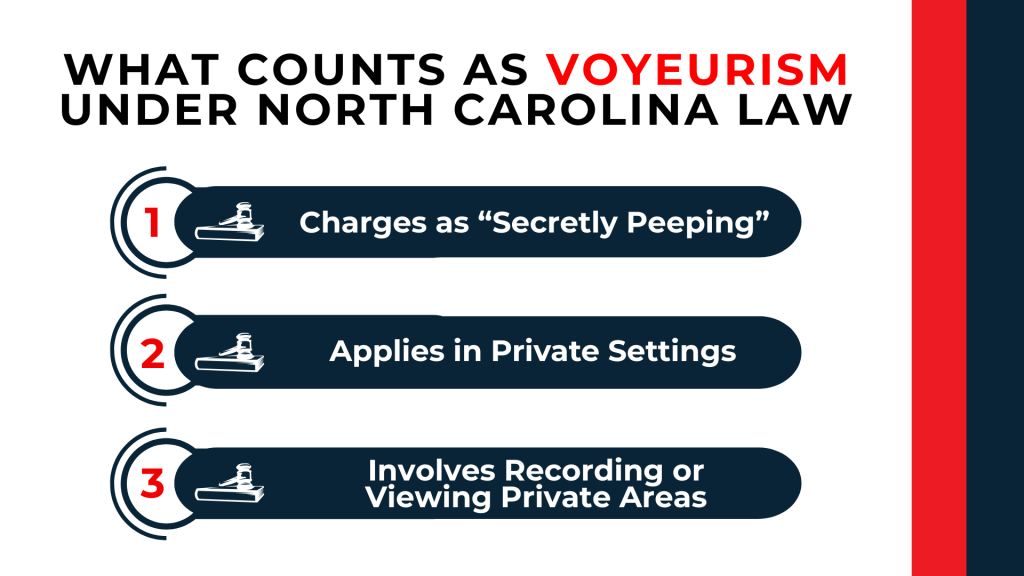
North Carolina does not use the word “voyeurism” in its criminal code. The charge appears on court documents as “secretly peeping into room occupied by another person” under N.C.G.S. § 14-202. If you search your name in court records or read your charging paperwork, that is the language you will see.
The statute covers a broad range of conduct built around a few key terms.
“Secretly” means the person being observed did not know they were being watched or recorded. If the person was aware of the observation, the secret peeping statute does not apply — though other statutes like harassment or stalking could.
“Room” is defined broadly. It includes bedrooms, bathrooms, restrooms, showers, dressing rooms, dressing stalls, cubicles, and any similar area designed to provide privacy. The statute also reaches situations outside of a traditional room. It covers any circumstances in which a reasonable person would believe they could disrobe in privacy or that a private area of their body would not be visible to the public. This applies whether the person is in a public or private place.
“Photographic image” covers any photograph, video, digital image, live transmission, or motion picture of any individual person.
“Private area” means the naked or genitals, pubic area, buttocks, or female breast covered by undergarments.
These definitions matter because the specific facts of what allegedly happened determine whether a charge is filed as a misdemeanor or a felony. The gap between those two outcomes is significant.
Is Voyeurism a Misdemeanor or a Felony in North Carolina?
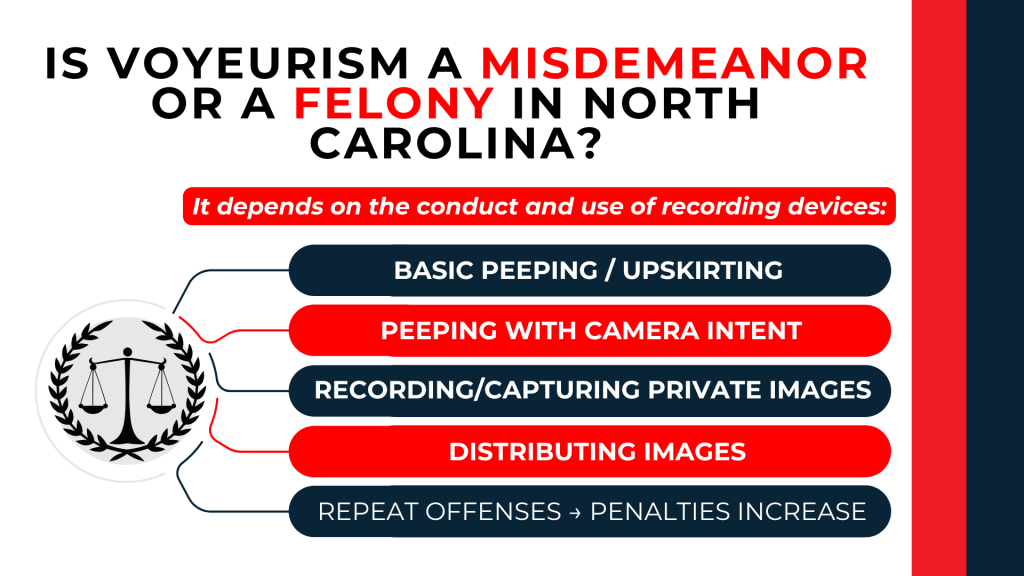
It can be either. N.C.G.S. § 14-202 creates a tiered system of offenses that escalates based on what the person allegedly did and whether recording technology was involved.
Basic secret peeping — looking secretly into a room occupied by another person — is a Class 1 misdemeanor under subsection (a). No camera or sexual motive needs to be proven. A first offense at this level carries the lowest penalties in the statute.
Upskirting or similar secret viewing — secretly peeping underneath or through another person’s clothing using a mirror or device without consent — is also a Class 1 misdemeanor under subsection (a1).
Peeping while possessing a camera — secretly peeping into a room while in possession of any device capable of creating a photographic image, with the intent to create an image — is a Class A1 misdemeanor under subsection (c). The state does not have to prove a photo was actually taken. Possession of the device plus intent is enough.
Recording for sexual gratification — using any device to create a photographic image of another person while secretly peeping, for the purpose of arousing or gratifying the sexual desire of any person — is a Class I felony under subsection (d). This is where the statute crosses from misdemeanor to felony territory. It is also the point at which sex offender registration enters the conversation.
Capturing images of private areas without consent — knowingly creating a photographic image of a private area of an individual without their consent, under circumstances where they had a reasonable expectation of privacy — is a Class I felony under subsection (e1).
Installing a secret recording device — secretly or surreptitiously using or installing a device in a room that can create a photographic image, with the intent to capture someone’s image without consent and for the purpose of sexual arousal or gratification — is a Class I felony under subsection (f).
Possessing secretly obtained images — knowingly possessing a photographic image that the person knows or has reason to believe was obtained through secret peeping — is a Class I felony under subsection (g).
Disseminating secretly obtained images — distributing or allowing the distribution of images the person knows or should have known were obtained through secret peeping, without the consent of the person depicted — is a Class H felony under subsection (h). This is the most severely classified offense in the statute.
The statute also includes a repeat-offense rule under subsection (i): a second or subsequent felony conviction is punished as though it were one class higher. A second misdemeanor conviction at the Class 1 level becomes a Class A1 misdemeanor. A second Class A1 misdemeanor becomes a Class I felony.
What Are the Penalties for a Voyeurism Conviction in North Carolina?
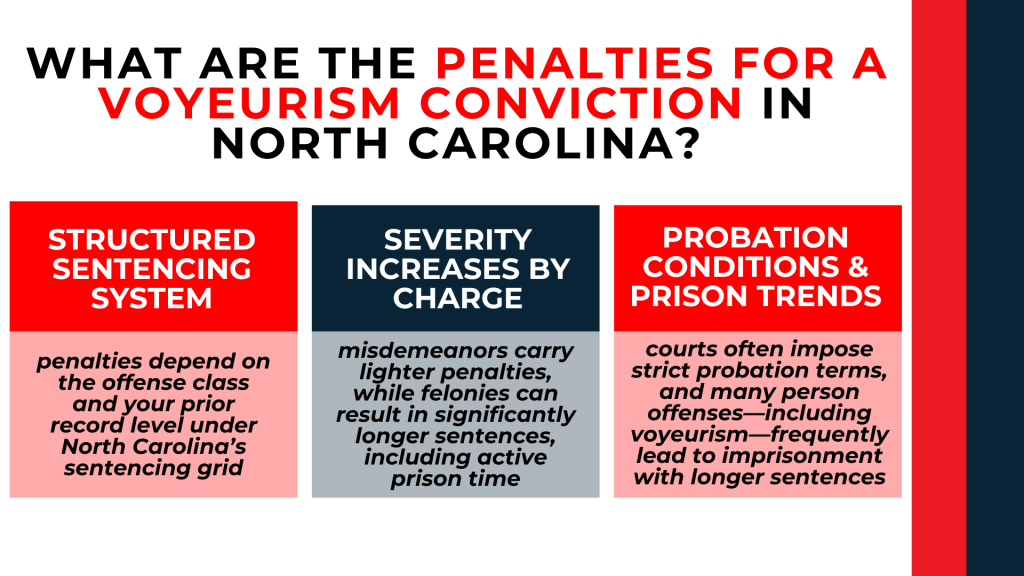
North Carolina uses a Structured Sentencing system under N.C.G.S. § 15A-1340.10 that calculates punishment based on two variables: the offense classification and your prior record level. The specific sentence range for any given conviction depends on where those two variables meet on the state’s sentencing grid.
For the misdemeanor tiers of secret peeping, penalties increase with the classification — a Class A1 misdemeanor (peeping with a camera in possession, or a second basic peeping offense) carries a higher sentencing range than a Class 1 misdemeanor.
For the felony tiers, the ranges are much higher. Class I felonies (recording for sexual gratification, capturing private images without consent, installing a device, or possessing secretly obtained images) carry sentences that depend on prior record level and can include active imprisonment. A Class H felony conviction for disseminating secretly obtained images carries a higher sentencing range still.
North Carolina sentencing data provides context for how courts handle person offenses — the category that includes sex-related crimes. In fiscal year 2024, 62% of person offense convictions resulted in active imprisonment, the highest rate of any crime type. Person offenses also carried the longest average active sentences compared to property, drug, and other categories, with an average minimum of 69 months and average maximum of 100 months. Eight percent of person offense sentences fell in the aggravated range — also the highest of any crime type.
If a voyeurism conviction results in probation rather than active time, the statute includes specific conditions. For a first conviction, the judge may require a psychological evaluation and following any recommended treatment. For a second or subsequent conviction, that evaluation and treatment are mandatory.
Will I Have to Register as a Sex Offender for a Voyeurism Charge?
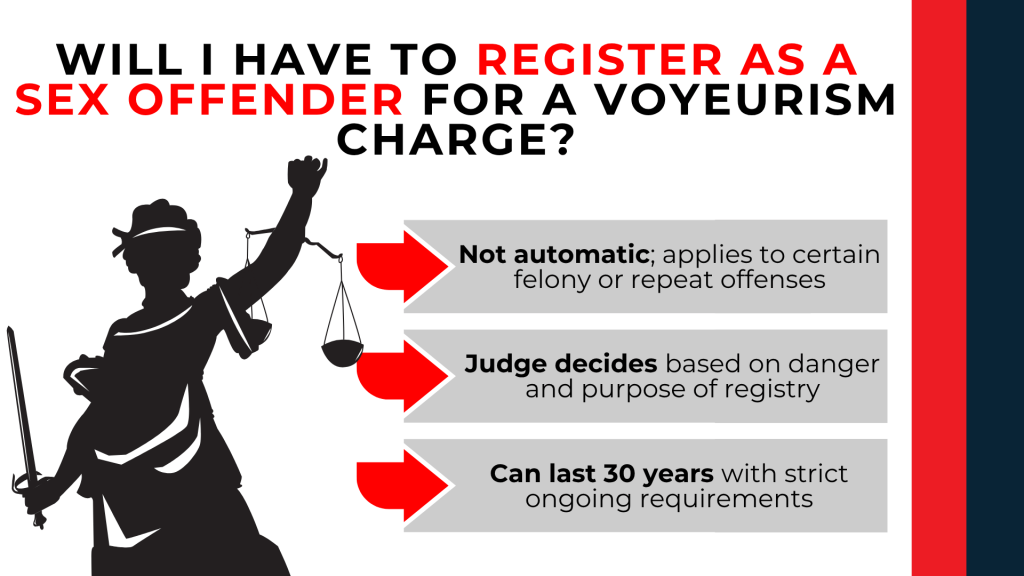
Sex offender registration is not automatic for every voyeurism conviction in North Carolina, but it is a real possibility — and for many people facing these charges, it is the consequence that concerns them most.
Under N.C.G.S. § 14-202(l), registration becomes a question the court must address whenever you are convicted of any felony-level secret peeping offense — subsections (d), (e1), (f), (g), or (h) — or are convicted of a second or subsequent misdemeanor-level offense under subsections (a), (a1), or (c).
When that trigger is met, the sentencing court is required to consider two things. First, whether you are a danger to the community. Second, whether requiring registration would further the purposes of North Carolina’s Sex Offender Registry as stated in N.C.G.S. § 14-208.5 — which are to assist law enforcement in protecting communities and to facilitate the exchange of relevant information about convicted offenders. If the court finds both, it enters an order requiring registration.
The standard registration period in North Carolina is 30 years. You may petition to end the registration requirement after 10 years, provided you are not classified as a recidivist, sexually violent predator, or aggravated offender under the registry statutes.
What makes this determination so serious is the weight of what follows. North Carolina currently has approximately 25,000 or more registered sex offenders. Registrants face ongoing obligations including verification requirements, location restrictions, and GPS electronic monitoring in some cases — with 581 sex offenders enrolled in GPS monitoring as of fiscal year 2022–2023. Whether registration is ordered depends heavily on the facts presented to the sentencing judge. That makes both the quality of the defense and the preparation for sentencing critical.
How Can You Defend Against a Voyeurism Charge?
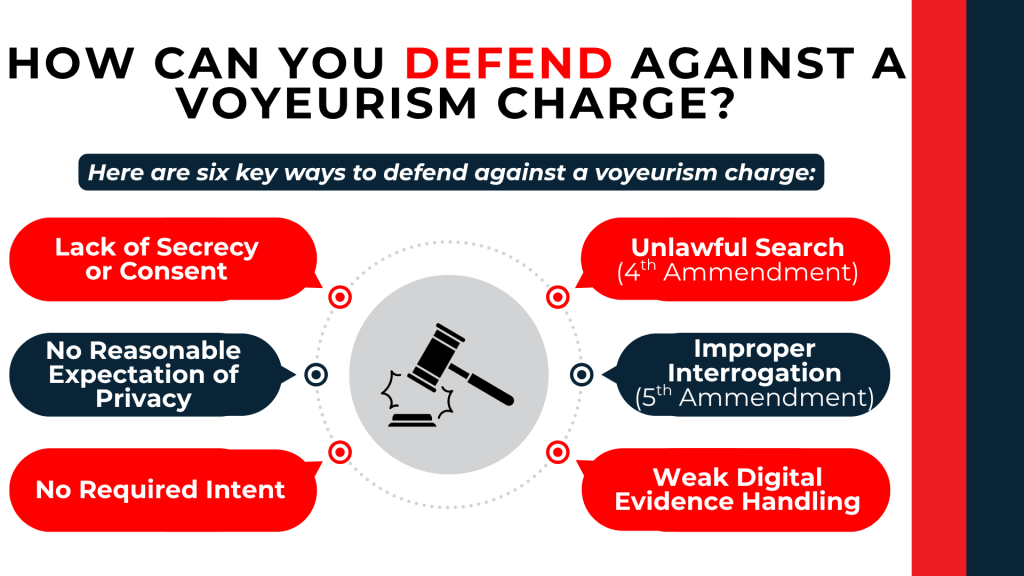
Every voyeurism case turns on its specific facts, but the structure of N.C.G.S. § 14-202 creates several categories of defense that a criminal defense attorney will evaluate.
The “secretly” element. The statute requires that the peeping was done without the knowledge or consent of the person being observed. If the person knew they were being watched or recorded — or consented to it — the secret peeping statute does not apply. Evidence of the other person’s knowledge or consent directly eliminates a required element of the offense.
The “room” element and reasonable expectation of privacy. The prosecution must prove that the observation occurred in a room as defined by the statute or under circumstances where the individual had a reasonable expectation of privacy. If the alleged conduct occurred in a setting where no reasonable expectation of privacy existed, that element fails.
Intent and purpose. The felony tiers of the statute require proof of specific intent — either intent to create a photographic image (subsection c), purpose of sexual arousal or gratification (subsections d and f), or knowing possession or dissemination (subsections g and h). The state must prove the specific mental state required for the charged offense. For the Class A1 misdemeanor under subsection (c), for example, the prosecution must prove not just that you had a camera-capable device, but that you intended to use it to create an image.
Fourth Amendment suppression. If evidence was obtained through an unlawful search — a device examined without a proper warrant, a search that exceeded the warrant’s scope, or cloud data accessed without separate authorization — a motion to suppress can remove that evidence from the case entirely. In voyeurism prosecutions, where the state’s case frequently depends on digital evidence, successful suppression may seriously weaken the prosecution’s ability to proceed.
Fifth Amendment suppression. Statements obtained during custodial interrogation without proper Miranda warnings, or through coercive circumstances, may be suppressed. If a required recording of the interrogation was not made, that failure is itself admissible evidence about whether any resulting statement was voluntary.
Chain of custody and forensic methodology. Digital evidence must be collected, preserved, and analyzed under proper forensic procedures. Challenging whether material was automatically downloaded, cached by software without the user’s knowledge, or accessed by someone other than you can undermine the state’s proof of knowing possession or intentional creation.
No defense strategy can be evaluated in the abstract. What matters is how the facts of a particular case interact with the elements the prosecution is required to prove.
Why Does Your Choice of Attorney Matter in a Voyeurism Case?
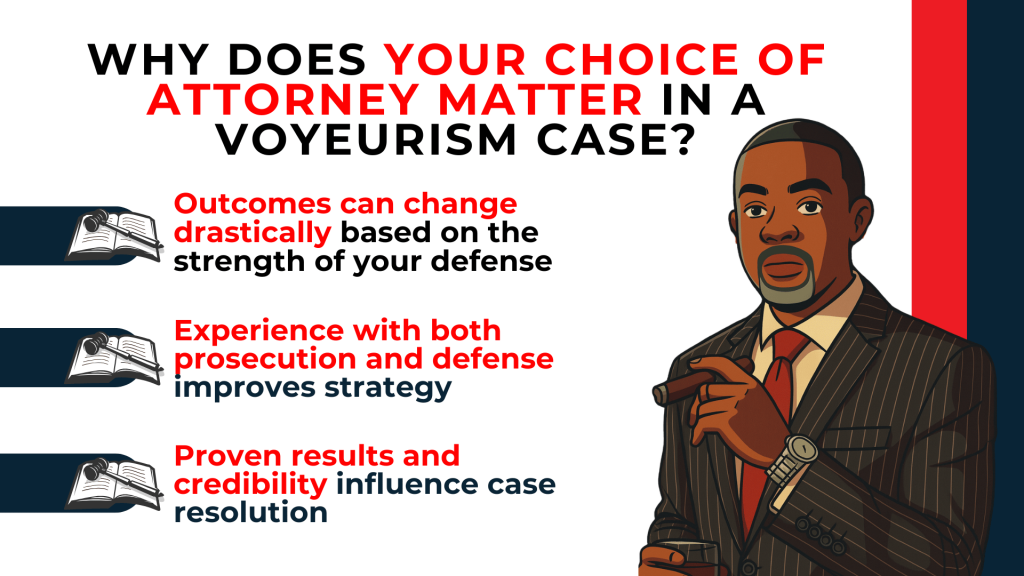
Voyeurism cases involve sensitive factual circumstances and high-stakes sentencing decisions. The difference between a misdemeanor and a felony — or between registration and no registration — often comes down to how the defense is prepared and presented.
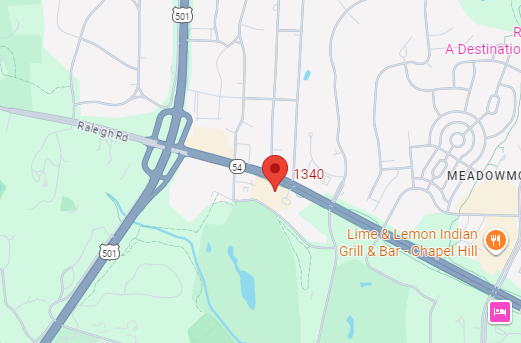
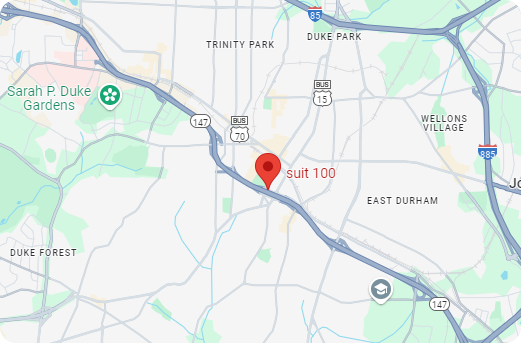
Attorney Patrick Roberts has defended clients facing sex offense charges from the firm’s offices in Raleigh, Durham, Chapel Hill, and Cary for more than two decades. He is a graduate of Duke University School of Law (Top 7 in best law schools and Top 9 in their criminal law program) and finished his bachelor’s degree from Johns Hopkins University, top 7 in National Universities. He is a graduate of Gerry Spence’s Trial Lawyers College and the National Criminal Defense College Trial Practice Institute, and completed the 2025 NCDC Cross-Examination Intensive — advanced training in high-stakes witness examination. He has been rated AV Preeminent by Martindale-Hubbell for over five consecutive years, holds a 10/10 “Superb” AVVO rating maintained for more than 15 years, and has been recognized as a Client Champion Platinum by Martindale-Hubbell for over five consecutive years.
Before founding Patrick Roberts Law PLLC, Mr. Roberts served as an Assistant District Attorney in Wake, Johnston, and New Hanover counties — experience that gives him a firsthand understanding of how prosecutors build, evaluate, and prioritize sex offense cases. He is admitted to practice before the U.S. Supreme Court, the Fourth Circuit Court of Appeals, and all federal district courts in North Carolina. He is a lifetime member of the National Association of Criminal Defense Lawyers and the only North Carolina attorney listed on the National Child Abuse Defense & Resource Center as of 2026. He has co-authored two legal books, including one on defending internet sex crimes.
Attorney Patrick Roberts has successfully* resolved serious sex offense allegations, including:
- 2025 — Closed allegation of sexual assault by a child under 13 claiming molestation by stepfather.
Result: No charges filed
- 2025 — Closed allegation of sexual assault by a 15-year-old teenager claiming sexual touching.
Result: No charges filed
- 2026 — Closed allegation of rape after client met a woman at a bar who claimed he raped her.
Result: No charges filed
Disclaimer: Each case is different and must be evaluated separately. Prior results achieved do not guarantee similar results can be achieved in future cases.
Click here to see more case results.
Client Testimonial
What clients consistently describe is the experience of working with someone who is prepared, direct, and present when it counts:
“I was lost, frustrated, and scared after my arrest. I was falsely accused of first degree rape. After speaking with Patrick I was put at ease. He asked questions, was engaged, and very straight to the point. I was blown away and hired him. He worked long hours and weekends on my case, while running his practice. If I ever need anyone again in the area he would be the only person I would go with.” — Verified client review on Avvo.com
Peer Testimonial
His peers in the legal profession share that assessment:
“Mr. Roberts demonstrates a high level of expertise, competence and professionalism. He is well prepared for trial and represents all clients well. Mr. Roberts is dependable and he represents the legal profession well. I am confident in his ability to represent his clients.” — Martindale-Hubbell verified Peer Review
Disclaimer: The testimonials are actual comments. Every case is different and depends on its own unique facts and legal circumstances. These results are illustrative of the matters the firm handles but do not guarantee, warrant, or predict a similar outcome in your legal matter.
If you are facing voyeurism or secret peeping charges in North Carolina, contact Patrick Roberts Law PLLC to discuss your case.
The law firm is currently accepting a limited number of new consultations to ensure each potential matter receives a thorough, high-level evaluation.
Disclaimer: The information on this website is for general informational purposes only and does not constitute legal advice for any individual case or situation. Contacting us via this website, email, or contact form does not create an attorney-client relationship. Each case is different and must be evaluated separately; prior results do not guarantee a similar outcome.

Former assistant district attorney
Contact Patrick Roberts
Facing criminal charges in North Carolina demands seasoned representation. Trust in the experience and dual perspective of Patrick Roberts. Reach out today for a confidential consultation.
-
Call Our Team
Calls answered 24/7






For more information on the selection criteria, go to www.martindale.com
*Each case is different and must be evaluated separately. Prior results achieved do not guarantee similar results can be achieved in future cases.