

Researching the costs associated with a sex crimes defense in North Carolina is a necessary step in navigating a high-stakes legal matter. Because these cases are among the most resource intensive areas of criminal law, the cost of representation is a direct reflection of the analytical precision and exhaustive investigation required.
While fees are a primary consideration, a more critical factor is the valuation of the advocacy being provided. This article outlines the professional standards that drive the cost of a defense and examines how the long-term consequences of a conviction compare to the requirements of a sophisticated legal strategy.
What Factors Determine the Cost of a Sex Crimes Defense Attorney?
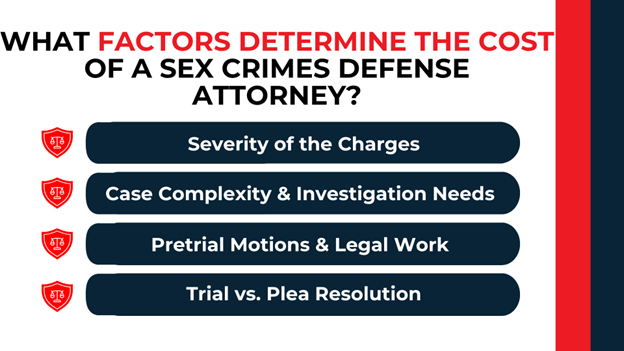
There is no single price for sex crime defense. Fees vary based on the complexity of the case, the severity of the charges, and the work required to mount an effective defense. Several factors consistently drive cost.
Charge severity. North Carolina’s sex offense framework ranges from Class A1 misdemeanors (sexual battery under N.C.G.S. § 14-27.33) to Class B1 felonies (first-degree forcible rape under N.C.G.S. § 14-27.21, statutory rape of a child by an adult under N.C.G.S. § 14-27.23). The more serious the charge, the more preparation, investigation, and court time the defense requires. According to the NC Sentencing Commission, the median time from charge to sentencing for Class B1 felonies is 30 months — significantly longer than the 10-month median for all felonies. Cases that stretch over years require sustained legal work.
Investigation and expert witnesses. Sex crime defense frequently requires independent investigation: forensic analysis of digital devices, expert witnesses on memory suggestibility or forensic interview technique, and sometimes private investigators to locate witnesses or develop alibi evidence. Under State v. McGrady, 368 N.C. 880, 787 S.E.2d 1 (2016), North Carolina applies the Daubert reliability standard to expert testimony — meaning both prosecution and defense experts must meet rigorous evidentiary thresholds. Retaining qualified defense experts is a significant component of case cost.
Pretrial motions and hearings. Effective defense in sex crime cases involves extensive pretrial work. Suppression motions challenging evidence obtained in violation of Riley v. California, 573 U.S. 373 (2014), Daubert motions to exclude unreliable expert testimony, Rule 412 motions for in camera hearings on complainant bias or motive evidence under State v. Goins, 244 N.C. App. 499, 781 S.E.2d 45 (2015), and confrontation challenges under Crawford v. Washington, 541 U.S. 36 (2004) — each requires legal research, briefing, and court argument. This pretrial work is often what creates the leverage for dismissal or charge reduction.
Trial preparation and trial itself. Only 15% of Class B1 felony convictions in FY 2024 went to jury trial, but that number is the highest trial rate of any felony class. Sex crime cases that go to trial require jury selection strategy — NC permits extensive attorney-led voir dire under N.C.G.S. § 15A-1214 — witness preparation, cross-examination, opening and closing arguments, and often multi-day courtroom presence. Trial-level representation is the most resource-intensive phase of any criminal case.
Why is Experienced Representation Worth the Investment?
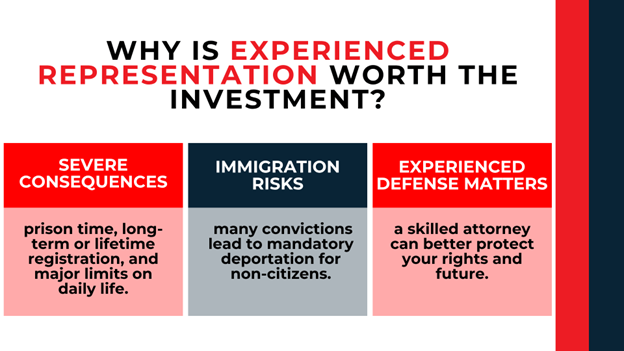
Convictions for serious sex offenses carry severe legal and personal consequences, including substantial prison terms. In North Carolina, sex offender registration under N.C.G.S. § 14-208 et seq. is mandatory for virtually all convictions, with a standard registration period of 30 years and lifetime registration for aggravated offenses. Beyond the mandatory public listing, registrants face restrictive GPS monitoring and permanent residency limitations. With approximately 25,000 individuals currently listed on the NC SBI registry, the ongoing restrictions on housing, career trajectory, and private life are both predictable and permanent.
For non-citizens, the Supreme Court ruling in Padilla v. Kentucky, 559 U.S. 356 (2010), mandates that defense counsel provide specific advice regarding immigration consequences prior to any plea. Under federal law, most sex offense convictions are classified as aggravated felonies, triggering mandatory deportation. Furthermore, data from the North Carolina Sentencing Commission indicates that defendants facing Class B1 felonies often spend an average of 27 months in pretrial detention. Given these permanent legal and personal stakes, securing a defense grounded in elite analytical rigor is a structural necessity.
What Should You Look for When Evaluating a Sex Crimes Defense Attorney?
Cost is one factor — but it should not be the only factor. The following considerations help distinguish attorneys who are equipped for these cases.
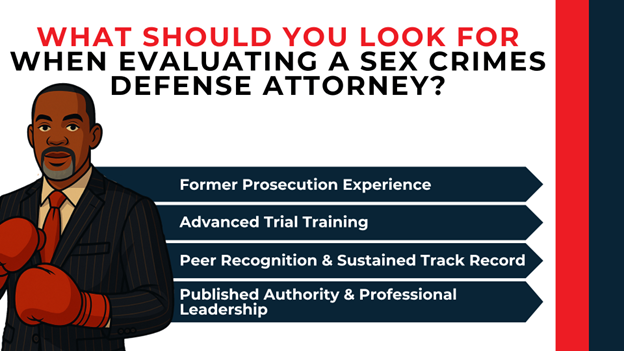
Former prosecution experience. An attorney who has prosecuted sex crimes understands the State’s approach — how cases are built, which evidence prosecutors prioritize, and where the weaknesses in their method tend to appear.
Advanced trial training. Sex crime cases that go to trial are won or lost on cross-examination and witness credibility. Attorney Roberts completed training at Gerry Spence’s Trial Lawyers College — a three-week intensive covering every phase of trial — the NCDC Trial Practice Institute, and the 2025 NCDC Cross-Examination Intensive. These programs develop the specific skills that matter in high-stakes courtroom proceedings.
Peer recognition and sustained track record. Attorney Roberts maintains a 10/10 “Superb” Avvo rating held for over 15 years and is the only North Carolina lawyer listed on the National Child Abuse Defense & Resource Center (as of 2026). He is admitted to practice before the U.S. Supreme Court, the Fourth Circuit Court of Appeals, and all Federal District Courts in North Carolina.
Published authority and professional leadership. Mr. Roberts is the co-author of two legal books, has been featured in Super Lawyers Magazine and on the cover of Attorney-at-Law Magazine, and has been quoted by national media outlets including USA Today and Fox News. He is a lifetime member of the National Association of Criminal Defense Lawyers, a Former Commissioner of the North Carolina State Ethics Commission, and has served on the North Carolina Juvenile Justice Planning Committee.
Academic Precision & Trial Advocacy
Attorney Patrick Roberts applies the rigorous standards of a Duke University School of Law education (Class of 2000) to the defense of the accused. Ranked tied for #6 in the nation alongside Harvard Law (U.S. News & World Report, 2025–2026), Duke Law serves as a global pillar for criminal law scholarship and intellectual precision.
A graduate of both The Johns Hopkins University and Duke Law, Patrick Roberts brings nearly two decades of high-level litigation experience to the defense of the accused. His practice is built on the principle that a robust constitutional defense is an essential safeguard against the weight of government prosecution. Having served as an Assistant District Attorney in Wake, Johnston, and New Hanover counties, he understands the mechanics of the state and utilizes that insight to direct hundreds of bench and jury trials in both state and federal courts.
Verified Professional Standing
The quality of this advocacy is reflected in sustained peer and client recognition. Patrick Roberts holds the AV Preeminent Peer Rating from Martindale-Hubbell—the highest possible mark for legal ability and ethical standards—maintained for over five consecutive years. Additionally, he has earned the Client Champion Platinum recognition for consistent excellence in client service.
What Do Clients and Peers Say About Attorney Patrick Roberts?
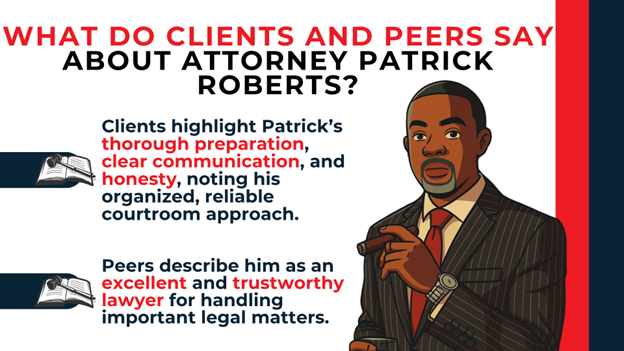
“Patrick and his team double check their own knowledge of the law so that their courtroom presentation is well organized and flawless. Someone from the office always calls the morning of a court appearance to verify your attendance as well as tell you who will be present from their office. Patrick is VERY upfront and honest.” — Review originally posted by a verified client on Avvo.com.
“Patrick is an excellent lawyer and I trust him to handle my important legal matters.” — Martindale-Hubbell Peer Review
Disclaimer: The testimonials and peer reviews on this site are for informational purposes. They do not constitute a guarantee, warranty, or prediction regarding the outcome of your legal matter. Every case is different and must be evaluated on its own merits.
Testimonials and peer endorsements found on this website are actual comments.
How Do You Take the Next Step?
While the cost of a sex crimes defense in North Carolina varies based on the complexity of the allegations, the cost of an inadequate defense is predictable and severe. At Patrick Roberts Law, we provide the elite analytical rigor of a Top 6 national law program (Duke Law, ’00) to every matter we accept.
We strictly limit our active caseload to ensure that every client receives the exhaustive research and deep-tier strategic focus required in North Carolina criminal litigation. This focused model allows Patrick Roberts to ensure all your constitutional rights are defended.
Request a Confidential Initial Evaluation
We provide private evaluations to review the specific facts of your case, analyze the statutory charges, and provide a strategic roadmap for your defense. Contact Patrick Roberts Law to secure the dedicated professional direction your future requires.

Disclaimer: The information on this website is for general informational purposes only. Nothing herein should be taken as legal advice for any individual case or situation. Contacting us via this website, email, or contact form does not create an attorney-client relationship. Case results depend on a variety of factors unique to each case; prior results do not guarantee a similar outcome.
Former assistant district attorney
Contact Patrick Roberts
Facing criminal charges in North Carolina demands seasoned representation. Trust in the experience and dual perspective of Patrick Roberts. Reach out today for a confidential consultation.
-
Call Our Team
Calls answered 24/7






For more information on the selection criteria, go to www.martindale.com
*Each case is different and must be evaluated separately. Prior results achieved do not guarantee similar results can be achieved in future cases.