
If you are facing sex crime charges in North Carolina, one of the first questions on your mind is whether a lawyer can get those charges dropped or reduced. The answer depends on the facts, the evidence, and the specific legal vulnerabilities in the State’s case. North Carolina law provides multiple pathways where defense counsel can challenge the prosecution’s case at every stage — from pre-indictment investigation through trial — and secure outcomes that range from outright dismissal to significant charge reductions.
Understanding how those pathways work is the first step toward protecting yourself.
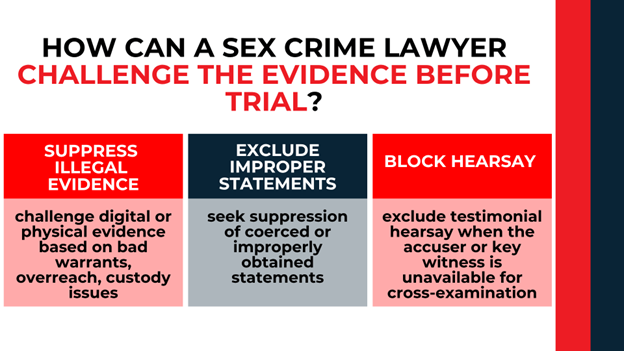
How Can a Sex Crime Lawyer Challenge the Evidence Before Trial?
The most effective defense work in sex crime cases often happens before the case reaches a courtroom. North Carolina’s procedural and constitutional framework gives defense counsel several tools to challenge the State’s evidence at the pretrial stage.
Suppression of illegally obtained evidence. Following Riley v. California, 573 U.S. 373 (2014), law enforcement needs a warrant to search cell phones and digital devices — even during an arrest. In sex crime cases, digital evidence is often the prosecution’s foundation. Under N.C.G.S. § 15A-248, search warrants must be executed within 48 hours. Defense counsel files suppression motions challenging warrant particularity (did the warrant specifically authorize forensic examination?), scope (did the search go beyond what was authorized?), and chain of custody. If the court suppresses key evidence, the prosecution may lack sufficient evidence to proceed.
Challenging statements and confessions. North Carolina mandates recording of custodial interrogations for serious sex offenses under N.C.G.S. § 15A-211. An unrecorded interrogation is admissible evidence supporting involuntariness claims. Where a defendant made statements under pressure, defense counsel moves to suppress under the voluntariness doctrine. Polygraph evidence is inadmissible in North Carolina under State v. Grier, 307 N.C. 628, 300 S.E.2d 351 (1983), preventing prosecutors from introducing failed polygraph results.
Confrontation challenges. Under Crawford v. Washington, 541 U.S. 36 (2004), testimonial hearsay — statements made primarily to establish past events for prosecution — requires the declarant’s availability for cross-examination. State v. Locklear, 363 N.C. 438, 681 S.E.2d 293 (2009), found a Confrontation Clause violation where a non-testifying expert’s opinions were admitted through another witness. If the complainant is unavailable or refuses to testify, and their prior statements are testimonial, the prosecution’s case may collapse.
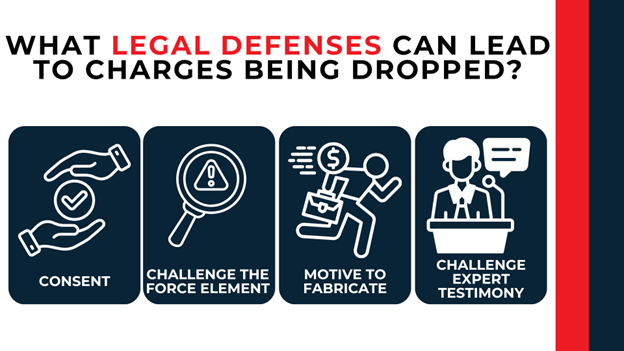
What Legal Defenses Can Lead to Charges Being Dropped?
The specific defense depends on the charge. North Carolina’s sex offense statutes each require distinct elements — and if the prosecution cannot prove every element beyond a reasonable doubt, the charge fails.
Consent. For forcible sex offenses, consent is a complete defense. State v. Yelverton, 274 N.C. App. 348, 851 S.E.2d 434 (2020), affirmed this principle. The prosecution must prove both force and lack of consent as separate elements. State v. Henderson, 233 N.C. App. 538, 756 S.E.2d 860 (2014), confirmed that a nonconsensual act alone — without independent proof of force — is insufficient for a forcible rape conviction. Defense counsel documents text messages, witness accounts, and prior relationship evidence to establish that the encounter was consensual.
Challenging the force element. In State v. Alston, 310 N.C. 399, 312 S.E.2d 470 (1984), the NC Supreme Court held that force must be specific to the charged act. Generalized fear from a prior relationship does not satisfy the force requirement. This distinction is critical in cases involving former partners or ongoing relationships.
Motive to fabricate. NC Rule 412 (the Rape Shield law) generally excludes evidence of a complainant’s prior sexual behavior, but courts have carved important exceptions. State v. Martin, 241 N.C. App. 602, 774 S.E.2d 330 (2015), held that motive and bias evidence is admissible outside Rule 412’s scope. State v. Goins, 244 N.C. App. 499, 781 S.E.2d 45 (2015), held that bias evidence is admissible when the State’s case depends on complainant credibility. Where the accusation is driven by a custody dispute, relationship breakdown, or other motive, defense counsel files a motion for in camera hearing with a specific offer of proof.
Expert testimony challenges. State v. Hall, 330 N.C. 808, 412 S.E.2d 883 (1992), permits prosecution expert testimony about victim behavior (delayed reporting, recantation) — but not to prove abuse actually occurred. State v. Hammett, 361 N.C. 92, 637 S.E.2d 518 (2006), requires that expert opinions on whether abuse occurred rest on physical evidence, not solely on a complainant’s statements. Daubert motions under State v. McGrady, 368 N.C. 880, 787 S.E.2d 1 (2016), can exclude prosecution experts who exceed these boundaries.
Can Sex Crime Charges Be Reduced to Lesser Offenses?
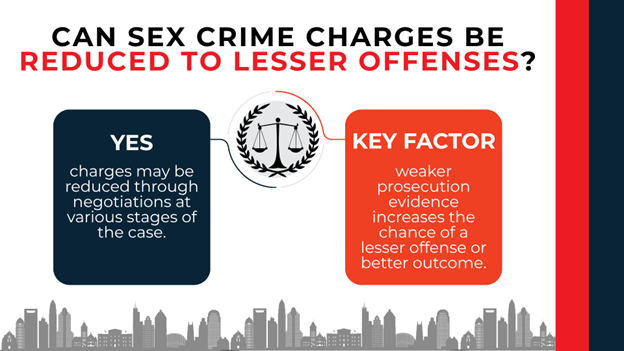
Yes — and this is one of the most important functions of a sex crime lawyer. North Carolina’s graduated statutory scheme means the difference between charge classifications can be significant in terms of consequences.
Charge reduction negotiations happen at multiple points: before indictment, during pretrial conferences, and even during trial through lesser-included offense instructions. The leverage for these negotiations comes from the strength of the defense — the weaker the State’s evidence, the stronger the position for a reduced charge.
According to the NC Sentencing Commission, 85% of Class B1 felony convictions in FY 2024 resulted from guilty pleas, while 15% went to jury trial — the highest trial rate of any felony class. The 98% guilty plea rate across all NC felony convictions includes cases where plea agreements resulted in reduced charges. Defense counsel’s role is to identify the specific weaknesses in the State’s case and use them to negotiate the best possible resolution — whether that is a dismissal, a reduction, or a plea to a charge that avoids the most severe collateral consequences.
Recent Case Result: In 2025, Attorney Roberts closed an allegation of sexual assault by a child under 13 claiming a stepfather was molesting her.
Result: No Charges Filed.
Disclaimer: Each case is different and must be evaluated separately. Prior results achieved do not guarantee similar results can be achieved in future cases.
See more case results here.
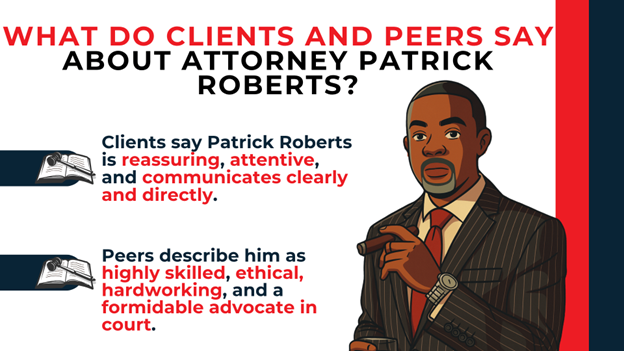
“After speaking with Patrick I was put at ease. He asked questions, was engaged, and very straight to the point.” — Review originally posted by a verified client on Avvo.com.
“Patrick is an extremely talented lawyer who has the highest ethical standards. He works extremely hard for his clients and is a very skilled adversary in court.” — Martindale-Hubbell Peer Review
Disclaimer: The testimonials and peer reviews on this site are for informational purposes. They do not constitute a guarantee, warranty, or prediction regarding the outcome of your legal matter. Every case is different and must be evaluated on its own merits.
Testimonials and peer endorsements found on this website are actual comments.
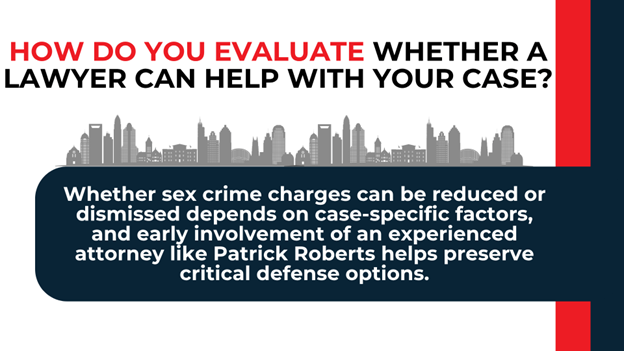
How Do You Evaluate Whether a Lawyer Can Help With Your Case?
The resolution of a high-stakes criminal matter depends on a rigorous analysis of the specific evidence, the credibility of witnesses, and the underlying constitutional issues. Securing a defense grounded in academic precision early in the process ensures that all potential legal avenues are preserved.
Academic Credentials & Trial Experience
Attorney Patrick Roberts is a graduate of Duke University School of Law and The Johns Hopkins University. Duke University School of Law is currently tied for #6 in the 2025–2026 U.S. News & World Report rankings, placing it alongside institutions such as Harvard and the University of Pennsylvania as a premier center for legal scholarship.
Direct Prosecutorial Insight
Since 2007, Patrick Roberts has directed hundreds of bench and jury trials across both state and federal courts. Before transitioning to defense, he served as an Assistant District Attorney in Wake, Johnston, and New Hanover counties. This background provides a technical advantage in analyzing how the State evaluates evidence, determines charging priorities, and responds to complex pretrial challenges.
Advanced Litigation & Trial Training
To maintain the highest standards of courtroom advocacy, Patrick Roberts has completed intensive, specialized training at the nation’s most recognized trial institutes:
- The NCDC Trial Practice Institute and the 2025 NCDC Cross-Examination Intensive (National Criminal Defense College)
- Gerry Spence’s Trial Lawyers College
This commitment to ongoing professional development ensures that every case is managed with the analytical depth and strategic precision required in North Carolina criminal litigation.
National Recognition & Federal Admissions
Patrick Roberts is currently the only North Carolina practitioner listed by the National Child Abuse Defense & Resource Center (as of 2026). His professional standing is further evidenced by a 10/10 “Superb” Avvo rating maintained for over 15 years and the AV Preeminent® Peer Rating from Martindale-Hubbell—a mark of the highest level of ethical standards and legal ability, held for over five consecutive years.
To provide a comprehensive defense in both state and federal jurisdictions, Patrick Roberts is admitted to practice before:
- The Supreme Court of the United States
- The U.S. Court of Appeals for the Fourth Circuit
- All Federal District Courts in North Carolina (EDNC, MDNC, WDNC)
Leadership in Legal Ethics and Scholarship
Beyond the courtroom, Patrick Roberts has contributed to the structural integrity of the North Carolina legal system. He is a former Commissioner of the North Carolina State Ethics Commission and has served on the North Carolina Juvenile Justice Planning Committee.
A lifetime member of the National Association of Criminal Defense Lawyers (NACDL) and co-author of two legal texts, his insights on complex litigation have been featured in Super Lawyers Magazine, Attorney-at-Law Magazine, and national outlets including USA Today and Fox News.
Request a Confidential Case Evaluation
To maintain a high standard of intellectual thoroughness and dedicated oversight for every client, Patrick Roberts Law manages a strictly restricted caseload. Contact our office to schedule a confidential evaluation of your situation and available legal options.
Disclaimer: The information on this website is for general informational purposes only. Nothing herein should be taken as legal advice for any individual case or situation. Contacting us via this website, email, or contact form does not create an attorney-client relationship. Case results depend on a variety of factors unique to each case; prior results do not guarantee a similar outcome.
Former assistant district attorney
Contact Patrick Roberts
Facing criminal charges in North Carolina demands seasoned representation. Trust in the experience and dual perspective of Patrick Roberts. Reach out today for a confidential consultation.
-
Call Our Team
Calls answered 24/7






For more information on the selection criteria, go to www.martindale.com
*Each case is different and must be evaluated separately. Prior results achieved do not guarantee similar results can be achieved in future cases.