
How Do Juries Make Decisions in North Carolina Homicide Cases?
Yes, in North Carolina, juries can choose to convict a defendant of manslaughter instead of murder when the evidence supports such a finding. This is a critical aspect of North Carolina’s criminal justice system, particularly in homicide cases where the stakes are extremely high.
When a defendant is charged with first-degree murder in North Carolina, the jury typically has multiple verdict options available, as outlined in the North Carolina Pattern Jury Instructions (N.C.P.I.-Crim. 206.10):
- Guilty of first-degree murder
- Guilty of second-degree murder
- Guilty of voluntary manslaughter
- Guilty of involuntary manslaughter
- Not guilty
These options allow the jury to consider the specific circumstances of each case and determine which charge, if any, most accurately reflects the defendant’s actions and mental state.

What Are North Carolina’s Homicide Classifications?
To understand how juries make these decisions, it’s important to understand how North Carolina law defines each type of homicide:
What Constitutes First-Degree Murder? (Class A Felony)
First-degree murder in North Carolina is defined under N.C. Gen. Stat. § 14-17(a) as:
- A killing committed with “willful, deliberate, and premeditated” intent
- A killing committed during the perpetration of certain felonies (felony murder)
- A killing using “nuclear, biological, or chemical weapon of mass destruction, poison, lying in wait, imprisonment, starving, torture”
- Certain domestic violence-related killings under N.C. Gen. Stat. § 14-17(a1)
First-degree murder carries the most severe penalties, including the possibility of death or life imprisonment without parole.
How Is Second-Degree Murder Defined? (Class B1 or B2 Felony)
Second-degree murder is defined in N.C. Gen. Stat. § 14-17(b) as an unlawful killing with malice but without premeditation and deliberation. The key distinction from first-degree murder is the absence of planning before the act.
What Qualifies as Voluntary Manslaughter? (Class D Felony)
Voluntary manslaughter is defined in N.C. Gen. Stat. § 14-18 and case law as the unlawful killing of another without malice and without premeditation and deliberation. According to N.C.P.I.-Crim. 206.10, this typically occurs in two scenarios:
- When a person kills in the “heat of passion” upon adequate provocation
- When a person kills in imperfect self-defense (using excessive force or acting as an aggressor)
What Is Involuntary Manslaughter? (Class F Felony)
Involuntary manslaughter is defined in N.C. Gen. Stat. § 14-18 as the unintentional killing of another person through either:
- An unlawful act not amounting to a felony
- An act done in a criminally negligent manner

How Do Juries Make the Decision Between Murder and Manslaughter?
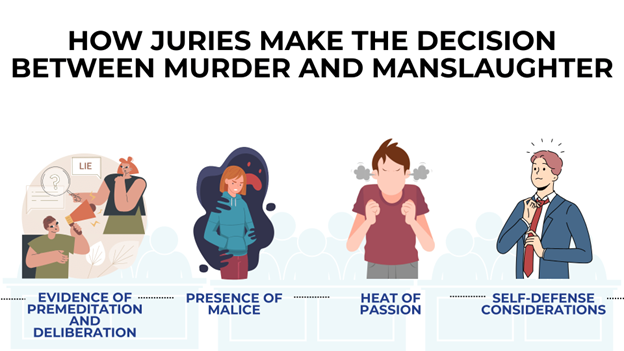
When deciding between murder and manslaughter charges, North Carolina juries must consider several key factors:
Evidence of Premeditation and Deliberation
For first-degree murder, the prosecution must prove the defendant formed the intent to kill over some period of time (premeditation) and acted in a cool state of mind (deliberation). According to N.C.P.I.-Crim. 206.10, evidence might include:
- Lack of provocation by the victim
- Conduct before, during, and after the killing
- Threats or declarations made by the defendant
- Use of excessive force
- Manner of killing
What Is the Role of Malice in Murder Charges?
Malice is a crucial element that distinguishes murder from manslaughter. In North Carolina law, malice is defined in N.C.P.I.-Crim. 206.10 as:
- Hatred, ill will, or spite
- “The condition of mind which prompts a person to intentionally take the life of another or to intentionally inflict serious bodily harm that proximately results in another person’s death without just cause, excuse or justification”
If a defendant acted with malice, they may be guilty of murder rather than manslaughter.
Heat of Passion
A key factor that can reduce murder to voluntary manslaughter is whether the defendant acted in the “heat of passion” upon adequate provocation. N.C.P.I.-Crim. 206.10 explains this occurs when:
- The defendant’s state of mind was “so violent as to overcome reason”
- The provocation would naturally cause such passion in a person of average mind and disposition
- The killing occurred before a reasonable cooling-off period
What Are the Self-Defense Considerations?
Self-defense plays a significant role in determining the appropriate charge under N.C. Gen. Stat. §§ 14-51.2, 14-51.3, and 14-51.4:
- Complete self-defense may result in a not guilty verdict
- Imperfect self-defense (excessive force or being the aggressor) may reduce murder to voluntary manslaughter
What Are Lesser Included Offenses in North Carolina Jury Instructions?
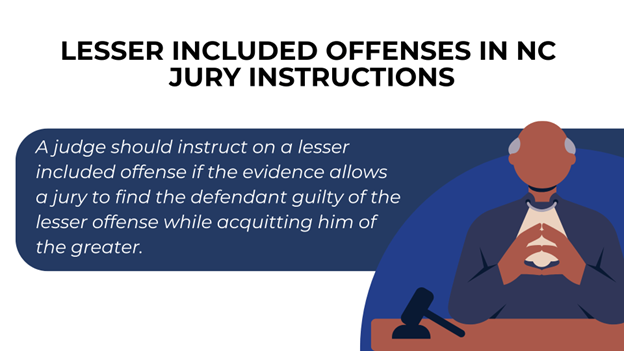
North Carolina law requires judges to instruct juries on lesser included offenses when the evidence warrants it. This is a critical protection in the criminal justice system.
According to State v. Leazer, 353 N.C. 234, 237 (2000), a judge should instruct on a lesser included offense if “the evidence would permit a jury rationally to find the defendant guilty of the lesser offense and acquit him of the greater.”
The standard jury instructions for first-degree murder in N.C.P.I.-Crim. 206.10 explicitly direct jurors to consider all lesser included homicide offenses, including second-degree murder, voluntary manslaughter, and involuntary manslaughter.
What Are Common Scenarios Where Juries Choose Manslaughter?
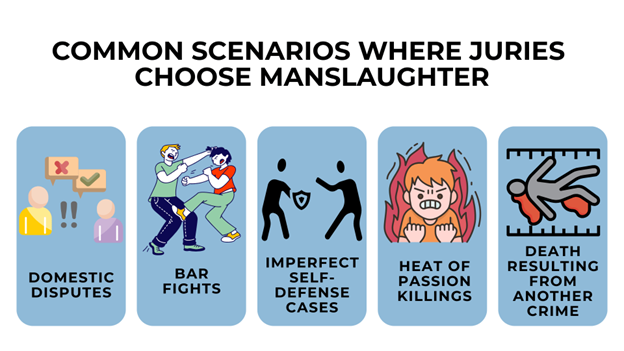
Several common factual scenarios might lead a North Carolina jury to choose manslaughter over murder:
- Domestic disputes that escalate to violence: When arguments between spouses or partners lead to violence without prior planning
- Bar fights or similar altercations: When a confrontation unexpectedly results in death
- Imperfect self-defense cases: When someone genuinely believed they needed to defend themselves but used excessive force as defined in N.C. Gen. Stat. § 14-51.4
- Heat of passion killings: When a person reacts immediately to a highly provocative situation, such as discovering a spouse in the act of infidelity
- Death resulting from another crime: When death occurs during the commission of a non-felony crime or through criminal negligence
The Role of a Defense Attorney in Jury Decisions
A skilled North Carolina criminal defense attorney plays a crucial role in helping juries understand when manslaughter may be more appropriate than murder by:
- Challenging evidence of premeditation and deliberation
- Presenting evidence of provocation
- Establishing grounds for self-defense under N.C. Gen. Stat. §§ 14-51.2 and 14-51.3
- Demonstrating a lack of malice
- Ensuring proper jury instructions are given regarding lesser included offenses

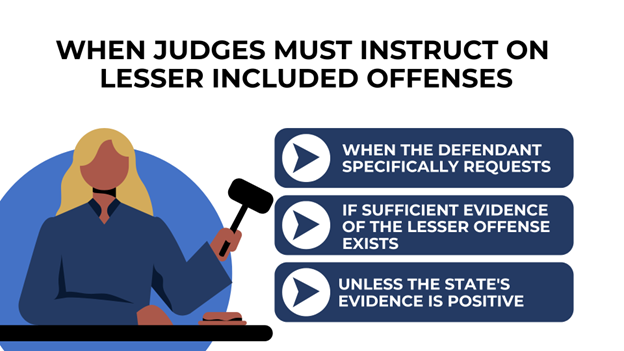
When Judges Must Instruct on Lesser Included Offenses
In North Carolina, case law has established when judges are required to provide instructions on lesser included offenses like manslaughter:
- When the defendant specifically requests such instructions and the evidence supports it (State v. Debiase, 2011 WL 1643629 (N.C. App. 2011))
- Even without a request, if sufficient evidence of the lesser offense exists (State v. Lowe, 150 N.C. App. 682, 686 (2002))
- Unless the State’s evidence is positive as to each element of murder with no contradictory evidence (State v. Millsaps, 356 N.C. 556, 562 (2002))
However, if a defendant explicitly asks the judge not to instruct on lesser included offenses (preferring an “all-or-nothing” approach), the judge may comply. In such cases, the defendant would be barred from later appealing based on the lack of those instructions (State v. Williams, 333 N.C. 719 (1993)).
Conclusion
The ability of a North Carolina jury to choose between murder and manslaughter charges provides important flexibility in the justice system, allowing for verdicts that accurately reflect the circumstances of each case. These options are firmly established in North Carolina statutory law (N.C. Gen. Stat. §§ 14-17 and 14-18) and reflected in the standard jury instructions (N.C.P.I.-Crim. 206.10).
If you or a loved one are facing a charge for murder or manslaughter, you deserve a legal advocate with the experience and dedication to secure the best possible outcome. Attorney Patrick Roberts of Patrick Roberts Law has successfully* defended numerous clients facing the most serious homicide charges. Contact our firm today for a confidential consultation.
*Disclaimer: Each case is different and must be evaluated on its individual facts. Attorney Roberts works hard to assess each case individually. Prior results do not guarantee any future outcome.
Former assistant district attorney
Contact Patrick Roberts
Facing criminal charges in North Carolina demands seasoned representation. Trust in the experience and dual perspective of Patrick Roberts. Reach out today for a confidential consultation.
-
Call Our Team
Calls answered 24/7






For more information on the selection criteria, go to www.martindale.com
*Each case is different and must be evaluated separately. Prior results achieved do not guarantee similar results can be achieved in future cases.