

What Are the Different Homicide Types in North Carolina?
In North Carolina, the difference between murder and manslaughter is important. These two charges can mean very different punishments and reflect how the law views the person’s intent and the circumstances of the death. Whether you’re looking for information for yourself or someone you care about, understanding these differences can help you navigate a difficult legal situation.
How Does North Carolina Define Murder Charges?
North Carolina law divides murder into different categories, each with specific elements that prosecutors must prove beyond a reasonable doubt.
What Constitutes First-Degree Murder in North Carolina?
First-degree murder is the most serious homicide charge in North Carolina. According to North Carolina General Statute § 14-17(a), first-degree murder includes killings that are:
- Planned and thought out ahead of time (willful, deliberate, and premeditated killing)
- Committed while doing another serious crime (like robbery or rape) or felony murder
- Carried out using poison, lying in wait, imprisonment, starving, or torture
- Done using “nuclear, biological, or chemical weapon of mass destruction” as defined in G.S. 14-288.21
The prosecutor must prove the person meant to kill, decided to do it before acting, and had time to think about it—even if just briefly. This can be very different from manslaughter charges.
First-degree murder in North Carolina is a Class A felony under G.S. § 14-17(a), punishable by either death or life in prison without the chance of parole. For people under 18 at the time of the crime, different sentencing rules apply under Part 2A of Article 81B of Chapter 15A of the General Statutes.
What Makes a Killing Second-Degree Murder?
Second-degree murder, defined in G.S. § 14-17(b), lacks the planning required for first-degree murder but still involves malice. This can be direct intent to kill or actions so reckless they show complete disregard for human life.
Examples of second-degree murder might include:
- Killing someone during an argument without planning it beforehand
- Shooting into a car knowing people are inside
- A death caused by extreme drunk driving, depending on the circumstances
Second-degree murder is usually a Class B1 felony in North Carolina. However, under G.S. § 14-17(b), if it comes from an “inherently dangerous act or omission, done in such a reckless and wanton manner as to manifest a mind utterly without regard for human life and social duty and deliberately bent on mischief,” it may be a Class B2 felony with somewhat lighter penalties.

How Are Manslaughter Charges Different in North Carolina?
Manslaughter charges, while still serious, are less severe than murder charges. North Carolina has two types of manslaughter, as outlined in G.S. § 14-18:
Voluntary Manslaughter: Killing in the Heat of Passion
Voluntary manslaughter typically involves a killing that would normally be murder, but happens under circumstances that make it less serious. North Carolina courts have consistently ruled that voluntary manslaughter lacks the malice required for murder due to mitigating factors.
The classic example is a killing committed in the “heat of passion” after strong provocation. For provocation to be legally sufficient, it must be the kind that would cause a reasonable person to lose control. Finding a spouse in the act of cheating has traditionally been recognized as such provocation.
Another scenario is imperfect self-defense, where someone truly but unreasonably believed they needed to use deadly force to protect themselves.
North Carolina General Statute § 14-18 classifies voluntary manslaughter as a Class D felony, typically punishable by serious prison time even for people with no prior criminal record.
Involuntary Manslaughter: Accidental Killing Through Carelessness
Involuntary manslaughter is the least serious form of homicide in North Carolina law. It involves an unintentional killing resulting from either:
- Carelessness that created a risk of death that a reasonable person would have recognized
- Doing something illegal but not a felony that results in death
Examples might include fatal hunting accidents, deaths from reckless driving (but not as extreme as would qualify for murder), or deaths during minor fights.
Classified as a Class F felony under G.S. § 14-18, involuntary manslaughter typically carries a prison sentence even for first-time offenders.

What Are the Key Differences Between Murder and Manslaughter?
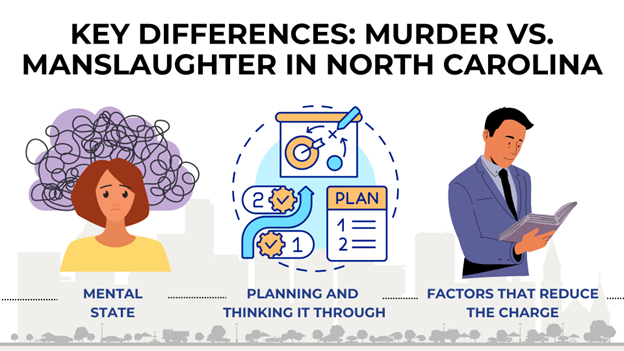
The main differences between murder and manslaughter charges in North Carolina focus on three key elements:
Mental State (What the Person Was Thinking)
The most important distinction involves what was going on in the person’s mind:
- Murder requires malice—either direct intent to kill or actions so reckless they show complete disregard for human life
- Manslaughter lacks this malice, involving either heat of passion (voluntary manslaughter) or carelessness (involuntary manslaughter)
This distinction explains why manslaughter has lighter penalties—the law considers killings without malice to be less blameworthy.
Planning and Thinking It Through
First-degree murder requires planning (deciding to kill before acting) and thinking it through (considering it, even briefly). Neither second-degree murder nor any form of manslaughter requires these elements.
The absence of planning in manslaughter cases reflects the law’s view that spontaneous or unintended killings deserve less punishment than calculated ones.
Factors That Reduce the Charge
Certain factors can reduce what would otherwise be murder to voluntary manslaughter. These include:
- Strong provocation causing heat of passion
- Imperfect self-defense (honestly but unreasonably believing deadly force was necessary)
- Diminished mental capacity in some cases
These factors do not excuse the killing but reduce the person’s blame to a level below murder.
How Does North Carolina Handle Drug-Related Deaths?
In response to the opioid crisis, North Carolina has created special laws for deaths caused by illegal drug distribution. Under G.S. § 14-18.4, these include:
Death by Distribution Through Unlawful Delivery
This charge applies when someone illegally provides certain drugs that cause death. According to G.S. § 14-18.4(a1), it requires no proof of intent to harm and is a Class C felony under § 14-18.4(h)(1).
Death by Distribution with Malice
If the illegal delivery of drugs is done with intent to harm and results in death, the offense becomes a Class B2 felony under G.S. § 14-18.4(h)(1a)—the same level as some types of second-degree murder.
Aggravated Death by Distribution
This enhanced charge applies when the person has prior convictions for certain drug offenses within the past 10 years, as specified in G.S. § 14-18.4(c)(5). It’s a Class B1 felony under G.S. § 14-18.4(h)(2).
These special charges represent the state’s attempt to address drug-related deaths with penalties between traditional murder and manslaughter charges.

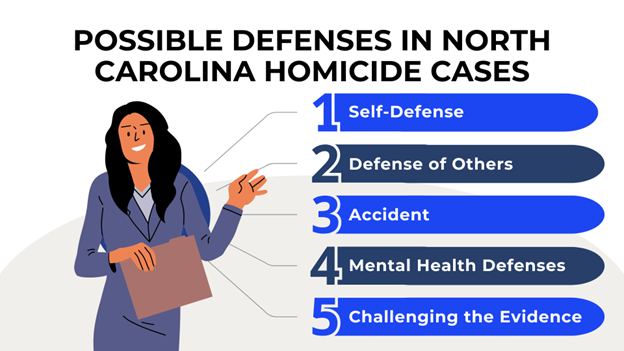
What Defenses Can Be Used in Homicide Cases?
Defense strategies in murder and manslaughter cases vary based on the specific charges and circumstances, but may include:
Self-Defense
North Carolina recognizes the right to use reasonable force, including deadly force in certain situations, to protect yourself from death or serious harm. A successful self-defense claim may result in complete acquittal.
Defense of Others
Similar to self-defense, people may legally use force, including deadly force when appropriate, to protect others from immediate harm.
Accident
For involuntary manslaughter charges, showing that the death was a genuine accident without carelessness may be a valid defense.
Mental Health Defenses
North Carolina law recognizes various mental health-related defenses, which may reduce charges or affect sentencing.
Challenging the Evidence
Defense attorneys often challenge the prosecution’s evidence regarding intent, cause of death, identification, and other important elements of homicide charges.
The Importance of Good Legal Representation
The big difference in penalties between murder and manslaughter charges in North Carolina shows why experienced legal representation is so important. A skilled criminal defense attorney can:
- Make sure charges accurately reflect what happened
- Find and develop possible defense strategies
- Negotiate potential plea deals when appropriate
- Present evidence to seek charge reductions
Provide guidance through every stage of the criminal process

Conclusion: Understanding the Key Differences Between Murder and Manslaughter
The distinction between murder and manslaughter in North Carolina is more than just legal terms—it reflects basic principles about blame, intent, and justice. From the possibility of the death penalty for first-degree murder under G.S. § 14-17(a) to the much lower penalties for involuntary manslaughter as a Class F felony under G.S. § 14-18, these classifications create a range of accountability for homicide offenses.
For anyone facing homicide charges in North Carolina, understanding these distinctions is just the beginning. Each case involves unique circumstances, evidence, and potential defenses that require careful analysis and planning. With so much at stake—potentially including life in prison or even death—getting experienced legal help isn’t just advisable; it’s essential.
If you or a loved one are facing murder or manslaughter charges, you deserve a legal advocate with the experience and dedication to secure the best possible outcome. Attorney Patrick Roberts of Patrick Roberts Law has successfully defended numerous clients accused of the most serious homicide offenses. Contact our firm today for a confidential consultation.
Former assistant district attorney
Contact Patrick Roberts
Facing criminal charges in North Carolina demands seasoned representation. Trust in the experience and dual perspective of Patrick Roberts. Reach out today for a confidential consultation.
-
Call Our Team
Calls answered 24/7









For more information on the selection criteria, go to www.martindale.com
*Each case is different and must be evaluated separately. Prior results achieved do not guarantee similar results can be achieved in future cases.