
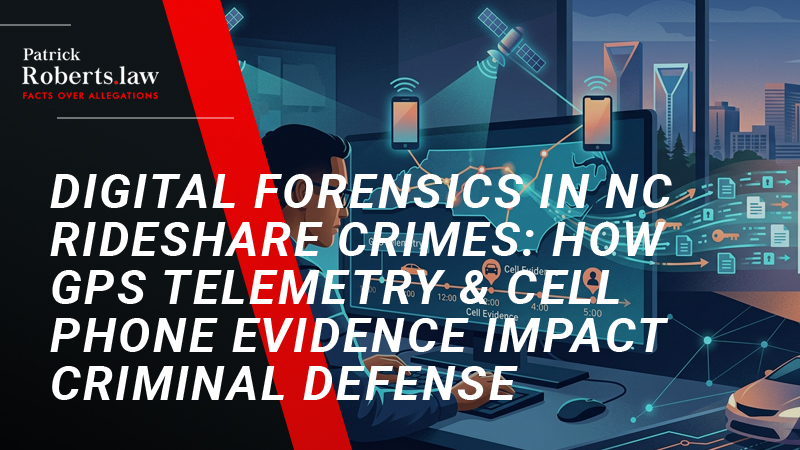
A $50 million civil lawsuit recently filed in Durham County Superior Court against Lyft has placed ridesharing safety standards and vetting protocols under intense public scrutiny. Filed on behalf of a victim alleging sexual assault during a rideshare trip, the civil complaint targets platform background check policies—specifically highlighting that the driver’s prior driving while impaired (DWI) conviction fell outside North Carolina’s statutory 7-year lookback window.
While civil proceedings evaluate corporate liability, the parallel criminal prosecution focuses on an entirely different evidentiary threshold: digital forensics, GPS telemetry, and the digital chain of custody.
The Evidentiary Core: Digital Forensics in Platform Offenses
In complex felony prosecutions involving rideshare platforms, verbal testimony rarely forms the sole basis of the state’s case. Prosecution and defense teams analyze four primary electronic data streams to establish location, intent, and timing:
- Server-Side Telemetry & GPS Logs: Geolocation data maintained on TNC servers, documenting latitude, longitude, velocity spikes, and route deviations.
- On-Device Cellular Telemetry: Hardware extraction logs retrieved directly from mobile devices using specialized forensic software.
- In-Cabin Media: Audio and video recordings captured by dual-facing dashcams, personal mobile devices, or in-app emergency features.
- Application Transaction Logs: Timestamped electronic records tracking ride requests, driver acceptance, cancellation attempts, and status changes.
Because electronic records are subject to sampling rates, time-synchronization variances, and network latency, validating their technical reliability is critical to trial preparation.
Authentication Standards Under N.C.G.S. § 8C-1, Rule 901
Before electronic telemetry can be admitted as substantive evidence in a North Carolina courtroom, the state must establish its authenticity under Rule 901 of the North Carolina Rules of Evidence. Satisfying Rule 901 requires a foundational showing of reliability:
- N.C.G.S. § 8C-901(b)(1) – Witness with Knowledge: The prosecution often introduces device extractions through an investigating officer. Cross-examination evaluates whether the witness possesses formal digital forensics expertise or relied entirely on automated extraction tools.
- N.C.G.S. § 8C-901(b)(9) – System or Process: Introducing server-side GPS exports requires proving that the platform’s tracking systems yield accurate results, typically supported by testimony or affidavits from the TNC’s official Custodian of Records.
Digital Chain of Custody Protocol
Digital evidence requires strict handling protocols to demonstrate that raw data extracted from servers or mobile hardware remains uncorrupted throughout the proceedings:
- Faraday Shielding: Securing mobile hardware inside signal-blocking enclosures prevents remote data wiping commands or incoming cellular overwrites immediately upon seizure.
- Cryptographic Hash Verification: Forensic examiners generate a unique cryptographic hash value (such as SHA-256) at the initial extraction. Any discrepancy between the working file’s hash and the original acquisition hash indicates file alteration or data corruption.
- Hardware Write-Blockers: Analysts utilize write-blocking hardware during examination to ensure the host operating system does not alter underlying file metadata.
Primary Technical Vulnerabilities in Telemetry Evidence
Auditing electronic discovery in platform-based cases involves evaluating four common technical vulnerabilities:
| Vulnerability | Technical Mechanism | Strategic Defense Impact |
| Clock-Drift & UTC Offsets | Discrepancies between local device clocks, cell tower logs, and server Universal Time Coordinated (UTC) stamps. | Reconciles timeline gaps that might otherwise misrepresent routine traffic stops as unlawful restraint. |
| GPS Polling & “Jitter” | Periodic logging intervals combined with satellite signal interference near structures or heavy foliage. | Demonstrates that apparent route deviations on digital maps can be artifacts of algorithmic estimation. |
| API vs. Raw Exports | Summarized PDF exports provided by platforms compared to underlying raw data files. | Uncovers critical missing metadata, confidence radiuses, and system error codes omitted from summary reports. |
| Data Volatility & Spoliation | Automated operating system purges that overwrite volatile device memory over time. | Highlights potential losses of ambient sensor logs or messaging records due to delayed preservation requests. |
Defense Counsel Action Items
When handling criminal cases involving mobile telemetry and location data in North Carolina courts, defense strategy centers on thorough technical verification:
- Issue 18 U.S.C. § 2703(f) Preservation Demands: Serve formal preservation notices on TNC platforms, cellular carriers, and third-party data providers immediately to prevent automated deletion routines.
- Request Raw Bit-Stream Extractions: File discovery motions for full raw images (.E01 or .raw formats), system audit logs, and verified hash values rather than relying solely on high-level extraction summaries.
- Audit Metadata Integrity: Evaluate foundational witness testimony under Rule 901 to determine whether the state can verify the underlying technical process of data acquisition.
- Retain Independent Forensic Experts: Engage certified digital forensic analysts to independently re-verify cryptographic hashes, assess GPS confidence intervals, and review extraction logs for chain-of-custody errors.
Legal Representation for Complex Digital Evidence Cases
When facing felony charges involving digital telemetry, forensic app extractions, or TNC data in North Carolina, technical evidence demands experienced analysis. Former prosecutor Patrick Roberts brings over two decades of trial experience to evaluate electronic evidence, review forensic extraction protocols, and structure comprehensive defense strategies.
Education & Advanced Trial Advocacy
- Duke University School of Law: Juris Doctor (Ranked #7 National Law School & #9 Criminal Law Program by U.S. News & World Report)
- The Johns Hopkins University: Bachelor’s Degree (Ranked #7 National University by U.S. News & World Report)
- Gerry Spence’s Trial Lawyers College: Graduate
- National Criminal Defense College (NCDC): Trial Practice Institute Graduate (Including the 2025 Cross-Examination Intensive)
Peer Recognition & Legal Accolades
- Martindale-Hubbell AV Preeminent® Rating: Peer-rated for the highest level of professional excellence (8 Consecutive Years)
- Martindale-Hubbell Client Champion Platinum: Recognized for exceptional client service (5+ Consecutive Years)
- Avvo 10.0/10 “Superb” Rating: Highest legal rating for experience, outcome history, and professional conduct (15+ Consecutive Years)
- The National Trial Lawyers: Top 100 Trial Lawyers
Peer Endorsement
“Patrick is a thoughtful and experienced attorney. When I have a client needing representation in the Raleigh area in his areas of practice, he would be my referral of choice.” -Verified Peer Endorsement via Avvo.com
Client Review
“Throughout the process, he remained a constant calm and reassuring presence during a challenging time in my life. His guidance and dedication made a difficult experience much more manageable. ” – Verified Client Review via Avvo.com
Disclaimer: Testimonials and peer reviews are actual comments from clients and peers. They are for informational purposes only and do not guarantee or predict the outcome of your legal matter. Every case is unique and must be evaluated on its own merits.
To stay current with evolving legal and technical standards, he attended the Defending Digital Sex Crimes Bootcamp in Orlando, Florida, in July 2026—a two-day intensive program focused on defending possession and distribution cases involving digital evidence. For individuals navigating state charges, felony classifications, or registry exposure, he provides the interactive North Carolina Sex-Offense Search Tool to help evaluate charge severity and statutory penalties.
For confidential legal consultations regarding criminal matters in Raleigh, Durham, Chapel Hill, or throughout North Carolina, contact Patrick Roberts Law at (919) 746-7206 or visit patrickroberts.law.
Legal Disclaimer
This content is provided for educational and informational purposes only and does not constitute formal legal advice. Reading this information or contacting the firm does not create an attorney-client relationship.
Former assistant district attorney
Contact Patrick Roberts
Facing criminal charges in North Carolina demands seasoned representation. Trust in the experience and dual perspective of Patrick Roberts. Reach out today for a confidential consultation.
-
Call Our Team
Calls answered 24/7






For more information on the selection criteria, go to www.martindale.com
*Each case is different and must be evaluated separately. Prior results achieved do not guarantee similar results can be achieved in future cases.