
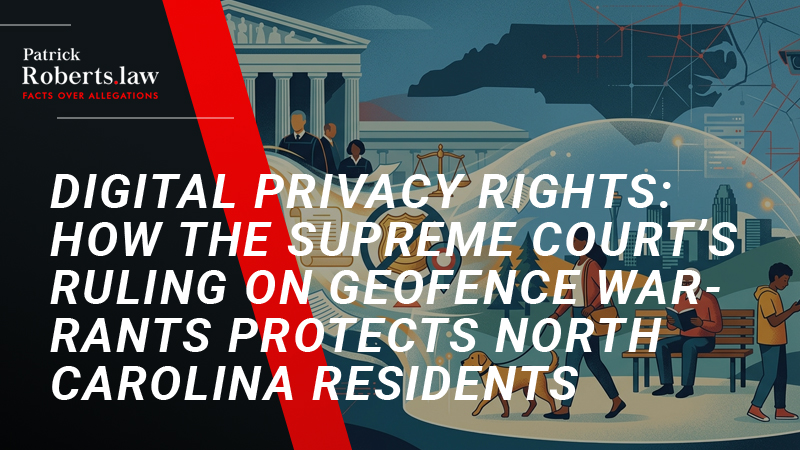
When a family member or loved one is unexpectedly arrested or served with a search warrant, the situation is overwhelming. In the hours following a police intervention, families are often left with urgent questions about what happened, what evidence law enforcement collected, and whether officers overstepped their authority.
In modern law enforcement investigations, digital evidence—such as mobile phone location history, text messages, and app activity—frequently serves as the primary basis for an arrest. However, a landmark U.S. Supreme Court decision (Chatrie v. United States) significantly restricts how law enforcement can collect and use digital location tracking against North Carolina residents.
Understanding these legal boundaries can help families navigate the critical first steps following an arrest or the execution of a search warrant.
What Are Geofence Warrants and Digital Dragnet Searches?
For years, state and local law enforcement agencies across North Carolina—including police departments and county sheriff’s offices—have relied on a broad investigative technique known as a geofence warrant.
A traditional search warrant requires law enforcement to demonstrate probable cause regarding a specific person, a specific location, or specific items associated with a alleged crime. A geofence warrant reverses this process:
- Virtual Perimeter: Detectives draw an arbitrary boundary (a “geofence”) around a crime scene—such as a storefront, bank, or residential street.
- Data Demand: Police submit a warrant to tech providers (most commonly Google’s Location History database) demanding location records for every mobile device present inside that perimeter during a specified timeframe.
- Broad Data Dragnet: Tech databases search millions of user accounts to filter down to a list of devices active within that geographic zone.
- Identification: Police make expanding follow-up demands to obtain identifying details (names, email addresses, device IDs) associated with those accounts.
Defense attorneys and civil liberties advocates argue that geofence warrants permit law enforcement to “search first and develop suspicion later.” Under this broad approach, hundreds of innocent bystanders risk having their private location data searched without individualized probable cause.
The Supreme Court’s Decision on Digital Location Tracking
The Supreme Court’s ruling stemmed from a credit union robbery investigation in Virginia where police, lacking initial leads, obtained a geofence warrant directing Google to search its location history database. Google initially produced location data for 19 individuals who were in the surrounding area. Police eventually narrowed the list down to one suspect, searched his home, and secured a conviction.
The defense appealed, arguing that searching millions of user records to identify a handful of accounts violates the Fourth Amendment requirement that search warrants be grounded in individualized probable cause.
Writing for the 6–3 majority, Justice Elena Kagan established that constitutional protections must adapt to modern digital technology, stating:
“The Fourth Amendment must, as ever, protect against unjustified government intrusion on the privacy of the individual.”
The Court emphasized three key principles regarding digital surveillance:
- Protection of Non-Suspects: Dragnet searches that compromise the personal privacy of non-suspects fail Fourth Amendment standards.
- Mandatory Constitutional Reasonableness: Location data requests must be evaluated for objective constitutional reasonableness rather than granted through broad, automated requests.
- Rejection of Third-Party “Opt-In” Arguments: The Court rejected the argument that individuals waive their privacy rights simply because mobile operating systems allow location services to remain enabled.
How Does This Ruling Impact North Carolina Criminal Cases?
This ruling directly impacts how federal agencies (such as the FBI and DEA) and local North Carolina law enforcement agencies handle digital investigations.
1. Grounds for Suppressing Digital Evidence
If criminal charges in North Carolina rely on cell phone location records, IP address captures, or third-party app data, defense counsel can challenge the legality of the underlying warrant. Under the Exclusionary Rule (N.C. Gen. Stat. § 15A-974), if a search warrant violates state or federal constitutional rights, evidence obtained through that unlawful search—and secondary evidence derived from it—may be suppressed and declared inadmissible at trial.
2. Reinforcing North Carolina State Constitutional Protections
Article I, Section 20 of the North Carolina Constitution provides explicit protection against overbroad state warrants, declaring that general warrants:
“…whereby any officer or messenger may be commanded to search suspected places without evidence of the fact committed, or to seize any person or persons not named, whose offense is not particularly described and supported by evidence, are dangerous to liberty and ought not to be granted.”
North Carolina’s constitutional prohibition against general warrants, alongside established Fourth Amendment jurisprudence, offers a robust legal basis for contesting broad digital searches.
3. Increased Scrutiny in Serious Felony Prosecutions
Digital location tracking is frequently used in high-stakes state and federal felony investigations, including:
- Armed robbery and burglary allegations
- Drug trafficking and conspiracy cases
- Homicide and assault prosecutions
- Internet-related offenses and complex digital investigations
Demonstrating that location records were seized through an overbroad or legally defective warrant can fundamentally weaken the prosecution’s case before trial begins.
How Are Law Enforcement Geofence Warrants Challenged in Court?
- Law Enforcement Requests Data
Police draw a virtual border around a crime scene and demand mobile location history from tech companies (like Google). - Tech Database Filter
The tech company filters millions of accounts down to every device active within that geographic zone during the specified timeframe. - The Defense Challenge: Does the Warrant Lack Probable Cause?
An attorney reviews whether police had a legal reason to search everyone in that zone, or if they searched non-suspects indiscriminately.- If YES (Lacks Probable Cause):
File a Motion to Suppress Evidence
The defense asks the judge to throw out the location data and any secondary evidence under the Exclusionary Rule. - If NO (Has Probable Cause):
Evaluate Constitutional Protections
The defense examines whether the warrant violated Fourth Amendment privacy rights or North Carolina’s prohibition against broad general warrants (Article I, Section 20).
- If YES (Lacks Probable Cause):
What to Do Right After an Arrest or Search Warrant in North Carolina?
When law enforcement officers execute a search warrant or arrest a loved one, taking calm, informed action in the immediate aftermath is vital for protecting their legal rights.
1. Request Copy of Search Warrant
- Inspect the Inventory Sheet: Law enforcement must leave a physical copy of the search warrant and a complete inventory receipt listing every seized item (phones, computers, storage drives).
- Verify Officer Details: Keep all copies intact, taking note of the issuing magistrate, execution timestamp, and listed items for legal review.
2. Preserve Account & Digital Logs
- Do Not Modify Cloud Data: Never attempt to delete apps, clear search history, or wipe account logs after a device has been seized.
- Avoid Account Adjustments: Changing passwords or altering cloud settings after a warrant is executed can complicate digital forensic audits or lead to tampering allegations.
3. Exercise Right to Remain Silent
- Advise Silence: Remind your family member that they have a constitutional right to remain silent and request an attorney before speaking with law enforcement.
- Beware of Recorded Jail Phones: All non-attorney calls placed from North Carolina detention facilities are recorded and monitored by police. Never discuss case facts or digital accounts on jail telephone lines.
Frequently Asked Questions (FAQ)
Is cell phone tracking legal without a search warrant in North Carolina?
Generally, no. Under federal law and North Carolina General Statutes (N.C. Gen. Stat. § 14-196.3 / N.C. Gen. Stat. § 14-401.25), law enforcement officers must obtain a valid search warrant supported by probable cause to track an individual’s real-time movements or access historical Cell Site Location Information (CSLI) and GPS logs. Limited exceptions apply only in narrow emergency circumstances involving immediate danger to life.
Can police search the contents of a seized cell phone without a warrant?
No. Under the U.S. Supreme Court ruling in Riley v. California, police cannot search the digital contents of a phone seized during an arrest without a separate search warrant, unless the owner provides free and voluntary consent or a genuine exigent emergency exists.
What happens if police seized my family member’s phone during a search warrant execution?
If law enforcement seizes a phone or mobile device under a North Carolina search warrant, officers typically hold the physical hardware to perform off-site digital forensic analysis. Defense counsel can review the original warrant affidavit to verify whether officers established probable cause and adhered to statutory execution rules.
How long do police have to search a cell phone once they seize it in NC?
In North Carolina, search warrants must generally be executed within 48 hours of issuance (N.C. Gen. Stat. § 15A-248). While the physical seizure of the device must occur within that 48-hour window, courts typically permit forensic data analysis to occur within a reasonable timeframe after the physical hardware is secured.
Can evidence obtained from an illegal cell phone search be thrown out?
Yes. Under North Carolina General Statute § 15A-974, if a judge determines that law enforcement gathered location tracking data or phone contents in violation of the U.S. or North Carolina Constitutions, that evidence—and any additional evidence derived from it—can be suppressed and rendered inadmissible in court.
Protecting Your Constitutional Rights: Attorney Patrick Roberts
Digital forensics and search-and-seizure jurisprudence are complex, fast-evolving areas of law. Challenging a digital warrant requires examining technical data logs, reviewing magistrate authorizations, and filing targeted legal motions in state or federal court.
When law enforcement oversteps constitutional boundaries to collect digital evidence, swift legal action is critical to protecting your rights, your privacy, and your freedom.
Challenging overbroad digital evidence, reverse-location search warrants, and complex phone extractions requires deep technical knowledge combined with aggressive courtroom litigation. Attorney Patrick Roberts brings established expertise in criminal defense and sex crime defense law, backed by decades of legal practice and advanced technical training.
Jurisdictional Admissions & Federal Practice
- North Carolina State Bar: Admitted to all North Carolina State Courts (2002).
- U.S. District Courts: Admitted to the Eastern District, Middle District, and Western District of North Carolina.
- U.S. Court of Appeals: Admitted to practice before the Fourth Circuit Court of Appeals.
- Supreme Court of the United States: Admitted to practice before the U.S. Supreme Court.
Educational Background & Technical Foundation
- Duke University School of Law: Juris Doctor (J.D.). (Ranked #7 National Law School and #9 Criminal Law Program by U.S. News & World Report)
- Johns Hopkins University: Bachelor of Arts (B.A.) in Engineering.
- Former Assistant District Attorney: Served across three North Carolina prosecutorial districts (New Hanover County, Johnston County, and Wake County) prior to entering private defense practice.
Driven by a commitment to mastering current legal and technical developments, he participated in the July 2026 Defending Digital Sex Crimes Bootcamp in Orlando, Florida, an intensive program dedicated to defending cases built on digital evidence.
Peer Recognition & Professional Credentials
Attorney Roberts’ expertise and ethical standing in criminal defense are recognized across national peer-reviewed institutions:
- Martindale-Hubbell: AV Preeminent® Rating and Client Champion Platinum or 8 years, since 2018.
- Super Lawyers: Selected to Super Lawyers and Rising Stars.
- National Recognition: Top 100 Trial Lawyers (National Trial Lawyers) and Nation’s Top One Percent (National Association of Distinguished Counsel).
Client Reviews
“Mr. Roberts took the time to understand our situation… He truly cares about his clients, he goes above and beyond to ensure your needs are met.” – Verified Client Review via Avvo.com
“Mr. Roberts is honestly one of the hardest working individuals I’ve ever come across. All of the Saturday meetings and phone calls; his accessibility and straightforwardness… meant the world to me, really. I needed a hero, and he filled that role effortlessly.” – Verified Client Review via Avvo.com
Peer Endorsement
“I endorse this lawyer without reservation. Patrick is plain outstanding. The highest remark I can give a lawyer is that I would ask him to represent me were I charged with a crime. I would ask Patrick and know that I would be in the very best of hands. “ – Verified Peer Endorsement via Avvo.com
Disclaimer: Testimonials and peer reviews are actual comments from clients and peers. They are for informational purposes only and do not guarantee or predict the outcome of your legal matter. Every case is unique and must be evaluated on its own merits.
Schedule a Confidential Legal Consultation
If you or a loved one are facing criminal charges or a search warrant execution involving digital location tracking, cell phone extractions, or digital forensics in North Carolina, early legal intervention is critical.
- Call Today: (919) 746-7206
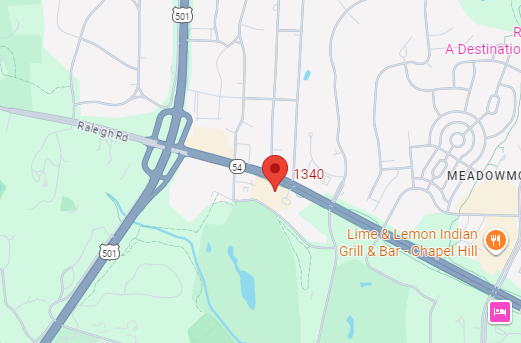
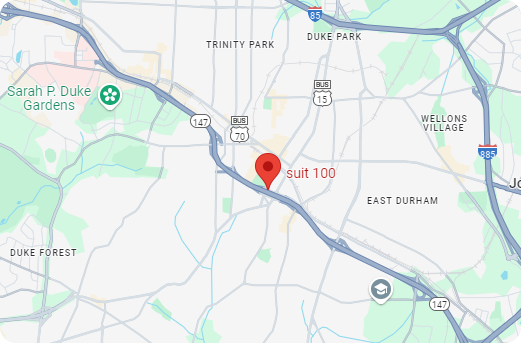
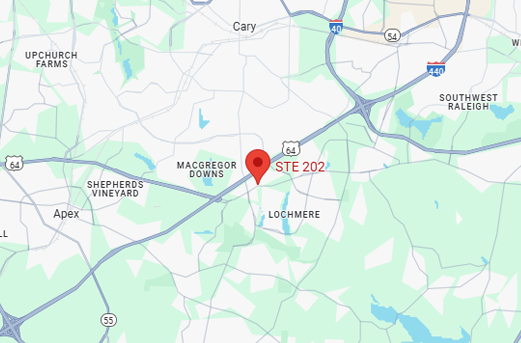
- Office Locations: Raleigh, Durham, Chapel Hill, and Cary, NC
- Online: Patrick Roberts Law
The firm provides legal defense for high-stakes matters across North Carolina, focusing locally on Wake County areas including Raleigh, Cary, Apex, Holly Springs, Garner, and Fuquay-Varina. To maintain the focus and preparation required for complex criminal matters, Patrick Roberts Law PLLC accepts a restricted number of new cases.
Legal Disclaimer
This content is provided for educational and informational purposes only and does not constitute formal legal advice. Reading this information or contacting the firm does not create an attorney-client relationship.
Former assistant district attorney
Contact Patrick Roberts
Facing criminal charges in North Carolina demands seasoned representation. Trust in the experience and dual perspective of Patrick Roberts. Reach out today for a confidential consultation.
-
Call Our Team
Calls answered 24/7






For more information on the selection criteria, go to www.martindale.com
*Each case is different and must be evaluated separately. Prior results achieved do not guarantee similar results can be achieved in future cases.