
In North Carolina, “possession with intent to distribute” is charged as possession with intent to sell or deliver — often shortened to PWISD. It is a felony under N.C. Gen. Stat. § 90-95(a)(1). The critical thing to understand is that the State does not have to prove you sold anything to anyone; it only has to prove you intended to. That single word — intent — is what elevates the offense, and it’s also where most of these cases can be fought.
This article breaks down what the charge actually means, how it differs from simple possession, how prosecutors try to prove intent when nobody witnessed a sale, the penalties you’re looking at, where the line into trafficking sits, and the defenses that apply. It closes with the immediate steps that protect you.
What does “possession with intent to sell or deliver” mean in North Carolina?
It means the State alleges you had a controlled substance and planned to hand it off to someone else — whether by selling it, giving it away, or delivering it. The claim is that you meant to pass it on rather than keep it for yourself. Under § 90-95(a)(1), it is unlawful to “manufacture, sell or deliver, or possess with intent to manufacture, sell or deliver, a controlled substance.” That last clause is your charge.
Notice what’s not required. There’s no completed sale. No money changing hands. No buyer. The charge is about your alleged state of mind at the moment police found the drugs. The prosecutor is asking a court to look at the circumstances and conclude what you were going to do next.
This is a common category of felony charge in the state, not some rare or exotic accusation. In fiscal year 2024, non-trafficking drug offenses — the category that includes possession with intent to sell or deliver — made up 30% of all felony convictions in North Carolina, the single largest category, out of more than 27,000 felony convictions. You are not the first person to face this, and there is a well-worn path for defending it.
How is this different from a simple possession charge?
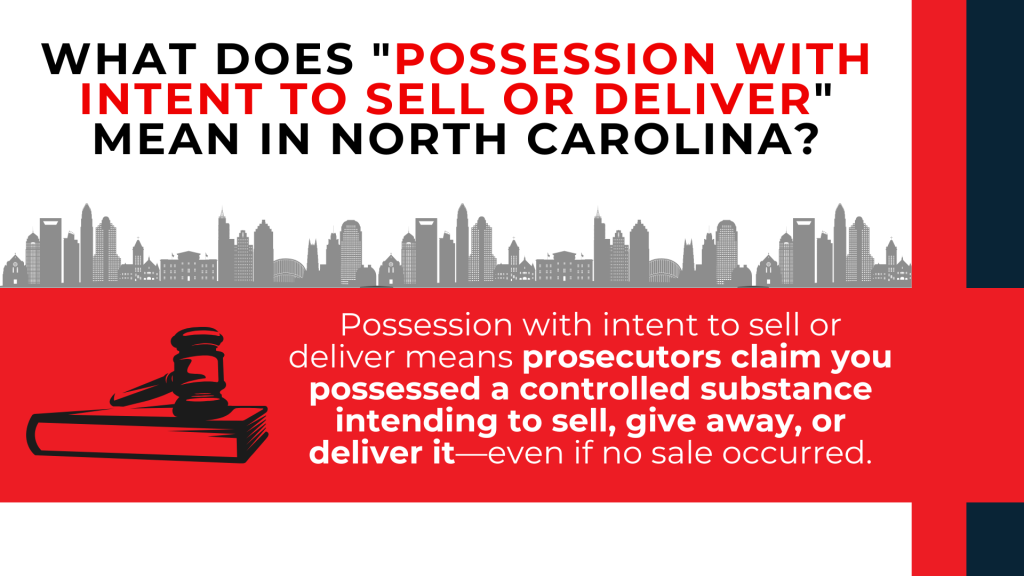
The difference is intent, and it raises the level of the offense — though how far depends on the drug. Simple possession under § 90-95(a)(3) means you had a controlled substance for your own use. For some substances — marijuana, for example — simple possession is a misdemeanor. Adding the State’s claim that you intended to sell or deliver turns it into a felony under (a)(1). For others — cocaine, heroin, and methamphetamine — simple possession is already a felony under § 90-95(d). The intent allegation pushes it to a higher felony class still.
That’s why the intent element matters so much. It’s the reason your charge is more serious than it would otherwise be. Take that element away and, in many cases, what’s left is a less severe offense.
Here’s the strategic flip side: the element that makes your charge worse is also the weakest part of the State’s case. A prosecutor can usually show you possessed something — the drugs are sitting in an evidence bag. Showing what you intended to do with them is a different and much harder job.
How can they charge me with intent if nobody saw me sell anything?
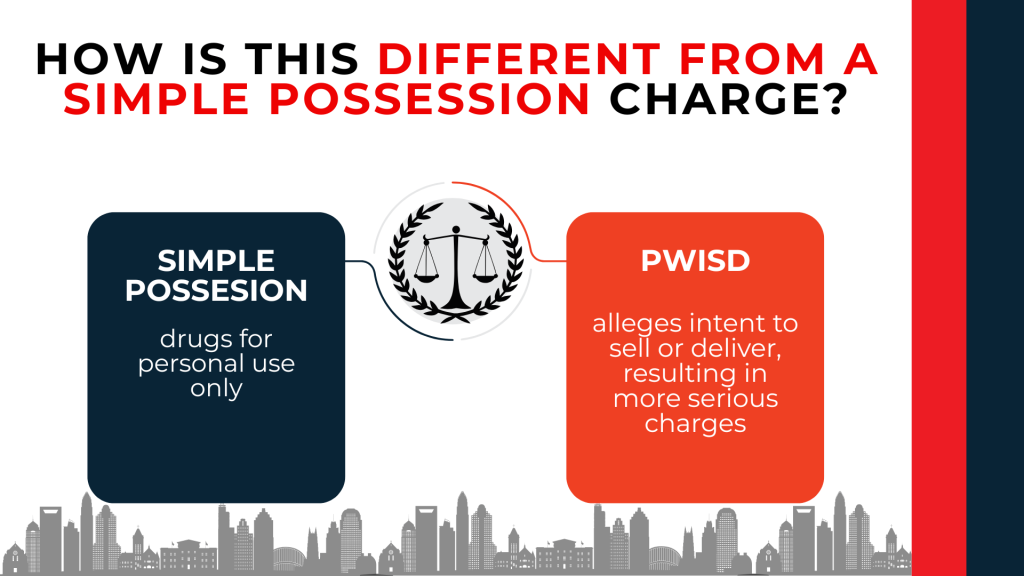
Because in practice prosecutors rarely have a witnessed sale, so intent is usually argued from the surrounding circumstances rather than from a transaction anyone observed. In most of these cases, no one saw a sale at all; the intent is inferred.
The circumstances prosecutors commonly point to:
- Quantity. More than a personal-use amount, they’ll argue, suggests it was meant for sale.
- Packaging. Multiple small baggies or individually portioned amounts, rather than one container.
- Scales, cutting agents, or packaging materials found nearby.
- Cash, especially a large amount or many small bills.
- Phone messages or contacts they read as arranging sales.
Each of these is an argument, not a fact. A quantity consistent with a heavy personal habit is not proof of dealing. Cash has innocent explanations. A scale can belong to someone who buys in bulk for personal use. Because intent is inferred rather than observed, it can be contested — and that is often the heart of the defense.
How much prison time am I facing?
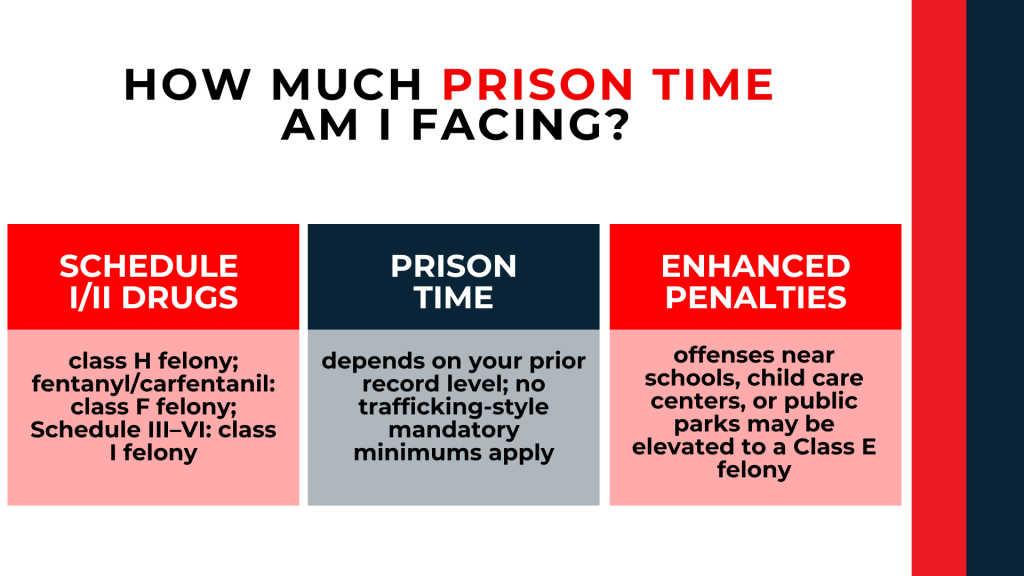
It depends on which drug is involved, because the felony class is tied to the substance’s schedule. Unlike trafficking, PWISD carries no mandatory minimum tied to weight, which means outcomes vary rather than being fixed by the amount involved.
Under § 90-95(b), possession with intent to sell or deliver is punished as follows:
- Schedule I or II substances (heroin, cocaine, methamphetamine, MDMA, oxycodone, and similar) — a Class H felony.
- Fentanyl or carfentanil — elevated to a Class F felony under § 90-95(b)(1b).
- Schedule III through VI substances (marijuana is Schedule VI in North Carolina) — a Class I felony.
What those classes actually translate into depends on your prior record level — your criminal history — under North Carolina’s structured sentencing framework (§ 15A-1340.17). This is the key contrast with trafficking. Trafficking sentences are mandatory active prison terms fixed by weight, regardless of record, while PWISD sentences flex with your history and the facts. For someone with little or no record, the sentence you’d realistically face at the lower felony classes is very different from the statute’s maximum. These offenses are not subject to trafficking’s mandatory active terms.
A few things can push the class higher. Under § 90-95(e), a defendant 21 or older who commits the offense within 1,000 feet of a school or child care center, or a public park, is punished as a Class E felon. Where the alleged conduct happened can matter as much as what it involved.
When does this become a trafficking charge instead?
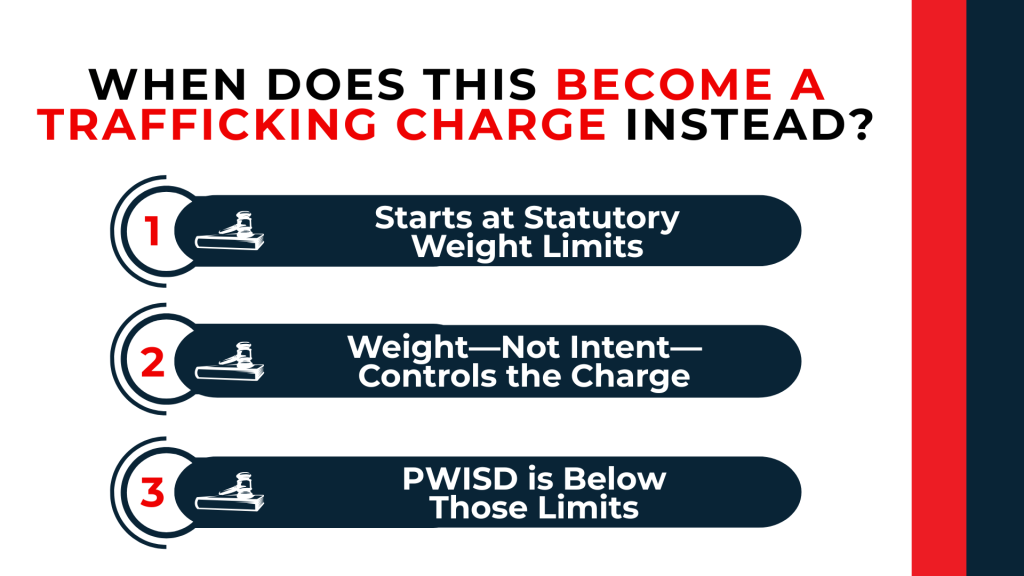
The moment the weight crosses a statutory threshold, an intent-based PWISD charge becomes trafficking. That is a different offense, with mandatory minimum prison terms and heavy fines. This is the line you want to know which side of you’re on.
Trafficking under § 90-95(h) is triggered by amount, not intent, and the minimums are severe. 28 grams of cocaine starts at 35 months minimum. Just 4 grams of heroin or another opioid starts at 70 months. And more than 10 pounds of marijuana starts at 25 months. These minimums apply regardless of your record.
If your charge is PWISD rather than trafficking, you are below those thresholds. Keeping it there, or putting the weight into question, can be part of the defense. Trafficking is its own subject; the point here is simply to locate your charge on the ladder.
Can a possession with intent to sell or deliver charge be beaten?
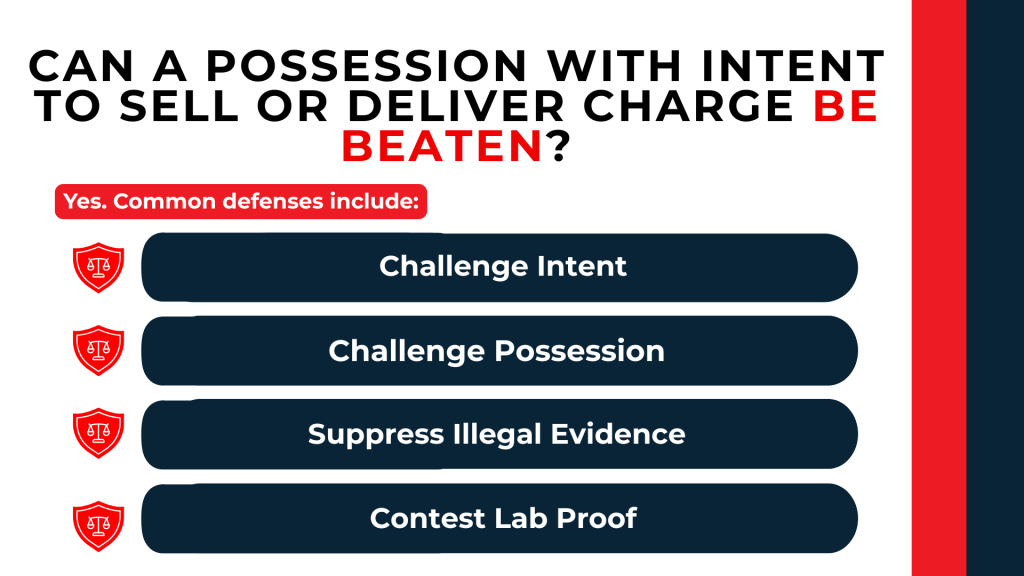
Often, yes. Because the State has to prove both that you possessed the drugs and that you intended to distribute them, there are multiple independent points of attack. Defeating either element can dismantle the felony. These cases are frequently resolved or reduced well before trial.
Can they really prove I intended to sell?
The most direct defense goes at the weakest link: intent. Where the quantity, packaging, and circumstances are equally consistent with personal use, the State’s inference is far weaker than it may first appear. A defense attorney will often reframe the same evidence the prosecutor is using — arguing the facts show a user, not a seller.
Challenging the stop and search
A defense attorney will examine whether the stop and search complied with the Fourth Amendment — whether police had justification to stop you, whether they searched with a warrant or a valid exception, and whether they stayed within the scope of any consent. Where they didn’t, there may be grounds to challenge whether that evidence can be used at all. If the evidence is kept out, the case is often left with little to stand on.
What if the drugs weren’t found on me?
Where drugs are found on your person, possession is straightforward for the State to argue. Where they’re found in a shared car, a house, or a space you didn’t exclusively control, the State is relying on the theory that you nonetheless had the power and intent to control them. That theory can be contested when others had equal access and nothing ties the drugs specifically to you.
Challenging the lab analysis and chain of custody
The State usually proves what the substance is with a lab report. Under § 90-95(g), that report can come into evidence without the analyst testifying — but only if the defense fails to object in time. The State must give at least 15 business days’ notice, and the defense must object at least 5 business days before the proceeding. A timely objection forces the analyst into court, where the testing and the chain of custody under § 90-95(g1) can be challenged directly. Missing that deadline hands the State an easy win; catching it preserves real leverage.
What should I do right now?
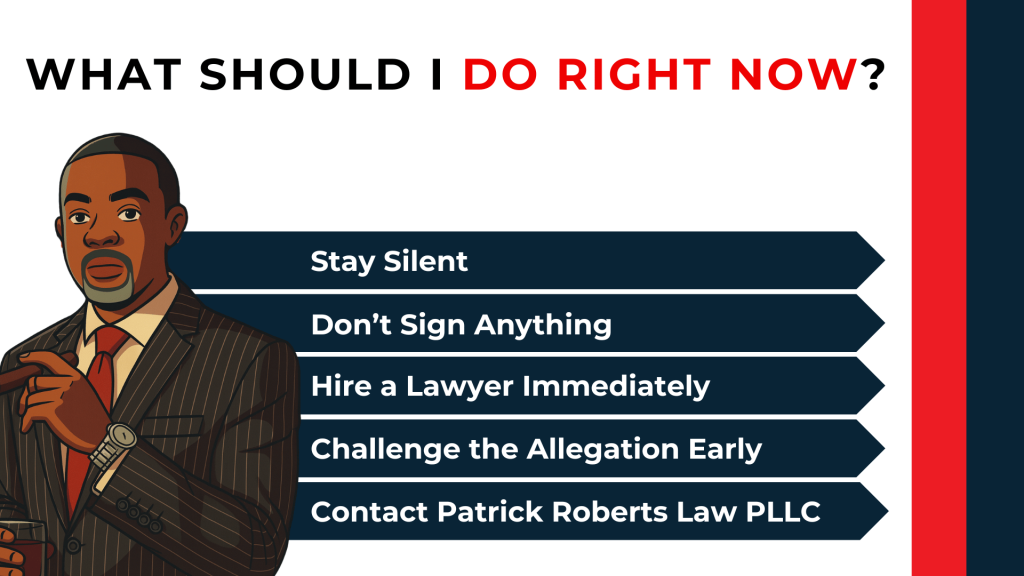
Three steps, in order:
- Stop talking about the case — to the police and to everyone else. Politely decline to answer questions and ask for a lawyer.
- Don’t sign or agree to anything without a lawyer present.
- Get a defense attorney involved immediately, before charging decisions and plea options harden.
The earlier a lawyer engages, the more room there is to contest the intent inference and shape the outcome while it’s still fluid.
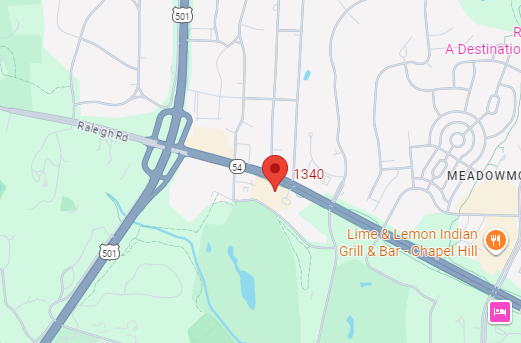
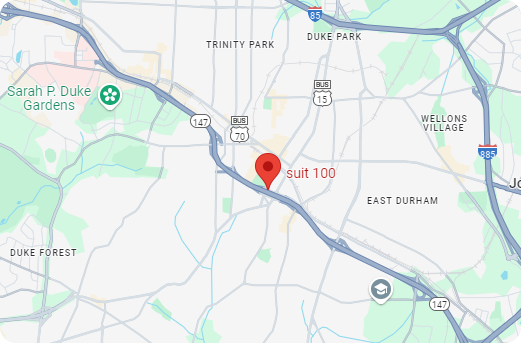
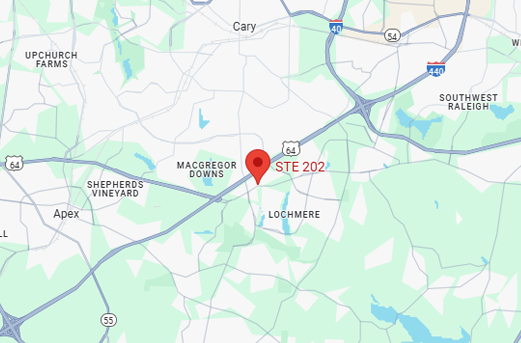
That’s where the experience of Patrick Roberts Law PLLC in Raleigh matters. Patrick Roberts is a former Assistant District Attorney who prosecuted cases in Wake, Johnston, and New Hanover counties — which means he knows from the inside exactly how the State assembles an intent case out of quantity, packaging, and cash, because he used to build them. That perspective is directly relevant to the defenses that decide these cases: knowing where the intent inference breaks down and how to force the State’s lab evidence into the open. With more than two decades of North Carolina criminal defense experience and offices serving Raleigh, Durham, Chapel Hill, and Cary, the firm defends PWISD charges in the courts where your case will actually be heard.
Attorney Patrick Roberts utilizes his high-level criminal law expertise to safeguard the rights of the accused, drawing upon an extensive trial history that includes more than 80 criminal jury trials taken to verdict and hundreds of bench trials in state and federal jurisdictions. He is qualified to handle cases at the highest levels, he is admitted to the U.S. Supreme Court, the Fourth Circuit Court of Appeals, and all North Carolina federal districts.
Mr. Roberts is an alumnus of Johns Hopkins University (#7 National Universities) and Duke University School of Law (#7 in Best Law Schools; #9 Criminal Law Program), Mr. Roberts has dedicated his career to honing his trial craft. He is a graduate of the prestigious Gerry Spence’s Trial Lawyers College and the National Criminal Defense College (NCDC) Trial Practice Institute, including the 2025 Cross-Examination Intensive. He is a lifetime member of the National Association of Criminal Defense Lawyers and remains the sole North Carolina representative listed by the National Child Abuse Defense & Resource Center as of 2026.
Accolades, Client Testimonials & Peer Review
• Martindale-Hubbell AV Preeminent Rating: 8 Consecutive Years
• Martindale-Hubbell Client Champion Platinum: 8 Consecutive Years
• AVVO 10/10 “Superb” Rating: 15 Consecutive Years
• The National Trial Lawyers: Top 100 Trial Lawyers
Client Review
“Mr. Roberts was amazing! Had a very difficult case & the outcome didn’t look bright at all. I was looking at some serious time. But he was able to get me probation* (which wasn’t on the table at all before he got involved) He was honest, to the point & laid out everything that could be a possibility. Never gave false hope, just the facts & logically what we could do to possibly get this in my favor. I would recommend Mr. Roberts to anyone seeking REAL guidance, honest & qualifications to back it up. “- Verified client review on Avvo.com
Peer Endorsement
“I endorse this lawyer. Patrick is a great trial lawyer and a person who I go to for legal advice in my own practice. Patrick is dedicated to his clients and a master at criminal defense. I would not hesitate to hire him if I was in trouble and needed a lawyer.” – Verified Peer endorsement via Avvo.com.
Disclaimer: Testimonials and peer reviews are actual comments from clients and peers. They are for informational purposes only and do not guarantee or predict the outcome of your legal matter. Every case is unique and must be evaluated on its own merits.
Case Review
A client of Attorney Patrick Roberts faced a mandatory active prison sentence of 70 to 93 months for trafficking in opium or heroin, alongside potential consecutive sentences of up to 126 months for additional charges including felony possession of a firearm by a felon and maintaining a dwelling for controlled substances.
The defense team filed a targeted constitutional challenge against the sufficiency of the search warrant, demonstrating that the affidavit lacked probable cause due to unreliable informant data and inadequate operational controls during alleged drug purchases. The court agreed with Attorney Roberts’ arguments and suppressed the resulting evidence. Lacking the physical evidence necessary to sustain the burden of proof, the State subsequently dismissed* all charges against the client.
*Disclaimer: Each case is different and must be evaluated separately. Prior results achieved do not guarantee similar results can be achieved in future cases.
View more case results.
Schedule a Case Evaluation with Attorney Patrick Roberts
If you’re facing a possession with intent to sell or deliver charge, contact Patrick Roberts Law PLLC to discuss your situation before you talk to anyone else.
While representing clients in critical legal matters across all North Carolina counties, Attorney Patrick Roberts’ practice maintains a strong presence in Wake County, specifically serving Raleigh, Cary, Apex, Holly Springs, Garner, and Fuquay-Varina.
To maintain the focus necessary for complex criminal matters, the firm is accepting a restricted number of new cases.
Disclaimer: This article is general legal information, not legal advice. Reading it does not create an attorney-client relationship. Drug offense cases turn on their specific facts, and you should consult a licensed North Carolina attorney about your particular situation.
Former assistant district attorney
Contact Patrick Roberts
Facing criminal charges in North Carolina demands seasoned representation. Trust in the experience and dual perspective of Patrick Roberts. Reach out today for a confidential consultation.
-
Call Our Team
Calls answered 24/7






For more information on the selection criteria, go to www.martindale.com
*Each case is different and must be evaluated separately. Prior results achieved do not guarantee similar results can be achieved in future cases.