
Being accused of rape when you know you’re innocent is one of the most devastating experiences a person can face. Your freedom, reputation, career, and relationships hang in the balance based on an allegation you know to be untrue. According to End Violence Against Women International (2016), methodologically rigorous research places the false reporting rate for sexual assault between 2-8% which means false accusations may happen. If you’re facing false rape accusations in Apex, NC, understanding how the criminal justice system works and what defense strategies can challenge wrongful charges is critical to protecting your future.
Wake County courts process rape cases through a system where the stakes couldn’t be higher. North Carolina treats forcible rape as a Class B1 or Class C felony carrying decades in prison. But being accused is not the same as being convicted. The State must prove every element of the charge beyond a reasonable doubt, and experienced defense attorneys have multiple tools to expose false accusations and protect the wrongly accused.
What Happens When You’re Falsely Accused of Rape in North Carolina?
The moment someone accuses you of rape, the criminal justice system begins moving often faster than you expect. Understanding what happens next helps you make better decisions about protecting yourself.
How Quickly Do Rape Accusations Lead to Arrest?
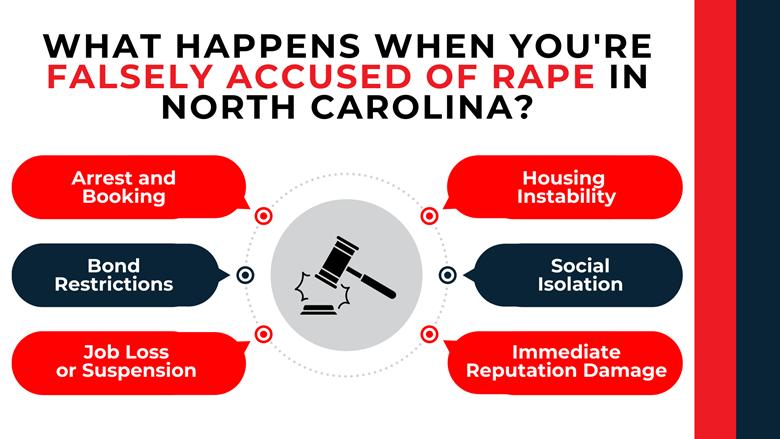
Rape accusations can lead to arrest within hours of a report, especially if the accuser identifies you by name. Apex Police Department works closely with Wake County law enforcement, and officers have authority to make warrantless arrests when they have probable cause to believe a felony occurred. Once arrested, you face immediate consequences that can devastate your life even before any trial:
- Arrest and booking at the Wake County Detention Center, where your information becomes public record
- Bond restrictions that may include GPS monitoring, no-contact orders, and travel limitations
- Job loss or suspension as employers learn of the charges, particularly in Apex’s professional community
- Housing instability if you share a residence with the accuser or face lease violations
- Social isolation as friends, family, and community members react to the allegations
- Immediate reputation damage that spreads through social media and word of mouth
What Restrictions Will You Face While Awaiting Trial?
Under N.C.G.S. § 15A-533(b), only a district or superior court judge not a magistrate can set pretrial release conditions for sex offense charges. This means you may wait in jail until a judge is available to hear your case. The NC Sentencing Commission’s FY 2024 Report found that 93% of defendants convicted of person offenses (including sex crimes) received credit for time served, reflecting widespread pretrial detention. For Class B1 felonies like first-degree rape, the average pretrial detention is 27 months over two years awaiting trial.
How Long Do These Cases Take to Resolve?
False accusation cases often take longer to resolve because both sides must conduct extensive investigation. The NC Sentencing Commission’s FY 2024 data shows the median time from charge to sentencing for Class B1 felonies is 30 months two and a half years. This compares to just 10 months for the average felony case. The complexity of sex offense prosecutions, combined with the need for thorough defense investigation, extends these timelines significantly.
How Common Are False Rape Accusations?
Understanding the reality of false accusations provides important context for your defense and helps counter the assumption that all accusations are true.
What Do Studies Say About False Reporting Rates?
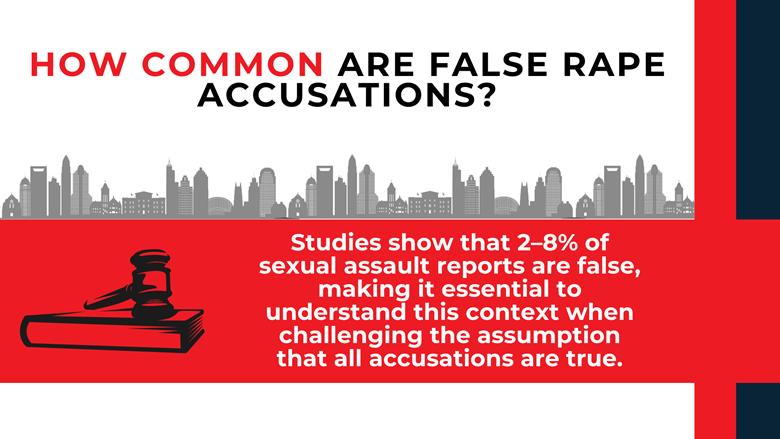
Multiple peer-reviewed studies using rigorous methodology converge on a 2-8% false reporting rate for sexual assault, according to End Violence Against Women International (2016). This means that while most reports are genuine, thousands of people nationwide face false accusations each year. The National Registry of Exonerations (2024) reports that 10% of all exonerations are for sexual assault and 9% for child sex abuse making these among the most common categories of wrongful convictions alongside homicide.
These numbers reflect only cases where innocence was eventually proven. The actual number of people wrongfully accused, charged, or even convicted likely exceeds documented exonerations.
Why Do False Rape Accusations Happen?
False accusations arise from various circumstances. Some involve mistaken identification, where the accuser genuinely believes the wrong person committed an assault. Others stem from relationship conflicts, custody disputes, or revenge motives. Mental health conditions, intoxication affecting memory, or external pressure from family or advocates can also contribute to false reports. Understanding the specific motivation in your case helps your defense attorney develop targeted strategies to expose the truth.
What Must the State Prove to Convict You of Rape in NC?
North Carolina places the burden entirely on the prosecution. The State must prove every element of the charge beyond a reasonable doubt.
What Are the Legal Elements of Forcible Rape?
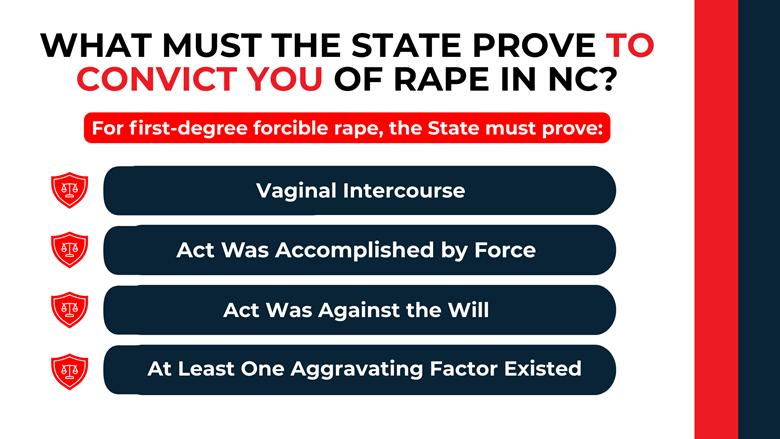
For first-degree forcible rape under N.C.G.S. § 14-27.21, the State must prove:
- Vaginal intercourse occurred (penetration, however slight, satisfies this element)
- The act was accomplished by force sufficient to overcome resistance or through constructive force (threats, coercion)
- The act was against the will of the complainant
- At least one aggravating factor existed (weapon use, serious injury, multiple perpetrators, or certain victim vulnerabilities)
For second-degree forcible rape under N.C.G.S. § 14-27.22, the State must prove force and lack of consent without an aggravating factor, or that intercourse occurred with a victim incapable of consent due to mental disability or physical helplessness.
Critically, North Carolina courts require proof of both force AND lack of consent as separate elements. In State v. Alston, 310 N.C. 399 (1984), the NC Supreme Court held that force must be specific to the charged act. General fear from a prior relationship is insufficient. The more recent State v. Henderson, 233 N.C. App. 538 (2014), confirmed that a nonconsensual act alone, without proof of force, cannot sustain a conviction.
Does the State Need Physical Evidence or Witnesses to Convict?
In North Carolina, physical evidence or third-party corroboration is not a legal requirement for a conviction in a sex offense case. Under longstanding legal principles, the testimony of the complainant alone is legally sufficient to support a conviction, provided the jury finds that testimony credible beyond a reasonable doubt.
Because a case can rest entirely on a single person’s account, the defense strategy must focus heavily on the reliability and consistency of the evidence presented. A robust defense involves a meticulous review of the accuser’s statements to identify inconsistencies, explore potential biases, and present alternative explanations or evidence that may create reasonable doubt. In these cases, your attorney’s role is to ensure that uncorroborated testimony is held to the highest standard of scrutiny required by the law.
How Does the Burden of Proof Protect the Accused?
The beyond-a-reasonable-doubt standard means jurors must be firmly convinced of guilt before convicting. Any reasonable doubt about identification, about whether force occurred, about the accuser’s truthfulness requires acquittal. According to the NC Sentencing Commission’s FY 2024 Report, Class B1 felonies have a 15% jury trial rate the highest of any felony class suggesting defendants in serious sex cases often believe they can prevail at trial when they maintain innocence.
What Defense Strategies Challenge False Rape Accusations?
Defending against false accusations requires aggressive investigation, strategic use of evidence rules, and thorough preparation for trial. Multiple approaches can expose a false accuser.
How Can Defense Attorneys Expose a False Accuser’s Motive?
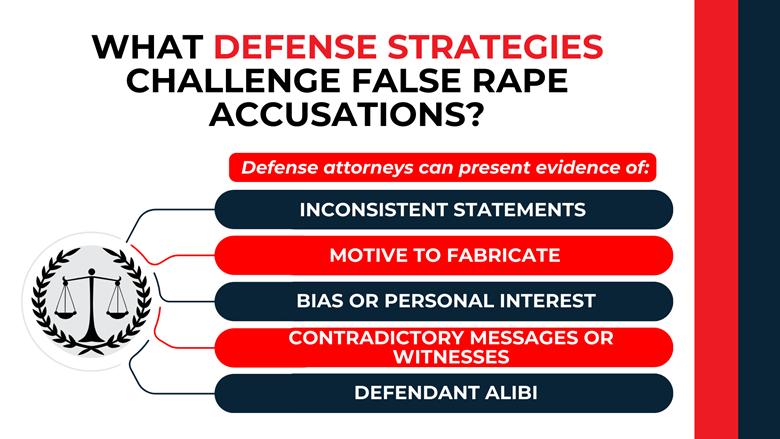
North Carolina’s Rape Shield law (Rule 412) limits evidence about a complainant’s sexual history, but important exceptions exist for impeachment and bias. Under State v. Martin, 241 N.C. App. 602 (2015), and State v. Goins, 244 N.C. App. 499 (2015), evidence showing motive or bias to fabricate is admissible even when it falls outside Rule 412’s categories. Defense attorneys can present evidence of:
- Prior inconsistent statements the accuser made about the incident or the defendant
- Motive to fabricate arising from relationship conflicts, custody battles, or personal grievances
- Bias or interest in the outcome, such as financial gain from civil litigation
- Communications (texts, emails, social media) contradicting the accusation timeline or content
- Witness testimony from people who observed the accuser’s behavior or heard contradictory accounts
- Alibi evidence placing the defendant elsewhere when the alleged assault occurred
The NC Sentencing Commission’s FY 2024 Report shows that 98% of NC felonies resolve by guilty plea but the 15% jury trial rate for Class B1 felonies suggests these defenses succeed often enough that defendants are willing to fight.
What Role Does Digital Evidence Play in Proving Innocence?
Modern false accusation defenses often turn on digital evidence. Text messages, social media posts, location data, and electronic communications can establish alibis, reveal motives, or expose lies. Following Riley v. California, 573 U.S. 373 (2014), police generally need warrants to search cell phones but defendants can consent to forensic examination of their own devices to extract exculpatory evidence.
Defense attorneys work with forensic experts to analyze:
- Communication timestamps that contradict the accuser’s timeline
- Location data from phones, vehicles, or security systems
- Social media activity showing the accuser’s state of mind
- Deleted messages that may reveal fabrication discussions
Can Expert Witnesses Help Challenge False Accusations?
Under North Carolina’s adoption of the Daubert standard in State v. McGrady, 368 N.C. 880 (2016), defense attorneys can retain experts on witness suggestibility, false memory formation, and interview technique flaws. These experts can testify about how memories can be influenced by leading questions, how stress affects recall, and how repeated interviewing can contaminate initial accounts. While experts cannot directly state the accuser is lying, they can provide jurors with scientific context for evaluating credibility.
What Constitutional Rights Protect You During a Rape Investigation?
The Constitution provides critical protections that, if properly invoked, prevent self-incrimination and preserve your defense options.
What Should You Do if Police Want to Question You?
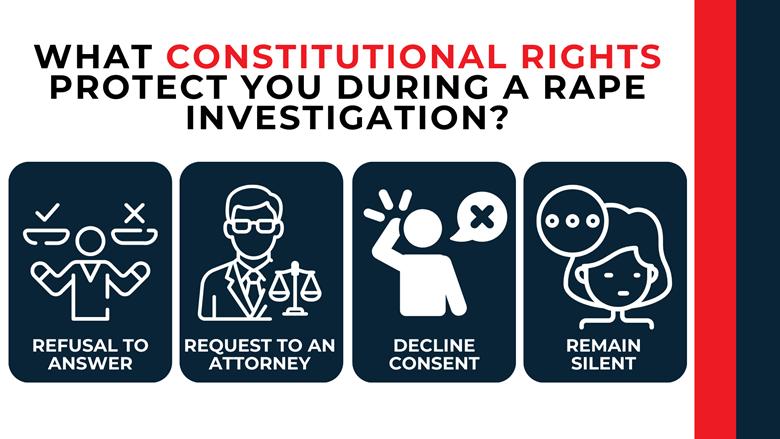
The Fifth Amendment protects your right to remain silent and your right to counsel during custodial interrogation. Police must provide Miranda warnings before questioning someone in custody, but they often attempt to speak with suspects before formal arrest. Your rights include:
- Refusing to answer questions without an attorney present this cannot be used against you
- Requesting an attorney immediately upon any police contact about sexual assault allegations
- Declining consent to searches of your home, vehicle, or electronic devices
- Remaining silent even if police suggest talking will “clear things up” or “make this easier”
Under State v. Jackson, 308 N.C. 549 (1983), police deception during interrogation does not automatically make confessions involuntary making it even more critical to invoke your rights immediately rather than trying to explain your innocence without counsel.
Can Police Search Your Phone Without a Warrant?
Following Riley v. California, police generally cannot search cell phones without a warrant. However, officers may seize your phone to prevent evidence destruction while obtaining a warrant. N.C.G.S. § 15A-248 requires warrants to be executed within 48 hours of issuance. If police searched your phone without proper authorization, your attorney can file a suppression motion to exclude that evidence.
What Are Pretext Calls and How Do They Work?
North Carolina is a one-party consent state under N.C.G.S. § 15A-287, meaning law enforcement can record phone calls when one party (typically the accuser) consents. Police often arrange for accusers to call defendants and attempt to elicit incriminating statements. These “pretext calls” are legal but can be challenged if they involve improper inducement. Never discuss allegations by phone without attorney guidance; anything you say can be recorded and used against you.
What Are the Consequences of a Rape Conviction in North Carolina?
The stakes in a rape case cannot be overstated. North Carolina imposes severe penalties that extend far beyond prison time.
What Prison Sentences Do Rape Convictions Carry?
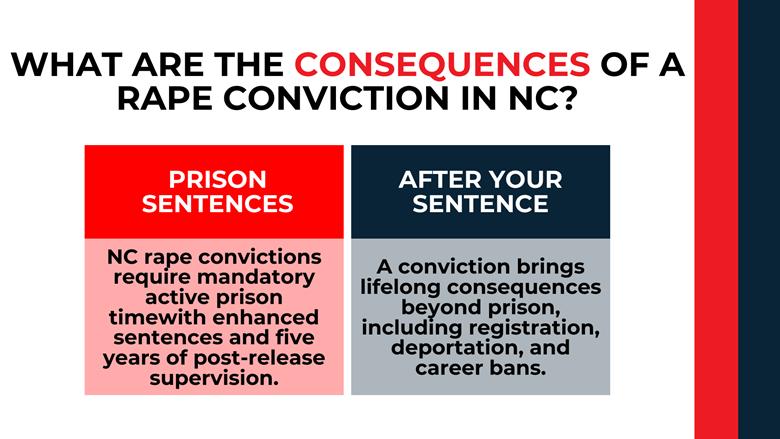
According to the NC Sentencing Commission’s FY 2024 Report, rape convictions result in:
- First-degree rape (Class B1): Average sentences of 236 months minimum to 315 months maximum (approximately 19.7 to 26.25 years)
- Second-degree rape (Class C): Mandatory active imprisonment with sentence length based on prior record
- 100% active imprisonment rate for Class B1 through D felony sex offense convictions no probation
- Enhanced maximum sentences for sex offenses: 120% of minimum plus 60 additional months under N.C.G.S. § 15A-1340.17(f)
- 60 months post-release supervision (versus 9-12 months for other felonies)
What Happens After You Serve Your Sentence?
Conviction triggers lifelong consequences beyond incarceration:
- Sex offender registration for 30 years minimum under N.C.G.S. § 14-208.7 (lifetime for recidivists or aggravated offenders)
- GPS electronic monitoring potential the NC Department of Adult Correction (FY 2023) reports 581 sex offenders currently enrolled
- Housing and employment restrictions that severely limit where you can live and work
- Immigration consequences for non-citizens, including mandatory deportation for most sex offenses under Padilla v. Kentucky, 559 U.S. 356 (2010)
- Professional licensing bars affecting careers in healthcare, education, law, and other regulated fields
Why Does Early Legal Intervention Matter in False Accusation Cases?
The period between accusation and formal charges presents critical opportunities that disappear once the prosecution commits to a case.
What Can a Defense Attorney Do Before Charges Are Filed?
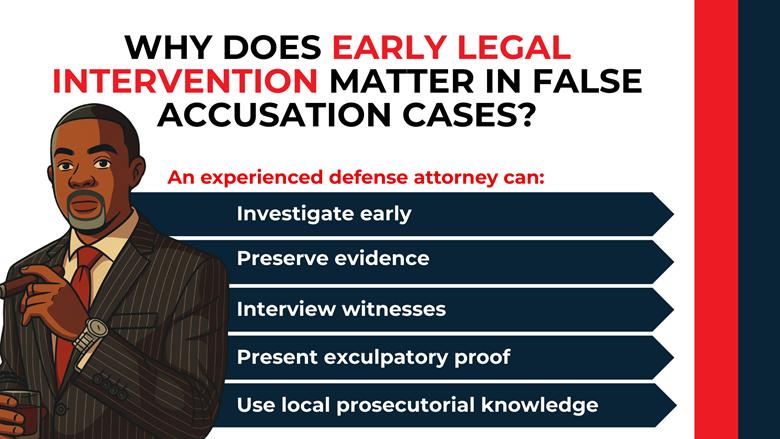
Before charges are filed, a defense attorney can conduct independent investigation that may prevent prosecution entirely. This includes interviewing witnesses while memories are fresh, preserving electronic evidence before it’s deleted, documenting your alibi, and gathering character evidence. Your attorney can also communicate with investigators to present exculpatory evidence without you making any statements that could be used against you.
In Wake County, where Apex cases are prosecuted, relationships with prosecutors’ offices and knowledge of local practices matter. An attorney familiar with how Wake County handles sex offense allegations can navigate the system more effectively than someone unfamiliar with local procedures.
Why Early Investigation is a Must
Every day that passes without a defense investigation is a day evidence may be lost. Witnesses forget details or become unavailable. Surveillance footage gets overwritten. Electronic records are deleted. The 27-month average pretrial detention for Class B1 felonies means wrongly accused defendants who wait to retain counsel may spend years in jail while their defense options narrow.
The Advantage of Rigorous Trial Training
Because the window to secure evidence is so small, choosing an attorney with the specific training to dismantle a prosecution’s case is critical. Attorney Patrick Roberts has built his practice on the foundation of rigorous, hands-on trial advocacy designed to challenge even the most difficult accusations:
- 2025 Cross-Examination Intensive: Recently completed a 3-day intensive hands-on training with the National Criminal Defense College (NCDC), focusing exclusively on advanced cross-examination techniques to expose inconsistencies in witness testimony.
- NCDC Trial Practice Institute Graduate (2011): Completed the prestigious 2-week intensive program covering every phase of defending the accused, a “gold standard” for criminal defense practitioners.
- Gerry Spence Trial Lawyer College Graduate: A graduate of the rigorous 3-week program founded by legendary trial lawyer Gerry Spence, focusing on the human element of a trial—from jury selection to powerful closing arguments.
By combining this high-level training with over 20 years of experience as both a defense attorney and a former prosecutor, Attorney Patrick Roberts understands how to act quickly to preserve evidence and build a trial-ready defense from day one.
“Patrick Roberts is my #1 referral for my own clients facing criminal issues (State and Federal) and for people that call my office requesting consultation on criminal matters . Patrick’s expertise in the field, experience in the courtroom and professionalism are the reasons he is my top recommendation. He is trustworthy, reliable and highly esteemed by his peers, employees and friends. If I were ever facing charges of a criminal nature, I would want Patrick to go to bat for me.” – Peer review via Martindale-Hubbell on October 29, 2019
Disclaimer: The testimonials and peer reviews on this site are for informational purposes. They do not constitute a guarantee, warranty, or prediction regarding the outcome of your legal matter. Every case is different and must be evaluated on its own merits.
*Testimonials and peer endorsements found on this website are actual comments.
Frequently Asked Questions
Can I sue my accuser for making a false rape accusation?
Civil remedies for false accusations exist, including defamation and malicious prosecution claims, but pursuing them during criminal proceedings is generally inadvisable. Filing a civil suit can appear retaliatory and may complicate your criminal defense. Most attorneys recommend waiting until the criminal matter resolves ideally with acquittal or dismissal before considering civil action. North Carolina law provides immunity for certain reports made in good faith, so proving the accusation was knowingly false is essential.
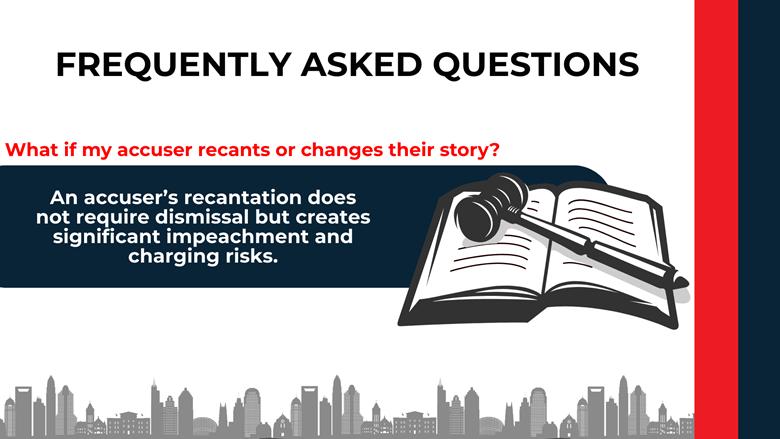
What if my accuser recants or changes their story?
Accuser recantation does not automatically result in dismissal. Prosecutors in Wake County may proceed using evidence-based prosecution techniques, relying on prior statements, physical evidence, and corroborating witnesses even when the accuser no longer cooperates. However, recantation or significant changes in the accuser’s account create powerful impeachment opportunities at trial and may influence prosecutorial charging decisions.
Should I take a polygraph test to prove my innocence?
Polygraph results are inadmissible in North Carolina courts under State v. Grier, 307 N.C. 628 (1983). While passing a polygraph might influence prosecutorial decisions in some cases, failing one even falsely could encourage more aggressive prosecution. Never take a polygraph without consulting your attorney about the specific risks and potential benefits in your case.
How long will a false rape accusation case take to resolve?
Class B1 felony cases average 30 months from charge to sentencing according to NC Sentencing Commission data. Cases involving complex forensic evidence, multiple witnesses, or extensive investigation may take longer. The timeline depends on factors including court scheduling, discovery disputes, and whether the case proceeds to trial or resolves through dismissal or plea negotiation.
What happens if I’m acquitted? Can I clear my record?
Acquittal means you were found not guilty, but the arrest record remains unless expunged. North Carolina permits expunction of charges that were dismissed or resulted in acquittal under N.C.G.S. § 15A-146. The process requires filing a petition with the court and typically takes several months. Until expunction is complete, background checks may still reveal the arrest.
Protecting Your Future Against False Accusations
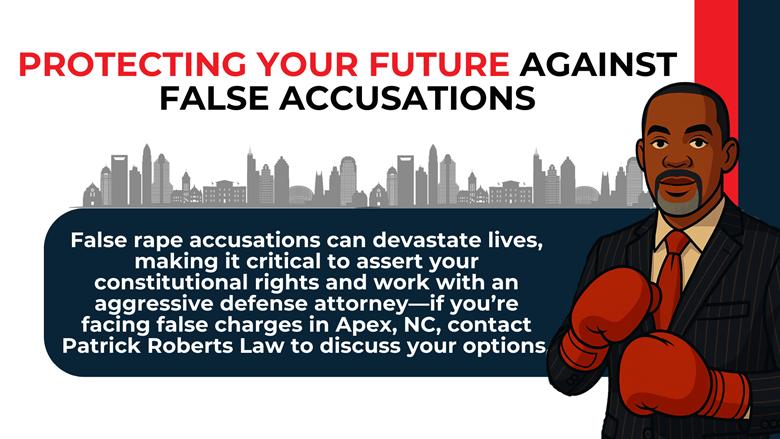
False rape accusations can destroy lives even when the truth eventually emerges. The combination of lengthy pretrial detention, severe potential sentences, and permanent collateral consequences makes defending against wrongful charges a high-stakes situation in criminal law. Understanding what the State must prove, knowing your constitutional rights, and working with an attorney who will aggressively investigate your case provides the best chance of exposing the truth.
The criminal justice system is designed to protect the innocent through the presumption of innocence “beyond a reasonable doubt.” However, these protections are not self-executing—they only work when defendants assert their rights and present a vigorous defense.
Don’t Let Silence Be Your Defense
When your reputation, your freedom, and your future are on the line, the quality of your defense is paramount. Attorney Patrick Roberts leverages his experience as a former prosecutor to rigorously scrutinize the state’s evidence, seeking to uncover inconsistencies and ensure that your side of the story is heard.
If you are fighting rape accusations in Apex, Raleigh, or the surrounding areas, do not leave your future to chance. Take a proactive step in your defense.
Contact Patrick Roberts Law for a confidential consultation.
Disclaimer: The information on this website is for general information purposes only. Nothing on this site should be taken as legal advice for any individual case or situation. Case results depend upon a variety of factors unique to each case. Prior results do not guarantee a similar outcome.
Former assistant district attorney
Contact Patrick Roberts
Facing criminal charges in North Carolina demands seasoned representation. Trust in the experience and dual perspective of Patrick Roberts. Reach out today for a confidential consultation.
-
Call Our Team
Calls answered 24/7






For more information on the selection criteria, go to www.martindale.com
*Each case is different and must be evaluated separately. Prior results achieved do not guarantee similar results can be achieved in future cases.