Yes, in North Carolina you can get many misdemeanor convictions expunged, meaning legally erased from your record. But not every misdemeanor qualifies, and the ones that do only clear after a waiting period and a formal court petition. Whether yours is eligible comes down to three things: what the offense was, how long ago your sentence ended, and whether anything else on your record blocks you.
This article walks through exactly that: which misdemeanors qualify and which are permanently off the table, how long you have to wait and when the clock actually starts, what else can disqualify you even when the offense and timing look fine, how to file the petition step by step, what it costs and how long it takes, and how to decide whether this is something you can file yourself or should hand to a lawyer.
Can you actually get a misdemeanor conviction expunged in North Carolina?
For most nonviolent misdemeanors, yes. North Carolina has no general "sealing" law that hides records automatically. Every bit of record relief comes from specific permissions written into the statutes (N.C. Gen. Stat. Chapter 15A, Article 5, §§ 15A-145 to 15A-160). If a statute doesn't cover your situation, there's no expungement for it.
That means there are really two gates, not one. The first is eligibility: does the law allow your offense to be cleared, and has enough time passed? The second is the petition, the paperwork and court process to make it happen. Most people searching for "how to" are focused on the second gate, but the first one is where cases actually live or die. Eligibility is decided by the statute in effect on the day you file. So the current rules, not the rules when you were convicted, are what matter.
The main pathway for clearing an actual misdemeanor conviction is the Second Chance Act, set out in N.C. Gen. Stat. § 15A-145.5. It's a real but narrow door: in the most recent fiscal year, North Carolina courts granted only 3,599 nonviolent-conviction expunctions statewide under that statute. It works, but you have to fit through it precisely.
Which misdemeanors qualify, and which are shut out for good?
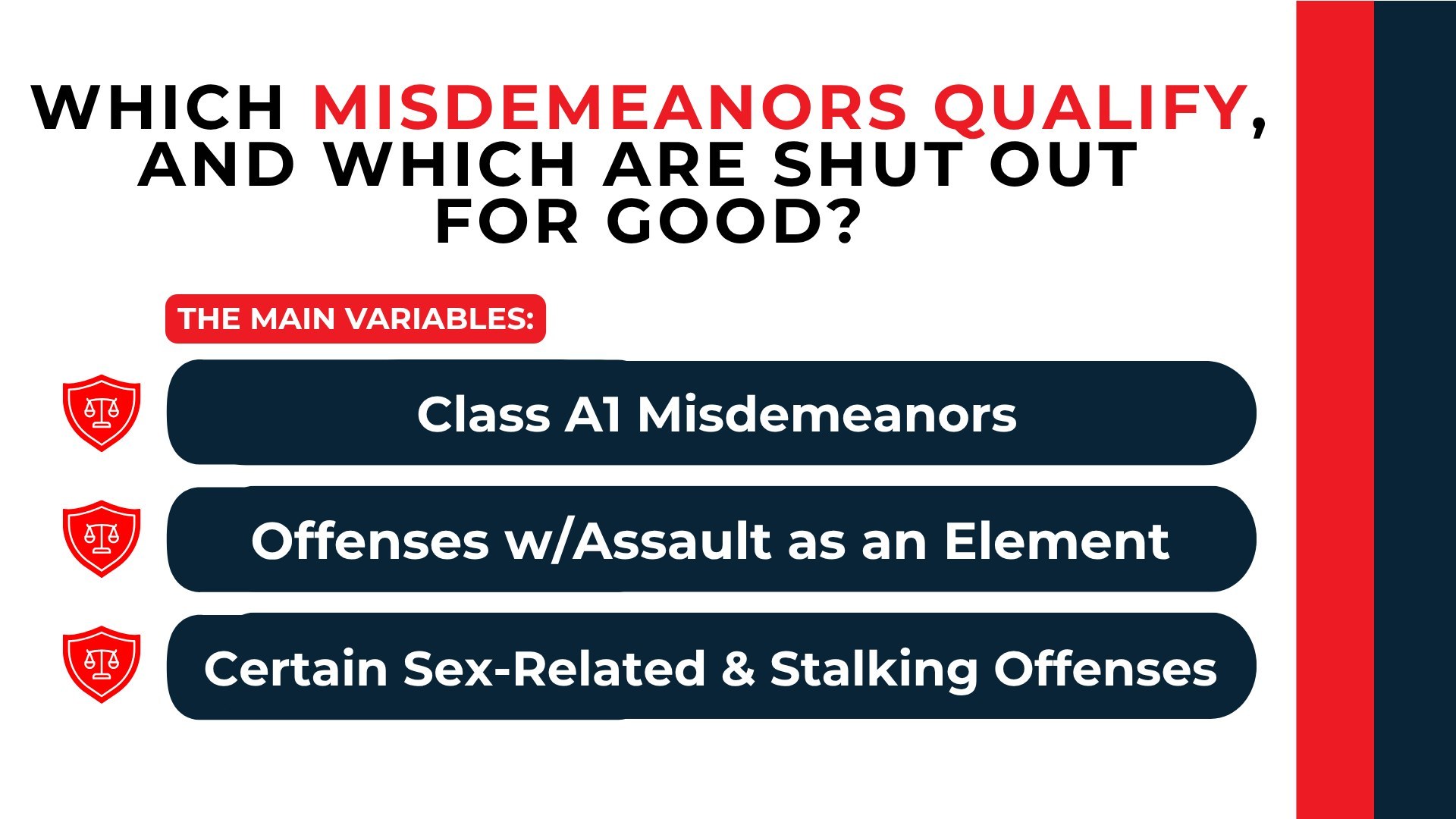
Only "nonviolent" misdemeanors qualify, and "nonviolent" is a defined legal term, not a judgment call about how your case felt. Under § 15A-145.5(a), the definition carves out entire categories of offenses that can never be expunged under this statute, no matter how much time passes.
Permanently excluded are:
• Class A1 misdemeanors, the most serious misdemeanor level in North Carolina.
• Offenses with assault as an element, meaning assault is a required part of the charge itself.
• Certain sex-related and stalking offenses.
If your conviction falls into one of those buckets, no waiting period fixes it. If it doesn't, and a great many common misdemeanors don't, you're likely looking at a qualifying "nonviolent misdemeanor." For scale, traffic offenses alone make up 43% of North Carolina misdemeanor convictions, and the single most common one is Driving While License Revoked (non-DWI). The point isn't that your specific charge is guaranteed eligible; it's that the disqualified list is specific, and most everyday misdemeanors sit outside it.
The safest move is to confirm the exact offense and class as they appear on your court record. Then check them against the § 15A-145.5(a) exclusions before you count on anything.
How long do you have to wait before you can file?
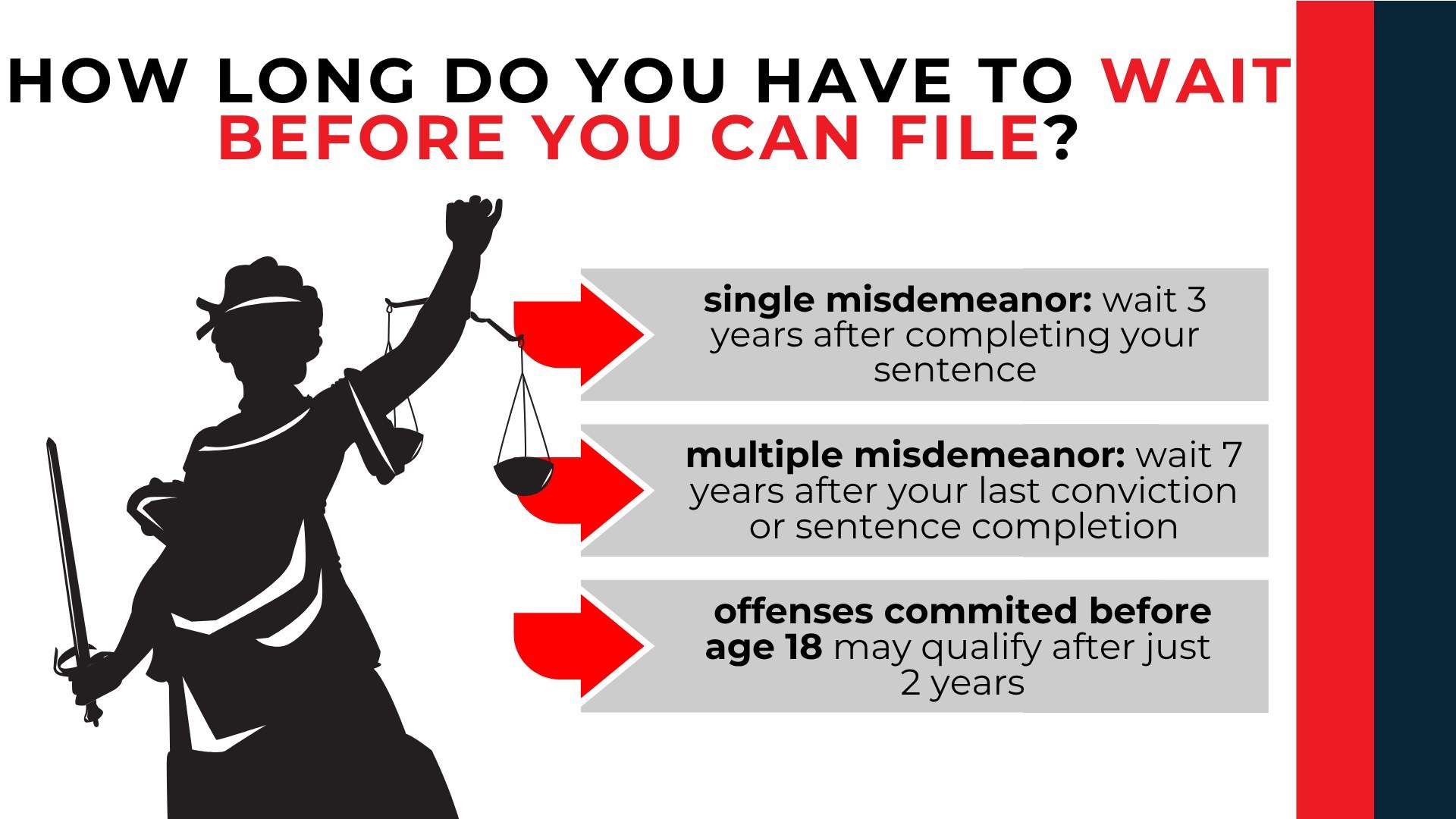
For a single nonviolent misdemeanor, the wait is three years. For multiple nonviolent misdemeanors, it's seven years. That three-year figure is recent: the legislature cut it down from five years in 2025 (S.L. 2025-71, effective July 9, 2025). So if you looked into this a couple of years ago and gave up, the timeline may now be shorter than you think.
Here's the detail that trips people up: the clock doesn't start on your conviction date. It starts on the later of your conviction or the day you finished your entire sentence, including any probation or post-release supervision. So if you were convicted in 2020 but stayed on probation until 2022, your three-year single-misdemeanor clock runs from 2022, not 2020.
For the seven-year multiple-misdemeanor track, the wait runs from your last conviction (setting aside certain unlisted traffic offenses) or from completion of the sentence tied to it, whichever is later.
There's also a shorter route for offenses committed young. Under § 15A-145, a misdemeanor committed before you turned 18, or a first underage-alcohol offense, can qualify for expungement after just a two-year wait. You do have to meet the first-offender requirements for that statute. If your misdemeanor is from your teenage years, that's often the faster and cleaner path.
What else can disqualify you, even when the offense and the waiting period check out?
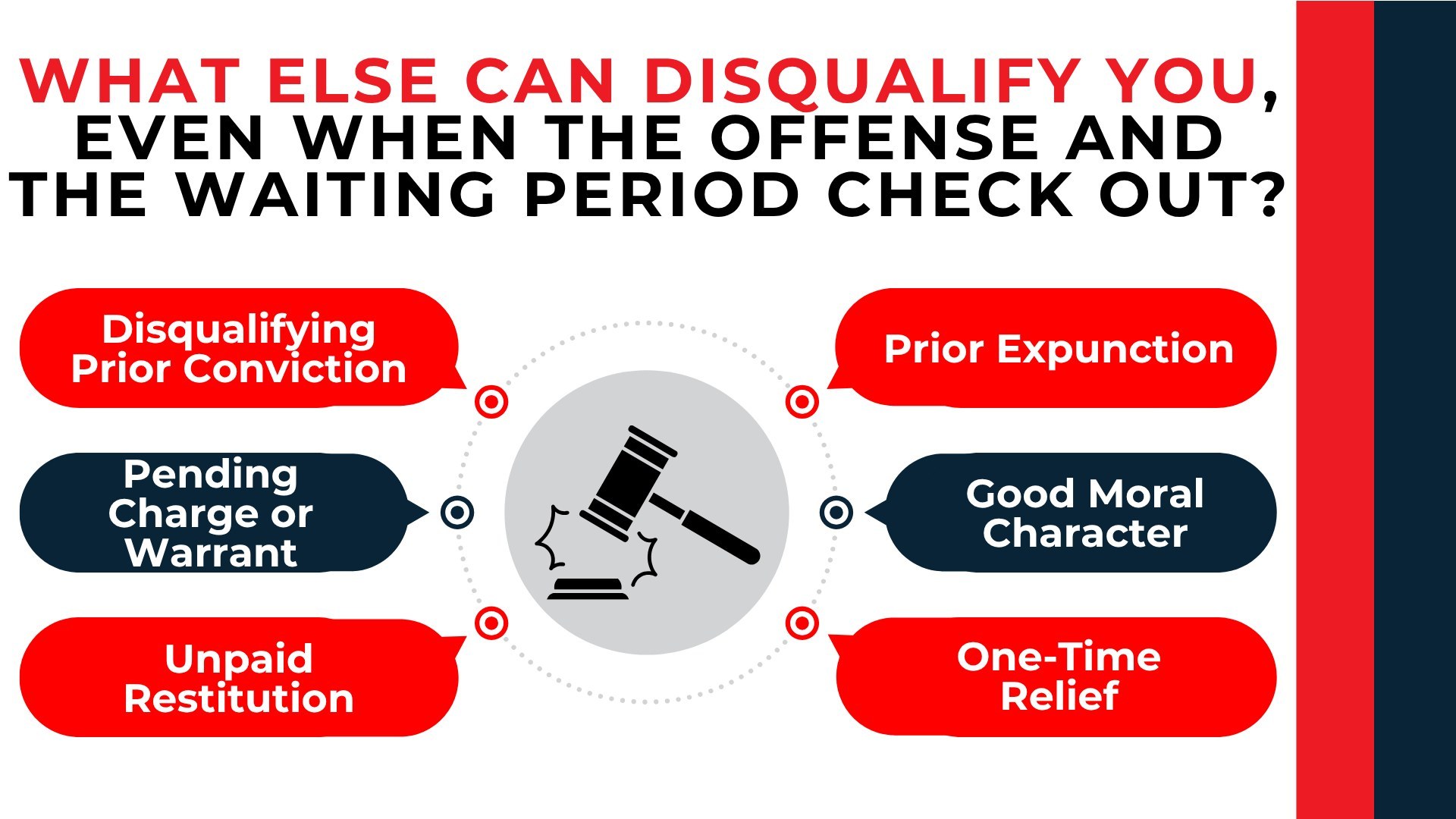
Plenty. Eligibility is a stack of conditions, and every one of them has to hold. Clearing the offense type and the waiting period only gets you partway. Under § 15A-145.5, you can still be blocked by any of the following:
• A disqualifying prior conviction on your record.
• An outstanding warrant or a pending charge: you generally can't expunge the past while a current case is open.
• Unpaid restitution still owed on the case.
• A prior § 15A-145.5 expunction you've already used, with only narrow multi-county exceptions.
• A failure to show "good moral character" during the waiting period; the statute requires it, so what you've done since the conviction matters.
That prior-expunction bar deserves special attention. This relief is largely a one-time tool. If you burn it on one case now, you may not be able to use it again later for another. That's exactly why it's worth being sure you're clearing the right things, in the right order, before you file.
How do you actually file the petition?
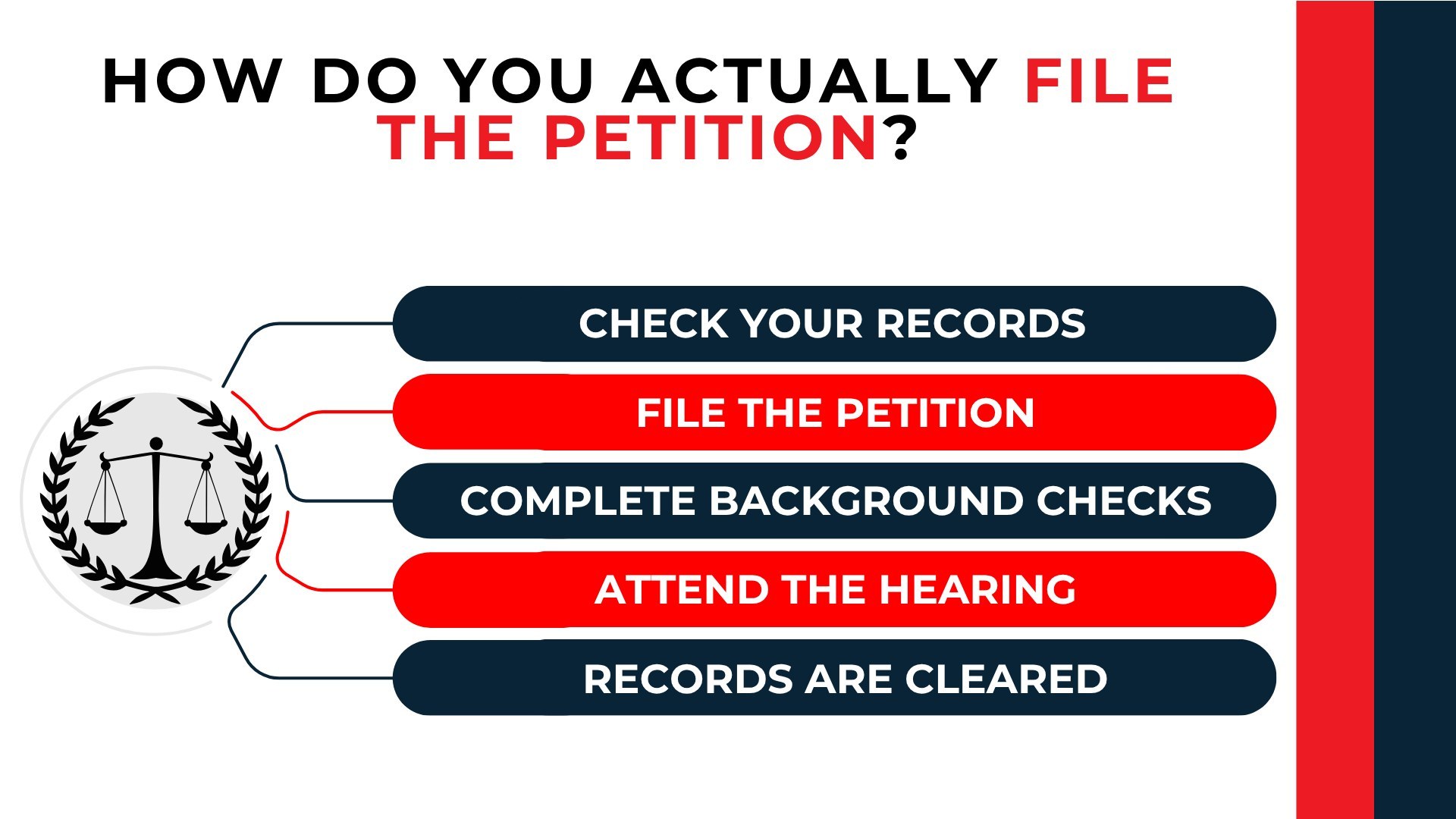
You file a verified petition, meaning a written, sworn request, on the official Administrative Office of the Courts (AOC) form, in the county where you were convicted. A judge then decides it after a hearing. Here's the sequence:
• Pull your own records and identify the right statute. Get your certified criminal record and confirm the exact offense, class, and disposition date. Then match your situation to the correct expungement statute (for most misdemeanor convictions, § 15A-145.5).
• Complete the verified AOC petition form for that statute, filed in the trial division of the county where the charge or conviction arose.
• Trigger the required background checks. Most petitions require an SBI criminal-history check and an AOC check for any prior expunctions; the court uses these to confirm you actually qualify.
• Attend the hearing and let the judge rule on the petition, which is generally resolved after a hearing.
• The order goes out to the agencies holding your record. If granted, the clerk sends the order under § 15A-150 to the AOC, the arresting agency (sheriff or chief of police), the DMV if applicable, the Department of Adult Correction, the SBI, and, through the SBI, the FBI. That clears the record across the system, not just at the courthouse.
Each step has to be right. A petition on the wrong form, filed in the wrong county, or resting on a miscounted waiting period doesn't just get delayed; it can get denied.
What does it cost and how long does it take?
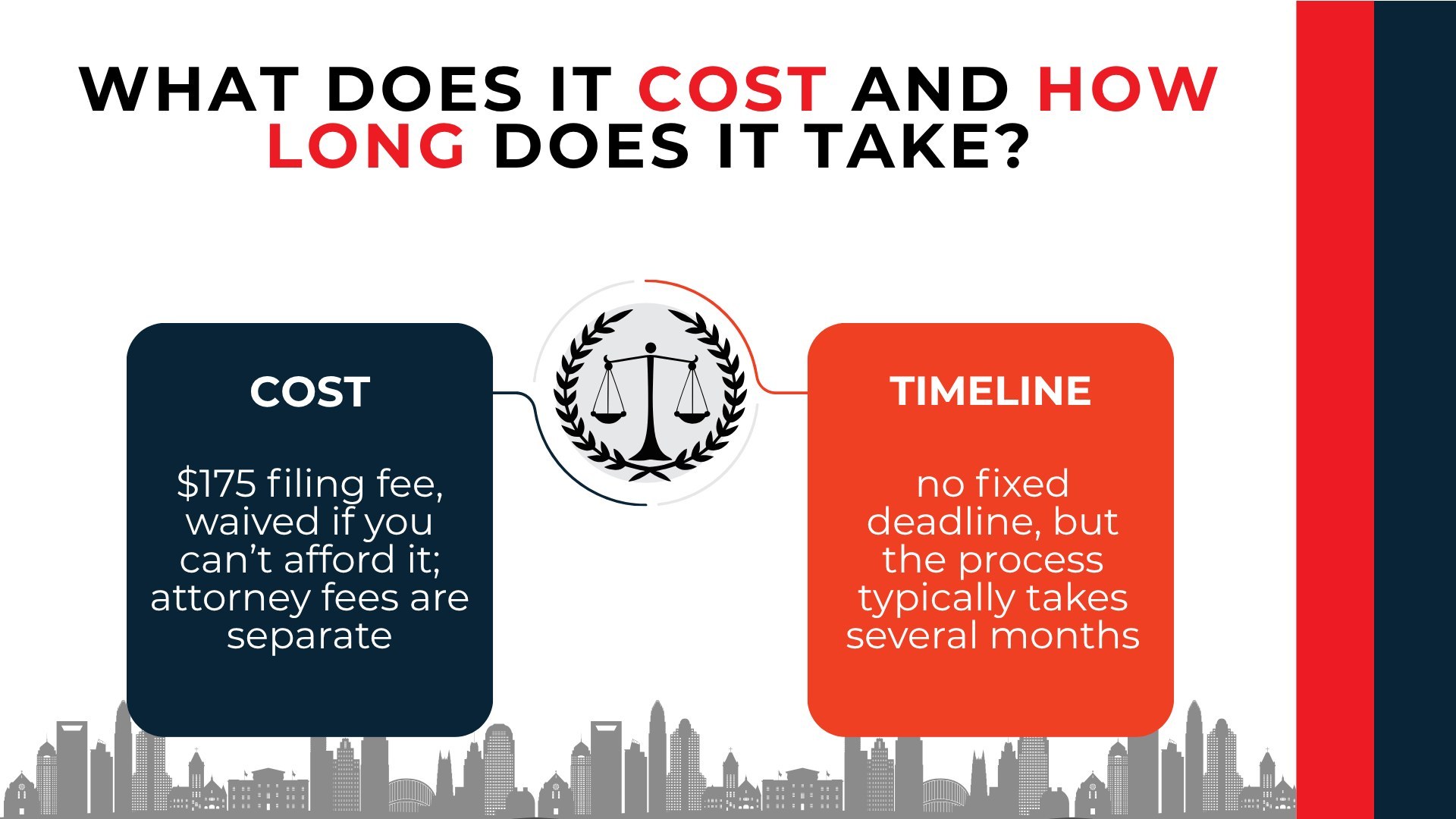
The filing fee is $175, and it's waived if you can't afford it (§§ 15A-145(e) and 15A-145.5(g)). That covers the petition itself; if you hire an attorney, their fee is separate.
There's no fixed statutory timeline for how long the whole process takes, and it isn't quick. Between the SBI and AOC background checks and getting on the court's calendar for a hearing, a petition realistically takes months from filing to order. That's normal: the moving parts, not your case specifically, drive the timeline.
Should you handle this yourself, or bring in a lawyer?
If you have a single, clearly nonviolent misdemeanor, your waiting period is plainly satisfied, nothing else is on your record, and you owe no restitution, you may be able to file this yourself. The forms exist and the fee can be waived. The catch is that the clean case and the complicated one look identical until someone checks the details.
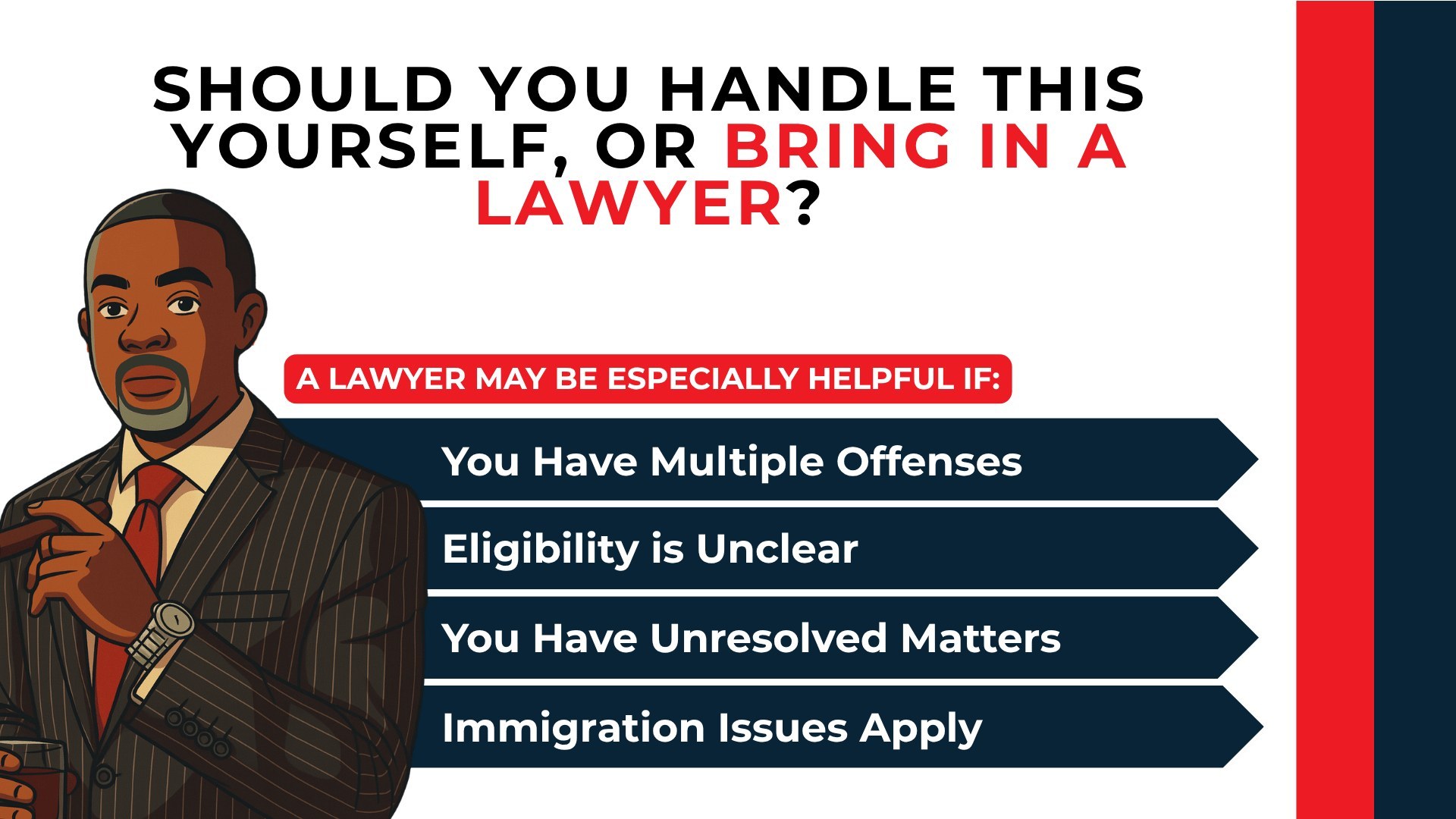
Several things tip this toward getting a lawyer:
• You have more than one offense, or offenses in different counties, and the order you clear them in affects what you can clear later.
• You're unsure whether your offense counts as "nonviolent" under § 15A-145.5(a), or whether your waiting period actually started when you think it did.
• There's unpaid restitution, a pending matter, or an old charge you're not certain was resolved.
• You're not a U.S. citizen and need to understand the immigration angle before you file.
Remember the one-shot problem: because a prior § 15A-145.5 expunction can itself bar a future one, filing hastily, or filing and getting denied, carries real cost. This is worth doing once, correctly.
That gap between eligible and actually cleared is enormous in practice. Nationally, only a small group of people obtain it within five years of becoming eligible. Most of that gap is the process itself: not knowing the rules, miscounting the clock, or giving up at the first obstacle. That's exactly where having someone who knows the statute cold changes the outcome.
What to do next
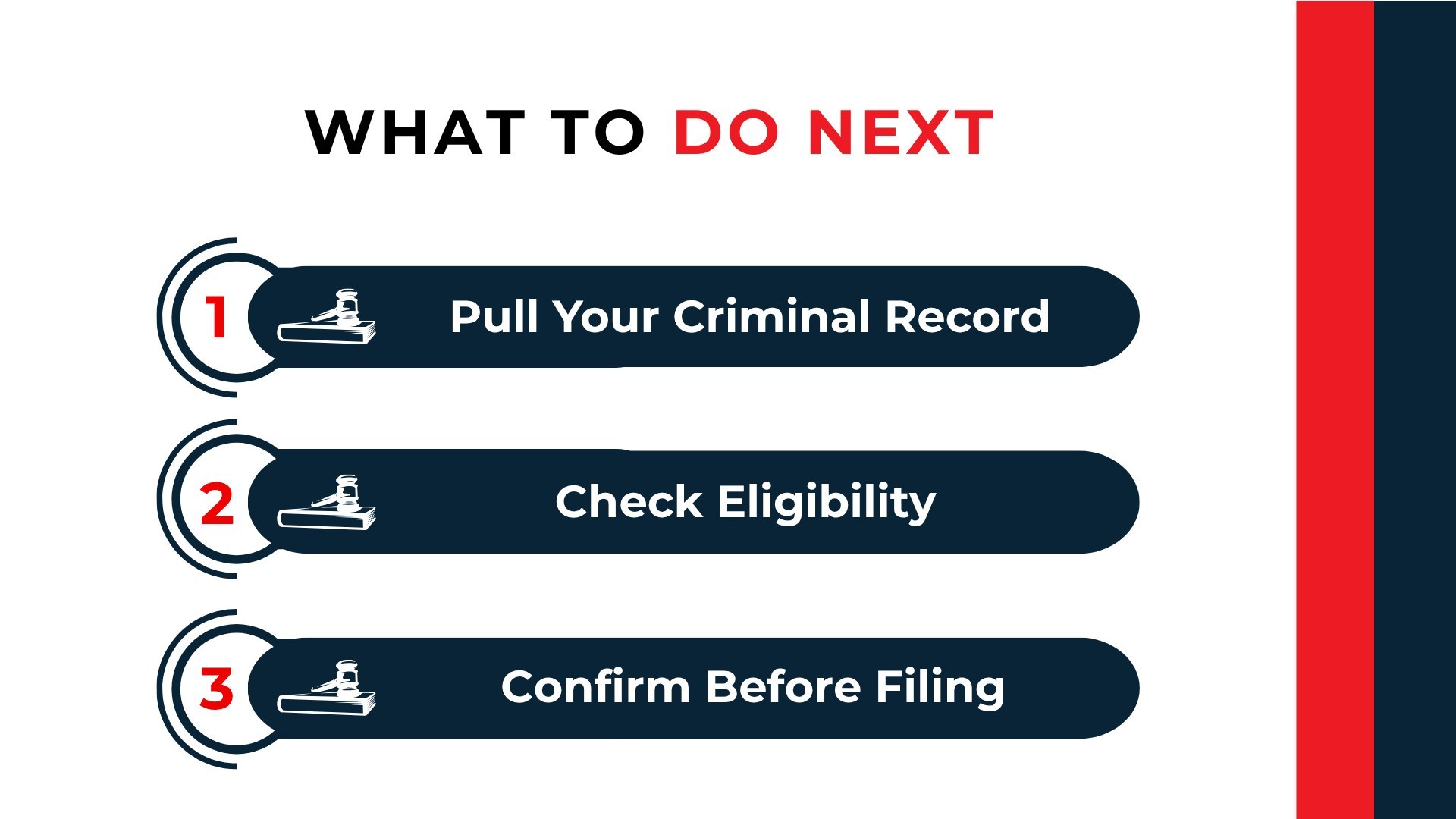
• Pull your certified criminal record and write down the exact offense, its class, and the date your sentence, including probation, ended.
• Check that offense against the § 15A-145.5(a) exclusions and count your waiting period from the later of conviction or sentence completion.
• Have your eligibility confirmed before you file, especially if you have more than one offense, owe restitution, or have any immigration concern.
Expungement Compliance and Criminal Defense Practice in North Carolina
Securing criminal record relief under North Carolina’s Second Chance Act demands strict procedural precision to avoid petition dismissal on technical grounds. Patrick Roberts applies over two decades of courtroom and litigation expertise to these statutory processes. As a former Assistant District Attorney who prosecuted state dockets, Mr. Roberts leverages practical insight into both state prosecution strategies and defense procedures to guide clients through expunction filings. Recognized with an AV Preeminent rating from Martindale-Hubbell for eight consecutive years, his practice focuses on statutory record relief and high-stakes criminal defense, including felony sex offense matters, within the North Carolina judicial system.
Professional Qualifications
• AV Preeminent Rating (Martindale-Hubbell): Recognized for 8 consecutive years (2018–2026) through a rigorous, peer-nominated national vetting process for high ethical standards and legal ability.
• Elite Academic Background: Graduate of Duke University School of Law (ranked Number 7 in Best Law Schools and Number 9 in Criminal Law for the 2026-2027 period) and Johns Hopkins (ranked No. #7 in National Universities).
• National Association of Distinguished Counsel: Selected to the "Nation's Top 1 Percent" in 2015, 2016, 2017, 2018, 2025, and 2026 based on peer nomination and vetting.
• Former Prosecutor Perspective: Leveraging four years of experience as an Assistant District Attorney across three North Carolina counties (New Hanover County, Johnston County, and Wake County), providing insight into the state’s procedural requirements for petitioning court records.
• Extensive Trial and Case Record: Handled more than 250 felony sex crime cases and completed more than 75 jury trials in state and federal courts, with extensive litigation experience in high-level felonies, white-collar crimes, complex drug trafficking, and sex offense allegations.
• Registry and Record Compliance Expertise: Demonstrates extensive litigation and administrative experience handling sex offender registry removal and compliance matters, skills directly applicable to complex record expungement petitions.
• Advanced Trial Advocacy Training: Graduate of the National Criminal Defense College and Gerry Spence’s Trial Lawyers College, equipping him with the skills necessary for navigating contested court hearings and evidentiary petitions.
Client Review
He worked to prove our case and got the case dismissed*. I was very pleased with him and his whole staff who kept me well informed at all times.
— Review by a verified client via Avvo
Peer Endorsement
Patrick is a thoughtful and experienced attorney. When I have a client needing representation in the Raleigh area in his areas of practice, he would be my referral of choice.
— Peer endorsement by a fellow North Carolina trial attorney via Avvo
*Disclaimer: The client reviews and peer endorsements displayed are authentic testimonials and comments provided by clients and fellow attorneys. Every case is unique and must be evaluated individually; past client experiences and case results do not guarantee, promise, or predict similar outcomes in any future matter.
Case Results
• Sex Offender Registry Removal: Legal counsel successfully petitioned to have the client removed from the sex offender registry after they completed the mandatory statutory registration period.
○ Outcome: Client removed from the sex offender registry (Year 2026)
• Probation Violation Defense: Counsel successfully argued that the client's alleged probation violations were the result of miscommunication between the client and their probation officers, leading the court to dismiss the violation and terminate probation.
•
○ Outcome: Probation violation dismissed and probation terminated
• Statutory Sex Offense Allegations: Defense counsel conducted a comprehensive investigation involving child psychology, forensic, and polygraph experts to challenge allegations of first-degree statutory sex offenses, successfully persuading the prosecution to drop all charges.
○ Outcome: Dismissal of all charges
• Second-Degree Sexual Offense (N.C.G.S. § 14-27.5(a)) Defense: In North Carolina v. D.C., defense counsel represented a client accused of second-degree sexual offense. Through extensive witness interviews of individuals present at the time of the alleged incident and acquaintances of the accuser, counsel uncovered critical evidence regarding the accuser's substance abuse and potential motives, persuading the Assistant District Attorney to dismiss the charge completely.
○ Outcome: Dismissal of all charges
Disclaimer: Case outcomes depend upon a variety of factors unique to each case. Prior results do not guarantee or predict a similar outcome in any future legal matter.
Navigating Relief Under North Carolina's Second Chance Act
Misdemeanor expunction requires strict compliance with statutory eligibility standards, mandatory waiting periods, and precise petition drafting. Because these statutory pathways do not occur automatically, knowledgeable legal counsel is critical to executing the process correctly. Patrick Roberts Law PLLC delivers skilled representation for clients seeking record relief across North Carolina, with an emphasis on Wake County jurisdictions including Raleigh, Cary, Apex, Holly Springs, Garner, and Fuquay-Varina.
To evaluate your statutory eligibility and initiate the expunction process, connect with Patrick Roberts Law PLLC at www.patrickroberts.law to schedule a formal case assessment.
The firm maintains a selective caseload to protect the integrity of its defense strategies and the thoroughness of its trial preparation.
Disclaimer: This article is general legal information, not legal advice. Reading it does not create an attorney-client relationship. North Carolina expunction law is almost entirely statutory and subject to legislative change, and how these rules apply depends on the specific facts of your case. For guidance on your situation, consult a licensed North Carolina attorney.