Blog / Felony Charges Lawyer

How Long Does a Felony Stay on Your Record in North Carolina?

Concerned man reads a record document beside the question of how long a felony stays on your North Carolina record.

In North Carolina, a felony conviction stays on your record permanently. There is no number of years after which it automatically drops off, expires, or disappears on its own. What can change is whether you're able to have it removed through a court process called expunction (also called expungement). That process is the legal erasing of a record.

So the real question usually isn't "how long until it goes away." It's "how long until I can do something about it." Below, I'll cover three things. The first is the difference between a felony that was dismissed and one that ended in a conviction. The second is exactly how long you have to wait before you can ask a court to clear a conviction. The third is which felonies can never be cleared at all.

Does a felony ever come off your record on its own?

A felony conviction does not come off on its own, ever. North Carolina has no general "sealing" law and no automatic clock that wipes a conviction after a set number of years. Every form of record relief comes from a specific set of statutes, N.C. Gen. Stat. Chapter 15A, Article 5 (§§ 15A-145 to 15A-160).

That's the part most people don't expect. You can finish your entire sentence, stay out of trouble for a decade, and the conviction is still sitting there on a background check. The record doesn't reward you for time passing. It only changes when you take a specific legal step to remove it, and even then, only if your offense qualifies.

There's one important exception to all of this, and it depends on how your case actually ended.
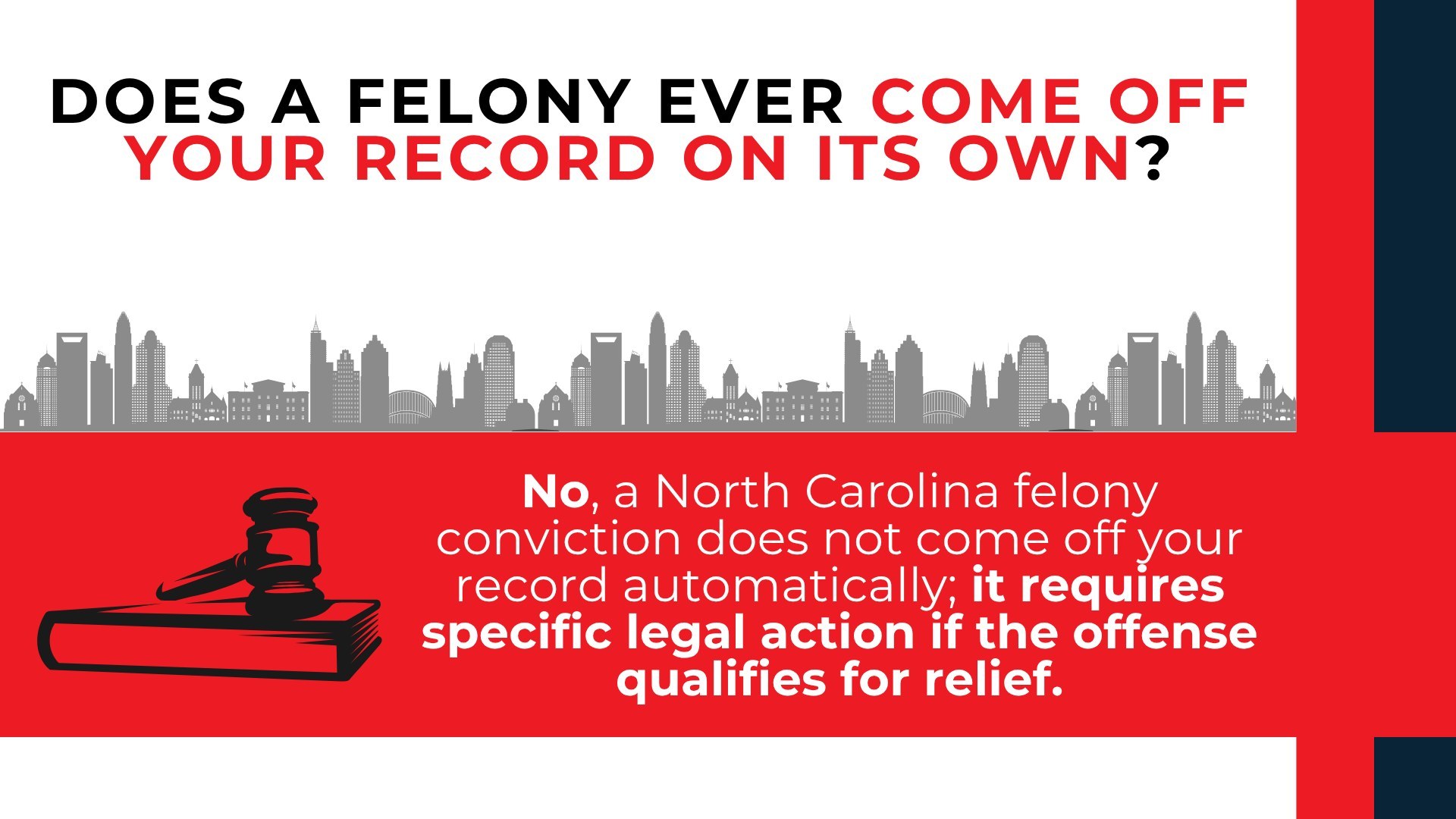
Gavel and North Carolina skyline explain that a felony stays on your record unless you qualify for legal relief.

Was your felony a conviction, or a charge that got dismissed?

This is the single most important distinction, because a dismissed charge and a conviction are treated in completely opposite ways. A felony charge that was dismissed, or one where you were found not guilty, can be cleared quickly, sometimes automatically. A felony conviction stays until you petition a court to remove it.

Here's how the two tracks work.

If your charge was dismissed or you were acquitted (found not guilty), you can petition to expunge it under N.C. Gen. Stat. § 15A-146. There is no waiting period. For a single dismissed charge or an acquittal on all related charges, that relief is mandatory; the court must grant it. It also isn't blocked by prior convictions or by an earlier expunction. That's a real advantage that conviction relief doesn't get.

On top of that, North Carolina now clears many qualifying dismissals and acquittals automatically, without you filing anything, under § 15A-146(a4). As restructured by S.L. 2024-35, automatic expunction happens roughly six to seven months (about 180 to 210 days) after the case is finally resolved. This is a large-scale reality, not a technicality: NC courts issued 1,381,128 automatic expunctions in a single fiscal year.

One catch worth knowing: a felony charge that was dismissed as part of a plea agreement is not cleared automatically. That means you pled guilty to something else in exchange. That one still requires you to file a petition (a formal written request to the court).

If your case ended in an actual conviction, none of the automatic clearing process applies to you. Keep reading; the timeline below is yours.
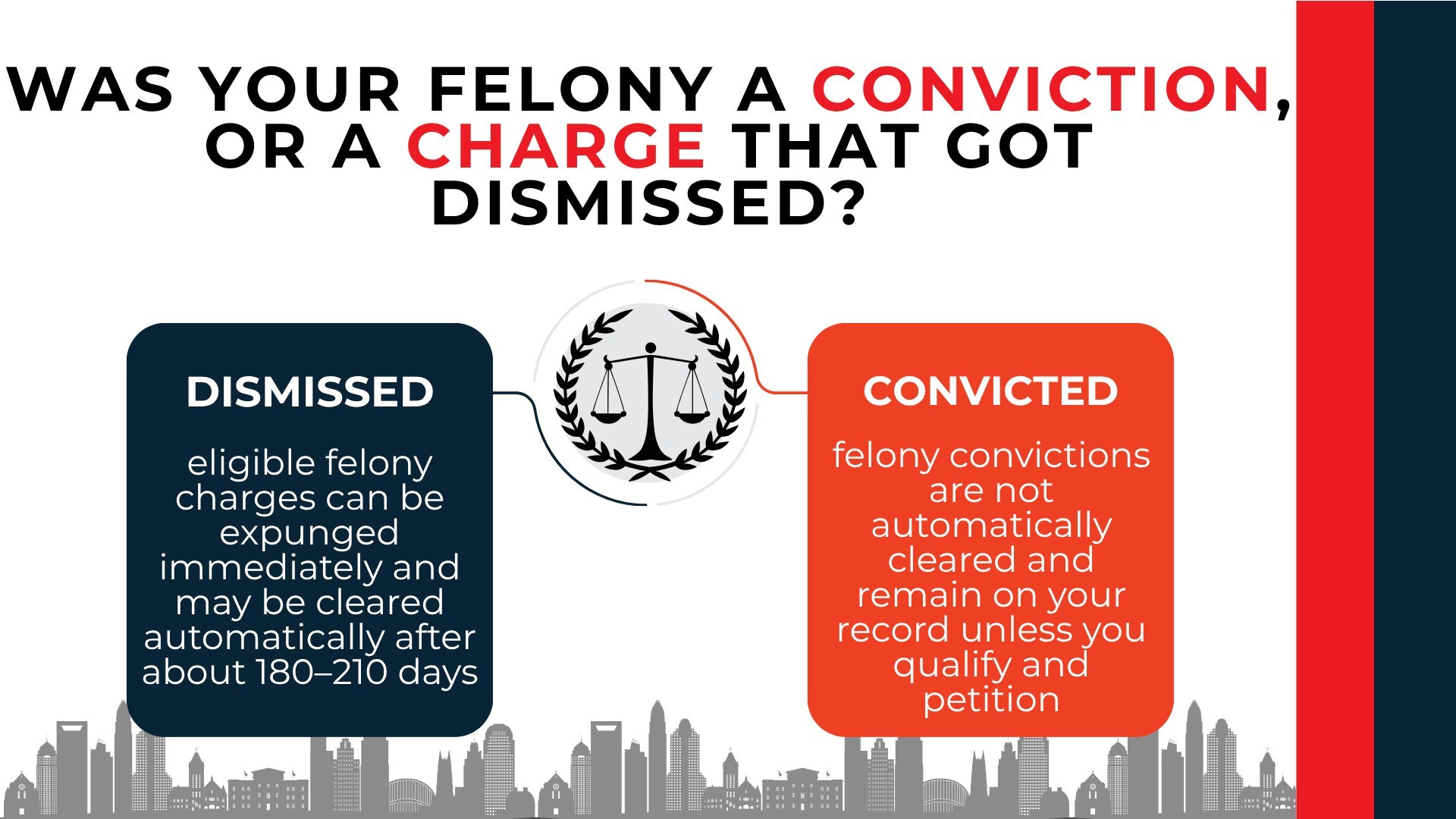
Scales of justice compare dismissed felony charges with convictions and their different paths to expungement.


When can you get a felony conviction taken off your record in North Carolina?

For a felony conviction, you generally have to wait ten years before you can even ask a court to clear it. Certain offenses require even longer. That waiting period is the closest thing to a real answer to "how long." But it's a clock to eligibility to petition, not a clock to automatic erasure.

The waiting periods live in North Carolina's Second Chance Act, N.C. Gen. Stat. § 15A-145.5. For nonviolent convictions, the statutory waits are:

• One nonviolent felony: 10 years.

• A felony breaking-or-entering conviction under G.S. 14-54(a): 15 years.

• Two or three nonviolent felonies: 20 years from the most recent conviction listed in your petition.

• (For comparison, a single nonviolent misdemeanor is now 3 years, reduced from 5 by S.L. 2025-71 effective July 9, 2025; multiple misdemeanors, 7 years.)

Read the fine print on where the clock starts, because it trips people up. The waiting period runs from the date of conviction or from the day you finished any active sentence, probation, or post-release supervision (the monitored period after prison), whichever is later. So if you were convicted ten years ago but only came off probation two years ago, your ten-year felony clock started two years ago, not ten.

And running out the clock isn't the whole test. Even after the waiting period, § 15A-145.5 blocks the petition if you have a disqualifying prior conviction, an outstanding warrant or pending charge, or unpaid restitution (money you were ordered to pay a victim). It also blocks you if you've already used a § 15A-145.5 expunction before (with limited exceptions). You also have to show good moral character during the waiting period. These aren't paperwork hurdles; any one of them can stop an otherwise-eligible petition cold.

That's part of why so few eligible people ever act. Nationally, among those legally eligible, only a small group of people obtain it within five years of becoming eligible. That gap is driven largely by people not realizing they qualify.
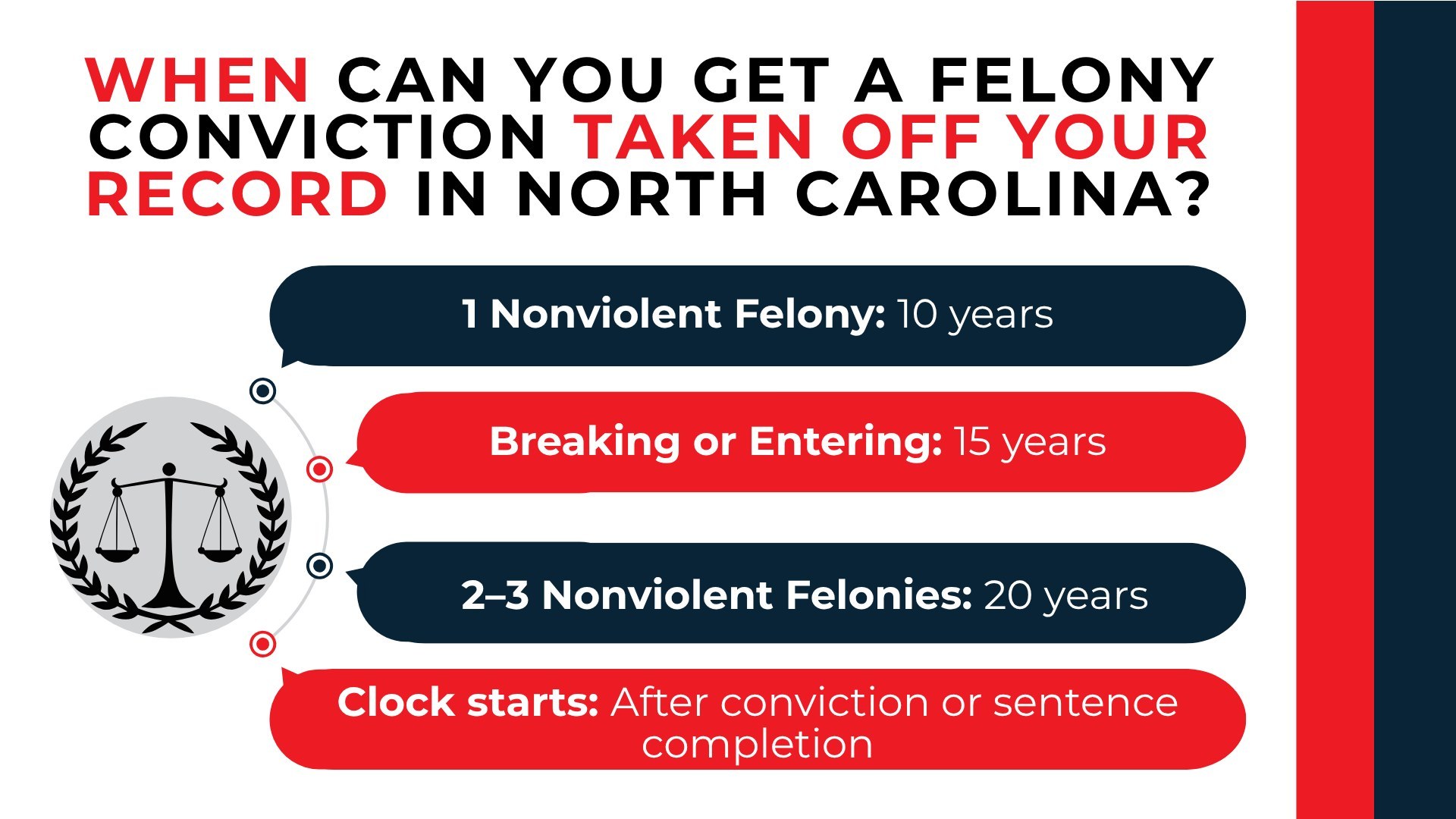
Scales of justice show NC felony expungement waits of 10, 15, or 20 years based on the conviction history.


What if your felony is one that can never be cleared?

Some felonies have no removal path at all. For those, the honest answer to "how long does it stay" is: permanently, with no exception.

North Carolina's relief is limited to what the statute calls a "nonviolent felony," defined in § 15A-145.5(a). That definition specifically excludes:

• Class A through G felonies: the more serious felony classes.

• Offenses that include assault as an element, and certain sex-related or stalking offenses.

• Certain drug-trafficking felonies: including methamphetamine and heroin trafficking, and possession with intent to sell or deliver cocaine.

• A handful of other exceptions, including food-contamination offenses under G.S. 14-401.16, offenses under G.S. 14-54(a1), and certain commercial-vehicle felonies.

If your conviction falls into one of these categories, no waiting period helps, because there's no door at the end of it. This is exactly the kind of line that's easy to guess wrong about on your own. The difference between a Class G felony and a Class H felony, for instance, decides whether relief is even possible. It's worth having someone read your actual record before you conclude anything.
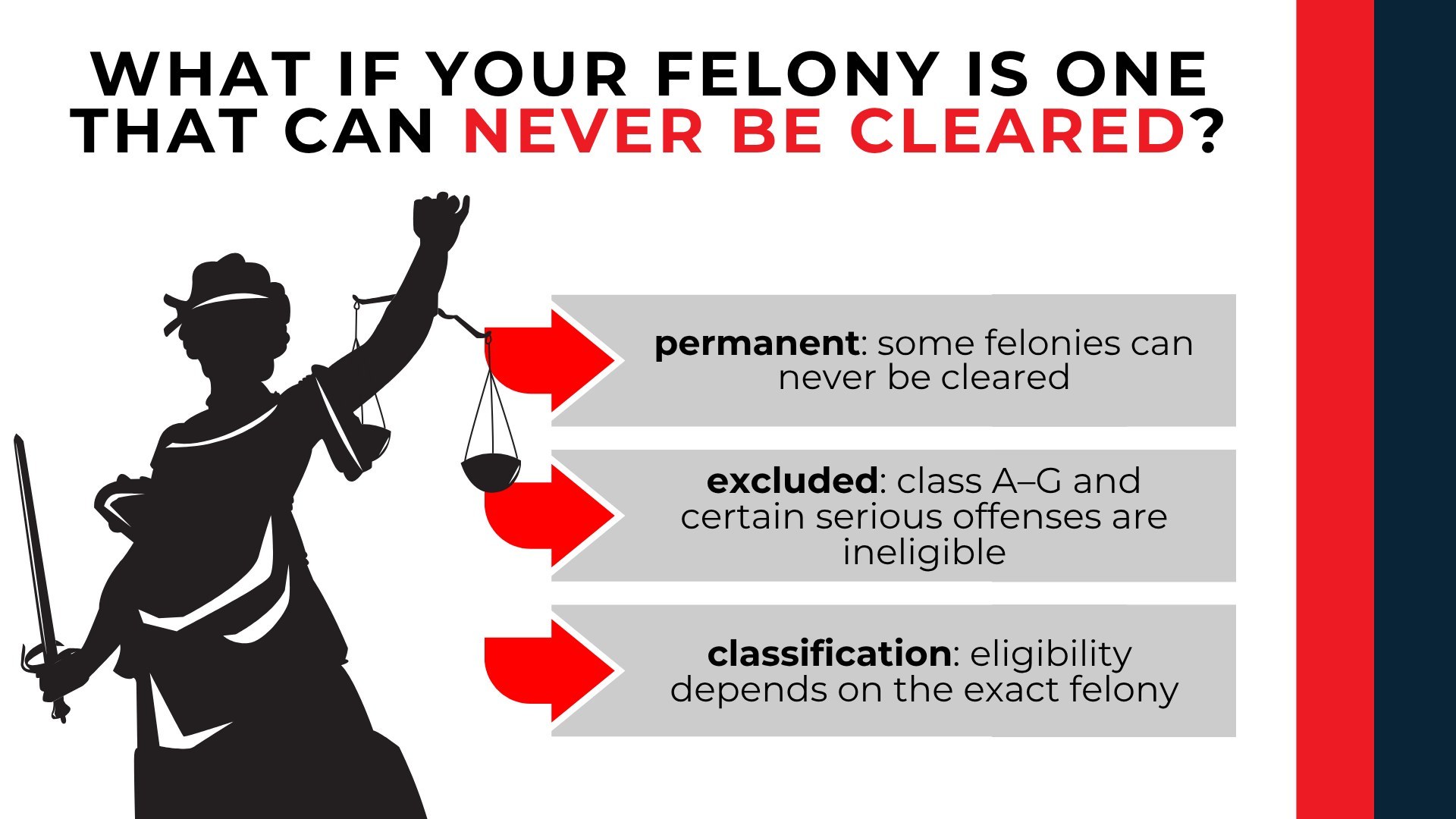
Lady Justice and arrows explain that Class A–G and certain serious felonies may be permanently ineligible for relief.

What should you do now?

Three steps, in order:

• Figure out which track you're on. Pull your record and confirm whether your felony ended in a conviction or a dismissal/acquittal. That alone determines whether you're waiting years or potentially clearing it now.

• Find your real start date. If it's a conviction, identify the later of your conviction date or the date you finished all sentencing, probation, or supervision. That's where your clock actually begins.

• Get your offense class and eligibility checked. Whether your felony is "nonviolent" under § 15A-145.5, and whether any bar applies, are the questions that decide everything. They turn on specifics that are easy to misread.

That last step is where an experienced criminal defense attorney earns their keep, and it's the work Patrick Roberts Law PLLC in Raleigh does. Patrick Roberts is a former Assistant District Attorney in Wake, Johnston, and New Hanover counties; he spent years on the side that builds and maintains these records, so he reads a criminal history the way the State does and knows precisely where an offense class or a bar will make or break eligibility. With 24-plus years of criminal law experience across North Carolina and a Duke Law background, he can tell you quickly whether your conviction has a path off your record, when that path opens, and what stands in the way. The firm serves clients from offices in Raleigh, Durham, Chapel Hill, and Cary.
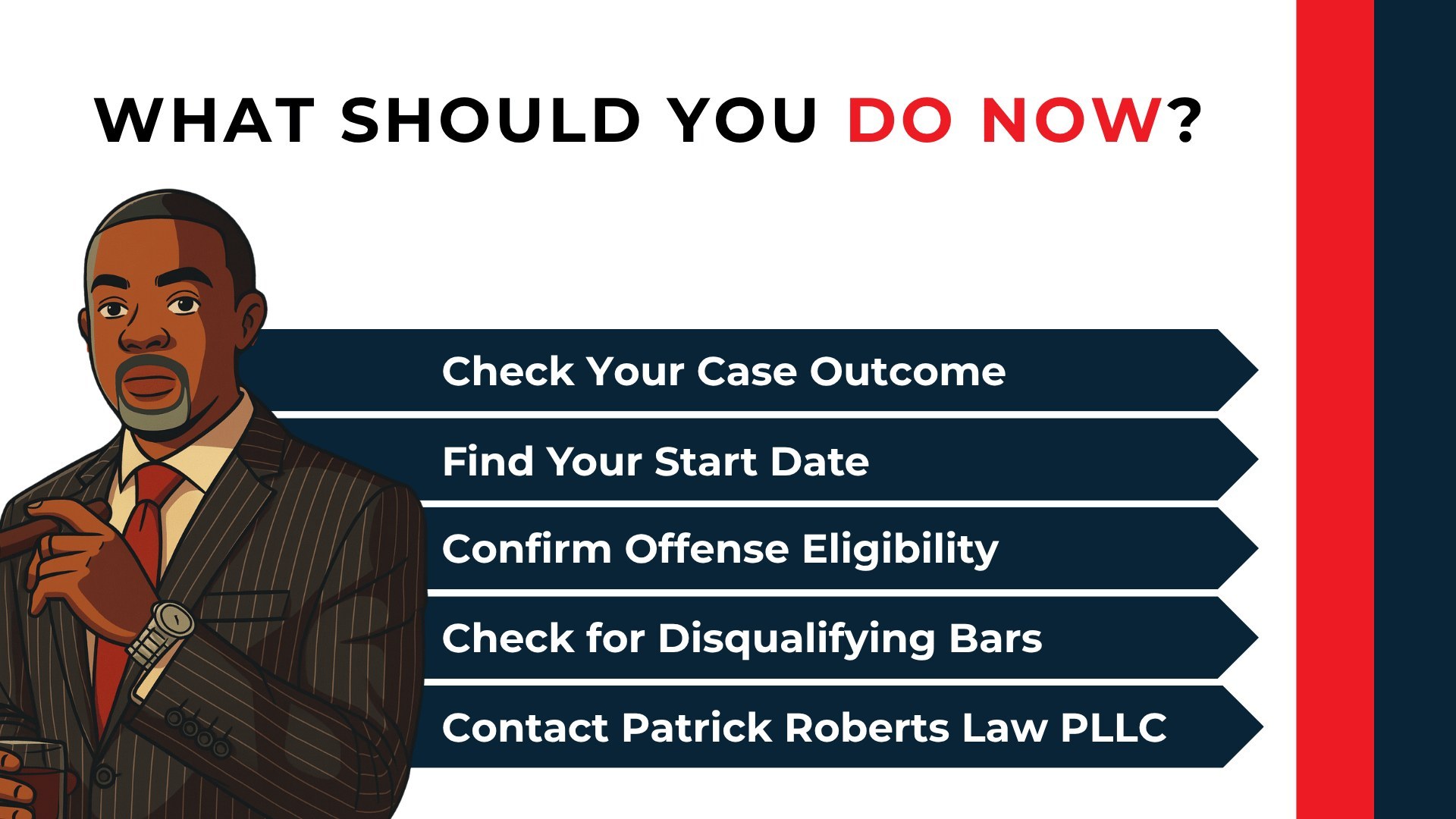
Attorney beside five steps to check your case outcome, eligibility, start date, disqualifying bars, and legal help.


Navigating North Carolina Expunction and Criminal Record Relief

With over two decades of experience navigating the complexities of the North Carolina legal system, Attorney Patrick Roberts provides focused advocacy for individuals seeking to resolve permanent criminal records and complex defense matters. As a former Assistant District Attorney who transitioned to a dedicated career in defense, Mr. Roberts possesses a unique understanding of how the prosecution approaches eligibility and dismissal, a perspective he now utilizes to guide clients through the stringent requirements for expunctions and record clearing. He leverages this expertise to assess case-specific eligibility, ensuring that clients accurately calculate waiting periods and navigate the statutory exclusions that often complicate relief. Mr. Roberts offers the technical legal analysis necessary to effectively challenge charges and pursue the restoration of a clean record. 

• Elite Academic Background: Graduate of Duke University School of Law (ranked Number 7 in Best Law Schools and Number 9 in Criminal Law for the 2026-2027 period) and Johns Hopkins University (ranked No. 7 in National Universities).

• Former Prosecutor Perspective: Leveraging four years of experience as an Assistant District Attorney across three North Carolina counties (New Hanover County, Johnston County, and Wake County), providing authoritative insight into the state’s sentencing, record retention, and the procedural requirements necessary to navigate criminal expunction statutes and petition court records.

• Extensive Trial & Felony Defense Experience: Handled more than 250 felony sex crime cases and completed more than 75 jury trials in state and federal courts, with extensive litigation experience in high-level felonies, white-collar crimes, complex drug trafficking, and serious criminal defense allegations.

• National Association of Criminal Defense Lawyers (NACDL): Lifetime Member.

• Martindale-Hubbell Ratings: Maintained both the peer-nominated AV Preeminent rating and the verified Client Champion Platinum designation for eight consecutive years (2018–2026).

• Super Lawyers Selection: Selected to the annual Super Lawyers list for five total years, including three years of recognition as a North Carolina Rising Star.

• National Association of Distinguished Counsel: Recognized as one of the "Nation’s Top 1 Percent" of attorneys for six separate years, including the 2025 and 2026 designations.

• Published Legal Authority: Co-authored The Legality of Search and Seizure in DUI Cases (Thomson Reuters/Aspatore Books), demonstrating the analytical proficiency required to interpret complex statutory criteria for legal relief.

• Advanced Trial Advocacy Training: Graduated from the National Criminal Defense College (NCDC) Trial Practice Institute, establishing the rigorous legal analysis skills necessary to evaluate client eligibility for record clearing under North Carolina law.

Client Review

What truly set Mr. Roberts apart was how integral he became in helping us navigate the North Carolina legal system while ensuring every rule, requirement, and regulation was followed precisely. Managing a case from out of state is no small task, but he made sure we were informed, prepared, and supported at every turn. His communication was clear, timely, and compassionate, and he treated our daughter with dignity and respect throughout the entire process.

Mr. Roberts is kind, professional, and exceptionally competent. His dedication to restoring normalcy to our daughter’s life was evident in everything he did, and our family is deeply grateful for his guidance and advocacy.

We would highly recommend Attorney Patrick Roberts to anyone in need of skilled, trustworthy, and compassionate legal representation. He is exactly the type of attorney you want standing beside you when everything feels uncertain.

— Review by a verified client via Avvo

Peer Endorsement

I attended the Trial Lawyers College with Patrick. If I was facing serious criminal charges anywhere in North Carolina, he would be my first call.

— Peer endorsement by a fellow North Carolina trial attorney via Avvo

Disclaimer: The client reviews and peer endorsements displayed are authentic testimonials and comments provided by clients and fellow attorneys. Every case is unique and must be evaluated individually; past client experiences and case results do not guarantee, promise, or predict similar outcomes in any future matter.

Case Results

Before hiring an attorney, you deserve full clarity on their track record and the results they bring to the table. Below, you can explore some of the specific cases and outcomes Attorney Patrick Roberts has achieved for his clients:

• Robbery with a Dangerous Weapon:  Client accused of armed theft exceeding $85,000 in cash and jewelry using a semi-automatic weapon while facing 160–204 months in prison and possessing a prior record. Attorney Roberts challenged prosecution evidence and procedural vulnerabilities.

â—‹ Outcome: Full dismissal of all felony counts.

• Felony Statutory Sex Offense Allegations: The client was originally charged with multiple felony statutory sex offenses. Mr. Roberts negotiated a plea agreement reducing the charges to a single count of misdemeanor sexual battery, and subsequently secured the client's removal from the sex offender registry on the first attempt after a ten-year period.    

â—‹ Outcome: Plea negotiated to misdemeanor sexual battery with 10-year registration, followed by successful removal from the sex offender registry on the first petition.

• Felony Larceny:  Attorney Patrick Roberts represented a client accused by police officers of conspiring to steal a vehicle from a former workplace. The client was facing 6-8 months in prison. Despite the accuser already being arrested for the same crime, Mr. Roberts was able to prove to the Assistant District Attorney that the charge was without merit.

â—‹ Outcome: Dismissed.

Disclaimer: Case outcomes depend upon a variety of factors unique to each case. Prior results do not guarantee or predict a similar outcome in any future legal matter.

Securing a North Carolina Felony Expunction

If you are seeking to clear a felony conviction from your record, understanding the nuances of North Carolina’s expunction laws is the first critical step. Because these records do not automatically disappear, you require a precise, legally sound approach to determine your eligibility and petition the court effectively. Whether you are located in Raleigh, Cary, Apex, Holly Springs, Garner, Fuquay-Varina, or anywhere else across North Carolina, Patrick Roberts Law PLLC is prepared to provide the experienced counsel necessary to navigate this complex process. Please visit www.patrickroberts.law to review your options and schedule a consultation to discuss your specific legal standing.

We maintain a selective intake process to ensure that each client receives the focused professional attention their case requires.

Disclaimer: This article is general legal information, not legal advice. Reading it does not create an attorney-client relationship. North Carolina expunction law is almost entirely statutory and subject to legislative change, and how these rules apply depends on the specific facts of your case. For guidance on your situation, consult a licensed North Carolina attorney.

Posted in:

Related Posts

"Felony Death by Vehicle in North Carolina" text over a highway scene with trucks under and above an overpass on a clear day.

Felony Death by Vehicle in North Carolina

Car accidents that cause someone's death can lead to serious criminal charges in North Carolina. One of the most serious charges is called felony death by vehicle. This is a severe charge that can result in years in prison and change your life forever. more What is Felony Death by Vehicle in North Carolina? According to North Carolina General Statute § 20-141.4(a1), you can be charged with felony death by vehicle when: You accidentally cause someone's death in a car accident; You were driving while impaired by alcohol or drugs at the time (violating G.S. 20-138.1 or G.S. 20-138.2); and Your impaired driving directly caused the death. In simple terms, if you drink and drive or use drugs and drive, and someone dies as a result, you can face this serious felony charge. What Are the Different Types of Vehicle Death Charges in North Carolina? North Carolina has several different charges that can apply when someone dies in a car accident: What Qualifies as Felony Death by Vehicle? What it is: A Class D felony under G.S. 20-141.4(b)(2) When it applies: When someone dies because you were driving while impaired How you might defend against it: Your lawyer might question whether the alcohol tests were done correctly or whether your impairment actually caused the accident How Is Aggravated Felony Death by Vehicle Different? What it is: Still a Class D felony, but with harsher sentencing as stated in G.S. 20-141.4(a5) When it applies: When you cause a death while driving impaired AND you have a previous DWI conviction within the last seven years How you might defend against it: Your lawyer could challenge whether your prior conviction should count or was properly recorded What Makes Something a Repeat Felony Death by Vehicle? What it is: A Class B2 felony under G.S. 20-141.4(a6) When it applies: When you've been convicted of felony death by vehicle before and commit another similar offense How you might defend against it: Your lawyer might challenge how the previous conviction is being used against you How Does Misdemeanor Death by Vehicle Compare? What it is: A Class A1 misdemeanor under G.S. 20-141.4(a2) When it applies: When you cause someone's death by breaking a traffic law that doesn't involve impairment How you might defend against it: Your lawyer could show that your traffic violation didn't actually cause the death What Are the Penalties for Felony Death by Vehicle? The punishments for these charges are very serious: Regular Felony Death by Vehicle: Potentially years in prison according to G.S. 20-141.4(b)(2) If you have no prior criminal record, G.S. 15A-1340.17 allows for intermediate punishment You'll have a permanent felony record that affects job opportunities, housing, and voting rights Aggravated Felony Death by Vehicle: Potentially years in prison Little chance of getting a reduced sentence Same long-term consequences as regular felony death by vehicle Repeat Felony Death by Vehicle: Potentially decades in prison as a Class B2 felony under G.S. 20-141.4(b)(1) One of the most serious charges below murder Almost certain to serve a very long prison sentence How Can You Defend Against These Charges? If you're facing a felony death by vehicle charge, there are several ways a good lawyer might defend you: Question the DWI Evidence Were the breathalyzer or blood tests done correctly? Was the testing equipment properly maintained? Was the person who did the testing properly trained? Did the police have a legal reason to stop you in the first place? Show Something Else Caused the Accident Was there bad weather that contributed to the crash? Did the other driver make mistakes that actually caused the accident? Was there a mechanical failure in your vehicle? Would the accident have happened even if you weren't impaired? Challenge Legal Procedures Did police follow proper procedures when arresting you? Did they read you your rights? Did they get search warrants when needed? Were you illegally stopped without reasonable suspicion? Argue for a Lesser Charge Could this be charged as misdemeanor death by vehicle instead? Is there enough evidence to support the felony charge? Can your lawyer negotiate for a lesser charge through a plea deal? How Does North Carolina Law Protect Against Double Charges? North Carolina law protects people from being charged twice for the same action. G.S. 20-141.4(c) specifically states: If you're charged with death by vehicle, you can't also be charged with manslaughter for the same death If you're charged with manslaughter, you can't also be charged with death by vehicle for the same death Why Do You Need a Criminal Defense Lawyer Right Away? Being charged with felony death by vehicle is extremely serious. Having a good lawyer as soon as possible is crucial because they can: Start investigating the accident before evidence disappears Talk to witnesses while their memories are still fresh Make sure the police don't violate your rights Begin building your defense strategy right away Help you understand what's happening and what to expect Potentially negotiate with prosecutors for a better outcome What Is the Emotional Impact of Felony Death by Vehicle Cases? These cases are difficult not just legally, but emotionally. When someone faces a felony death by vehicle charge: They often struggle with guilt and grief over the death that occurred They worry about possibly going to prison for many years Their family members also suffer from stress and uncertainty They may face harsh judgment from the community The victim's family is dealing with their own grief and loss A good defense attorney understands these emotional challenges and can help you cope while also handling the legal aspects of your case. How Do Courts Handle Felony Death by Vehicle Cases? The court process for these cases can be lengthy and complex: Arraignment: This is when you first appear in court and hear the formal charges against you Pre-trial motions: Your lawyer may file motions to have certain evidence thrown out or to get more information from prosecutors Plea negotiations: Many cases end with a plea deal rather than going to trial Trial: If your case goes to trial, it may last several days to weeks Sentencing: If convicted, the judge will determine your punishment within the ranges allowed by law Contact a North Carolina Defense Attorney Today If you're facing felony death by vehicle charges, time is critically important. Evidence needs to be preserved, witnesses need to be interviewed, and your rights need to be protected from the very beginning. A felony death by vehicle charge is one of the most serious accusations someone can face. With prison time and a felony record on the line, the right legal representation is critical. Attorney Patrick Roberts has the experience and resolve to handle high-stakes cases* with the care they demand. Contact our office today for a confidential consultation and start building your defense. *While Attorney Roberts works hard to secure results for his clients, every case is unique and must be evaluated on its individual facts. Past results do not guarantee future success. Each client’s case requires a unique strategy based on the facts of that case.

Title page with an image of a courthouse, introducing the topic of felony arraignment hearings and what to expect in the process.

What Happens at an Arraignment Hearing for a Felony?

An arraignment is a critical formal court appearance in the felony criminal process in North Carolina. Unlike in some states, in North Carolina's two-tiered court system (N.C.G.S. § 7A-270, § 7A-271), arraignment typically does not occur immediately after arrest. Instead, felony cases begin in District Court with an initial appearance (N.C.G.S. § 15A-601), and if indicted, move to Superior Court where the formal arraignment takes place after discovery (N.C.G.S. § 15A-623, N.C.G.S. § 15A-941). The arraignment is where you are officially notified of the charges against you and informed of your legal rights. more Key Components of a Felony Arraignment Reading of Charges During the arraignment, the judge reads the criminal complaint or indictment aloud. This formal reading: Clearly outlines the felony charges you face. Provides details such as the date, time, and nature of the alleged crime. Ensures you know the specific allegations and the potential penalties involved. This step is crucial because it sets the foundation for your case and ensures you are fully aware of what you are being accused of. Explanation of Your Rights The judge takes the time to explain your constitutional rights during the hearing. In a felony arraignment, you are informed of several important rights, including: The Right to Legal Representation: You have the right to hire a private attorney. If you cannot afford one, the court will appoint a public defender. The Right to Remain Silent: You are advised that you do not need to answer questions or provide statements that might be used against you later. Additional Rights: These may include the right to a speedy trial and, if applicable, the right to a jury trial. This explanation helps ensure that you make informed decisions about your case from the very beginning. Entering Your Plea One of the main functions of the arraignment is to have you enter a plea. The options typically include: Guilty Not Guilty No Contest For felony cases, most defendants enter a “not guilty” plea. This plea does not determine your guilt but initiates the pretrial process and sets the stage for future hearings. By pleading not guilty, you are exercising your right to contest the charges and work with your attorney on building a defense. Bail Determination and Release Conditions During the arraignment, the judge also considers bail. The judge evaluates several factors, such as: The severity of the felony charge. Your prior criminal history. Whether you are considered a flight risk. Based on this assessment, the judge will decide whether to: Release you on bail, Release you on your own recognizance (ROR), or Keep you in custody until your next court appearance. In North Carolina, local practices and the specifics of your case will influence these decisions. It is essential to understand that bail is meant to secure your future court appearances and is not a reflection of your guilt. Scheduling Future Proceedings After you enter your plea and the judge addresses bail, the arraignment hearing concludes with the scheduling of future court dates. These may include: Pretrial Motion Hearings: Hearings where both sides discuss legal arguments and evidence. Preliminary Hearings: Proceedings to determine if there is enough evidence to continue to trial. Trial Dates: The eventual date when your case will be heard in full if you maintain your not guilty plea. Keeping track of these scheduled dates is vital. Missing a court appearance can lead to additional charges and may result in a bench warrant for your arrest. Important Considerations for North Carolina Residents Although the basic steps of a felony arraignment are similar nationwide, North Carolina residents should be aware of a few local factors: Local Court Procedures: Procedures and practices may vary by county. Consulting with a local attorney can help ensure that you understand the nuances of the local court system. Legal Support: Private attorneys in North Carolina are well-versed in local procedures and can provide guidance tailored to your specific case. What to Do If You Miss Your Arraignment Failing to appear at your arraignment hearing can have serious consequences. If you miss your court date: The judge may issue a bench warrant for your arrest. Any bail posted could be forfeited. You may face additional charges, complicating your case further. It is crucial to attend your arraignment and all subsequent court appearances to avoid these risks. Conclusion Understanding what happens at an arraignment hearing for a felony can help you navigate the initial stages of the criminal justice process with confidence. This hearing is your first opportunity to learn about the charges, assert your rights, enter your plea, and set the timeline for your case. By being well-informed—especially if you are based in North Carolina—you can work more effectively with your legal counsel and ensure that you are prepared for the next steps in your defense. If you or a loved one are facing an arraignment hearing for criminal charges, you deserve a legal advocate with the experience and dedication to secure the best possible outcome. Attorney Patrick Roberts of Patrick Roberts Law has successfully defended numerous clients facing the most serious criminal charges. Contact our firm today for a confidential consultation.

Law books and scales beside headline introducing North Carolina’s new habitual domestic violence felony law.

Habitual Domestic Violence in North Carolina: Understanding the New Felony Offense

A domestic violence arrest in North Carolina has always carried serious consequences. But as of December 1, 2025, certain defendants now face something far more significant: a felony charge that can escalate with each subsequent conviction. North Carolina's new habitual domestic violence statute transforms what would otherwise be misdemeanor charges into felony prosecutions for individuals with qualifying prior convictions. This law creates a standalone enhancement mechanism that prosecutors can use to pursue felony charges against defendants whose records show a pattern of domestic violence offenses. Understanding how this new offense works—what the prosecution must prove, how prior convictions factor into the analysis, and what punishment exposure exists—is essential for anyone facing these charges or concerned about how past convictions might affect their future. What Is the New Habitual Domestic Violence Offense in North Carolina? How Does This Charge Differ from Misdemeanor Domestic Violence? Traditional domestic violence charges in North Carolina are typically prosecuted as misdemeanors. The habitual domestic violence offense changes that framework entirely. When prosecutors can establish that a defendant has the required pattern of prior domestic violence convictions, they can pursue felony charges for conduct that would otherwise remain at the misdemeanor level. This elevation from misdemeanor to felony status represents a fundamental shift in how repeat domestic violence offenders are prosecuted. Rather than facing the relatively limited consequences associated with misdemeanor convictions, defendants charged under this statute confront felony punishment classifications that carry substantially more severe consequences. What Statute Governs This New Felony? The habitual domestic violence offense is codified at N.C. Gen. Stat. § 14-32.6. This statute establishes the elements the prosecution must prove, defines which prior convictions qualify for enhancement purposes, and sets forth the punishment structure that applies to convictions under this section. When Did This Law Take Effect? The habitual domestic violence statute took effect on December 1, 2025. This effective date is critically important because the law applies only to offenses committed on or after that date. Conduct occurring before December 1, 2025, cannot form the basis of a habitual domestic violence charge, even if the defendant has the qualifying prior convictions. However, prior convictions from before the effective date can still count toward establishing habitual status for offenses committed after the law took effect. What Must the Prosecution Prove to Convict Someone of Habitual Domestic Violence? To secure a conviction under N.C. Gen. Stat. § 14-32.6, the prosecution must prove three distinct components: qualifying current conduct, the required prior conviction record, and compliance with the statutory lookback period. What Current Conduct Qualifies Under This Statute? The prosecution must first establish that the defendant committed either misdemeanor domestic violence under the existing statute or committed an assault against someone with whom they share a qualifying domestic relationship. This current offense forms the foundation of the habitual charge—without it, the enhancement cannot apply regardless of how many prior convictions exist. How Many Prior Convictions Are Required? Beyond the current conduct, the prosecution must prove that the defendant has at least two prior convictions that qualify under the statute. The law establishes two pathways to meet this requirement: Pathway 1: Two or more convictions under North Carolina's misdemeanor domestic violence statute (G.S. 14-32.5) or substantially similar offenses from other states. Pathway 2: One conviction under G.S. 14-32.5 (or a substantially similar out-of-state offense) plus at least one conviction for an assault involving a victim with whom the defendant shared a qualifying domestic relationship. The critical distinction is that at least one prior must be an actual domestic violence statute conviction—two generic assault convictions involving domestic relationships are not sufficient on their own, even if both victims were intimate partners or family members. What Is the 15-Year Lookback Period? Not every prior conviction counts toward habitual status. The statute imposes a 15-year lookback period that limits which convictions the prosecution can use. Specifically, the earlier of the two required prior convictions must have occurred within 15 years of the current offense. Convictions that fall outside this window—meaning they occurred more than 15 years before the earliest qualifying prior—cannot be counted toward establishing habitual status. This lookback calculation can become complex when a defendant has multiple prior convictions spanning many years. The timing of each conviction relative to both the current offense and the other priors matters significantly. Do Out-of-State Convictions Count Toward Habitual Status? Yes. The statute explicitly allows the prosecution to use "substantially similar convictions from other states" as qualifying priors. This means defendants who have domestic violence convictions from other jurisdictions remain exposed to felony enhancement in North Carolina, provided those out-of-state offenses are substantially similar to North Carolina's domestic violence statutes. Determining whether an out-of-state conviction is "substantially similar" often requires careful legal analysis of the elements of the foreign offense compared to North Carolina law. What Are the Potential Punishments for a Habitual Domestic Violence Conviction? The punishment structure for habitual domestic violence is designed to escalate with each subsequent conviction, reflecting the legislature's intent to impose increasingly severe consequences for repeat offenders. What Felony Class Applies to a First Habitual DV Conviction? A first conviction under the habitual domestic violence statute is classified as a Class H felony. This represents a significant elevation from the misdemeanor classification that would otherwise apply to domestic violence charges without the habitual enhancement. How Does Punishment Escalate with Subsequent Convictions? The statute creates an escalating punishment framework where each subsequent conviction under this section is punished one felony class higher than the defendant's most recent habitual domestic violence conviction. The escalation structure works as follows: First habitual DV conviction: Class H felony Second habitual DV conviction: Class G felony Third habitual DV conviction: Class F felony Continued escalation with each subsequent conviction This escalating structure means that defendants who continue to accumulate convictions under this statute face progressively more serious felony classifications. What Is the Maximum Felony Classification? The escalation caps at Class C felony status. Once a defendant reaches Class C classification, subsequent convictions remain at the Class C level rather than continuing to escalate. Class C felonies represent one of the more serious felony classifications in North Carolina's structured sentencing system, carrying substantial prison exposure depending on the defendant's prior record level. How Does This Offense Interact with Other Domestic Violence Laws? The habitual domestic violence statute functions as part of a broader package of changes affecting how domestic violence cases are handled in North Carolina. Can a Habitual DV Conviction Be Used to Enhance Other Charges? No. The statute specifically provides that a conviction under the habitual domestic violence section cannot be used as a prior conviction to enhance punishment under other habitual offense laws. This makes the habitual domestic violence enhancement a standalone mechanism—it elevates the current offense to felony status but does not feed into other habitual offender statutes. What Arrest Powers Do Police Have Under the New Law? Related legislative changes have expanded police authority in domestic violence cases. Officers can now arrest without a warrant for misdemeanor domestic violence offenses, extending their powers beyond traditional assault charges. This means law enforcement has greater flexibility to make immediate arrests in domestic violence situations without first obtaining judicial authorization. The following changes affect how domestic violence arrests and pretrial proceedings work: Police may now make warrantless arrests for misdemeanor domestic violence Defendants charged with misdemeanor domestic violence must have pretrial release conditions set by a judge rather than a magistrate Judges must review the defendant's criminal history before setting pretrial release conditions How Have Pretrial Release Procedures Changed for DV Cases? Defendants charged with misdemeanor domestic violence now face modified pretrial release procedures. Instead of having a magistrate set conditions of release, these defendants must appear before a judge who will review their criminal history before establishing appropriate conditions. This change ensures that judicial officers making pretrial release decisions have access to information about the defendant's prior record, which may be particularly relevant given the new habitual enhancement statute. What Defense Strategies Apply to Habitual Domestic Violence Charges? Defending against habitual domestic violence charges requires attention to both the current conduct allegations and the prior conviction record the prosecution intends to use for enhancement purposes. Can the Validity of Prior Convictions Be Challenged? The prosecution's ability to prove habitual status depends entirely on establishing that the defendant has qualifying prior convictions. Defense strategies may focus on whether prior convictions were constitutionally obtained, whether proper procedures were followed in earlier cases, and whether documentation adequately establishes the convictions the prosecution claims. If the validity of prior convictions can be successfully challenged, the enhancement may fail even if the current conduct is proven. What If Prior Convictions Fall Outside the Lookback Period? The 15-year lookback requirement creates a potential defense avenue when prior convictions are aged. If the earlier of the two required priors occurred more than 15 years before the current offense, it cannot count toward habitual status. Careful analysis of conviction dates relative to the current offense date can reveal whether the prosecution's theory of habitual status actually satisfies the statutory timing requirements. This calculation becomes particularly important when defendants have multiple prior convictions from different time periods. Identifying which convictions fall within and outside the lookback window may determine whether felony enhancement applies. How Does the Qualifying Relationship Requirement Affect the Case? Both the current conduct and the prior convictions must involve victims with whom the defendant shared a qualifying domestic relationship. If the prosecution cannot establish the required relationship element—either for the current offense or for the priors being used for enhancement—the habitual charge may not stand. Defense strategies may focus on whether the relationships at issue actually qualify under the statutory definitions. Why Does Legal Representation Matter When Facing This Felony Charge? What's at Stake with a Felony Domestic Violence Conviction? A habitual domestic violence conviction creates a felony record with all the collateral consequences that follow. Employment opportunities, housing options, professional licensing, and firearm rights can all be affected by felony convictions. The escalating punishment structure means that defendants who face multiple prosecutions under this statute confront increasingly serious felony classifications, potentially reaching Class C status with its substantial prison exposure. The complexity of the habitual enhancement analysis—including prior conviction validity, lookback period calculations, and relationship requirement issues—demands careful legal attention to every element the prosecution must prove. How Can an Attorney with Prosecutorial Experience Help? Facing charges under a new statute requires understanding how prosecutors will interpret and apply the law in its early implementation. The habitual domestic violence offense creates multiple points of potential challenge, from the validity of prior convictions to the timing requirements of the lookback period. Attorney Patrick Roberts brings the perspective of a former prosecutor who handled domestic violence cases, meaning he understands how the State approaches these matters from investigation through trial. His training at the National Criminal Defense College, including ongoing participation in advanced cross-examination programs, provides the technical courtroom skills these cases demand. As a graduate of Gerry Spence's Trial Lawyers College—where he trained directly with one of the most accomplished trial lawyers in the country—he brings a methodology focused on connecting with juries and humanizing clients facing serious allegations. Contact Patrick Roberts Law to discuss your case and understand your options under this new law. Frequently Asked Questions When did habitual domestic violence become a crime in North Carolina? The habitual domestic violence statute took effect on December 1, 2025. Only offenses committed on or after that date can be charged under this law, though prior convictions from before the effective date can still count toward establishing habitual status. Can I be charged with habitual domestic violence if my prior convictions are from another state? Yes. The statute allows the prosecution to count "substantially similar convictions from other states" toward the required two prior convictions. Whether an out-of-state conviction qualifies requires analysis of whether that offense is substantially similar to North Carolina's domestic violence laws. What happens if I'm convicted of habitual domestic violence more than once? Each subsequent conviction is punished one felony class higher than your most recent habitual domestic violence conviction, starting at Class H and escalating up to a maximum of Class C. Does the new law apply to conduct that occurred before December 1, 2025? No. Conduct occurring before the effective date cannot form the basis of a habitual domestic violence charge. However, prior convictions from before December 1, 2025, can still count toward establishing habitual status for offenses committed after the law took effect. Who sets my bond conditions if I'm arrested for a domestic violence offense? Under related changes to domestic violence procedures, defendants charged with misdemeanor domestic violence must have pretrial release conditions set by a judge who reviews the defendant's criminal history, rather than a magistrate. Yoast SEO Disclaimer: The information on this website is for general information purposes only. Nothing on this site should be taken as legal advice for any individual case or situation. Case results depend upon a variety of factors unique to each case. Prior results do not guarantee a similar outcome.