Blog / Criminal Law

Expungement in North Carolina: What Can Be Cleared, and How to Do It

Expungement in North Carolina: What Can Be Cleared, and How to Do It

Yes, North Carolina lets you erase certain criminal records through a court process the state calls "expunction" (same thing most people mean by "expungement"). But whether your record qualifies depends entirely on what's on it. The single biggest factor is whether your case ended in a conviction or not, because those two situations run on completely different rules.

Below, I'll walk through both tracks: what happens with dismissed or dropped charges (many now clear on their own), what it takes to wipe an actual conviction, the shortcuts for people who were young when it happened, the things that will disqualify you, what the process costs, and what an expungement actually does for you once it's granted. By the end you'll know which bucket your record falls into and what your realistic next move is.

Can I actually get my record cleared in North Carolina?

Sometimes, and the answer turns on one question: did your case end in a conviction, or not? North Carolina has no general "sealing" law where a judge just tucks your record away. Every bit of relief comes from a specific statute in Chapter 15A, Article 5 of the state code (sections 15A-145 through 15A-160). Each statute covers a narrow situation.

Those statutes sort into two worlds. The first is non-convictions: charges that were dismissed (dropped) or where you were found not guilty. That's section 15A-146. The second is convictions, cases where you were actually found or pled guilty, covered by sections 15A-145 through 15A-145.9.

The distinction matters. The non-conviction side is fast, often automatic, and doesn't care about your prior record. The conviction side involves waiting periods measured in years and a list of disqualifiers. One more thing to know up front: eligibility is judged by the law in effect when you file, not when the offense happened. And these rules have changed repeatedly in the last few years, usually in your favor.

Gavel and city skyline explain that NC record-clearing eligibility depends on dismissal, acquittal, or conviction.

My charge was dismissed or I was found not guilty, is it already gone?

Quite possibly. If your charge was dismissed or you were found not guilty, North Carolina now clears many of those records automatically, without you filing anything or paying a dime.

This is the most common situation by a wide margin. Across the decade from 2014 to 2023, about 80.6% ended with no finding of guilt, the large majority dismissed. The state built an automated system to clear that flood. Under section 15A-146(a4), eligible dismissed and not-guilty charges are expunged roughly 180 to 210 days after the case reaches final disposition. In the 2024–25 fiscal year alone, North Carolina courts issued more than 1.38 million automatic expunctions.

Two catches worth knowing:

• Not everything clears automatically. A felony charge that was dismissed as part of a plea deal does not clear on its own. Say you pled to a lesser charge and the felony was dropped. That one still requires you to file a petition.

• The databases lag. The automatic process skips some of the normal clerk-notification steps. So an expunged charge can still surface on a background check for a while, until every agency's records catch up. If a dismissed charge is costing you a job or an apartment right now, don't assume "it should have cleared by now" is good enough; it's worth confirming.

If you'd rather not wait for the automatic window, or your dismissal doesn't qualify for it, you can petition directly under section 15A-146(a) or (a1). When a single charge was dismissed or you were found not guilty on all related charges, that expunction is mandatory: the judge has to grant it. And, unlike the conviction rules, it is not blocked by prior convictions or prior expunctions. There's no waiting period.
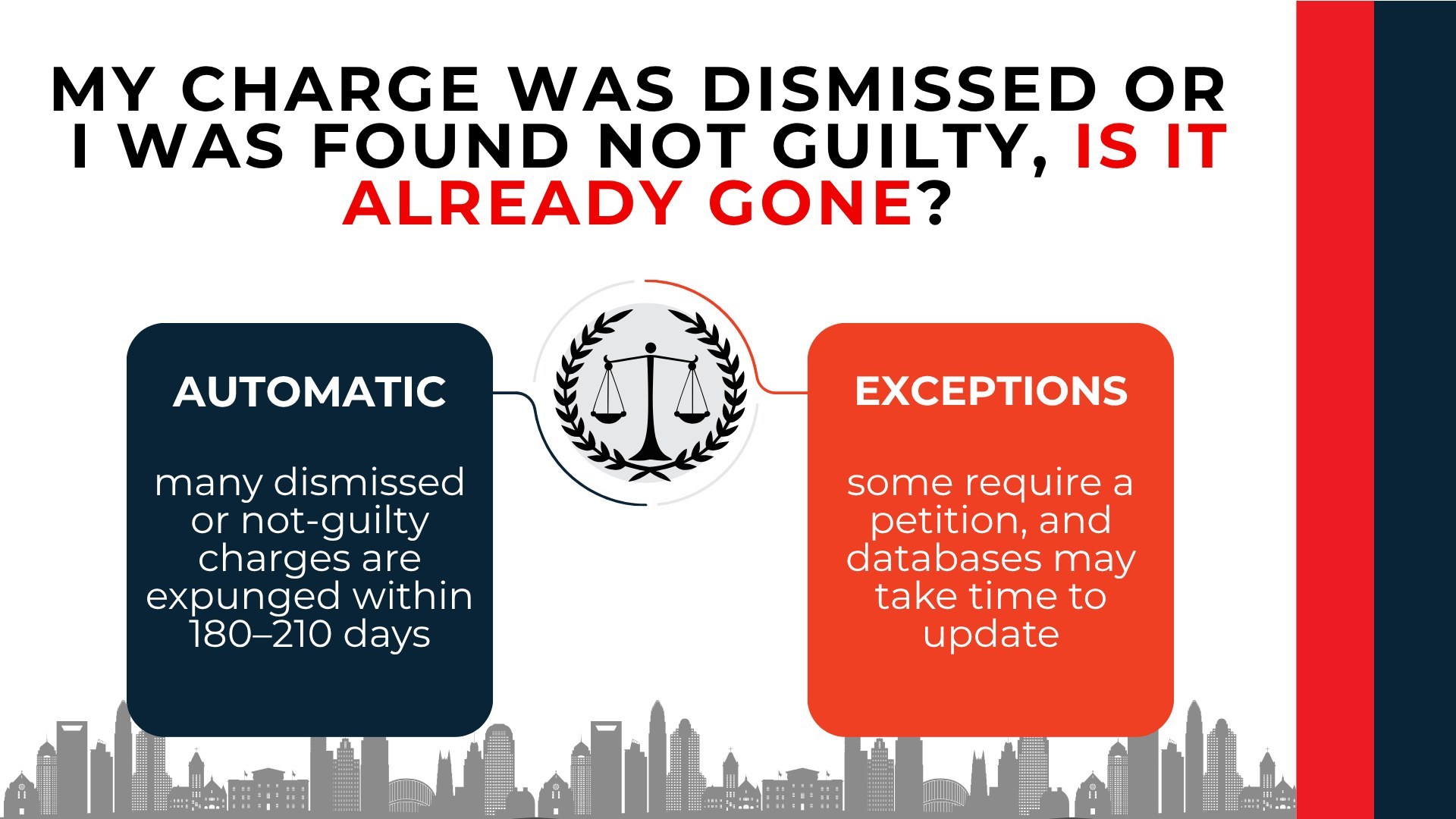
Scales compare automatic expungement within 180–210 days with exceptions requiring petitions or database updates.

What if I was actually convicted, can that be expunged too?

Often, yes, but only for nonviolent convictions, and only after you've waited out a set number of years. This is the Second Chance Act, section 15A-145.5, and it's the main pathway for clearing an actual conviction. There's no age limit, and it lets you clear more than one offense.

Here's the part that decides everything: what counts as "nonviolent." The statute (section 15A-145.5(a)) draws a hard line and excludes the serious stuff: Class A through G felonies, Class A1 misdemeanors, any offense with assault as an element, and certain sex and stalking offenses. If your conviction falls outside those exclusions, you're likely in play.

The waiting periods run from the later of your conviction date or the day you finished everything the sentence required, including probation and post-release supervision. So the clock doesn't start until you're fully done:

• One nonviolent misdemeanor: 3 years (dropped from 5 in July 2025).

• Multiple nonviolent misdemeanors: 7 years from the last conviction.

• One nonviolent felony: 10 years.

• One felony breaking-or-entering under G.S. 14-54(a): 15 years.

• Two or three nonviolent felonies: 20 years from the most recent one.

A reality check on the conviction path: it's far narrower in practice than the dismissal path. In 2024–25, North Carolina granted just 3,599 nonviolent-conviction expunctions under this statute, a tiny fraction of the automatic dismissal numbers. That's not a reason to skip it. It's a reason to get the eligibility analysis right the first time, because these petitions are where mistakes cost you.
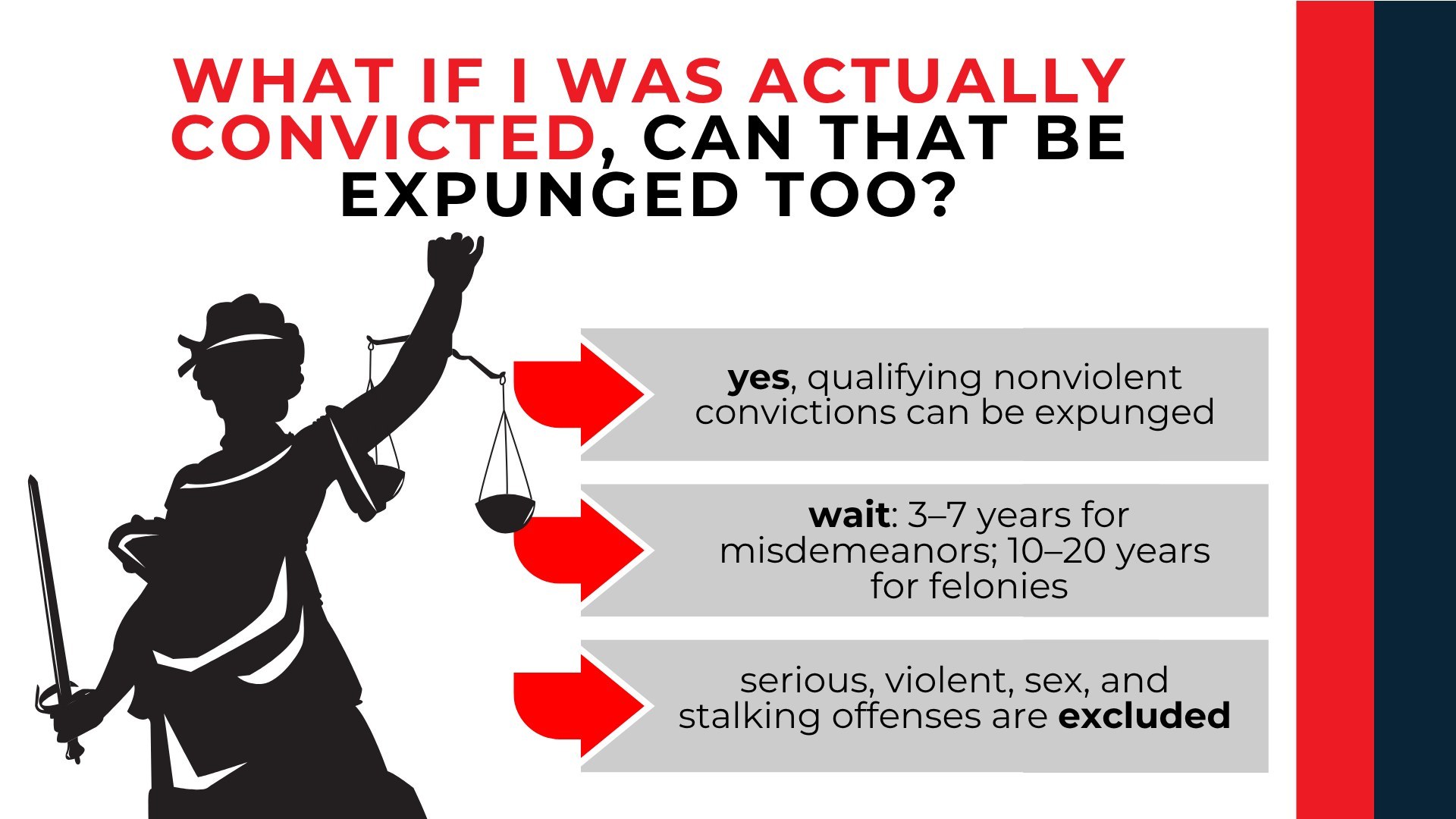
Lady Justice and arrows show qualifying nonviolent convictions, waiting periods, and offenses excluded from expungement.

I was young when it happened, does that change anything?

Yes, if you were young and it was your first offense, several statutes give you shorter waits than the standard adult track. These require that you had no prior misdemeanor or felony conviction and pick up no new conviction during the waiting period.

The main ones:

• Under-18 misdemeanor or underage-alcohol offense (section 15A-145): 2-year wait.

• Drug first offenders, 21 or younger (section 15A-145.2): 12-month wait, plus completion of a court-ordered program.

• Toxic-vapor first offenders (section 15A-145.3): 12-month wait, program completion.

• Under-18 nonviolent felony, other than Class A–G (section 15A-145.4): 4-year wait.

• "Raise the Age" relief for 16- and 17-year-olds convicted before December 1, 2019 (section 15A-145.8A): relief once you complete the sentence.

If a single mistake from years ago at 17 or 20 is the thing dragging on your record, one of these is often the fastest route, sometimes measured in months, not years.

(North Carolina also has narrow, specialized expunctions for people whose convictions stemmed from being a human-trafficking victim, from identity theft, or from a pardon of innocence. Those follow their own rules and are worth asking about if they fit your situation.)
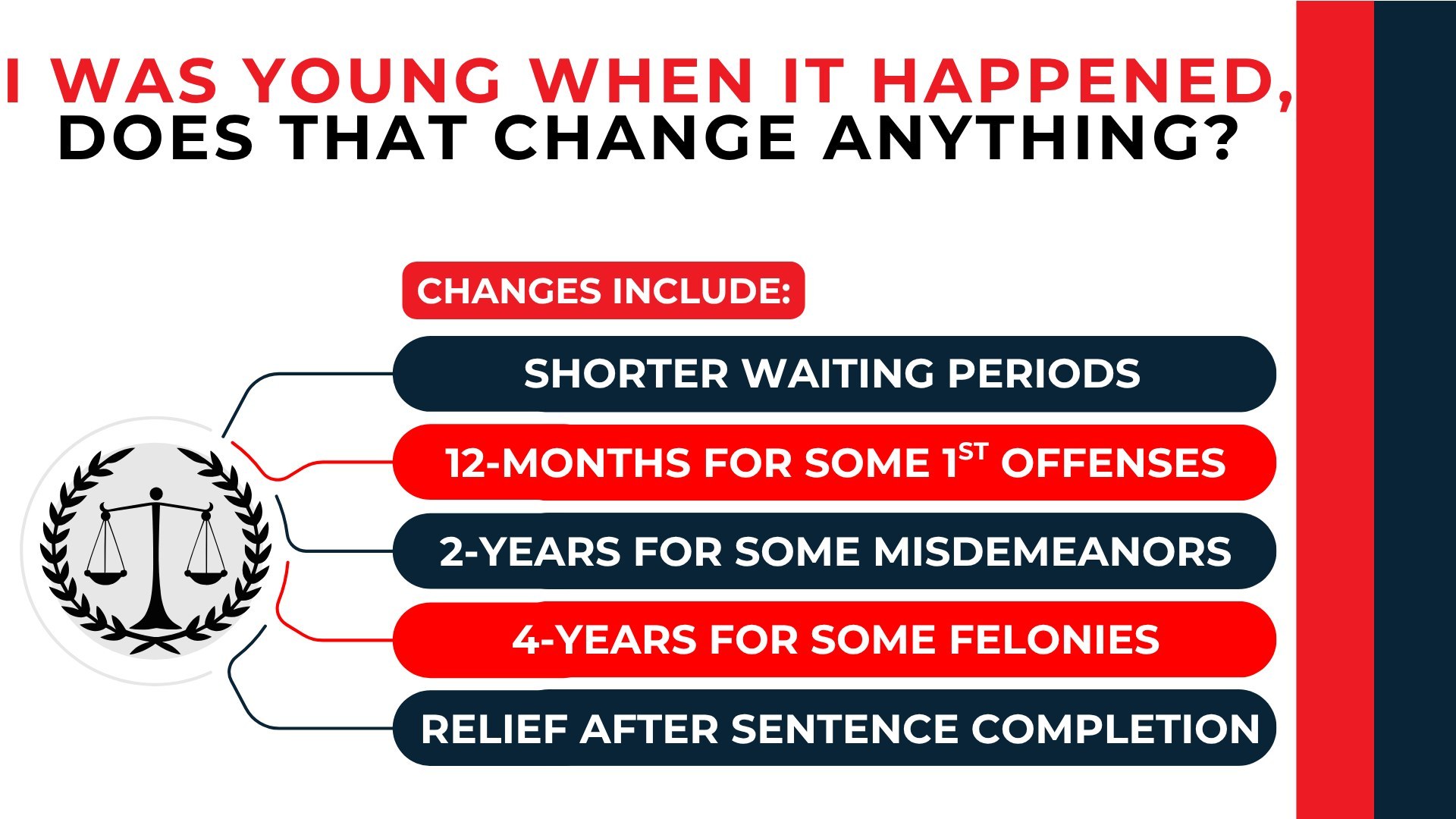
Scales of justice connect to shorter expungement waits of 12 months, two years, four years, or sentence completion.

Why might I not qualify?

The most common reasons are the nature of the offense and something else on your record blocking the way. Here's what stops a Second Chance Act petition:

• The offense isn't "nonviolent." Class A–G felonies, Class A1 misdemeanors, assault-element offenses, and certain sex and stalking offenses are carved out and can't be cleared this way. The exclusions also reach specific drug-trafficking felonies (methamphetamine, heroin, and possession-with-intent involving cocaine, among others).

• A disqualifying prior conviction on your record.

• An open case, an outstanding warrant or a pending charge anywhere.

• Unpaid restitution you still owe.

• A prior expunction under this same statute (there are narrow exceptions for offenses across different counties).

• Failing the good-character requirement, you have to show good moral character across the waiting period.

Be honest with yourself about these before you file. The non-conviction (dismissal) side is forgiving and ignores your prior record; the conviction side is not. And one more limit catches people off guard. A dismissal entered because the defendant was found incapable to proceed under G.S. 15A-1008 was excluded from expunction as of December 1, 2025.
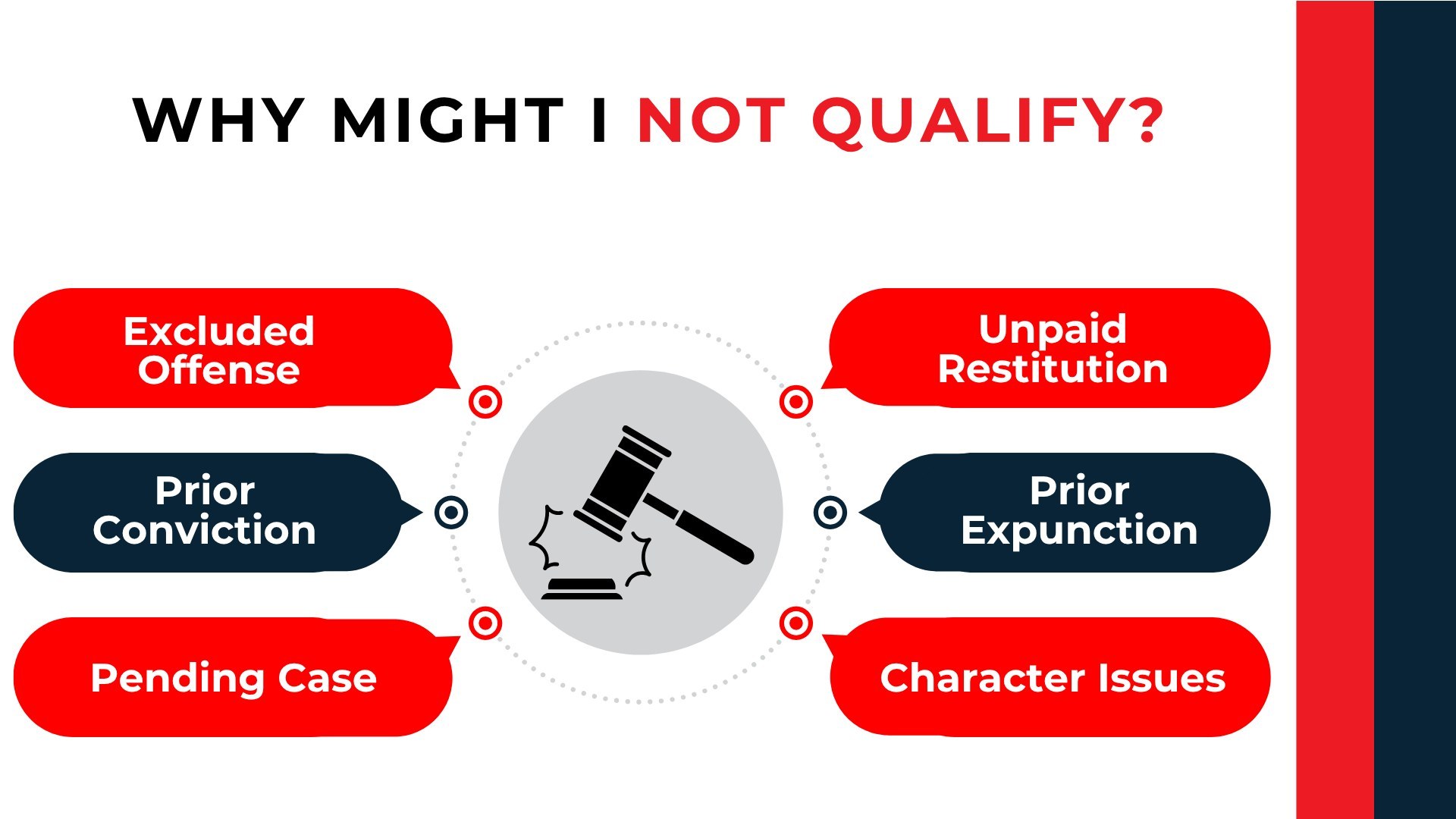
Gavel surrounded by six barriers to expungement, including excluded offenses, prior convictions, and unpaid restitution.
How does the expungement process work, and what does it cost?

You file a sworn petition on the official state (AOC) form in the county where the charge or conviction happened. The court runs background checks. Then a judge decides, usually after a hearing. The filing fee is $175, and it's waived if you can't afford it.

The steps, in order:

• File a verified (sworn-under-oath) petition on the correct Administrative Office of the Courts form, in the trial division of the county where the case originated.

• The checks run. Most petitions trigger an AOC check for prior expunctions and an SBI (State Bureau of Investigation) check of your criminal history.

• The hearing. The district attorney gets notice and can weigh in; the judge then grants or denies.

On cost: the $175 fee applies to the general misdemeanor and Second Chance Act petitions, and courts waive it for indigency (an inability to pay). Several categories, including trafficking-victim, identity-theft, and pardon-of-innocence expunctions, carry no fee at all.

Getting the county, the form, and the waiting-period timing right matters. These are the requirements the statute builds in. This is the stage where the details count most.
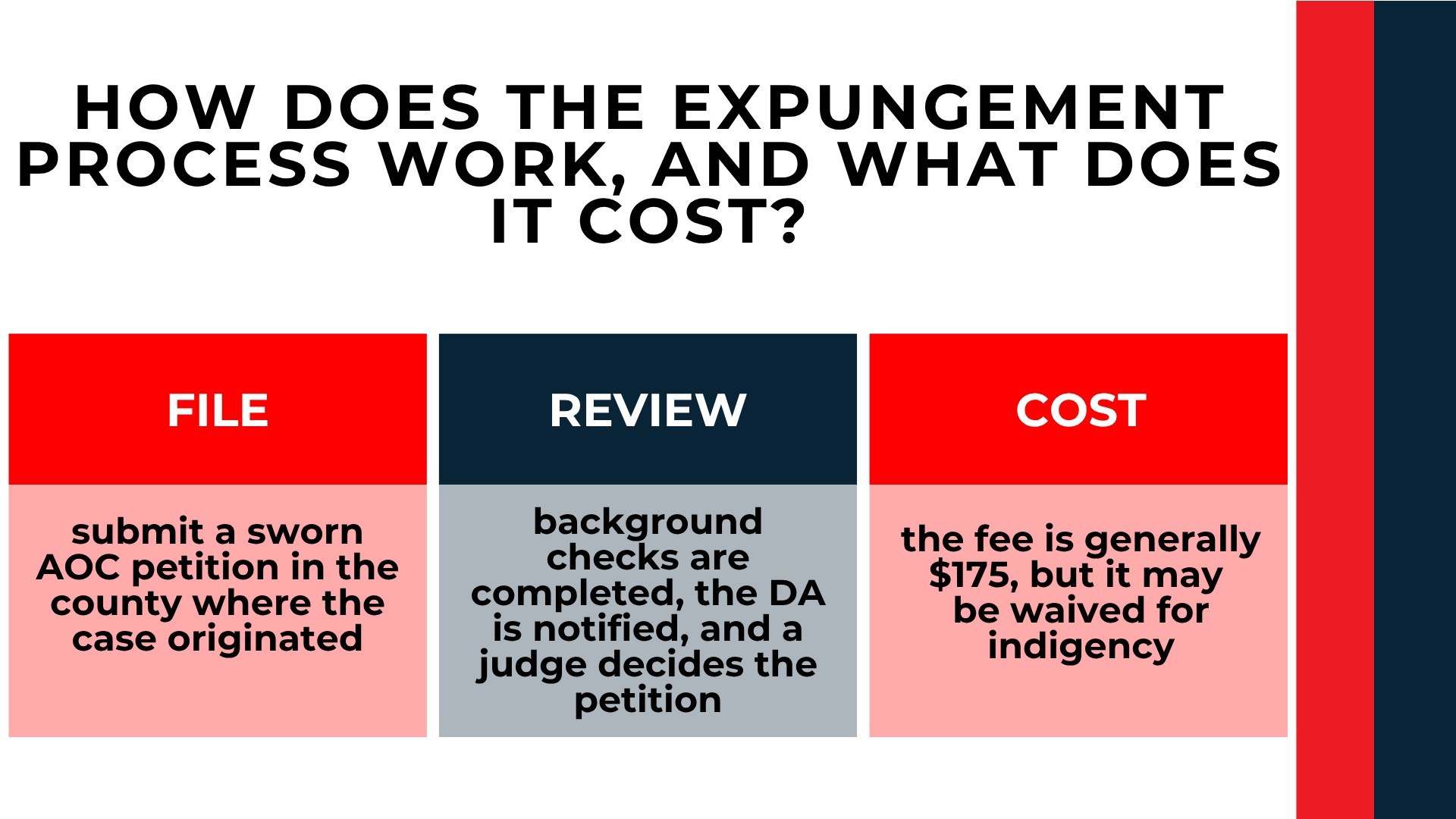
Three boxes outline filing an AOC petition, court review, and the general $175 North Carolina expungement fee.

If it works, what does an expungement actually do for me?

It legally restores you to where you stood before the charge. And in most situations you can truthfully say the arrest, charge, or conviction never happened. Under section 15A-153, employers and schools cannot require you to disclose an expunged matter. That's the practical payoff: the record stops showing up where it counts. Research on people who clear their records bears out why this matters. One national study found wages rose more than 22% within a year of expungement, mostly from people finally landing or keeping jobs.

Two honest limits, though:

• It's not truly gone for the justice system. An expunged conviction stays in a confidential file that prosecutors can still use for specific purposes: calculating your prior-record level, habitual-offender charges, sentencing enhancements, and certain evidence rules if you're ever in court again (sections 15A-151 and 15A-151.5).

• It doesn't fix immigration. A North Carolina expunction does not erase a conviction for federal immigration purposes; immigration law uses its own definition of "conviction." If you're not a U.S. citizen, treat this as a separate problem that needs its own analysis before you rely on an expunction.
Shield-and-scales icons highlight three expungement effects: clearing records, improving opportunities, and legal limits.

Should I do this myself, or hire a lawyer?

If your only issue is a single dismissed charge, the automatic system or a straightforward petition may handle it without much help. The moment your situation involves an actual conviction, judgment calls about eligibility, waiting-period math, or records spread across counties, it's worth having someone who does this regularly.

Here's the case for not going it alone. Nationally, only a small group of people obtain it within five years. Not because they don't qualify, but because the process trips them up. Whether an old offense counts as "nonviolent," whether a prior conviction blocks you, exactly when your clock started, whether a plea-dismissed felony needs a petition: these are the questions that decide the outcome. Getting one wrong means a denied petition and lost time.

Attorney illustration explains DIY expungement may suit simple dismissals, while complex records may need legal help.


Your next three steps

• Pull your complete record and identify, for each case, how it ended (dismissed, not guilty, or convicted), the disposition date, and the county.

• Sort each entry into the right track. Confirm whether dismissals have already auto-cleared or still need a petition. Then calculate the waiting period on anything that ended in a conviction.

• Get an eligibility read before you file, so your fee and waiting time go toward a petition that's filed correctly the first time.

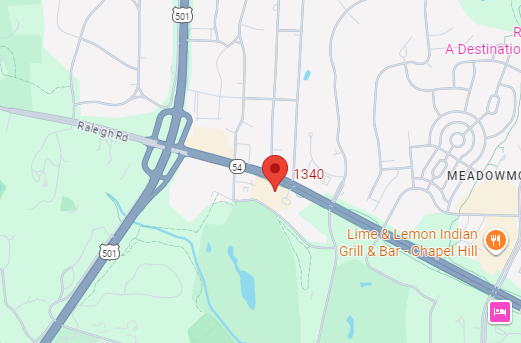
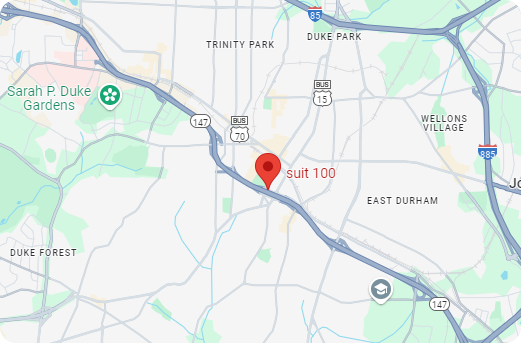
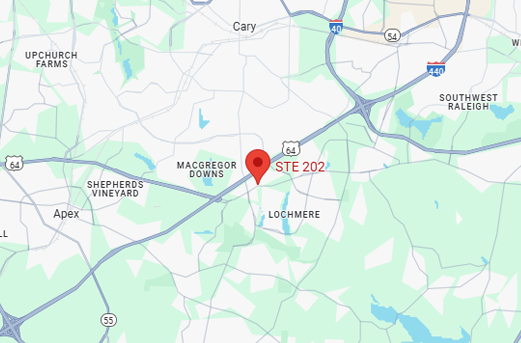
That analysis — reading a record, knowing what a prosecutor will flag at the hearing, and filing it correctly the first time — is where experience earns its keep, and it's the work Patrick Roberts Law PLLC does from offices in Raleigh, Durham, Chapel Hill, and Cary. Patrick Roberts spent years as an Assistant District Attorney in Wake, Johnston, and New Hanover counties before founding the firm, which means he's seen expunction petitions from the other side of the table — how the state reviews them, what draws an objection, and what a clean, grantable petition looks like. Over 24-plus years and thousands of North Carolina cases, that former-prosecutor's read on eligibility is exactly what a clean, grantable petition depends on.
Numbered gavel icons show three next steps: pull your complete record, sort each entry, and get an eligibility review.

Legal Frameworks for North Carolina Record Expunction

With over two decades of experience spanning prosecution and defense, Attorney Patrick Roberts provides legal counsel on North Carolina expunction statutes and registry removal frameworks. Drawing on his prior tenure as an Assistant District Attorney, Mr. Roberts evaluates petition requirements through the lens of state compliance and statutory thresholds. At Patrick Roberts Law PLLC, he represents clients seeking relief from past charges by addressing statutory criteria under the Second Chance Act, resolving administrative obstacles, and advancing precise legal petitions to clear judicial records.

• AV Preeminent Rating: Maintains the highest possible peer-reviewed rating from Martindale-Hubbell for legal ability and ethical standards continuously from 2018 through 2026.

• National Association of Distinguished Counsel: Recognized in the "Nation's Top 1 Percent" of attorneys in 2015, 2016, 2017, 2018, 2025, and 2026.

• Education & Academic Credentials: Graduate of Duke University School of Law (ranked Number 7 in Best Law Schools and Number 9 in Criminal Law for the 2026-2027 period) and Johns Hopkins (ranked No. #7 in National Universities).

• Former Prosecutor Perspective: Leveraging four years of experience as an Assistant District Attorney across three North Carolina counties (New Hanover County, Johnston County, and Wake County), providing insight into the state’s procedural requirements for petitioning court records.

• Extensive Trial & Defense Experience: Handled more than 250 felony sex crime cases and completed more than 75 jury trials in state and federal courts, with extensive litigation experience in high-level felonies, white-collar crimes, complex drug trafficking, and sex offense allegations.

• Expertise in Statutory Compliance: Extensive background in navigating complex legislative requirements, including specific training on trial advocacy and forensic evidence analysis critical for meeting the technical eligibility criteria of the Second Chance Act.

• Registry and Record Clearance Experience: Demonstrated history of successfully petitioning courts for legal relief regarding criminal records and sex offender registry removal upon the completion of mandatory waiting periods.

Client Review

Mr. Roberts is the best lawyer he handled my son’s case with such care and concern for my son's future and the outcome was great for all the hard work he did thanks so much Mr. Roberts, if you need a criminal lawyer please get him you won’t be disappointed.

— Review by a verified client via Avvo

Peer Endorsement

I endorse this lawyer's work. I have known A. Patrick Roberts for 5 years. He has always been very professional and very highly regarded in the criminal defense community. I have gotten to know Patrick over the years and come to highly respect him as a friend and an attorney.

— Peer endorsement by a fellow North Carolina trial attorney via Avvo

Disclaimer: The client reviews and peer endorsements displayed are authentic testimonials and comments provided by clients and fellow attorneys. Every case is unique and must be evaluated individually; past client experiences and case results do not guarantee, promise, or predict similar outcomes in any future matter.

Case Results

Understanding the specific outcomes a lawyer has delivered helps you feel confident in your decision. Below are examples of past cases resolved by Attorney Patrick Roberts.

• Robbery with a Deadly Weapon Charges: The client was accused of robbery with a deadly weapon and conspiracy. Defense counsel argued that the client lacked a financial motive and had been falsely implicated by a co-defendant. Consequently, the prosecution dismissed all felony charges.

â—‹ Outcome: Dismissed

•  Obtaining Property by False Pretenses: The client faced eight felony counts of obtaining property by false pretenses. Defense counsel successfully proved that the client had been misidentified due to sharing a name with the actual offender, leading the State to dismiss all charges.

â—‹ Outcome: Dismissed

•  Sex Offender Registry Expungement: Legal counsel successfully petitioned to have the client removed from the sex offender registry once the mandatory statutory registration period was completed.

â—‹ Outcome: Client's name removed from the sex offender registry after the period ended in 2026.

Disclaimer: Case outcomes depend upon a variety of factors unique to each case. Prior results do not guarantee or predict a similar outcome in any future legal matter.

Securing Legal Relief: North Carolina Expunction

Clearing a criminal record under North Carolina law requires strict compliance with statutory mandates and procedural precision. The Second Chance Act establishes specific criteria and timelines; filing errors or misjudged waiting periods can result in summary dismissals or significant delays. Patrick Roberts Law PLLC applies deep statutory knowledge to assess eligibility, prepare petitions, and manage the full scope of the expunction process.

Although the firm represents clients in complex proceedings statewide, our practice maintains a concentrated focus on criminal defense matters within Wake County—including Raleigh, Cary, Apex, Holly Springs, Garner, and Fuquay-Varina. To evaluate your statutory eligibility and review relief options, visit www.patrickroberts.law.

To maintain the quality of its defense and provide each client with individualized attention, the firm limits the number of cases it accepts at any given time.

Disclaimer: This publication provides informational analysis only and does not constitute formal legal advice or establish an attorney-client relationship. North Carolina expunction statutes remain subject to legislative amendments, and statutory application depends entirely on individual case facts.


Posted in:

Related Posts

Cover: Crossing State Lines: How Teenage Elopement Shifts from "Romeo and Juliet" Territory to Federal Kidnapping and Trafficking

Crossing State Lines: How Teenage Elopement Shifts from "Romeo and Juliet" Territory to Federal Kidnapping and Trafficking

In criminal defense, few areas of law are as heavily misunderstood by the public as the intersection of teenage relationships, geographic boundaries, and statutory consent. It is a frequent occurrence for young adults or older teenagers to believe that as long as a romantic relationship is mutual, consensual, and characterized by a relatively small age gap, it remains outside the scope of severe criminal prosecution. In popular culture and everyday conversation, this concept is often generalized under the umbrella of the "Romeo and Juliet" law. more Within the borders of North Carolina, the state legislature has established precise statutory frameworks to differentiate between predatory exploitation and consensual, peer-to-peer relationships close in age. These state-level protections, found primarily within the text of N.C.G.S. § 14-27.25 and related statutes, provide clear guidelines on how age disparities dictate charging levels and sentencing mitigation for statutory sex offenses. However, these domestic legal safety valves are strictly bound by geography and jurisdictional limits. A profound shift occurs the moment a teenage couple decides to leave their home municipality and cross a state line—an act historically labeled or dismissed as a simple "teenage elopement" or running away. When a minor is transported across state boundaries, local and state-level age-gap exemptions lose their structural authority. The act of crossing a state line introduces the absolute jurisdiction of the federal government, transforming a localized domestic issue into a high-stakes federal matter governed by complex kidnapping, harboring, and transport statutes. What was perceived as a private, peer-to-peer decision can instantly expose an individual to federal indictments carrying mandatory minimum prison sentences that entirely bypass North Carolina's localized protections. To properly evaluate these risks or to build a comprehensive defense strategy when allegations arise, it is necessary to examine how North Carolina handles close-in-age relationships, where state lines alter the statutory calculation, and how federal authorities construct charges of kidnapping and human trafficking out of consensual travel. The Structural Mechanics of North Carolina's Age-Gap Rules To understand how a case escalates to the federal level, one must first analyze the baseline operations of state law. North Carolina does not explicitly use the term "Romeo and Juliet law" within its penal code. Instead, the state relies on a tiered system of statutory offenses where the age of the minor and the exact age gap of the defendant dictate the class of the felony and the corresponding punishment structure. The age of consent in North Carolina is strictly established at 16 years old. Any sexual activity involving an individual under the age of 16 is subject to strict liability prosecution, meaning the legal consent of the minor is legally impossible and completely irrelevant to the state's burden of proof. However, the legislature accounted for high-school age relationships by introducing specific close-in-age provisions under N.C.G.S. § 14-27.25, which governs statutory rape and statutory sex offenses involving 15-year-old minors. North Carolina Statutory Age-Gap Tiers (Complainant is 15 Years of Age) Age Difference Between Parties North Carolina Felony Classification Sentencing Impact / Mandatory Penalties 4 Years or Less (Close-in-Age Exemption) Not an offense under N.C.G.S. § 14-27.25 Case dismissed under this specific provision; avoids criminal liability. More than 4 Years but Less than 6 Years Class C Felony Presumptive active prison sentence; triggers mandatory sex offender registration. 6 Years or More Class B1 Felony Severe mandatory minimum prison terms; maximum penalty up to life without parole. Under this state-level tier system: Four Years or Less: If a person engages in consensual sexual intercourse with a 15-year-old minor, and the defendant is four years or less older than the minor, the conduct does not constitute a crime under this specific statutory provision. More than Four but Less than Six Years: If the defendant is more than four years but less than six years older than the 15-year-old minor, the offense is classified as a Class C felony, which carries a presumptive active prison sentence but avoids the most severe categories of punishment. Six Years or More: If the defendant is six or more years older than the 15-year-old minor, the offense escalates dramatically to a Class B1 felony, positioning the defendant adjacent to the state's most severe criminal categories and carrying lengthy mandatory minimum prison terms. Similar stepped penalty structures are codified under N.C.G.S. § 14-27.30 for statutory sex offenses involving sexual acts other than vaginal intercourse. These laws are designed to shield young adults from lifetime sex offender registration and devastating felony records when the relationship lacks a predatory age disparity. To see how these local age parameters are systematically analyzed within state borders, you can review the specific technical breakdowns via the Patrick Roberts Law Sex-Offense Search Tool or explore the firm’s dedicated resource page regarding the application of the Romeo and Juliet Law in North Carolina. While these calculations provide a structured pathway for defense attorneys operating in North Carolina superior courts, they are entirely internal mechanisms. They hold no jurisdiction over federal prosecutors, federal courts, or the statutory definitions maintained by United States Code titles. The Jurisdictional Boundary: How Crossing State Lines Changes the Law The absolute boundary of state-level protections is geography. When an individual crosses from North Carolina into another state—such as Virginia, South Carolina, or Tennessee—with a minor, the legal character of that travel changes immediately under the eyes of the law. Under the United States constitutional framework, the federal government maintains primary jurisdiction over interstate commerce and actions that span multiple state borders. Consequently, what a defendant or minor might view as a consensual car ride to start a new life together is viewed by federal law enforcement as an interstate movement subject to federal criminal statutes. The moment a state border is crossed, the narrow statutory exclusions of N.C.G.S. § 14-27.25 are completely neutralized. Federal courts are under no obligation to respect or apply North Carolina’s close-in-age exemptions, as the case is no longer being tried under state law. Instead, the prosecution shifts to Title 18 of the United States Code, where the thresholds for criminal liability are structured differently. The Federal Kidnapping Act (18 U.S.C. § 1201) The primary mechanism used by federal prosecutors in interstate runaway scenarios is the Federal Kidnapping Act, codified under 18 U.S.C. § 1201. To the general public, "kidnapping" implies physical force, binding, or a demand for a cash ransom. However, the federal statutory definition is significantly broader. Under the text of the statute, an individual commits kidnapping when they unlawfully seize, confine, inveigle, decoy, kidnap, abduct, or carry away and hold for ransom, reward, or otherwise any person, provided that the person is willfully transported in interstate commerce. Key Statutory Term Federal Legal Definition & Application in Court Inveigle or Decoy To entice, lure, lead astray, or influence a person through digital flattery, false promises of a better life, or misrepresentation. Physical force is not required. Or Otherwise Established by federal case law to mean any purpose whatsoever, including companionship, romantic relationships, or personal gratification. Financial ransom is not a required element. Interstate Commerce The physical crossing of any state line or international boundary during the commission or furtherance of the offense. The inclusion of the terms "inveigle" and "decoy" alters the entire defense strategy. If federal prosecutors can demonstrate that an adult enticed a minor to leave home using emotional manipulation, promises of freedom, or financial support, the element of unlawful restraint is legally satisfied. Furthermore, under federal law, a minor under a certain age cannot legally consent to their own transportation across state lines without parental or guardian permission. Therefore, even if the minor packed their own bags, willingly entered the vehicle, and actively participated in planning the trip, the law views the removal as non-consensual regarding the parents’ legal custody rights. The statutory penalties for a conviction under 18 U.S.C. § 1201 are exceptionally severe. While general violations can carry any term of years up to life in prison, the statute mandates a strict 20-year mandatory minimum prison sentence if the victim is a minor (under 18) and the offender is an adult (over 18) who is not a close family member or legal guardian. This mandatory minimum functions as a blunt instrument, stripping federal judges of the discretion to lower a sentence based on the small age difference between the parties. The Mann Act and Federal Human Trafficking Implications Beyond the scope of federal kidnapping charges, crossing state lines during a teenage elopement immediately exposes an individual to prosecution under the Mann Act, codified at 18 U.S.C. § 2423. Originally passed in 1910 to combat systemic involuntary exploitation, the modern application of the Mann Act is exceptionally rigid when applied to minors under the age of 18. Under 18 U.S.C. § 2423(a), it is a federal felony to knowingly transport any individual under the age of 18 across state lines with the intent that the individual engage in prostitution or "any sexual activity for which any person can be charged with a criminal offense". The key operational hurdle for the defense in a Mann Act prosecution involves the specific construction of the word "intent". Federal courts look at the intent of the adult at the moment the state boundary was crossed. If an older teen or young adult drives a 15-year-old minor from North Carolina into Virginia, and the prosecution can establish that the couple intended to cohabitate and engage in a normal, ongoing romantic relationship, that intent satisfies the federal requirement. Because any sexual contact with a 15-year-old is a criminal offense in both North Carolina and Virginia due to strict liability statutory age limits, the journey fits the federal definition of transporting a minor for illegal sexual conduct. The penalties for violating 18 U.S.C. § 2423(a) do not permit a judge to consider mitigating factors such as the minor’s willingness, affection, or closeness in age. A conviction mandates a 10-year mandatory minimum prison sentence, with a maximum penalty of life imprisonment. The Evolution Into Sex Trafficking Under 18 U.S.C. § 1591 A separate, parallel risk in runaway or elopement scenarios involves the potential for charges to escalate to federal sex trafficking under 18 U.S.C. § 1591. Similar to kidnapping, the public often misconstrues sex trafficking as an act requiring physical chains, criminal syndicates, or overt financial sales. However, the federal statutory framework relies on broad functional triggers. Under 18 U.S.C. § 1591, anyone who knowingly recruits, entices, harbors, transports, provides, obtains, maintains, patronizes, or solicits a person—knowing that the person is under 18 and will be caused to engage in a "commercial sex act"—is guilty of a first-degree federal trafficking offense. Element Legal Standard Applied to Minors Commercial Sex Act Any sexual act on account of which anything of value is given to or received by any person ( 18 U.S.C. § 1591(e)(3)). Anything of Value Broadly interpreted by federal courts to include shelter, food, narcotics, cell phone bills, clothing, or basic protection. Force, Fraud, Coercion Not Required if the minor is under 18 years old. The mere existence of a commercial sex element involving a minor triggers strict liability. In an interstate elopement where the parties have limited financial resources, this definition becomes highly problematic. If an adult provides shelter, food, or financial maintenance to a runaway minor, and there is an explicit or implicit expectation of sexual intimacy within the relationship, an aggressive federal prosecutor can argue that the shelter and sustenance constitute "anything of value" exchanged for sexual access. Because the law explicitly removes the requirement to prove force, fraud, or coercion when the individual is under 18, the distinction between a consensual, resource-depleted relationship and a federal sex trafficking venture becomes exceptionally thin. If the minor is between 14 and 17 years of age, a conviction under this section carries a catastrophic 15-year mandatory minimum prison sentence. Strategic Defense Frameworks in Federal Cases Defending against federal allegations of kidnapping or trafficking that stem from an apparent teenage elopement requires a highly technical approach. Because federal judges face mandatory minimum frameworks that limit their sentencing discretion upon conviction, a defensive strategy must focus on preventing the government from satisfying the essential elements of the crime during the pre-trial and trial phases. 1. Challenging the Element of "Inveiglement" or Deception In federal kidnapping cases under 18 U.S.C. § 1201, where physical force is absent, the government invariably relies on proving "inveiglement"—the argument that the minor was lured or enticed away through manipulation. A critical defensive strategy involves a meticulous audit of all digital communications, including social media direct messages, text message threads, and email records. If the evidence establishes that the minor initiated the travel, independently planned the logistical details, or acted completely under their own volition without deceptive pressure or false promises from the defendant, the legal foundation for an "inveiglement" charge is fundamentally compromised. 2. Contesting the "Dominant Purpose" Under the Mann Act To secure a conviction under the Mann Act ( 18 U.S.C. § 2423), federal prosecutors must prove that the defendant’s primary or "dominant purpose" in transporting the minor across state lines was to engage in prohibited sexual activity. If the defense can document that the cross-border travel was motivated by entirely distinct, non-sexual objectives—such as seeking employment, escaping an abusive household, relocating to stay with extended family members, or establishing independent residency—the strict intent requirement of the statute is not met. The presence of a romantic relationship between the parties during the trip does not automatically satisfy the government's burden if the sexual aspect was merely incidental to the primary purpose of the relocation. 3. Preventing the Application of Sex Trafficking Definitions When facing allegations under 18 U.S.C. § 1591, the defense must aggressively separate basic acts of relational support from the statutory definition of a "commercial sex act." Providing standard life necessities—such as buying a meal, paying for a shared motel room, or providing a regular cell phone plan—must be contextually proven to be features of mutual cohabitation rather than an explicit, transactional exchange for sexual access. Demonstrating a shared domestic routine devoid of commercial intent is essential to keeping the case from escalating into a mandatory minimum trafficking category. The Imperative of Sophisticated, Multi-Jurisdictional Counsel The boundary separating a state-level statutory offense from federal kidnapping or human trafficking is narrow, governed entirely by the physical crossing of a state border. While North Carolina’s close-in-age statutes under N.C.G.S. § 14-27.25 offer a logical, proportional legal pathway within state borders, those protections dissolve the moment a state line is crossed. Federal statutes evaluate consent, intent, and cross-border transport through an entirely different lens, enforcing severe mandatory minimum sentences that ignore local mitigating factors. When an individual is caught in the overlapping gears of state and federal enforcement, standard defensive measures are insufficient. A viable defense requires an analytical, evidence-driven approach capable of handling state statutory nuances while simultaneously dismantling the technical elements of federal indictments. Patrick Roberts provides the multi-jurisdictional defense required to navigate these high-stakes, overlapping legal systems. A graduate of Duke Law School—consistently ranked among the top law schools nationwide for criminal law —he brings a deep academic and practical understanding of complex constitutional and statutory frameworks. His analytical perspective is further shaped by his background as a former prosecutor in Wake, Johnston, and New Hanover counties, giving him direct insight into how the state constructs multi-charge cases before they ever reach a courtroom. In addition to his academic background, he has completed several of the nation’s most rigorous trial advocacy programs, including Gerry Spence’s Trial Lawyers College, the National Criminal Defense College (NCDC) Trial Practice Institute, and the 2025 NCDC Cross-Examination Intensive. He is also a Lifetime Member of the National Association of Criminal Defense Lawyers (NACDL). For his work in the legal field, Mr. Roberts has earned several long-standing professional recognitions and distinctions: AV Preeminent Peer Rating (Martindale-Hubbell): Held for over 5 consecutive years. Client Champion Platinum (Martindale-Hubbell): Maintained for over 5 consecutive years. AVVO “Superb” Rating (10/10): Maintained for more than 15 years. Top 100 Trial Lawyers: Recognized by The National Trial Lawyers. Nation’s top 1 percent: National Association of Distinguished Counsel (2026) Client Review “I highly recommend this attorney to anyone needing experienced and knowledgeable legal representation. From the beginning, he clearly explained the steps necessary to address my situation and made sure I understood the process along the way. He kept me informed as progress was being made and was always professional, responsive, and prepared. Although the legal process can move slowly at times, I always felt confident that my case was being handled properly. When my court date finally arrived, he was exceptionally well prepared and navigated the courtroom procedures with confidence and skill. His experience and attention to detail ultimately helped lead to a very positive outcome in my case. I truly appreciated his guidance and representation throughout the entire process.” - Verified client review via Avvo.com Peer Endorsement “I have known Patrick for years and have always been struck by his knowledge and dedication. I endorse him without hesitation or qualification.” - verified peer endorsement via Avvo.com Disclaimer: The testimonials are actual comments from clients. Every case is different and depends on its own unique facts and legal circumstances. These results are illustrative of the matters the firm handles but do not guarantee, warrant, or predict a similar outcome in your legal matter. Addressing multi-jurisdictional allegations requires defense counsel to hold active standing across both state and federal systems. Patrick Roberts maintains comprehensive jurisdictional admissions to represent clients at every tier of the legal process, holding active license with the North Carolina State Bar to defend clients across all state courts. To address federal allegations, he is admitted to practice before the United States District Courts for the Eastern, Middle, and Western Districts of North Carolina, as well as the United States Court of Appeals for the Fourth Circuit. Furthermore, his qualifications extend to the highest court in the nation, with official admission to practice before the Supreme Court of the United States. If you or a family member are facing a complex criminal investigation that spans state lines or involves stacked allegations of statutory offenses, kidnapping, or trafficking, early intervention is critical. Attorney Patrick Roberts provides criminal defense representation to individuals throughout the entire state of North Carolina. For focused local assistance within the Wake County area, he provides strategic defense representation to clients in Raleigh, Cary, Apex, Holly Springs, Garner, and Fuquay-Varina. Contact Patrick Roberts Law to schedule a comprehensive, confidential case evaluation and begin outlining an evidence-based defense strategy. To instantly check state felony classes, sentence exposure, and specific age-gap exemptions—such as the unique Class 1 misdemeanor rules for close-in-age peer conduct under G.S. § 14-202.2 —use the Patrick Roberts Law Sex-Offense Search Tool. The law firm maintains a selective caseload to ensure the integrity of their defense strategies and the thoroughness of their trial preparation. Disclaimer: The information on this website is for general informational purposes only. Nothing herein should be taken as legal advice for any individual case or situation. Contacting us via this website, email, or contact form does not create an attorney-client relationship. Case results depend on a variety of factors unique to each case; prior results do not guarantee a similar outcome.

Concerned man reads a record document beside the question of how long a felony stays on your North Carolina record.

How Long Does a Felony Stay on Your Record in North Carolina?

In North Carolina, a felony conviction stays on your record permanently. There is no number of years after which it automatically drops off, expires, or disappears on its own. What can change is whether you're able to have it removed through a court process called expunction (also called expungement). That process is the legal erasing of a record. So the real question usually isn't "how long until it goes away." It's "how long until I can do something about it." Below, I'll cover three things. The first is the difference between a felony that was dismissed and one that ended in a conviction. The second is exactly how long you have to wait before you can ask a court to clear a conviction. The third is which felonies can never be cleared at all. Does a felony ever come off your record on its own? A felony conviction does not come off on its own, ever. North Carolina has no general "sealing" law and no automatic clock that wipes a conviction after a set number of years. Every form of record relief comes from a specific set of statutes, N.C. Gen. Stat. Chapter 15A, Article 5 (§§ 15A-145 to 15A-160). That's the part most people don't expect. You can finish your entire sentence, stay out of trouble for a decade, and the conviction is still sitting there on a background check. The record doesn't reward you for time passing. It only changes when you take a specific legal step to remove it, and even then, only if your offense qualifies. There's one important exception to all of this, and it depends on how your case actually ended. Was your felony a conviction, or a charge that got dismissed? This is the single most important distinction, because a dismissed charge and a conviction are treated in completely opposite ways. A felony charge that was dismissed, or one where you were found not guilty, can be cleared quickly, sometimes automatically. A felony conviction stays until you petition a court to remove it. Here's how the two tracks work. If your charge was dismissed or you were acquitted (found not guilty), you can petition to expunge it under N.C. Gen. Stat. § 15A-146. There is no waiting period. For a single dismissed charge or an acquittal on all related charges, that relief is mandatory; the court must grant it. It also isn't blocked by prior convictions or by an earlier expunction. That's a real advantage that conviction relief doesn't get. On top of that, North Carolina now clears many qualifying dismissals and acquittals automatically, without you filing anything, under § 15A-146(a4). As restructured by S.L. 2024-35, automatic expunction happens roughly six to seven months (about 180 to 210 days) after the case is finally resolved. This is a large-scale reality, not a technicality: NC courts issued 1,381,128 automatic expunctions in a single fiscal year. One catch worth knowing: a felony charge that was dismissed as part of a plea agreement is not cleared automatically. That means you pled guilty to something else in exchange. That one still requires you to file a petition (a formal written request to the court). If your case ended in an actual conviction, none of the automatic clearing process applies to you. Keep reading; the timeline below is yours. When can you get a felony conviction taken off your record in North Carolina? For a felony conviction, you generally have to wait ten years before you can even ask a court to clear it. Certain offenses require even longer. That waiting period is the closest thing to a real answer to "how long." But it's a clock to eligibility to petition, not a clock to automatic erasure. The waiting periods live in North Carolina's Second Chance Act, N.C. Gen. Stat. § 15A-145.5. For nonviolent convictions, the statutory waits are: • One nonviolent felony: 10 years. • A felony breaking-or-entering conviction under G.S. 14-54(a): 15 years. • Two or three nonviolent felonies: 20 years from the most recent conviction listed in your petition. • (For comparison, a single nonviolent misdemeanor is now 3 years, reduced from 5 by S.L. 2025-71 effective July 9, 2025; multiple misdemeanors, 7 years.) Read the fine print on where the clock starts, because it trips people up. The waiting period runs from the date of conviction or from the day you finished any active sentence, probation, or post-release supervision (the monitored period after prison), whichever is later. So if you were convicted ten years ago but only came off probation two years ago, your ten-year felony clock started two years ago, not ten. And running out the clock isn't the whole test. Even after the waiting period, § 15A-145.5 blocks the petition if you have a disqualifying prior conviction, an outstanding warrant or pending charge, or unpaid restitution (money you were ordered to pay a victim). It also blocks you if you've already used a § 15A-145.5 expunction before (with limited exceptions). You also have to show good moral character during the waiting period. These aren't paperwork hurdles; any one of them can stop an otherwise-eligible petition cold. That's part of why so few eligible people ever act. Nationally, among those legally eligible, only a small group of people obtain it within five years of becoming eligible. That gap is driven largely by people not realizing they qualify. What if your felony is one that can never be cleared? Some felonies have no removal path at all. For those, the honest answer to "how long does it stay" is: permanently, with no exception. North Carolina's relief is limited to what the statute calls a "nonviolent felony," defined in § 15A-145.5(a). That definition specifically excludes: • Class A through G felonies: the more serious felony classes. • Offenses that include assault as an element, and certain sex-related or stalking offenses. • Certain drug-trafficking felonies: including methamphetamine and heroin trafficking, and possession with intent to sell or deliver cocaine. • A handful of other exceptions, including food-contamination offenses under G.S. 14-401.16, offenses under G.S. 14-54(a1), and certain commercial-vehicle felonies. If your conviction falls into one of these categories, no waiting period helps, because there's no door at the end of it. This is exactly the kind of line that's easy to guess wrong about on your own. The difference between a Class G felony and a Class H felony, for instance, decides whether relief is even possible. It's worth having someone read your actual record before you conclude anything. What should you do now? Three steps, in order: • Figure out which track you're on. Pull your record and confirm whether your felony ended in a conviction or a dismissal/acquittal. That alone determines whether you're waiting years or potentially clearing it now. • Find your real start date. If it's a conviction, identify the later of your conviction date or the date you finished all sentencing, probation, or supervision. That's where your clock actually begins. • Get your offense class and eligibility checked. Whether your felony is "nonviolent" under § 15A-145.5, and whether any bar applies, are the questions that decide everything. They turn on specifics that are easy to misread. That last step is where an experienced criminal defense attorney earns their keep, and it's the work Patrick Roberts Law PLLC in Raleigh does. Patrick Roberts is a former Assistant District Attorney in Wake, Johnston, and New Hanover counties; he spent years on the side that builds and maintains these records, so he reads a criminal history the way the State does and knows precisely where an offense class or a bar will make or break eligibility. With 24-plus years of criminal law experience across North Carolina and a Duke Law background, he can tell you quickly whether your conviction has a path off your record, when that path opens, and what stands in the way. The firm serves clients from offices in Raleigh, Durham, Chapel Hill, and Cary. Navigating North Carolina Expunction and Criminal Record Relief With over two decades of experience navigating the complexities of the North Carolina legal system, Attorney Patrick Roberts provides focused advocacy for individuals seeking to resolve permanent criminal records and complex defense matters. As a former Assistant District Attorney who transitioned to a dedicated career in defense, Mr. Roberts possesses a unique understanding of how the prosecution approaches eligibility and dismissal, a perspective he now utilizes to guide clients through the stringent requirements for expunctions and record clearing. He leverages this expertise to assess case-specific eligibility, ensuring that clients accurately calculate waiting periods and navigate the statutory exclusions that often complicate relief. Mr. Roberts offers the technical legal analysis necessary to effectively challenge charges and pursue the restoration of a clean record. • Elite Academic Background: Graduate of Duke University School of Law (ranked Number 7 in Best Law Schools and Number 9 in Criminal Law for the 2026-2027 period) and Johns Hopkins University (ranked No. 7 in National Universities). • Former Prosecutor Perspective: Leveraging four years of experience as an Assistant District Attorney across three North Carolina counties (New Hanover County, Johnston County, and Wake County), providing authoritative insight into the state’s sentencing, record retention, and the procedural requirements necessary to navigate criminal expunction statutes and petition court records. • Extensive Trial & Felony Defense Experience: Handled more than 250 felony sex crime cases and completed more than 75 jury trials in state and federal courts, with extensive litigation experience in high-level felonies, white-collar crimes, complex drug trafficking, and serious criminal defense allegations. • National Association of Criminal Defense Lawyers (NACDL): Lifetime Member. • Martindale-Hubbell Ratings: Maintained both the peer-nominated AV Preeminent rating and the verified Client Champion Platinum designation for eight consecutive years (2018–2026). • Super Lawyers Selection: Selected to the annual Super Lawyers list for five total years, including three years of recognition as a North Carolina Rising Star. • National Association of Distinguished Counsel: Recognized as one of the "Nation’s Top 1 Percent" of attorneys for six separate years, including the 2025 and 2026 designations. • Published Legal Authority: Co-authored The Legality of Search and Seizure in DUI Cases (Thomson Reuters/Aspatore Books), demonstrating the analytical proficiency required to interpret complex statutory criteria for legal relief. • Advanced Trial Advocacy Training: Graduated from the National Criminal Defense College (NCDC) Trial Practice Institute, establishing the rigorous legal analysis skills necessary to evaluate client eligibility for record clearing under North Carolina law. Client Review What truly set Mr. Roberts apart was how integral he became in helping us navigate the North Carolina legal system while ensuring every rule, requirement, and regulation was followed precisely. Managing a case from out of state is no small task, but he made sure we were informed, prepared, and supported at every turn. His communication was clear, timely, and compassionate, and he treated our daughter with dignity and respect throughout the entire process. Mr. Roberts is kind, professional, and exceptionally competent. His dedication to restoring normalcy to our daughter’s life was evident in everything he did, and our family is deeply grateful for his guidance and advocacy. We would highly recommend Attorney Patrick Roberts to anyone in need of skilled, trustworthy, and compassionate legal representation. He is exactly the type of attorney you want standing beside you when everything feels uncertain. — Review by a verified client via Avvo Peer Endorsement I attended the Trial Lawyers College with Patrick. If I was facing serious criminal charges anywhere in North Carolina, he would be my first call. — Peer endorsement by a fellow North Carolina trial attorney via Avvo Disclaimer: The client reviews and peer endorsements displayed are authentic testimonials and comments provided by clients and fellow attorneys. Every case is unique and must be evaluated individually; past client experiences and case results do not guarantee, promise, or predict similar outcomes in any future matter. Case Results Before hiring an attorney, you deserve full clarity on their track record and the results they bring to the table. Below, you can explore some of the specific cases and outcomes Attorney Patrick Roberts has achieved for his clients: • Robbery with a Dangerous Weapon: Client accused of armed theft exceeding $85,000 in cash and jewelry using a semi-automatic weapon while facing 160–204 months in prison and possessing a prior record. Attorney Roberts challenged prosecution evidence and procedural vulnerabilities. ○ Outcome: Full dismissal of all felony counts. • Felony Statutory Sex Offense Allegations: The client was originally charged with multiple felony statutory sex offenses. Mr. Roberts negotiated a plea agreement reducing the charges to a single count of misdemeanor sexual battery, and subsequently secured the client's removal from the sex offender registry on the first attempt after a ten-year period. ○ Outcome: Plea negotiated to misdemeanor sexual battery with 10-year registration, followed by successful removal from the sex offender registry on the first petition. • Felony Larceny: Attorney Patrick Roberts represented a client accused by police officers of conspiring to steal a vehicle from a former workplace. The client was facing 6-8 months in prison. Despite the accuser already being arrested for the same crime, Mr. Roberts was able to prove to the Assistant District Attorney that the charge was without merit. ○ Outcome: Dismissed. Disclaimer: Case outcomes depend upon a variety of factors unique to each case. Prior results do not guarantee or predict a similar outcome in any future legal matter. Securing a North Carolina Felony Expunction If you are seeking to clear a felony conviction from your record, understanding the nuances of North Carolina’s expunction laws is the first critical step. Because these records do not automatically disappear, you require a precise, legally sound approach to determine your eligibility and petition the court effectively. Whether you are located in Raleigh, Cary, Apex, Holly Springs, Garner, Fuquay-Varina, or anywhere else across North Carolina, Patrick Roberts Law PLLC is prepared to provide the experienced counsel necessary to navigate this complex process. Please visit www.patrickroberts.law to review your options and schedule a consultation to discuss your specific legal standing. We maintain a selective intake process to ensure that each client receives the focused professional attention their case requires. Disclaimer: This article is general legal information, not legal advice. Reading it does not create an attorney-client relationship. North Carolina expunction law is almost entirely statutory and subject to legislative change, and how these rules apply depends on the specific facts of your case. For guidance on your situation, consult a licensed North Carolina attorney.

How Long Does an Expungement Take in North Carolina?

How Long Does an Expungement Take in North Carolina?

A North Carolina expungement takes anywhere from about six months to several years, and the single biggest factor is what you're trying to clear. A dismissed or dropped charge can be wiped automatically in roughly six to seven months. A conviction usually means waiting three to twenty years before you're even allowed to file. Then it's several more months for the court to rule. That gap is why there's no single number. Timing in North Carolina runs on two separate clocks: the waiting period before you're eligible to file, and the processing time after you file. On top of that, there's a third path, automatic expungement, that clears certain charges without you filing anything at all. Below, we break down each clock: how long you wait before filing, what happens if your charge was dismissed, how long the court takes once your petition is in, why some cases drag on far longer than others, and when your record actually goes clean on a background check. So how long does a North Carolina expungement actually take? It depends on which of three situations you're in: a dismissed or not-guilty charge (fastest, often automatic in about six to seven months), an older conviction you're petitioning to clear (a multi-month court process after a years-long waiting period), or a charge that needs a petition but was recently resolved. Here's the honest framing. Almost none of North Carolina's expungement relief is instant. Almost all of it is set by statute, specifically N.C. Gen. Stat. Chapter 15A, Article 5, sections 15A-145 through 15A-160. North Carolina has no general "sealing" law where a judge just makes a record disappear. Every path has its own eligibility rules and its own timeline. So when you ask "how long," you're really asking two questions at once: when can I start, and how long does it take once I do. The rest of this article answers both for your situation. Do I have to wait before I can even file? For a conviction, yes, usually years. For a dismissed or not-guilty charge, no, there's no waiting period at all. The length of the wait depends entirely on what's on your record. Under the Second Chance Act, N.C. Gen. Stat. § 15A-145.5, the waiting periods for adult convictions are: • One nonviolent misdemeanor: 3 years. (This was cut from five years by a 2025 change to the law, effective July 9, 2025.) • Multiple nonviolent misdemeanors: 7 years after your last conviction. • One nonviolent felony: 10 years. For a felony breaking-or-entering conviction under G.S. 14-54(a), it's 15 years. • Two or three nonviolent felonies: 20 years after the most recent one. Younger and first-time offenders get shorter clocks under separate statutes: a 2-year wait for an under-18 misdemeanor or underage-alcohol offense (§ 15A-145), a 12-month wait for certain drug or toxic-vapor first offenders (§§ 15A-145.2, 15A-145.3), and a 4-year wait for an under-18 nonviolent felony (§ 15A-145.4). Here's the nuance that catches people off guard. The clock doesn't start on your conviction date. It starts on the later of your conviction or the day you finished your entire sentence, including any probation or post-release supervision (court supervision after prison). So if you were convicted five years ago but were on probation for three of them, your three-year misdemeanor clock didn't start until that probation ended. Probation quietly pushes the whole timeline back. One more thing that gates the wait: "nonviolent" is a defined legal term, and it excludes a long list of offenses. Whether your specific charge qualifies is its own question. Getting it wrong is one of the most common reasons a petition gets rejected and has to start over. What if my charge was dismissed or I was found not guilty? This is the fast lane. There's no waiting period, and in many cases the state clears the charge automatically: you don't file anything. Under N.C. Gen. Stat. § 15A-146, a charge that's dismissed or ends in a not-guilty finding can be expunged. Importantly, that relief isn't blocked by prior convictions the way conviction expungements are. Since a 2024 restructuring of the law, eligible dismissals and acquittals are expunged automatically roughly 180 to 210 days, about six to seven months, after your case reaches final disposition (the day it officially ended). You don't lift a finger. This matters because dismissals are, by far, the largest expungement stream in the state. Of the roughly 15 million criminal charges disposed in North Carolina from 2014 to 2023, about 80.6% ended with no finding of guilt, most of them dismissed. In the 2024–25 fiscal year alone, North Carolina courts issued more than 1.38 million automatic expunctions. Two cautions, though, because they affect timing: • A felony dismissed as part of a plea deal is not automatic. If your felony charge was dropped in exchange for pleading to something else, you have to file a petition. You're on the processing timeline below, not the automatic one. • "Automatic" hasn't always meant "prompt." The automatic system was paused from August 2022 to July 1, 2024, and the backlog was enormous. When the pause lifted, automatic expunctions surged from about 395,000 a year to over 1.38 million as the state worked through the pile-up. The system now runs again, but if your case fell in that window, don't assume it cleared on schedule; it's worth checking. Once I file the petition, how long until a judge grants it? Once your petition is filed, expect a matter of months, not days or weeks. The exact length depends on your county's court, but the steps between filing and a signed order are what eat the time. Here's what has to happen, in order: • You file a verified petition, a sworn, signed request on the correct Administrative Office of the Courts (AOC) form, in the county where the charge or conviction happened. • The state runs background checks. Most petitions require a criminal-history check by the State Bureau of Investigation (SBI) and a prior-expunction check by the AOC to confirm you haven't used up your one shot. • The district attorney gets notice and an opportunity to weigh in. • The court holds a hearing, and a judge signs the order granting or denying the expunction. None of these steps is fast, and they stack. The SBI and AOC checks take time to come back. The DA's office needs its window. And then you're waiting for court scheduling in a system that handles enormous volume: North Carolina district courts alone saw over 1.85 million case filings in fiscal year 2023–24. Your petition is one file in a very deep stack. Why do some expungements take so much longer than others? Because a few specific things can stall a petition, or bar it outright, and most of them are within your control before you ever file. The length isn't purely luck of the draw. The main variables: • Your county's backlog. Court caseloads vary widely across North Carolina's 100 counties. The same petition can move faster in one courthouse than another. • Whether you got it right the first time. A petition with the wrong form, a miscategorized offense, or a missed eligibility requirement gets rejected, and you start over. That's often the single biggest source of avoidable delay. • Bars that stop the clock cold. Under § 15A-145.5, a petition can be denied or blocked by an outstanding warrant, a pending charge, or unpaid restitution (money you were ordered to pay a victim). Until those are resolved, you're not going forward. • Multiple offenses or multiple counties. More charges, or charges spread across different counties, means more checks, more filings, and more moving parts, each with its own timeline. When will my record actually be clear on a background check? Not the instant the judge signs. The order is granted quickly once approved, but it takes additional time for every database to reflect it. That lag is what actually matters when you're facing an employer's screening. When a petition is granted, § 15A-150 requires the clerk of court to send the order to a list of agencies: the AOC, the SBI, the FBI, the DMV where relevant, and the sheriff or police department that made the arrest. That notification isn't instant, and it's how your record gets scrubbed from the systems a background check actually pulls from. There's a catch with the automatic path. Those § 15A-150 notification duties don't apply to automatic expunctions, which can leave downstream agency records out of sync. Your court record shows the charge cleared, but a private background-check database may still be carrying it. So there can be a real gap between "legally expunged" and "invisible to the person running your background check." If a screening is tied to a specific deadline, that gap is worth planning around. How can I make my expungement go faster? You can't shorten the statutory waiting period, but you can eliminate the delays that come after it. Those are where most lost time actually happens. Three things that move the timeline: • Confirm your exact eligibility and clock before you file. Know whether your offense qualifies as "nonviolent." Count your waiting period from the later of conviction or the end of probation, not the conviction date. Filing too early or in the wrong category just resets you. • Clear your bars first. Pay off any outstanding restitution and resolve pending charges or warrants before you petition, so nothing stops the process midstream. • File clean and complete, in the right county, the first time. Gather your sentence- and probation-completion documentation up front and file on the correct AOC form. A rejected petition is the most expensive delay there is. That last point is where experienced counsel makes the biggest difference. The most common reason an expungement takes longer than it should isn't the courts; it's a petition that has to be corrected and refiled. At Patrick Roberts Law PLLC in Raleigh, with offices in Durham, Chapel Hill, and Cary, avoiding that kind of filing error is exactly what experienced counsel is for. Patrick Roberts spent years as an Assistant District Attorney in Wake, Johnston, and New Hanover counties before moving to the defense side, and that background gives him a prosecutor's understanding of how the state builds and evaluates cases from the inside. In more than two decades practicing North Carolina criminal law, handling thousands of criminal cases across the state, he brings the meticulous preparation that gets a petition categorized correctly, filed clean the first time, and its bars addressed before they can stall it. If you're trying to get a record cleared ahead of a specific deadline, that experience is what helps keep your petition moving instead of bouncing back. Strategic Record Relief in North Carolina Jurisdictions Successful expungement petitions in North Carolina depend on precise statutory interpretation and procedural compliance. Patrick Roberts draws on more than two decades of focused criminal law experience to guide clients through the record relief process. As a former Assistant District Attorney who transitioned to private defense in 2007, Mr. Roberts applies insights from both sides of the courtroom to evaluate eligibility, resolve legal impediments, and fulfill evidentiary standards. His exclusive focus on criminal defense ensures thorough management of the administrative and legal filings essential for clearing records in state and federal systems. • Martindale-Hubbell AV Preeminent Rating: Achieved the peer-nominated AV Preeminent rating for eight consecutive years (2018–2026), reflecting sustained professional excellence and ethical standards. • Duke University School of Law & Johns Hopkins University: Earned a Juris Doctor (J.D.) from the Duke University School of Law (ranked No. 7 in Best Law Schools and No. 9 in Criminal Law for 2026–2027) and an undergraduate degree from Johns Hopkins University (ranked No. 7 among National Universities), providing an elite foundation in statutory interpretation and procedural law. • Former Prosecutor Perspective: Leveraged four years of hands-on experience as an Assistant District Attorney across three North Carolina counties—Wake County, Johnston County, and New Hanover County—providing distinctive insight into the State's procedural requirements, review standards, and evidentiary evaluations when petitioning court records. • Extensive Trial and Case Experience: Handled thousands of criminal matters, including more than 75 jury trials across North Carolina state and federal courts and over 250 felony sex crime cases, bringing deep litigation proficiency across high-level felonies, white-collar crimes, complex drug trafficking offenses, and sex offense allegations. • National Association of Distinguished Counsel (NADC): Selected for inclusion in the "Nation's Top 1 Percent" of attorneys, a distinction recognized across multiple consecutive years, including 2025 and 2026. • Published Legal Author: Co-authored scholarly texts published by Thomson Reuters/Aspatore Books, including The Legality of Search and Seizure in DUI Cases, analyzing complex procedural frameworks and constitutional protections. • NCDC Trial Practice Institute Graduate: Completed the National Criminal Defense College's intensive Trial Practice Institute, specialized training in advanced courtroom advocacy and criminal procedure. Client Review "...Patrick was always honest with my wife and I, and from the first day we hired him, we felt that he immediately started working on my defense. He takes the time to explain in detail what to expect with the court process... There couldn't have been a better lawyer to handle our case." — Review by a verified client via Avvo Peer Endorsement "I have known Patrick for years and have always been struck by his knowledge and dedication. I endorse him without hesitation or qualification." — Peer endorsement by a fellow North Carolina trial attorney via Avvo Disclaimer: The client reviews and peer endorsements displayed are authentic testimonials and comments provided by clients and fellow attorneys. Every case is unique and must be evaluated individually; past client experiences and case results do not guarantee, promise, or predict similar outcomes in any future matter. Case Results Before hiring an attorney, you deserve full clarity on their track record and the results they bring to the table. Below, you can explore some of the specific cases and outcomes Attorney Patrick Roberts has achieved* for his clients: • Allegations of Inappropriate Contact Investigation: Law enforcement investigated the client regarding allegations of inappropriate contact involving the children of an ex-partner. Mr. Roberts conducted an independent investigation, uncovering evidence that the biological father was a convicted sex offender, which successfully redirected suspicion. Consequently, the State declined to pursue charges. ○ Outcome: No Charges Filed • Second Degree Sexual Offense Charge: The client faced a charge of Second Degree Sexual Offense. Attorney Roberts investigated the circumstances and presented evidence to the prosecution highlighting significant credibility issues regarding the accuser’s motives. As a result, the prosecutor agreed to a full dismissal of all charges. ○ Outcome: Dismissal • First Degree Burglary and Felony Larceny Charges: The client was charged with multiple counts of First Degree Burglary and Felony Larceny following an eyewitness identification from a photo lineup. Mr. Roberts analyzed the client’s phone records to prove the eyewitness identification was inaccurate. Following this evidence, the prosecutor agreed to dismiss all charges. ○ Outcome: Dismissed • Sex Offender Registry Removal: The client sought legal assistance regarding their ongoing status on the sex offender registry. Mr. Roberts successfully petitioned for the removal of the client’s name once the mandatory statutory registration period concluded. ○ Outcome: Client's name expunged from the sex offender registry after the period ended. *Disclaimer: Case outcomes depend upon a variety of factors unique to each case. Prior results do not guarantee or predict a similar outcome in any future legal matter. Procedural Precision in North Carolina Expunctions Expunging a criminal record in North Carolina requires strict adherence to statutory timelines and procedural mandates. Whether managing automatic relief for dismissed charges or filing a formal petition for past convictions, early verification of eligibility and precision in documentation prevent procedural delays. Patrick Roberts Law PLLC offers focused legal counsel across North Carolina, representing clients throughout Wake County—including Raleigh, Cary, Apex, Holly Springs, Garner, and Fuquay-Varina. To assess your eligibility and review your legal options, visit www.patrickroberts.law to schedule a formal consultation. Patrick Roberts Law PLLC utilizes a selective intake process to ensure full commitment of necessary time and resources to complex legal challenges. Disclaimer: This content provides general legal information, not formal legal advice, and does not establish an attorney-client relationship. North Carolina expunction statutes are subject to legislative amendment, and application depends on specific case details. Consult a licensed North Carolina attorney for individual guidance.