Blog / Sex Defense Lawyer

Can a Lawyer Get Sex Crime Charges Dropped or Reduced in NC?

Person testifying in courtroom with bold headline about reducing or dropping sex crime charges in North Carolina

If you are facing sex crime charges in North Carolina, one of the first questions on your mind is whether a lawyer can get those charges dropped or reduced. The answer depends on the facts, the evidence, and the specific legal vulnerabilities in the State's case. North Carolina law provides multiple pathways where defense counsel can challenge the prosecution's case at every stage — from pre-indictment investigation through trial — and secure outcomes that range from outright dismissal to significant charge reductions.

Understanding how those pathways work is the first step toward protecting yourself.

How Can a Sex Crime Lawyer Challenge the Evidence Before Trial?

The most effective defense work in sex crime cases often happens before the case reaches a courtroom. North Carolina's procedural and constitutional framework gives defense counsel several tools to challenge the State's evidence at the pretrial stage.

Suppression of illegally obtained evidence. Following Riley v. California, 573 U.S. 373 (2014), law enforcement needs a warrant to search cell phones and digital devices — even during an arrest. In sex crime cases, digital evidence is often the prosecution's foundation. Under N.C.G.S. § 15A-248, search warrants must be executed within 48 hours. Defense counsel files suppression motions challenging warrant particularity (did the warrant specifically authorize forensic examination?), scope (did the search go beyond what was authorized?), and chain of custody. If the court suppresses key evidence, the prosecution may lack sufficient evidence to proceed.

Challenging statements and confessions. North Carolina mandates recording of custodial interrogations for serious sex offenses under N.C.G.S. § 15A-211. An unrecorded interrogation is admissible evidence supporting involuntariness claims. Where a defendant made statements under pressure, defense counsel moves to suppress under the voluntariness doctrine. Polygraph evidence is inadmissible in North Carolina under State v. Grier, 307 N.C. 628, 300 S.E.2d 351 (1983), preventing prosecutors from introducing failed polygraph results.

Confrontation challenges. Under Crawford v. Washington, 541 U.S. 36 (2004), testimonial hearsay — statements made primarily to establish past events for prosecution — requires the declarant's availability for cross-examination. State v. Locklear, 363 N.C. 438, 681 S.E.2d 293 (2009), found a Confrontation Clause violation where a non-testifying expert's opinions were admitted through another witness. If the complainant is unavailable or refuses to testify, and their prior statements are testimonial, the prosecution's case may collapse.
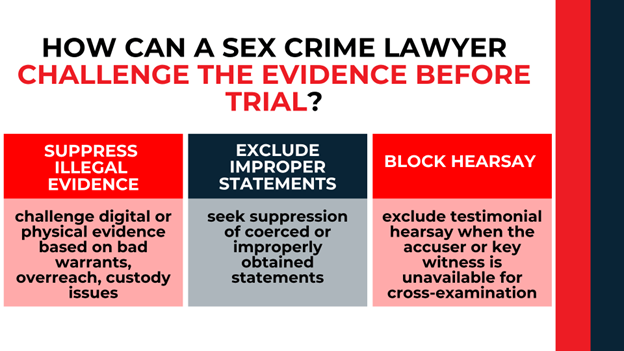
Three panels outlining suppressing illegal evidence, excluding improper statements, and blocking hearsay testimony

What Legal Defenses Can Lead to Charges Being Dropped?

The specific defense depends on the charge. North Carolina's sex offense statutes each require distinct elements — and if the prosecution cannot prove every element beyond a reasonable doubt, the charge fails.

Consent. For forcible sex offenses, consent is a complete defense. State v. Yelverton, 274 N.C. App. 348, 851 S.E.2d 434 (2020), affirmed this principle. The prosecution must prove both force and lack of consent as separate elements. State v. Henderson, 233 N.C. App. 538, 756 S.E.2d 860 (2014), confirmed that a nonconsensual act alone — without independent proof of force — is insufficient for a forcible rape conviction. Defense counsel documents text messages, witness accounts, and prior relationship evidence to establish that the encounter was consensual.

Challenging the force element. In State v. Alston, 310 N.C. 399, 312 S.E.2d 470 (1984), the NC Supreme Court held that force must be specific to the charged act. Generalized fear from a prior relationship does not satisfy the force requirement. This distinction is critical in cases involving former partners or ongoing relationships.

Motive to fabricate. NC Rule 412 (the Rape Shield law) generally excludes evidence of a complainant's prior sexual behavior, but courts have carved important exceptions. State v. Martin, 241 N.C. App. 602, 774 S.E.2d 330 (2015), held that motive and bias evidence is admissible outside Rule 412's scope. State v. Goins, 244 N.C. App. 499, 781 S.E.2d 45 (2015), held that bias evidence is admissible when the State's case depends on complainant credibility. Where the accusation is driven by a custody dispute, relationship breakdown, or other motive, defense counsel files a motion for in camera hearing with a specific offer of proof.

Expert testimony challenges. State v. Hall, 330 N.C. 808, 412 S.E.2d 883 (1992), permits prosecution expert testimony about victim behavior (delayed reporting, recantation) — but not to prove abuse actually occurred. State v. Hammett, 361 N.C. 92, 637 S.E.2d 518 (2006), requires that expert opinions on whether abuse occurred rest on physical evidence, not solely on a complainant's statements. Daubert motions under State v. McGrady, 368 N.C. 880, 787 S.E.2d 1 (2016), can exclude prosecution experts who exceed these boundaries.
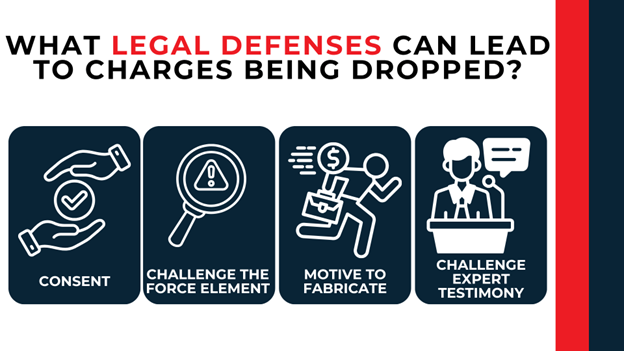
Four icons showing consent, force element challenges, fabrication motive, and expert testimony disputes

Can Sex Crime Charges Be Reduced to Lesser Offenses?

Yes — and this is one of the most important functions of a sex crime lawyer. North Carolina's graduated statutory scheme means the difference between charge classifications can be significant in terms of consequences.

Charge reduction negotiations happen at multiple points: before indictment, during pretrial conferences, and even during trial through lesser-included offense instructions. The leverage for these negotiations comes from the strength of the defense — the weaker the State's evidence, the stronger the position for a reduced charge.

According to the NC Sentencing Commission, 85% of Class B1 felony convictions in FY 2024 resulted from guilty pleas, while 15% went to jury trial — the highest trial rate of any felony class. The 98% guilty plea rate across all NC felony convictions includes cases where plea agreements resulted in reduced charges. Defense counsel's role is to identify the specific weaknesses in the State's case and use them to negotiate the best possible resolution — whether that is a dismissal, a reduction, or a plea to a charge that avoids the most severe collateral consequences.

Recent Case Result: In 2025, Attorney Roberts closed an allegation of sexual assault by a child under 13 claiming a stepfather was molesting her. 

Result: No Charges Filed.

Disclaimer: Each case is different and must be evaluated separately. Prior results achieved do not guarantee similar results can be achieved in future cases.

See more case results here.
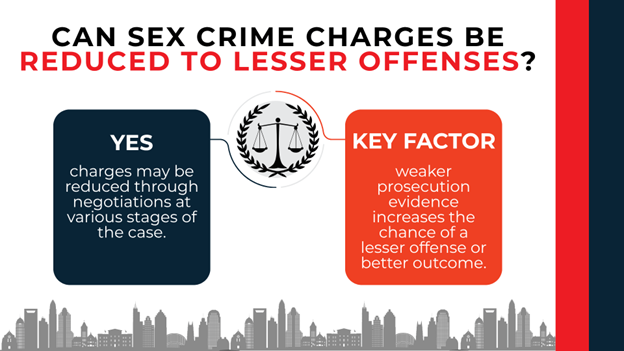
 Scales icon between panels showing charge reduction through negotiation and impact of weaker prosecution evidence

"After speaking with Patrick I was put at ease. He asked questions, was engaged, and very straight to the point." — Review originally posted by a verified client on Avvo.com.

"Patrick is an extremely talented lawyer who has the highest ethical standards. He works extremely hard for his clients and is a very skilled adversary in court." — Martindale-Hubbell Peer Review

Disclaimer: The testimonials and peer reviews on this site are for informational purposes. They do not constitute a guarantee, warranty, or prediction regarding the outcome of your legal matter. Every case is different and must be evaluated on its own merits.

Testimonials and peer endorsements found on this website are actual comments.
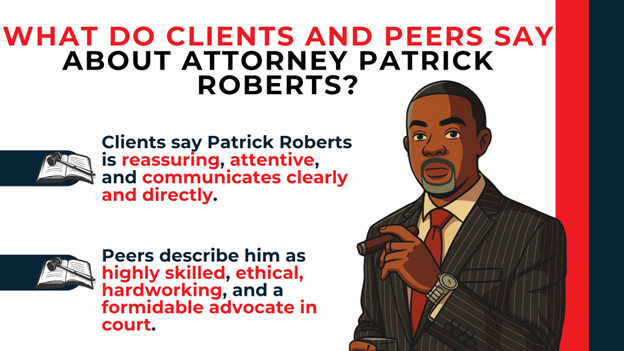
Illustrated attorney with quotes highlighting reassurance, communication skills, professionalism, and courtroom strength

How Do You Evaluate Whether a Lawyer Can Help With Your Case?

The resolution of a high-stakes criminal matter depends on a rigorous analysis of the specific evidence, the credibility of witnesses, and the underlying constitutional issues. Securing a defense grounded in academic precision early in the process ensures that all potential legal avenues are preserved.

Academic Credentials & Trial Experience

Attorney Patrick Roberts is a graduate of Duke University School of Law and The Johns Hopkins University. Duke University School of Law is currently tied for #6 in the 2025–2026 U.S. News & World Report rankings, placing it alongside institutions such as Harvard and the University of Pennsylvania as a premier center for legal scholarship.

Direct Prosecutorial Insight

Since 2007, Patrick Roberts has directed hundreds of bench and jury trials across both state and federal courts. Before transitioning to defense, he served as an Assistant District Attorney in Wake, Johnston, and New Hanover counties. This background provides a technical advantage in analyzing how the State evaluates evidence, determines charging priorities, and responds to complex pretrial challenges.

Advanced Litigation & Trial Training

To maintain the highest standards of courtroom advocacy, Patrick Roberts has completed intensive, specialized training at the nation’s most recognized trial institutes:

This commitment to ongoing professional development ensures that every case is managed with the analytical depth and strategic precision required in North Carolina criminal litigation.

National Recognition & Federal Admissions

Patrick Roberts is currently the only North Carolina practitioner listed by the National Child Abuse Defense & Resource Center (as of 2026). His professional standing is further evidenced by a 10/10 "Superb" Avvo rating maintained for over 15 years and the AV Preeminent® Peer Rating from Martindale-Hubbell—a mark of the highest level of ethical standards and legal ability, held for over five consecutive years.

To provide a comprehensive defense in both state and federal jurisdictions, Patrick Roberts is admitted to practice before:

Leadership in Legal Ethics and Scholarship

Beyond the courtroom, Patrick Roberts has contributed to the structural integrity of the North Carolina legal system. He is a former Commissioner of the North Carolina State Ethics Commission and has served on the North Carolina Juvenile Justice Planning Committee.

A lifetime member of the National Association of Criminal Defense Lawyers (NACDL) and co-author of two legal texts, his insights on complex litigation have been featured in Super Lawyers Magazine, Attorney-at-Law Magazine, and national outlets including USA Today and Fox News.

Request a Confidential Case Evaluation

To maintain a high standard of intellectual thoroughness and dedicated oversight for every client, Patrick Roberts Law manages a strictly restricted caseload. Contact our office to schedule a confidential evaluation of your situation and available legal options.
City skyline above text explaining case factors and importance of early experienced legal representation

Disclaimer: The information on this website is for general informational purposes only. Nothing herein should be taken as legal advice for any individual case or situation. Contacting us via this website, email, or contact form does not create an attorney-client relationship. Case results depend on a variety of factors unique to each case; prior results do not guarantee a similar outcome.

Posted in:

Related Posts

Criminal defense attorney in a courtroom with Patrick Roberts Law branding discussing whether sex crime charges can be dropped in North Carolina, highlighting legal defense and criminal justice representation.

Can Sex Crime Charges Be Dropped in North Carolina?

In North Carolina, sex crime charges can be dropped if a prosecutor or judge determines there is insufficient evidence, witness credibility issues, or constitutional violations. While victims cannot personally drop charges, the State may dismiss a case through a voluntary dismissal or a deferred prosecution agreement if legal thresholds for a conviction are not met. more How Does Prosecutorial Discretion Affect Sex Crime Cases? The North Carolina District Attorney (DA) holds significant power over the life cycle of a criminal case. This power is known as prosecutorial discretion. Under N.C.G.S. § 15A-931, a prosecutor may enter a voluntary dismissal at any time before the trial begins. This is the primary mechanism through which sex crime charges are dropped. The Role of the District Attorney The DA is tasked with seeking justice, not merely securing convictions. If, after a thorough review of the case file, the prosecutor determines that the evidence is insufficient or that a conviction is unlikely, they have the authority to dismiss the charges. This decision is often based on: The strength of physical evidence (e.g., DNA or digital forensics). The availability and reliability of witnesses. The presence of legal hurdles, such as evidence that may be suppressed due to police misconduct. The Victim’s Influence vs. Legal Authority A common misconception is that a victim can call the police and "cancel" a charge. In North Carolina, the victim is considered a complaining witness for the State, not a party to the lawsuit. While the North Carolina Crime Victims’ Rights Act (N.C.G.S. § 15A-832) ensures that victims are consulted and kept informed, the DA is not legally bound by the victim's preferences. Even if a victim recants or refuses to testify, the DA may still attempt to move forward using "victimless prosecution" strategies, such as relying on physical evidence or excited utterances made to third parties. Public Interest and Safety Considerations When deciding whether to drop a sex crime charge, the prosecutor also weighs the impact on public safety. If the defendant has a history of similar allegations or if the crime involves a minor, the threshold for dismissal becomes much higher. The DA must balance the rights of the defendant with the mandate to protect the community. What Evidence Is Needed to Drop a Sex Crime Charge? To understand what leads to a dismissal, one must understand the "beyond a reasonable doubt" standard. This is the highest burden of proof in the American legal system. If the defense can demonstrate that the State’s evidence does not reach this level, the DA may choose to drop the charges rather than face an acquittal at trial. Lack of Physical or Forensic Evidence Sex crimes are frequently prosecuted based on forensic evidence collected via a Sexual Assault Evidence Collection Kit (SAECK). If the kit returns no DNA from the defendant, or if the DNA found is consistent with a consensual encounter rather than a forcible one, the State’s case is significantly weakened. In North Carolina, the absence of physical trauma or biological evidence does not automatically result in a dismissal, but it creates a substantial hurdle for the prosecution. Constitutional Violations and Evidence Suppression A significant portion of sex crime dismissals results from procedural errors by law enforcement. Under the Fourth, Fifth, and Sixth Amendments of the U.S. Constitution: Illegal Searches: If police obtained physical evidence or digital data (such as cell phone records) without a valid warrant or a recognized exception to the warrant requirement, that evidence may be suppressed. Coerced Confessions: If a defendant was interrogated without being read their Miranda rights or was coerced into a statement, that statement cannot be used in court. Right to Counsel: Violations of a defendant’s right to an attorney during critical stages of the investigation can lead to the dismissal of the entire case. When a judge grants a Motion to Suppress, and the suppressed evidence was the cornerstone of the State's case, the DA often has no choice but to enter a voluntary dismissal. Evidence Thresholds and Technical Sufficiency While North Carolina law does not strictly require independent verification for a victim's testimony to sustain a conviction, the practical reality of a jury trial often does. If there are no eye-witnesses, no incriminating digital communications (texts, emails, or social media messages), and no physical evidence, the "he-said, she-said" nature of the case may lead a prosecutor to conclude that the evidence is technically insufficient to proceed. How Do Credibility Issues Lead to Dismissed Charges? In many North Carolina sex offense cases, the outcome is determined long before a jury is ever selected. Because physical evidence is often absent or inconclusive, the State’s case frequently rests entirely on the testimony of the complaining witness. When a defense investigation uncovers significant credibility issues, the prosecution may quietly dismiss the case to avoid a public loss at trial. Inconsistent Statements and the "Rule of Completeness" Under N.C.R. Evid. 801, prior statements made by a witness can be used to impeach their credibility if they deviate from their current testimony. If a witness provides one version of events to a 911 operator, another to a responding officer, and a third during a deposition or grand jury hearing, the reliability of the entire prosecution is compromised. Small inconsistencies regarding the timeline, the location, or the actions of the parties involved can create enough reasonable doubt for a District Attorney to conclude that a conviction is unattainable. The Role of Defense Investigations in Uncovering Bias A thorough defense investigation often reveals underlying motives for a false accusation. In North Carolina, while the Rape Shield Law (N.C.R. Evid. 412) generally protects a victim’s sexual history, it does not prevent the defense from introducing evidence of bias, prejudice, or a motive to fabricate. Common examples include: Custody and Divorce Litigation: Accusations made during high-stakes family law disputes to gain leverage. Financial Motives: Threats of reporting an incident unless a specific sum of money is paid. Personal Vendettas: Documented evidence of prior threats or a history of animosity between the parties. When these motives are brought to the prosecutor’s attention through a formal "defense packet," the State must evaluate whether the witness can withstand cross-examination. If the witness’s bias is clear, the case is often dismissed via a voluntary dismissal. The Impact of Digital Forensics on Credibility In the modern legal landscape, digital footprints—including text messages, social media interactions, and GPS data—often serve as the "silent witnesses" that confirm or refute an allegation. If a complaining witness claims they were held against their will, but cell tower pings or social media check-ins show them in a different location, the physical impossibility of the claim usually leads to an immediate dismissal of charges. What Is the Difference Between Pre-Charge and Post-Charge Dismissal? The timing of a dismissal is a critical factor in how a defendant's record and reputation are affected. There is a common misconception that once an investigation begins, an arrest is inevitable. In reality, a significant number of sex crime cases are resolved during the investigative phase. Pre-Charge Investigation: The "Window of Opportunity" The most effective way to "drop" a sex crime charge is to prevent it from being filed in the first place. During the pre-charge phase, law enforcement is still gathering evidence to determine if probable cause exists. An experienced legal team can present exculpatory evidence—such as surveillance footage, alibi witnesses, or electronic records—directly to the lead investigator or the DA’s office before an arrest warrant is issued. If the evidence is strong enough to negate probable cause, the case is cleared by investigation, and no formal charges are ever brought. Post-Charge Voluntary Dismissal Once a defendant has been arrested and processed, the case enters the court system. At this stage, the DA may enter a Voluntary Dismissal (VD) under N.C.G.S. § 15A-931. This can happen at any time, from the first appearance to the morning of the trial. Dismissal Without Prejudice: Most voluntary dismissals are "without prejudice," meaning the State technically retains the right to refile the charges if new evidence comes to light within the statute of limitations. Dismissal With Prejudice: Though rare in the context of a prosecutor's voluntary filing, a judge may dismiss a case "with prejudice" if there are severe constitutional violations, meaning the charges can never be refiled. Involuntary Dismissal by a Judge While the DA has the primary authority to drop charges, a judge can dismiss a case against the State's wishes through a Motion to Dismiss for Lack of Evidence. At the close of the State's evidence during a trial, if the judge determines that even when viewing the evidence in the light most favorable to the State, no reasonable jury could find the defendant guilty, the judge must dismiss the charges. This acts as an acquittal and prevents further prosecution for the same offense. Can a Defendant Be Cleared Through Deferred Prosecution? While most sex crime charges are dropped due to evidentiary failure, some cases are resolved through structured legal programs. In North Carolina, deferred prosecution and conditional discharges offer a statutory pathway to dismissal for specific types of offenses. These programs are governed strictly by N.C.G.S. § 15A-1341. Statutory Requirements for Deferral Deferred prosecution is essentially an agreement between the defendant and the State. The defendant agrees to comply with certain conditions—such as a clean criminal record for a specified period, psychological evaluation, or community service—in exchange for the State dismissing the charges upon successful completion. This is typically reserved for: First-time offenders with no prior felony convictions. Offenses that do not involve "forcible" sexual assault. Cases where the District Attorney believes rehabilitation is more productive than incarceration. Conditional Discharge Programs A conditional discharge is a unique procedural tool where a defendant may enter a plea of guilty, but the court chooses not to enter a "judgment of conviction." Instead, the proceedings are stayed, and the defendant is placed on probation. Under N.C.G.S. § 15A-1341(a4), if the defendant fulfills all terms of their probation, the court dismisses the case. Because no judgment was ever entered, the individual technically avoids a criminal conviction for that charge. Risk Factors and Eligibility Limitations It is important to note that deferred prosecution is rarely an option for high-level felonies, such as First-Degree Forcible Rape or offenses involving minors (Class B1 through D felonies). For these serious charges, the State’s policy is almost always to seek a conviction or a voluntary dismissal based on evidence—rarely a "middle ground" deferral. What Happens to a Criminal Record After Charges Are Dropped? A common and dangerous misconception is that once a District Attorney drops a sex crime charge, the legal ordeal is over. In the digital age, the paper trail of an arrest can be as damaging as a conviction if not addressed properly. The Persistence of the Arrest Record When a case is dismissed via a Voluntary Dismissal (VD), the records of the arrest, the fingerprinting, and the initial charge remain in the public database of the North Carolina Administrative Office of the Courts (AOC). Employers, landlords, and professional licensing boards can see that an individual was charged with a sex offense, even if the Disposition column reads "Dismissed by Prosecutor." Expunction Eligibility under N.C.G.S. § 15A-146 To truly drop the charge from public view, a defendant must petition the court for an expunction. In North Carolina, if a charge is dismissed or results in a finding of "not guilty," the individual is generally eligible to have the record permanently deleted. The Petition Process: An expunction is not automatic. It requires filing a formal petition in the county where the charge originated. Restoration of Status: Once the order is signed by a judge, the law treats the person as if the arrest never occurred. They can legally state on most applications that they have never been charged with the crime. Are All Cases Resolved at Trial? The reality of the North Carolina legal system is that the majority of sex crime dismissals do not happen in a dramatic courtroom scene. Instead, they are the result of rigorous, behind the scenes advocacy during the pre-trial phase. Prosecutors are ethically bound not to bring a case to trial if they know they cannot win. When a defense attorney presents a comprehensive Dismissal Memorandum highlighting forensic gaps, witness inconsistencies, or constitutional errors, the District Attorney often chooses to drop the charges quietly to protect the resources of the State. This pre-trial window is the most critical period for any individual facing these allegations, as it represents the highest statistical probability of a case being resolved without the trauma and public exposure of a jury trial. What Are the Strategies for Negotiating a Voluntary Dismissal in North Carolina? The process of securing a dismissal in a North Carolina sex offense case often involves a strategic presentation of evidence to the District Attorney before a trial date is even set. This phase of the legal process is critical, as it allows for a technical evaluation of the State’s case without the unpredictable nature of a jury. The Defense Memorandum and Evidentiary Gaps A primary tool in these negotiations is the defense memorandum. This document outlines the legal and factual reasons why the State cannot meet its burden of proof. In North Carolina, defense counsel may highlight specific statutory deficiencies, such as the failure to prove the element of force in a second-degree forcible sexual offense or the lack of corroborating evidence in cases involving minors. When a prosecutor is presented with a clear legal argument for why a conviction is unlikely, the ethical obligation to seek justice often leads to a voluntary dismissal. Challenging Probable Cause in Preliminary Hearings For felony sex crimes, a defendant has the right to a probable cause hearing under N.C.G.S. § 15A-606. While many defendants waive this hearing, it can be a vital opportunity to test the strength of the State’s witnesses. If the witness testimony is found to be fundamentally flawed or if the State fails to establish the basic elements of the crime, the judge may dismiss the charges for lack of probable cause. Legal Counsel for High-Stakes Cases When selecting an attorney for a sex crime allegation in North Carolina, consider their experience practicing in that jurisdiction. Attorney Patrick Roberts has prior experience as a prosecutor and has received extensive trial advocacy training. He evaluates procedural issues that may affect charges and focuses on the early stages of the criminal process with an emphasis on informing clients about options and potential consequences. In North Carolina’s legal system, the quiet resolution of a case—one that avoids the public spectacle of a trial—is often the result of identifying constitutional or procedural errors early in the process. Attorney Patrick Roberts focuses on these details, from the validity of search warrants for digital devices to the adherence to Miranda protocols during police interrogations. By addressing these issues during the window of opportunity before a case reaches the superior court, he works to secure dismissals* that protects his clients' long-term records. *Disclaimer: Each case is different and must be evaluated separately. Prior results achieved do not guarantee similar results can be achieved in future cases. Frequently Asked Questions (FAQ) Can a victim drop charges in North Carolina? No. In North Carolina, the victim is a witness for the State. Only the District Attorney has the legal authority to dismiss a criminal charge via a voluntary dismissal. While the prosecutor may consider the victim's wishes, they are not required to follow them. How long does the DA have to refile charges after a dismissal? If a case is dismissed "without prejudice," the State can refile the charges at any time as long as the statute of limitations has not expired. In North Carolina, there is no statute of limitations for most felonies, including many sex offenses. However, a dismissal "with prejudice" prevents the State from ever refiling the same charge. Does a dismissed charge show up on a background check? Yes. A dismissal ends the prosecution, but it does not remove the record of the arrest or the charge from public databases. To clear this information, an individual must successfully petition for an expunction under N.C.G.S. § 15A-146. What is a "Dismissal with Leave" in NC? A Dismissal with Leave (VL) is a procedural tool used when a defendant cannot be located or is otherwise unavailable for trial. It removes the case from the active court calendar but allows the prosecutor to reinstate the charges instantly once the defendant is found. This is not a final resolution of the case. The Importance of Technical Proficiency in Sex Offense Cases The resolution of a sex crime case in North Carolina often hinges on the technical proficiency of the defense counsel. Because the stakes include potential lifetime registration on the North Carolina Sex Offender Registry and significant active prison sentences, the defense must be built on a foundation of rigorous training and solid education. Professional Background and Training Attorney Patrick Roberts has completed several of the most recognized trial advocacy programs, which focus on the practical application of defense strategies: Gerry Spence Trial Lawyer College: A three-week intensive program that covers every phase of a criminal trial, emphasizing the human element and communication with a jury. NCDC Trial Practice Institute: A two-week mastery course focusing on comprehensive criminal defense and the strategic dismantling of the prosecution’s case. 2025 NCDC Cross-Examination Intensive: Advanced, hands-on training specifically tailored for high-stakes witness questioning, which is often the deciding factor in cases involving sex offense allegations. Peer and Client Perspectives: “Patrick impressed me with his thorough understanding of the law and his strategic approach to my case. He not only provided clear and practical legal advice but also employed smart strategies that were beyond my expectations. His attention to detail and dedication to my defense made all the difference.” - Client comment via Avvo on Sept. 25, 2024 "I have known him as both an assistant district attorney and a private attorney. He’s one of the best I know." — Peer Review via Martindale-Hubbell, October 22, 2018 Disclaimer: The testimonials and peer reviews on this site are for informational purposes. They do not constitute a guarantee, warranty, or prediction regarding the outcome of your legal matter. Every case is different and must be evaluated on its own merits. *Testimonials and peer endorsements found on this website are actual comments. Case Review: In 2025, Attorney Patrick Roberts handled a case involving a 15-year-old stepdaughter’s allegations of sexual touching that was successfully* resolved without charges. Attorney Roberts got involved early in the process, providing critical representation during the Child Protective Services (CPS) investigation as the client faced a potential minimum sentence of 12 years in prison. Following the investigation, CPS declined to substantiate the allegations, and the case* was closed without any formal charges being brought. *Disclaimer: Each case is different and must be evaluated separately. Prior results achieved do not guarantee similar results can be achieved in future cases. Understanding the Process for Dismissing Charges in North Carolina In North Carolina, being charged with a sex offense is a serious matter, but it is important to remember that a charge is an accusation, not a conviction. The state’s legal system requires the prosecution to prove every part of their case with solid evidence. Because the stakes are high, the law provides several checkpoints where a case can be reviewed and, if the evidence is lacking, dismissed before it ever reaches a jury. Getting charges dropped is rarely about luck; it is usually the result of a detailed legal review of the facts. A defense focus typically involves looking for "evidentiary gaps"—missing or weak evidence—and ensuring that law enforcement followed the rules set by the Constitution. If there are major inconsistencies in witness statements or if evidence was collected improperly, there may be a legal basis to ask for a dismissal. The Role of the Prosecutor and the Defense In North Carolina, the District Attorney has the discretion to drop a case if they realize they cannot prove it beyond a reasonable doubt. The goal of a defense attorney is to present the prosecutor with these legal and factual reasons why the case should not move forward. The period before a case goes to trial is often the most important time for these discussions. Attorney Patrick Roberts brings an extensive understanding of North Carolina’s criminal procedure and local prosecutorial protocols to evaluate the viability of the State’s case. By identifying flaws in the prosecution’s evidence early on, it is possible to seek a resolution that protects your future and avoids the long-term consequences of a criminal record. To discuss the specific details of your case* and see if the facts support a motion for dismissal, you can contact Patrick Roberts Law for a confidential consultation. *Every case is unique and prior results do not guarantee a similar outcome. Disclaimer: The information on this website is for general informational purposes only. Nothing herein should be taken as legal advice for any individual case or situation. Contacting us via this website, email, or contact form does not create an attorney-client relationship. Case results depend on a variety of factors unique to each case; prior results do not guarantee a similar outcome.
Blindfolded Lady Justice statue beside bold headline introducing key legal differences between statutory and forcible rape in North Carolina.

Statutory Rape vs. Rape Charges in North Carolina: Key Differences Explained

Facing rape or statutory rape charges in Apex or anywhere in Wake County demands immediate clarity about what you're up against. According to the NC Sentencing and Policy Advisory Commission's FY 2024 Statistical Report, North Carolina courts recorded 431 Class B1 felony convictions, the most serious sex offense classification in a single fiscal year. These two charge types operate under fundamentally different legal frameworks, and understanding the distinction affects every aspect of your defense. Statutory rape focuses entirely on the alleged victim's age, while forcible rape requires the State to prove force and lack of consent. This article breaks down the elements, penalties, and defense approaches for each offense category so you can understand exactly what prosecutors must prove and how a defense attorney can challenge their case. more What Is the Difference Between Statutory Rape and Forcible Rape in North Carolina? North Carolina's criminal code treats statutory rape and forcible rape as distinct offenses with different elements, defenses, and underlying legal theories. The NC State Bureau of Investigation's 2024 Annual Summary Report documented 2,944 reported rape offenses statewide, reflecting the scope of prosecution activity across all rape categories. Understanding the distinction between these charges is essential because the available defenses and the State's burden of proof differ significantly. What Elements Must the State Prove For Forcible Rape? Forcible rape under North Carolina law requires the State to prove specific elements beyond a reasonable doubt. The prosecution cannot secure a conviction simply by proving sexual contact occurred, they must establish both force and lack of consent as separate elements under the statutory scheme. For a first-degree or second-degree forcible rape conviction, prosecutors must prove: Vaginal intercourse occurred between the defendant and the alleged victim The act was accomplished by force sufficient to overcome resistance or through fear, coercion, or threats The sexual act occurred against the will of the alleged victim For first-degree charges, an aggravating factor was present (such as use of a weapon, infliction of serious injury, or multiple perpetrators) The North Carolina Supreme Court in State v. Alston, 310 N.C. 399 (1984), established that force must be specific to the charged act general fear from a prior relationship is insufficient. This means prosecutors cannot rely on the overall dynamics of a relationship but must prove force connected directly to the alleged offense. How Do Statutory Rape Charges Differ From Forcible Rape? Statutory rape operates under an entirely different legal framework. These charges focus exclusively on the alleged victim's age rather than force or consent. North Carolina's age of consent is 16 years old, meaning sexual activity with anyone under 16 can result in statutory rape charges regardless of whether the minor agreed to participate. The National Children's Alliance Statistics Report documented 3,127 children reported for sexual abuse at North Carolina Children's Advocacy Centers during a six-month period in 2023 illustrating the significant enforcement activity in cases involving minors. Statutory rape charges are strict liability offenses. The State does not need to prove force, threats, or coercion. The prosecution's burden is limited to proving the defendant engaged in sexual activity with someone below the statutory age. Why Does Consent Matter For One Charge But Not the Other? Consent serves as a complete defense to forcible rape charges because the "against the will" element requires proving the alleged victim did not consent. If the defense can establish the sexual activity was consensual, the State cannot meet its burden on this essential element. For statutory rape, consent is legally irrelevant. The North Carolina Court of Appeals in State v. Breathette, 202 N.C. App. 697 (2010), confirmed that mistake of age is NOT a defense to statutory offenses. Even if a defendant genuinely believed the alleged victim was 16 or older, this belief provides no legal protection. The law presumes minors below the age of consent cannot legally agree to sexual activity. How Does North Carolina Classify Statutory Rape Offenses? North Carolina uses a tiered classification system for statutory rape based on the alleged victim's age and the age differential between the defendant and the minor. The penalties increase dramatically as the victim's age decreases and the age gap widens. What Are the Different Tiers of Statutory Rape Charges? North Carolina's statutory rape scheme creates distinct offense classifications with corresponding penalties: Statutory rape of child by adult (N.C.G.S. § 14-27.23): Defendant is 18 or older, victim is under 13 Class B1 felony with a mandatory minimum of 300 months (25 years) First-degree statutory rape (N.C.G.S. § 14-27.24): Defendant is 12 or older and at least 4 years older than a victim under 13 Class B1 felony Statutory rape of person 15 or younger (N.C.G.S. § 14-27.25): Defendant is at least 12 and 6 or more years older than victim 15 or younger Class B1 felony; if victim is 15 and defendant is more than 4 but less than 6 years older Class C felony Indecent liberties with children (N.C.G.S. § 14-202.1): Defendant 16 or older and at least 5 years older than victim under 16 Class F felony The age differential requirements in each tier determine both the applicable charge and the potential sentence. What is North Carolina's Age of Consent? North Carolina sets the age of consent at 16 years old. Sexual activity with anyone under 16 can result in criminal charges, though the specific charge and penalty depend on both the victim's exact age and the defendant's age. The law recognizes that younger victims require greater protection. A defendant who engages in sexual activity with a 12-year-old faces significantly more severe charges than one involving a 15-year-old, even though both situations involve minors below the age of consent. Does North Carolina Have a Romeo and Juliet Law? North Carolina provides limited close-in-age protections through its statutory structure rather than a separate "Romeo and Juliet" law. The age differential requirements built into each offense tier create some protection for relationships between teenagers close in age. For example, under N.C.G.S. § 14-27.25, a defendant must be at least 6 years older than the victim to face a Class B1 felony when the victim is 15 or younger. Similarly, indecent liberties charges under N.C.G.S. § 14-202.1 require the defendant to be at least 5 years older than the victim. However, these provisions are narrow. A 19-year-old who engages in sexual activity with a 14-year-old could still face serious felony charges despite being only 5 years apart in age. The statutory scheme does not provide blanket protection for all teenage relationships. What Are the Degrees of Forcible Rape in North Carolina? North Carolina distinguishes between first-degree and second-degree forcible rape based on the presence of aggravating factors. According to the NC Sentencing Commission's FY 2024 report, Class B1 felonies which include first-degree rape have the highest jury trial rate (15%) of any felony class, with 85% resolving through guilty pleas. What Makes Rape a First-Degree Felony in North Carolina? First-degree forcible rape under N.C.G.S. § 14-27.21 is a Class B1 felony the most serious classification for sex offenses. To elevate a rape charge to first-degree, the State must prove the presence of at least one aggravating factor beyond the basic elements of force and lack of consent. Aggravating factors that elevate rape to first-degree include: The defendant employed or displayed a dangerous or deadly weapon or an article the victim reasonably believed to be a weapon The defendant inflicted serious personal injury upon the victim or another person The offense was committed with the aid of one or more other persons The victim was physically helpless or mentally incapacitated Without one of these aggravating factors, prosecutors must charge the offense as second-degree rape. When is Rape Charged as a Second-Degree Offense? Second-degree forcible rape under N.C.G.S. § 14-27.22 is a Class C felony. This charge applies when the State can prove force and lack of consent but cannot establish any aggravating factor required for first-degree. Second-degree rape also applies to incapacity-based prosecutions where the alleged victim was mentally disabled, mentally incapacitated, or physically helpless. In these cases, the State must prove the defendant knew or reasonably should have known of the victim's condition. The North Carolina Supreme Court in State v. Moorman, 320 N.C. 387 (1987), held that force and consent are implied by law when the victim is sleeping or incapacitated. What Penalties Do These Charges Carry in North Carolina? The penalties for rape and statutory rape convictions rank among the most severe in North Carolina's criminal code. According to the NC Sentencing Commission, 100% of Class B1-D felony sex offense convictions result in active imprisonment probation or intermediate punishment is not an option. What Sentences Do Statutory Rape Convictions Carry? Statutory rape sentences depend on the specific charge classification and the defendant's prior record level under Structured Sentencing: Class B1 statutory rape (child by adult, first-degree, or 6+ year age gap): Average sentences of 236-315 months (approximately 19.7 to 26.25 years) Statutory rape of child by adult (N.C.G.S. § 14-27.23): Mandatory minimum of 300 months (25 years) when defendant is 18+ and victim is under 13 Class C statutory rape (15-year-old victim, 4-6 year age gap): Presumptive range of 58-73 months for a first-time offender Class F indecent liberties: Presumptive range of 13-16 months for a first-time offender, though active imprisonment is discretionary The FY 2024 Sentencing Report documented one life without parole sentence imposed for a statutory sex offense with a child under 15 during the fiscal year. How Are Forcible Rape Sentences Determined? Forcible rape sentences follow NC's Structured Sentencing grid based on offense class and prior record level: First-degree forcible rape (Class B1): Presumptive range of 192-240 months (16-20 years) for a first-time offender; can reach 300+ months with aggravating factors or prior record Second-degree forcible rape (Class C): Presumptive range of 58-73 months (approximately 5-6 years) for a first-time offender The average sentence for all Class B1 felony convictions including both statutory and forcible rape was 236 months minimum to 315 months maximum according to FY 2024 data. What Factors Increase or Decrease a Sentence? North Carolina's Structured Sentencing Act permits sentences in the presumptive, aggravated, or mitigated range based on case-specific factors. According to the NC Sentencing Commission, 8% of person offense convictions received aggravated sentences, the highest percentage among all crime types. Sex offenses also carry an enhanced maximum sentence under N.C.G.S. § 15A-1340.17(f). For Class B1 through Class E felonies requiring sex offender registration, the maximum sentence equals 120% of the minimum plus 60 additional months. This formula significantly extends potential incarceration beyond standard ranges. The defendant's prior record level has substantial impact. A Prior Record Level I defendant faces dramatically different exposure than a Level VI defendant, even for identical charges. How Do Defense Strategies Differ Between These Charges? The fundamental difference between statutory rape and forcible rape shapes every aspect of defense strategy. What works for one charge type may be completely unavailable for the other. Can Consent Be a Defense to Statutory Rape Charges? No. Consent is not a legal defense to statutory rape in North Carolina. The law presumes that minors below the age of consent cannot legally agree to sexual activity, making the minor's willingness irrelevant to the prosecution's case. The North Carolina Court of Appeals in State v. Breathette, 202 N.C. App. 697 (2010), specifically held that mistake of age is NOT a defense. Even evidence that the minor lied about their age, presented a fake ID, or appeared significantly older provides no legal protection. Defense strategies for statutory rape must focus on other grounds: Challenging whether sexual activity actually occurred Disputing the alleged victim's testimony through inconsistencies or credibility issues Verifying the alleged victim's exact age and calculating age differentials precisely Investigating whether charges were filed under the correct statute Examining constitutional violations in evidence collection How Can Defendants Challenge Forcible Rape Accusations? Forcible rape defenses have more avenues available because the State must prove both force AND lack of consent. The defense can attack either element. Effective defense approaches for forcible rape include: Consent defense: Presenting evidence the sexual activity was consensual, negating the "against the will" element Challenging the force element: Under State v. Alston, force must be specific to the charged act general relationship dynamics are insufficient Attacking witness credibility: NC does not require corroboration for victim testimony, but credibility challenges can create reasonable doubt Rape Shield exceptions: While NC Rule 412 limits evidence of the complainant's sexual history, exceptions exist for prior sexual conduct with the defendant, evidence showing an alternative source of injury, and bias/motive evidence under State v. Martin, 241 N.C. App. 602 (2015) Constitutional challenges: Suppression of illegally obtained evidence, Miranda violations, or Confrontation Clause issues The National Registry of Exonerations reports that 10% of all exonerations nationally are for sexual assault and 9% for child sex abuse underscoring the reality that wrongful accusations occur. Additionally, according to End Violence Against Women International, methodologically rigorous research places the false reporting rate for sexual assault at 2-8%. What Constitutional Protections Apply to Both Charge Types? Constitutional protections under the Fourth and Fifth Amendments apply equally to both statutory rape and forcible rape investigations. Fourth Amendment protections require police to obtain warrants before searching cell phones and digital devices. The U.S. Supreme Court in Riley v. California, 573 U.S. 373 (2014), held that cell phone searches incident to arrest require a warrant. NC courts apply this standard, and evidence obtained through illegal searches may be suppressed. Fifth Amendment protections require Miranda warnings before custodial interrogation. NC also mandates recording of interrogations for serious felonies under N.C.G.S. § 15A-211, including Class C sex offenses. Failure to record can support claims of involuntariness. What Collateral Consequences Follow a Conviction? Beyond imprisonment, sex offense convictions trigger severe collateral consequences that extend far beyond the sentence. According to the NC SBI Sex Offender Registry, in 2025, North Carolina has approximately 28,200 registered sex offenders statewide, with 839 registered offenders in Wake County alone. How Long Does Sex Offender Registration Last? North Carolina's Sex Offender Registry under N.C.G.S. § 14-208 et seq. requires registration for 30 years as the standard period. However, certain classifications require lifetime registration: Recidivists with prior sex offense convictions Aggravated offenders based on offense characteristics Sexually violent predators (SVP designation) Defendants may petition for termination of registration after 10 years under N.C.G.S. § 14-208.12A if they do not fall into a lifetime registration category. The registration requirements include address verification, restrictions on where offenders can live and work, and GPS monitoring for certain offenders. According to NC Department of Adult Correction data, 581 sex offenders were enrolled in GPS electronic monitoring in FY 2022-2023. What Other Consequences Follow a Conviction? Sex offense convictions create lasting consequences beyond registration: Immigration consequences: Sexual abuse of a minor is an aggravated felony under federal law, triggering mandatory deportation for non-citizens. The U.S. Supreme Court in Padilla v. Kentucky, 559 U.S. 356 (2010), requires defense counsel to advise clients of immigration consequences before any plea Employment restrictions: Many professions require background checks, and sex offense convictions bar employment in education, healthcare, childcare, and other fields Housing limitations: Registered sex offenders face restrictions on where they can live, particularly near schools and childcare facilities Professional licensing: Convictions affect "good moral character" determinations for professional licenses Federal firearms prohibition: Felony convictions result in permanent loss of firearm rights The NC Sentencing Commission reports that defendants convicted of Class B1 felonies spent an average of 27 months in pretrial detention before sentencing highlighting the immediate life disruption these charges create even before conviction. Frequently Asked Questions Can a defendant claim they didn't know the victim's age? No. North Carolina courts have consistently held that mistake of age is not a defense to statutory sex offenses. In State v. Breathette, the Court of Appeals confirmed this rule applies to indecent liberties charges, and the same principle extends to statutory rape. Even if the alleged victim lied about their age or presented false identification, this provides no legal defense. The law imposes strict liability based on the victim's actual age. What if the alleged victim consented to the sexual activity? Consent matters only for forcible rape charges. If someone faces statutory rape charges involving a minor under 16, the minor's consent is legally irrelevant North Carolina law presumes minors cannot consent to sexual activity. For forcible rape charges involving adults, consent is a complete defense because the State must prove the act occurred "against the will" of the alleged victim. How long do defendants typically wait in jail before trial? According to NC Sentencing Commission data, defendants convicted of Class B1 felonies which includes serious rape charges spent an average of 27 months in pretrial detention. The median time from charge filing to sentencing for Class B1 felonies is 30 months, significantly longer than the 10-month median for all felonies. This extended timeline reflects the complexity of these cases and the difficulty of obtaining pretrial release. Can statutory rape charges be reduced through plea bargaining? While 98% of all NC felony convictions result from guilty pleas rather than trials, Class B1 felonies have the highest jury trial rate at 15%. This suggests defendants facing the most serious charges are more likely to proceed to trial. Plea negotiations depend on case-specific factors including the strength of evidence, the defendant's prior record, and the prosecutor's assessment. An experienced defense attorney can evaluate whether negotiation or trial offers the better path forward. What happens if someone is falsely accused of rape in North Carolina? False accusations, while representing a small percentage of reports, do occur and have devastating consequences. Defendants maintain the presumption of innocence, and the State bears the burden of proving every element beyond a reasonable doubt. Defense strategies focus on challenging the accuser's credibility, identifying inconsistencies in testimony, presenting alibi evidence, and ensuring constitutional protections are enforced. NC law does not require corroboration for victim testimony, making vigorous cross-examination and independent investigation critical. Protecting Your Future Against Serious Charges Both statutory rape and forcible rape charges carry life-altering consequences decades of potential imprisonment, mandatory sex offender registration, and permanent collateral effects on employment, housing, and relationships. The critical differences between these charge types determine what defenses are available and how the case should be approached. Forcible rape charges require the State to prove force and lack of consent, creating opportunities to challenge both elements. Statutory rape charges eliminate consent as a defense entirely, requiring different strategic approaches focused on witness credibility, accurate age verification, and constitutional protections. When facing allegations that carry life-altering penalties, the caliber of your legal representation is a critical factor in the protection of your rights. Attorney Patrick Roberts offers a defense informed by two decades of criminal law experience, including a perspective gained as a former prosecutor. This background allows him to analyze cases from both sides of the courtroom, developing strategic legal approaches tailored to the complexities of North Carolina’s state and federal courts. Having tried hundreds of bench and jury trials, Mr. Roberts is a dedicated advocate for the accused, a commitment reflected in his designation as a Martindale-Hubbell Client Champion Platinum recipient for over five consecutive years (2021–2026). In a legal system where your future is at stake, you deserve a seasoned trial lawyer who will provide a rigorous defense and uphold your right to a fair trial. *Disclaimer: The information provided does not constitute a guarantee of outcome. Prior results do not guarantee a similar result in future cases. “Patrick is an excellent lawyer and I trust him to handle my important legal matter.” – Peer review on November 2, 2018 via Martindale-Hubbell* Disclaimer: The testimonials and peer reviews on this site are for informational purposes. They do not constitute a guarantee, warranty, or prediction regarding the outcome of your legal matter. Every case is different and must be evaluated on its own merits. *Testimonials and peer endorsements found on this website are actual comments. Disclaimer: The information on this website is for general information purposes only. Nothing on this site should be taken as legal advice for any individual case or situation. Case results depend upon a variety of factors unique to each case. Prior results do not guarantee a similar outcome.

image

Sexting Laws in North Carolina: What You Need to Know Before It Becomes a Felony

In North Carolina, "sexting" is not a specific legal term found in the criminal code. Instead, the state relies on aggressive felony sexual exploitation of a minor statutes—the same laws used to prosecute high-level child pornography cases. This means that a single digital image involving anyone under the age of 18 can instantly transition from a "teen mistake" into a Class C, E, or H felony. Understanding this distinction is critical for parents, teenagers, and adults alike. Under N.C.G.S. § 14-190.16 and § 14-190.17, prosecutors do not distinguish between "consensual sexting" and exploitation. If a minor is depicted, the law treats the creation, possession, or distribution of that image as a serious sex offense. more What Charges Can Sexting Lead To in North Carolina? Because North Carolina has no standalone "sexting" statute, law enforcement utilizes the state's three-tiered sexual exploitation of a minor system. These charges are governed by N.C.G.S. § 14-190.16 through § 14-190.17A. All three tiers are classified as felonies, and the specific charge depends on whether the material was produced, distributed, or simply possessed. The Three-Tiered Felony System for Digital Images 1. First-Degree Sexual Exploitation (Production) Statute: N.C.G.S. § 14-190.16 Conduct: Producing or facilitating sexually explicit material involving a minor. This includes taking a photo of a minor or convincing a minor to take one. Classification: Class C or D Felony. Sentence: 38 to 182 months in state prison. 2. Second-Degree Sexual Exploitation (Distribution) Statute: N.C.G.S. § 14-190.17 Conduct: Distributing, sending, or receiving sexually explicit digital images of a minor. Classification: Class E Felony. Sentence: 15 to 63+ months in state prison. 3. Third-Degree Sexual Exploitation (Possession) Statute: N.C.G.S. § 14-190.17A Conduct: Simply possessing an image of a minor on a phone, cloud account, or device. Classification: Class H Felony. Sentence: 5 to 29 months in state prison. Critical Sentencing and Legal Facts Fact Category Data & Consequences Incarceration Rate 100% of defendants convicted of Class B1 through D felony sex offenses in FY 2024 received active prison time (per the NC Sentencing Commission). Case Duration High-level sex offense cases carry a median timeline of 30 months from charge to sentencing. "Mistake of Age" Legally not a defense. The state only needs to prove you knew the content of the image, not the age of the person in it. The "Knowing" Requirement Under North Carolina law, the "knowing" element refers to the defendant's knowledge of the character or content of the material. This creates a high burden for the defense, as prosecutors do not have to prove that the defendant intended to exploit a child—only that they knowingly possessed or sent the digital file. Can a Teenager Be Charged With a Felony for Sexting? Yes. North Carolina law permits minors to be prosecuted under these same sexual exploitation statutes — including for images they created of themselves. A 16- or 17-year-old who takes a sexually explicit selfie and sends it to a boyfriend or girlfriend can be charged with both producing and distributing sexually explicit material involving a minor. The minor in the image and the person facing charges are the same person. The recipient — even if they are the same age and in a consensual relationship — can be charged with possession. North Carolina has limited close-in-age protections for certain sexual contact offenses. For example, N.C.G.S. § 14-202.2 creates a separate Class 1 misdemeanor for indecent liberties when the defendant is under 16 and the child is at least three years younger. But no equivalent protection exists for sexting. There is no Romeo-and-Juliet exception, no diversion program written into the exploitation statutes, and no reduced charge category for consensual image-sharing between teenagers. Whether a teenager is actually charged as an adult, handled in the juvenile system, or diverted depends heavily on prosecutorial discretion. That discretion varies by county, by district attorney, and by the specific facts of the case. It is exactly why early legal intervention matters. The difference between a juvenile petition and an adult felony prosecution is not automatic. It is negotiated. What About Adults Involved in Sexting With Someone Under 18? When an adult sends or receives sexually explicit images involving a minor, the risk is greater and the charging options multiply. Beyond the sexual exploitation charges described above, an adult who uses a phone, computer, or any electronic device to solicit a minor for sexual purposes can also face charges under N.C.G.S. § 14-202.3 — solicitation of a child by computer or electronic device. This is a Class H felony, increasing to a Class G felony if either party appears at a proposed meeting location. Several features of this statute make it particularly aggressive. The offense is complete upon solicitation — no meeting has to occur, no sexual act has to take place, and there does not have to be an actual minor on the other end of the conversation. If the defendant believed the person was underage, that belief alone is enough for a conviction. NC appellate courts have applied broad interpretation to the terms "entice," "advise," "coerce," "order," and "command." Law enforcement sting operations using fictional minors are specifically allowed under the statute. The defendant must be at least 16 years old and at least five years older than the believed minor for this statute to apply. But when it does apply, it stacks on top of any exploitation charges — meaning a single sexting exchange can produce multiple felony counts. North Carolina's enforcement resources reflect how seriously the state treats these cases. The NC SBI Computer Crimes Unit coordinates a task force of more than 200 law enforcement agencies across the state. The unit has 17 full-time special agents stationed across eight field districts dedicated exclusively to investigating internet crimes against children. Nationally, the CyberTipline operated by the National Center for Missing & Exploited Children received 20.5 million reports of suspected child sexual exploitation in 2024 alone. These reports routinely generate referrals to state and local agencies, including North Carolina law enforcement. How Does North Carolina Compare to Other States? Many states have enacted laws that specifically address teen sexting — reducing charges to misdemeanors, creating diversion programs, or distinguishing consensual image-sharing between peers from exploitative conduct involving adults. North Carolina has not. The lack of a teen sexting statute means North Carolina prosecutors have only two options when a sexting case involving minors crosses their desk: charge it as a felony under the exploitation statutes or decline to prosecute entirely. There is no middle-ground charging option built into the law. This gap places enormous weight on how a case is handled before formal charges are filed. In states with dedicated sexting laws, the statute itself provides a pathway to appropriate outcomes. In North Carolina, that pathway has to be built by the defense attorney and the prosecutor on a case-by-case basis. That makes the quality of legal representation one of the most important factors in how a sexting case ends. How Can a Defense Attorney Fight Sexting Charges? Sexting cases prosecuted under North Carolina's exploitation statutes carry severe penalties. However, these cases present specific technical and procedural pressure points that a defense attorney can challenge to protect a client’s rights. 1. Challenging "Knowing" Possession The prosecution must prove you knowingly possessed the material. In the digital age, images are frequently: Automatically downloaded by messaging apps (e.g., WhatsApp or Telegram). Cached by web browsers without direct user action. Stored in cloud backups (i.e., iCloud or Google Photos) that a user may never have opened. Placed on a shared device by another individual. A forensic analysis of metadata, timestamps, and file access logs can often establish that a user never intentionally saved, viewed, or interacted with the material in question. 2. Challenging the Search of Digital Devices Law enforcement generally cannot search a cell phone incident to arrest without a warrant. Particularity: The warrant must specifically authorize a forensic examination. Scope: If police exceeded the scope of the warrant or accessed cloud data without separate authorization, the evidence may be subject to suppression (exclusion from trial). 3. Reviewing Investigative Conduct and Entrapment In digital sting operations conducted under N.C.G.S. § 14-202.3, the defense may look for evidence of entrapment. This requires showing government inducement and a lack of predisposition by the defendant. Under N.C.G.S. § 15A-905(c), written notice of an entrapment defense must be filed within 20 working days of the trial setting date, making early legal intervention vital. 4. Negotiating Charge Reductions or Diversion For cases involving teenagers or first-time offenders, counsel may negotiate for: Reduced Charges: Moving a felony down to a misdemeanor level. Juvenile Handling: Keeping the case in the juvenile system to avoid adult criminal records. Alternative Outcomes: Seeking paths that avoid mandatory Sex Offender Registration. Strategic Defense Data North Carolina Legal Reality Plea Rate 98% of felony convictions in NC result from guilty pleas. The strength of the defense determines the terms of that plea. Trial Rate The jury trial rate for serious sex offenses is 15% —the highest of any felony class, reflecting how aggressively these cases are contested. Critical Window Pre-charge negotiation options often disappear once a case is formally indicted or moved to adult court. Why Families Choose Patrick Roberts for Sex Offense Cases in North Carolina When facing charges that carry mandatory prison time and registration, the quality of legal representation is the most significant factor in the trajectory of a case. Attorney Patrick Roberts has defended clients against sex offense allegations across North Carolina for more than two decades. The Value of Prosecutorial Perspective Patrick Roberts served as an Assistant District Attorney in Wake, Johnston, and New Hanover counties. This background provides an inside look at how the state: Evaluates the credibility of digital evidence. Determines whether to elevate a charge to a higher felony tier. Approaches plea negotiations in sensitive sex offense matters. This experience allows for an informed anticipation of the prosecution's strategy throughout the investigative and trial phases. Credentials and Professional Standing Attorney Roberts’ credentials reflect a commitment to rigorous trial advocacy and ethical practice: Legal Education: Graduate of Duke University School of Law ( Top 9 best criminal law program) and The Johns Hopkins University ( Top 7 rank in National Universities). Advanced Advocacy Training: Alumnus of the Gerry Spence Trial Lawyers College and the NCDC Trial Practice Institute, including the 2025 Cross-Examination Intensive. Lifetime member of the National Association of Criminal Defense Lawyers ( NACDL) Highest Peer Ratings: Holds the AV Preeminent® rating from Martindale-Hubbell (2026)—the highest possible peer-reviewed honor for legal ability and ethics. National Recognition: The only North Carolina attorney listed on the National Child Abuse Defense & Resource Center (as of 2026). Federal Authority: Admitted to practice before the United States Supreme Court and the Fourth Circuit Court of Appeals. Recent Cases Attorney Patrick Roberts has successfully* resolved high-stakes allegations, preventing formal charges from being filed in complex criminal investigations: 2025 | Allegation of Sexual Assault: Investigated claim of molestation by a stepfather against a child under 13. Result: No Charges Filed.* 2025 | Allegation of Sexual Assault: Investigated claim of sexual touching by a 15-year-old teenager. Result: No Charges Filed.* 2026 | Allegation of Rape: Investigated claim of rape following a meeting at a bar. Result: No Charges Filed.* *Disclaimer: Each case is different and must be evaluated separately. Prior results achieved do not guarantee similar results can be achieved in future cases. Peer Endorsement "Patrick is an experienced and knowledgeable criminal attorney. I highly recommend him if you're seeking competent and professional representation in a state or federal criminal matter." — Martindale-Hubbell Verified Peer Endorsement Client Review "Patrick was professional, honest, and the best lawyer I could have asked for during a very tough situation. Throughout the process, he remained a constant calm and reassuring presence during a challenging time in my life. His guidance and dedication made a difficult experience much more manageable. " — Verified Avvo Client Review Disclaimer: The testimonials are actual comments. Every case is different and depends on its own unique facts and legal circumstances. These results are illustrative of the matters the firm handles but do not guarantee, warrant, or predict a similar outcome in your legal matter. Talk to a North Carolina Sexting Defense Attorney Now Allegations involving digital media or physical contact move rapidly through the North Carolina justice system. The strategy implemented in the first few days of an investigation often determines whether a case ends in a felony conviction or is dismissed before reaching a courtroom. Contact Patrick Roberts Law for a private case evaluation in Raleigh, Durham, Chapel Hill, or Cary. The firm limits the number of active cases it accepts. This ensures that every client receives the exhaustive forensic and procedural review necessary to challenge the state's technical proof. Disclaimer: The information on this website is for general informational purposes only and does not constitute legal advice for any individual case or situation. Contacting us via this website, email, or contact form does not create an attorney-client relationship. Each case is different and must be evaluated separately; prior results do not guarantee a similar outcome.