Blog / Domestic Violence

Strangulation Charge in North Carolina: What You're Facing and What to Do Next

Hooded person in handcuffs introduces North Carolina strangulation charges and the next legal steps.

A strangulation charge in North Carolina is a Class H felony under N.C.G.S. § 14-32.4(b) — not a misdemeanor, regardless of whether the alleged victim has visible injuries. That single fact changes everything about the penalties, the process, and what's at stake long after the case ends.

This page covers what the charge means under North Carolina law, why the felony classification catches people off guard, what the actual potential sentences look like, the permanent consequences that follow a conviction, and what realistic defense options exist.

What Does a Strangulation Charge Actually Mean in North Carolina?

Under N.C.G.S. § 14-32.4(b), a person commits assault by strangulation when they assault another person and inflict physical injury by strangulation. The statute is short. But it contains four distinct elements the State must prove beyond a reasonable doubt: that there was an assault, that it was committed against another person, that it inflicted physical injury, and that the injury was caused by strangulation.

Two of those four elements — "strangulation" and "physical injury" — are not defined anywhere in the statute itself. Their meaning comes from case law and the North Carolina Pattern Jury Instructions.

The pattern jury instruction (N.C.P.I.—Crim. 208.61) defines strangulation as a form of asphyxia caused by closure of the blood vessels and/or air passages of the neck as a result of external pressure. That pressure can come from hanging, a ligature, or manual force applied to the neck. The definition does not require complete airway closure or a complete inability to breathe. Evidence that sufficient pressure was applied to the throat to cause difficulty breathing is enough.

This matters because most people hear "strangulation" and picture something extreme. The legal threshold is lower than the common understanding. Pressure on the neck that restricts breathing or blood flow — even briefly, even without loss of consciousness — can satisfy the element.
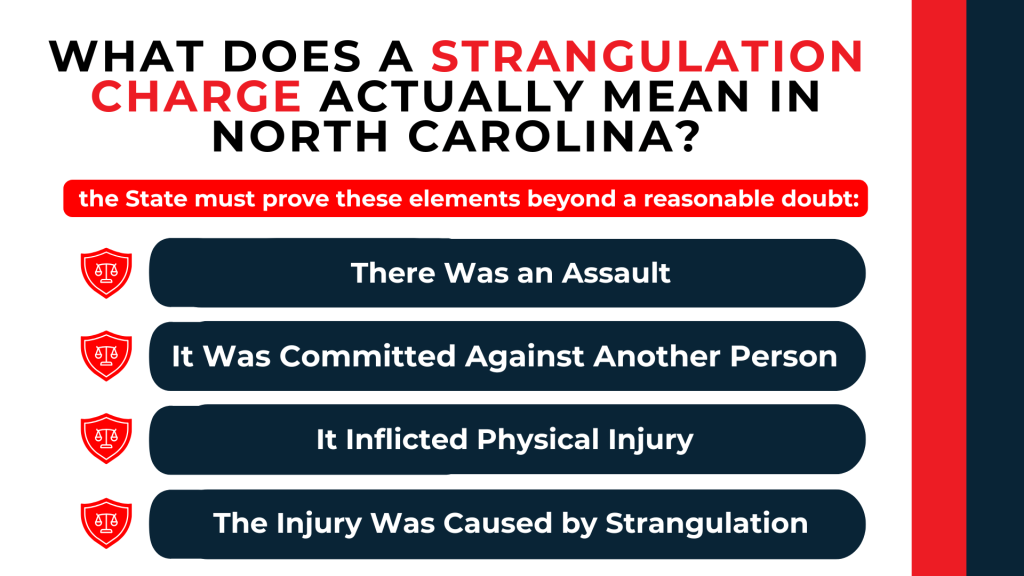
Shield icons list the legal elements prosecutors must prove for a North Carolina strangulation conviction.

Why Is Strangulation a Felony When There's Barely a Mark?

This is usually where the gap between expectation and reality hits hardest. Someone expecting a misdemeanor domestic violence charge learns they are facing a felony, and the reason is the physical injury threshold under this statute.

The physical injury required for a strangulation conviction is not "serious injury" and not "serious bodily injury." It is simply "physical injury." The parallel definition in G.S. § 14-34.7(c) explains this standard: cuts, scrapes, bruises, or other physical injury that does not constitute serious injury. North Carolina courts have found sufficient physical injury from cuts and bruises, petechiae (small broken blood vessels in the eyes or skin), redness, soreness, blurred vision, and difficulty swallowing. Courts have also recognized that physical injury may exist even where no injuries are externally visible.

To put that in context, consider where strangulation sits on North Carolina's assault severity ladder. Simple assault is a Class 2 misdemeanor with no felony injury element. Assault inflicting serious injury is a Class A1 misdemeanor requiring a higher injury showing. Assault by strangulation jumps to a Class H felony while requiring only "physical injury" — the lowest injury standard in the felony range. Above it, assault inflicting serious bodily injury is a Class F felony. That charge requires proof of injury creating a substantial risk of death, serious permanent disfigurement, coma, a permanent or protracted condition that causes extreme pain, permanent or protracted loss or impairment of the function of a bodily member or organ, or prolonged hospitalization.

The legislature drew the line where it did deliberately. Strangulation requires only minimal physical evidence for felony treatment because the act itself, not the severity of the resulting injury, is what the statute targets.
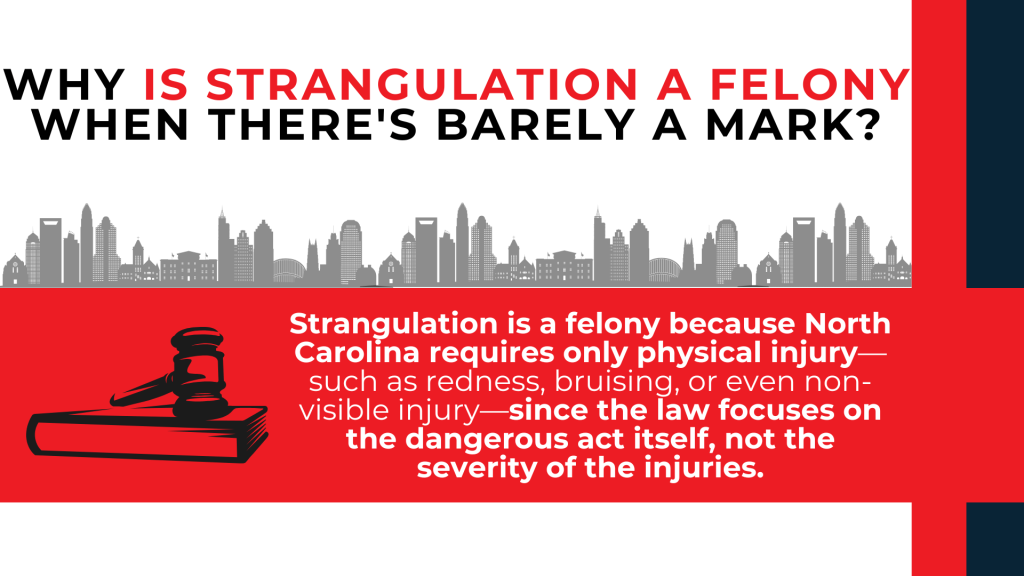
Judge's gavel explains why minor or unseen injuries can still support a felony strangulation charge.

What Kind of Prison Time Does a Class H Felony Carry?

North Carolina sentences felonies under the Structured Sentencing Act, which sets punishment based on two variables: the offense class and the defendant's prior record level. Prior record levels run from Level I (little or no criminal history) to Level VI (extensive history). Each prior Class H or I felony conviction adds 2 points, and each prior Class A1 or Class 1 misdemeanor adds 1 point.

For a Class H felony at Prior Record Level I, the presumptive sentencing range is a 5 to 6 month minimum, with the mitigated range starting at 4 months. At the other end of the spectrum, the absolute statutory maximum for any Class H felony is 39 months, which is a Level VI aggravated sentence. Each cell on the sentencing grid also designates a disposition type: community, intermediate, or active. That designation determines whether the sentence can be served on probation or must be served in custody. Community and intermediate dispositions (both probation-based) are available at lower prior record levels, while active time becomes mandatory at Prior Record Level VI.

Probation conditions in these cases commonly include supervised probation, substance-abuse or domestic-violence treatment, potential periods of short-term confinement, electronic monitoring, and restitution. A fine may also be imposed at the court's discretion.

Across all North Carolina felonies in FY2024, 40% of sentences were active (incarceration), 36% were intermediate, and 24% were community. And it is worth understanding how these cases typically resolve: only about 2% of all North Carolina felony convictions resulted from jury trials in FY2024 — 498 out of 26,577. The vast majority were resolved through guilty pleas. For Class G, H, and I felonies specifically, the jury trial rate drops to roughly 1%. That does not mean trial is off the table, but it does mean the negotiation and preparation that happen before trial often determine the outcome.
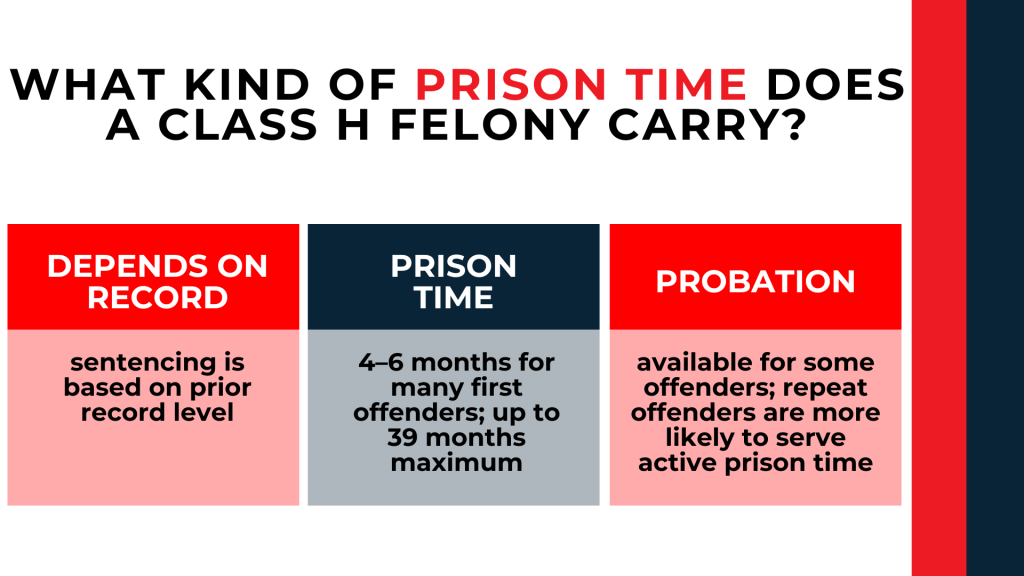
Three panels explain sentencing based on record, possible prison time, and probation eligibility.

How Will a Conviction Affect Your Life After the Case Ends?

A strangulation conviction is a felony conviction, and in North Carolina, the collateral consequences extend well beyond whatever sentence the court imposes.

Firearms. A felony conviction triggers the federal firearms ban under 18 U.S.C. § 922(g)(1), which bars possession of firearms and ammunition. When the offense involves a domestic relationship, the Lautenberg Amendment under 18 U.S.C. § 922(g)(9) imposes a separate lifetime ban on firearms and ammunition. Section 922(g)(8) also bars firearm possession by anyone subject to a qualifying protective order. The 2022 Bipartisan Safer Communities Act expanded domestic-relationship coverage to include dating partners. North Carolina state law under G.S. § 14-415.1 independently bars felons from possessing, purchasing, owning, or controlling firearms.

Immigration. The Fourth Circuit held in U.S. v. Rice, 36 F.4th 578 (4th Cir. 2022), that North Carolina's assault inflicting physical injury by strangulation is categorically a crime of violence. United States v. Robinson, 92 F.4th 531 (4th Cir. 2024), confirmed that holding remains binding. The immigration consequences that result from this classification are severe. The offense can be treated as an aggravated felony under 8 U.S.C. § 1101(a)(43)(F) when a sentence of one year or more is imposed. For immigration purposes, a felony's maximum term is what matters. That means even a suspended sentence can trigger this classification. It is separately deportable as a crime of domestic violence under 8 U.S.C. § 1227(a)(2)(E) when committed against a victim in a qualifying domestic relationship. This distinguishes strangulation from simple assault or assault on a female, which the Fourth Circuit has held are not crimes of violence because they can be committed through mere culpable negligence.

Professional licensing. Under G.S. § 93B-8.1, a North Carolina licensing board may deny a license based on a conviction. The board can act when the criminal history is directly related to the occupation's duties, or when the crime is violent or sexual in nature. An assault-by-strangulation conviction fits the latter category. The Nursing Practice Act, for example, expressly lists Article 8 assaults — which includes § 14-32.4 — among offenses related to fitness to practice.

Criminal record. This conviction is generally not eligible for expunction under current North Carolina law and makes you ineligible for other expungements that might otherwise be available.

The sentence itself may end. These consequences, in most cases, do not.
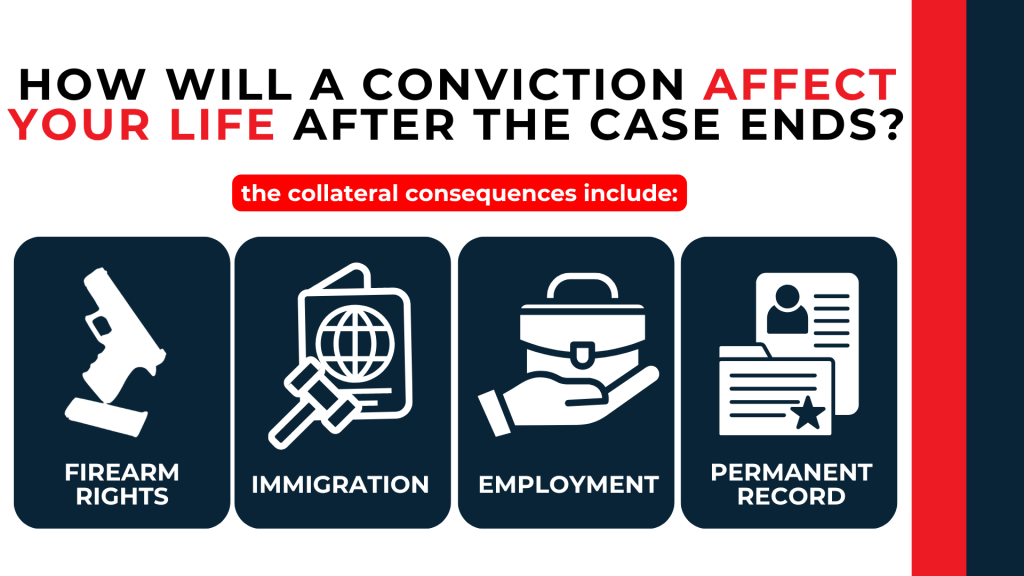
Four icons show lasting effects on firearm rights, immigration, employment, and permanent criminal record.

What Defenses Work Against a Strangulation Charge?

The realistic options depend entirely on the facts, and understanding which defenses actually apply to this specific charge matters.

Self-defense and defense of others. North Carolina's self-defense statute, N.C.G.S. § 14-51.3, authorizes the use of force — including in defense of another person — when the person reasonably believes the force is necessary to defend against the imminent use of unlawful force. North Carolina imposes no duty to retreat from any place a person is lawfully present. The same statute authorizes deadly force where a person reasonably believes it is necessary to prevent imminent death or great bodily harm.

The critical requirements are imminence and proportionality. The threat must be happening or about to happen — not something that occurred earlier or might happen later. The force used must also be proportionate to the threat as it existed at the moment. In a strangulation prosecution, the practical question is whether your actions were a proportionate, necessary response to an imminent threat you reasonably perceived.

Challenging the elements. Because "strangulation" and "physical injury" are undefined in the statute and interpreted through case law, there is room to challenge both elements. The two challenges that most often matter are whether the pressure applied actually constituted strangulation as opposed to incidental neck contact, and whether any qualifying physical injury resulted. Both challenges are heavily evidence-driven. Photographs of the neck and surrounding area, the complainant's testimony about pain or difficulty breathing, medical records, and any petechiae evidence all factor in. Evidence preservation and early investigation directly affect the strength of these challenges.

What typically does not work. Assault by strangulation is a general-intent crime. The Fourth Circuit confirmed in Rice that the offense requires intentional, knowing, or purposeful conduct. But the prosecution does not need to prove you intended a specific injury. Intent is shown by deliberate rather than accidental conduct. Because it is a general-intent offense, voluntary intoxication is essentially unavailable as a defense under North Carolina law. Even in the rare cases where voluntary intoxication applies to specific-intent crimes, you would need to show you were utterly incapable of forming intent — not merely impaired or intoxicated.

The strength of any defense depends on facts that can shift or disappear quickly. Witness recollections change. Physical evidence fades. The earlier the facts are investigated and preserved, the more options remain available.
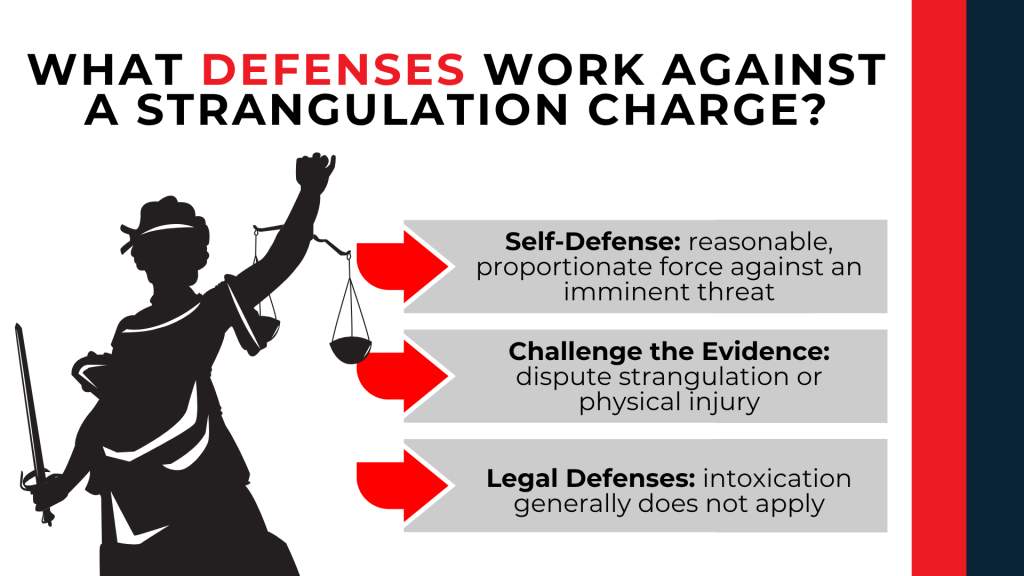
Lady Justice silhouette highlights self-defense, evidence challenges, and legal defenses to strangulation charges.

Do I Need a Lawyer for a Strangulation Charge?

A Class H felony with potential prison time, a permanent criminal record, federal firearms restrictions, possible immigration consequences, and professional licensing implications is not a charge that resolves favorably on its own. Decisions made in the first days after an arrest — in early interactions with law enforcement and the court — shape the course of the entire case. Many of those decisions happen before you fully understand what you are facing.

Patrick Roberts is a Raleigh criminal defense attorney and former prosecutor who has handled thousands of criminal cases across North Carolina. His experience as an Assistant District Attorney in Wake, Johnston, and New Hanover counties means he understands how strangulation cases are built, charged, and evaluated from the prosecution's side — and where they are vulnerable. He is a graduate of Duke University School of Law (Top 9 in criminal law for year 2026),  Gerry Spence's Trial Lawyers College, the National Criminal Defense College Trial Practice Institute, and the White Collar Criminal Defense College, and has been recognized among the Top 100 Trial Lawyers by The National Trial Lawyers.

Client Review

"I cannot speak highly enough of Mr. Patrick Roberts. From the moment we connected over the phone, he demonstrated confidence, support, and a sharp analytical mind, providing our family with much-needed reassurance during one of the most difficult periods in our lives.

Mr. Roberts took the time to fully understand our situation and walked us through various scenarios regarding how he could defend our case—which he ultimately won. What sets Mr. Roberts apart is his combination of legal expertise, in-depth knowledge of judicial procedures, and genuine compassion for his clients. He goes above and beyond to ensure your needs are met. I am incredibly grateful for his services and highly recommend him to anyone needing legal representation." - Verified client review via Avvo.com

Peer Endorsement

“I have had the challenge of working with Atty Roberts when he served as Asst. District Atty in Wake Co. and have worked closely with him as fellow defense counsel. As an ADA, I found him to be professional, reasonable and fair in every regard. He represented the State of North Carolina with integrity. As private counsel, his intelligence and knowledge of procedure and law has been even more impressive. Attorney Roberts is not your "run of the mill" lawyer. While he's sharp and knows his stuff, he is also approachable and relates well with clients, colleagues, judges and courthouse personnel. He never, never walks away from a challenge. In the courtroom, his experience as both prosecutor and criminal defense attorney provides him with a unique perspective and ability to process each matter he handles quickly, efficiently and effectively. I highly recommend Attorney Roberts and place full confidence in his abilities."  -  Verified peer endorsement via Avvo.com 

Disclaimer: Testimonials and peer reviews are actual comments from clients and peers. They are for informational purposes only and do not guarantee or predict the outcome of your legal matter. Every case is unique and must be evaluated on its own merits. 

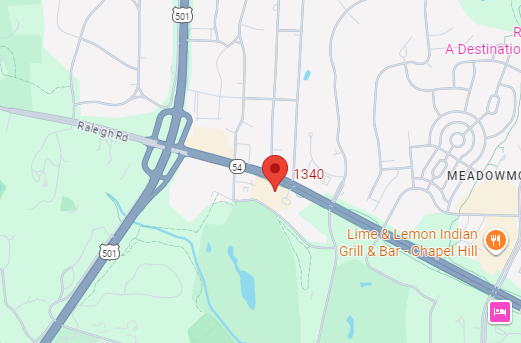
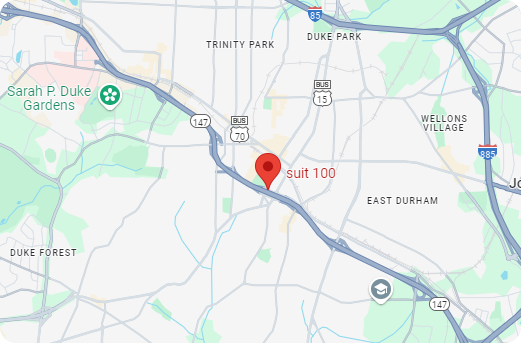
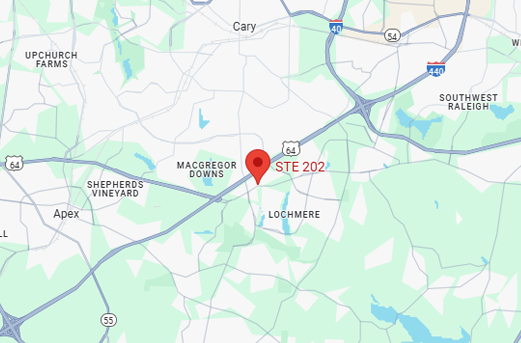
Patrick Roberts Law serves clients facing strangulation and domestic violence charges throughout the Triangle, with offices in Raleigh, Durham, Chapel Hill, and Cary. He maintains a dominant presence in Wake County—including Raleigh, Cary, Apex, Holly Springs, Garner, and Fuquay-Varina—while handling critical litigation in all North Carolina counties.

If you or someone close to you is facing a strangulation charge, the time to act is now — not after the next court date. Call Patrick Roberts Law at 919-746-7206 to discuss your case.

To maintain a high standard of service and thorough oversight for each client, the firm manages a restricted caseload.
Disclaimer: The information on this website is for general informational purposes only. Nothing herein should be taken as legal advice for any individual case or situation. Contacting us via this website, email, or contact form does not create an attorney-client relationship. Case results depend on a variety of factors unique to each case; prior results do not guarantee a similar outcome.


Posted in:

Related Posts

Police handcuff a person beside title introducing assault by strangulation charges in North Carolina.

Assault by Strangulation in North Carolina — What You're Actually Facing

Assault by strangulation is a Class H felony in North Carolina under N.C.G.S. § 14-32.4(b). It is not a misdemeanor, not a lesser assault charge, and not something the court system treats as a routine domestic dispute. It is a standalone felony offense. A conviction carries up to 39 months in prison, a permanent criminal record, and collateral consequences that follow you for life. more Many people searching for information about this charge don't yet realize how broadly North Carolina defines strangulation, how little injury the prosecution actually needs to prove, or how far the consequences extend beyond the sentence itself. This page covers what the statute requires, what the prosecution has to show, what the sentencing exposure looks like, what a felony conviction means for your future, and how these charges can be challenged. What Is Assault by Strangulation Under North Carolina Law? Under N.C.G.S. § 14-32.4(b), a person who assaults another person and inflicts physical injury by strangulation is guilty of a Class H felony, unless the conduct falls under another statute that provides greater punishment. The legislature created this offense as a distinct category because it treats strangulation as inherently dangerous conduct — dangerous enough to warrant felony treatment even when the physical injuries are relatively minor. This is a critical distinction. If you are charged under this statute, you are not facing an elevated misdemeanor or a simple assault with added facts. You are facing a felony — with everything that comes with a felony conviction in North Carolina. The charge applies regardless of the relationship between the parties. N.C.G.S. § 14-32.4(b) does not vary the offense class based on whether the accused and the alleged victim are in a domestic relationship, are strangers, or fall anywhere in between. While many strangulation charges arise in a domestic context, the statute itself is relationship-neutral. What Does the Prosecution Have to Prove? A conviction under N.C.G.S. § 14-32.4(b) requires the State to prove four elements: that there was an assault, that the assault was on another person, that the assault inflicted physical injury, and that the physical injury was caused by strangulation. Two of those elements — "strangulation" and "physical injury" — are not defined anywhere in the statute itself. How North Carolina courts have interpreted them is where most people's understanding falls short. The North Carolina Pattern Jury Instruction (N.C.P.I.—Crim. 208.61) defines strangulation as a form of suffocation characterized by closure of the blood vessels and/or air passages of the neck as a result of external pressure on the neck, whether brought about by hanging, a cord or similar object, or the manual assertion of pressure. What the instruction does not require is proof of complete airway closure or a complete inability to breathe. Evidence that sufficient pressure was applied to the throat to cause difficulty breathing is enough. That means the State does not need to prove that anyone lost consciousness, that the airway was fully blocked, or that the situation reached the level of severity many people associate with the word "strangulation." Pressure on the neck that restricts breathing, even partially, can satisfy the element. The physical injury threshold is equally low. The statute requires only "physical injury," which North Carolina courts and the UNC School of Government have interpreted using the related definition in G.S. § 14-34.7(c): cuts, scrapes, bruises, or other physical injury that does not constitute serious injury. Courts have found sufficient physical injury based on bruising, redness, petechiae (small broken blood vessels in the eyes or skin), soreness, blurred vision, and difficulty swallowing. Critically, courts have also recognized that physical injury may exist even where no injuries are externally visible. The complainant's testimony about pain, difficulty breathing, or other symptoms can be enough on its own. This is the knowledge gap that catches most people off guard. The prosecution does not need dramatic injuries. The bar is deliberately set low because the legislature intended the act of strangulation itself, paired with any physical consequence, to carry felony weight. This is also a general-intent crime. In U.S. v. Rice, 36 F.4th 578 (4th Cir. 2022), the court held that assault by strangulation under this statute can only be committed with an intentional, knowing, or purposeful state of mind. The court reasoned that a person cannot strangle someone without knowing or intending it. The prosecution does not need to prove you intended a specific injury. It only needs to prove the conduct was deliberate rather than accidental. What Are the Penalties for a Conviction? Assault by strangulation is sentenced under North Carolina's Structured Sentencing Act. The sentence is determined by two factors: the offense class (Class H) and your prior record level. Prior record level ranges from Level I to Level VI based on a point system that assigns points for prior convictions. Each prior Class H or I felony adds two points, and each prior Class A1 or Class 1 misdemeanor adds one point. At Prior Record Level I — a person with minimal or no criminal history — the presumptive sentencing range is a minimum of 5 to 6 months, with the mitigated range starting at 4 months. The absolute statutory maximum for any Class H felony is 39 months, which is a Level VI aggravated sentence. At lower prior record levels, community punishment (probation) and intermediate punishment (probation with additional conditions like electronic monitoring or short-term confinement) are available sentencing options. Active prison time becomes mandatory at Prior Record Level VI. Probation conditions in cases involving domestic circumstances can include supervised probation, electronic monitoring, substance-abuse treatment, completion of an abuser-treatment program under G.S. § 15A-1343(b)(12), restitution, and a fine at the court's discretion. If you are facing this charge in a domestic context, there is an immediate procedural reality you need to understand. Under N.C.G.S. § 15A-534.1, if you are arrested for a crime of domestic violence, you can be held for up to 48 hours before a judge sets pretrial release conditions. Unlike most arrests where a magistrate can set bond quickly, this statute sends pretrial release decisions to a judge. That judge may set conditions including a secured appearance bond, no-contact provisions, and orders to stay away from the alleged victim's home, school, and workplace. Roughly 98 percent of North Carolina felony convictions result from guilty pleas rather than jury trials. The jury trial rate for Class H felonies sits around one percent. That means the decisions made early in a case, including at the pretrial stage, carry enormous weight in shaping how the case turns out. What Happens to Your Record and Your Life After a Felony Conviction? The sentence is only part of what a conviction means. A Class H felony conviction for assault by strangulation triggers consequences that extend well beyond the courtroom and, in many cases, last permanently. A felony conviction imposes a federal firearms ban under 18 U.S.C. § 922(g)(1) and a state ban under G.S. § 14-415.1, preventing you from possessing, purchasing, or owning firearms. In cases involving a domestic relationship, the Lautenberg Amendment under 18 U.S.C. § 922(g)(9) can independently impose a lifetime ban on firearms and ammunition. A qualifying domestic violence protective order triggers its own separate federal firearms ban under § 922(g)(8). For noncitizens, the consequences can be even more severe. The Fourth Circuit held in U.S. v. Rice, 36 F.4th 578 (4th Cir. 2022), that North Carolina's assault by strangulation is categorically a "crime of violence." United States v. Robinson, 92 F.4th 531 (4th Cir. 2024), confirmed that holding still applies. That classification means a conviction can be treated as an aggravated felony under federal immigration law when a sentence of one year or more is imposed. For immigration purposes, a suspended sentence counts. The result can be mandatory detention and near-automatic deportation. When the offense involves a victim in a qualifying domestic relationship, it separately qualifies as a deportable crime of domestic violence under 8 U.S.C. § 1227(a)(2)(E), which carries no minimum sentence requirement at all. A conviction also creates professional licensing risks. Under G.S. § 93B-8.1, North Carolina licensing boards can deny a license when a conviction is directly related to the occupation or involves a crime that is violent or sexual in nature. A crime of violence categorization clearly fits within that standard. Finally, an assault by strangulation conviction is generally not eligible for expungement under current North Carolina law. It also makes you ineligible for expungement of other offenses. The record is, for practical purposes, permanent. Can Assault by Strangulation Charges Be Fought? Yes — but the path depends entirely on the facts, and the facts need to be examined early. The most common areas of real dispute in strangulation cases involve challenging the two elements the statute leaves undefined. The first is whether what happened actually constituted strangulation. The question is whether sufficient pressure was applied to the neck to meet the legal definition, as opposed to accidental contact, grabbing, or a struggle that involved the neck area without the kind of sustained external pressure the pattern jury instruction describes. The second is whether any physical injury actually resulted, particularly in cases where there are no visible marks, no medical treatment, and the State's evidence consists primarily of the complainant's testimony. Both of these questions are heavily fact- and evidence-driven. Photographs taken at the scene or shortly after, medical records, the presence or absence of petechiae, the complainant's statements to law enforcement versus later testimony, and any conflicting accounts from witnesses all directly affect whether the prosecution can prove these elements beyond a reasonable doubt. Self-defense is the primary affirmative defense available under N.C.G.S. § 14-51.3. North Carolina law authorizes a person to use non-deadly force when and to the extent the person reasonably believes it is necessary to defend against another person's imminent use of unlawful force. There is no duty to retreat — a person who is lawfully present in any location may stand their ground. The same standards apply to the defense of another person under the same statute. The limits are imminence and proportionality. The threat being defended against must be imminent, not speculative, not future, and not already concluded. The force used must be proportionate to the threat as it existed at the moment force was applied. Grossly disproportionate force can defeat the claim even where the initial threat was real. In a strangulation prosecution, the practical question is whether the physical contact with the neck was a proportionate, necessary response to an imminent threat you reasonably perceived. The evidence must support that account. One defense that is generally not available is voluntary intoxication. Because assault by strangulation is a general-intent crime, North Carolina law does not permit voluntary intoxication as a defense. The court in State v. Tadlock, 299 N.C. App. 754 (2025), affirmed that even evidence of heavy drinking does not entitle a defendant to a voluntary intoxication instruction. The court found that the defendant's purposeful conduct showed he was not "utterly incapable" of forming intent. For a general-intent offense like strangulation, this defense is effectively unavailable. Why Do You Need a Defense Attorney Now? Everything about this charge rewards early action and penalizes delay. The 48-hour pretrial hold means bond and release conditions can be set before you have had any meaningful opportunity to consult with a lawyer. The evidence that will make or break the case — photographs of the alleged victim's neck and eyes, medical records, the complainant's initial statements, 911 recordings, body camera footage — begins to take shape in the first days after an arrest. Once the State's narrative is locked in, challenging it becomes significantly harder. The collateral consequences outlined above also mean that the difference between a conviction and another outcome is not just a matter of months served. It is the difference between a permanent felony record with firearms prohibitions, potential immigration consequences, and licensing barriers — and the possibility of a reduced charge, a dismissal, or an acquittal that avoids those outcomes entirely. Patrick Roberts is a Raleigh criminal defense attorney and former Assistant District Attorney in Wake, Johnston, and New Hanover counties. That prosecutorial background matters in strangulation cases specifically because he understands how the State builds these cases from the inside — what evidence prosecutors rely on, where the weaknesses tend to be, and how charging decisions get made. He is a graduate of Gerry Spence's Trial Lawyers College and the National Criminal Defense College Trial Practice Institute, with more than 24 years of experience and thousands of criminal cases handled across North Carolina. Patrick Roberts Law PLLC serves clients from offices in Raleigh, Durham, Chapel Hill, and Cary. His legal practice spans all North Carolina counties for high-stakes litigation, with a concentrated defense practice in Wake County—including Raleigh, Cary, Apex, Holly Springs, Garner, and Fuquay-Varina. Client Review “Patrick Roberts represented my son and we were blessed to meet such a God send. From the first meeting until present, Mr. Roberts has been transparent and thorough about every possible outcome. With his confidence and experience in criminal law, Mr. Roberts is able to give you the best outcome possible. I highly recommend Mr. Roberts he’s outstanding.” - Verified client review via Avvo.com Peer Endorsement “Patrick is a thoughtful and experienced attorney. When I have a client needing representation in the Raleigh area in his areas of practice, he would be my referral of choice ” - Verified peer endorsement via Avvo.com Disclaimer: Testimonials and peer reviews are actual comments from clients and peers. They are for informational purposes only and do not guarantee or predict the outcome of your legal matter. Every case is unique and must be evaluated on its own merits. If you are facing an assault by strangulation charge in North Carolina, or if someone close to you has been arrested, contact Patrick Roberts Law to discuss the case. To preserve high standards of diligence and thorough management, the firm strictly regulates its active case volume. Disclaimer: The information on this website is for general informational purposes only. Nothing herein should be taken as legal advice for any individual case or situation. Contacting us via this website, email, or contact form does not create an attorney-client relationship. Case results depend on a variety of factors unique to each case; prior results do not guarantee a similar outcome.

Attorney consultation introduces assault on a female charges in North Carolina with law firm branding.

Assault on a Female in North Carolina: What You're Actually Facing

Assault on a female in North Carolina is a Class A1 misdemeanor under N.C. Gen. Stat. § 14-33(c)(2) — the most serious misdemeanor classification the state has. It carries up to 150 days in jail, but the jail time is not the part of this charge that changes lives. The collateral consequences — what happens to your record, your firearms rights, your custody situation, and your employment — are what most people never see coming until it's too late to get ahead of them. more This page covers what the charge actually means under NC law and what the realistic penalties and long-term consequences look like. It also explains what a criminal defense attorney can do to affect the direction of a case. What Is "Assault on a Female" Under North Carolina Law? North Carolina does not have a single "domestic violence" crime on the books. Instead, prosecutors charge domestic-violence-related conduct through a patchwork of general assault statutes. Assault on a female is the one they reach for most often. In 2015 alone, North Carolina district courts reported 29,483 assault-on-a-female and assault-by-strangulation charges filed statewide. The statute is narrow in who it covers and broad in what conduct qualifies. Under § 14-33(c)(2), the charge requires three things: the defendant is male, the defendant is 18 years of age or older, and the alleged victim is female. That's it. There is no requirement that the parties have a romantic or domestic relationship. There is no requirement that the alleged victim suffered an injury. NC assault is a common-law offense that can be committed without the use of physical force — including through culpable negligence. Because of that, the range of conduct that can support a charge is broader than most people expect. This is not a simple assault charge with a different label. Simple assault under § 14-33(a) is a Class 2 misdemeanor. Assault on a female is a Class A1 misdemeanor. That single classification difference has serious effects on sentencing exposure, the permanent record it creates, and the federal consequences it can trigger. How Is This Charge Different From Simple Assault? The difference between simple assault and assault on a female is not about what happened. It is about the statutory classification that attaches based on who the parties are, and that classification determines everything downstream. Simple assault is a Class 2 misdemeanor. The maximum sentence is 60 days. Assault on a female is a Class A1 misdemeanor — two full classification levels higher — with a maximum sentence of 150 days. Under North Carolina's structured sentencing system, the gap between these two classifications is not just a matter of days in jail. It changes the type of punishment a judge can impose and the prior-record points the conviction adds to any future charges. It also changes how the conviction interacts with federal law. A Class A1 misdemeanor is the only misdemeanor class in North Carolina for which a judge can impose an active jail sentence regardless of whether you have any prior criminal record. For a Class 2 simple assault, if you're a first-time offender, you're generally looking at community punishment — supervised or unsupervised probation. For a Class A1 assault on a female, active time is on the table from the start. What Kind of Sentence Could I Get? North Carolina uses a structured sentencing system. That means punishment for any offense is determined by the combination of the offense class and your prior criminal record. For a Class A1 misdemeanor, the sentencing grid works across three prior-conviction levels. If you have no prior convictions, you face a sentencing range of 1 to 60 days. If you have five or more prior convictions, you face a range of 1 to 150 days. The middle tier falls between those two endpoints. Within each range, the judge chooses between community punishment (probation), intermediate punishment (probation with more restrictive conditions like supervised probation or electronic monitoring), or active punishment (jail time). The data shows that most misdemeanor defendants in North Carolina do not go to jail. According to the NC Sentencing and Policy Advisory Commission, 68% of misdemeanor sentences statewide in FY2024 were community punishment, meaning probation rather than active jail time. Only 29% received active jail time. For those who did receive active time on a Class A1 misdemeanor, the average sentence was 66 days. But probation in a domestic violence case is not the same as probation for a shoplifting charge. Under N.C. Gen. Stat. § 15A-1343(b)(12), if you are found responsible for acts of domestic violence, you must attend and complete an approved abuser-treatment program as a condition of probation. The only exception is if the court specifically finds it is not in the interests of justice. These are not anger management classes. Approved programs require 39 hours of group treatment, completed over 26 to 30 weeks, in groups of no more than 16 participants. As of 2026, only 34 programs operate across 65 North Carolina counties. That means 35 counties have no program at all, which can create practical burdens that follow you for months. What Are the Consequences Beyond the Sentence? The sentence a judge hands down is only one layer of what an assault on a female conviction does to your life. The collateral consequences — the ones that operate outside the courtroom — are often more severe and longer-lasting than any jail time. Firearms. This is the area where North Carolina's assault statutes interact with federal law in ways that are both serious and legally complex. Under 18 U.S.C. § 922(g)(9), a person convicted of a "misdemeanor crime of domestic violence" as defined by federal law faces a generally permanent ban on possessing firearms or ammunition. However, the Fourth Circuit held in United States v. Vinson, 805 F.3d 120 (4th Cir. 2015), that ordinary North Carolina assault — including assault on a female under § 14-33(c)(2) — does not categorically qualify as a federal misdemeanor crime of domestic violence. The reason is that NC assault can be committed through culpable negligence rather than the intentional use of physical force that the federal definition requires. That does not mean firearms consequences disappear. A Domestic Violence Protective Order is often issued alongside the case, since the DVPO runs on a separate civil track from the criminal charge. If one is issued, 18 U.S.C. § 922(g)(8) bars firearm possession for as long as the qualifying order remains in effect. North Carolina law under § 50B-3.1 separately requires you to surrender firearms, ammunition, and permits to the sheriff when the court makes certain findings in the DVPO, such as a finding that you used or threatened to use a deadly weapon. Possessing a firearm in violation of the order is a Class H felony under § 14-269.8. It is also worth noting that the General Assembly passed N.C. Gen. Stat. § 14-32.5 — the misdemeanor crime of domestic violence statute, effective December 1, 2023 — specifically to close the gap that Vinson created. Convictions under that newer statute are designed to categorically trigger the federal firearms ban. How the charging decision is made between § 14-33(c)(2) and § 14-32.5 can have lasting consequences for firearms rights. That is one reason the early involvement of a defense attorney matters. Child custody. Under N.C. Gen. Stat. § 50-13.2, courts are required to consider acts of domestic violence between the parties when making custody decisions. The court must also issue written findings on this factor. A conviction for assault on a female does not automatically result in a loss of custody. But it gives the other parent a powerful piece of evidence in any current or future custody proceeding, and courts take it seriously. The North Carolina Court of Appeals confirmed in Jordao v. Jordao, 273 N.C. App. 543 (2020), that trial courts must evaluate all relevant factors, including domestic violence, with written findings supporting the best-interest-of-the-child decision. Immigration. For anyone who is not a U.S. citizen, the immigration consequences of a domestic-violence-related conviction can be more severe than the criminal sentence itself. Under INA § 237(a)(2)(E), a noncitizen is deportable for a conviction of a crime of domestic violence, stalking, or child abuse. Separately, a judicial finding of a protective-order violation can trigger deportability even without a criminal conviction at all. Immigration courts use categorical and circumstance-specific approaches to evaluate these convictions, and those approaches involve their own body of case law. A criminal defense strategy that ignores immigration consequences can produce a result that technically resolves the state charge but devastates your ability to remain in the country. Employment. A Class A1 misdemeanor conviction appears on criminal background checks. If you work in a regulated profession, the impact of a visible conviction on your professional standing can be serious. This is something to evaluate with an attorney before any plea is entered. Can a Lawyer Actually Change the Outcome?* A criminal defense attorney does not make a charge disappear by showing up. What an attorney does is identify the specific weaknesses in the state's case and develop a strategy that accounts for the full range of consequences — criminal, civil, and collateral. The goal is to make sure you are not making decisions in the dark. In assault on a female cases, the state's evidence often hinges on the testimony of a single witness — the alleged victim. There may be no independent witnesses, no physical evidence of injury, and no video. The circumstances leading to the arrest may involve a mutual argument where the question of who was the aggressor is genuinely in dispute. North Carolina law recognizes self-defense as a justification for the use of force, and where the facts support it, that defense can be raised. Beyond the facts of the incident itself, a defense attorney evaluates whether the elements of the charge are actually met and whether the arrest and charging decisions were handled properly. The attorney also looks at whether there is room to negotiate a resolution that avoids the most damaging consequences. Assault on a female is a misdemeanor that moves on a faster timeline than felony cases. The median time to sentencing for felonies in superior court was 11 months in FY2024, while district court cases resolve much sooner. That shorter window means the opportunity for early intervention is limited. But it also means that an attorney who gets involved early can influence the case before it picks up momentum. The distinction between a conviction and a dismissal, or between a plea to the original charge and a negotiated reduction, is not academic. It determines whether the firearms consequences attach, whether a custody court sees a domestic violence conviction in the record, and whether an immigration court treats the disposition as a deportable offense. How Quickly Do I Need to Act? The consequences described on this page — a permanent criminal record, potential firearms restrictions, custody implications, immigration exposure — do not wait for a trial date to start taking shape. They are determined by decisions made early: how the charge is challenged, whether a plea is entered and to what, and whether the collateral consequences are accounted for before a disposition goes on the record. Patrick Roberts is a Raleigh criminal defense attorney and former Assistant District Attorney who has handled thousands of criminal cases across North Carolina. His practice at Patrick Roberts Law is based in Raleigh, with additional offices in Durham, Chapel Hill, and Cary. He offers comprehensive legal representation across every county in North Carolina for high-stakes cases, maintaining a core geographic focus on Wake County communities like Raleigh, Cary, Apex, Holly Springs, Garner, and Fuquay-Varina. If you are facing this charge, the consultation is where the defense begins. Client Review “Mr. Roberts was amazing! Had a very difficult case & the outcome didn’t look bright at all. I was looking at some serious time. But he was able to get me probation (which wasn’t on the table at all before he got involved) He was honest, to the point & laid out everything that could be a possibility. Never gave false hope, just the facts & logically what we could do to possibly get this in my favor. I would recommend Mr. Roberts to anyone seeking REAL guidance, honesty & qualifications to back it up.” - Verified client review via Avvo.com Peer Endorsement “I have known Patrick for years and have always been struck by his knowledge and dedication. I endorse him without hesitation or qualification.” - Verified peer endorsement via Avvo.com Disclaimer: Testimonials and peer reviews are actual comments from clients and peers. They are for informational purposes only and do not guarantee or predict the outcome of your legal matter. Every case is unique and must be evaluated on its own merits. Through a selective intake process, the firm caps its active case volume to protect the quality and pace of its legal oversight. Disclaimer: The information on this website is for general informational purposes only. Nothing herein should be taken as legal advice for any individual case or situation. Contacting us via this website, email, or contact form does not create an attorney-client relationship. Case results depend on a variety of factors unique to each case; prior results do not guarantee a similar outcome.

Person covering face during accusation introduces guidance for false domestic violence allegations in North Carolina.

Falsely Accused of Domestic Violence in North Carolina — What to Do Right Now

A false domestic violence accusation can lead to an arrest, a protective order, and criminal charges before you ever get to tell your side of the story. In North Carolina, the legal system is built to move quickly once an accusation is made. It often moves before any independent investigation takes place — and before you have any meaningful opportunity to respond. more That speed is exactly why the decisions you make in the first days after an accusation matter so much. This page covers the mistakes that turn a defensible case into a disaster, why false accusations happen and how a defense attorney fights them, and what's at stake if you don't act. Can I Really Be Arrested Based on Nothing but Their Word? The short answer is that the system is designed to act first and sort out the truth later. North Carolina's domestic violence procedures — the 48-hour pretrial hold, the ex parte protective order process, the special release conditions — all operate up front, before you have any meaningful opportunity to respond. The question of whether the accusation is true gets resolved in court, with evidence, in front of a judge or jury. But the arrest, the booking, and the initial restrictions on your freedom happen first. That reality is difficult to accept, especially when you know the accusation is false. But understanding it is the first step toward responding effectively rather than reactively. What Should I Do (and Not Do) If I've Been Falsely Accused? The gap between people who successfully defend against false accusations and people who don't is almost always about what they did in the first days after the accusation — before the legal process had a chance to work. Get an attorney immediately. Not after you've talked to the police. Not after you've tried to sort things out with the accuser. Before either of those things. A defense attorney can intervene at the pretrial stage, advise you on protective order hearings, and begin building your defense while the evidence is fresh. Preserve everything. Text messages, voicemails, emails, social media messages, call logs, photographs, receipts, GPS data, security camera footage — anything that documents your whereabouts, the accuser's statements or behavior, or the timeline of events. Digital evidence disappears. Preserve it now, before it's deleted or overwritten. Comply with every court order completely. If a no-contact order or protective order has been issued, follow it to the letter. Even if you believe the order is unjust. Compliance is not an admission that the accusation is true. It is what keeps you from catching a second criminal charge while you fight the first one. Do not contact the accuser. Not to explain. Not to apologize. Not to ask them to drop the charges. Any contact can be used against you. And if a no-contact order is in place, any contact is a separate crime under N.C. Gen. Stat. § 50B-4.1. Do not talk to law enforcement without your attorney present. You will not talk your way out of this at the police station. Anything you say — including statements you believe are helpful to your defense — becomes evidence the prosecution controls. Do not post about the situation on social media. Not vaguely. Not specifically. Not to your close friends list. Prosecutors and opposing counsel check social media. Posts made in frustration have a way of being turned into evidence of anger, instability, or consciousness of guilt. Why Would Someone Make a False Domestic Violence Accusation? Defense attorneys who handle these cases see the same patterns repeatedly, and understanding those patterns is part of how a defense is built. What if the accusation is really about custody or divorce? A domestic violence accusation — and especially a protective order — can shift the balance in a custody dispute overnight. Under N.C. Gen. Stat. § 50-13.2(a), courts are required to consider acts of domestic violence as a factor in the best-interest determination for child custody. An accusation, even an unproven one, introduces that consideration into the case and can restrict your access to your children while the matter is pending. Retaliation after a breakup. When a relationship ends badly, a false accusation can serve as a way to maintain control. It can remove you from a shared home, trigger a no-contact order that cuts off communication, and create legal consequences that put you on the defensive. Gaining sole possession of a shared residence. An ex parte protective order can require you to leave a shared home immediately — before any hearing on the merits. For someone who wants the other person out, an accusation is the fastest route. What if the accuser was actually the aggressor? In some cases, the accuser is the person who was actually aggressive. They file first to control the story before you have a chance to report what really happened. None of this means every domestic violence accusation is false. It means these motives exist, defense attorneys know how to identify them, and evidence of motive is relevant to your defense. How Does a Defense Attorney Actually Fight a False DV Charge? The prosecution bears the burden of proving every element of the charge beyond a reasonable doubt. "Their word against yours" is not a legal standard — it is a starting point that thorough defense work can dismantle. Here's what that work looks like. Inconsistencies in the accuser's account. A false accusation has to be fabricated, and fabricated stories change. The initial 911 call, the statement to responding officers, the written statement at the magistrate's office, the testimony at the protective order hearing, and the testimony at trial are all separate opportunities for the accuser's story to shift. A defense attorney obtains and compares each version, identifying contradictions in the sequence of events, the description of the alleged assault, the location of alleged injuries, and the timeline. Absence of physical evidence. If the accusation describes an assault that should have produced injuries, marks, or damage to the scene — and none exists — that gap is evidence. Photographs taken at the time of the arrest, body camera footage from responding officers, and medical records (or the absence of medical treatment) all help show whether the alleged assault actually occurred. Digital evidence. Text messages and social media communications from the accuser — before and after the alleged incident — are often the most powerful evidence in false accusation cases. Messages that are friendly, romantic, or routine in tone minutes or hours after the alleged assault undermine the accusation. Messages that reveal a motive — threats to "ruin" you, discussions of custody strategy, statements to friends about the plan — can be devastating to the prosecution's case. What if the timeline proves I wasn't there? Cell phone location data, GPS records, security camera footage, credit card transactions, and witness testimony can establish where both parties were at the time of the alleged offense. When the timeline doesn't support the accusation, the case weakens significantly. Witness testimony. A defense attorney will identify and interview several types of witnesses. That includes people who were present during or immediately after the alleged incident, people who observed the accuser's demeanor or heard the accuser's statements, and people who can speak to the accuser's motive or pattern of behavior. 911 call analysis. The 911 recording — tone, specific language, what the caller does and does not say, background noise — is often the first and least rehearsed version of the accusation. It can reveal whether the call sounds like a genuine report of violence or a performance designed to create a record. The point is not that any single piece of evidence wins the case. It's that false accusations, by definition, are not supported by reality — and a thorough investigation can expose the gaps between the accusation and what actually happened. What's at Stake If I Don't Fight This? A Class A1 misdemeanor is the most common DV charge class. The direct sentencing range for a conviction is 1 to 60 days with no prior convictions, up to 1 to 150 days with five or more priors. Most misdemeanor DV defendants in North Carolina receive community punishment rather than active jail time. Statewide, 68% of misdemeanor sentences in FY2024 resulted in community (probation) punishment. But the jail time is not the real threat. The collateral consequences of a domestic violence conviction extend far beyond the sentence and, in some cases, are permanent. Federal firearms ban. A conviction under N.C. Gen. Stat. § 14-32.5 — the misdemeanor crime of domestic violence statute — triggers a generally permanent ban on possessing firearms or ammunition under 18 U.S.C. § 922(g)(9). Separately, being subject to a qualifying DVPO that includes a credible-threat finding triggers a firearms ban under 18 U.S.C. § 922(g)(8) for as long as the order remains in effect. If you own firearms, hunt, or work in any field that requires you to carry a weapon, this consequence alone can reshape your life. Custody. Under N.C. Gen. Stat. § 50-13.2(a), courts must consider acts of domestic violence and the safety of the child and parties as factors in the best-interest determination for custody. The court must support this determination with written findings of fact. A DV conviction — or even a DVPO — introduces this factor into any current or future custody proceeding and can be used to justify restricted visitation or supervised contact. Immigration consequences. For non-citizens, a domestic violence conviction can trigger deportability under INA § 237(a)(2)(E). The protective-order-violation ground under that same section requires no conviction at all. A judicial finding of a protective order violation is enough to make a non-citizen removable. Will I have to complete an abuser-treatment program? Under N.C. Gen. Stat. § 15A-1343(b)(12), a defendant found responsible for acts of domestic violence must complete an approved abuser-treatment program as a condition of probation. The only exception is if the court specifically finds it not in the interests of justice. These are not anger management classes — approved programs require 39 hours of group treatment completed over 26 to 30 weeks. A criminal record. A domestic violence conviction creates a criminal record that appears on background checks. An attorney can explain how this may affect your specific situation. Every one of these consequences attaches to a conviction. Some attach to a protective order alone, without any conviction at all. Fighting the charge is not optional when these are the stakes. Why Does the Attorney You Choose for This Matter? False domestic violence accusations require a specific kind of defense. The attorney needs to understand how prosecutors evaluate and build DV cases — what evidence they rely on, what weaknesses they overlook, and what leverage exists at each stage of the process. The attorney also needs to be willing to investigate the accuser's credibility and motive aggressively. That means not defaulting to plea negotiation simply because these cases are treated as routine by the system. North Carolina resolved roughly 98% of felony convictions through guilty pleas in FY2024 — only 498 of 26,577 went to a jury. That statistic reflects a system where most cases are resolved through negotiation. The threat of a real trial — prepared by an attorney who actually tries cases — is one of the most powerful tools in your defense. Patrick Roberts is a Raleigh criminal defense attorney and former Assistant District Attorney in Wake, Johnston, and New Hanover counties. That prosecutorial background means he understands how the state builds domestic violence cases from the inside — what they look for, what they assume, and where the case is vulnerable. Attorney Patrick Roberts is a graduate of Gerry Spence's Trial Lawyers College and the National Criminal Defense College Trial Practice Institute, has handled thousands of criminal cases across North Carolina, and has been named among the Top 100 Trial Lawyers by The National Trial Lawyers. Client Review “Have you ever found yourself in a situation and didn’t know who to turn to? That was us when our young adult got into legal trouble for the first time in his life. As parents, we were overwhelmed and scared. We prayed for an experienced criminal defense attorney who would be honest, direct, yet compassionate — and God led us to Patrick Roberts, Esquire. We couldn’t have asked for better representation! Attorney Roberts is well-versed in the law and the Wake County Court System. He’s candid and doesn’t sugarcoat things — which was exactly what we needed. His years of experience exuded a strong sense of confidence. From day one, it was clear that he’s deeply committed to advocating for his clients, no matter how tough the situation. He’s a man of his word and asked us to trust his process.” - Verified client review via Avvo.com Peer Endorsement “His experience as a former prosecutor is invaluable to any client seeking an attorney who knows the ropes. His honesty, integrity, and straightforwardness are qualities every client should seek in an attorney. I would, without hesitation, strongly recommend Mr. Roberts to anyone seeking an outstanding criminal defense lawyer.” - Verified peer endorsement via Avvo.com Disclaimer: Testimonials and peer reviews are actual comments from clients and peers. They are for informational purposes only and do not guarantee or predict the outcome of your legal matter. Every case is unique and must be evaluated on its own merits. Case Review Attorney Roberts’ client was placed under active law enforcement investigation following severe domestic violence allegations made by his spouse. The specific accusation involved non-consensual sexual assault, an offense that carries significant felony penalties and long-term legal consequences in North Carolina. Defense Strategy & Evidentiary Discovery Attorney Patrick Roberts and the defense team initiated an independent investigation to assess the credibility and context of the allegations. During this phase, the defense gathered evidence establishing a clear alternative motive for the accuser's report. Specifically, documentation and contextual facts revealed that the spouse was facing potential deportation and sought to leverage the allegations to alter her immigration status (potentially via legal avenues reserved for victims of crimes, such as a U-visa or VAWA petition). Resolution By presenting this evidence of an ulterior motive directly to the prosecution prior to formal indictments, Attorney Roberts demonstrated substantial credibility issues regarding the state's complaining witness. Following a single strategic meeting with the prosecuting agency, the defense successfully* convinced the State to decline the formal filing of all criminal charges against K.M., terminating the investigation without an arrest or trial. Result: No charges filed* View other case results here. * Disclaimer: Each case is different and must be evaluated separately. Prior results achieved do not guarantee similar results can be achieved in future cases. Patrick Roberts serves clients from offices in Raleigh, Durham, Chapel Hill, and Cary. If you've been falsely accused of domestic violence, the time to act is now — before the system moves further without your side of the story. He offers comprehensive legal representation across every county in North Carolina for high-stakes cases, maintaining a core geographic focus on Wake County communities like Raleigh, Cary, Apex, Holly Springs, Garner, and Fuquay-Varina. Contact Patrick Roberts Law to schedule a consultation. By managing a restricted number of active cases, the firm ensures comprehensive time and resources are dedicated to every matter. Disclaimer: The information on this website is for general informational purposes only. Nothing herein should be taken as legal advice for any individual case or situation. Contacting us via this website, email, or contact form does not create an attorney-client relationship. Case results depend on a variety of factors unique to each case; prior results do not guarantee a similar outcome.