Blog / child grooming

Child Grooming Charges in North Carolina: What the Law Actually Says

Justice scales and gavel beside bold headline explaining how North Carolina law treats child grooming allegations.

Being accused of child grooming in North Carolina is a serious situation, but it helps to understand that "grooming" is not a standalone criminal charge under NC law. Instead, prosecutors charge the underlying behavior using existing statutes that carry significant felony penalties. With more than 200 law enforcement agencies participating in North Carolina's Internet Crimes Against Children (ICAC) Task Force according to the NC State Bureau of Investigation (2025), these investigations are well-funded and aggressively pursued. Understanding which charges actually apply is the first step toward building an effective defense.

What Exactly Is a "Child Grooming" Charge in North Carolina?

Does North Carolina Have Aa Specific Grooming Statute?

No. North Carolina does not have a criminal statute specifically titled "child grooming." Unlike some states that have enacted standalone grooming laws, NC prosecutors rely on existing statutes to charge behaviors associated with grooming. When someone says they face a "grooming charge," they are actually facing prosecution under laws like solicitation of a child by computer (N.C.G.S. § 14-202.3) or indecent liberties with a child (N.C.G.S. § 14-202.1).

This distinction matters for defense purposes. The specific statute on the charging document determines what the State must prove, what penalties apply, and which defense strategies are available.

What Behaviors Are Considered Grooming Under NC Law?

The term "grooming" generally describes a pattern where an adult builds trust with a minor for the purpose of eventual sexual contact or exploitation. Law enforcement uses the term broadly to encompass conduct that NC law addresses through specific criminal statutes.

Behaviors that may lead to charges in North Carolina include:

  • Sending sexually explicit messages to someone believed to be under 16 through electronic devices, apps, or social media platforms
  • Initiating conversations about sexual topics with a minor or believed minor for the purpose of arranging an in-person meeting
  • Engaging in immoral or indecent conduct with a child under 16 for the purpose of sexual arousal or gratification, even without physical touching
  • Arranging or attempting to arrange a meeting with a minor after sexual communication online
  • Exposing a child to sexual content or activity as a means of normalizing sexual behavior

Each behavior maps to a specific NC statute with elements the prosecution must prove beyond a reasonable doubt.

How Do Prosecutors Decide Which Charges to Bring?

Charging decisions depend on the specific conduct alleged, the ages involved, and whether technology was used. If the alleged grooming occurred through electronic communication, prosecutors typically charge under the solicitation statute. If the conduct involved in-person behavior with a child, indecent liberties is the more common charge.

The National Center for Missing & Exploited Children (2024) received 20.5 million reports of suspected child sexual exploitation through its CyberTipline nationally. This massive reporting volume means electronic communications flagged by platforms often trigger the investigations that lead to grooming-related charges in North Carolina.
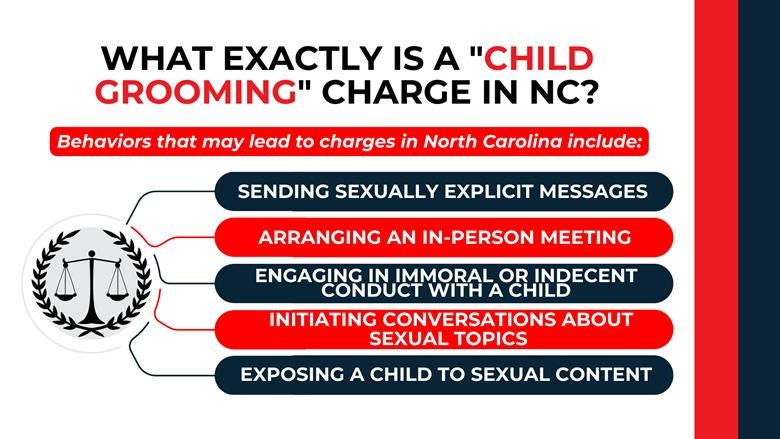
 Legal scale graphic listing behaviors like explicit messaging, meetings, and exposing minors to sexual content.

Which North Carolina Statutes Cover Grooming Behavior?

What Is Solicitation of a Child by Computer?

Under N.C.G.S. § 14-202.3, it is a crime for a person who is 16 or older and at least five years older than the believed minor to use a computer or electronic device to solicit, entice, or advise a child to meet for the purpose of committing an unlawful sex act. This is the statute most frequently applied to online grooming behavior.

The offense is a Class H felony under NC's structured sentencing guidelines. If either party actually appears at the proposed meeting location, the charge elevates to a Class G felony with greater sentencing exposure. No actual minor victim is required for prosecution the defendant's belief that the person is underage is sufficient. This allows law enforcement sting operations using undercover officers posing as minors, which NC courts have consistently upheld as a valid enforcement method.

What Are Indecent Liberties With a Child?

N.C.G.S. § 14-202.1 criminalizes taking indecent liberties when the defendant is 16 or older and at least five years older than the victim, who must be under 16. This Class F felony covers a broader range of grooming conduct than the solicitation statute.

NC courts interpret "indecent liberties" expansively. In State v. Every, 157 N.C. App. 200, 578 S.E.2d 642 (N.C. App. 2003), the Court of Appeals held that physical touching is not an element of this offense. Exposing a child to sexual activity, engaging in sexually explicit conversations, or masturbating in a child's presence can all qualify. The prosecution must prove the conduct was performed "for the purpose of arousing or gratifying sexual desire" the element that distinguishes criminal behavior from non-criminal conduct.

During a six-month period in 2023, the National Children's Alliance documented 3,127 children reported for sexual abuse at North Carolina's Children's Advocacy Centers, reflecting the scale of enforcement activity across the state.

Can Grooming Lead to Federal Charges?

Yes. Federal authorities actively investigate child exploitation in North Carolina. Federal prosecution carries significantly harsher penalties. The U.S. Sentencing Commission (FY 2024) reports a 99.2% prison rate for federal sexual abuse offenses with an average sentence of 221 months. Cases involving interstate communication, internet platforms headquartered outside NC, or connections to broader exploitation networks may draw federal attention.
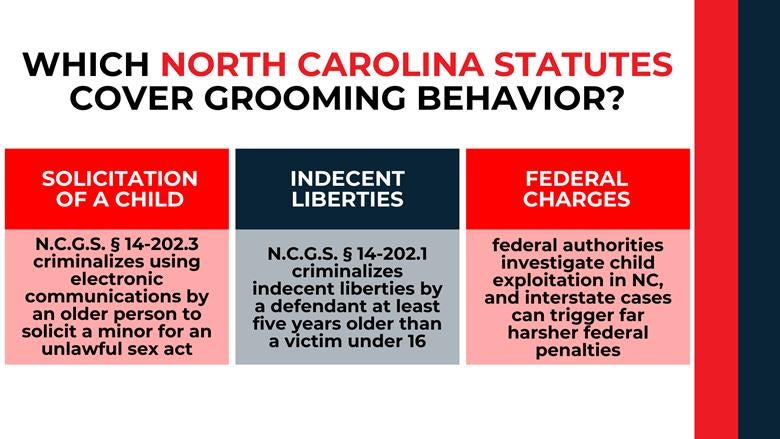
Three-column layout summarizing solicitation, indecent liberties, and potential federal charges with statute references.

What Penalties Do Grooming-Related Charges Carry?

What Is the Sentence for Solicitation of a Child by Computer?

Solicitation under § 14-202.3 is a Class H felony in its base form. Under NC's structured sentencing guidelines, the penalty range depends on the defendant's prior record level. For defendants with minimal criminal history, the presumptive range includes the possibility of community or intermediate punishment. If either party appeared at a proposed meeting location, the Class G felony enhancement increases the available sentencing range.

What Penalties Apply to Indecent Liberties Convictions?

Indecent liberties carries a Class F felony classification with more significant sentencing exposure. The NC Sentencing and Policy Advisory Commission (FY 2024) reports that for person offenses overall, 62% received active prison sentences, 28% received intermediate punishment, and 10% received community punishment.

According to the NC Department of Adult Correction (FY 2023-2024), 29% of Class F felony probation entries were for "other sexual offenses," making it the single most common Class F crime on probation. This data indicates that while active imprisonment is possible, probation with strict conditions is a realistic outcome for some Class F sex offense convictions depending on the circumstances and the defendant's prior record.

How Does Sex Offender Registration Affect Sentencing Consequences?

Both solicitation and indecent liberties convictions trigger mandatory sex offender registration under N.C.G.S. § 14-208 et seq. Registration consequences extend far beyond any prison sentence:

  • 30-year standard registration on the NC Sex Offender Registry, with the possibility of petitioning for removal after 10 years under N.C.G.S. § 14-208.12A
  • Location restrictions under N.C.G.S. § 14-208.18 prohibiting presence near schools, daycare centers, and places where children gather
  • Regular in-person verification with local law enforcement, including address and employment reporting requirements
  • GPS electronic monitoring in qualifying cases the NC Department of Adult Correction reported 581 sex offenders enrolled in GPS monitoring in FY 2022-2023
  • Public database listing through the NC SBI Sex Offender Registry, accessible to anyone with internet access

These obligations affect housing, employment, and daily life for decades after any sentence ends.
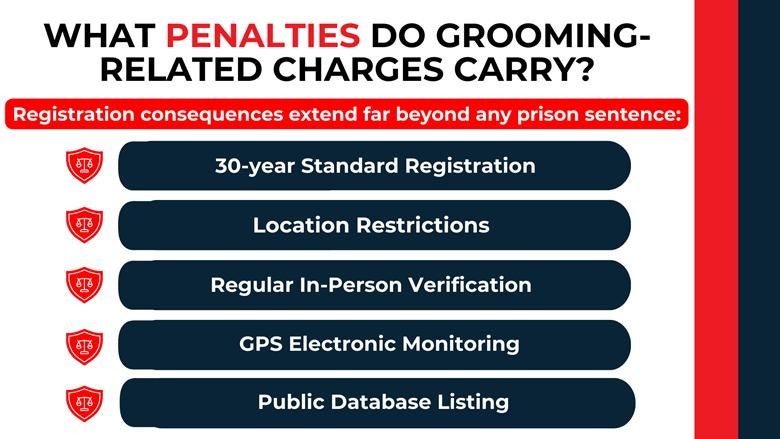
Shield icons outlining long-term registration, monitoring, location limits, and public database listing.

How Do Police Investigate Grooming Allegations?

What Role Do Online Sting Operations Play?

Law enforcement agencies conduct proactive sting operations targeting online grooming. The NC SBI Computer Crimes Unit assigns 17 full-time special agents across eight field districts specifically to investigate internet crimes against children. These agents coordinate with the broader ICAC Task Force.

In a typical operation, an undercover officer creates a profile on a social media platform or chat application posing as a minor. If an adult initiates sexually explicit communication or proposes a meeting, law enforcement documents the exchange and may arrange an arrest at a designated location. The legality of these operations is well-established in NC courts, but the investigative tactics also create the factual foundation for entrapment defenses.

Can Police Search Phones and Computers Without A Warrant?

Digital evidence is central to grooming investigations. Following Riley v. California, 573 U.S. 373 (2014), police generally cannot search cell phones or digital devices without a warrant, even during a lawful arrest. NC courts require warrants that specifically authorize forensic examination of electronic devices.

Under N.C.G.S. § 15A-248, search warrants must be executed within 48 hours of issuance. Officers may seize and secure a phone to prevent destruction of evidence while obtaining a warrant. Consent to search a home does not automatically extend to digital devices found inside. These protections create important defense opportunities when evidence is obtained through improper procedures.
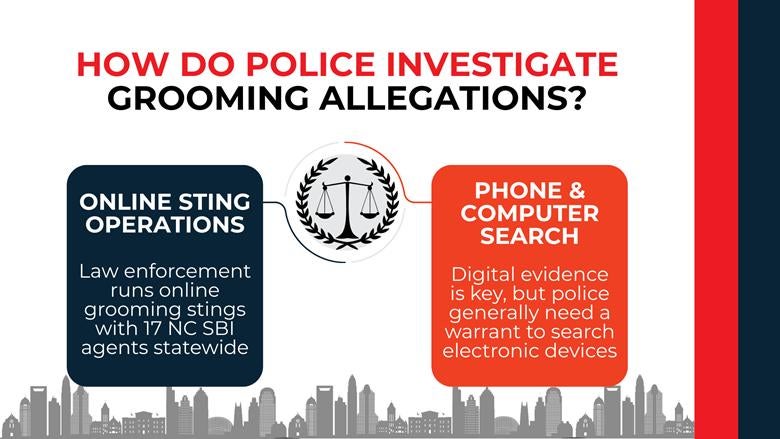
Balanced scales icon linking two panels on online sting operations and warrant-based device searches.

What Defenses Apply to Grooming-Related Charges?

What Is the Entrapment Defense for Sting Operation Cases?

Entrapment is the most significant defense in solicitation cases involving sting operations. The defense requires proving two elements: (1) government inducement of the criminal conduct and (2) lack of predisposition on the defendant's part.

In State v. Keller, 265 N.C. App. 526, 828 S.E.2d 578 (N.C. App. 2019), the Court of Appeals found that a defendant's continued engagement after learning the "child's" age demonstrated predisposition that defeated the entrapment claim. Evidence of initial reluctance, statements declining sexual contact with minors, and persistent government pressure can support the defense. Written notice of an entrapment defense is required within 20 working days of the trial setting date under N.C.G.S. § 15A-905(c).

How Can the Evidence Be Challenged?

Beyond entrapment, several strategies target the prosecution's case:

  • Challenge the "knowing" element the State must prove the defendant knowingly engaged in prohibited conduct with awareness of the other person's stated age
  • Examine chat logs for government initiation if law enforcement introduced sexual topics first, this supports inducement under State v. Morse, 194 N.C. App. 685, 671 S.E.2d 538 (N.C. App. 2009)
  • Verify the age differential requirement both § 14-202.3 and § 14-202.1 require the defendant to be at least five years older than the victim or believed victim, and charging errors occur
  • Contest the purpose element for indecent liberties the State must prove conduct was "for the purpose of arousing or gratifying sexual desire," and ambiguous behavior may not meet this standard
  • Challenge digital forensic evidence metadata, timestamps, and account authentication may raise questions about who actually sent specific messages

Research compiled by End Violence Against Women International (2016) places the false reporting rate for sexual assault between 2-8% based on peer-reviewed studies. Additionally, the National Registry of Exonerations (2024) reports that 10% of all exonerations nationally involve sexual assault and 9% involve child sex abuse. These figures underscore the critical importance of thorough defense investigation in every case.

What Constitutional Protections Apply?

The Fifth Amendment provides protections during grooming investigations. Any custodial interrogation requires proper Miranda warnings, and statements obtained without them may be suppressed. NC is a one-party consent state under N.C.G.S. § 15A-287, meaning pretext phone calls where one party consents to recording are lawful, a tactic commonly used in grooming investigations to gather incriminating statements.

Exercising the right to remain silent cannot be used against a defendant at trial. Consulting an attorney before any interaction with law enforcement is critical to preserving these protections.
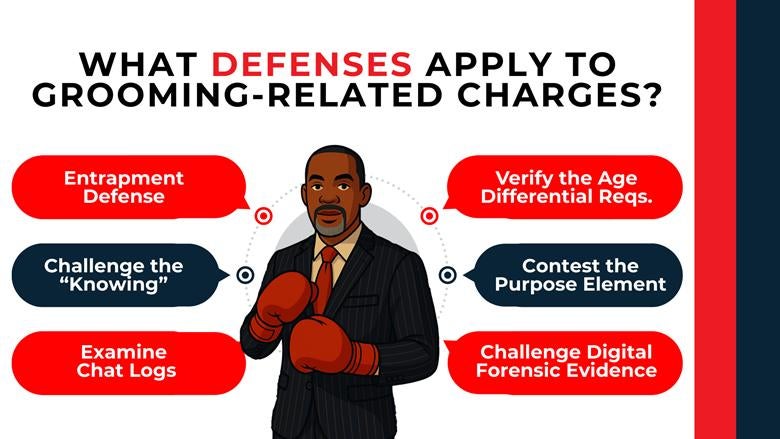
Defense attorney illustration with callouts listing entrapment, intent challenges, age requirements, and digital evidence review.

What Happens After an Arrest on Grooming Charges?

How Does Pretrial Release Work for Sex Offense Charges?

Under N.C.G.S. § 15A-533(b), certain sex offenses require a district or superior court judge not a magistrate to authorize pretrial release. This requirement can mean additional time in custody before a judge reviews the case.

The NC Sentencing Commission (FY 2024) reports that 93% of person offense convictions reflected credit for pretrial detention, with an average of 15 months of pretrial credit. This data confirms that pretrial detention is common for defendants facing sex-related charges in North Carolina.

Attorney Patrick Roberts is a North Carolina criminal defense lawyer whose practice heavily emphasizes defending those accused of serious sex offenses. His background as a former prosecutor provides a unique perspective on the strategies used by the state, which is particularly relevant when navigating the strict pretrial requirements of North Carolina law.

Attorney Patrick Roberts: Qualifications & Experience

Attorney Patrick Roberts offers a formidable defense rooted in two decades of high-stakes litigation and a profound understanding of the North Carolina legal system.

  • Veteran Prosecutorial Perspective: With over 20 years of experience, Mr. Roberts began his career as a prosecutor in three North Carolina counties. This background is a strategic cornerstone of his practice; having spent years building cases for the State, he possesses an in-depth understanding of prosecutorial methods and the specific evidentiary standards required for serious felony charges.
  • Rigorous Advocacy Training: Mr. Roberts is a graduate of the National Criminal Defense College (NCDC) and Gerry Spence’s Trial Lawyers College. These institutions are recognized for their rigorous focus on advanced trial advocacy, equipping him with the skills to effectively communicate a client’s story and challenge the prosecution's narrative before a jury.

How Long Do These Cases Take To Resolve?

Sex offense cases move slowly through the NC court system. Digital forensic analysis, review of electronic communications, and the complexity of these investigations all contribute to extended timelines. Defendants often live under the weight of pending charges for months before resolution, with potential restrictions on employment, housing, and personal relationships during that period. Early engagement with a defense attorney allows the defense to begin building its case during this critical window.
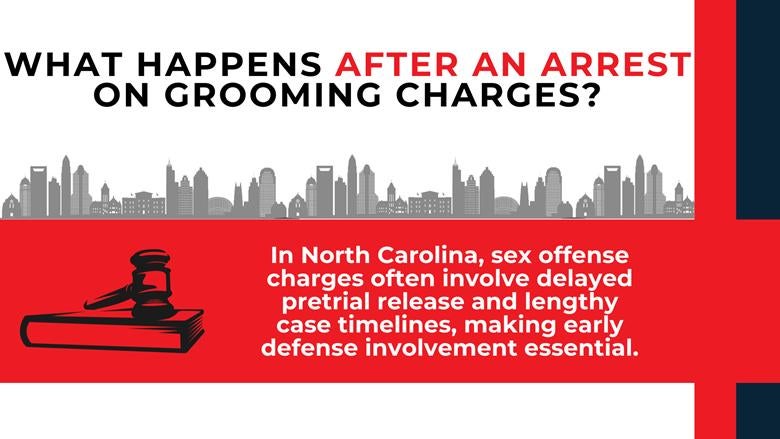
Gavel over city skyline explaining delayed pretrial release and lengthy case timelines in North Carolina.

What Are the Long-Term Consequences of a Conviction?

How Does the Sex Offender Registry Work?

The NC Sex Offender Registry currently lists approximately 28,200+ registered individuals statewide as of January 2026, according to the NC State Bureau of Investigation. Standard registration lasts 30 years under N.C.G.S. § 14-208.7, though defendants may petition for early termination after 10 years under N.C.G.S. § 14-208.12A if they do not qualify as a recidivist, sexually violent predator, or aggravated offender.

The public nature of the registry means that neighbors, employers, and anyone with internet access can view the registrant's information. This creates lasting personal and professional consequences well beyond the period of criminal supervision.

What Collateral Consequences Should Defendants Expect?

A conviction for solicitation or indecent liberties triggers consequences that extend across every area of a defendant's life:

  • Immigration consequences are severe sexual abuse of a minor qualifies as an aggravated felony under federal immigration law, triggering mandatory deportation for non-citizens as addressed in Padilla v. Kentucky, 559 U.S. 356 (2010)
  • Employment restrictions affect careers in education, healthcare, law enforcement, and any field involving contact with minors or requiring background checks
  • Professional licensing boards may revoke or deny licenses based on sex offense convictions under "good moral character" standards
  • Housing limitations result from both registry restrictions near schools and private landlord screening practices
  • Child custody proceedings are significantly affected because courts must consider sex offense convictions in custody determinations
  • Post-conviction options exist through a Motion for Appropriate Relief (MAR) under N.C.G.S. § 15A-1411 for constitutional violations, ineffective assistance of counsel, or newly discovered evidence

Defense strategy must account for these collateral impacts from the earliest stages of a case to protect a defendant's future.
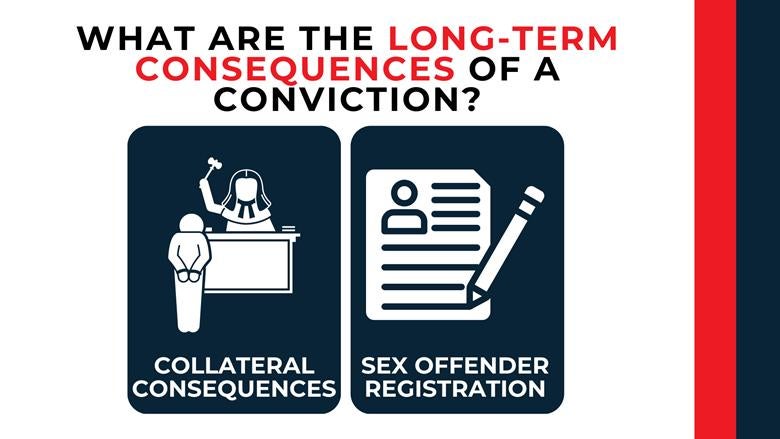
 Court and document icons summarizing collateral consequences and mandatory sex offender registration.

Frequently Asked Questions

Is "child grooming" a specific crime in North Carolina?

No. North Carolina does not have a standalone statute criminalizing "child grooming." Behaviors described as grooming are prosecuted under existing laws such as solicitation of a child by computer (N.C.G.S. § 14-202.3) and indecent liberties with a child (N.C.G.S. § 14-202.1). The specific charges filed depend on the alleged conduct and whether electronic communication was involved.

Can I be charged with solicitation if the "minor" was actually an undercover officer?

Yes. N.C.G.S. § 14-202.3 covers situations where the defendant "believes" the other person is underage, and no actual minor victim is required. However, sting operation cases open the door to an entrapment defense if law enforcement induced the conduct and the defendant was not predisposed to commit the offense.

Does mistake of age work as a defense to indecent liberties?

No. In State v. Breathette, 202 N.C. App. 697, 690 S.E.2d 1 (N.C. App. 2010), the Court of Appeals confirmed that mistake of age is not a defense to indecent liberties. However, verifying the exact ages of both parties remains critical because the required five-year age differential creates a potential basis for challenging improperly filed charges.

Will I have to register as a sex offender if convicted?

Yes. Both solicitation of a child by computer and indecent liberties require mandatory registration under the NC Sex Offender Registry for a minimum of 30 years. Early termination may be available after 10 years through a petition under N.C.G.S. § 14-208.12A, but only if the defendant does not qualify as a recidivist or aggravated offender.

Should I talk to the police if I'm being investigated for grooming?

You have the right to remain silent under the Fifth Amendment, and exercising that right cannot be used against you at trial. Grooming investigations frequently involve law enforcement attempting to collect statements before formal charges are filed. Consulting an attorney before any contact with investigators protects your constitutional rights and prevents potentially harmful admissions.

Secure Your Future with a Robust Defense

A "child grooming" accusation in North Carolina carries devastating criminal consequences, even though "grooming" is not a specific charge in the state statutes. Instead, prosecutors utilize charges such as Solicitation of a Child by Computer and Indecent Liberties with a Child to pursue these allegations. These are high-level felonies that carry mandatory sex offender registration and collateral consequences that can permanently dismantle your personal and professional life.

When the stakes are this high, understanding the specific evidence the State must prove—and identifying the constitutional defenses available to you—is the only way to protect your rights.

Don't leave your freedom to chance. Attorney Patrick Roberts is highly qualified to handle these sensitive cases. As of December 2025, he is theonly North Carolina lawyer listed by the National Child Abuse Defense & Resource Center. Furthermore, his commitment is recognized by Martindale-Hubbell, having earned the Client Champion Platinum award for 2026—a distinction he has maintained for more than five consecutive years based on verified client acclaim.

The respect Patrick commands in the legal community is best summarized by a colleague’s 2018 endorsement:

"Patrick is my #1 referral for my own clients facing criminal issues... His expertise in the field and experience in the courtroom are the reasons he is my top recommendation. He is trustworthy, reliable, and highly esteemed by his peers." – Peer review via Martindale-Hubbell on October 29, 2018

Disclaimer: The testimonials and peer reviews on this site are for informational purposes. They do not constitute a guarantee, warranty, or prediction regarding the outcome of your legal matter. Every case is different and must be evaluated on its own merits.

*Testimonials and peer endorsements found on this website are actual comments.

Facing allegations of this nature is a serious matter with lifelong consequences. At Patrick Roberts Law, we believe every individual deserves a fair trial and a dedicated defense. If you are navigating charges in North Carolina, contact us for a confidential consultation to ensure your legal rights are fully protected.
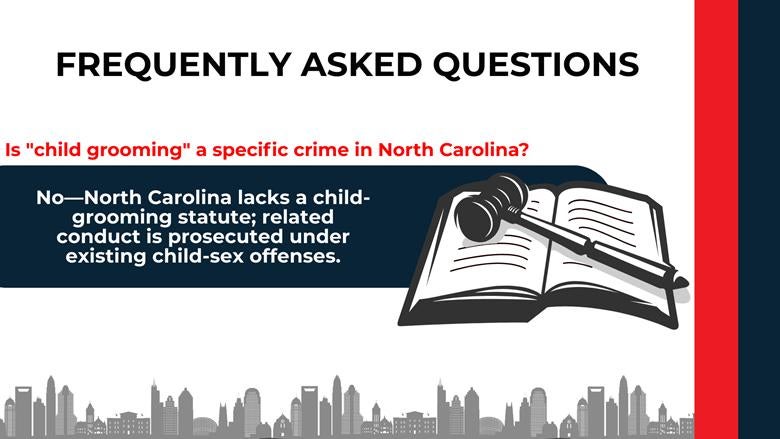
Open law book with gavel highlighting FAQ answer that North Carolina has no standalone child grooming statute.

Disclaimer: The information on this website is for general information purposes only. Nothing on this site should be taken as legal advice for any individual case or situation. Case results depend upon a variety of factors unique to each case. Prior results do not guarantee a similar outcome.

Posted in:

Recommended Posts

7 Criteria to Evaluate a Criminal Defense Firm in Wake County, NC

Choosing a criminal defense law firm in Wake County, NC requires evaluating seven key factors: trial experience, local courtroom familiarity, relevant case outcomes, peer recognition, client reviews, fee transparency, and attorney availability. This guide explains what each criterion means and how to apply it when evaluating any firm. more Facing criminal charges is one of the most consequential situations a person can encounter. The criminal defense attorney you choose will shape how your case is investigated, argued, and resolved. That decision deserves careful thought—not a quick Google search and a gut feeling. The word "best" gets used loosely in legal marketing. Rankings, badges, and bold claims are everywhere. But the firm that's right for one person may not be right for another. What matters is finding a criminal defense attorney whose background, approach, and communication style align with your specific situation. This guide outlines seven objective criteria for evaluating any criminal defense law firm serving Wake County, NC. It also explains how Patrick Roberts Law can be assessed against each one. Every criminal case is different. Nothing in this guide constitutes legal advice. Use this information to help you ask the right questions—not to predict the outcome of your case. 1. What Does Trial Experience Actually Mean for a Criminal Defense Attorney? Trial experience refers to an attorney's history of preparing and litigating cases in front of a judge or jury—not just negotiating settlements or plea agreements. This distinction matters because criminal cases sometimes proceed to trial, and an attorney who rarely steps into a courtroom may be less prepared when that happens. General legal experience is not the same as criminal defense experience. A civil litigator with 20 years of practice has a very different skill set than a criminal defense lawyer who has spent two decades in courtrooms handling felony charges, sex offenses, and violent crimes. Ask any attorney you're considering: How often do your cases go to trial? What types of criminal cases have you litigated? What does your preparation process look like? Attorney Patrick Roberts is a Duke Law graduate with over 24 years of experience in criminal law and has handled more than 1,000 cases. He previously served as a prosecutor in three counties, which means he has courtroom experience on both sides of criminal proceedings. Prospective clients can review his background and case history at patrickroberts.law. Attorney Patrick Roberts delivers high-level expertise in North Carolina Criminal Law, a distinction forged through more than 80 criminal jury trials taken to verdict, hundreds of bench trials and hundreds of motions in both state and federal courts. 2. Why Does Local Courtroom Familiarity Matter in Wake County? Criminal defense practice is local. Procedures, scheduling practices, and the general culture of a courthouse vary from county to county. A criminal defense attorney who regularly practices in Wake County courts will understand how cases move through the system there—something that can affect strategy and timing. "Local reputation" should be evaluated through verifiable professional information. Look for attorneys who openly discuss their Wake County practice, rather than relying on vague claims about "relationships" with prosecutors or judges. Patrick Roberts Law is based in Raleigh and serves clients throughout Wake County, NC. The firm's Wake County criminal defense practice page describes the range of charges it handles locally, from felony charges to drug crimes and sexual offenses. You can review the firm's stated scope of practice to assess how relevant its experience is to your situation. 3. How Should You Review a Criminal Defense Firm's Case Outcomes? Published case results can give you a sense of the types of situations a firm has handled and how those cases concluded. However, they require careful interpretation. A dismissal in one case does not mean your case will be dismissed. Outcomes depend on the specific facts, evidence, jurisdiction, and legal strategy involved. Look for results involving charges similar to yours. Ask the attorney: Have you handled cases like mine? What factors affected the outcome? What might those factors look like in my situation? Past results do not guarantee future results. Every criminal case must be evaluated individually. Patrick Roberts Law publishes case results on its website, organized by charge type. These include outcomes in cases involving first-degree murder, rape, felony burglary, statutory rape, and indecent liberties, among others. Reviewing those published results can help you assess whether the firm has handled cases with similar charges and complexities to your own. 4. What Do Peer Awards and Professional Recognition Tell You About a Criminal Defense Lawyer? Professional recognition from peer organizations can indicate that a criminal defense attorney is well-regarded within the legal community. Peer-based awards typically involve nominations from other lawyers and a vetting process based on professional standards—making them meaningfully different from advertiser-driven rankings. That said, awards should be one data point, not the deciding factor. Verify who issued the award, what criteria were used, and when it was granted. Patrick Roberts Law Based on publicly available information, Attorney Patrick Roberts has received recognition that includes the Avvo Clients' Choice Award 2026, the Martindale-Hubbell AV Preeminent rating, a Distinguished Counsel designation for 2026, and a Super Lawyers designation from 2013 to 2019. These are verifiable credentials that prospective clients can independently confirm through the issuing organizations. 5. How to Read Client Reviews of a Wake County Criminal Defense Firm Client reviews can offer insight into a firm's communication style, responsiveness, and how clients feel they were treated throughout the process. Look for patterns across multiple reviews, not just individual comments. A review that says "he fought hard for me" tells you less than one that describes specific interactions, response times, or how the attorney explained the process. Reviews that address the experience of working with the firm—not just the outcome—tend to be more informative. Keep in mind that online reviews have limits. They don't predict case outcomes, and they reflect individual perspectives. Use them as one factor among several. Patrick Roberts Law The firm has accumulated over 130 reviews on Trustindex. Published client testimonials on the firm's website describe experiences involving federal fraud cases, sex offense allegations, and other serious criminal matters. Prospective clients can read those reviews directly on the firm's site or on third-party platforms to form their own assessment. In addition to client feedback, Attorney Patrick Roberts is endorsed by fellow criminal defense attorneys who have observed his deep knowledge of North Carolina criminal law and his skill in managing complex cases. Read selected reviews from Attorney Roberts’ Avvo page below: Client Review “I highly recommend this attorney to anyone needing experienced and knowledgeable legal representation. From the beginning, he clearly explained the steps necessary to address my situation and made sure I understood the process along the way. He kept me informed as progress was being made and was always professional, responsive, and prepared. Although the legal process can move slowly at times, I always felt confident that my case was being handled properly. When my court date finally arrived, he was exceptionally well prepared and navigated the courtroom procedures with confidence and skill. His experience and attention to detail ultimately helped lead to a very positive outcome in my case. I truly appreciated his guidance and representation throughout the entire process.” — Verified Client via Avvo.com Peer Endorsement “I endorse this lawyer. Patrick is a great trial lawyer and a person who I go to for legal advice in my own practice. Patrick is dedicated to his clients and a master at criminal defense. I would not hesitate to hire him if I was in trouble and needed a lawyer.” — Review From a Criminal Defense Attorney via Avvo.com *Testimonials and peer reviews are for informational purposes only and do not guarantee or predict the outcome of your legal matter. Every case is unique and must be evaluated on its own merits. All endorsements featured on this site are actual comments from clients and peers. 6. What Should You Ask About Fees Before Hiring a Criminal Defense Law Firm? Fee structures vary among criminal defense law firms. Some charge flat fees for specific services; others bill hourly. Most require a retainer upfront. There may be additional costs for investigators, expert witnesses, filing fees, or extended litigation. The lowest fee is not necessarily the best value. A firm that charges less but lacks relevant experience may cost more in the long run—in time, outcomes, and stress. Before signing any agreement, ask: What does your fee cover? What could result in additional charges? How will I be billed if my case goes to trial? Patrick Roberts Law Specific fee information for the firm is not published on the firm's website, which is common practice in criminal defense. Prospective clients should ask directly during a consultation. Patrick Roberts Law offers free consultations, which is an appropriate opportunity to raise questions about billing structure, what services are included, and what additional costs might arise. 7. How Should You Evaluate Attorney Availability and Communication? Criminal cases can move quickly. Hearings get scheduled. Evidence needs to be reviewed. Decisions have to be made under pressure. An attorney who is difficult to reach—or who hands off your case without telling you—can leave you feeling uninformed at critical moments. Before hiring anyone, clarify: Who will handle my case day to day? How do I reach the attorney directly? What is the typical response time for questions or updates? Patrick Roberts Law Patrick Roberts Law's main contact number is 919-746-7206. You may also send inquiries through the firm's email address info@patrickroberts.law. Prospective clients should confirm during a consultation how communication is handled, who their primary point of contact will be, and what to expect during different stages of their case. Questions to Ask Before Hiring a Wake County Criminal Defense Attorney Use this checklist when meeting with any criminal defense attorney in Wake County, NC: How much experience do you have with cases like mine? How often do your criminal cases go to trial? How familiar are you with the Wake County courts? Can you explain your approach to my type of charge? What outcomes have you achieved in similar cases? What will my legal fees include? Who will handle my case? How will we communicate, and how quickly should I expect responses? What should I expect during the next stage of my case? These questions apply to every firm you consider—including Patrick Roberts Law. How Patrick Roberts Law Fits These Evaluation Criteria When you apply the seven criteria above to Patrick Roberts Law, here is what the verifiable record shows: Patrick Roberts is a Duke Law graduate and former prosecutor with over 24 years of experience in North Carolina criminal law. The firm has handled more than 1,000 cases and has published detailed case results covering a wide range of serious charges. Mr. Roberts has received peer recognition including Super Lawyers (2013–2019), an AV Preeminent Martindale-Hubbell rating, a Distinguished Counsel designation, and an Avvo Clients' Choice Award. The firm has over 220 client reviews and offers free consultations with a 24/7 phone line. That does not make Patrick Roberts Law the right choice for every person facing criminal charges in Wake County. The right firm depends on the nature of your charges, your priorities, and how you want to communicate with your attorney. Use the same criteria to compare Patrick Roberts Law with any other qualified options you are considering. You can review the firm's Wake County criminal defense services to assess how its practice areas align with your situation. Speak With Patrick Roberts Law About Your Criminal Defense Case If you are facing criminal charges in Wake County, NC, the most important step you can take right now is to speak with a qualified criminal defense attorney. The earlier you get legal guidance, the more options you may have. Patrick Roberts Law offers free consultations and serves clients throughout Wake County and the surrounding areas. While representing clients in critical legal matters across all North Carolina counties, his practice maintains a strong presence in Wake County, specifically serving Raleigh, Cary, Apex, Holly Springs, Garner, and Fuquay-Varina. To discuss your situation and learn about your legal options, contact Patrick Roberts Law today. Choose Your Criminal Defense Attorney Based on What Matters Most The seven criteria in this guide—trial experience, local courtroom familiarity, case outcomes, peer recognition, client reviews, fee transparency, and attorney availability—give you a practical framework for comparing criminal defense law firms in Wake County, NC. No ranking, badge, or advertisement replaces this kind of objective evaluation. The "best" criminal defense attorney is the one whose background, communication style, and approach match your specific case and circumstances. Patrick Roberts Law is one firm worth evaluating using these criteria. There are others. Take the time to compare your options carefully, ask direct questions, and make a decision based on what the evidence actually shows—not what a firm says about itself. Frequently Asked Questions How do I find a qualified criminal defense law firm in Wake County, NC? Start by identifying attorneys who focus on criminal defense and regularly practice in Wake County courts. From there, evaluate each firm using objective criteria: trial experience, published case results, peer recognition, client reviews, fee transparency, and attorney availability. Free consultations—offered by firms like Patrick Roberts Law—are a practical way to assess fit before making a commitment. Does hiring a former prosecutor as a criminal defense attorney make a difference? It can. A criminal defense attorney who previously worked as a prosecutor understands how the government builds its cases, what evidence it tends to rely on, and where weaknesses may exist. Patrick Roberts Law's lead attorney served as an assistant district attorney in three counties before moving to criminal defense, which provides a dual perspective on case strategy. What is the difference between a criminal defense lawyer and a criminal defense law firm? A solo criminal defense lawyer and a law firm both provide legal representation, but they differ in staffing, capacity, and support resources. A firm may have multiple attorneys and support staff, which can affect how cases are managed and communicated. Before hiring, ask who specifically will handle your case and what role each team member plays. How do I know if a criminal defense attorney's awards are meaningful? Look for recognition issued by established legal organizations with clear selection criteria. For example, Martindale-Hubbell's AV Preeminent rating is based on peer review by other attorneys. The Super Lawyers designation involves peer nominations and independent research. Awards that require payment or have no vetting process carry less weight. Always verify the source and criteria independently. Disclaimer: The information on this website is for general informational purposes only. Nothing herein should be taken as legal advice for any individual case or situation. Contacting us via this website, email, or contact form does not create an attorney-client relationship. Case results depend on a variety of factors unique to each case; prior results do not guarantee a similar outcome.
Under Investigation for Cyber Offenses in NC? How Federal Authorities Build These Cases

Federal cyber crime enforcement in North Carolina has reached unprecedented levels, marked by proactive digital surveillance, multi-agency task force operations, and severe judicial outcomes. A prime example of this environment is the August 2026 sentencing of a Charlotte man to 15 years (180 months) in federal prison, followed by 30 years of supervised release and $23,000 in mandatory restitution, following a guilty plea to digital child exploitation distribution charges under federal jurisdiction. more Initiation of Investigations & Forensic Mechanics Unlike traditional criminal matters, modern federal cyber cases originate from automated monitoring systems. Major tech platforms utilize perceptual hashing algorithms (e.g., PhotoDNA) to scan cloud accounts, messaging applications, and file uploads, generating automated CyberTiplines to the National Center for Missing & Exploited Children (NCMEC). These reports are routed directly to federal task forces (including the FBI, HSI, and NC SBI), where agents correlate subscriber records, IP logs, IMEI/MAC device identifiers, and metadata to link online personas to physical locations. Why Cases Land in State vs. Federal Court How Federal Jurisdiction Is Triggered: Because almost all modern digital communications, cloud platforms, social media apps (like Snapchat or Meta), and internet service providers cross state or international lines, the federal government nearly always has the legal basis to claim jurisdiction under the Commerce Clause. However, having jurisdiction does not mean federal prosecutors adopt every case. State Court Prosecution (North Carolina): Many digital exploitation cases remain in North Carolina state court, where they are prosecuted under N.C.G.S. § 14-190 (Sexual Exploitation of a Minor) by local District Attorneys. These cases often involve lower file volumes, local law enforcement investigations, or initial offenses where federal authorities choose not to adopt the case. When Federal Authorities Step In: Federal prosecutors (the U.S. Attorney's Office) typically adopt a case when: The investigation was directly spearheaded by federal agencies like the FBI or Homeland Security Investigations (HSI). The offense involves production, extensive distribution across state/international borders, or high-volume file sharing. The case involves complex multi-account networks, encryption, or commercial trading. Key Differences Between State and Federal Charges Feature North Carolina State Court Federal Court Statute Sexual Exploitation of a Minor (1st, 2nd, 3rd Degree) 18 U.S.C. § 2251, § 2252A, etc. Sentencing Structure NC Structured Sentencing (Felony Classes C, E, H) Federal Sentencing Guidelines & Statutory Mandatory Minimums Bail / Pre-trial Release Handled via local magistrate or state judge bonds Highly restrictive; federal detention hearings with strong presumptions against release Parole / Time Served Earned time credits available under state law No federal parole; defendants must serve at least 85% of their sentence Key Legal & Evidentiary Challenges Defendants in federal court face significantly higher procedural and penal hurdles than those in state court: Statutory Penalties: Mandatory minimums under statutes such as 18 U.S.C. § 2252A range from 5 to 15 years, with strict Federal Sentencing Guidelines enhancements based on file volume, victim age, and multi-account network usage. Complex Forensic Data: Prosecutions rely heavily on timestamped metadata, IP access logs, and thousands of extracted media files that non-technical juries often find overwhelmingly persuasive. Financial Restitution: Frameworks such as the Amy, Vicky, and Andy Act impose significant joint-and-several financial liabilities that persist beyond term completion. Strategic Defense Considerations Navigating a federal digital investigation requires targeted early-stage interventions: Exercise of Fifth Amendment Rights: Refusing informal interviews, "knock and talk" operations, or statements regarding account ownership. Independent Digital Forensics: Deploying defense experts to audit government reports for automated background downloads, unprompted cloud syncing, shared Wi-Fi access, third-party network compromise, or timestamp/hash discrepancies. Fourth Amendment Warrants & Mitigation: Evaluating whether federal agents exceeded warrant scope or relied on stale data, alongside early pre-trial mitigation (including psychological evaluations and sentencing departure petitions). How Attorney Patrick Roberts Can Help Navigating a federal or state cyber offense investigation demands immediate intervention from a highly knowledgeable defense attorney. Admitted to practice in all state and federal courts across North Carolina (Eastern, Middle, and Western Districts), the U.S. Court of Appeals for the Fourth Circuit, and the United States Supreme Court, Attorney Patrick Roberts possesses the jurisdictional authority and strategic depth to represent clients at every tier of the legal system. Academic Background & Trial Credentials Juris Doctor (J.D.): Duke University School of Law ( Ranked #7 National Law School and #9 Criminal Law Program by U.S. News & World Report ) Undergraduate Degree: The Johns Hopkins University Advanced Trial Advocacy Training: Graduate of the National Criminal Defense College (NCDC) and Gerry Spence’s Trial Lawyers College Prosecutorial & Defense Experience: Former prosecutor across three North Carolina counties with over two decades of criminal trial practice Experience in Sex Crimes Defense Law Attorney Patrick Roberts has established himself as an expert in sex crime defense law, backed by a deep history of handling high-stakes, highly sensitive digital and physical offense allegations: 250+ Felony Sex Crime Cases: Substantiated expertise reflected in having handled more than 250 felony sex crime cases across North Carolina. ICAC & Cyber Crime Mastery: Extensive experience defending complex cases involving the Internet Crimes Against Children (ICAC) Task Force and advanced digital forensics. Federal & State Task Force Practice: Routinely handles cases brought directly by federal investigative agencies (such as the FBI and HSI) or the North Carolina State Bureau of Investigation (SBI) ICAC Task Force. Independent Forensic Auditing: A track record retaining and collaborating with independent digital forensic experts and data analysts to thoroughly audit and challenge government electronic evidence, search warrant parameters, and metadata logs. As a former prosecutor and seasoned defense attorney, Attorney Roberts understands the technical mechanics of NCMEC CyberTiplines, IP logging, and ICAC task force operations. Whether your case involves negotiating early pre-trial mitigation to keep charges in state court or mounting a technical forensic challenge against federal evidence, early representation is critical. To stay current with evolving legal and technical standards, he attended the Defending Digital Sex Crimes Bootcamp in Orlando, Florida, in July 2026—a two-day intensive program focused on defending possession and distribution cases involving digital evidence. Recent Case Review: State Court Jurisdiction Charges: 4 Counts of Second-Degree Sexual Exploitation of a Minor (N.C.G.S. § 14-190.17) 6 Counts of Third-Degree Sexual Exploitation of a Minor (N.C.G.S. § 14-190A) Case Summary: The North Carolina State Bureau of Investigation (SBI) and local law enforcement initiated an investigation after digital monitoring flagged online activity linked to a specific IP address. Based on this data, authorities secured and executed a search warrant at the client’s residence. During the search, investigators recovered multiple digital items suspected of containing illicit material, and the client made admissions to law enforcement officers on site. Facing these severe allegations, the client retained Attorney Patrick Roberts to manage their legal defense. Defense Strategy: The defense focused on a mitigation-based approach during pre-trial negotiations. Rather than disputing the physical evidence or the on-site statements, Attorney Patrick Roberts compiled and presented comprehensive mitigating factors to the District Attorney's office to provide context regarding the client's background, lack of prior criminal history, and psychological profile. Result: Probation. Attorney Patrick Roberts successfully* negotiated a resolution with the prosecution that avoided active prison time. The client received a strictly probationary sentence and was subsequently granted legal authorization to transfer their probation supervision to a new state of residency. (*Disclaimer: The results of specific cases reported are not meant to be a prediction or guarantee of a similar outcome in any future matter. Each legal case is unique and subject to distinct factual and legal circumstances.) Peer Endorsements & Client Review Peer Endorsement "I endorse this lawyer. Patrick is a great trial lawyer and a person who I go to for legal advice in my own practice. Patrick is dedicated to his clients and a master at criminal defense. I would not hesitate to hire him if I was in trouble and needed a lawyer." -Verified Peer Endorsement via Avvo.com Client Review “I highly recommend this attorney to anyone needing experienced and knowledgeable legal representation. From the beginning, he clearly explained the steps necessary to address my situation and made sure I understood the process along the way. He kept me informed as progress was being made and was always professional, responsive, and prepared.” - Verified Client Review via Avvo.com Disclaimer: Testimonials and peer reviews are actual comments from clients and peers. They are for informational purposes only and do not guarantee or predict the outcome of your legal matter. Every case is unique and must be evaluated on its own merits. Schedule a Confidential Legal Consultation If you learn that you are under investigation or if law enforcement officers execute a search warrant, exercise your right to remain silent and seek qualified counsel before providing statements or answering questions. Law Firm: Patrick Roberts Law PLLC Website: patrickroberts.law Direct Office Phone: (919) 746-7206 Office Locations: Raleigh, Cary, Durham, and Chapel Hill Attorney Patrick Roberts defends clients in complex legal matters throughout North Carolina, centering his practice in Wake County cities and towns, including Raleigh, Cary, Apex, Holly Springs, Garner, and Fuquay-Varina. To maintain a high standard of service and thorough oversight for each client, we manage a restricted caseload. For individuals navigating state charges, felony classifications, or registry exposure, Attorney Roberts provides the interactive North Carolina Sex-Offense Search Tool to help evaluate charge severity and statutory penalties. Legal Disclaimer: The information provided on this page is for educational and informational purposes only and does not constitute formal legal advice. Accessing this material, submitting a query, or contacting Patrick Roberts Law does not create an attorney-client relationship.

Digital Forensics in NC Rideshare Crimes: How GPS Telemetry & Cell Phone Evidence Impact Criminal Defense

A $50 million civil lawsuit recently filed in Durham County Superior Court against Lyft has placed ridesharing  safety standards and vetting protocols under intense public scrutiny. Filed on behalf of a victim alleging sexual assault during a rideshare trip, the civil complaint targets platform background check policies—specifically highlighting that the driver's prior driving while impaired (DWI) conviction fell outside North Carolina’s statutory 7-year lookback window. While civil proceedings evaluate corporate liability, the parallel criminal prosecution focuses on an entirely different evidentiary threshold: digital forensics, GPS telemetry, and the digital chain of custody. more The Evidentiary Core: Digital Forensics in Platform Offenses In complex felony prosecutions involving rideshare platforms, verbal testimony rarely forms the sole basis of the state's case. Prosecution and defense teams analyze four primary electronic data streams to establish location, intent, and timing: Server-Side Telemetry & GPS Logs: Geolocation data maintained on TNC servers, documenting latitude, longitude, velocity spikes, and route deviations. On-Device Cellular Telemetry: Hardware extraction logs retrieved directly from mobile devices using specialized forensic software. In-Cabin Media: Audio and video recordings captured by dual-facing dashcams, personal mobile devices, or in-app emergency features. Application Transaction Logs: Timestamped electronic records tracking ride requests, driver acceptance, cancellation attempts, and status changes. Because electronic records are subject to sampling rates, time-synchronization variances, and network latency, validating their technical reliability is critical to trial preparation. Authentication Standards Under N.C.G.S. § 8C-1, Rule 901 Before electronic telemetry can be admitted as substantive evidence in a North Carolina courtroom, the state must establish its authenticity under Rule 901 of the North Carolina Rules of Evidence. Satisfying Rule 901 requires a foundational showing of reliability: N.C.G.S. § 8C-901(b)(1) – Witness with Knowledge: The prosecution often introduces device extractions through an investigating officer. Cross-examination evaluates whether the witness possesses formal digital forensics expertise or relied entirely on automated extraction tools. N.C.G.S. § 8C-901(b)(9) – System or Process: Introducing server-side GPS exports requires proving that the platform’s tracking systems yield accurate results, typically supported by testimony or affidavits from the TNC’s official Custodian of Records. Digital Chain of Custody Protocol Digital evidence requires strict handling protocols to demonstrate that raw data extracted from servers or mobile hardware remains uncorrupted throughout the proceedings: Faraday Shielding: Securing mobile hardware inside signal-blocking enclosures prevents remote data wiping commands or incoming cellular overwrites immediately upon seizure. Cryptographic Hash Verification: Forensic examiners generate a unique cryptographic hash value (such as SHA-256) at the initial extraction. Any discrepancy between the working file's hash and the original acquisition hash indicates file alteration or data corruption. Hardware Write-Blockers: Analysts utilize write-blocking hardware during examination to ensure the host operating system does not alter underlying file metadata. Primary Technical Vulnerabilities in Telemetry Evidence Auditing electronic discovery in platform-based cases involves evaluating four common technical vulnerabilities: Vulnerability Technical Mechanism Strategic Defense Impact Clock-Drift & UTC Offsets Discrepancies between local device clocks, cell tower logs, and server Universal Time Coordinated (UTC) stamps. Reconciles timeline gaps that might otherwise misrepresent routine traffic stops as unlawful restraint. GPS Polling & "Jitter" Periodic logging intervals combined with satellite signal interference near structures or heavy foliage. Demonstrates that apparent route deviations on digital maps can be artifacts of algorithmic estimation. API vs. Raw Exports Summarized PDF exports provided by platforms compared to underlying raw data files. Uncovers critical missing metadata, confidence radiuses, and system error codes omitted from summary reports. Data Volatility & Spoliation Automated operating system purges that overwrite volatile device memory over time. Highlights potential losses of ambient sensor logs or messaging records due to delayed preservation requests. Defense Counsel Action Items When handling criminal cases involving mobile telemetry and location data in North Carolina courts, defense strategy centers on thorough technical verification: Issue 18 U.S.C. § 2703(f) Preservation Demands: Serve formal preservation notices on TNC platforms, cellular carriers, and third-party data providers immediately to prevent automated deletion routines. Request Raw Bit-Stream Extractions: File discovery motions for full raw images (.E01 or .raw formats), system audit logs, and verified hash values rather than relying solely on high-level extraction summaries. Audit Metadata Integrity: Evaluate foundational witness testimony under Rule 901 to determine whether the state can verify the underlying technical process of data acquisition. Retain Independent Forensic Experts: Engage certified digital forensic analysts to independently re-verify cryptographic hashes, assess GPS confidence intervals, and review extraction logs for chain-of-custody errors. Legal Representation for Complex Digital Evidence Cases When facing felony charges involving digital telemetry, forensic app extractions, or TNC data in North Carolina, technical evidence demands experienced analysis. Former prosecutor Patrick Roberts brings over two decades of trial experience to evaluate electronic evidence, review forensic extraction protocols, and structure comprehensive defense strategies. Education & Advanced Trial Advocacy Duke University School of Law: Juris Doctor (Ranked #7 National Law School & #9 Criminal Law Program by U.S. News & World Report) The Johns Hopkins University: Bachelor’s Degree (Ranked #7 National University by U.S. News & World Report) Gerry Spence’s Trial Lawyers College: Graduate National Criminal Defense College (NCDC): Trial Practice Institute Graduate (Including the 2025 Cross-Examination Intensive) Peer Recognition & Legal Accolades Martindale-Hubbell AV Preeminent® Rating: Peer-rated for the highest level of professional excellence (8 Consecutive Years) Martindale-Hubbell Client Champion Platinum: Recognized for exceptional client service (5+ Consecutive Years) Avvo 10.0/10 “Superb” Rating: Highest legal rating for experience, outcome history, and professional conduct (15+ Consecutive Years) The National Trial Lawyers: Top 100 Trial Lawyers Peer Endorsement “Patrick is a thoughtful and experienced attorney. When I have a client needing representation in the Raleigh area in his areas of practice, he would be my referral of choice.” -Verified Peer Endorsement via Avvo.com Client Review “Throughout the process, he remained a constant calm and reassuring presence during a challenging time in my life. His guidance and dedication made a difficult experience much more manageable. ” - Verified Client Review via Avvo.com Disclaimer: Testimonials and peer reviews are actual comments from clients and peers. They are for informational purposes only and do not guarantee or predict the outcome of your legal matter. Every case is unique and must be evaluated on its own merits. To stay current with evolving legal and technical standards, he attended the Defending Digital Sex Crimes Bootcamp in Orlando, Florida, in July 2026—a two-day intensive program focused on defending possession and distribution cases involving digital evidence. For individuals navigating state charges, felony classifications, or registry exposure, he provides the interactive North Carolina Sex-Offense Search Tool to help evaluate charge severity and statutory penalties. For confidential legal consultations regarding criminal matters in Raleigh, Durham, Chapel Hill, or throughout North Carolina, contact Patrick Roberts Law at ( 919) 746-7206 or visit patrickroberts.law. Legal Disclaimer This content is provided for educational and informational purposes only and does not constitute formal legal advice. Reading this information or contacting the firm does not create an attorney-client relationship.