Blog / North Carolina Criminal Law

Can Sex Offenders Go to Church in North Carolina?

Person seated in church pew introduces North Carolina church attendance rules for registered sex offenders.

North Carolina law does not specifically prohibit registered sex offenders from attending church. The state statute that restricts where registrants can go — N.C.G.S. § 14-208.18 — lists specific categories of locations. Houses of worship are not among them. But that one-line answer is incomplete, and acting on it without understanding the details could lead to a felony charge. Whether church attendance is actually safe in your situation depends on the type of offense on your record, the physical layout of the church, and the conditions of any sentence or supervision you may be under.

This page breaks down what the statute actually says, where the gray areas are, and what practical steps can reduce the risk of an unintentional violation.

What Places Are Sex Offenders Not Allowed to Go in NC?

N.C.G.S. § 14-208.18 is the statute that covers location restrictions for registered sex offenders in North Carolina. It does not impose a blanket ban on all public places. Instead, it identifies specific categories of locations that are off-limits.

Under subsection (a), if you are a covered registrant, you cannot knowingly be at any of the following:

  • Premises intended primarily for the use, care, or supervision of minors, including schools, children's museums, child care centers, nurseries, and playgrounds.
  • Within 300 feet of any location intended primarily for minors when that location sits on a larger property not primarily intended for minors.
  • Any place where minors frequently congregate — the statute names libraries, arcades, amusement parks, recreation parks, and swimming pools as examples — when minors are present.
  • On fairgrounds during the State Fair, the Mountain State Fair, or any agricultural fair.

Not every person on the registry faces these restrictions. Under subsection (c), the premises limitations apply to you if you committed an offense under Article 7B of Chapter 14 (North Carolina's sexual offense statutes), any offense where the victim was under 18, or an offense involving sexual exploitation of a minor under G.S. §§ 14-190.16, 14-190.17, 14-190.17A, or 14-190.17C.

The 300-foot buffer rule in subsection (a)(2) has an additional requirement. It applies only when a court has found in a criminal or civil proceeding that you present or may present a danger to minors. It also applies when the original offense involved a victim under 18 or a sexual exploitation charge.

The distinction matters. The restrictions you face depend on the specific offense that triggered your registration, not simply the fact that you are on the registry.
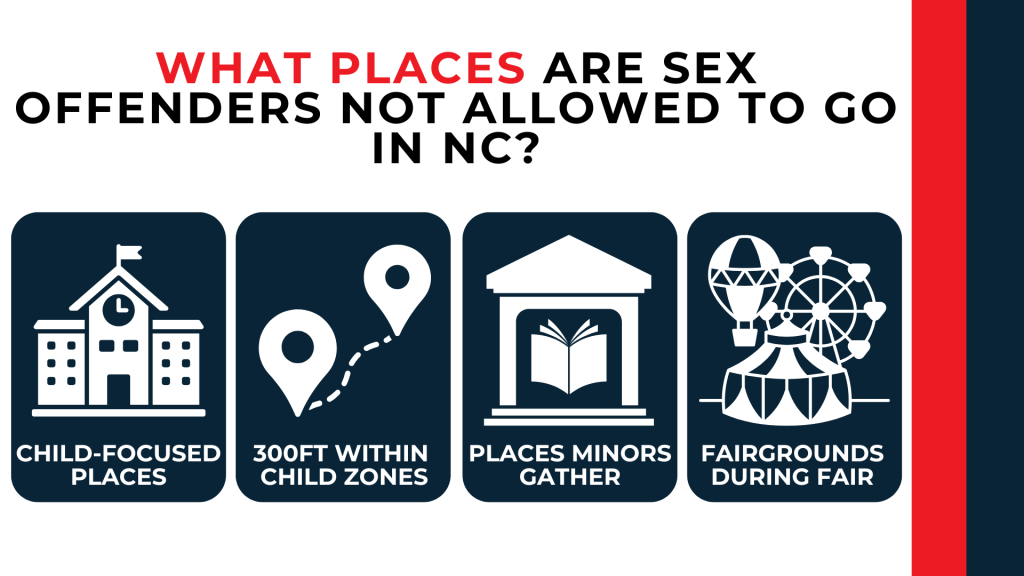
Icons show schools, child zones, gathering places, and fairgrounds restricted under North Carolina law.

Could a Church Count as a Place Where Minors Congregate?

This is where the answer gets complicated, and it is the reason a general "churches aren't listed" response can be misleading.

A church sanctuary used for a regular Sunday worship service is not a place "intended primarily for the use, care, or supervision of minors" under § 14-208.18(a)(1). Adults make up the majority of the congregation, and the primary purpose of the space is worship for people of all ages.

But many churches contain spaces that could fall within the statute's reach. A dedicated nursery room, a children's Sunday school wing, a youth ministry area, or a vacation Bible school program may qualify as a location intended primarily for minors. If those spaces exist within the church building, the 300-foot buffer in subsection (a)(2) could also come into play. This is especially true on larger church campuses where children's programming happens in a separate building or wing.

The statute also restricts you from being at places "where minors frequently congregate" when minors are present. A church fellowship hall hosting a youth group meeting, a gymnasium used for children's basketball, or a Wednesday-night kids' program could potentially meet that description depending on the specific facts.

None of this means that attending a worship service is automatically a violation. It means that the physical layout of the church, the timing of your visit, and the specific areas you enter all matter in determining whether you are following the law.
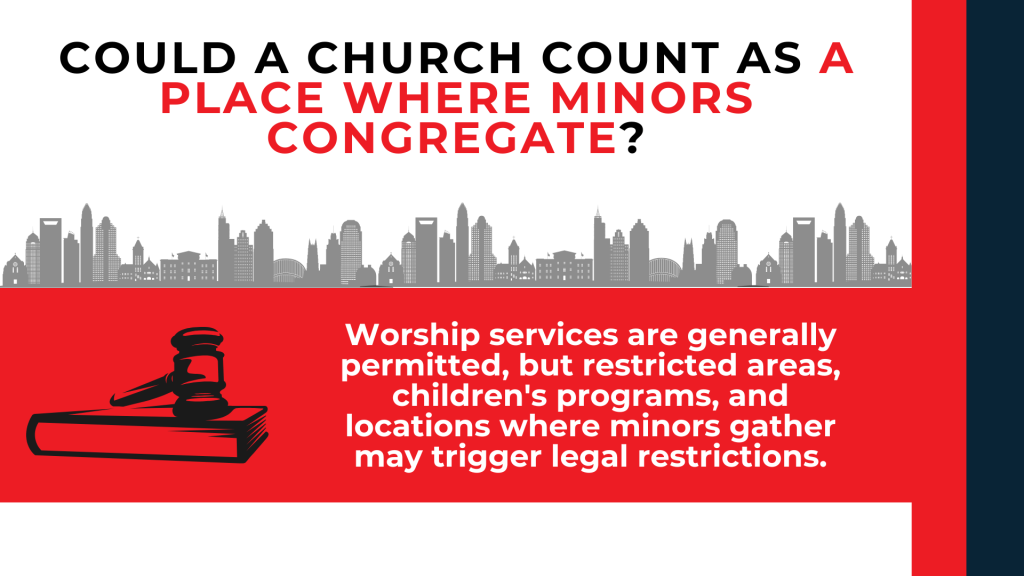
Gavel on law book highlights church attendance limits, youth programs, and areas where minors gather.

Could Conditions of My Sentence Add Restrictions Beyond the Statute?

Sex offense convictions in North Carolina carry additional consequences beyond the registry itself. Defense attorneys should advise clients on location restrictions tied to their specific case. Section 14-208.18 defines the statutory restrictions, but it may not be the only source of limitations on where you can go.

If your sentence included probation, post-release supervision, or other court-ordered conditions, those terms may impose additional restrictions. These restrictions are specific to your case and may go further than what the statute requires. What those conditions cover depends on the language of your judgment and the terms set by the court. The restrictions that apply to you may come from more than one source — the registry statute, your judgment, and any supervision conditions. It is important to review all of them together rather than relying on the statute alone.

An attorney familiar with sex offense cases in North Carolina can review the specific documents that apply to your situation. They can tell you whether church attendance is allowed under every restriction that applies to you, not just the ones in § 14-208.18.
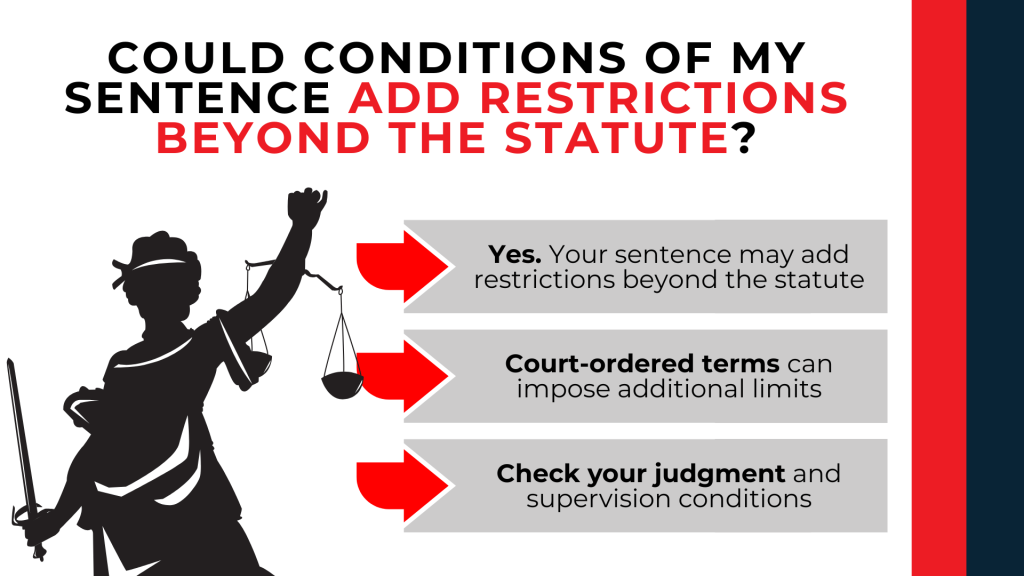
Lady Justice with arrows explains court-ordered restrictions, supervision terms, and sentencing conditions.

What Can I Do to Attend Church Without Violating the Law?

The following are general considerations — not legal standards — that may help reduce the risk of an unintentional violation. They are not a substitute for reviewing your specific case with an attorney.

Start by reviewing your judgment and commitment order and any other court orders that govern your supervision. These documents define what you are and are not permitted to do. If you are unsure how to read them, a criminal defense attorney can walk you through the specific language.

If you are on active supervision, consider discussing church attendance with your supervising officer before attending rather than assuming it is permitted. A clear answer in advance is better than an unclear situation after the fact.

If you do attend, staying in the main worship area and avoiding spaces designated for minors — nurseries, children's classrooms, youth group rooms — may help you stay on the right side of the statutory restrictions in § 14-208.18. Arriving close to the start of the service and leaving promptly when it ends limits time spent in common areas where children may gather.

Communicating with church leadership about your situation in advance may also be worthwhile. Some churches have existing policies that address this, and being upfront can prevent misunderstandings.

Keeping a record of the steps you take — conversations with a supervising officer, communications with church staff, and the specific services you attend — may be useful if a question ever arises about your actions.
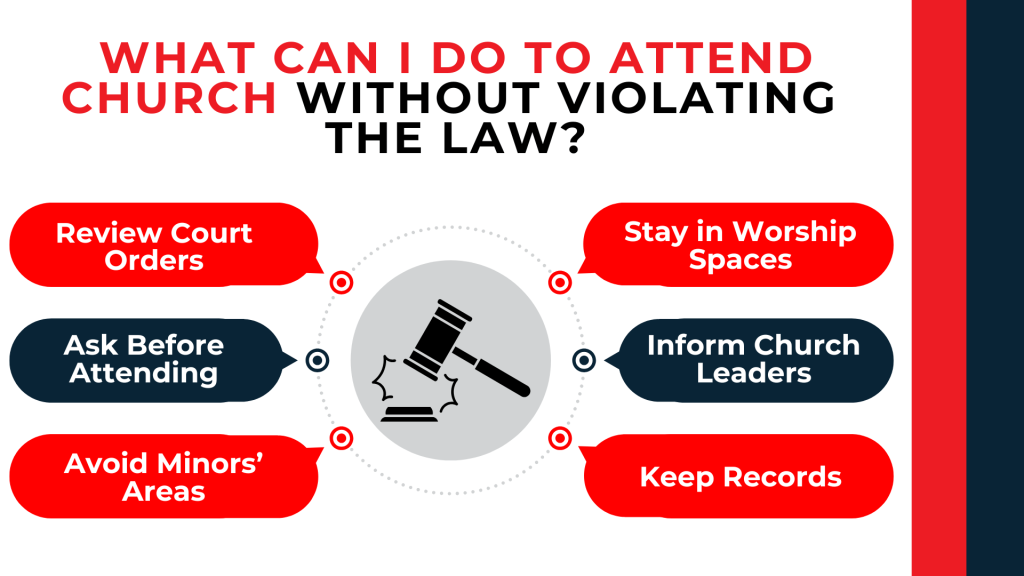
Gavel icon with checklist covers reviewing orders, avoiding minors’ areas, informing leaders, and records.

What Happens If I Go Somewhere I'm Not Supposed to Be?

A violation of N.C.G.S. § 14-208.18 is a Class H felony under subsection (h). That is a separate criminal charge on top of whatever consequences may follow from other aspects of your case. A Class H felony in North Carolina carries a potential prison sentence that varies based on your prior record level. A conviction also adds another offense to a record that already carries significant additional consequences.

The statute requires that you "knowingly" be at a restricted location, which means the state must prove awareness. But "I didn't realize there was a daycare in the building" is a difficult argument to make when the information was available in advance. The safest approach is to know the layout of any location before you go.
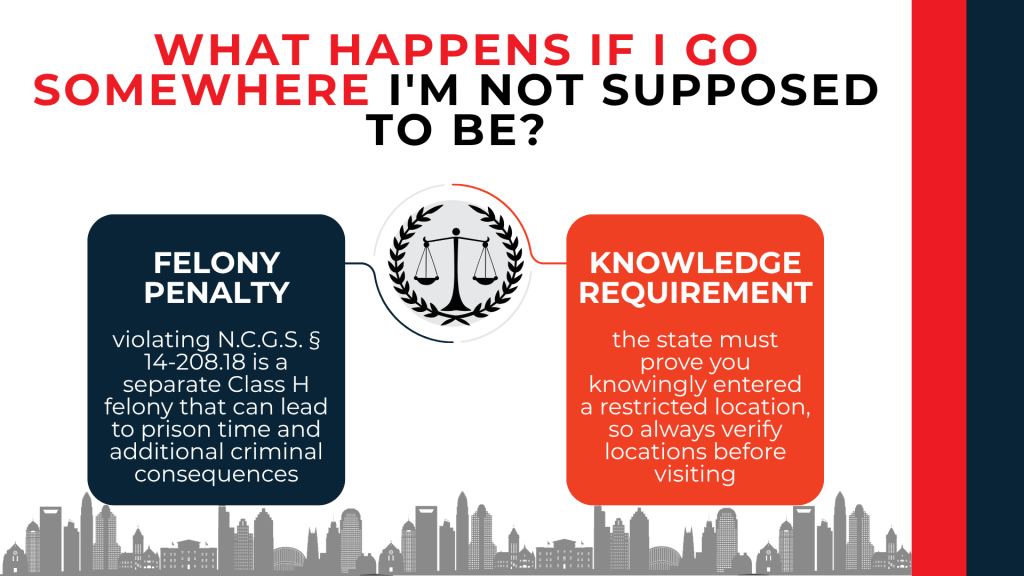
Scales of justice compare felony penalties and knowledge requirements for entering restricted locations.

Talk to a North Carolina Sex Crimes Defense Attorney

The answer to whether you can attend church depends on your specific offense, your specific court orders, and any conditions tied to your sentence or supervision. A general overview of the statute can tell you what the law says in broad terms, but it cannot tell you where you personally stand.

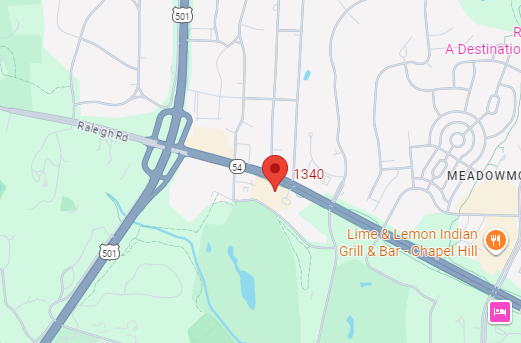
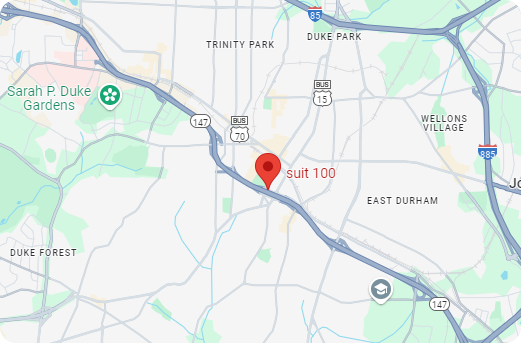
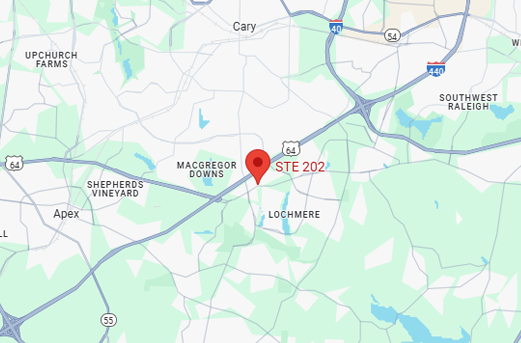
Patrick Roberts is a Raleigh-based attorney who handles sex offenses statewide, with regional offices in Cary, Durham, and Chapel Hill. Over a 20-year career, he has managed thousands of cases, supported by an academic foundation from Johns Hopkins and Duke Law. His commitment to trial advocacy is evidenced by his graduation from Gerry Spence’s Trial Lawyers College and the NCDC. An AV Preeminent rated lawyer and published author, Mr. Roberts utilizes his past experience as an Assistant District Attorney to counter the prosecution's strategies.

Education & Advanced Training

An alumnus of Johns Hopkins University (#7 National University) and Duke University School of Law (#7 National Law School; #9 Criminal Law Program), Mr. Roberts has dedicated his career to honing his trial craft. He is a graduate of the prestigious Gerry Spence’s Trial Lawyers College and the National Criminal Defense College (NCDC) Trial Practice Institute, including the 2025 Cross-Examination Intensive.

Accolades & Peer Review

• Martindale-Hubbell AV Preeminent Rating: 5+ Consecutive Years

• Martindale-Hubbell Client Champion Platinum: 5+ Consecutive Years

• AVVO 10/10 “Superb” Rating: 15+ Consecutive Years

• The National Trial Lawyers: Top 100 Trial Lawyers

Mr. Roberts is a published author of two legal books and a lifetime member of the National Association of Criminal Defense Lawyers.

A Former Prosecutor’s Insight

Mr. Roberts’ defense strategy is informed by his tenure as an Assistant District Attorney in the Wake, Johnston, and New Hanover offices. This experience allows him to anticipate the methods used by the state in complex sex crime litigation.

Jurisdictional Admissions

Qualified to handle cases at the highest levels, he is admitted to the U.S. Supreme Court, the Fourth Circuit Court of Appeals, and all North Carolina federal districts. He remains the sole North Carolina representative listed by the National Child Abuse Defense & Resource Center as of 2026.

Client Review

“Have you ever found yourself in a situation and didn’t know who to turn to? That was us when our young adult got into legal trouble for the first time in his life. As parents, we were overwhelmed and scared. We prayed for an experienced criminal defense attorney who would be honest, direct, yet compassionate — and God led us to Patrick Roberts, Esquire. We couldn’t have asked for better representation! Attorney Roberts is well-versed in the law and the Wake County Court System. He’s candid and doesn’t sugarcoat things — which was exactly what we needed. His years of experience exuded a strong sense of confidence. From day one, it was clear that he’s deeply committed to advocating for his clients, no matter how tough the situation. He’s a man of his word and asked us to trust his process. We did and it worked! Using a serious yet compassionate tone, Attorney Roberts made time to provide the hard facts about the consequences of breaking the law and concluded his talk with words of encouragement and optimism, not false hope. If you have a type A personality like we do, take our advice, relax. We eventually accepted that this busy attorney would not always be immediately available to answer questions, because his priority was advocating for his clients behind the scenes. His dedication became clear when it mattered most — and that’s exactly the kind of attorney you want on your side! We are forever thankful for Attorney Patrick Roberts' professional work. Due to his strong advocacy, our child now has a second chance to pursue their endless dreams and future aspirations. If you need help with a criminal defense case in the Raleigh area of North Carolina, we highly recommend Patrick Roberts Law, PLLC.” - Verified Client Review via Avvo.com

Peer Endorsement

“I endorse this lawyer without reservation. Patrick is plain outstanding. The highest remark I can give a lawyer is that I would ask him to represent me were I charged with a crime. I would ask Patrick and know that I would be in the very best of hands.” - Verified peer endorsement via Avvo.com

Disclaimer: Testimonials and peer reviews are for informational purposes only and do not guarantee or predict the outcome of your legal matter. Every case is unique and must be evaluated on its own merits. All endorsements featured on this site are actual comments from clients and peers.

Seeking Clarity on North Carolina Registry Compliance? 

Statutory boundaries regarding property lines, church activities, and childcare facilities require careful, case-by-case legal analysis. If you or a family member need guidance navigating North Carolina's complex registry rules, our legal team can review your specific situation to ensure you are fully informed and compliant.

The firm maintains a selective intake process to ensure that each client receives the focused professional attention their case requires. 

Disclaimer: The information on this website is for general informational purposes only. Nothing herein should be taken as legal advice for any individual case or situation. Contacting us via this website, email, or contact form does not create an attorney-client relationship. Case results depend on a variety of factors unique to each case; prior results do not guarantee a similar outcome.

Attorney illustration with boxing gloves encourages legal guidance on church attendance and supervision rules.
Posted in:

Related Posts

Attorneys reviewing documents and laptop summarize key information about sexual exploitation charges in North Carolina.

Sexual Exploitation of a Minor in North Carolina: What You Need to Know

Sexual exploitation of a minor is not a single charge in North Carolina. It is a three-tiered criminal offense defined under N.C.G.S. §§ 14-190.16, 14-190.17, and 14-190.17A. Each degree carries different elements, different felony classifications, and very different prison ranges — from a Class H felony for possession to a Class C felony for production. Below is a detailed breakdown of what each degree involves, what the prosecution must prove, what the penalties look like, where defense challenges exist, and what a conviction means for the rest of a person's life. more What Does "Sexual Exploitation of a Minor" Mean Under North Carolina Law? North Carolina criminalizes sexual exploitation of minors through a three-level system that separates the offense into three degrees based on the type of conduct involved. First-degree sexual exploitation of a minor under N.C.G.S. § 14-190.16 involves the production or facilitation of material depicting a minor engaged in sexual activity. This is the most serious tier, classified as a Class C or Class D felony. Courts distinguish production — direct involvement with a minor — from facilitation of the creation of such material. Second-degree sexual exploitation of a minor under N.C.G.S. § 14-190.17 covers the distribution or receipt of that material. This is a Class E felony. Distribution covers the transfer of material to others. Receipt means knowingly obtaining it. Third-degree sexual exploitation of a minor under N.C.G.S. § 14-190.17A is a possession offense. This is a Class H felony. All three degrees require mandatory sex offender registration upon conviction. There is no tier of this offense that avoids registration. One critical feature of North Carolina's system: the state has no teen-specific sexting statute. This means minors aged sixteen and older — who are tried as adults under NC law — can be prosecuted for sexually exploiting themselves through consensual sexting. This creates issues with how prosecutors choose to bring charges and means the statute reaches further than many people assume. What Does the Prosecution Have to Prove? Each degree of sexual exploitation requires the state to prove specific elements beyond a reasonable doubt. Understanding those elements matters because each one represents a point where the prosecution's case can succeed or fail. Across all three degrees, the state must prove the defendant acted knowingly. Under NC case law, the "knowing" element requires knowledge of the material's character or content — not necessarily knowledge of the victim's actual age. In other words, the prosecution does not need to prove the defendant knew how old the person depicted was. It needs to prove the defendant knew what the material contained. This connects to a second rule that applies at every level: mistake of age is explicitly not a defense to any degree of sexual exploitation of a minor in North Carolina. You cannot argue you believed the person in the material was an adult. North Carolina courts also permit the trier of fact — the jury or judge — to infer that a person depicted as a minor is in fact a minor based on the title, text, or visual representation of the material itself. The state does not always need to independently identify the minor depicted. Beyond these shared elements, the degrees differ. For first-degree, the state must connect the defendant to the production or facilitation of the material — direct involvement with a minor or active assistance in the creation process. For second-degree, the state must prove a distribution or receipt act — an intentional transfer or knowing acquisition. For third-degree, the state must establish knowing possession. What Are the Penalties for a Conviction? North Carolina sentences these offenses under the Structured Sentencing Act, which assigns a standard sentencing range based on the offense classification and the defendant's prior record level. The sentencing ranges by degree are: First-degree (Class C felony): 44 to 182 months First-degree (Class D felony): 38 to 160 months Second-degree (Class E felony): 15 to 63+ months Third-degree (Class H felony): 5 to 29 months, depending on prior record level These ranges carry a critical enhancement. Under N.C.G.S. § 15A-1340.17(f), Class B1 through E felonies requiring sex offender registration are subject to an enhanced maximum sentence calculated at 120% of the minimum plus 60 additional months. This means the gap between the minimum and maximum sentence for sexual exploitation convictions at those felony classes is much wider than for comparable non-sex felonies. The data on how courts actually sentence these cases leaves no doubt about how serious these cases are. According to the NC Sentencing and Policy Advisory Commission's FY 2024 report, 100% of Class B1 through D felony sex offense convictions received active imprisonment — not probation, not intermediate punishment. Person offenses as a category carry the highest active punishment rate of any crime type in North Carolina, with 62% receiving active sentences, 28% intermediate, and 10% community punishment. Sex offenses also carry 60 months of post-release supervision upon release from prison, compared to 9 to 12 months for other felony offenses. For defendants awaiting trial, the timeline is long. The median time from charge to sentencing for Class B1 felonies is 30 months. The average time spent in pretrial detention is 27 months. NC law requires a district or superior court judge — not a magistrate — to set pretrial release conditions for sex offense defendants, making bail harder to obtain from the start. Federal prosecution raises the stakes further. If the case is picked up at the federal level, 99.2% of federal sexual abuse offense convictions result in prison, with an average sentence of 273 months — nearly 23 years — for child pornography production. How Can a Defense Attorney Challenge These Charges? Sexual exploitation cases are built on digital evidence and constitutional procedures, which means they create specific, well-defined ways to fight the charges. None of this guarantees a particular outcome, but each one addresses an element the prosecution must prove or a procedure the government must follow. Challenging "knowing" possession. The state must prove the defendant knowingly possessed the material. A defense investigation examines whether material was automatically downloaded, cached, or planted on a device without the defendant's knowledge or intent. A forensic expert can analyze metadata, timestamps, and user access patterns to determine whether you actually accessed or controlled the material. Challenging distribution evidence. In second-degree cases, the state must prove intentional distribution. One key approach is distinguishing intentional sharing from automatic backup or peer-to-peer software default sharing. Forensic analysis can establish whether files were transferred through deliberate user action or through automatic software behavior. Can the Police Search Your Phone or Computer Without a Warrant? The U.S. Supreme Court held in Riley v. California, 573 U.S. 373 (2014), that police generally cannot search cell phones or digital devices incident to arrest without a warrant. North Carolina courts require particularized warrants for electronic device searches. Consent to search a home does not automatically include consent to search digital devices found inside. Defense challenges in this area focus on whether a valid warrant existed, whether the warrant specifically authorized forensic examination, and whether the search exceeded the scope of what the warrant permitted. Cloud storage searches present additional issues. There is no controlling North Carolina authority on whether a warrant for a physical device extends to connected cloud services. Suppression motions may apply when cloud data is accessed without separate authorization. What Protections Do You Have During Interrogation? Miranda warnings are required before custodial interrogation. North Carolina law under N.C.G.S. § 15A-211 mandates recording of custodial interrogations for Class C sex offenses, which includes first-degree sexual exploitation. Failure to comply with this recording requirement is admissible evidence to support a claim that a confession was involuntary. North Carolina is also a one-party consent state for recorded communications under N.C.G.S. § 15A-287. This means pretext phone calls arranged by law enforcement are lawful. However, the procedures used in those calls can be challenged for compliance with recording requirements. These are not abstract legal theories. They map directly to the elements from the previous section: if the state cannot prove knowing possession, knowing distribution, or that evidence was lawfully obtained, the case weakens at its foundation. What Happens After the Sentence Ends? A conviction for any degree of sexual exploitation of a minor triggers consequences that extend far beyond the prison sentence. These long-term restrictions are what can most seriously reshape your daily life. Sex offender registration. North Carolina requires 30 years of sex offender registration under N.C.G.S. § 14-208 et seq. Registration is not passive. It requires reporting in person to the county sheriff, with ongoing obligations: reporting any change of address within three business days, reporting changes to online identifiers within ten days, reporting changes in academic enrollment or employment at institutions of higher education, and reporting any legal name change. Under N.C.G.S. § 14-208.9A, the NC Department of Public Safety mails a verification form to your last known address every six months. You must return it in person within three business days. Failure to comply with any registration or verification requirement is a Class F felony under N.C.G.S. § 14-208.11. After ten years, you may petition the superior court to terminate the registration requirement under N.C.G.S. § 14-208.12A, but only if you have not been convicted of a subsequent registrable offense. The court must find that you have not been arrested for any registrable crime since completing the sentence, that termination complies with applicable federal standards, and that you are not a current or potential threat to public safety. The district attorney is entitled to notice and may oppose the petition. Victims may appear and be heard. Location restrictions. Under N.C.G.S. § 14-208.18, registered sex offenders convicted of offenses under §§ 14-190.16, 14-190.17, or 14-190.17A are prohibited from knowingly being on the premises of places intended primarily for the use, care, or supervision of minors — schools, childcare centers, playgrounds, children's museums. They are also restricted from places where minors frequently congregate, including libraries, arcades, amusement parks, recreation parks, and swimming pools, when minors are present. A separate provision creates a 300-foot restriction from certain locations intended for minors. Violations are a Class H felony. Limited exceptions exist for parents or guardians attending school conferences under strict supervision and notification protocols. Immigration consequences. For non-citizens, the consequences can be immediate and irreversible. Under federal immigration law, sexual abuse of a minor is classified as an aggravated felony, which triggers mandatory deportation. The U.S. Supreme Court held in Padilla v. Kentucky, 559 U.S. 356 (2010), that defense counsel has a constitutional obligation to advise clients of the immigration consequences of a guilty plea. If you are not a U.S. citizen, your defense strategy must account for immigration exposure from the outset. Employment, housing, and licensing. Sex offense convictions create barriers to employment and housing that persist for decades. Professional licensing boards may deny or revoke licenses based on the conviction. Public registry listings are accessible to employers, landlords, and the general public. The scope of these consequences is why early intervention by a defense attorney matters. Decisions made at the investigation and charging stage — before trial, before plea negotiations — shape not just the criminal case but the decades that follow it. Why the Defense Attorney You Choose for This Charge Matters Sexual exploitation of a minor cases combine digital forensics, constitutional law, and some of the most severe sentencing and registration consequences in the North Carolina criminal code. The attorney handling this type of case needs to understand how digital evidence is collected, preserved, and challenged; how Fourth and Fifth Amendment protections apply to electronic searches and interrogations; how North Carolina's structured sentencing and enhanced maximums work for sex offenses; and how to navigate the collateral consequences — registration, location restrictions, immigration exposure — that follow a conviction. Patrick Roberts of Patrick Roberts Law in Raleigh, North Carolina brings experience to these cases. As a former Assistant District Attorney in Wake, Johnston, and New Hanover counties, he understands how the state builds and evaluates sex crime prosecutions from the inside. He is the co-author of a legal book on defending internet sex crimes — the category that includes sexual exploitation charges. He is a graduate of Gerry Spence's Trial Lawyers College, the National Criminal Defense College Trial Practice Institute, and the White Collar Criminal Defense College. A graduate of Gerry Spence’s Trial Lawyers College and the NCDC Trial Practice Institute, Mr. Roberts holds an AV Preeminent rating and is a Top 100 Trial Lawyer. As a former prosecutor in Wake, Johnston, and New Hanover Counties, he leverages internal government insights to defend complex sex crime allegations. Education & Advanced Training An alumnus of Johns Hopkins University (#7 National University) and Duke University School of Law (#7 National Law School; #9 Criminal Law Program), Mr. Roberts has dedicated his career to honing his trial craft. He is a graduate of the prestigious Gerry Spence’s Trial Lawyers College and the National Criminal Defense College (NCDC) Trial Practice Institute, including the 2025 Cross-Examination Intensive. Accolades & Peer Review • Martindale-Hubbell AV Preeminent Rating: 5+ Consecutive Years • Martindale-Hubbell Client Champion Platinum: 5+ Consecutive Years • AVVO 10/10 “Superb” Rating: 15+ Consecutive Years • The National Trial Lawyers: Top 100 Trial Lawyers Mr. Roberts is a published author of two legal books and a lifetime member of the National Association of Criminal Defense Lawyers. A Former Prosecutor’s Insight Mr. Roberts’ defense strategy is informed by his tenure as an Assistant District Attorney in the Wake, Johnston, and New Hanover offices. This experience allows him to anticipate the tactics used by the state in complex sex crime litigation. Jurisdictional Admissions Qualified to handle cases at the highest levels, he is admitted to the U.S. Supreme Court, the Fourth Circuit Court of Appeals, and all North Carolina federal districts. He remains the sole North Carolina representative listed by the National Child Abuse Defense & Resource Center as of 2026. He is admitted to practice before the NC State Bar, all three federal district courts in North Carolina, the Fourth Circuit Court of Appeals, and the United States Supreme Court — which matters because sexual exploitation cases can be prosecuted at both the state and federal level. With more than 24 years of practice and thousands of criminal cases handled across North Carolina, he serves clients from offices in Raleigh, Durham, Chapel Hill, and Cary. Case Review Charges: Two Counts of Second-Degree Exploitation of a Child (N.C.G.S. § 14-190.17) Defense Counsel: Attorney Patrick Roberts Facing: Up to 136 months of active prison time per count; Mandatory Lifetime Sex Offender Registration Final Disposition: Plea to two non-sex offense misdemeanors with probation Result*: No active prison time, no felony convictions, and no sex offender registration requirements *Disclaimer: Each case is different and must be evaluated separately. Prior results achieved do not guarantee similar results can be achieved in future cases. Summary and Allegations The State initiated criminal proceedings against the client based on allegations of online misconduct involving a minor. Specifically, the state alleged that the client utilized online communication platforms to engage in sexually explicit conversations and exchange sexually explicit photographs with an individual under the age of majority. Defense Strategy and Action Plan 1. Identification of Mitigating Psychological Factors Upon reviewing the case file, the defense counsel identified that the alleged digital misconduct correlated with a pre-existing, documented psychological diagnosis. Rather than focusing solely on factual disputes regarding the online transmissions, the defense strategy integrated a clinical approach to address the underlying behavioral catalysts. 2. Medical Records and Expert Evaluation The counsel executed a two-step clinical evaluation process: Records Retrieval: Counsel compiled and audited the client's historical psychiatric and mental health records to establish a clear medical history. Expert Engagement: Counsel retained a qualified independent mental health professional well-experienced in evaluating individuals accused of sexual misconduct. This professional conducted a comprehensive diagnostic assessment of the client to establish a nexus between the psychological condition and the alleged behavior. 3. Mitigated Plea Negotiation Armed with the clinical evaluation and verified medical history, defense counsel initiated formal negotiations with the prosecution. The objective was to shift the prosecutor's perspective from a standard punitive approach to one focused on managed treatment and rehabilitation, demonstrating that the behavior was a manifestation of a clinical condition rather than predatory intent. Disposition and Legal Analysis The presentation of documented mitigating mental health factors fundamentally altered the trajectory of the state's prosecution strategy. In criminal defense, presenting a verified psychological profile allows the prosecution to exercise structured discretion. By demonstrating that the client was actively engaged in addressing the clinical roots of the behavior, defense counsel provided the state with a viable alternative to long-term incarceration. Disclaimer: Each case is different and must be evaluated separately. Prior results achieved do not guarantee similar results can be achieved in future cases. View more case results Client Review “Mr.Roberts was a great attorney to work with. From the start he was confident and transparent with us. He told us he had other strategies as back up in case his main one didn't go as planned. That showed us that he was prepared for any obstacle that was coming his way. We went to the first court hearing and waited, we then saw Mr. Roberts walk in with confidence and his head up high. He looked fearless and ready. That day we were the first ones out, we were in there for probably 10 minutes. The one thing that stuck with me that he said was "don't be scared because I'm not scared." He was good at communicating with us and keeping us informed with what was going on and when the next court dates would be. Overall he was a good attorney to work with, he dedicates and puts his time into your case and will work on it for however long he will need to whether it's lengthy or not.” - Verified client review via Avvo.com Peer Endorsement “I knew Patrick when he was an assistant District Attorney, and was also impressed with his high ethical standards, and his reasoned and experienced approach in handling his cases. He is an exemplary attorney and I highly recommend him.” - Verified peer endorsement via Avvo.com Disclaimer: Testimonials and peer reviews are for informational purposes only and do not guarantee or predict the outcome of your legal matter. Every case is unique and must be evaluated on its own merits. All endorsements featured on this site are actual comments from clients and peers. If you or someone close to you is facing a sexual exploitation of a minor charge or investigation in North Carolina, the consultation is confidential. Contact Patrick Roberts Law to discuss the facts of the case and understand the options available. To maintain the quality of the defense and provide each client with individualized attention, the law firm limits the number of cases we accept at any given time. Disclaimer: The information on this website is for general informational purposes only. Nothing herein should be taken as legal advice for any individual case or situation. Contacting us via this website, email, or contact form does not create an attorney-client relationship. Case results depend on a variety of factors unique to each case; prior results do not guarantee a similar outcome.
Businessman raises hand in stop gesture while introducing restrictions and prohibited activities in North Carolina.

What Are Sex Offenders Not Allowed to Do in North Carolina?

Registered sex offenders in North Carolina face a specific set of legal restrictions that control where they can go, what they must report to law enforcement, and how they live for decades after their conviction. These restrictions are not optional guidelines — they are legal requirements under N.C.G.S. § 14-208 and related statutes, and violating them is a felony. North Carolina currently has over 25,000 people on its Sex Offender Registry, making it one of the largest registries in the country. Whether you are facing registration for the first time or trying to understand what an existing registration actually requires, the restrictions below are what NC law imposes. more Where Are You Not Allowed to Go in North Carolina? The most immediate restriction most people notice is where they are no longer allowed to be. N.C.G.S. § 14-208.18 prohibits you from knowingly being present at locations intended for the use, care, or supervision of children. The statute lists these categories specifically: Schools, child care centers, nurseries, children's museums, and playgrounds. These are off-limits entirely. You cannot be on the property of any of these locations, regardless of whether children happen to be there at the time. Libraries, arcades, amusement parks, recreation parks, and swimming pools. These locations are restricted when minors are present. The statute describes them as places where minors "frequently congregate." The North Carolina State Fair, the Mountain State Fair, and any county agricultural fair during the period the fair is being conducted. Locations within 300 feet of any child-focused facility that sits inside a larger property — for example, a daycare inside a shopping mall or a children's play area inside a shopping center. This 300-foot buffer applies automatically when your offense involved a victim under 18. It also applies when the offense involved child sexual exploitation under §§ 14-190.16, 14-190.17, 14-190.17A, or 14-190.17C. For offenses under Article 7B (NC's rape and sexual offense statutes), the 300-foot restriction applies only if a finding has been made in a criminal or civil proceeding. That finding must establish that the person presents, or may present, a danger to minors under the age of 18. Not every registered offender is subject to every restriction in § 14-208.18. Which subsections apply depends on the type of the original offense. Offenses involving victims under 18, offenses under Article 7B, and child exploitation offenses each trigger specific restrictions. But for the majority of people on the registry — particularly anyone whose offense involved a minor — the full set of location restrictions applies. There are narrow, carefully defined exceptions. If you are a parent or guardian, you may take your own child to a location for emergency medical care. If you are eligible to vote, you may enter a polling place located at a restricted site, but only for the purpose of voting. You must notify the school principal if the polling place is a school. If your child is enrolled, you may visit their school, but only for a scheduled conference or at the principal's specific request. You must notify the principal of your registration status before the visit. At all times on school property, you must remain under the direct supervision of school personnel. Any permission for ongoing visits must be in writing. If you are required to wear an electronic monitoring device, you must wear one that enforces exclusion zones around every elementary and secondary school in the state. As of the most recent reporting period, 581 sex offenders in North Carolina were enrolled in GPS electronic monitoring. What Do You Have to Report in North Carolina? Beyond location restrictions, NC law imposes a set of ongoing reporting requirements that effectively mean you cannot make routine life changes without notifying the sheriff's office — in person, in writing, and within strict deadlines. Under N.C.G.S. § 14-208.9, you must report the following: Change of address. If you move within the same county, you must report in person to the sheriff within three business days. If you move to a different county, you must also report in person to the sheriff of the new county within ten days. Intent to leave the state. If you plan to move out of North Carolina, you must report in person to the sheriff at least three business days before you intend to leave. The sheriff will tell you that you must comply with the registration requirements of your new state. The sheriff will also forward your information to that state's registry. If you change your mind and decide to stay in NC, you must report that decision in person within three business days of the date you originally said you would leave. Changes in academic enrollment or employment at a college or university. Enrolling, dropping out, getting a job at a higher education institution, or leaving that job — all must be reported in person within three business days. New or changed online identifiers. Any new username, email address, or other online identifier must be reported in person within ten days. Legal name changes. A name change by any method must be reported in person within three business days. Separately, N.C.G.S. § 14-208.9A requires the NC Department of Public Safety to mail you a verification form every six months. This form is mailed on the anniversary of your initial registration and again six months after. The form is not forwardable. It goes to the last address on file and will not follow you if you have moved without reporting. You must return the form in person to the sheriff within three business days of receiving it. The form requires you to confirm your current address, online identifiers, and legal name. If the sheriff believes your photograph no longer reflects your current appearance, the sheriff may require a new photograph at any time. Every one of these requirements must be completed in person. There is no option to report by phone, by mail, or online. What Happens If You Violate Sex Offender Restrictions in NC? The penalties for violating registration requirements in North Carolina are severe — and they are separate criminal charges on top of whatever conviction led to registration in the first place. Under N.C.G.S. § 14-208.11, if you willfully fail to comply with any of the following, you commit a Class F felony: Failing to register as required. Failing to notify the sheriff of a change of address. Failing to return the twice-a-year verification form. Submitting false information on any required form. Failing to report enrollment or employment changes at a higher education institution. Failing to report new or changed online identifiers. Failing to appear in person as required. Reporting an intent to move out of state but remaining in NC without notifying the sheriff. A Class F felony in North Carolina carries a presumptive sentencing range that can mean years of active imprisonment depending on prior record level. Being present at a restricted location in violation of § 14-208.18 is a separate offense — a Class H felony. Under § 14-208.11(a1), when a probation officer, parole officer, or any law enforcement officer becomes aware of a registration violation, they are required to immediately arrest you or seek an arrest order. There is no warning, no grace period, and no discretion built into the statute. A new felony conviction can also reset or extend registration requirements, creating a cycle that makes compliance even more critical. Can an Attorney Help With Sex Offender Restrictions in North Carolina? The restrictions described above are specific, statutory, and enforceable. But they are not all identical for every person on the registry. Which location restrictions apply depends on the category of the original offense. Whether the 300-foot buffer zone applies depends on specific statutory findings. Reporting requirement deadlines are strict, and an alleged violation can result in a new felony charge and immediate arrest. Category disputes, verification compliance issues, and alleged violations all involve legal questions where the outcome depends on how the case is handled. Patrick Roberts of Patrick Roberts Law in Raleigh, North Carolina, is a criminal defense attorney whose practice areas include sex offenses and who has handled thousands of criminal cases across the state. A former assistant district attorney in Wake, Johnston, and New Hanover counties, he understands how the state builds and evaluates cases from the inside. He has co-authored a legal book on defending internet sex crimes, has been recognized among the Top 100 Trial Lawyers by The National Trial Lawyers, and is admitted to practice before the NC state courts, all three federal district courts in North Carolina, the Fourth Circuit Court of Appeals, and the United States Supreme Court. Education & Advanced Training An alumnus of Johns Hopkins University (#7 National University) and Duke University School of Law (#7 National Law School; #9 Criminal Law Program), Mr. Roberts has dedicated his career to honing his trial craft. He is a graduate of the prestigious Gerry Spence’s Trial Lawyers College and the National Criminal Defense College (NCDC) Trial Practice Institute, including the 2025 Cross-Examination Intensive. Accolades & Peer Review • Martindale-Hubbell AV Preeminent Rating: 5+ Consecutive Years • Martindale-Hubbell Client Champion Platinum: 5+ Consecutive Years • AVVO 10/10 “Superb” Rating: 15+ Consecutive Years • The National Trial Lawyers: Top 100 Trial Lawyers Mr. Roberts is a published author of two legal books and a lifetime member of the National Association of Criminal Defense Lawyers. Client Review “Mr. Roberts was amazing! Had a very difficult case & the outcome didn’t look bright at all. I was looking at some serious time. But he was able to get me probation (which wasn’t on the table at all before he got involved) He was honest, to the point & laid out everything that could be a possibility. Never gave false hope, just the facts & logically what we could do to possibly get this in my favor. I would recommend Mr. Roberts to anyone seeking REAL guidance, honest & qualifications to back it up.” - Verified client review via Avvo.com Peer Endorsement “I knew Patrick when he was an assistant District Attorney, and was also impressed with his high ethical standards, and his reasoned and experienced approach in handling his cases. He is an exemplary attorney and I highly recommend him.” - Verified peer endorsement via Avvo.com Disclaimer: Testimonials and peer reviews are for informational purposes only and do not guarantee or predict the outcome of your legal matter. Every case is unique and must be evaluated on its own merits. All endorsements featured on this site are actual comments from clients and peers. If you are facing sex offender registration in North Carolina or are currently on the registry and dealing with a compliance issue, contact Patrick Roberts Law to discuss your situation. The firm has offices in Raleigh, Durham, Chapel Hill, and Cary. The firm limits the volume of active cases to ensure that their staff can provide consistent, comprehensive attention to every matter they handle. Disclaimer: The information on this website is for general informational purposes only. Nothing herein should be taken as legal advice for any individual case or situation. Contacting us via this website, email, or contact form does not create an attorney-client relationship. Case results depend on a variety of factors unique to each case; prior results do not guarantee a similar outcome.

Man looking at a phone beside a sleeping partner introduces revenge porn felony laws in North Carolina.

Is Revenge Porn a Felony in North Carolina?

Yes. In North Carolina, sharing someone's intimate images without their consent is a felony for anyone 18 or older. The state classifies this offense — formally called "disclosure of private images" — as a Class H felony under N.C.G.S. § 14-190.5A. But the severity of the charge depends on the specific circumstances, including the defendant's age and criminal history. Below is what you need to know about how North Carolina classifies these cases, what the penalties actually look like, and what to do next. more When is it a misdemeanor instead of a felony? The distinction between a misdemeanor and a felony under this specific statute ( § 14-190.5A(c)) is determined strictly by two factors: age at the time of the offense and prior offense history. Charge Classification Under § 14-190.5A(c) Offender Age at Time of Offense Offense History Charge Classification Penalty Level 18 Years or Older First Offense Felony Class H Felony 18 Years or Older Second or Subsequent Offense Felony Class H Felony Under 18 Years First Offense Misdemeanor Class 1 Misdemeanor Under 18 Years Second or Subsequent Offense Felony Class H Felony Key Legal Takeaways The Age Cutoff: Reaching age 18 eliminates any possibility of a misdemeanor classification under this statute. Adults (18 and older) face an automatic Class H felony, even for a first-time offense. The "One-Time" Juvenile Exception: While minors (under 18) are granted leniency with a Class 1 misdemeanor for an initial violation, this mitigation disappears immediately upon a second offense, elevating subsequent charges to the same Class H felony faced by adults. What are the penalties for a Class H felony conviction? North Carolina uses a structured sentencing system where the actual punishment for any felony depends on two things: the offense class and the defendant's prior record level. The state's Structured Sentencing Act under N.C.G.S. § 15A-1340.10 et seq. sets default sentencing ranges for each combination of offense class and prior record. For a Class H felony, a person with no criminal history will face a much different sentencing range than someone with prior convictions. At the lower end of the prior record scale, community or intermediate punishment — meaning probation with conditions — may be available. At higher prior record levels, prison time becomes the expected sentence. Beyond the immediate sentence, the conviction itself is a felony on a permanent criminal record. In North Carolina, that carries lasting consequences for employment, housing, professional licensing, and — for non-citizens — potential immigration consequences including deportation. Sex offense convictions can trigger mandatory deportation when classified as an aggravated felony or a crime involving moral turpitude. Defense counsel has a constitutional obligation under Padilla v. Kentucky to advise non-citizen clients of these immigration consequences before any plea. The question people often fail to ask at this stage is not just "how long could I go to prison" but "what does my life look like after this conviction follows me?" What should I do right now? If you are facing a revenge porn accusation in North Carolina — or believe charges may be coming — stop communicating about the images with anyone other than an attorney. Do not delete messages, images, or posts, because destroying evidence can create additional legal problems. Do not speak to law enforcement without an attorney present. If someone has shared your intimate images without your consent, document everything: screenshots, URLs, timestamps, and any communications from the person who shared them. Either way, the next step is the same: talk to a criminal defense attorney who understands how these cases are charged and sentenced in North Carolina. Attorney Patrick Roberts provides statewide defense for sex crimes from his offices in Raleigh, Durham, Chapel Hill, and Cary.  He defends clients facing sex offense charges across North Carolina's Triangle region. Backed by 24 years of practice and an education from the nation's top-ranked institutions—Johns Hopkins and Duke University School of Law —he focuses on high-stakes litigation. Mr. Roberts is a graduate of the NCDC Trial Practice Institute and Gerry Spence’s Trial Lawyers College, contributing to his AV Preeminent status. Having served as a prosecutor in three North Carolina districts, he possesses a unique vantage point on how sex offense cases are built. Education & Advanced Training An alumnus of Johns Hopkins University (#7 National University) and Duke University School of Law (#7 National Law School; #9 Criminal Law Program), Mr. Roberts has dedicated his career to honing his trial craft. He is a graduate of the prestigious Gerry Spence’s Trial Lawyers College and the National Criminal Defense College (NCDC) Trial Practice Institute, including the 2025 Cross-Examination Intensive. Accolades & Peer Review • Martindale-Hubbell AV Preeminent Rating: 5+ Consecutive Years • Martindale-Hubbell Client Champion Platinum: 5+ Consecutive Years • AVVO 10/10 “Superb” Rating: 15+ Consecutive Years • The National Trial Lawyers: Top 100 Trial Lawyers Mr. Roberts is a published author of two legal books and a lifetime member of the National Association of Criminal Defense Lawyers. Jurisdictional Admissions Qualified to handle cases at the highest levels, he is admitted to the U.S. Supreme Court, the Fourth Circuit Court of Appeals, and all North Carolina federal districts. He remains the sole North Carolina representative listed by the National Child Abuse Defense & Resource Center as of 2026. Client Review “Mr. Roberts handled my son’s case with such care and concern for my son's future. The outcome was positive, and we are grateful for all the hard work he did. Thank you so much, Mr. Roberts.” - verified client review via Avvo.com Peer Endorsement “I have known Patrick for years and have always been struck by his knowledge and dedication. I endorse him without hesitation or qualification.” - verified peer endorsement via Avvo.com Disclaimer: Testimonials and peer reviews are for informational purposes only and do not guarantee or predict the outcome of your legal matter. Every case is unique and must be evaluated on its own merits. All endorsements featured on this site are actual comments from clients and peers. Experienced Defense Against North Carolina Disclosure of Private Images Allegations Navigating the complexities of North Carolina’s disclosure of private images laws requires an informed legal strategy. With strict sentencing guidelines and the potential for long-term collateral consequences, securing experienced counsel is a critical step in addressing these allegations. Patrick Roberts brings over two decades of legal experience to your case, including a background as a former prosecutor in Wake, Johnston, and New Hanover counties. This dual perspective allows our firm to provide comprehensive representation based on a thorough understanding of how the state builds sex offense cases. If you are seeking legal guidance, contact Patrick Roberts Law at 919-746-7206 or complete our online contact form to schedule a confidential consultation. Our office serves clients throughout Raleigh, Durham, Chapel Hill, and the surrounding North Carolina communities. Disclaimer: The information on this website is for general informational purposes only. Nothing herein should be taken as legal advice for any individual case or situation. Contacting us via this website, email, or contact form does not create an attorney-client relationship. Case results depend on a variety of factors unique to each case; prior results do not guarantee a similar outcome.